In this article
You’re chest-deep in 50°F water in the middle of July, 200 feet below the Colorado Plateau, and your Osprey Atmos just became a 40-pound anchor dragging you toward the bottom of a pothole. The sky above is a blue ribbon no wider than your shoulders. You can’t climb out the way you came. The rope goes down, not up. And the pack won’t drain.
That’s not a story about bad luck. That’s what happens when a competent hiker assumes hiking gear is good enough for a slot canyon.
I’ve seen it play out in Zion, in Moab, in every technical canyon where people cross over from trails into slots assuming the gear that got them to Class 3 and Class 4 terrain will hold up. It won’t. The failure modes are different here, they’re faster, and they don’t announce themselves in advance.
This guide is written for the technical hiker making that specific transition. You’ll learn which gear survives the slot, why standard equipment fails, and how to read the environment before it puts you in a position where gear is the least of your problems.
⚡ Quick Answer: Canyoneering requires a static rope (EN 1891 Type A), a friction-adjustable descender like the Petzl Pirana or Critr, a 1000D Cordura/PVC-laminate pack with Insta-Drain technology, and a 3mm–5mm neoprene wetsuit — even in summer. Sandstone abrasion destroys hiking-grade textile and gear at a rate that will surprise you on your first serious descent. Flash flood risk is managed by reading your canyon’s catchment basin radius — not the sky directly above you. Get those three systems right before you touch your first rappel anchor.
The Sandstone Crucible — Why Canyon Terrain Destroys Normal Gear
Most hikers think sandstone is just rock. It’s not. It’s an industrial abrasive — a high-grit silicate composite with the same contact mechanics as the abrasive paper in your workshop. Dry, it grips like nothing else. Wet, the picture changes completely.
Sandstone compressive strength under saturated conditions drops by as much as 75%. That “bomber” looking spire you’re thinking about rigging as an anchor may have internal micro-fissures invisible to the naked eye — weaknesses that become critical under the cyclic loading of multiple rappellers. This isn’t speculation. It’s documented geomechanics. The consequences of ignoring it are measured in medical evacuations.
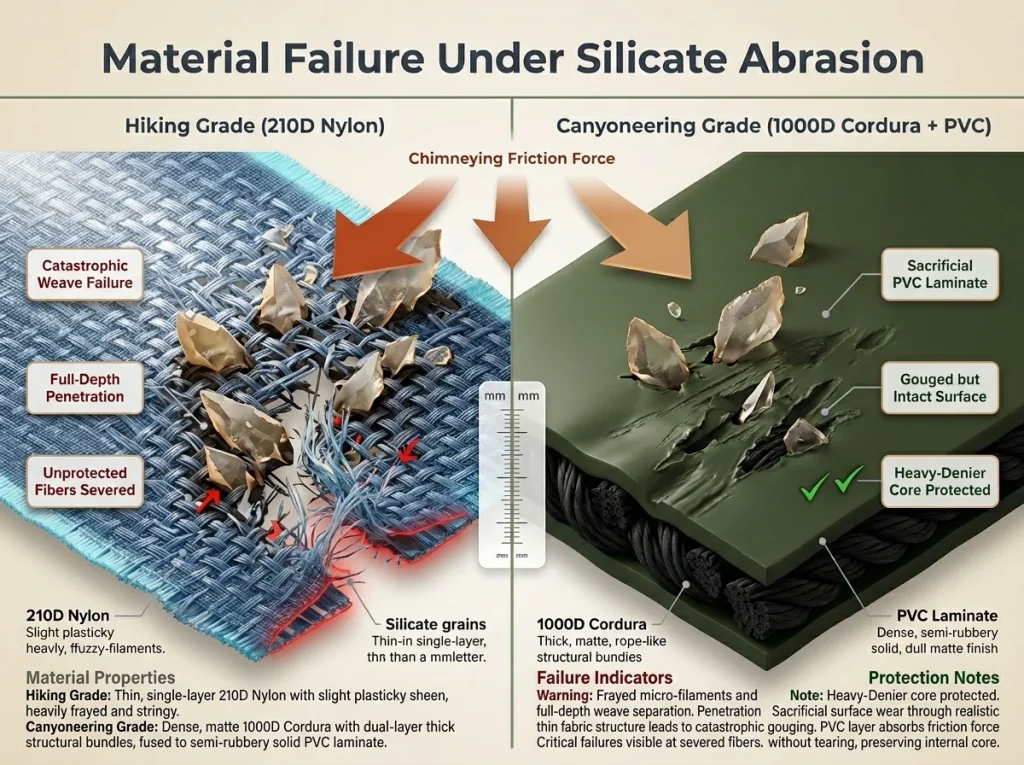
What makes this triply hazardous is the abrasion pattern. Sandstone attacks your gear through two-body abrasion (direct contact between your rope and the rock edge) and three-body abrasion — sand and silt trapped between the rope fibers or between the rope and your descender. Three-body abrasion is the more catastrophic of the two. You don’t see it happening. You see it after, when the sheath is filed through.
Understanding where you stand in the Class 3 and Class 4 terrain classifications system matters here, because Class 3 canyoneering is categorically different from Class 3 scrambling. The terrain rating doesn’t tell you what the rock does to your gear over sustained contact. That’s the part most guides skip entirely.
The Textile Failure Equation — Why 210D Nylon Dies in Slots
Standard hiking packs use 210D to 400D nylon. That material is engineered for abrasion against vegetation and rock edges on a trail — brief, intermittent contact. Not continuous sandpaper contact under body weight for hours.
Technical canyoneering packs solve this with a 1000D Cordura and PVC-laminate hybrid. The Cordura provides structural integrity. The PVC layer acts as a sacrificial outer shell — and critically, it can be heat-welded in the field. Once 210D nylon abrades through, you’re done. The Imlay Kolob is built for single-day technical routes; the Imlay Heaps handles multi-day expeditions. The Black Diamond Speed crosses over reasonably for dry-approach sections, but it’s not built for sustained aquatic punishment.
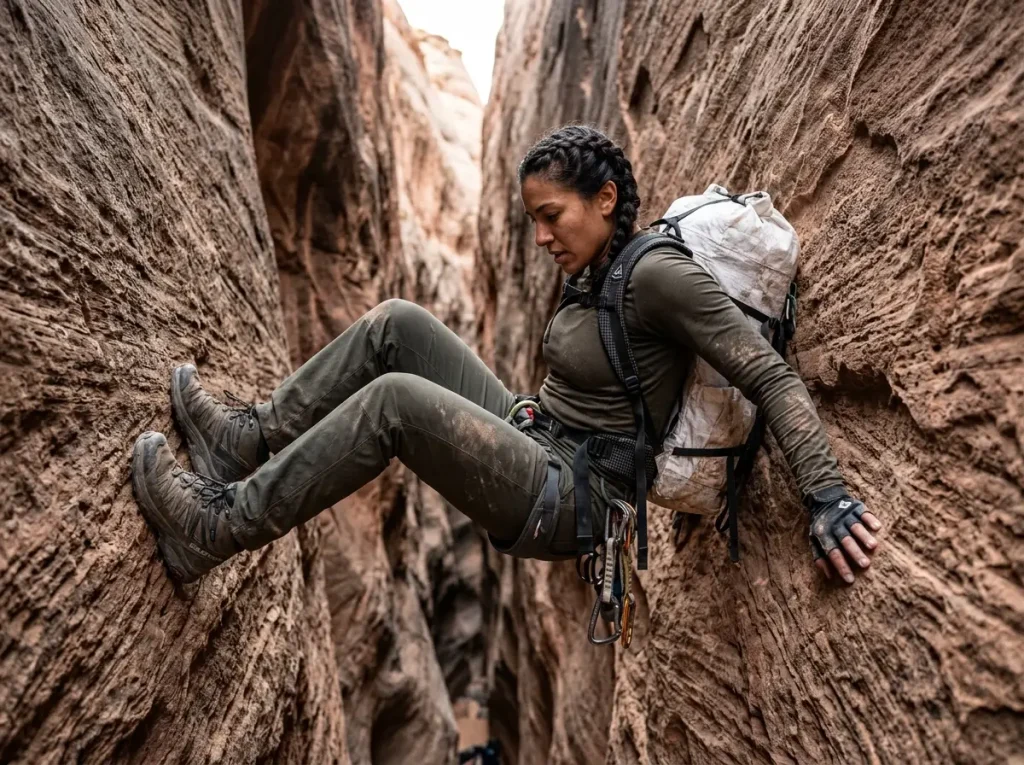
The failure point in hiking packs is almost always the spine panel. Chimneying — back-to-wall, feet-to-opposite-wall movement — concentrates all the pack abrasion into a six-inch band. That’s exactly where thin hiking packs fail first. External pockets and hip-belt pockets are also snag magnets in tight squeeze sections. The pack geometry that works on a trail becomes a liability in a narrows.
Before your first technical descent, drag your pack across rough concrete at home under moderate pressure for ten seconds. If it pills or fuzzes, it won’t survive one chimney sequence. Check this now, not at the trailhead.
If you’re not sure whether your current pack has already accumulated damage from previous terrain, run through the signs your hiking backpack has already failed its structural limits before you commit it to canyon use.
Pro tip: Test your pack against rough concrete at home — 10 seconds of moderate pressure. If the fabric pills, it won’t survive one chimney sequence in a canyon slot.
Static Ropes and the Physics of Controlled Descent
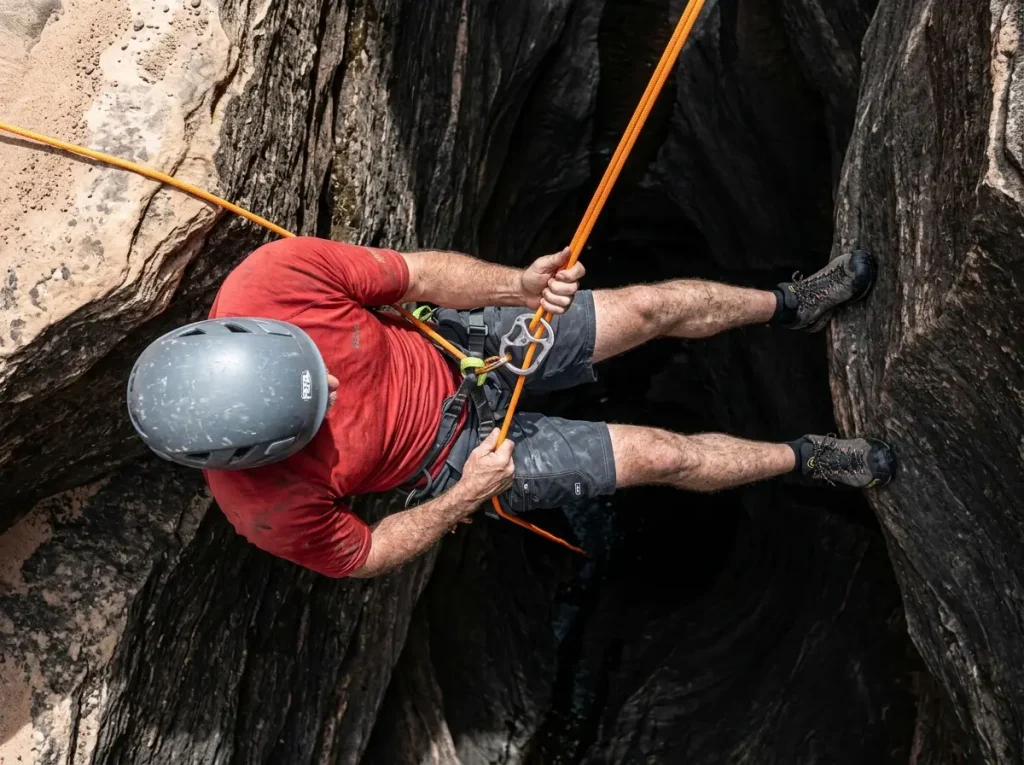
Here’s where most transitioning hikers make the most hazardous assumption: they bring a dynamic climbing rope because that’s what they know. A dynamic rope in a canyon is an accelerated gear-destruction event that can become a life safety event.
Dynamic ropes stretch 30 to 40% under fall loads. That elasticity is the whole point in lead climbing — you fall, the rope absorbs the energy. In a rappel, where you’re descending under steady tension, that stretch becomes a piston motion. The rope elongates and retracts with every movement, dragging fibers against the sandstone edge under high pressure. One rappel on a sharp sandstone lip has been documented to cause a core shot — exposed load-bearing fibers — requiring immediate retirement of the rope. You cannot manage a compromised rope through another descent.
Static ropes certified to EN 1891 Type A elongate less than 5% under an 80kg working load. The rope stays in contact with the same two millimeters of rock rather than cycling across a two-inch arc. Beyond that, many canyoneering ropes use a 50/50 sheath-to-core ratio — a thicker sacrificial sheath for the same core diameter.
If you see a dynamic rope with a fuzzy patch after one desert rappel, that’s not cosmetic damage. That’s a retirement event.
How rope systems differ by terrain and consequence is a subject that carries over from glacier travel, but the assumptions need to be reset entirely when entering canyons. What you learned about rope behavior in alpine environments doesn’t translate to sandstone narrows. The physics are the same; the consequences of ignoring them are not.
Descenders and Friction Adjustability
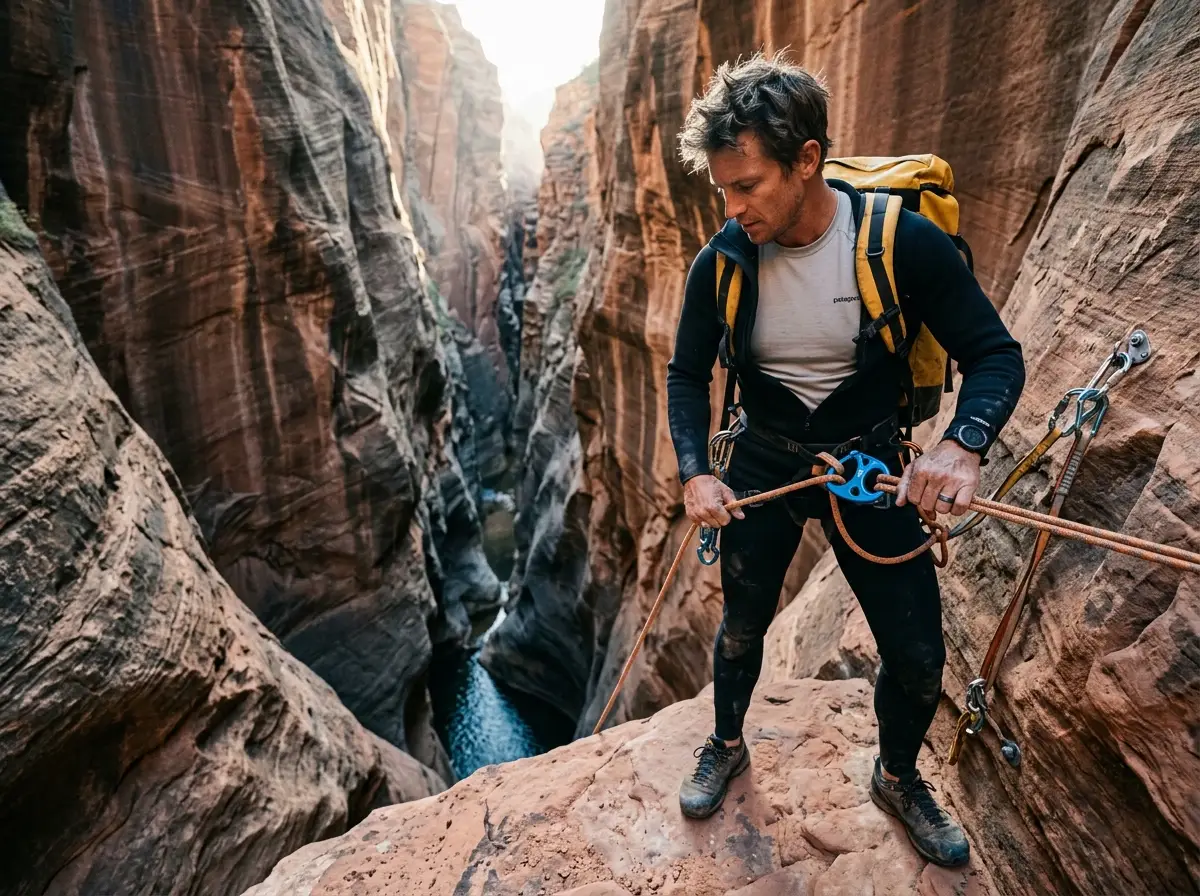
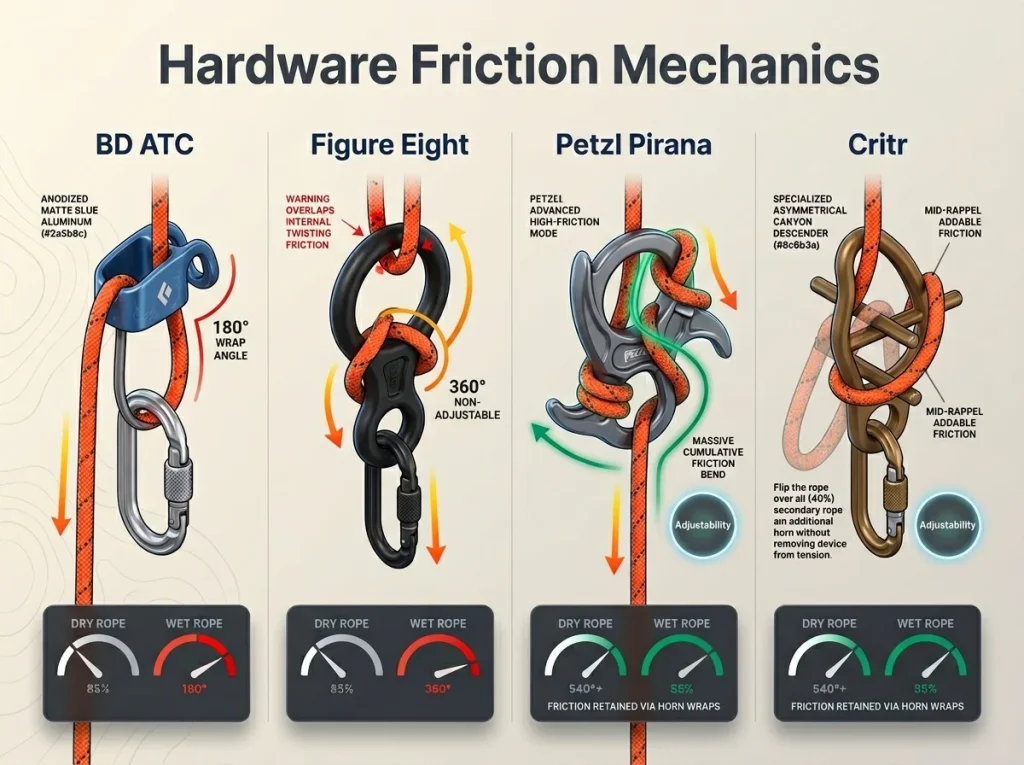
A standard BD ATC works fine in a gym or on a dry sport route. It does not work well when your rope transitions from dry to soaking wet mid-descent — which is exactly what happens in a technical aquatic canyon.
When a rope goes from dry to wet, the coefficient of friction drops significantly. A canyoneer using an ATC goes faster than expected and reaches for the brake hand harder. A canyoneer using a Petzl Pirana, Critr, or Sqwurel adjusts the wrap angle mid-rappel, compensating for the friction change before it becomes a control problem.
That’s the functional difference between canyon-specific descenders and general climbing hardware. They allow you to add horns or extra loops during the descent, varying the angle of rope wrap to tune friction on the fly. A Figure Eight descender is acceptable for emergency use but accumulates rope twist, creating unpredictable friction on subsequent rappels in the same session.
Always test your descender friction on a wet section of rope before committing to a rappel. A ten-second dunk in the pool tells you everything. If the difference in friction between dry and wet surprises you, that’s information you needed before you got on rappel.
For a broader look at transitioning from hiking to peak bagging safely, the canyoneering hardware section diverges from scrambling and alpine racks — the systems are not interchangeable, and treating them as if they are is how people end up managing a compromised descent with the wrong tools.
The Thermodynamics You Didn’t Expect — Desert Hypothermia
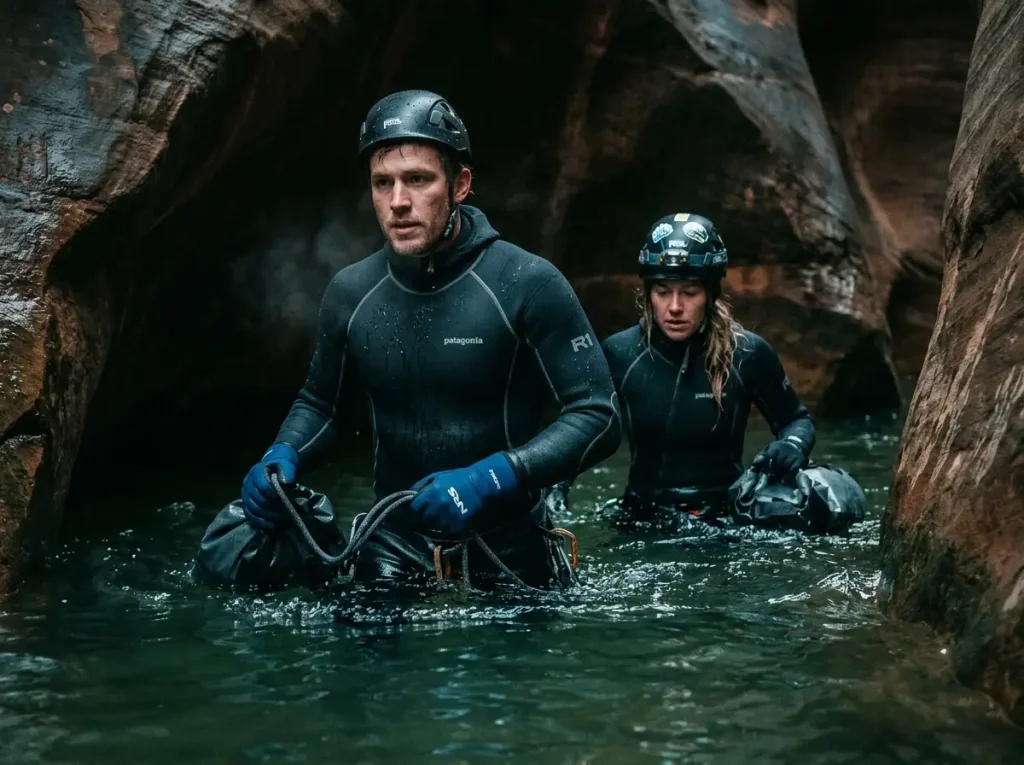
This is the one that gets people every single time. You’re in the desert. It’s 105°F at the trailhead. Hypothermia is the furthest thing from your mind. It shouldn’t be.
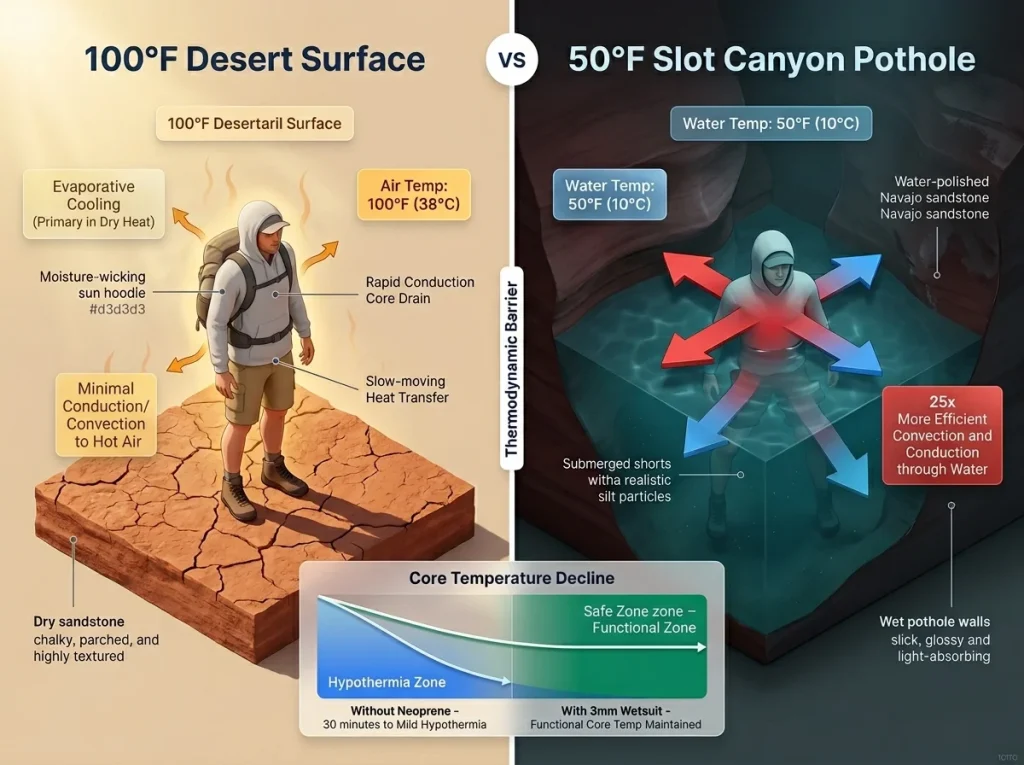
A slot canyon pothole receives no direct sunlight. The water temperature in that pothole can sit at 45 to 55°F year-round — regardless of what the air temperature is doing above the canyon rim. Water conducts heat away from the body approximately 25 times faster than air. When you’re submerged, ambient desert heat does nothing for you. The physics of how thermal conductivity of wet materials drives heat loss applies here in its most extreme form — you are not insulated by the hot air around you once your core is in contact with cold water.
Without insulation, your body sheds heat to that cold water at a rate the desert air cannot compensate for. Mild hypothermia begins when core temperature drops to 35°C (95°F). At that point, you lose fine motor skills — the exact skills you need to rig a belay device, thread a rope end, or manage an anchor under load. That’s not a setback. That’s a critical system failure in a one-way environment.
Pro tip: Desert air temperature is irrelevant once you’re submerged. A 50°F pothole surrounded by 100°F desert air will still drop your core temperature below functional threshold in under 30 minutes without neoprene.
Monsoon season compounds all of this. A hiker who enters a slot in dry morning conditions may exit in wet evening conditions after a thunderstorm 30 miles away raised water levels and dropped pool temperatures. This is not a hypothetical. Zion’s technical canyons see this pattern every summer. The peer-reviewed literature on accidental hypothermia physiology and core temperature thresholds is specific about functional impairment stages — those stages are relevant to canyon safety in ways that most gear guides never acknowledge.
Wetsuit Selection — Thickness, Fit, and Canyon-Specific Cuts
3mm neoprene is the minimum viable insulation for summer technical canyons on the Colorado Plateau. Spring or shaded aquatic routes call for 5mm. Neoprene works by trapping a thin water layer against the skin that your body warms, effectively slowing heat transfer to the cold water outside.
Canyon-specific wetsuits use flatlock stitching to reduce seam abrasion against sandstone. Standard diving wetsuits use blind-stitching that catches on rock and tears. That’s a material selection decision, not a brand preference — get the right construction for the environment.
Full-length farmer john style (sleeveless) wetsuits give you arm mobility for stemming and chimneying while maintaining core protection. If spring conditions or potential head immersion are factors, add a neoprene hood — the head accounts for a meaningful portion of total body heat loss in cold water scenarios.
Know how to recognize the warning signs before conditions deteriorate on-route. The field protocol for wilderness first aid and emergency preparedness in technical terrain closes the loop between prevention and what you do if prevention fails — neoprene protects you most of the time; knowing the response protocol covers the rest.
Footwear That Doesn’t Quit on Wet Sandstone
Trail runners fail in slots. Most hikers learn this the hard way. Here’s why, so you don’t have to.
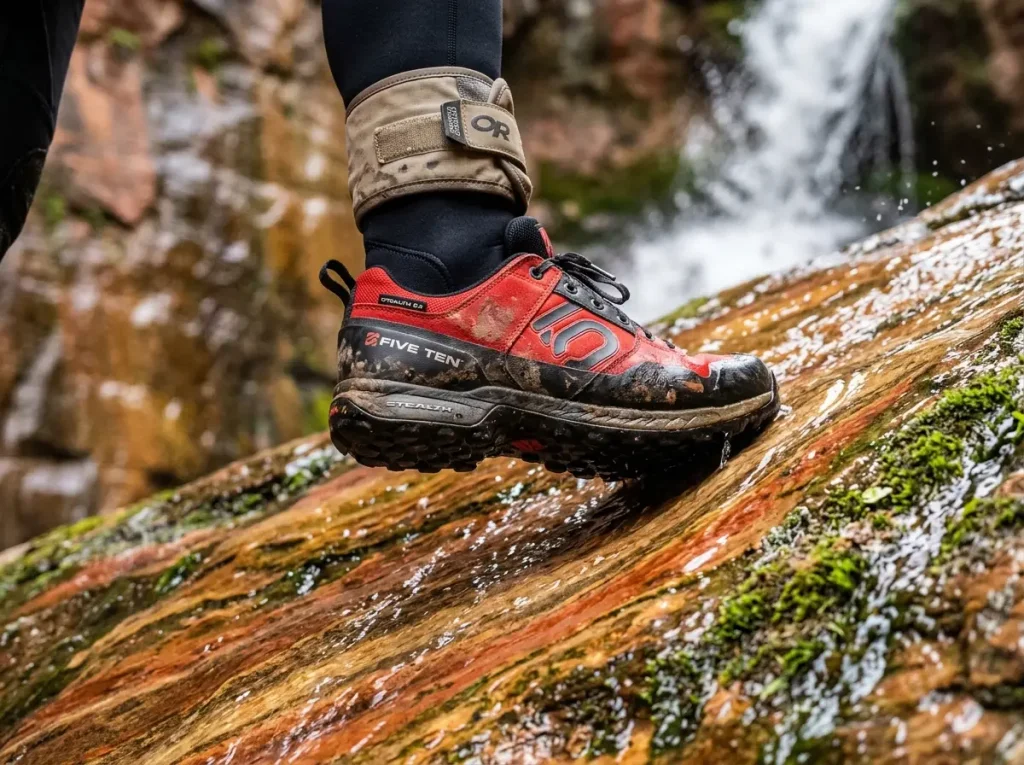
Standard trail runners — Hoka, Altra, Salomon Speedcross — use universal EVA outsoles optimized for trail soil. The contact area and compound hardness are engineered for dirt, roots, and loose rock, not wet silicate. On wet sandstone, they slide. The difference in grip between a Five Ten Stealth C4 sole and an EVA trail outsole on wet slabs is not subtle. It’s the difference between controlled movement and a fall.
Sticky rubber adheres by deforming into the microscopic surface irregularities of the rock — contact chemistry, not mechanical interlocking. Stealth C4 offers the maximum dry friction coefficient on sandstone. It’s the gold standard for dry routes. The tradeoff: it wears fast — resole every 3 to 6 months with active use.
Vibram Idrogrip is engineered for wet environments and maintains its integrity when submerged. It resists hydrolysis — the breakdown of rubber due to sustained water exposure — which makes it the right choice for aquatic or mossy canyon routes where the Stealth C4’s advantage disappears. Vibram XS Edge gives you structural edging for technical foot placements with a 12-plus month lifespan, but less smear ability on slabs.
The right call depends on the route’s water character, not your brand preference. The deep-dive on how rubber compound hardness determines wet rock grip breaks down the chemistry behind why these compounds behave differently under load — worth reading before you commit to footwear for your first technical descent.
The “Altra Trap” and Zero-Drop in a Slot
Zero-drop trail runners lack lateral stability and toe box protection for stemming and chimneying movements. That’s the structural issue. The behavioral issue is worse: the EVA foam in most trail runners compresses under the high-pressure loads of a chimney squeeze, causing unpredictable foot slip and lower-leg fracture risk. Lower-leg fractures are the most common backcountry injury in Zion’s technical canyons, and most of them happen to people in the wrong footwear.
Approach shoes — La Sportiva TX series, Scarpa Crux — bridge the gap reasonably for dry-approach plus moderate technical sections. They lack the hydrolysis resistance for sustained aquatic routes. For a full comparison of approach shoes for technical terrain — where they work and where they don’t — the answer depends on what percentage of your route is dry versus wet. There’s no universal answer; there’s only route-specific selection.
Pro tip: Test your footwear on wet concrete at a 45° angle before the canyon. If it slides under body weight, it slides in the narrows. This takes two minutes at home.
The Pack as a Technical System — Hydrodynamics and Buoyancy
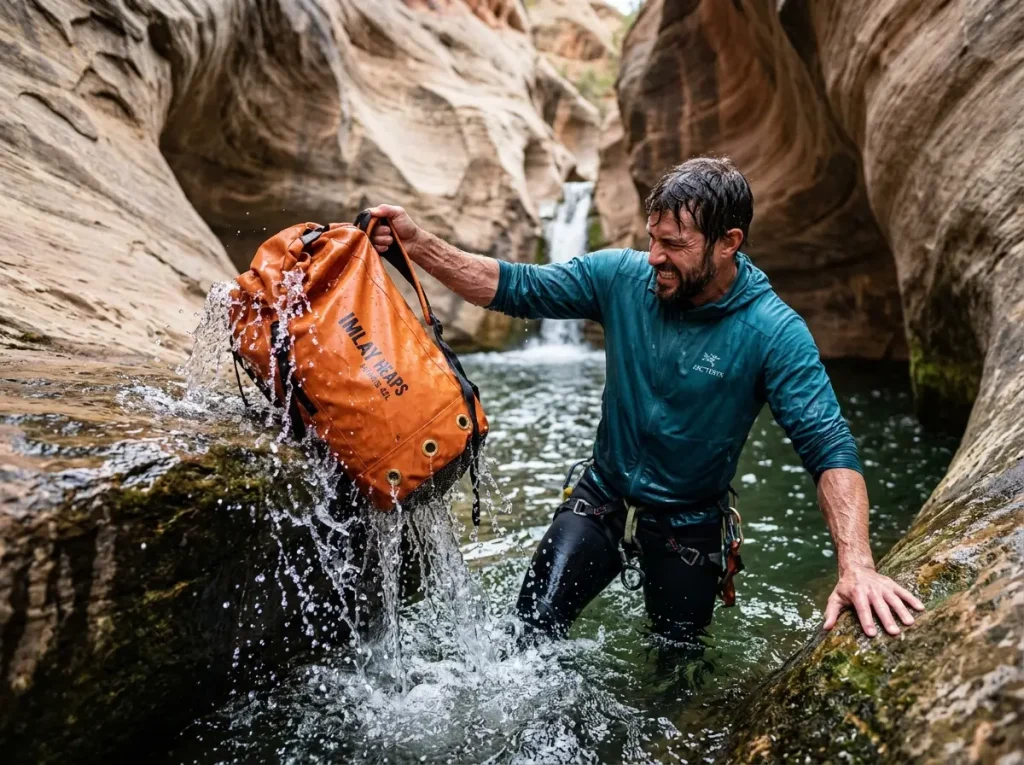
A standard Osprey or Gregory submerged in a pothole traps water inside a sealed structure. That’s 40 to 60 additional pounds instantaneously. It can pin you underwater. It can make it impossible to exit the pool. The design that makes a hiking pack comfortable on a trail — padded hipbelt, internal frame, external mesh pockets — becomes a trap in the water.
Technical packs solve this with Insta-Drain design: punched holes in the PVC base and a mesh-bottom lid allow water to exit as fast as the user moves through the pool. A sleek profile with no external pockets eliminates the snag risk in squeeze sections. The 1000D Cordura/PVC construction also lets the pack be tossed across potholes too wide to swim with gear — a standard technique in canyon travel that would destroy a standard hiking pack’s external structure on contact.
Volume sweet spot for single-day technical routes: 30–40 liters. A 200-foot static rope takes up 8–12 liters alone. Rope Silo bags allow rope deployment directly from the pack on rappel, preventing rope tangles in the pool below — a detail that matters on longer rappels where ground management visibility is poor.
How suspension systems fail under unconventional load explains why the hip belt and external frame that distribute load on a trail become the primary entrapment vectors in a squeeze slot. The same features that make a hiking pack work on a trail are the features that get you in trouble underwater. That’s not a design flaw — it’s a category mismatch.
The Gear Lifecycle Reality — What Canyons Actually Cost
Canyoneering is harder on gear than any other outdoor discipline. Abrasive sandstone plus constant saturation plus mechanical friction equals an accelerated lifecycle for everything in your kit.
Rope runs $160 to $340 for a 200-foot static. Retire it on the first visible core shot or sheath fray — do not attempt to manage a compromised rope through a second descent. Descenders retire when rope grooves exceed 1mm depth; those grooves function as rope-cutting traps on subsequent rappels. Canyon shoes resole every 3 to 6 months for Stealth C4, 6 to 12 months for Vibram Idrogrip. Wetsuits retire when neoprene tears accumulate to the point of exposing the inner foam — each tear accelerates cold-water contact at that point.
The carabiner microfracture myth — dropping a biner on rock causes internal failure — is metallurgically unsubstantiated. Abrasive wear is real. Retire when rope grooves or nicks are visible; those edges can snag and cut a rope mid-rappel.
Plan to spend $800 to $1,200 getting into a functional technical kit. Budget $200 to $400 per active season for replacement of consumables: rope, shoes, and descender. This isn’t pessimism — it’s what canyoneering actually costs. Ignoring the replacement cycle is the thrift store gear mindset that gets people into situations they can’t get out of.
Apply the systematic gear retirement protocol that applies across all technical disciplines as the baseline for everything beyond canyoneering-specific items. Know when to retire gear before it fails in the field, not after.
Flash Flood Intelligence — The Catchment Basin Protocol
Most beginners watch the sky. Experienced canyoneers watch the map.
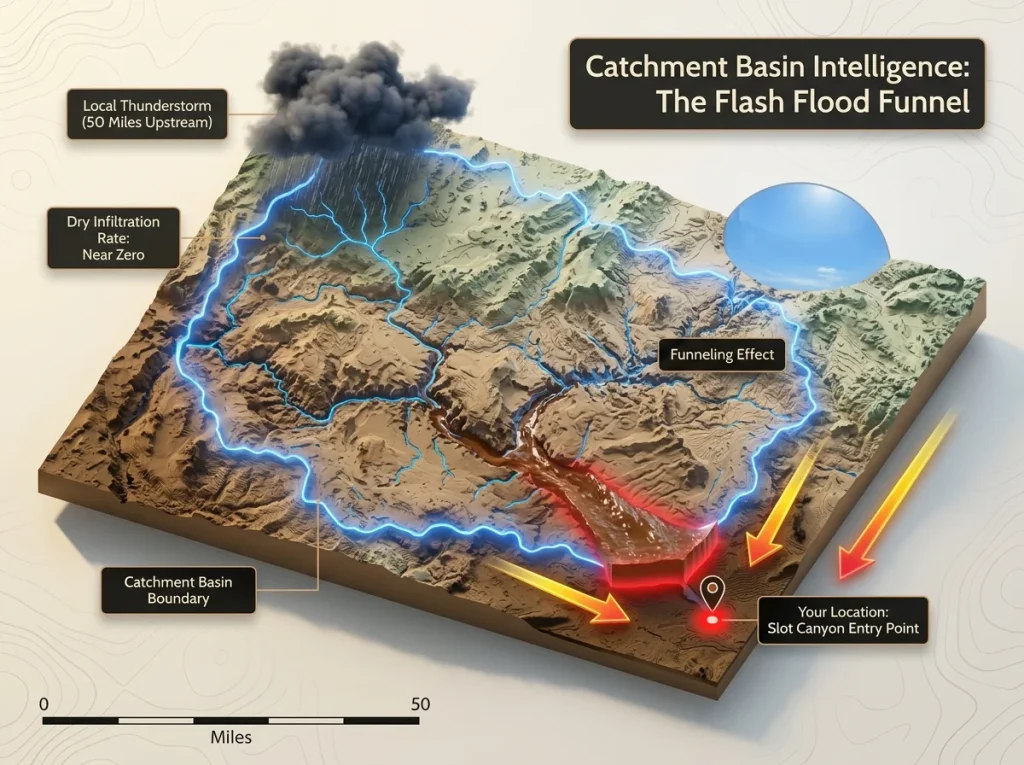
A catchment basin is the entire geographic area draining into a specific canyon. The lower section of Eardley Canyon is fed by a watershed extending 12 miles away. The Chute of Muddy Creek drains an area spanning 50 miles. A localized thunderstorm in the headwaters, completely invisible from the canyon floor, generates a leading wave of debris and water that can arrive with zero local indication of rain.
Desert soil is often hydrophobic after prolonged heat — infiltration rate near zero — meaning virtually all precipitation becomes runoff. It has nowhere to go except the canyon. That water collects in washes and gullies and arrives at your location as a wall.
The NWS PoP figure is the most misunderstood number in canyon safety. A 30% chance of rain does not mean there’s a 30% chance it rains on you. It means 30% of the forecast area receives measurable precipitation. If that 30% coincides with your canyon’s headwaters, the risk is not 30% — the risk is absolute.
I check weather radar for a 50-mile radius around any canyon I plan to enter. Blue sky above me means nothing. The storm that ends your trip forms over the mesa you can’t see.
The Zion National Park official flash flood safety protocols formalize what experienced canyoneers have learned by reading the terrain. They’re worth reading as a baseline before your first technical descent in the region. For the full pre-trip methodology, run through the 3-step weather and terrain research protocol before any technical route — applying this to canyon trips is one of the most high-leverage things a transitioning hiker can do.
Monsoon season (July through September) changes the calculus entirely. Daily thunderstorm formation from solar-driven convection makes the No-Go threshold much lower. Any day with “Possible” or higher flood potential for the drainage should be treated as a no-entry day.
The Psychology of Commitment — Knowing When to Turn Back
The first rappel is the point of no return. Once the rope is pulled, your group is committed to completing the canyon. There’s no reversing course, no going back the way you came. Trail hikers are accustomed to a world where turning around is always an option. That assumption gets people into serious trouble in slot canyons.
The Gut Check protocol: evaluate weather, water levels, and group energy before the first rappel — not after, not during, before. Once you’re committed, conditions that would have been a turn-back signal are now just problems you’re managing without exits.
Flash flood warning signs to read on-route: distant thunder (even if the sky above is clear), rising water smell, increasing turbidity in pool water, and sudden drop in water temperature. Debris lines on the walls above current water level tell you the canyon’s flood history — read that history before you commit.
Establish a named No-Go condition before you leave the trailhead. Written down. Shared with the group. Something like: “If we hear thunder within 10 miles of any headwater drainage at any point before or during the descent, we turn back.” Remove the in-canyon debate by settling it before you enter. Reading storm development signs without a weather app gives you the meteorological foundation to identify those signals accurately before conditions go sideways.
A group that turns back from a canyon they were ready for made the correct decision. A group that completes a canyon despite warning signs got lucky. Those are different things, even when the outcome looks the same from the outside.
The Transition Is Real — Three Things That Don’t Move
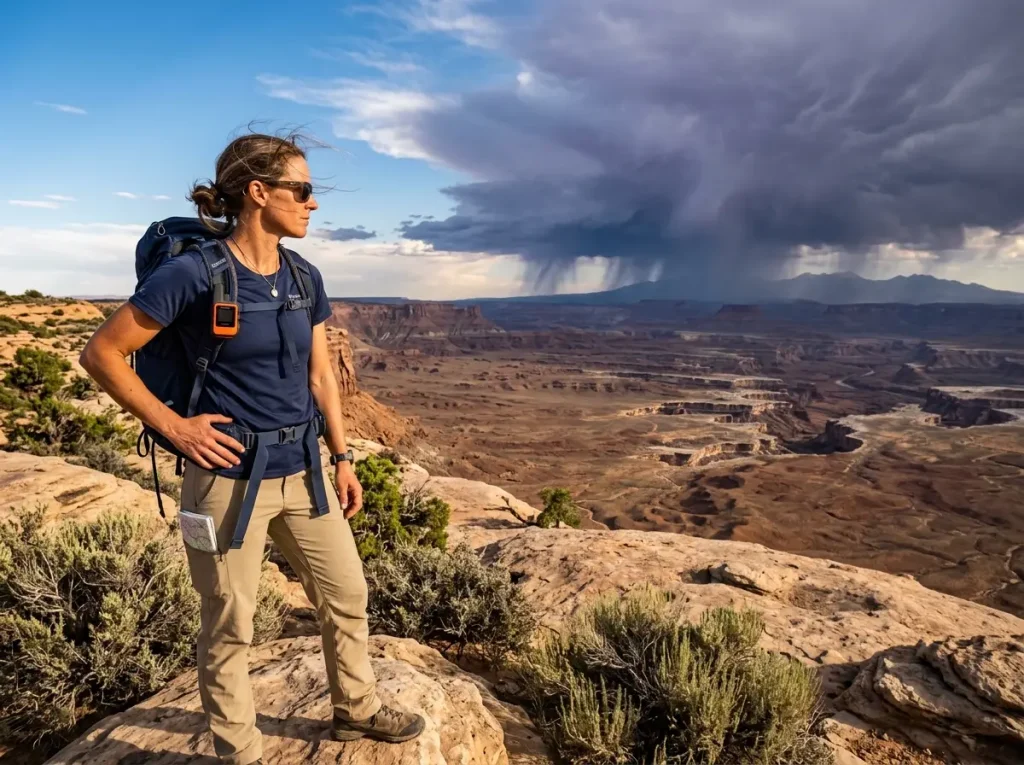
The hiker-to-canyoneer transition isn’t about difficulty. It’s about a category shift in how terrain interacts with your body and your gear.
Your hiking gear is not canyoneering gear. The materials, the physics, and the failure modes are categorically different. A 210D nylon pack and a dynamic rope will be damaged by the first serious slot canyon, and damaged gear in a one-way environment is a different problem than damaged gear on a reversible trail.
The slot’s biggest hidden threat isn’t the rappel — it’s the storm you can’t see. Flash floods form 50 miles away. Learning to read topographic catchment analysis instead of relying on simple sky-watching is the single most impactful skill shift in the beginner-to-competent canyoneer transition.
The wetsuit isn’t optional comfort gear. It’s insulation against a thermodynamic trap. 50°F water surrounded by 100°F desert air produces the same hypothermia. The slot operates as a cold environment at the contact surface, regardless of what the ambient temperature is doing above the rim. Neoprene is what separates a clean descent from a medical evacuation.
Before your first technical descent, build your kit around three non-negotiables: a static rope (EN 1891 Type A), a friction-adjustable descender, and a canyon-specific wetsuit. Then do an ACA-certified canyoneering course to put the hardware into operational context. Gear without technique is just expensive weight.
FAQ
Is canyoneering harder than hiking?
Yes. Canyoneering requires technical skills that trail hiking does not — rope rappelling, anchor assessment, flash flood forecasting, and mechanical self-rescue. A competent Class 3 hiker has the terrain awareness and fitness base to begin, but should expect a significant technical learning curve around rope physics and aquatic risk management specifically.
What is the best shoe for canyoneering?
It depends on the canyon’s water character. For dry sandstone routes, Five Ten Stealth C4 rubber offers the maximum friction coefficient. For aquatic or mossy canyons, Vibram Idrogrip maintains traction when submerged and resists hydrolysis. Don’t use zero-drop trail runners — they lack the torsional rigidity and toe box protection needed for stemming and chimneying movements. Lower-leg fractures in Zion’s technical canyons are disproportionately associated with the wrong footwear.
Can you go canyoneering without a guide?
Technically yes, but the point of no return at the first rappel means consequences are immediate and non-reversible if your technique fails. The American Canyoneering Academy (ACA) offers skills-based certification courses that cover rigging, descender management, and group self-rescue — none of which is adequately replaced by YouTube. At minimum, complete one guided descent of a Class 3 canyon before leading a group.
What happens in a flash flood in a slot canyon?
A flash flood arrives as a leading wave — a surge of debris, mud, and water moving faster than a sprinting human. In a narrow slot, there’s no lateral escape. The only valid protocol is pre-emptive: do not enter a canyon with any flood potential in the catchment area. Once you hear the rumble, it’s too late to climb out. This is why catchment basin analysis before entry is the primary life-safety behavior in technical canyoneering — not just a recommendation.
Do you need a permit for canyoneering in Zion?
Yes. Most technical canyons in Zion National Park — including The Subway, Mystery Canyon, and The Narrows (full technical) — require a permit via recreation.gov or the park’s permit lottery. Availability varies by season and canyon difficulty. Verify current requirements with Zion’s backcountry desk before you plan a trip — regulations change seasonally and occasionally mid-season.
Risk Disclaimer: Hiking, trekking, backpacking, and all related outdoor activities involve inherent
risks which may result in serious injury, illness, or death. The information provided on The Hiking Tribe is for
educational and informational purposes only. While we strive for accuracy, information on trails, gear, techniques,
and safety is not a substitute for your own best judgment and thorough preparation. Trail conditions, weather, and
other environmental factors change rapidly and may differ from what is described on this site. Always check with
official sources like park services for the most current alerts and conditions. Never undertake a hike beyond your
abilities and always be prepared for the unexpected. By using this website, you agree that you are solely
responsible for your own safety. Any reliance you place on our content is strictly at your own risk, and you assume
all liability for your actions and decisions in the outdoors. The Hiking Tribe and its authors will not be held
liable for any injury, damage, or loss sustained in connection with the use of the information herein.
Affiliate Disclosure: We are a participant in the Amazon Services LLC Associates Program, an
affiliate advertising program designed to provide a means for us to earn advertising fees by advertising and linking
to Amazon.com. As an Amazon Associate, we earn from qualifying purchases. We are also an official affiliate partner
of Black Diamond Equipment via the AvantLink network. If you click on a Black Diamond affiliate link and make a
purchase, we may earn a commission at no additional cost to you. We also participate in other affiliate programs and
may receive a commission on products purchased through our links. Additional terms are found in the terms of
service.