In this article
The grueling 15-mile push through muddy alpine terrain is finally over. You dump your heavy pack, pull off your boots, toss them into the trunk, and hit the road back to civilization. What you can’t see, however, is the hazardous microscopic payload packed tightly into those 5-millimeter Vibram lugs. Invisible hitchhikers—like the chytrid fungus or mucilaginous seeds—are ready to drastically alter the next pristine watershed you visit. Most of us pack out our trash and stay on the path, genuinely committed to minimizing invisible damage to fragile ecosystems. But the cold, unforgiving reality of the backcountry is that your high-end footwear has just turned you into a high-stakes biological vector.
I have spent decades navigating remote routes, observing firsthand how a single contaminated trailhead can ripple destruction through an entire drainage within months. This guide provides a strictly gear-safe protocol to neutralize the pathogens and seeds clinging to your outsoles, ensuring that your pursuit of the summit doesn’t come at the ecosystem’s survival expense. We aren’t doing this to feel good; we are doing this because the physics of the backcountry demand it.
⚡ Quick Answer: The deep lugs and porous fabrics of modern hiking boots trap invasive seeds and hazardous waterborne pathogens like the chytrid fungus, spreading them across the backcountry. You can stop this transmission without destroying your expensive gear by adopting a strict three-step protocol. Physically brush out the mud at the trailhead, apply a quaternary ammonium disinfectant to the outsoles, and perform routine at-home gear restoration to preserve your waterproof membranes.
The Mechanics of Anthropochory: How Boots Transport Seeds
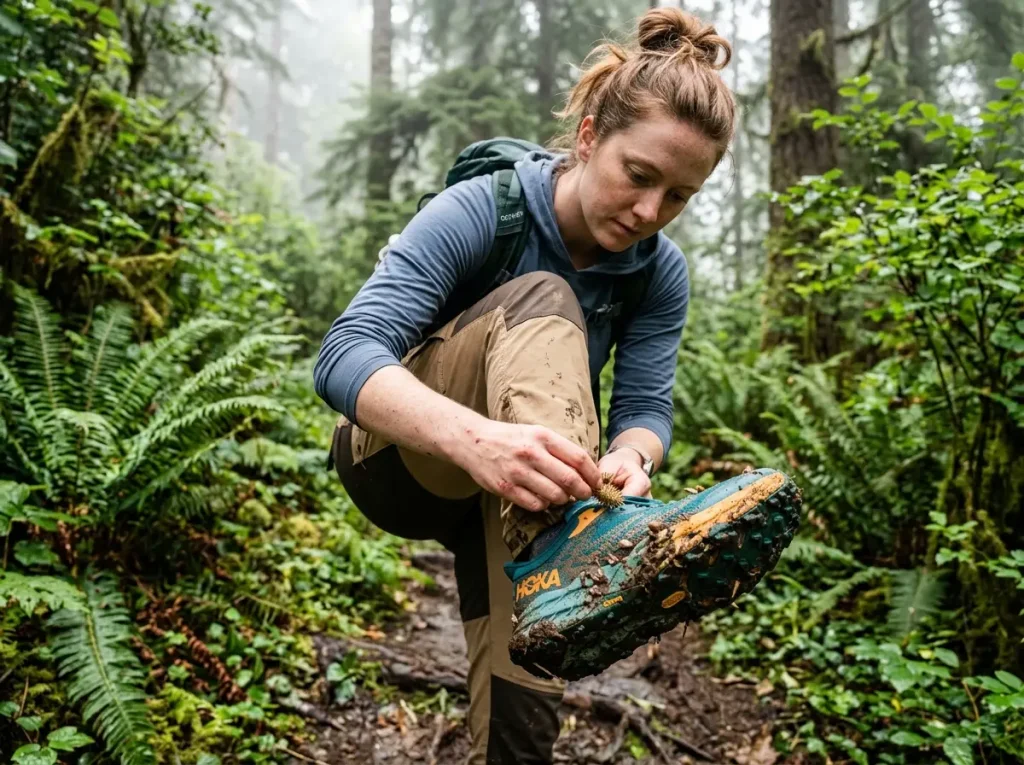
To understand how you become an unwitting carrier, you have to look at the physical interaction between your boot and the dirt. The outdoor industry spends millions engineering treads that grip loose rock and shed wet clay. Ironically, the very features that keep you upright on a Class 3 scramble also make your boots the perfect vehicle for seed dispersal. Botanists call this human-mediated transport anthropochory.
We are constantly dragging foreign material into natural spaces, completely unaware of the physics of mud adhesion. The mud that solidifies on your walk back to the car acts as a protective bunker for whatever you stepped in. The boots that carried you up the summit are simultaneously acting as mobile delivery systems for vegetation that has zero business crossing the treeline.
The Mucilage Trap (Myxospermy)
The seeds of many aggressive invaders employ a brutal survival tactic called myxospermy. When these seeds encounter moisture—like morning dew on a grassy approach or a wet river crossing—they excrete a sticky, adhesive mucilage. It acts exactly like biological superglue. You step on a patch of wet garlic mustard or Japanese stiltgrass, and those glued seeds instantly bond to the sidewalls of your rubber lugs and the fabric of your upper.
This bond is shockingly resilient to friction. While hiking, the heavy mechanics of your foot strike naturally eject larger clumps of mud, but these tiny mucilaginous seeds stay anchored deeply within the tread patterns. They wait patiently in the dark recesses of your sole, fully protected from the sun and elements until you drag them from an agricultural perimeter deep into untouched wilderness. You will absolutely not notice them when casually kicking the dirt off your boots against your rear tire.
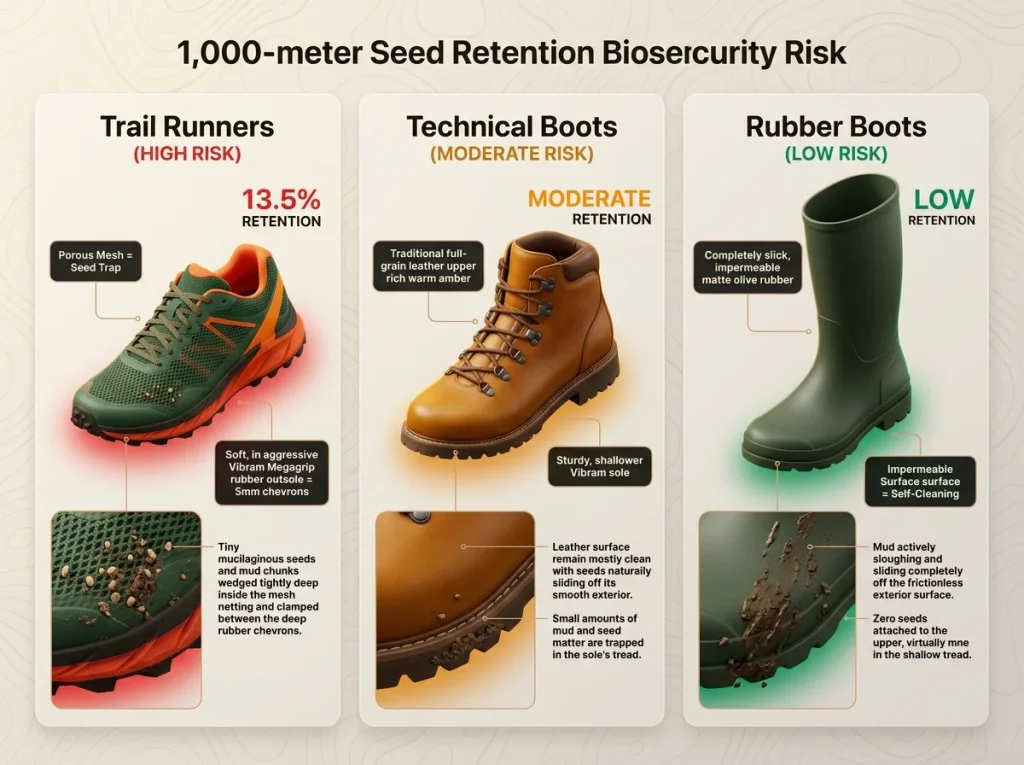
Pro Tip: When trekking in consistently wet, grassy environments where invasive weeds thrive, favor full-grain leather boots over mesh trail runners if you want to minimize your ecological footprint and seed retention. Smooth leather gives seeds far fewer places to hide and anchor.
The 1,000-Meter Dispersal Threshold
The hazard lies in how far you carry these seeds before they finally drop and take root. Field observations consistently show that while over half of the seeds you pick up will fall off within the first 50 meters of walking, the stubbornly attached ones will ride for miles. This is the pathogen spread scenario we try to avoid.
Ecologists consider anything traveling over 1,000 meters to be long-distance dispersal. A fit hiker easily covers a kilometer in fifteen minutes on a flat grade. This means you are routinely dragging non-native seeds past the standard dispersal thresholds of native plants, overriding natural boundaries, and depositing aggressive invaders directly into isolated alpine basins where they have absolutely no natural predators to keep them in check. The forest does not stand a chance when we bypass natural geographic barriers for a weekend summit bag.
Why Lightweight Materials Carry Higher Risk
Your specific footwear choice drastically changes your biosecurity risk profile. Heavy, traditional boots actually perform remarkably well here. Smooth, full-grain leather boots and impermeable rubber boots pick up about 50 seeds upon initial contact in dense brush. They are relatively easy to wipe down and maintain when you return to the trailhead.
Modern trail runners, on the other hand, are a biological disaster. The porous, woven mesh fabrics that make them so wonderfully breathable act like a fine net. During field testing, running shoes captured an average of 109 seeds upon initial contact in the grass. Worse, their retention rate at the 1,000-meter mark sits at an alarming 13.5 percent. The softer, highly flexible deep lug soles on trail runners also fold differently around debris, gripping it tight rather than shedding it as the shoe bends. Your lightweight setup effectively becomes a mobile nursery. When you sacrifice the smooth exterior of a traditional boot for ventilation, you exponentially increase your capacity to haul invasive seeds.
The Microscopic Layer: Lethal Pathogens in Your Treads
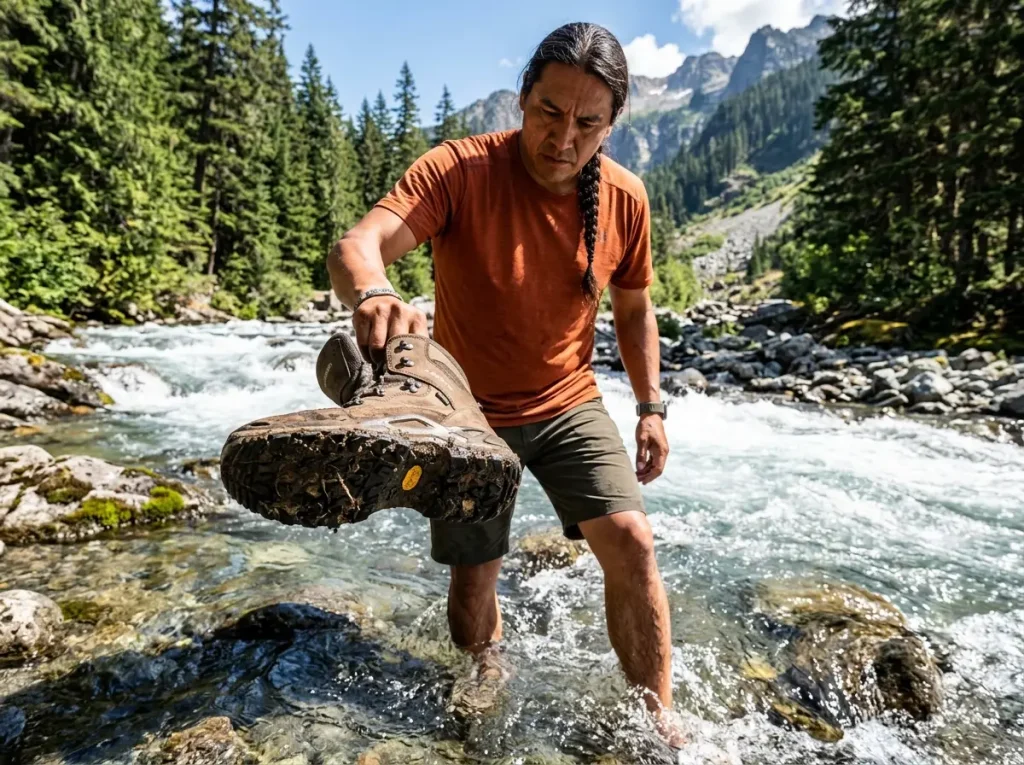
Seeds are a highly visible nuisance, but they are only half the problem. The thick mud trapped inside your outsoles often harbors threats you cannot possibly see with the naked eye. We are talking about invasive micro-pathogens—fungi, viruses, and bacteria capable of surviving in dark, moist mud for weeks at a time.
When you walk from a muddy lowland creek up to a high alpine lake, you are dragging a microscopic zoo with you across the mountain. Understanding and assessing invisible pathogens in backcountry water sources is mandatory for anyone stepping out of their vehicle. You are the bridge these diseases need to cross land, and without you, they would never reach the isolated cirques at ten thousand feet.
Batrachochytrium dendrobatidis (Chytrid Fungus)
Nothing demonstrates the stakes quite like the chytrid fungus, often referred to in the field as Bd. This waterborne spore is perhaps the most destructive pathogen currently operating in the wild. It aggressively attacks the skin of frogs and salamanders, essentially suffocating them and causing mass population collapse. It is directly linked to the decline of over 500 amphibian species globally and 90 presumed total extinctions.
Here is the terrifying part about this fungus: chytrid spores thrive in the exact type of wet, cool mud that cakes inside your hiking boots. You cross an infected stream on Friday, throw your muddy boots in the closet, and wear them exactly as they are the following weekend in a completely different mountain range. The moment you step into the new water source, the dried mud rehydrates, releasing live spores into a previously uninfected biological population. You do not even have to wade in; sliding down a muddy embankment into the shallows is more than enough to trigger an outbreak.
Ranavirus and Aquatic Ecosystem Collapse
If chytrid targets amphibians specifically, ranavirus takes a much broader approach. It infects reptiles, amphibians, and fish, boasting a brutal 90 to 100 percent mortality rate in susceptible aquatic populations. The pathogen causes catastrophic organ failure and massive internal trauma to the local wildlife.
This virus is exceptionally durable against environmental stress. It survives freezing temperatures and bakes stubbornly in dried mud on the sidewall of your boot without breaking down. Anglers moving between drainages or hikers hopping across boulders who occasionally dunk a foot are the primary delivery system for ranavirus. If you frequently visit isolated lakes or remote streams, the unwashed dirt on your boots is a loaded vector aimed at the local ecosystem. The virus can sit dormant on your gear for days, waiting for the perfect moment you decide to rinse your boots off in the next pristine alpine tarn you encounter.
Pro Tip: Never wash your hiking boots directly in a lake or stream to clear away mud mid-hike. If you need to knock off heavy clay deposits, use a stick on dry land well away from the water source to prevent directly injecting pathogens into the aquatic system.
Avian Influenza (H5N1) and Trail Interfaces
The risk is absolutely not confined solely to the water. The global surge in Highly Pathogenic Avian Influenza (H5N1) has drastically changed how guides and professionals look at trail-to-trail transitions. The messy interface where agricultural land meets wilderness is often where hikers unknowingly pick up the virus from bird droppings or infected soil.
As you hike through these transition zones, your boots collect the virus on the rubber tread. When you hike near nesting grounds, coastal cliffs, or dense seabird colonies later in the day, you can introduce H5N1 directly into highly vulnerable bird populations. The US Fish and Wildlife Service regularly mandates aggressive boot decontamination protocols before stepping onto sensitive refuge islands specifically to prevent hikers from delivering bird flu to isolated nesting colonies. If professionals treat their boots like biohazards, recreational hikers should take the hint.
Outsole Engineering: Traction vs. Contamination
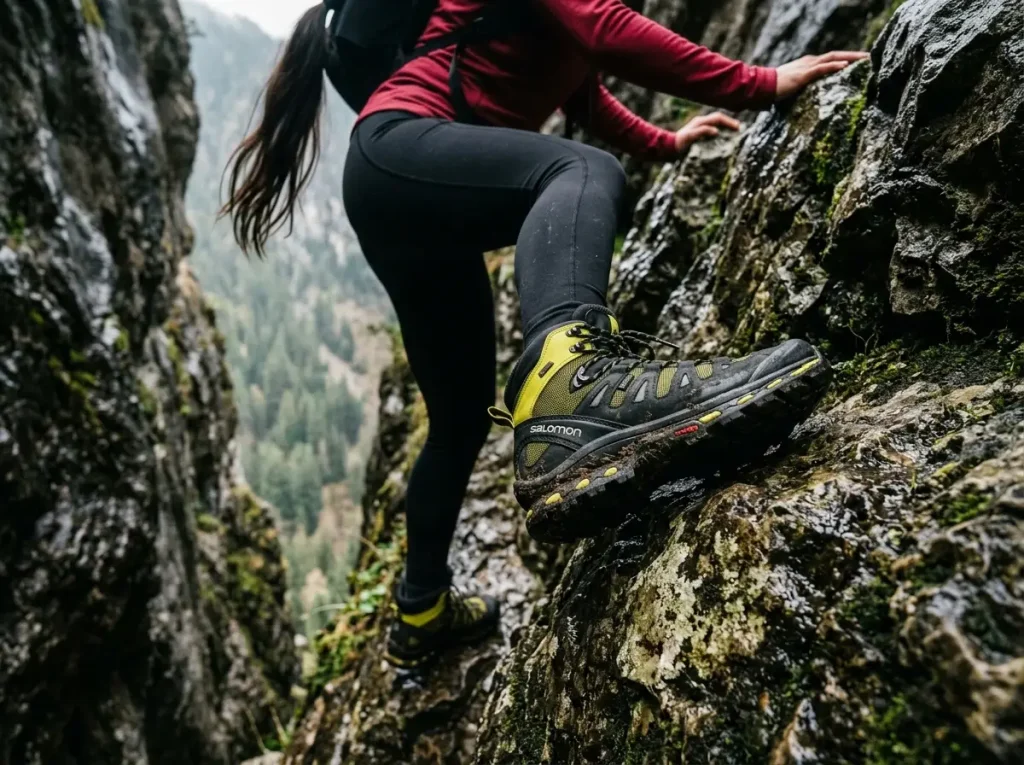
All of this brings us to a harsh mechanical reality. The outsole engineering that prevents you from sliding off a wet, off-camber slab is directly responsible for making you a better biological vector. We demand maximum traction from our footwear, and the industry delivers by creating the perfect microscopic environment for deep entrapment.
Let’s dissect the trade-offs of high-grip rubber compounds on wet terrain. The more aggressive and sticky the sole, the harder it is to actually clean the mud out of it. We engineered away the slips and falls, but we completely ignored the biological consequences of walking around with an inch of sticky rubber glued to our feet.
Lug Depth and Retentional Physics (3.5mm vs. 5mm+)
The exact measurement of your lug depth dictates how much earth you can forcefully retain with every footstep. Standard shallow lugs, measuring around 2.5 to 3.5 millimeters on typical road-to-trail running shoes, lack serious bite in loose terrain but naturally shed mud very quickly because they cannot grab much of it in the first place.
When you upgrade to aggressive technical boots or robust trail runners, you are looking at massive lugs deeper than 5 millimeters. These wide chevron patterns are engineered to plunge deep into mud and hold on, providing vital braking power on steep descents. The sheer volume of negative space between the heavy lugs means you are carrying significantly more soil. Tightly packed lug patterns fail to self-clean as the sole flexes, trapping mud indefinitely until you physically dig it out with a metal tool. The very mechanism that prevents you from blowing out an ankle on a muddy descent is precisely what ensures maximum species transmission.
Micro-Textures and High-Grip Rubber Compounds
Modern outsole technology has moved way beyond simple lug depth. Take the Vibram Traction Lug system as a prime example of incredible engineering with an ecological cost. Engineers added tiny, stepped micro-textures to the sides of the lugs themselves. This brilliant innovation increases the total surface area by up to 50 percent, translating to absolutely unparalleled grip on sketchy, technical descents.
However, those same micro-textured sidewalls act as deep microscopic shelves for seeds and pathogen-laden mud. The stickier the rubber compound—like Vibram Megagrip formulations—the tighter the mechanical bond between the sole and the debris. You gain superior friction underfoot, but you simultaneously turn the bottom of your boot into a high-retention sponge for invasive biology. Every new ledge added to the tread is another place for mucilage to cure and lock seeds in place.
The Felt Sole Danger
It is worth specifically calling out the serious hazard of felt soles, traditionally used on wading boots by fly fishers navigating slick river rock. Felt provides legendary grip on submerged cobblestones, but it is notoriously impossible to decontaminate effectively in the field. The densely matted synthetic fibers absorb water, mud, and microscopic spores deep into the core material, holding them for agonizingly long periods.
They are so catastrophic as vectors for things like whirling disease and chytrid that many regions have explicitly banned their use entirely. If you still own felt-soled boots and plan to use them across different watersheds, you are playing Russian roulette with the local fish and amphibian populations. Put them in the trash. Upgrade to sticky rubber and aluminum studs.
The Chemical Conflict: Disinfection Without Gear Destruction
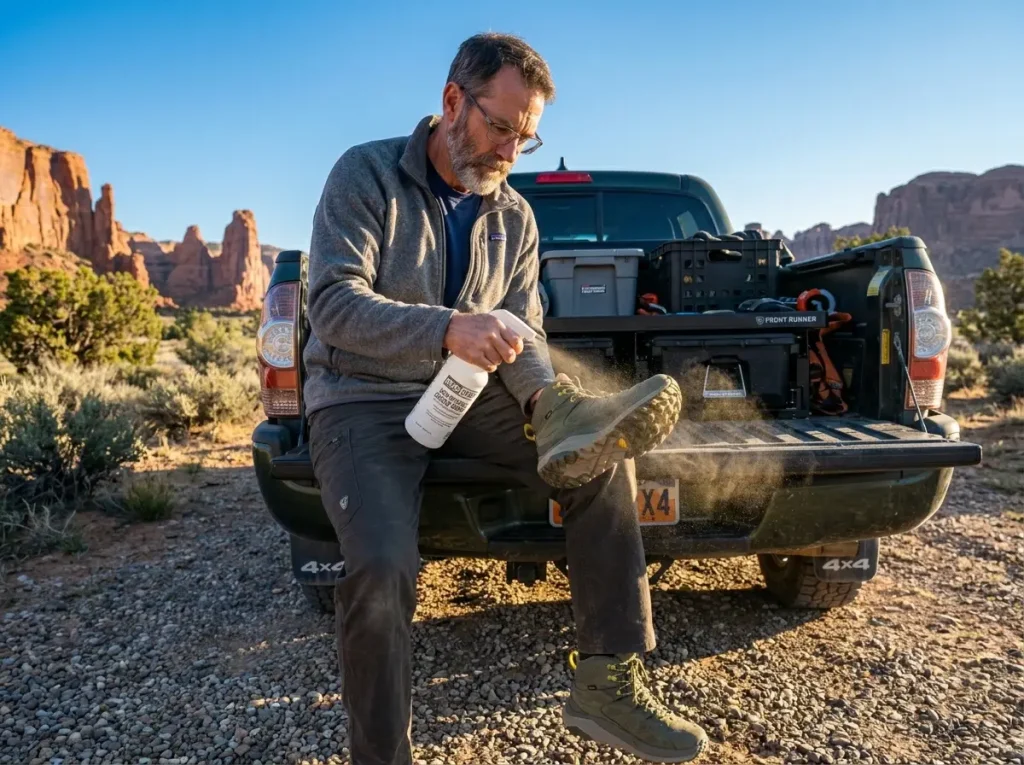
Here lies the absolute core of the problem: the chemical conflict. To truly stop resilient waterborne pathogens, you need chemical intervention. But the harsh chemicals that neutralize lethal spores will obliterate the structural integrity of your $300 technical hiking boots if used incorrectly.
Most government agency guidelines suggest dumping bleach on your gear. Anyone who has ever maintained premium outdoor equipment knows exactly why that is a terrible idea. Navigating this requires a detailed and practical understanding of maintenance protocols that preserve your DWR coatings and your boot’s layered construction. You cannot just douse your kit in solvents and hope the adhesives hold.
The Bleach Dilemma: DWR and ePTFE Membrane Degradation
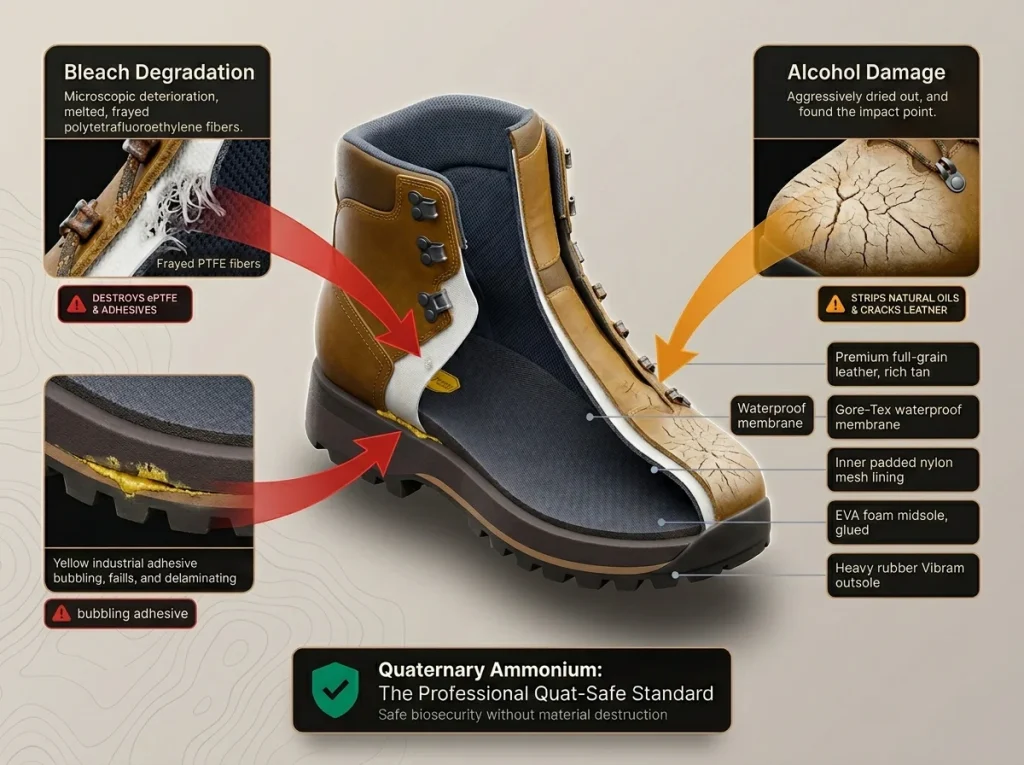
The standing advice for rapid biosecurity often calls for a 10% bleach solution. Yes, sodium hypochlorite absolutely neutralizes pathogens on contact. But look at the official care tags on any premium waterproof footwear. The warning is explicit and clear: keep bleach far away from the fabric.
When you douse your boots in bleach, the chemical acts as a highly aggressive oxidizer. It immediately strips away the Durable Water Repellent (DWR) coating on the upper fabric, causing your boot to “wet out” instantly in the rain. Far worse, bleach degrades the expanded polytetrafluoroethylene (ePTFE) layer—the actual Gore-Tex membrane that keeps your feet dry. If that isn’t punishing enough, bleach oxidizes your metal speed hooks to rust and relentlessly dissolves the specialized factory adhesives bonding the heavy rubber midsole to the upper. You get a sterile boot, but the sole peels off your shoe in three months.
Isopropyl Alcohol’s Impact on Full-Grain Leather
If heavy bleach destroys synthetics, what about strong alcohol? A wipe down with 70% isopropyl alcohol is frequently suggested as a safer alternative for sensitive electronics and medical gear in the field.
For full-grain leather hiking boots, alcohol is a slow but guaranteed sentence to the dumpster. Isopropyl alcohol is a powerful chemical solvent. When you scrub a leather upper with alcohol, it aggressively strips out the natural fats and tanning oils that keep the animal hide supple and waterproof. You are fundamentally drying out the organic material. Repeated exposure causes the leather to become rigid, crack deeply at the flex points across the toe box, and permanently lose its structural integrity. You are slow-cooking your investment for the sake of clean treads.
Quaternary Ammonium: The Professional Standard
The chemical solution used by professionals balancing rigorous biosecurity with gear preservation is quaternary ammonium. Compounds like Quat-128 or Formula 409 offer superior gore-tex membrane protection while still delivering biological results against resilient pathogens.
Professional testing proves that quaternary ammonium neutralizes the chytrid fungus at incredibly low concentrations—often just 0.001 percent. It effectively compromises ranavirus cell walls without aggressively melting your midsole glue or stripping the conditioning oils out of your leather. While you do still need to thoroughly rinse the boots with fresh water after application to prevent long-term chemical residue buildup, a Quat-based cleaner is the only truly viable option for регуляр field decontamination of high-end equipment.
The “Arrive Clean, Leave Clean” 3-Step Protocol
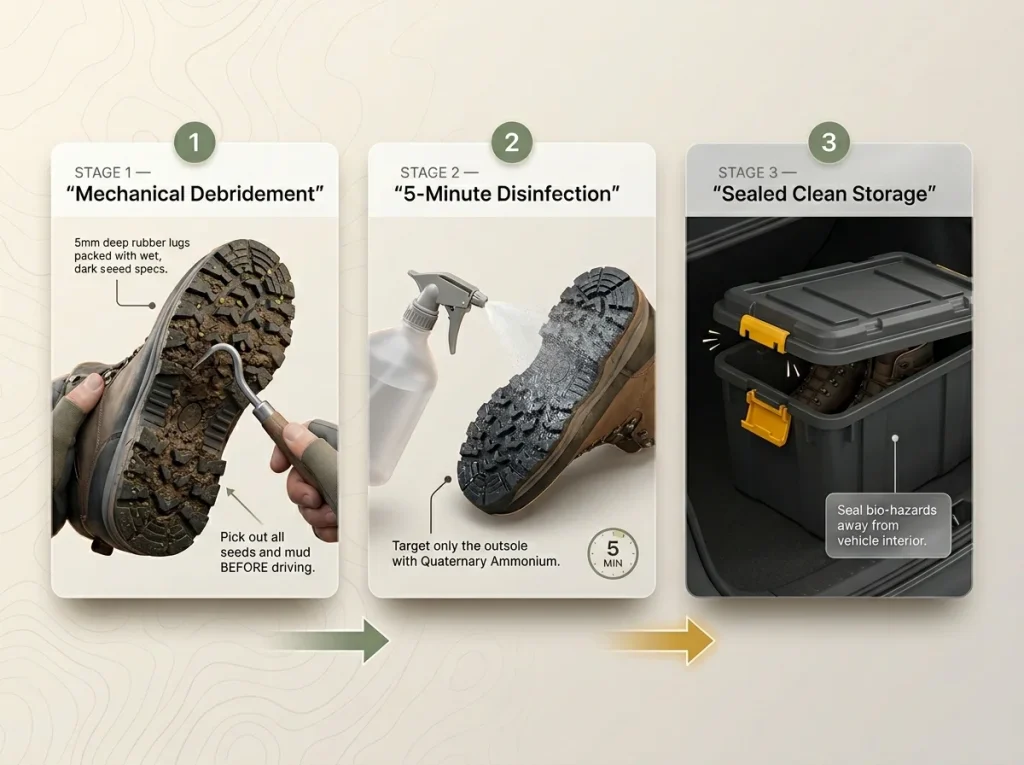
Knowing the ecological risks and the chemistry is useless without rapid field application. You need a fast, executable routine that protects the environment without ruining your gear. The following protocol strips away the mud, neutralizes the microscopic threats, and restores the factory waterproofing.
This is your mandatory post-hike bio-audit. Treat it with the exact same respect you give your baseline safety matrix before a difficult summit push. By performing regular structural diagnostics to catch boot degradation, you dramatically extend the lifespan of your footwear while doing the right thing. It takes five minutes and is entirely non-negotiable for anyone claiming to respect the outdoors.
Step 1: Mechanical Debridement at the Trailhead
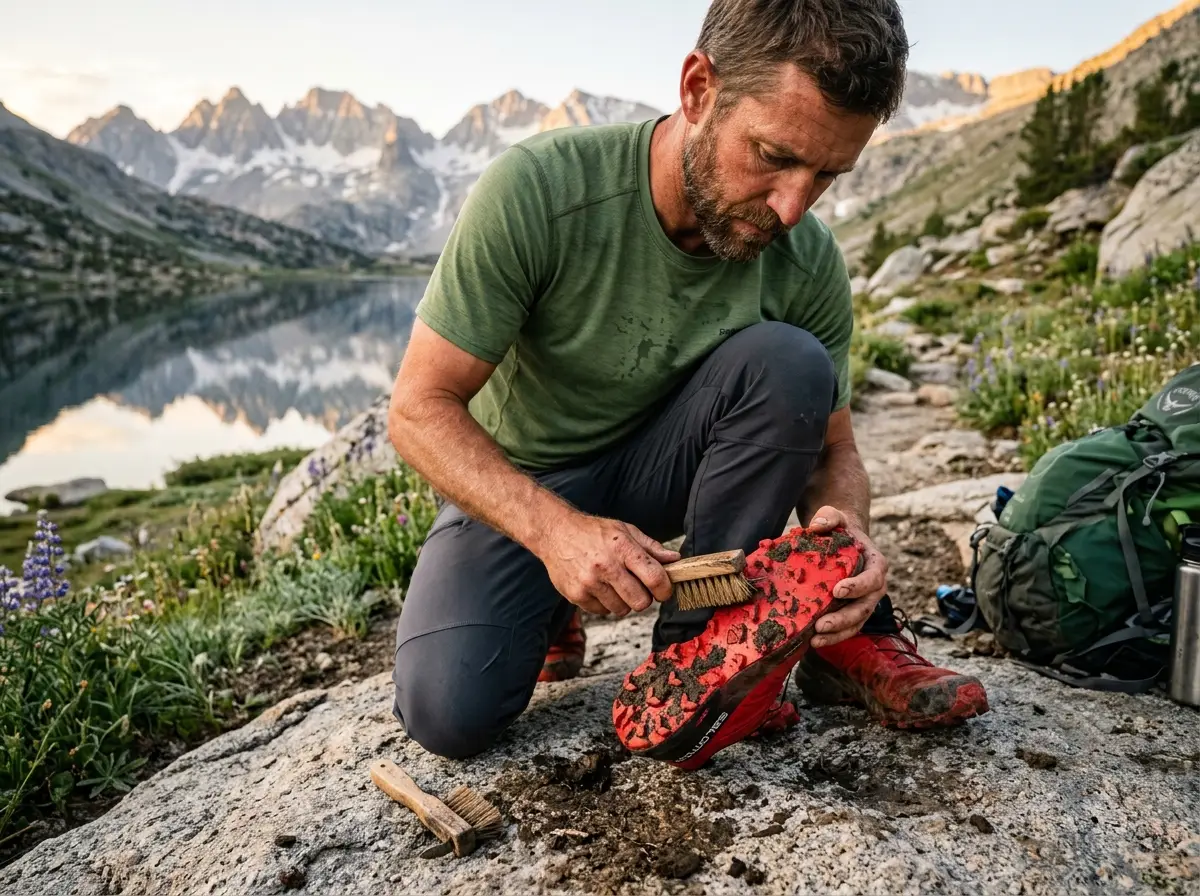
The overwhelming majority of your biosecurity risk is eliminated simply by aggressively removing the visible dirt before you ever put the car in drive. This is mechanical debridement, and it requires heavy physical friction.
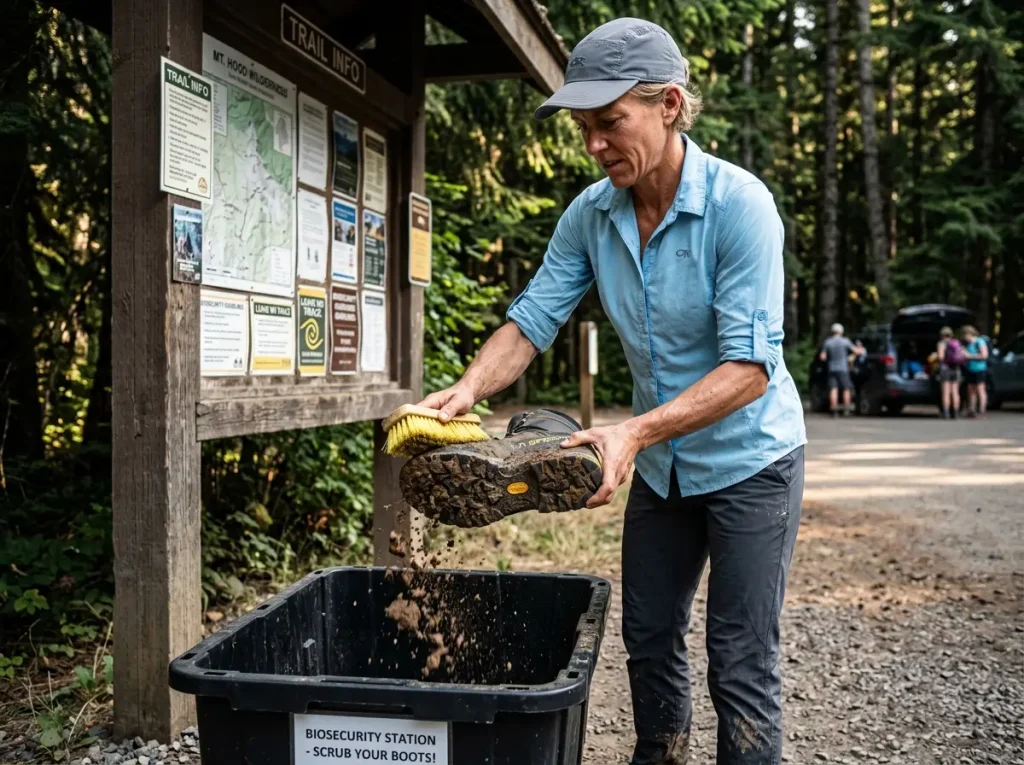
Keep a stiff-bristled brush or a heavy-duty metal horse hoof pick in your vehicle’s trunk. When you finish the hike, sit on the bumper and attack the deep negative spaces between your lugs. Mud removal should be methodical and unhurried. Do not ignore the delicate upper materials. Pay intense attention to the tongue gusset where the laces cross, and ruthlessly pick out any debris caught in Velcro closures. Velvet and Velcro act like massive seed traps. Knock the mud off onto the ground exactly where you hiked, ensuring the seeds and soil never leave their native watershed.
Step 2: The 5-Minute Disinfection Transition
Once the physical mud is gone, you target the invisible microscopic layer. This step happens right at the trailhead if you are transitioning between different wild spaces, or in a safe containment zone back at your home.
Pathogens are incredibly tough. Chemical disinfectants strictly require dwell time to break down and penetrate cell walls. The standard rule is five solid minutes of wet contact time. Spray your Quat-based disinfectant heavily onto the rubber outsoles and lower rands, entirely avoiding spraying the upper fabric or leather. You want the rubber visibly wet and soaking for a full five minutes.
Crucially, apply these harsh chemicals aggressively far away from the trail ecosystem. Stand at least 50 meters away from any creek, river, or drainage ditch. Disinfectants are highly toxic to all aquatic life, and washing the chytrid fungus into a stream alongside a chemical poison defeats the entire purpose of the exercise.
Pro Tip: Keep a dedicated, sealable plastic tub in your trunk. If a boot brush station is unavailable or broken at the trailhead, throw your contaminated boots directly into the tub and snap the heavy lid shut. Do not let loose seeds fall onto your car’s floor mats where they will inevitably hitch a ride on your daily shoes.
Step 3: At-Home Gear Restoration and DWR Maintenance
When you finally return home, your boots require dedicated technical gear care to undo whatever minor chemical stress the field cleaning caused.
Start by pulling out the insoles and taking a vacuum crevice tool to the interior footbed to suck out the tiny micro-seeds that inevitably bypass your tight gaiters. Next, thoroughly rinse the exterior of the boots with fresh water from a garden hose to eliminate any lingering chemical residue from your Quat spray. Let the boots dry naturally in a shaded, well-ventilated area away from the sun. Never place them directly on a heater or near a radiator; thermal heat combined with chemical exposure guarantees rapid delamination of the sole. Once completely dry, massage a high-quality, pH-balanced conditioner into the leather, or spray a fresh coat of water-based DWR onto your synthetic uppers to fully restore the waterproofing. Taking the time to care for your gear means it will not abandon you halfway down a long descent.
The Institutional Frontline: Trailhead Infrastructure and Extremes
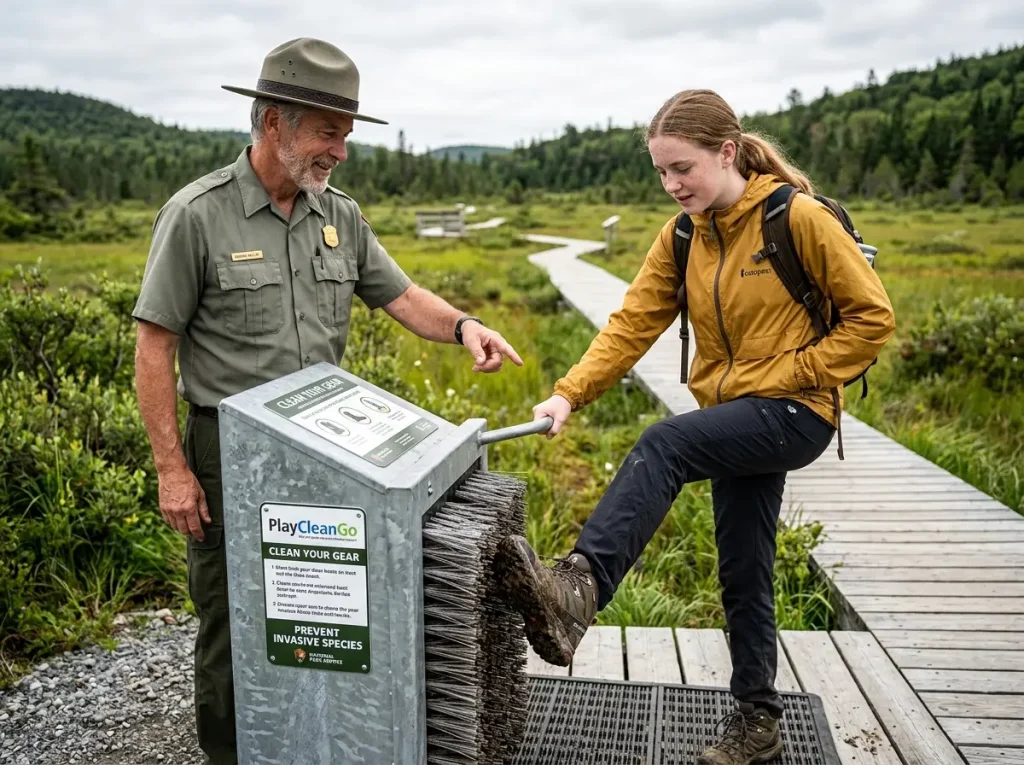
Your individual actions matter enormously on a micro scale, but solving a multi-billion dollar ecological crisis requires massive, organized infrastructure. Ecological stewardship cannot rely solely on the honor system of tired hikers. Government agencies and non-profits are fighting a desperate rear-guard action at the very edge of the wilderness, deploying everything from physical barriers to mandatory chemical footbaths.
Understanding this larger macro-level effort is vital for understanding how walker impact causes trail erosion and applying ethics to your standard routine. The system only works when everyone plays their designated part perfectly.
The Effectiveness of Boot Brush Stations
If you hike frequently on managed public land, you have undoubtedly walked past fixed boot brushes at major heavy-use trailheads. They look like heavy-duty scrubbers bolted to wooden kiosks. These are not polite suggestions; they are the absolute frontline of physical defense against anthropochory.
Field results confirm that these trailhead stations work exceptionally well when utilized correctly. In high-traffic zones like the scenic Columbia River Gorge, strategically placing standardized boot brush units has measurably and radically slowed the spread of destructive noxious weeds into vulnerable native shrub-steppe habitats. When hikers actually stop to scrub their heavy treads, the volume of invasive seeds entering the trail system drops dramatically. These stations serve simultaneously as a physical interdiction point and a loud billboard reminding you that the dirt on your shoes is genuinely hazardous.
Pro Tip: Always engage the boot brush station upon exiting the trail, not just when entering. Generating a habit of leaving the mud exactly in the ecosystem it originated from is far more effective than transporting it in your car back home.
Extreme Biosecurity in Fragile Environments
In the most isolated and delicate ecosystems on earth, managing authorities do not leave biosecurity up to chance. The strict invasive species regulations enforced by government agencies like the NPS and APHIS scale up dramatically when the ecological stakes are high.
Consider the harsh protocols for landing a boat in Antarctica. Visitors do not just wipe their feet nicely on a mat. Expedition staff mandate rigorous inspections of all outer clothing. You must meticulously pick every single seed out of your Velcro cuffs using fine metal tweezers. Before stepping off the Zodiac boat and onto the sensitive ice, you plunge your boots into a mandatory chemical footbath to eliminate all biological material. Similarly, the Channel Islands National Park enforces a rigid gear inspection for all cargo and footwear before anyone boards the public transport ferries. The more fragile the environment, the more draconian the decontamination protocol becomes.
Building a Community-Wide Ethic
This requires a fundamental shift in our collective outdoor culture. Initiatives spearheaded by the North American Invasive Species Management Association (NAISMA), particularly the loud PlayCleanGo movement, exist to build a unified biosecurity ethic among all user groups.
The primary goal is to make scrubbing your boots as automatic as packing out your toilet paper. Every single time you skip the brush station because you are tired after ten miles, you implicitly give the hikers walking behind you permission to do the exact same thing. Real stewardship means adopting the friction and doing the hard work. We have to collectively enforce this standard on the trail, holding ourselves and our backcountry partners accountable for the microscopic destruction we carry on our feet.
Conclusion
The wet dirt caked inside our deep lug outsoles carries a catastrophic ecological cost, actively threatening the survival of amphibian species across the globe and costing billions in annual agricultural damage. You possess the power to stop this silent, invisible invasion at the trailhead without slowly destroying your expensive footwear in the process. By heavily committing to the three-step decontamination protocol—aggressively brushing out mud, applying targeted quaternary ammonium disinfectants, and meticulously restoring your sensitive DWR membranes—you successfully transition from a biological vector into a true sentinel of the backcountry. Stand at the trailhead, take the extra five minutes to ruthlessly scrub your treads, and guarantee that the path behind you remains just as wild as you found it.
FAQ
How do hiking boots actually spread invasive seeds?
Seeds equipped with adhesive mucilage coatings or tiny physical hooks easily get trapped in the deep lugs and porous woven fabrics of your hiking boots. They hitch a ride over massive distances throughout the day, only dropping off into pristine, native soils as the boot flexes and bends on an entirely new trail system hundreds of miles away from the source.
Are boot brush stations at trailheads actually effective?
Yes, mandatory physical brushing removes the vast majority of soil and viable seeds hidden deeply within your tread patterns. Real-world data across critical areas like the Columbia River Gorge definitively proves these heavy-duty scrubbers significantly bottleneck the spread of aggressive noxious weeds into highly vulnerable native brush.
Can I use bleach to disinfect my boots after hiking in mud?
You must absolutely avoid dumping full-strength liquid bleach anywhere near the delicate upper fabrics of your expensive technical boots. While a diluted 10-percent bleach solution neutralizes pathogens on your rubber soles, any splash onto the upper will chemically strip your DWR coating, melt your Gore-Tex membranes, and slowly eat the factory adhesives holding the shoe together.
What invisible pathogens are hikers most likely to spread?
The most critical and rapidly spreading biological threats carried in boot mud are the chytrid fungus and ranavirus. These highly durable pathogens thrive in damp soil trapped tightly in your treads and are directly responsible for the total collapse of local amphibian and fish populations worldwide.
Risk Disclaimer: Hiking, trekking, backpacking, and all related outdoor activities involve inherent
risks which may result in serious injury, illness, or death. The information provided on The Hiking Tribe is for
educational and informational purposes only. While we strive for accuracy, information on trails, gear, techniques,
and safety is not a substitute for your own best judgment and thorough preparation. Trail conditions, weather, and
other environmental factors change rapidly and may differ from what is described on this site. Always check with
official sources like park services for the most current alerts and conditions. Never undertake a hike beyond your
abilities and always be prepared for the unexpected. By using this website, you agree that you are solely
responsible for your own safety. Any reliance you place on our content is strictly at your own risk, and you assume
all liability for your actions and decisions in the outdoors. The Hiking Tribe and its authors will not be held
liable for any injury, damage, or loss sustained in connection with the use of the information herein.
Affiliate Disclosure: We are a participant in the Amazon Services LLC Associates Program, an
affiliate advertising program designed to provide a means for us to earn advertising fees by advertising and linking
to Amazon.com. As an Amazon Associate, we earn from qualifying purchases. We are also an official affiliate partner
of Black Diamond Equipment via the AvantLink network. If you click on a Black Diamond affiliate link and make a
purchase, we may earn a commission at no additional cost to you. We also participate in other affiliate programs and
may receive a commission on products purchased through our links. Additional terms are found in the terms of
service.