







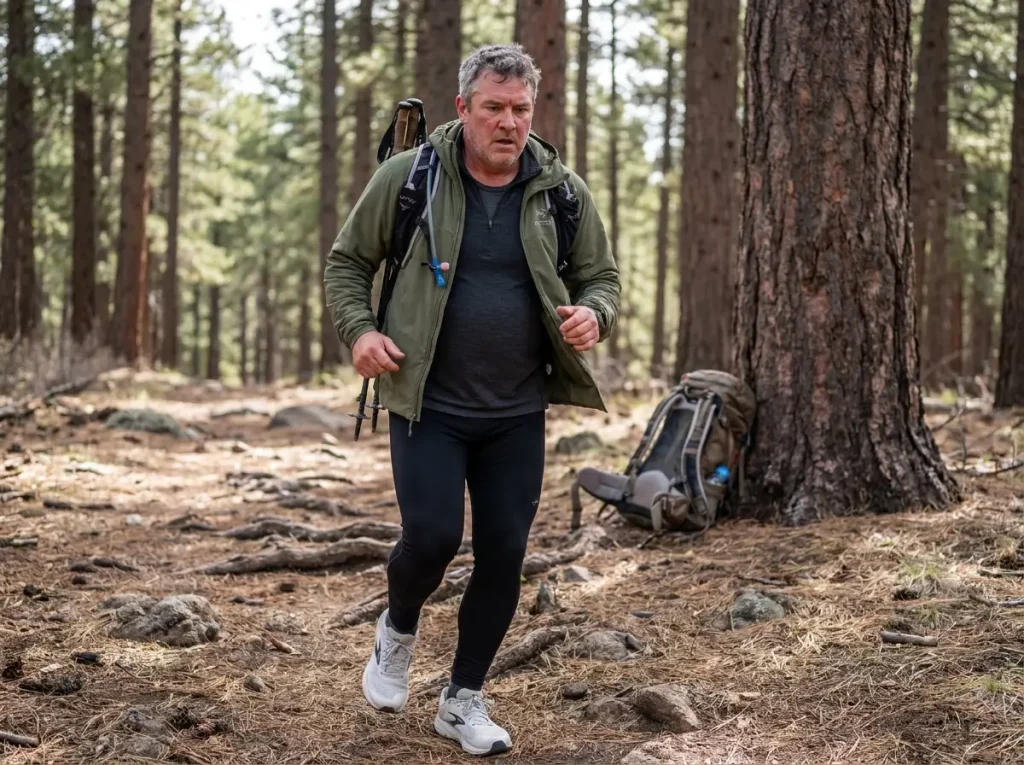
The first time I tried running a trail I’d hiked dozens of times, I made it about a mile and a half before my knees told me to stop. Not because I was out of shape — I’d been hiking 15-mile days all summer. But running uses your legs differently than hiking does, and my joints had no idea what was happening. If you’re a hiker thinking about trail running, that same surprise is probably waiting for you unless you approach the transition with some awareness.
Here’s how to make the shift from hiking to trail running without the joint pain, frustration, and blown-out first attempts that catch most hikers off guard.
Quick Answer: To transition from hiking to trail running safely, follow these steps:
- Start on trails you already know from hiking
- Use the run-walk method — walk all uphills, run gentle downhills and flats
- Get trail-specific shoes with traction and foot protection
- Build mileage by no more than 10% per week
- Add ankle and knee strengthening exercises twice per week
- Run by effort, not pace — trail miles are 2+ minutes slower than road miles
Why Your Hiking Fitness Doesn’t Fully Transfer
Same Trails, Different Biomechanics
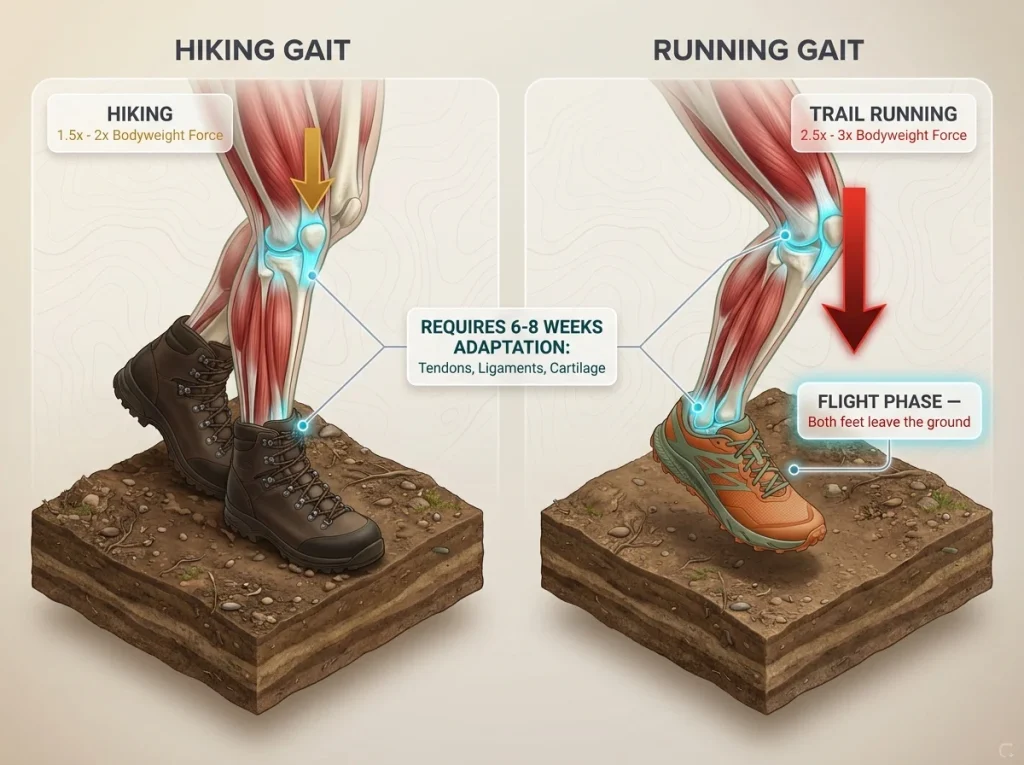
Hiking and running look similar on paper. You’re covering the same trail, using the same muscles, dealing with the same terrain. But biomechanically, they’re two separate gaits. Walking keeps at least one foot on the ground at all times. Running has a flight phase where both feet leave the ground — and when you land, your joints absorb significantly more force.
Research shows that impact forces on the knee can increase by more than 50% during trail running descents compared to flat terrain. Every foot strike while running transmits roughly 2.5 to 3 times your body weight through your knees. Hiking transmits about 1.5 to 2 times. That difference adds up fast over miles.
What Transfers and What Doesn’t
The good news: your cardiovascular fitness from hiking is real and it transfers. Your legs are strong. Your lungs are conditioned. Your ability to read terrain, manage elevation, and pace yourself over long distances — all of that carries over directly.
What doesn’t transfer: joint conditioning for impact. Your tendons, ligaments, and cartilage need 6 to 8 weeks of progressive loading to adapt to running forces. Your muscles can handle the effort long before your connective tissue can. That gap between muscular fitness and joint readiness is exactly where injuries happen.
Your ankle stability also needs work. Hiking boots provide external support. Trail running shoes don’t — they’re lower, lighter, and more flexible. Your ankles need to stabilize themselves, and if you’ve been relying on boot collars for stability, your ankle proprioception needs retraining.
The 10% Rule for Building Mileage
Increase your weekly running distance by no more than 10% per week. If you ran 6 miles total this week, next week’s cap is 6.6 miles. This feels painfully slow when your aerobic fitness says “go farther.” Ignore that signal. Your joints don’t care how strong your lungs are.
Pro tip: Track your running mileage separately from your hiking mileage. A 10-mile hike and a 3-mile run in the same week aren’t the same thing in terms of joint stress. The run puts more cumulative impact on your knees than the hike does, mile for mile.
The Right Shoes Change Everything
Why Hiking Boots Don’t Work for Running
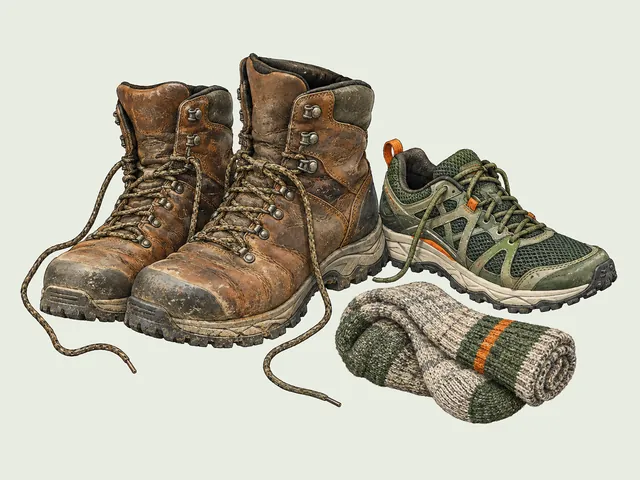
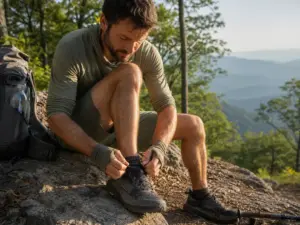
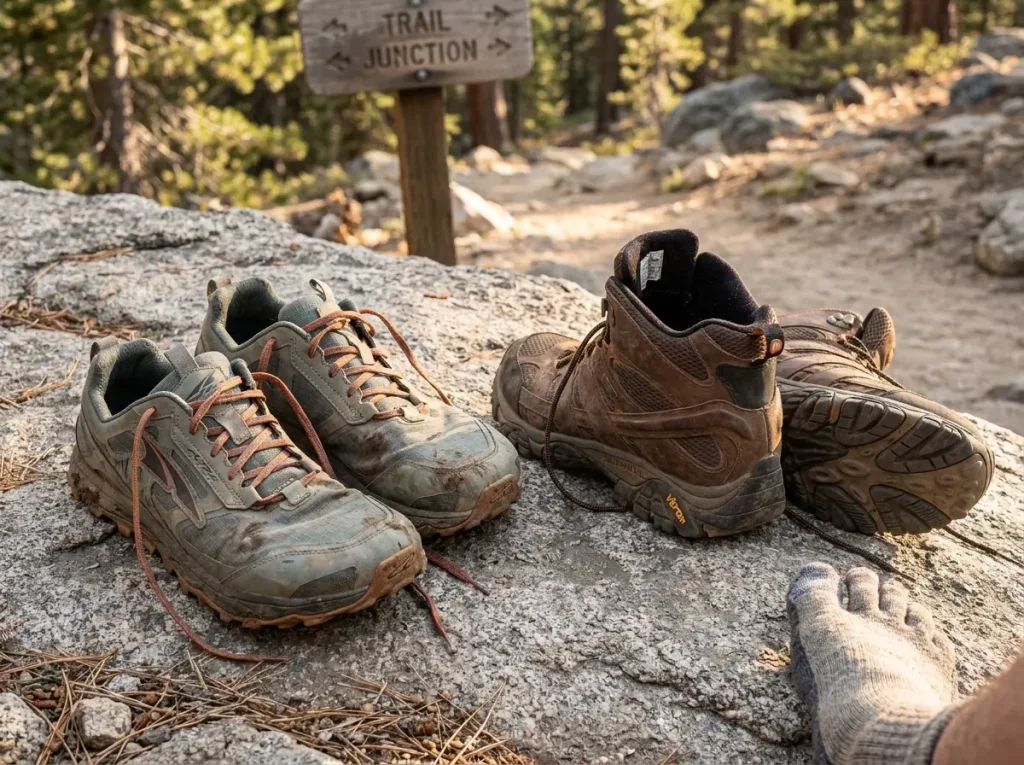
Your hiking boots are too heavy, too stiff, and too high to run in. The weight alone changes your stride mechanics — running in a 2-pound boot versus a 10-ounce trail shoe is like running with ankle weights. The stiff sole prevents your foot from flexing through a natural running gait. And the high collar restricts ankle movement that you need for quick terrain adjustments.
That said, you don’t need to sprint to the gear store today. If your first run will be on a smooth fire road or gravel path, road running shoes work fine as a starting point. But the moment you hit roots, rocks, and mud, you’ll feel the difference. Trail running shoes add aggressive tread for traction, a rock plate for underfoot protection, and reinforced toe caps for kicking the rocks you didn’t see.
What to Look for in Your First Pair
Don’t overthink this. Four things matter:
Traction — lugs deep enough for your typical terrain. Smooth groomed trails need less; muddy single track needs more. Look at the outsole before you look at anything else.
Fit — your running foot swells more than your hiking foot because of the higher impact forces. Size up half a size from your hiking shoe. Your toenails will thank you on downhills.
Drop — the height difference between heel and toe. If you’ve been in hiking boots (typically 10-12mm drop), don’t jump straight to zero-drop trail runners. Start around 4-6mm and let your calves adapt. The minimalist shoe transition guide covers this progression in detail.
Protection — a rock plate between your foot and the ground makes a real difference on rocky terrain. Without it, you feel every sharp stone, and your foot subconsciously shortens your stride to avoid pain.
For a broader perspective on choosing between different footwear types for different terrain, our boots vs. shoes vs. sandals breakdown covers the decision matrix.
Pro tip: Retire trail running shoes around 300-400 miles, not when they look worn. The midsole compresses and loses shock absorption before the outsole shows it. The press test tells you when cushioning is gone.
Run-Walk Is Not Cheating
Why Even Elite Runners Walk Uphills
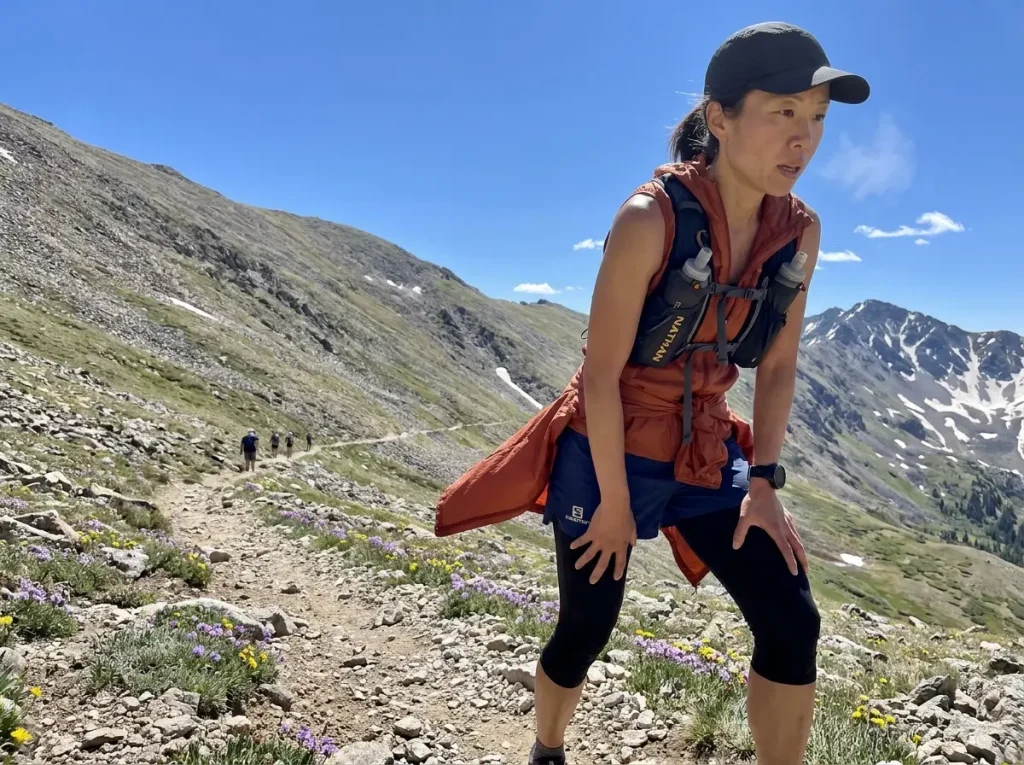
Watch footage from any ultramarathon or mountain race. The front runners walk steep uphills. Every single one. Because the energy cost of running a grade above about 15% is higher than power-hiking the same grade — for the same speed. Walking steep terrain is physiologically smarter, not weaker.
For hikers transitioning to trail running, this is the best news possible. You already know how to hike uphill efficiently. That skill is directly transferable. Your run-walk strategy is simple: run the flats and gentle downhills, power-hike anything steep. There’s no shame threshold to cross. It’s just efficient movement.
How to Structure Your Run-Walk Intervals
Start with a ratio that feels easy. For most hikers in their first weeks of trail running:
Weeks 1-2: Run 2 minutes, walk 1 minute on flat terrain. Walk all uphills. Walk or slow-jog all downhills.
Weeks 3-4: Run 4 minutes, walk 1 minute on flats. Start jogging gentle downhills with short, choppy strides. Walk steep uphills.
Weeks 5-8: Run by feel. Walk when the grade or your breathing demands it. Stop timing intervals — you’re developing intuition now.
The goal isn’t to eliminate walking. It’s to find a sustainable rhythm where walking becomes a tool you choose, not a failure you fall into.
Cadence Over Stride Length
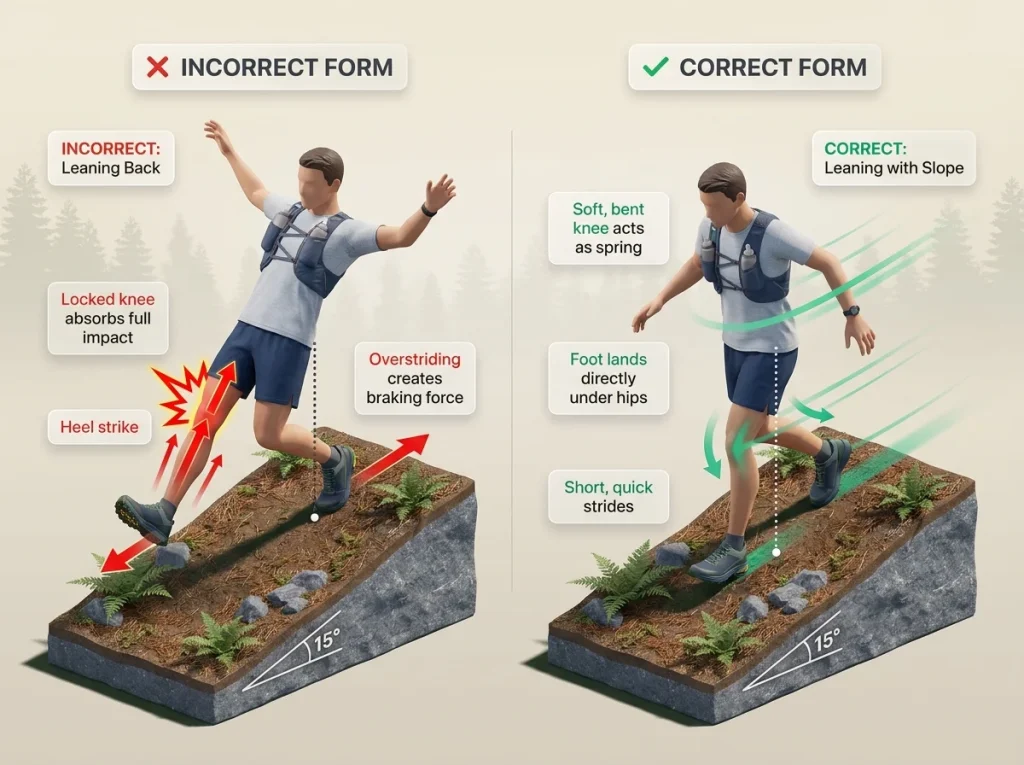
One of the biggest mistakes hikers make when they start running is taking long strides. Hiking rewards long strides — you cover ground efficiently. Running with long strides is called overstriding, and it brakes your forward momentum with every step while increasing impact force on your knees.
Shorten your stride. Increase your cadence — aim for 170-180 steps per minute. Your feet should land beneath your hips, not in front of them. This feels weird at first, like you’re shuffling. You are. That shuffle is proper trail running form for most terrain, and it’s significantly easier on your joints.
The same cadence principles that apply to trekking poles apply to your feet — rhythm and consistency beat power and force.
Protecting Your Knees and Ankles
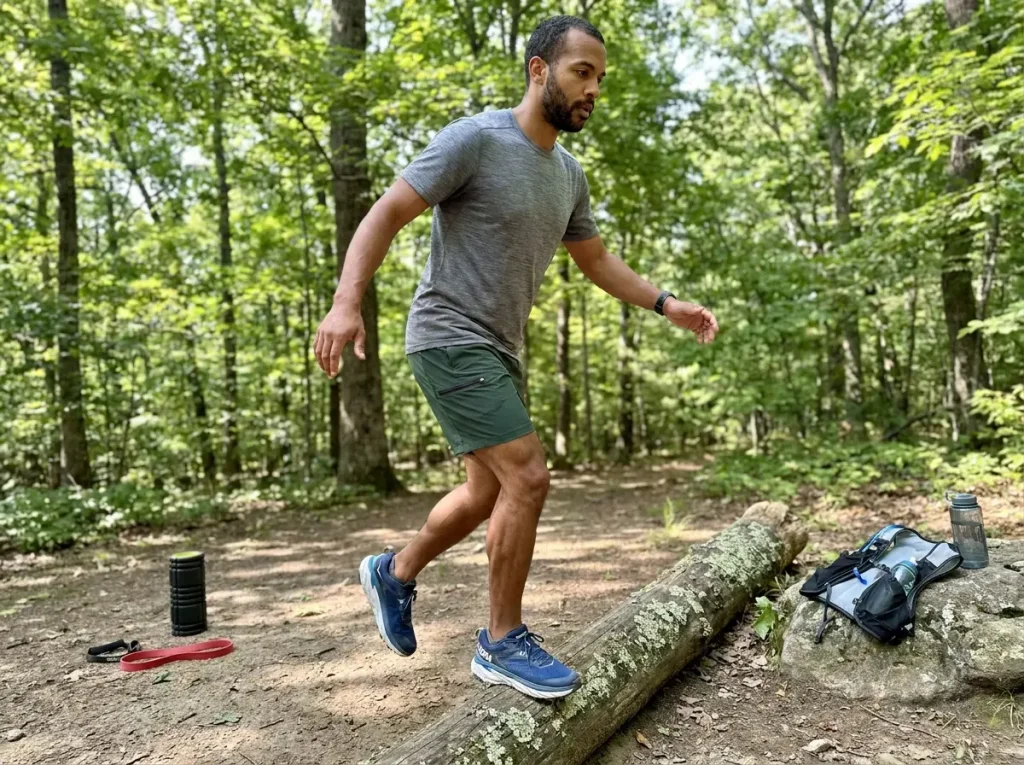
The Downhill Problem
Downhills are where knees take the most punishment. Compressive forces on the knee joint can increase by more than 50% on sustained descents, especially when you’re tired. Your quads act as brakes on every step, and they fatigue faster than your cardio system does.
Two techniques help:
Lean slightly forward. Match your body angle to the slope instead of leaning back. Leaning back locks your knees and turns them into shock absorbers. Leaning forward lets your whole body absorb the descent.
Short, quick steps. Long downhill strides create massive braking forces. Short steps reduce them dramatically. Think “fast feet, light contact” rather than “bounding down the mountain.”
Ankle Strengthening That Actually Works
If you’re transitioning from supportive hiking boots to flexible trail shoes, your ankles need dedicated strengthening. The muscles that stabilize your ankle joint — particularly the peroneals on the outside — may have been relying on boot support for years.
Three exercises, twice a week:
Single-leg balance: Stand on one foot for 30 seconds. When that’s easy, close your eyes. When that’s easy, stand on an uneven surface. Progress slowly.
Calf raises: 3 sets of 15, both double-leg and single-leg. Slow on the way down — the eccentric phase is where the strengthening happens.
Resistance band inversions/eversions: 2 sets of 12 in each direction. These target the specific stabilizer muscles that prevent ankle rolls on uneven terrain.
Our guide to scrambling fitness exercises covers additional ankle and foot-core drills that translate directly to trail running stability.
Pro tip: Trekking poles reduce lower limb joint forces by up to 25%. For your first few trail runs, bring your hiking poles. They provide stability on technical terrain while your ankles adapt, and they take significant load off your knees on descents. The exercises for trail training with poles show you how to use them for rehab and strengthening.
Your First 4-Week Trail Running Plan

Week 1 — Learn the Feel
Three runs, all on trails you’ve hiked before. Each run is 20-25 minutes total, including walk breaks.
Run 1: Out-and-back on a flat, smooth trail. Run 2 min / walk 1 min. Focus on keeping your feet under your hips.
Run 2: Same trail. Run 3 min / walk 1 min. Pay attention to how your body feels on the downhill sections — this is where you’ll notice the knee stress first.
Run 3: A trail with gentle elevation changes. Walk all uphills. Run flats and gentle downs. 25 minutes total.
Off days: One strength session — squats, lunges, calf raises, single-leg balance. 20 minutes is enough.
Week 2 — Build Rhythm
Three runs. Increase total time to 25-30 minutes.
Run 4 min / walk 1 min on flats. Walk uphills. Begin jogging easy downhills with short, quick strides. Add one strength session.
Week 3 — Extend Distance
Three runs. Total time 30-35 minutes. Start running by effort instead of timed intervals — run when it feels comfortable, walk when it doesn’t. One run should be on technical terrain (roots, rocks) to build foot awareness. Two strength sessions.
Week 4 — Recovery and Test
Two easy runs of 20 minutes (recovery week — back off 30% from week 3). One longer run of 35-40 minutes at comfortable effort on a trail you know well. This is your baseline test. How did your knees feel? Your ankles? Your energy? Adjust your plan for month two based on what you learned.
Fueling on the Move vs. Fueling on the Hike
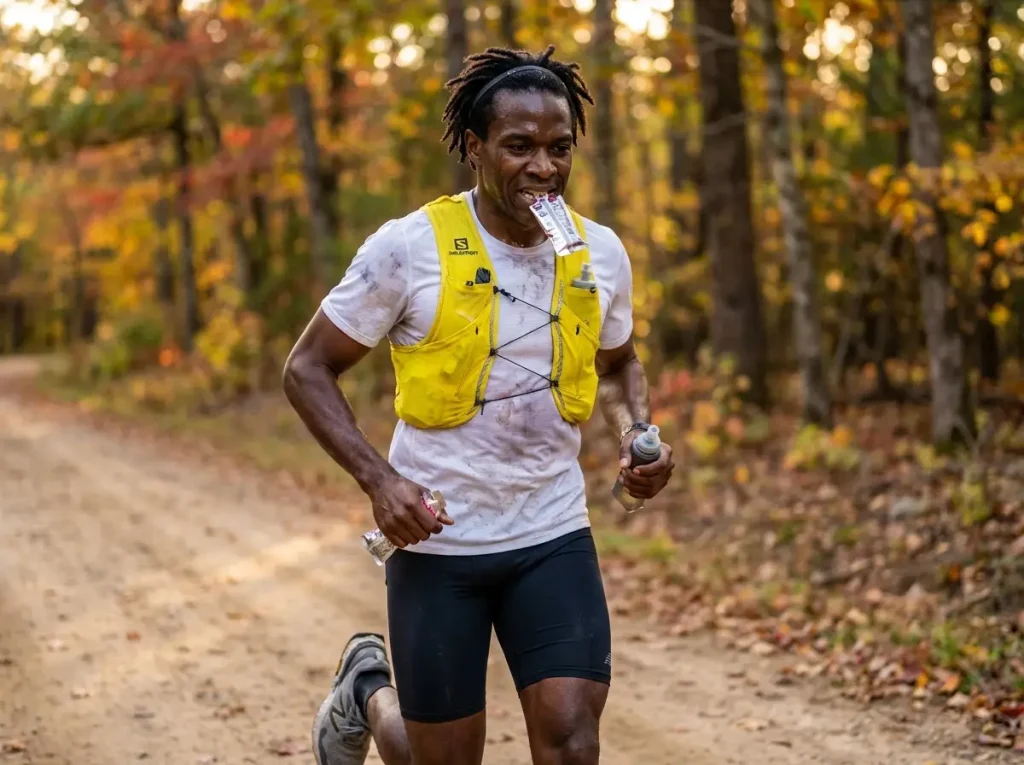
The Timing Problem
On a hike, you stop for snacks. You sit down, open your pack, eat a sandwich, drink water, and keep going. Trail running doesn’t give you that luxury. Stopping to eat kills your momentum and drops your heart rate — restarting is harder than it was the first time.
For runs under 60 minutes, you generally don’t need to eat during the run. Your body has enough stored glycogen to handle an hour of moderate trail running. Beyond 60 minutes, you need to start taking in calories — roughly 200-300 per hour of carbohydrates.
What Works at Speed
The foods that fuel hiking don’t always work for running. A PB&J sandwich that’s perfect at a hiking rest stop can sit like a brick in your stomach at running pace. Your digestive system diverts blood away from your gut to your working muscles when you run, so digestion slows dramatically.
What works: energy gels, chews, dates, small handfuls of gummy bears, and liquid calories. These are pre-digested or simple enough that your body can process them without a full digestive effort.
Electrolytes become important past the 60-minute mark, especially if you’re sweating hard. Aim for 300-500 mg of sodium per hour on hot days. Plain water alone can actually make things worse on long runs by diluting your electrolyte balance.
For dialing in your hydration math — how much to carry per mile based on temperature, effort, and body weight — our hydration calculator gives you the specific numbers.
Pro tip: Test your fueling strategy on training runs, never on a long run or race day. Your stomach needs practice processing food at running effort just like your legs need practice running trails. Start with one gel at 45 minutes on a short run and see how it sits.
Sharing the Trail — Safety and Etiquette

You’re the Fast-Moving Object Now
As a hiker, you’ve been the slower person on the trail. Trail runners passed you, sometimes politely, sometimes not. Now you’re on the other side. The rules shift.
Yield to hikers and horses. Always. Slow to a walk, announce yourself with a verbal “on your left” or “runner behind you” from 30 feet back — don’t sprint past someone on a narrow trail and scare them. Hikers can’t hear you coming on soft ground, and surprising someone near a cliff edge is how people get hurt.
Yield to uphill traffic regardless of whether you’re running or hiking. The person climbing has right of way because stopping mid-climb is harder than pausing mid-descent.
No headphones on shared trails. You need to hear approaching mountain bikes, other runners, wildlife, and your own footwork. If you need music, bone-conduction headphones keep your ear canals open. But on technical or remote trails, listen to the trail. Your hearing is a safety system.
Solo Running Safety
Always tell someone your planned route and expected return time. Set a “panic time” — the time at which they should call search and rescue if they haven’t heard from you. Carry a GPS device or have offline maps downloaded, because cell service disappears fast on mountain trails.
Run on higher-traffic trails when you’re starting out. Save the remote single track for when you know your fitness level and can trust your footing. According to the National Park Service’s hiking safety guidelines, planning and preparation are the foundation of trail safety — that applies to trail running just as much as hiking.
The Road Runners Club of America’s trail running tips emphasize running to the right, passing on the left, and always carrying identification — trail running moves faster through help-is-far-away terrain.
Gear You Already Own and Gear You Need
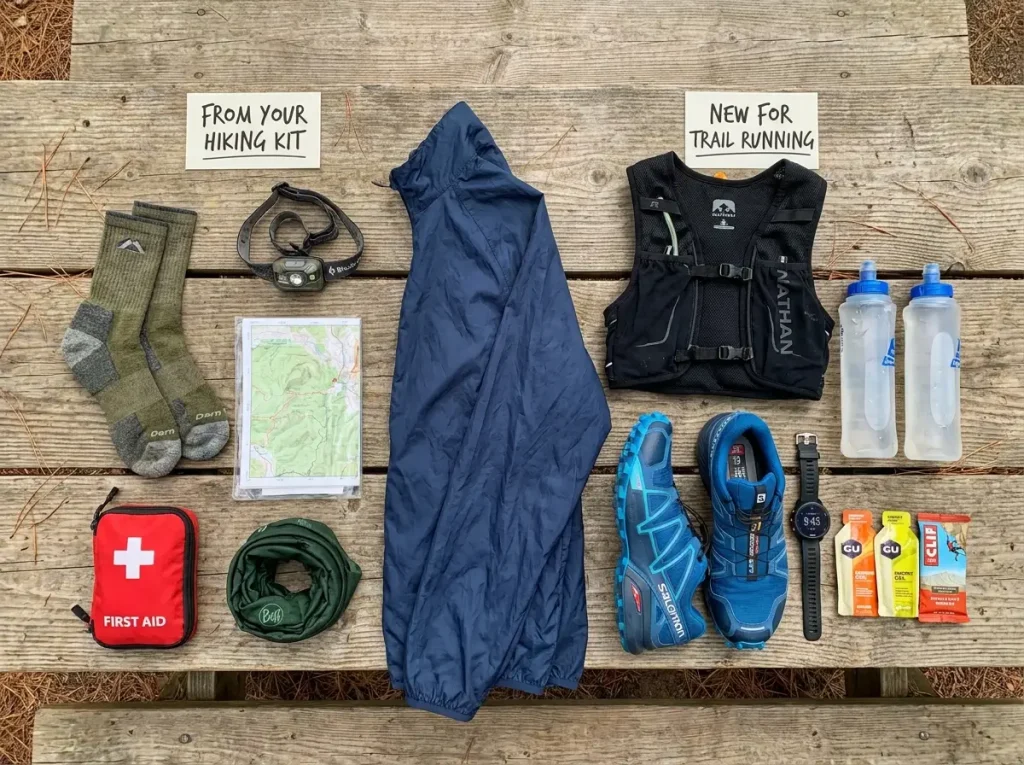
From Your Hiking Kit (Keep These)
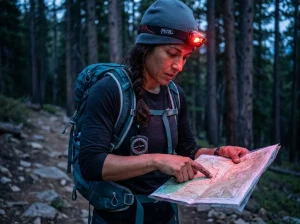
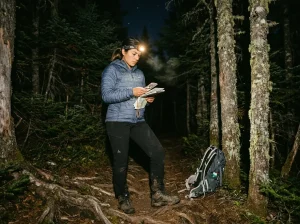
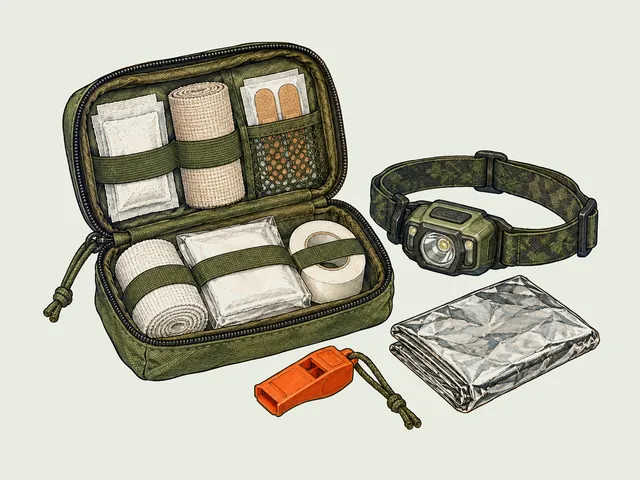
Your headlamp works for early morning or late evening runs. Your merino base layers work perfectly as running layers in cool weather. Your first aid kit should come along on every run longer than 30 minutes. Your trail map and navigation skills transfer completely.
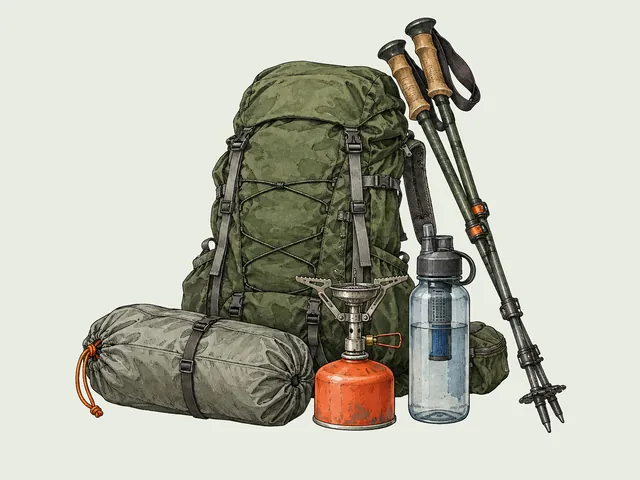
Trekking poles are optional for trail running but worth carrying during the transition period. They reduce knee stress on descents by up to 25% and give you four points of contact on technical terrain. As your ankle strength builds, you’ll use them less.
New Gear for Trail Running
Trail running shoes — your most important upgrade. Aggressive tread, rock plate, lightweight. Budget $100-150 for a quality first pair.
Running vest — replaces your day pack. A good running vest holds 1-2 liters of water in front-mounted soft flasks, has pockets for gels and your phone, and bounces zero. A hiking day pack bounces with every step and drives you crazy within a mile.
GPS watch — tracks your distance, elevation, heart rate, and cadence. Garmin, Suunto, and Coros all make trail-specific models. Not required for starting out, but it becomes your best training tool once you’re a few weeks in.
Moisture-wicking running socks — thinner than hiking socks, lower-cut, with targeted cushioning. Injinji toe socks or Darn Tough running-weight socks both prevent blisters at running friction levels. Your hiking socks are too thick and will cause hot spots. For long-term foot care on distance runs, thin wicking socks are the foundation.
If the idea of running with a lighter pack and covering more trail in less time appeals to you, fastpacking is the natural next step — a hybrid between trail running and ultralight backpacking.
Conclusion
Trail running as a hiker comes down to respecting the transition. Your cardio is ready, but your joints aren’t — give them 6 to 8 weeks of progressive loading with the 10% rule. Run-walk is not failure; it’s the strategy that every experienced trail runner uses on steep terrain. And get trail-specific shoes before anything else — they’re the single biggest safety upgrade for a hiker starting to run.
Your next move is simple. Pick a trail you’ve hiked at least twice. Lace up a pair of trail runners. Run the flat parts, walk the uphills, and pay attention to how your knees feel on the way down. That first run will tell you everything you need to know about where to start.
Q1 Can I trail run if I’m only a hiker?
Yes. Your hiking fitness gives you a strong cardiovascular base and terrain awareness that transfers directly. The adjustment period is about joint conditioning — your tendons and ligaments need 6 to 8 weeks to adapt to running impact forces. Start with short run-walk sessions on familiar trails.
Q2 What shoes do I need for trail running?
Trail-specific running shoes with aggressive tread, a rock plate, and a reinforced toe cap. Don’t run in hiking boots — they’re too heavy and stiff. For smooth trails, road running shoes work temporarily, but switch to trail shoes when terrain gets technical.
Q3 Is trail running harder on your knees than hiking?
Running generates 2.5 to 3 times your body weight in impact force per stride, compared to 1.5 to 2 times for hiking. However, proper form — short strides, forward lean on downhills, and high cadence — significantly reduces knee stress. Trekking poles cut joint forces by up to 25%.
Q4 How far should a beginner trail run?
Start with 1 to 2 miles of actual running, using run-walk intervals on a trail you already know. Most hikers can handle 20 to 25 minutes of total trail time in their first session. Increase weekly distance by no more than 10% to let joints adapt safely.
Q5 How do I start trail running as a beginner?
Begin on trails you’ve hiked before so terrain is familiar. Use the run-walk method — run flats and gentle downhills, walk all steep uphills. Get trail running shoes, start with 20-minute sessions three times per week, and add ankle-strengthening exercises twice weekly. Build slowly and run by effort, not pace.

I've spent more than a decade researching hiking gear and trail technique. I read the specs, the forum threads and the long-term reviews, and every pick here comes with what it gets wrong.
End of the trail
You read every mile of this one. Here's where the trail goes next.