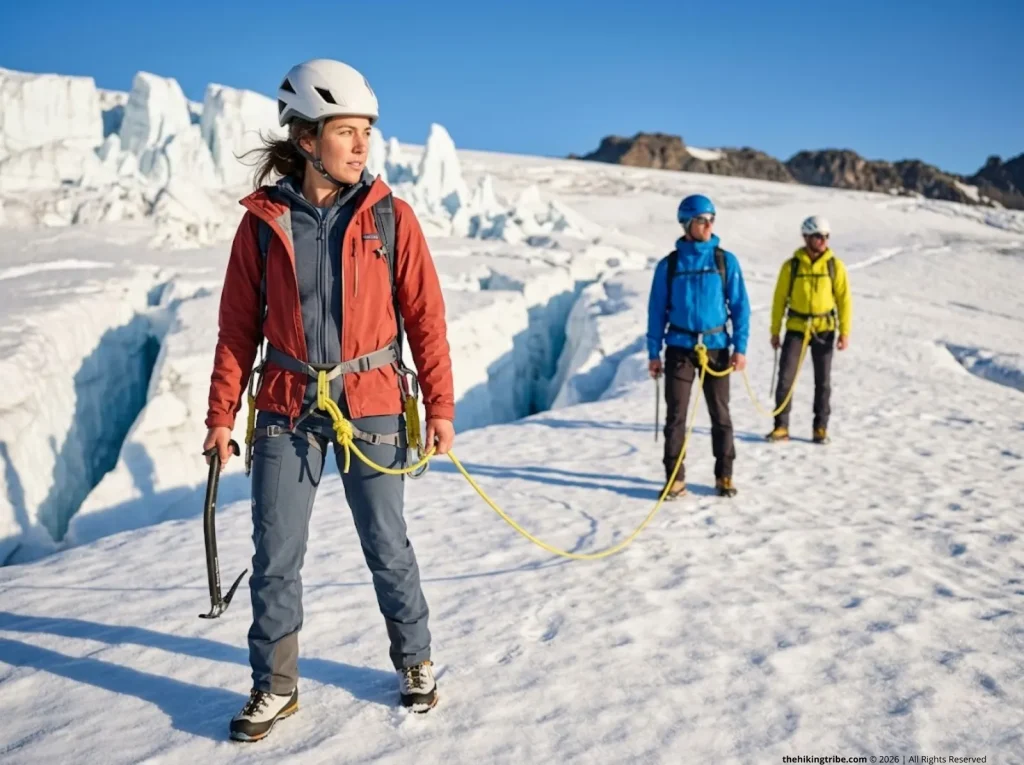
The first time you step off solid rock and onto the Easton Glacier, the silence is deceiving. Beneath that pristine, sun-baked expanse of white snow lies a labyrinth of hollow blue voids, waiting for a single misstep or a collapsing snow bridge to trigger a catastrophic fall. Transitioning from high-altitude trekking to glaciated mountaineering requires more than just buying a shiny ice axe; it demands a flawless, dummy-proof understanding of how to build a mechanical safety chain to catch a crevasse fall. I’ve spent years hauling heavy packs across remote icefields, and I’ve seen exactly what happens when trail hikers fail to respect the void. Here is exactly how to set up your rope team before you step into the danger zone, ensuring you and your partners return to the trailhead safe.
⚡ Quick Answer: Getting your rope team ready on a glacier means building a foolproof safety chain before you ever touch the ice. You need a 60-meter dynamic rope, a pair of locking and non-locking carabiners per person, and pre-rigged friction hitches ready at your waist. Distance your team securely using the professional “10-minus” equation—usually about 10.5 meters apart for three climbers. Keep the rope absolutely taut with every step, and always position your heaviest climber on the uphill side to guarantee you can hold a sudden crevasse fall.
| Spacing Requirements | ||
|---|---|---|
| Team Size | Required Arm Spans | Approximate Spacing |
| 2 Persons | 8 Double Spans | 12 Meters |
| 3 Persons | 7 Double Spans | 10.5 Meters |
| 4 Persons | 6 Double Spans | 9 Meters |
| 5 Persons | 5 Double Spans | 7.5 Meters |
The Hiker’s Glacier Gear Checklist (The Safety Chain)
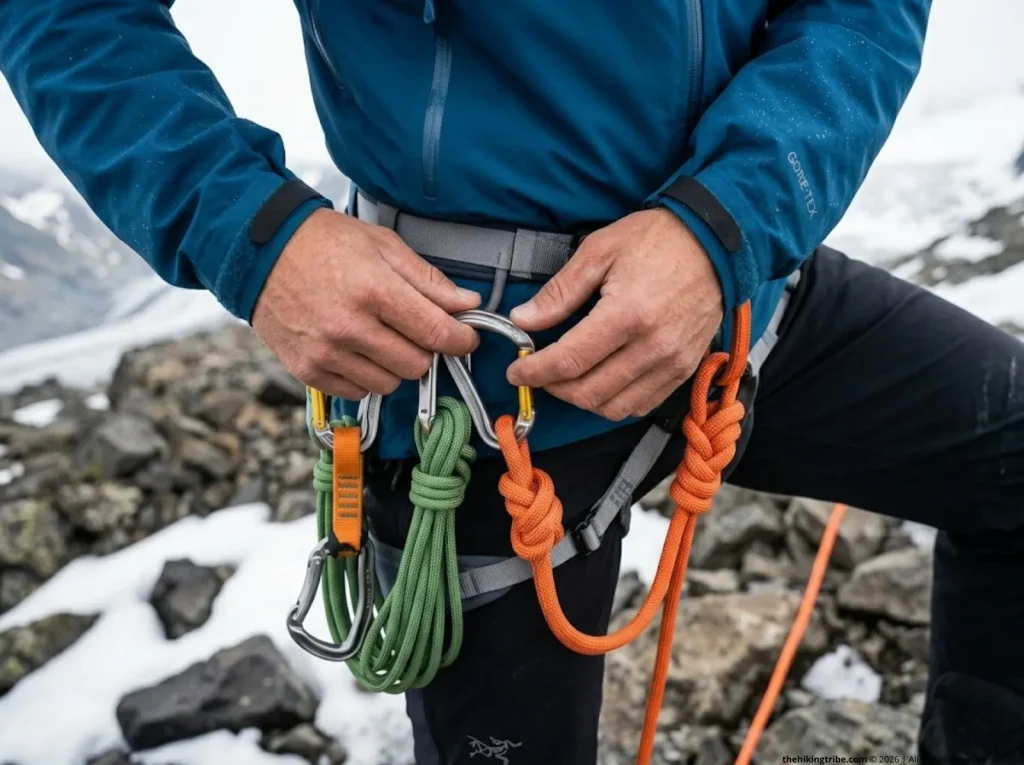
Trading a dirt trail for a glacier means a complete shift toward technical life-support equipment. A rigid pair of boots and a mountaineering climbing helmet are standard, but the core of your survival system is the hardware connecting your body to the team. The middle climber requires precise gear choices to anchor the system effectively without adding dead weight.
Dynamic Ropes vs. Hyperstatic Cords
Not all ropes are built the same, and choosing the wrong one can violently snap your ribs during a fall. Ropes are broadly classified by how much they stretch under load. A standard 60-meter single rope is dynamic, meaning it stretches over 10 percent of its length to absorb the brutal shock of a fall. This makes the dynamic rope the supple, forgiving gold standard for a beginner rope team learning the ropes on a big mountain.
Recently, ultralight alpinism has popularized hyperstatic 6mm cords. These ultra-thin lines offer almost zero stretch, making the process of hauling a fallen partner out of a hole incredibly efficient since you don’t fight rope bounce. However, because they do not stretch, they transmit harsh, violent impact forces straight into the climbers trying to anchor the fall. While dynamic stretch safely cushions your body, bear in mind that it can also cause a falling climber to “yo-yo” and plunge much deeper into a crevasse before coming to a complete stop.
The Double Carabiner Rule: Opposite and Opposed
Your harness connection is the single weakest link if you rig it poorly. A standard screwgate carabiner can subtly fail via “gate shiver” as it rubs against the crusty snow, or freeze completely shut in wet, freezing conditions. You must use two carabiners clipped together at your harness tie-in points to guarantee security.
The ironclad rule here is opposite and opposed. Use one locking carabiner and one non-locking carabiner, and clip them so their gates open in opposite directions and rest on opposite sides. This simple configuration ensures your setup cannot accidentally cross-load or get unclipped during a violent, twisting fall through a snow bridge.
Essential Harnesses and Pre-Rigged Prusiks
The vital interface between you and the climbing rope requires a friction hitch ready to deploy instantly. For standard 8.5mm or 9mm ropes, a 5mm prusik cord is the optimal diameter to ensure the hitch bites hard and stops you from sliding into the abyss. Anything thicker might slip right down the wet rope when you weight it with your body.
Pro-Tip: Make sure your climbing harness lacks bulky foam padding that absorbs water like a sponge. A clean harness works best when you are dragging your lower body through heavy, wet snow all day.
System Architecture: Team Size and The Spacing Matrix
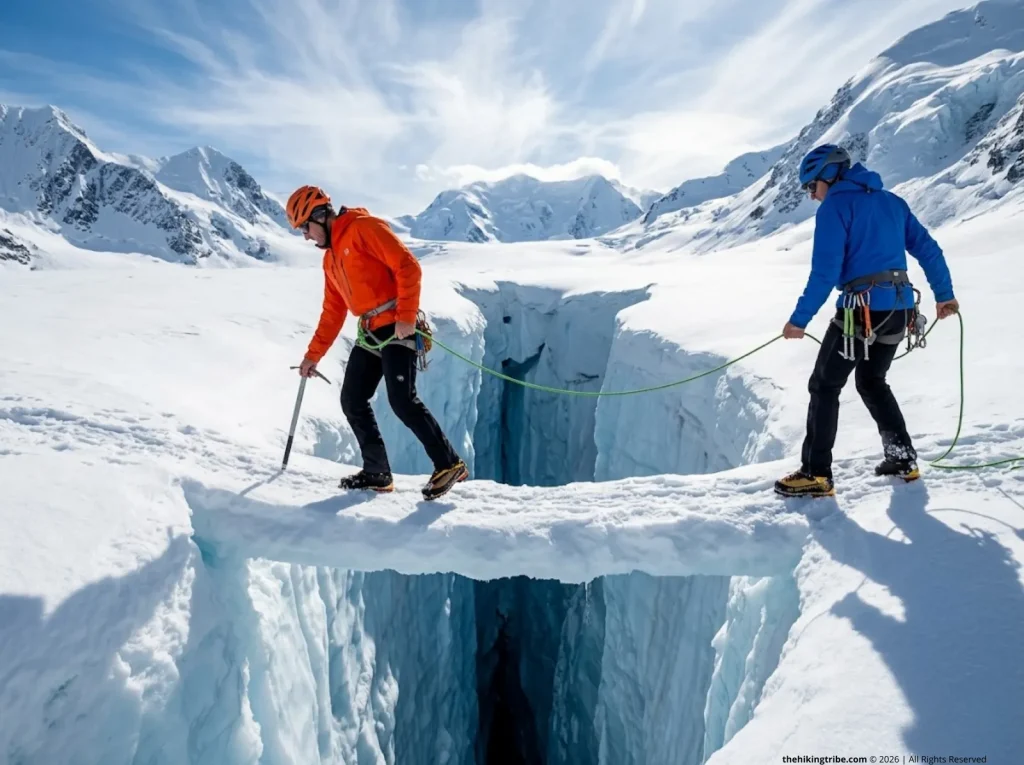
You cannot just tie in at random distances and hope for the best. Distributing human anchors along a single safety line is exactly what keeps a team alive during a sudden collapse. When the lead climber breaks through down to their chest, the rest of the team must already be positioned perfectly to catch the fall.
The “10-Minus” Equation for Rope Intervals
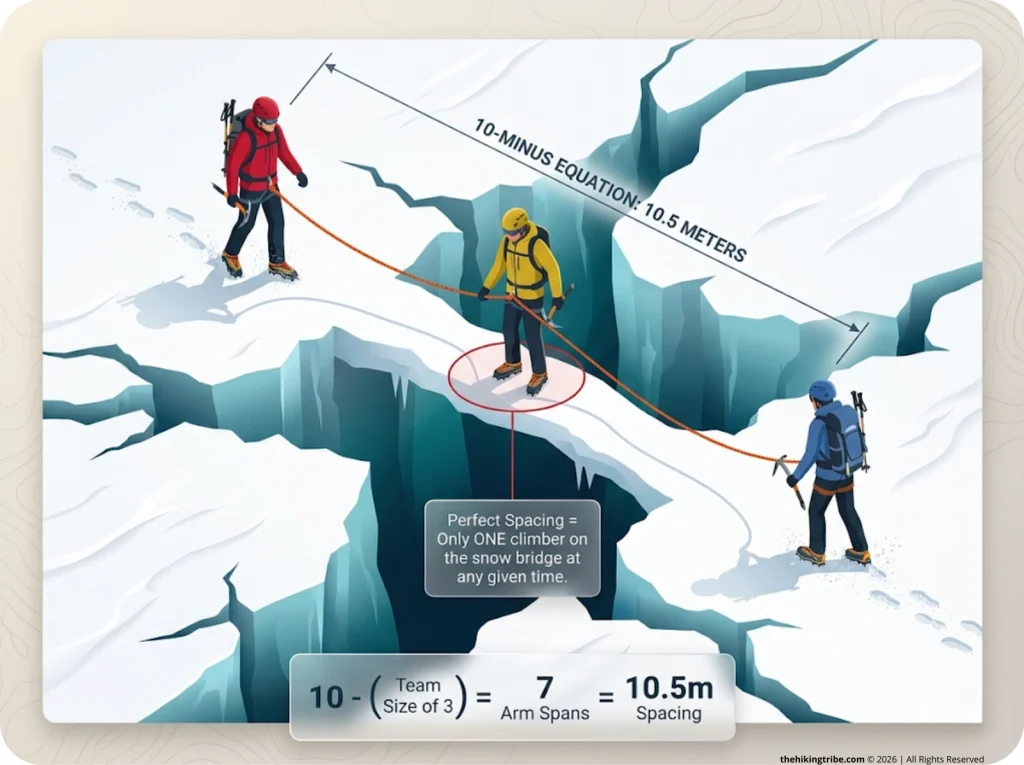
Your rope spacing is strictly dictated by the local crevasse sizes you expect to encounter. The gaps run 10 to 15 feet wide in the Cascades, compared to the massive 100-foot voids you might see in the Alaska Range. To figure this out in the field, professionals employ the “10-Minus Equation”.
Take the number 10 and subtract the team size. For a 3-person team, 10 minus 3 gives you 7. You then measure out 7 double arm spans from the end of the rope—which puts roughly 10.5 meters between climbers. If climbers are clustered too closely, a single collapsing snow bridge could swallow two team members simultaneously, instantly failing the entire fall-arrest system. Establishing proper spacing marks the true transition from steep hiking to peak bagging on heavily glaciated slopes.
Team Order: Solving the Weight Differential Paradox
Putting your strongest hiker up front is a massive beginner mistake. Your team order must be a highly calculated strategic decision. You should confidently position the least experienced team member safely as the middle climber, where they are protected and anchored from both the front and the rear.
The heaviest climber carries a terrifying amount of weight and momentum during a fall. The heaviest climber should almost never carry the heaviest pack, and they must act as your core anchor. In a critical two-person team descending a steep route, the lighter climber must lead downhill while the heavier acts as the primary uphill anchor. If the heavy climber leads and falls, the lighter person standing uphill will simply be vaulted through the air and dragged into the hole.
The “Two-Person” Risk Factor
Two-person rope teams bear the highest statistical risk during a crevasse incident. A study of Swiss Alps incidents determined that the average depth of a crevasse fall plunges to 15 meters during the winter months when snow bridges weaken.
If you attempt a glacier traverse with only two people, the remaining partner standing on the surface must hold the full drop force of the fallen climber while simultaneously building an anchor in soft snow. That is a near-impossible feat without intense, practiced crevasse rescue training. This is exactly why many professionals rely on tying bulky knots into the rope between the two climbers to create extra friction cutting into the snow lip.
Essential Mountaineering Knots for the Rope Team
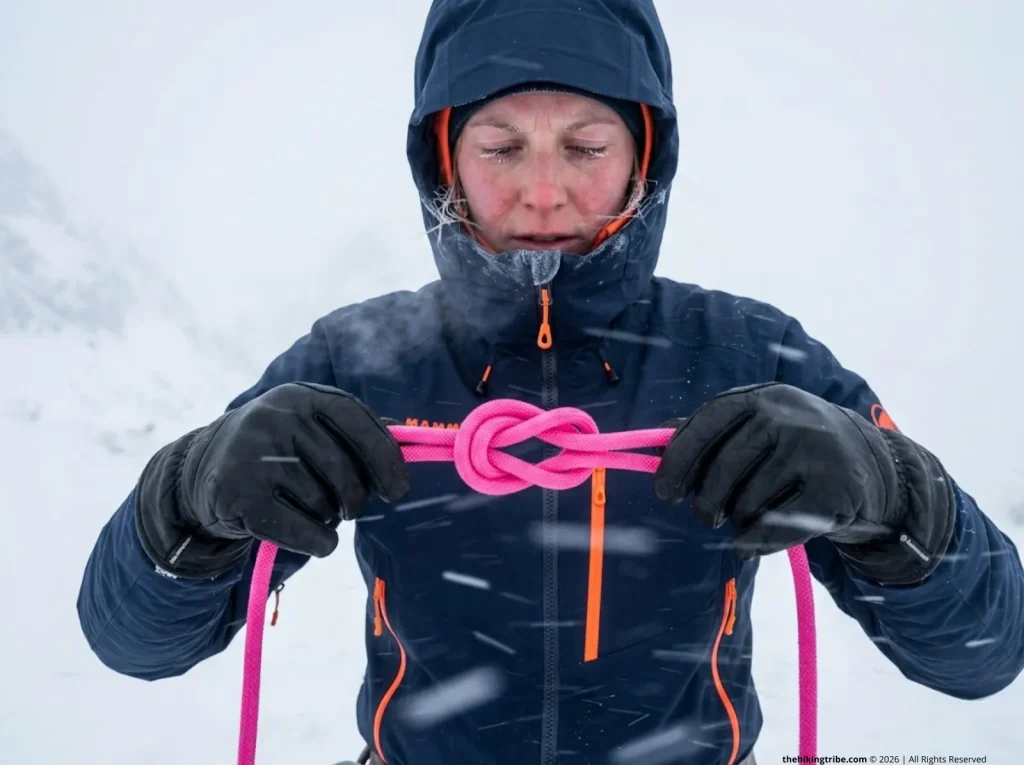
You must master verifiable, secure mechanical knots to tie into the system. Every climber ties their life directly to the rope, and there is zero margin for sloppy knot work in the freezing wind.
The Figure-8 on a Bight (For End Climbers)
The figure eight on a bight is the primary, fail-safe knot used for the front and rear climbers on the team. It is exceptionally strong, visually easy to inspect, and stays secure under extreme shock loads. A quick glance tells you if it is tied correctly. Always double-check your partner’s knot to ensure it is properly dressed and tightly cinched down before stepping off the rocks and onto the ice.
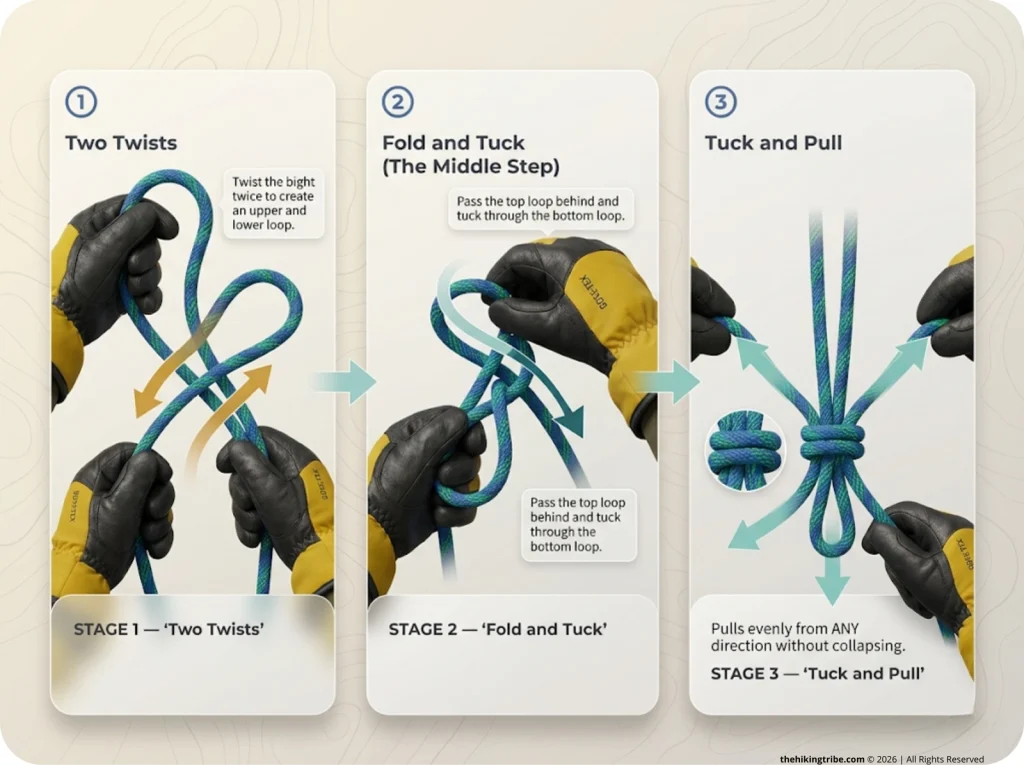
The Alpine Butterfly (For the Middle Climber)
The middle climber cannot tie in with a standard Figure-8 because that knot is only designed to take force from one direction. The butterfly knot is universally preferred for the middle of the line because it handles pulls from multiple directions at once effortlessly. It holds heavy force from the lead, the tail, and the harness clip at the exact same time without compromising the rope’s core strength.
Pro-Tip: The first time you attempt to tie a butterfly knot with thick, frozen winter gloves on, you will struggle. Practice tying it in your living room blindfolded until the movements become pure muscle memory.
Brake Knots: The French ENSA Protocol
For high-risk 2-person teams crossing homogenous neve terrain, adding friction to the rope can save your life. Bulky rethreaded Figure-8s act as brake knots. If a fall occurs, these thick knots cut a deep groove into the snowy lip of the crevasse, wedge tightly into the compressed snow, and drastically reduce the load pulling down on the arresting partner.
Per rigorous field testing by the French National Mountain Guide School (ENSA), you must place the first brake knot roughly 1.5 meters away from the climber. This guarantees the knot bites the lip accurately before the victim is pulled far down into the dark.
Step-by-Step Rigging Protocol: Don’t Wait for the Ice
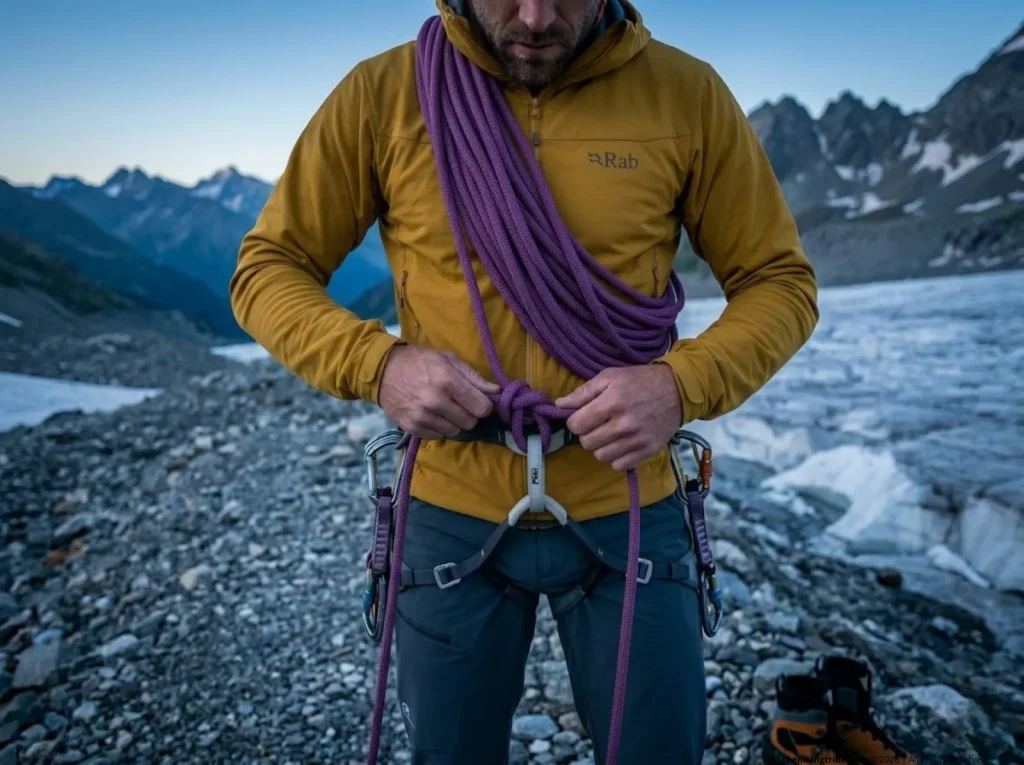
Never wait until you are standing at the snow line to drag your rope out of the bag. Rig the entire system smoothly on stable rock or dirt. Cold hands and high winds lead to deadly rigging mistakes.
Step 1: Measuring the Interval (Arm Spans)
Dropping your pack on an icy slope to measure a rope is a recipe for losing gear down the mountain. Use double arm spans—stretching the rope from fingertip to fingertip across your chest—to accurately measure your intervals. For a standard two-person team requiring an exact 20-meter spacing, pull out 13 to 14 full arm spans. Tie your knots directly at these calculated points.
Step 2: Securing Excess Rope (The Kiwi Coil)
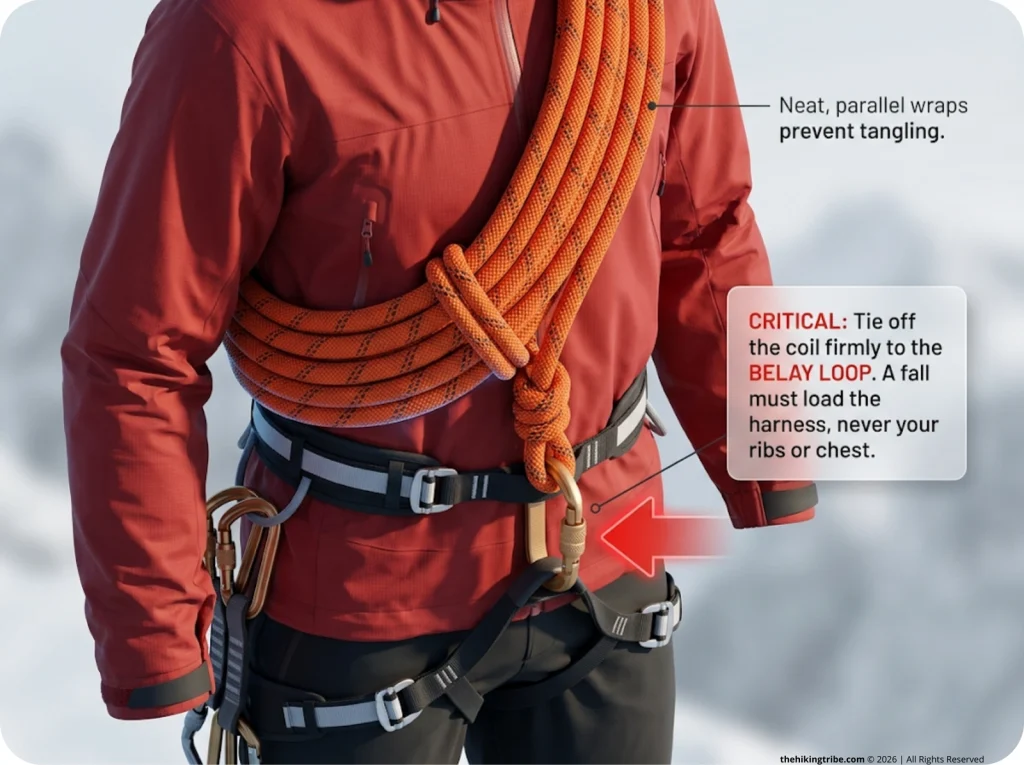
The end climber on a standard 60-meter rope will have massive amounts of leftover line dragging behind them. You manage this heavy mess by wrapping the excess rope tightly around your torso in a compact butterfly coiling method commonly known as the Kiwi Coil.
Pro-Tip: Always tie off your Kiwi Coil securely directly to your belay loop. If you fall, the brutal shock load must transfer entirely to your waist harness, not crush your ribs or your neck.
Step 3: Pre-Rigging Friction Hitches for Rescue
For high-stakes objectives like Mount Rainier, pre-rigging prusiks is the absolute industry standard. You must attach your waist prusik to the main climbing line and clip it to your harness before taking your first step on the ice. Denali National Park expedition guidelines strictly mandate these pre-trip orientation checks to prove climbers are ready.
Keep a secondary, much longer foot prusik readily stored in your chest pocket. If you end up dangling in a dark crevasse void, you will have an immediate stirrup loop ready to step into to relieve the crushing harness pressure on your legs.
The Dynamics of Roped Movement: Cadence and Tension
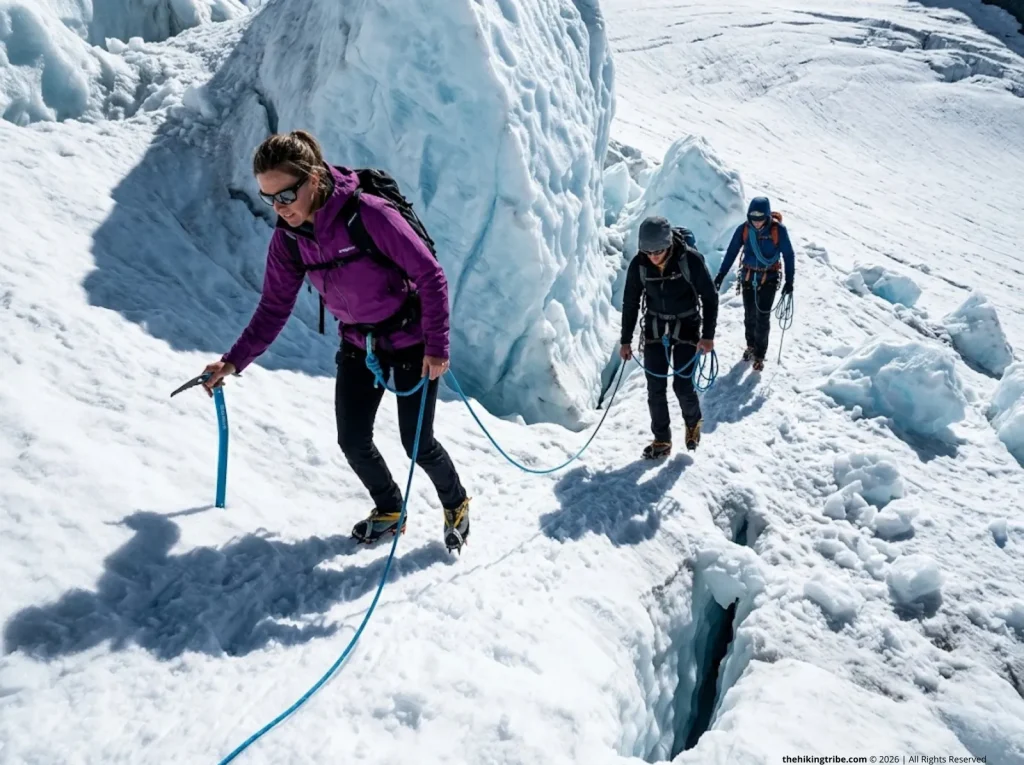
Once tied in, your team must move as a single organism to minimize the physical impact of a sudden snow bridges collapse. The lead climber sets a manageable pace, but everyone shares the strict responsibility of keeping the line safe.
Managing the “Taut Rope” Principle
A loose line is a fatal error on the glacier. If the rope droops onto the snow, the shock load and vertical fall distance of a failing snow bridge become much worse. The first time I roped up on Mount Baker, managing slack felt like walking a heavy, stubborn dog. It is exhausting work, but you must constantly monitor the rope tension rather than just staring blindly at the summit.
Negotiating Turns and Snow Bridges
Keep a slight curve in the rope that stays reliably above the snow surface but doesn’t yank your partner forward. You must always cross questionable snow bridges at a strict perpendicular 90-degree angle to minimize your time spent in the danger zone.
The middle climbers must meticulously trace the lead climber’s footprints around jagged ice blobs or sharp switchbacks. If you shortcut the corners, you instantly introduce dangerous slack into the system and ruin the team’s perfect spacing.
Vocal Commands vs. Silent Rope Tugs
High winds, grinding ice, and heavy jacket layers render vocal commands utterly useless over a 15-meter interval. Mount Rainier National Park authorities warn that crevasses act like vertical-sided iceboxes, completely silencing the screams of a fallen climber. Do not rely on your voice to trigger an arrest.
Establish a firm “Three-Tug Stop” silent contract before leaving camp. If you feel three sharp, heavy rope tugs on your harness, you must halt instantly, sink your weight, and physically brace your boots for an impact. Conversely, if you notice the rope whipping forward and hear “Falling!”, it means you must instantly execute a proper self-arrest into the snow with your precise ice axe placement.
Conclusion
Transitioning to glacier travel strips away all margins for error. A sturdy rope is completely useless if your spacing is wrong, your knots are sloppy, or your team lets the line drag loosely in the snow. Respect the 10-Minus spacing equation, pre-rig your friction hitches on solid ground, and ruthlessly eliminate rope slack with every single step to protect your team from catastrophic falls.
Set up a simulated crevasse rescue in your local park and practice tying the Alpine Butterfly and building a z-pulley system long before you ever touch a carabiner. That practiced muscle memory built at sea level is exactly what saves lives on the mountain.
FAQ
How far apart should climbers be on a glacier?
Spacing is primarily determined by local crevasse sizes and the geometry of the ice. For a standard 3-person team, the optimal distance is usually around 10.5 meters (7 double arm spans), derived from the professional 10-Minus equation. This ensures multiple climbers aren’t standing on the same fragile snow bridge if a sudden collapse occurs.
Should the heaviest person be in the front or back of a rope team?
The heaviest climber should strictly act as the secure uphill anchor on steep descents. If the heaviest climber leads downhill and falls, a lighter partner positioned above them will physically struggle to stop the massive weight pulling down, creating a deadly scenario for both climbers.
Do you need a locking carabiner for glacier travel?
Yes, locking carabiners are an absolute requirement for attaching the climbing rope safely to your harness. Best practices dictate using two carabiners—one locking and one non-locking—placed opposite and opposed to prevent the gates from accidentally opening due to rope friction or freezing snow.
Why use a butterfly knot applied for glacier travel?
The Alpine Butterfly is universally used by the middle climber on a rope team because it stays highly secure when pulled from multiple directions. Unlike a standard Figure-8, it will not collapse tightly or jam under pressure when pulled sideways from both the front and rear partners simultaneously.
I've spent more than a decade researching hiking gear and trail technique. I read the specs, the forum threads and the long-term reviews, and every pick here comes with what it gets wrong.
End of the trail
You read every mile of this one. Here's where the trail goes next.