

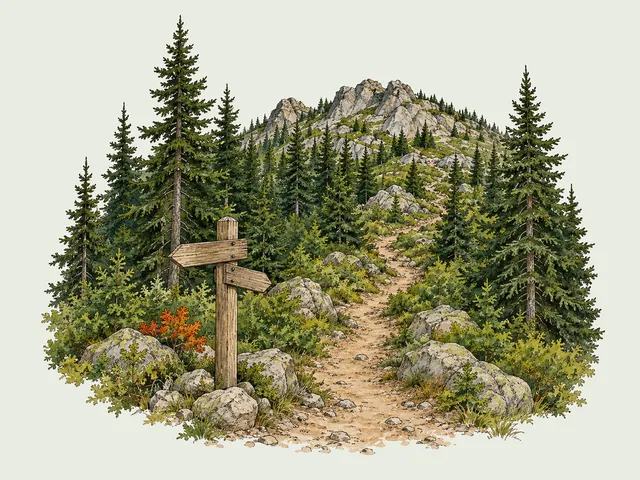





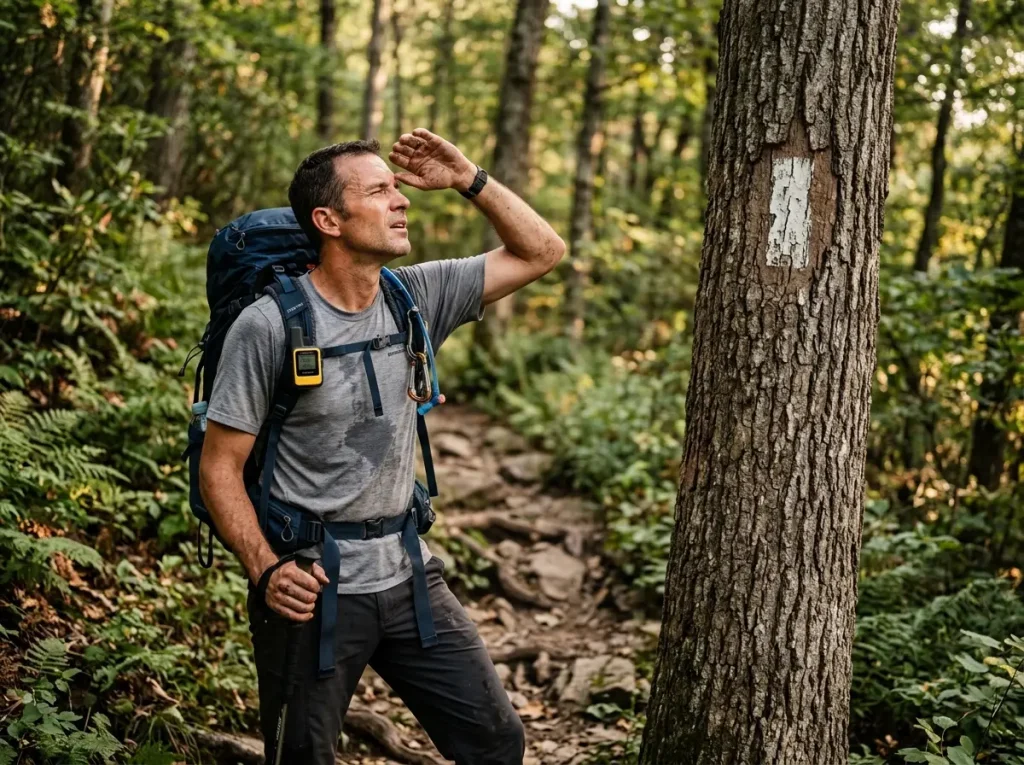
The fog rolled in at the second switchback, and within four minutes the white rectangle I’d been following on that birch trunk had vanished into the gray. Not obscured. Gone. I stood in what my brain insisted was the middle of the trail and stared at bark that looked exactly like a blaze—except it wasn’t. It was Stereum ostrea, a shelf fungus the literature calls False Turkey-tail, and it had just redirected me sixteen feet off the Escarpment Trail. That’s how fast visual navigation fails. That’s also how fast hikers end up calling search and rescue.
Most hikers treat trail markers as passive signs. They’re not. They’re a forensic system—one built on federal standards, optical physics, and ecological consequence. By the end of this, you’ll read a trail the way a maintainer does: understanding not just what each blaze means, but why it’s placed where it is, what it looks like when it’s failing, and exactly what to do when it disappears.
⚡ Quick Answer: A standard non-motorized trail blaze is a 2×6-inch vertical rectangle painted at eye level — roughly the size of a dollar bill. White blazes mark the main trail (Appalachian Trail standard), blue marks spurs, orange marks state boundaries. A double blaze is a high-alert signal: stop and check the direction shift before moving. If you haven’t seen a blaze in five minutes, stop — don’t keep walking. The most hazardous moment on any trail is a junction where the color changes but the shape stays the same.
| Trail Blaze Navigation Guide | |
|---|---|
| Blaze Configuration | Required Action |
| Single blaze | Continue on current bearing |
| Double blaze (upper offset right) | Turn right ahead |
| Double blaze (upper offset left) | Turn left ahead |
| Blue blaze | Spur trail — water, shelter, or viewpoint |
| Missing blaze (5+ minutes) | Stop. Backtrack to last confirmed marker |
The North American Blazing Standard (What the Signs Actually Mean)
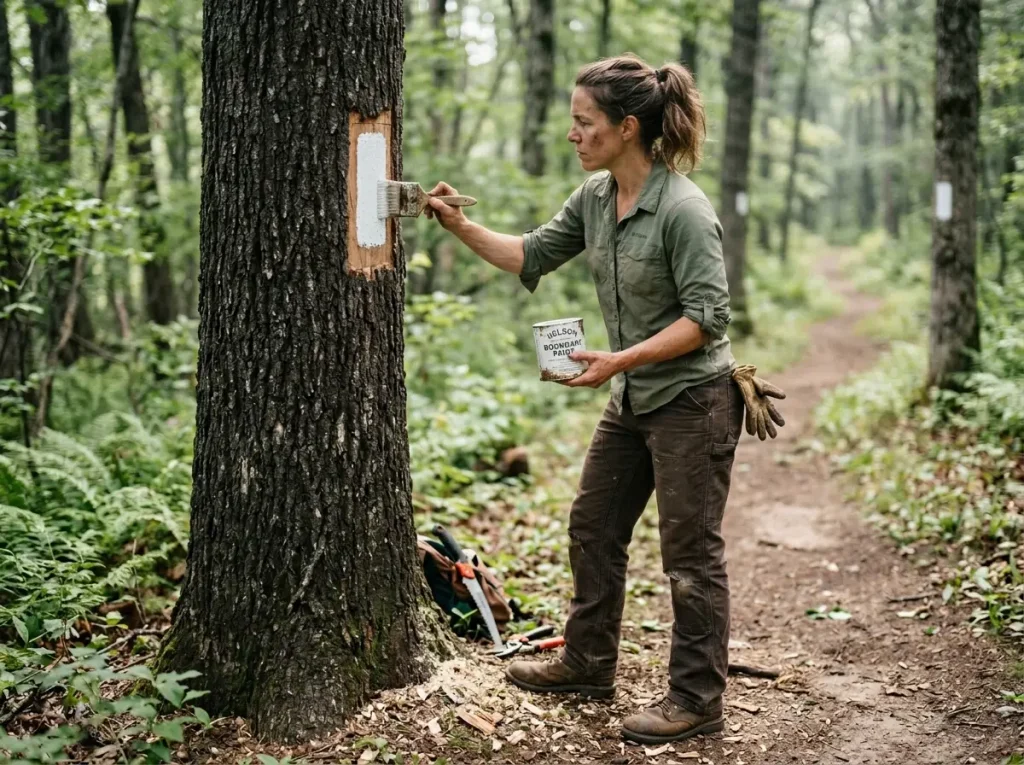
Shape, Size, and Color — The Federal Specifications
A standard 2×6 rectangular blaze is about the size of a dollar bill. That’s the ATC’s actual field test — hold a dollar against the tree, and that’s your reference. The USFS Trail Management Handbook (FSH 2309.18) governs the specs: approximately 2 inches wide, 6 inches tall, placed at roughly 5–6 feet off the ground. In alpine or snow-prone zones, maintainers mount them higher — sometimes considerably — because the seasonal snowpack can bury a standard-height marker entirely.
Color is not arbitrary. The Appalachian Trail Conservancy blazing standards establish white as the main-trail color for the AT, blue for connector and spur trails, orange for state land boundaries (Pennsylvania uses PMS 165 2X), and yellow for local connectors. Get this wrong at a junction and you’re following someone else’s trail entirely. The most common navigation error in this category isn’t missing a blaze — it’s continuing to follow the correct shape while the color quietly switches at a fork.
Materials range from latex or enamel paint on prepared bark to metal discs, plastic blazes, and Carsonite fiberglass posts in meadows where there are no trees to paint. When paint is used, the maintainer scrapes the outer bark first — there’s a specific sound and resistance to it, like peeling sunburned skin off rough wood — to expose the surface before the first brush stroke. The blaze bonds to living wood, not dead outer bark. If you see a blaze where the paint is bubbling away from the surface in sheets, the tree expired after the blaze was applied. Those are unreliable.
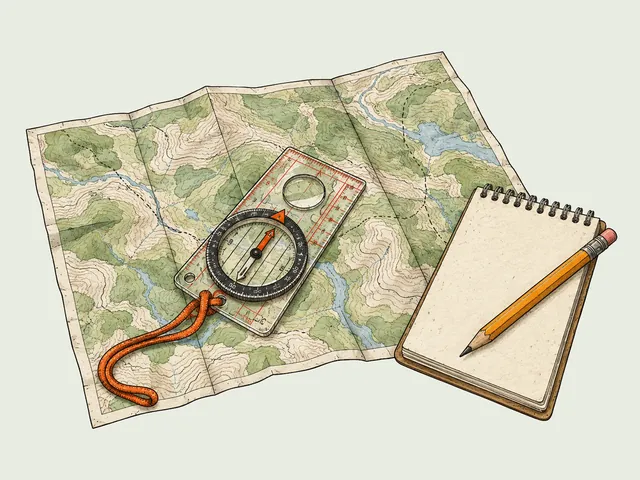
For readers who want to integrate blaze-reading with topographic map navigation to understand where the trail sits in terrain, terrain association is the next layer. A blaze tells you where the trail goes. A map tells you where the trail is.
Decoding the Double Blaze — The Signal Most Hikers Misread
Here’s where people get it wrong every time: a double blaze is not decoration. It’s a high-alert navigational signal. Two rectangles, one stacked above the other. Stop. You are about to make a decision. Do not walk through it without reading it first.
The offset direction of the upper rectangle is the code. Upper blaze shifted right → you’ll be turning right. Upper blaze shifted left → left turn coming. This is not an arrow. It’s a spatial shift you have to read from a few feet back, at angle. Get too close and you lose the offset.
The ATC’s staggered blazing protocol is engineering, not coincidence. Northbound and southbound blazes are placed on different trees in the same corridor. If a single tree falls, navigation fails in only one direction — not both. That’s intentional redundancy.
Reassurance blazes are placed within 50–100 feet beyond every junction or road crossing. If you cross a road and don’t see one within two minutes of walking, stop. You may have missed the turn. That reassurance blaze is the system telling you: “Yes, you got it right.” When it doesn’t appear, assume you didn’t.
Pro tip: Always look behind you. If blazes seem sparse, turn 180 degrees — the markers for hikers coming the other direction are often positioned on different trees and at slightly different angles, and they’re frequently much easier to see.
The 5-minute rule is close to an official standard: roughly one blaze every five minutes of hiking time, or about 6 blazes per mile on maintained trails. If you’re moving and haven’t seen a marker in more than five minutes, treat it as a signal to stop and verify. Not slow down. Stop. Take a compass bearing using magnetic declination to verify your direction of travel before committing another 50 feet in the wrong direction.
Color Changes at Junctions — The Most Hazardous Moment on Any Trail
SAR data from NatureOutside and ASU research confirms it: the majority of hikers who get lost do so at decision points — forks, intersections, sharp turns where a navigational choice exists. The error isn’t missing a blaze. It’s following a white rectangle off the main trail onto a blue spur because the shape was right but the color had already changed.
At any multi-trail junction: stop completely before moving. Identify every colored blaze present. Match your planned color to your intended destination. Do not move until you’ve confirmed the correct color continues in your chosen direction.
Check the ground for water bars — logs or rocks placed perpendicular to old social paths to close them off. Their presence means that trail is dead. Their absence doesn’t confirm you’re on-trail. After you commit to a direction, count steps to the reassurance blaze. If it hasn’t appeared in 200 steps, go back to the junction.
Cairns Above Treeline — Engineering, Authority, and the Chaos They Cause
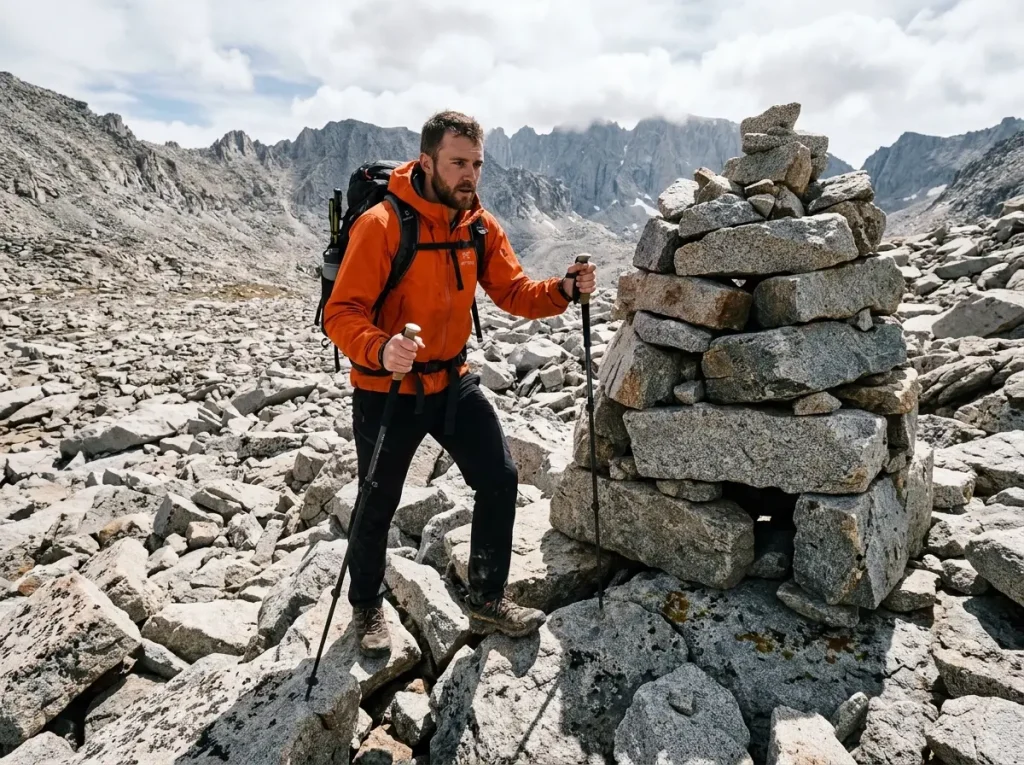
What an Official Cairn Actually Is (Structural Engineering)
Cairns replace paint blazes above treeline — in alpine tundra, boulder fields, and open meadow zones where there are no trees to paint and no Carsonite posts make sense. The AT alone features over 165,000 individual white blazes, but in alpine zones like the Franconia Ridge or Presidential Range, cairns assume the entire navigational burden.
What most hikers don’t know is that an official cairn is engineered to survive alpine winters. Per LNT Center structural analysis of official cairn construction, there are three non-negotiable requirements: the foundation is built on solid bedrock or a durable surface — never loose soil; the stones are stacked with gaps that allow water to flow through freely (free-draining cairn architecture); and there is no chinking — filling gaps with small gravel or soil — because that retained moisture freezes, expands, and breaks the cairn from inside during freeze-thaw cycles. Ice expansion inside a poorly built rock stack exerts enormous force. Well-built maintainer cairns are designed to survive this. Recreational rock stacks are not.
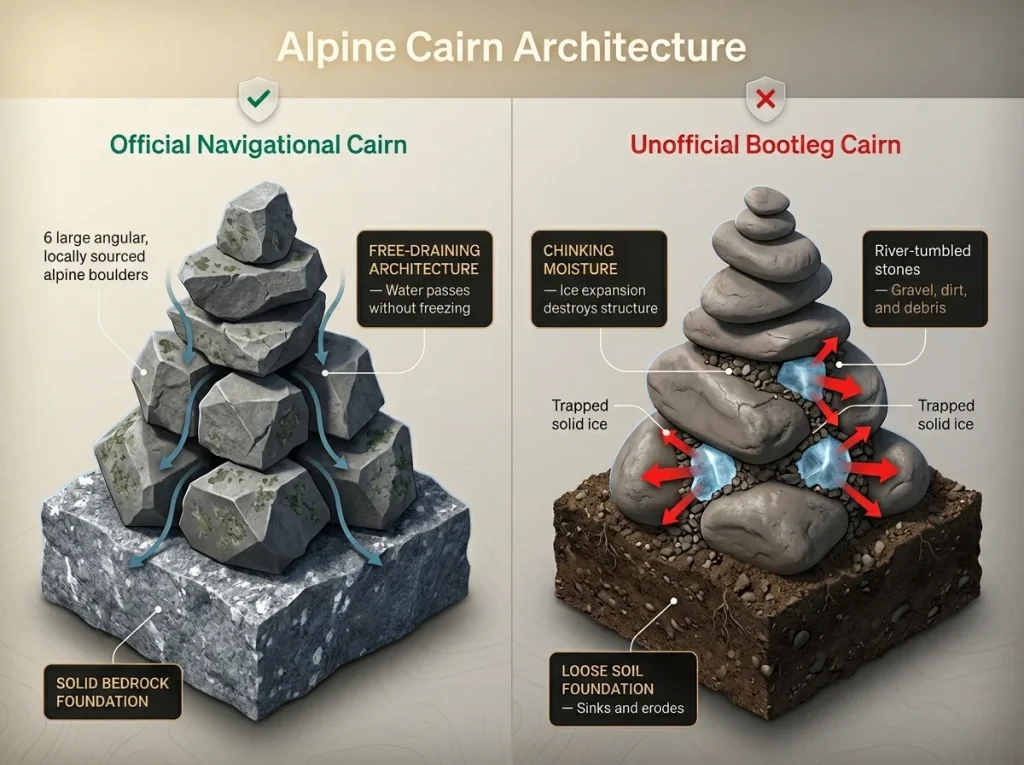
“Ducks” — a regional variant with one stone placed at an angle to point the direction of travel — are the navigation cue in the western alpine system. The “beak” is always the signal. Do not follow a duck unless you can confirm the beak direction aligns with your bearing.
For hikers moving beyond maintained trails, the rules around cairns change significantly — see the guide to reading cairns and route markers on Class 3 scrambling terrain for what applies in technical environments.
The Ecological Damage of Unauthorized Cairns
Alex DeLucia, LNT Manager, puts it plainly: “The stacking of rocks into cairns — except when done by professional trail crews — can damage fragile alpine ecosystems and lead hikers astray.”
Moving embedded stones from riverbeds or alpine soil disrupts the thermal regulation of micro-habitats. Ausable Freshwater Center data shows that disturbing these surfaces desiccates the larval stages of dragonflies and mayflies. In the Southern US, the endangered Hellbender Salamander loses critical nesting sites when river cobbles are moved for aesthetic rock stacks.
Bootleg cairns — unauthorized stacks near rivers, forests, or trail junctions — create real navigational hazard when a hiker in poor weather or fog follows one off the maintained route. The National Park Service guidance on unauthorized cairn building is unambiguous: don’t build them. Don’t add stones to existing ones. Don’t build in rivers.
The counterargument — “I’m just marking the way for other hikers” — is specifically addressed by land managers. Unofficial markers create competing signal channels that confuse the navigation system, and they erode the trust value of the official marker system. If you’re hiking and there’s a bootleg cairn next to a genuine navigational one, notice how the bootleg is usually taller, more artistically balanced, more aesthetic. It’s obvious. But in fog at dusk, it’s not obvious. Someone might follow it off a cliff.
For the broader picture of the invisible damage hikers cause in fragile alpine ecosystems, rock stacking is one specific instance of a much larger pattern.
Navigating a Boulder Field When Cairns Are Missing
When cairns vanish in a technical boulder field — fog, weather, blowdown, or vandalism — here’s the protocol, in order:
Stop immediately. Do not advance more than 20 meters without a confirmed marker. Use terrain features — look for a line of least resistance through the boulders, which is often (not always) the route. Turn 180 degrees and look back at the last confirmed cairn. Your back-bearing gives you the direction to hold. If you have a topo map and altimeter, use contour lines to identify the ridgeline or col the route is likely following.
If three consecutive cairns are missing, that’s a STOP situation. Backtrack to your last confirmed position. Do not build a cairn to mark your location — this creates visual noise and compounds the problem for emergency responders.
Carry a compass even when following cairned routes. In fog, navigating boulder fields when fog eliminates your visible marker range requires a different skill set than clear-day cairn hopping.
Pro tip: Check the ground at junctions. Look for water bars — logs or rocks placed to block old social trails. Their presence confirms that trail is closed, not just unofficial.
The Physics of Visibility — Why Your Brain Lies About Blazes
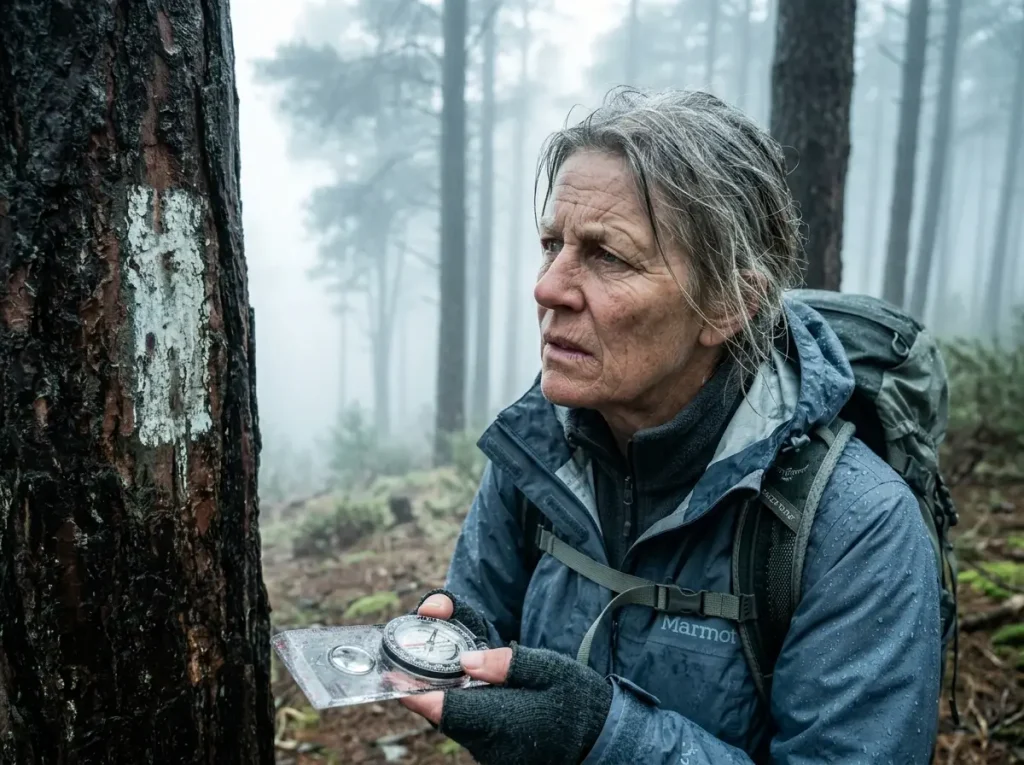
Mie Scattering and the Fog Myth
Here’s a thing that gets people lost: the belief that yellow blazes “cut through fog” better than white. This is false. Federal Highway Administration research is clear on this: in dense fog, there is “no advantage in using colored rather than white visual signals.” None.
The reason is Mie scattering. Fog is made of suspended water droplets that are larger than the wavelengths of visible light. Because those droplets are all roughly the same large size, they scatter every color of light equally — color becomes irrelevant. What determines blaze detection in fog is absolute brightness and physical size. A larger, bright blaze is more visible than a smaller colorful one. Full stop.
Trail maintainers in high-fog zones know this. Some use oversized or double-coat markers for exactly this reason. As a hiker, you need to know that in fog, your color perception is compromised — fog desaturates perceived hue. Don’t look for the color. Look for the shape and the brightness.
For the full protocol for fog navigation when blazes disappear, the operational response starts at the moment you realize the optical conditions have changed.
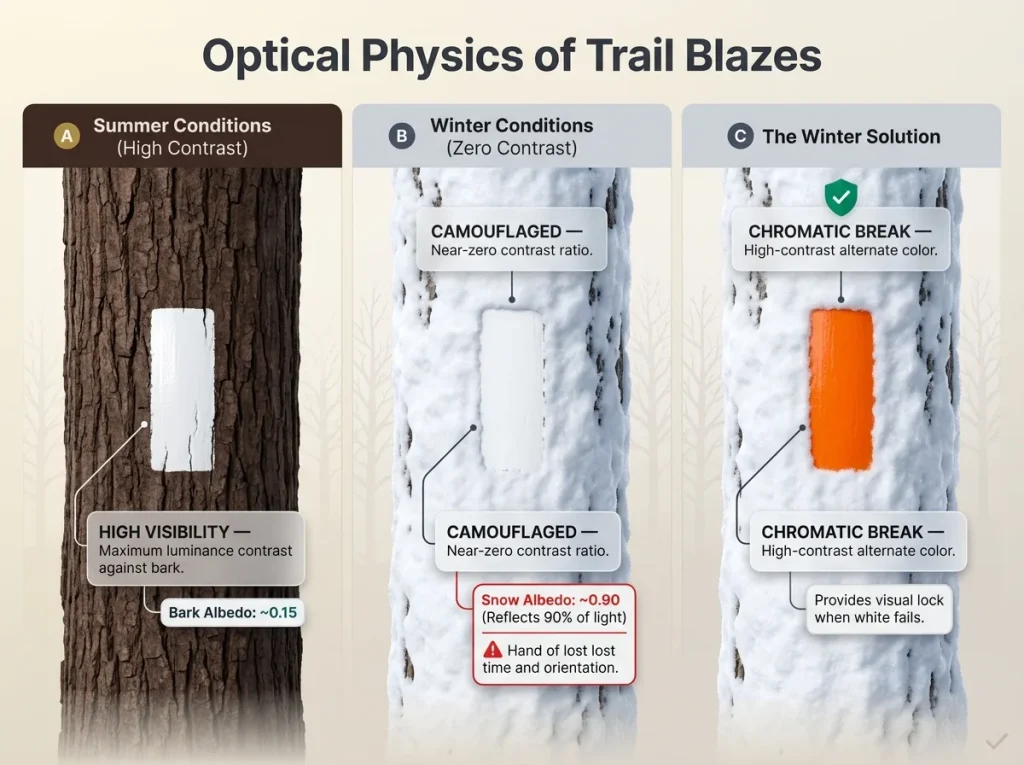
Albedo and White Blazes in Snow — Winter’s Invisible Problem
Fresh snow has an albedo of up to 0.90 — it reflects 90% of all incoming sunlight. When white blazes appear against a white-snow background, the contrast ratio approaches zero — they become effectively invisible. This is not a theoretical problem. February and March are statistically the most hazardous months for getting lost, precisely when snow coverage peaks and white blazes are most camouflaged.
Maintainers in high-snow zones address this with chromatic breaks — using yellow blazes at critical junctions during winter maintenance. They provide the contrast that white cannot.
Practical strategy: in snow conditions, look for the shadow of a blaze rather than its color. The slight relief of painted bark or a metal disc creates a subtle shadow even when the color is washed out. The elevation change of even 1–2 mm is detectable in low-angle morning or afternoon light.
Pro tip: Fresh paint has a specific sheen in sunlight — old blazes look like part of the bark’s texture. In snow, look for the sheen, not the color.
False Blazes — Biological Mimicry and Visual Archaeology
This is the thing no competitor article covers. Your brain pattern-matches on shape, and two biological processes know exactly what shape you’re looking for.
Fungal forgeries: Stereum ostrea (False Turkey-tail) grows in parchment-like rectangular brackets on vertical trunks, often identical in proportion to a 2×6 paint blaze. The differentiator: fungal structures lack the sharp corners and clean edges mandated by USFS standards. Run your thumb across a suspected blaze — paint and metal have a hard edge; fungus has a soft, fibrous boundary.
Bear claw mimicry: Black bears mark trees at heights of 4–6 feet using horizontal incisor bites that can resemble the configuration of a stacked double blaze. Check for rubbing patina — hair and oil deposits in the marks. Official blazes have clean edges; animal scratch mimicry leaves biological residue. Bears do not create clean rectangles.
The back-tracking technique works here too. Turn 180 degrees and look at the markers from behind. Official trail blazes are designed for two-way travel — the back-directed blaze is on a different tree but in a straight line. Game trails and social trails have no such structure.
In blowdown zones, listen and look for the thunk — trees that have been cut and snapped back to vertical, the distinctive cut of a chainsaw or bow-saw. This indicates a maintenance corridor even when the ground trace is invisible under debris.
Visual archaeology of older axe-blazed trails (pre-1970s paint standardization): catface scars — a flattened, healed wound in the bark. Historically significant but not reliable for navigation without a trained eye.
The SAR Dataset — What Getting Lost Actually Looks Like
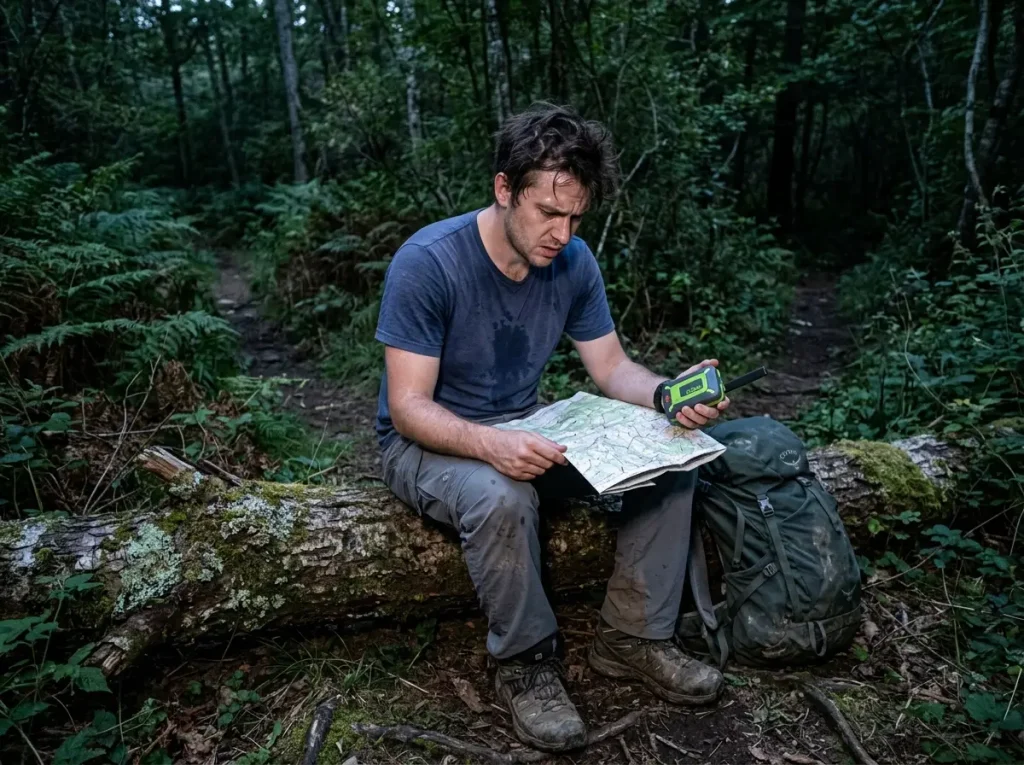
The Analytics of How Hikers Get Lost
Andrew Herrington, SAR leader at Great Smoky Mountains, puts location failure bluntly: “Wandering off trail is the number one reason, ahead of injury and bad weather, that adult hikers require search and rescue.”
The data from YOSAR and Great Smoky Mountains SAR is consistent: the majority of hikers who require rescue lose the trail at decision points — junctions, forks, gradual curves where the trail bends without a visible marker. Navigation failure falls into two categories. Misorientation is believing you’re moving straight when the path has curved — the most common. Disorientation is a complete disconnect between actual position and believed position — the most hazardous.
More than 70% of SAR callouts in Yosemite involve off-trail incidents among day hikers, not backpackers. ASU SAR research on behavior and survival timelines for lost hikers confirms that survival probability drops significantly if the subject is not located within the first 51 hours. Nightfall on Day 1 is the most critical transition point.
The Proximity Paradox: lost hikers are often found within a quarter-mile of the trail they were on. “Lostness” is frequently a mental failure, not a distance failure. Most people who keep moving dig themselves deeper. The people who stop, signal, and stay get found.
Before your next hike, file the trip plan protocol SAR teams need before you leave the trailhead. It doesn’t matter how good you are at reading blazes. Conditions change.
The Protocol for When Blazes Disappear
Three mistakes hikers share constantly: following shape without tracking color at a junction; pushing forward when blazes disappear rather than backtracking; building or following unauthorized cairns in confusing terrain.
The STOP protocol: when markers are missing, Stop, Think, Observe, Plan — before moving another step. Every step in the wrong direction costs two to recover.
Back-tracking rule: return to the last confirmed blaze you can positively identify. Not assume, identify. Maintainers design the system to be navigated from confirmed markers, not from estimated positions. Returning to your last known point is not defeat. It’s correct procedure.
Phone compass vs. dedicated compass: in a navigation emergency, a phone may have battery issues and spotty reception. If you have a baseplate compass, use it. Take a bearing off a visible terrain feature and cross-reference with your last known blaze direction. For how to triangulate your position when trail markers are gone, the technique is straightforward once you’ve practiced it.
A full search and rescue operation costs several thousand dollars per day to deploy, and the resource draw affects availability for other emergencies simultaneously. Learning not to need one is genuine community stewardship.
When to Call for Help — And How to Signal
Drew Clymer, SAR Coordinator in Vermont, says it this way: “If you’re thinking ‘I might need help soon,’ you definitely do need help. Now.” The internal debate about calling SAR is itself a signal.
Three whistle blasts, repeated at intervals, is the universal North American distress call. Personal Locator Beacons (PLBs) and Garmin InReach are the gold standard when you have no phone signal. They are not optional equipment for remote, alpine, or winter travel.
Stay where you are once you activate a distress signal. Moving subjects are harder to locate and often move toward hazard rather than away. For the field-tested guide to rescue signaling with a mirror and whistle, the operational steps matter more than you’d expect.
Regional Systems — Eastern Paint vs. Western Cairns

Understanding the Eastern US Paint Paradigm
The Eastern US trail system is a paint-based system. The Appalachian Trail’s 165,000+ white blazes are the most systematic blazing project in North American trail history, standardized by Myron Avery and the ATC in the 1920s.
Key differences from the West: denser forest creates more trees to blaze; lower treeline elevation means less alpine territory requiring cairns; and a longer institutional history of trail maintenance clubs keeps the standards active.
The “Green Tunnel” sections of the AT — heavily forested mid-Atlantic in spring and summer — create a specific blazing challenge. Visibility through filtered light is narrow, and maintainers add frequency in these sections. Pennsylvania’s state trail system uses orange as its boundary color, distinct from trail marking. Orange off the white blazes means state boundary, not direction. AT thru-hikers get confused by this every year.
Pro tip: Blue blazes in the Eastern system are always spurs — water source, viewpoint, shelter, or alternate route. They always reconnect to the main trail. Don’t blue-blaze expecting to pop out at a trailhead unless you’ve confirmed the route on a map.
Learn about how trail maintenance volunteers keep the blaze system alive — hikers who spend one season on a trail crew dramatically improve their navigational competence, because they see firsthand exactly why each marker is placed where it is.
The Western Post and Cairn System
Western trails operate in a fundamentally different environment. Granite slabs above treeline on the Pacific Crest Trail and Continental Divide Trail require cairn navigation. Vast distances between trees in desert CDT sections use Carsonite flexible fiberglass posts.
The PCT uses brown-routed signage at trailheads but relies on cairns and posts above treeline. “Duck” cairns are widely used on routes like Muir Pass, where the official system is occasionally supplemented by informal ones left by thru-hikers — creating exactly the confusion described above. In some wilderness areas of the CDT, there are no physical markers at all, just GPS tracks.
The implication: a map, compass, and GPS are not optional supplements for Western alpine terrain — they are primary navigation tools. Markers are secondary confirmation. For selecting a baseplate compass as your primary Western trail navigation tool, the specific features matter.
Bushed-Out Trails — When Markers Are Overgrown
In overgrown sections, experienced navigators use visual archaeology. Signs of an official trail corridor through high brush: consistent overhead clearance (the “plywood standard” — the mental image of a 4×8 sheet of plywood as the volumetric trail space); cambium-scarred trees at consistent heights from blazing history; subtle ground compaction on the true trail even under heavy vegetation.
Wildlife game trails and human social trails can look identical to a maintained trail in dense scrub. Game trails follow terrain of least resistance for quadrupeds — lower clearance, more diagonal. Maintained trails have consistent width, human-height clearing, and deliberate drainage structures.
When managing a bushed-out section: slow to a methodical pace, sweep vegetation with your arm, and maintain consistent bearing between identified markers rather than following the path of least resistance.
Ethical Blazing — The Hiker’s Responsibility to the System

Leave No Trace and the Marker System
The LNT principle “Leave What You Find” is the direct ethical foundation for the “do not build cairns” rule. Moving rocks — even small ones, even in rivers — is a measurable act with biological consequences at the micro-habitat scale. The Leave No Trace Center research on why rock stacking violates Leave What You Find addresses this directly.
USFS and NPS maintain the right to remove any unauthorized trail marker — including personally placed blazes on trees, which constitutes vandalism of federal property with potential fines. The counterargument (“I’m helping other hikers”) is specifically rejected by land managers: unofficial markers create competing signal channels that confuse the navigation system for subsequent hikers, especially in low-visibility conditions.
Responsible social media hiking is a related issue: geotagging locations with unofficial rock stacks in photos encourages replication. If you photograph cairns, photograph your act of dismantling unauthorized ones instead.
How to Report Damaged or Missing Markers
Most trail-maintaining clubs have formal blaze report systems. The ATC’s volunteer clubs use specific protocols for reporting damaged, fallen, or removed blazes. Carry a notepad or use your phone GPS to log the coordinates and a photograph of any missing, vandalized, or obscured blaze — then report it through the relevant trail association’s contact form.
Do not repaint blazes without authorization. Paint color standards, application methods, and placement heights are controlled specifications. Well-meaning hikers using the wrong color or position create a worse outcome than a missing blaze.
Hikers who volunteer with a trail crew for one season understand the system in a way no article can convey — because they see firsthand how and why each marker is placed. That knowledge makes you a better navigator. It also makes you someone who understands how your footsteps shape — and degrade — the trail corridor.
Conclusion
Three things, stated plainly:
Blazes are a forensic system, not decoration. Every configuration — color, offset, height, spacing cadence — communicates specific navigational data. Read them as code, not as reassurance.
Your brain will lie to you in fog, snow, and overgrown terrain. The physics of Mie scattering, the albedo problem of white-on-white, and the biology of fungal mimicry are real threats to visual navigation. Know the science; slow down accordingly.
The marker system only works if you respect it. Do not build unauthorized cairns. Report damaged blazes. Treat the trail as shared infrastructure that requires collective maintenance — because it does.
On your next hike, spend five minutes before you start actively reading the first three blazes you encounter. Note their color, height, spacing, and what the surrounding terrain tells you about why they’re placed where they are. Then turn around and see what the back-directed blazes look like. You’ll never look at a tree the same way again.
FAQ
What do two blazes stacked on top of each other mean?
A double blaze is a high-alert navigational signal: you are about to reach a turn or junction that requires an active decision. The offset direction of the upper blaze tells you which way to turn — upper blaze shifted right means turn right, upper blaze shifted left means turn left. Stop completely when you see one and verify your intended direction before moving.
Are cairns on trails official trail markers?
Only if they were built by a professional trail crew under authorization from the managing agency (USFS, NPS, ATC, etc.). Unofficial cairns built by hikers for artistic or directional purposes are not reliable for navigation and may be legally removed by land managers. If you’re above treeline and in doubt whether a cairn is official, cross-reference with your map and compass rather than following it blindly.
What should I do if I haven’t seen a blaze in 10 minutes?
Stop moving immediately. Backtrack to the last blaze you can positively identify — not assume, identify. The STOP protocol applies: Stop, Think, Observe, Plan. Most hikers who get lost compound the problem by continuing to move in the wrong direction. Return to your last confirmed marker and reassess from there.
Why do some trail blazes have different colors on the same trail?
Colors encode specific navigational meaning: white is typically the main trail (AT standard), blue marks spur trails to shelters or water or viewpoints, orange often indicates state land boundaries (not trail direction), and yellow marks local connector trails. At any junction where colors change, stop and identify each color before choosing your direction, because following the wrong color is the leading cause of unintended route deviation.
Can I build a cairn to help other hikers if the trail is confusing?
No. Unauthorized cairns create competing signal channels that confuse the navigation system for subsequent hikers, particularly in low-visibility conditions. They also cause measurable ecological harm by disturbing micro-habitats and thermal regulation in soil and riverbed ecosystems. If markers are missing, report them to the trail-managing organization — do not self-solve with unofficial structures.

I've spent more than a decade researching hiking gear and trail technique. I read the specs, the forum threads and the long-term reviews, and every pick here comes with what it gets wrong.
End of the trail
You read every mile of this one. Here's where the trail goes next.