In this article
The ridge looked identical in every direction. My phone had died somewhere between the second creek crossing and the talus field above treeline — buried in my pocket, warm and useless. I pulled the baseplate compass and folded topographic map from the bottom of my pack. Same tools I’d carried “just in case” for three years without touching them. This was the case. Ten minutes later, I had a position fix within 200 yards of where I actually stood.
After fifteen years of backcountry hiking — including a few humbling nights where I wandered farther than I should have — I can tell you that the gap between carrying navigation gear and knowing how to use it is where most problems start. Here’s exactly how compass triangulation works, when it fails, and what to do instead.
⚡ Quick Answer: To triangulate your position, take compass bearings to two or three visible landmarks that appear on your topographic map, adjust each bearing for magnetic declination, then plot the back-bearing lines on your oriented map. Your position is at or near the intersection. Landmarks should be at least 60 degrees apart for accuracy. If you’re on a known linear feature like a trail or ridge, a single bearing to one landmark is enough.
Why Every Hiker Needs to Find Their Position Without GPS

When Phones Die and Satellites Disappear
Your phone’s GPS drains battery faster than almost any other function — especially in cold weather, with the screen bright, running a navigation app with no cell service. Drop below a canyon rim or hike under dense Pacific Northwest canopy, and satellite signal vanishes entirely. Heavy weather does the same thing.
The Ten Essentials list has included a map and compass since the concept existed. There’s a reason for that. A magnetic compass has no battery, needs no satellite, and doesn’t care about your cell plan. It works in a blizzard, at the bottom of a ravine, and on day seven of a trip when everything rechargeable is dead.
I carry a charged phone AND a compass on every trip. The phone is Plan A. The compass is Plan B that never fails. If you’re heading into remote terrain for multi-day trips, mastering analog navigation isn’t optional — it’s the minimum standard.
Triangulation vs. Resection — Getting the Terms Right
Here’s something that trips people up. What hikers call triangulation is technically called resection. Triangulation means locating an unknown point from two known positions. Resection is the reverse — you’re at the unknown point, taking bearings to known visible landmarks to figure out where you are.
On trail, nobody corrects you. Both terms are understood. But knowing the difference signals that you’ve actually studied this, and it matters when you’re reading technical sources from places like the Princeton Outdoor Action map-and-compass guide. I’ll use both terms interchangeably here — the way real hikers do.
Gear Check — What You Need for Compass Triangulation
The Right Baseplate Compass
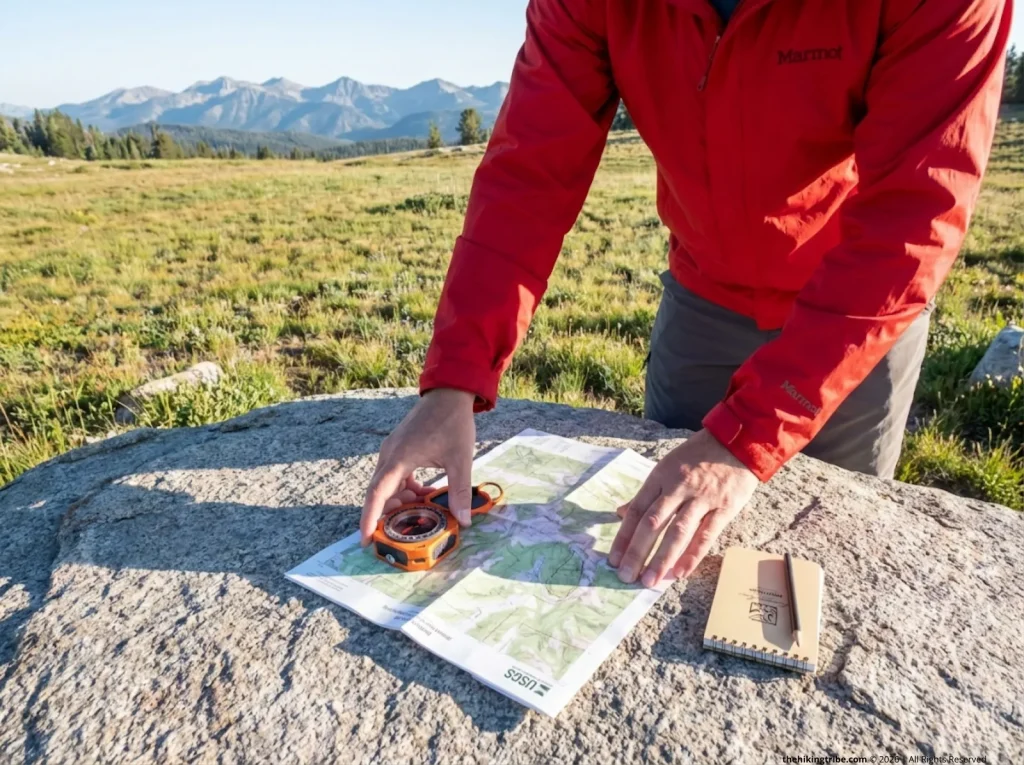
Not every compass works for position fixing. You need a baseplate compass with four specific features: a transparent flat base with a straight edge for line-plotting on maps, a rotating bezel with degree markings, orienting lines that align with map meridians, and a direction-of-travel arrow that points toward your target landmark.
An adjustable declination setting is strongly preferred. Models like the Suunto MC-2, Silva Ranger, and Brunton TruArc have it built in — set it once before your trip and forget about manual conversion. If you’re serious about choosing the right baseplate compass, those three sit at the top of the field for good reason.
Avoid button compasses, phone compass apps, and anything that doesn’t give you a straight compass edge long enough to span between landmarks on your map scale.
Pro tip: If your compass edge doesn’t reach from the landmark symbol to your general area on the map, you’re working with the wrong tool. A six-inch baseplate is the minimum for USGS quads.
Your Topographic Map — And Why It Must Be Current
You need a printed topographic map that shows the landmarks you can actually see. If the peak in front of you doesn’t appear on your paper map, the compass bearing to it is useless. USGS 7.5-minute quadrangles at 1:24,000 scale are the standard. CalTopo and USGS TopoView offer free printable versions you can fold and carry.
One thing that catches people: the declination value printed on old maps drifts over time. A map printed in 2010 may show a declination that’s off by several degrees today. Always verify your current local value using the NOAA magnetic declination calculator before every trip.
Checking Your Local Declination
Magnetic declination is the angle between where your compass needle points (magnetic north) and where your map says north is (true north). It changes depending on where you are. Parts of Washington state have roughly 20° east declination. Parts of Maine run about 20° west. That’s a massive difference — enough to put you a half mile off at trail distance of just a few miles.
If your orienteering compass has a permanent declination adjustment, set it before you leave home and you won’t have to do math in the field. If you’re doing temporary declination adjustment manually — for east declination, subtract from your magnetic bearing; for west, add. Write it on a piece of tape stuck to your compass until it becomes automatic.
The Step-by-Step Resection Process
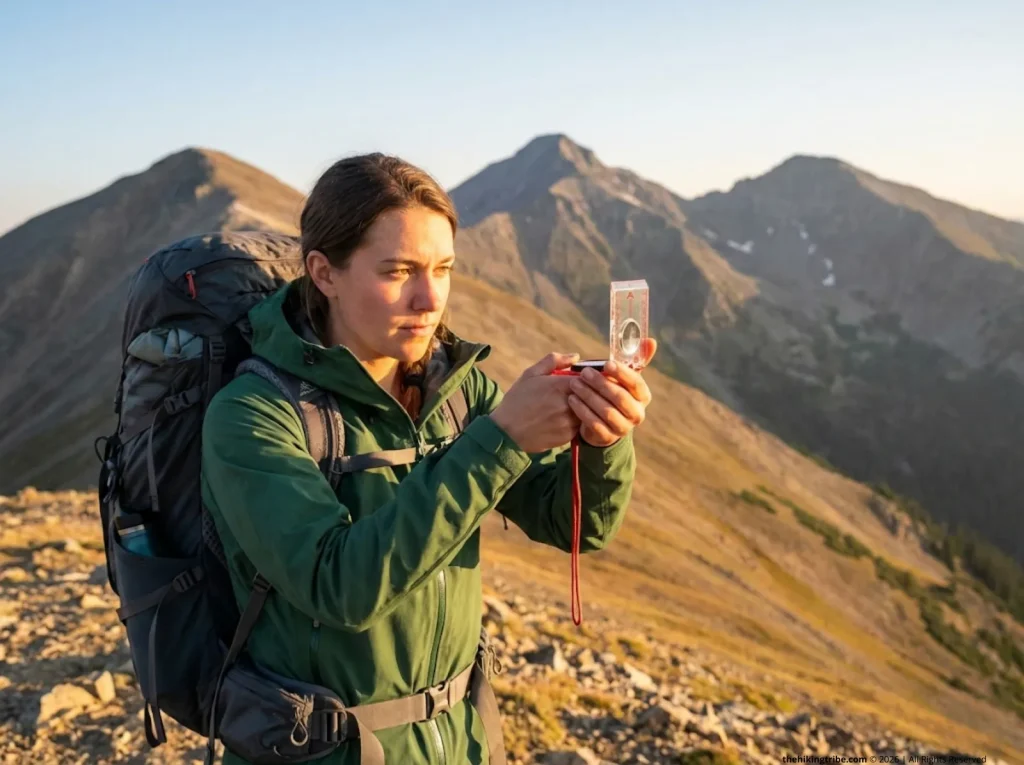
Step 1 — Pick Your Landmarks
Look around. Identify two or three prominent features that you can see clearly AND find on your topo map. Good choices: peaks, ridges, towers, distinct valley junctions — anything that’s a prominent landmark both in your field of view and symbolized on the map. Bad choices: vague tree-covered hills that look like every other hill on the horizon.
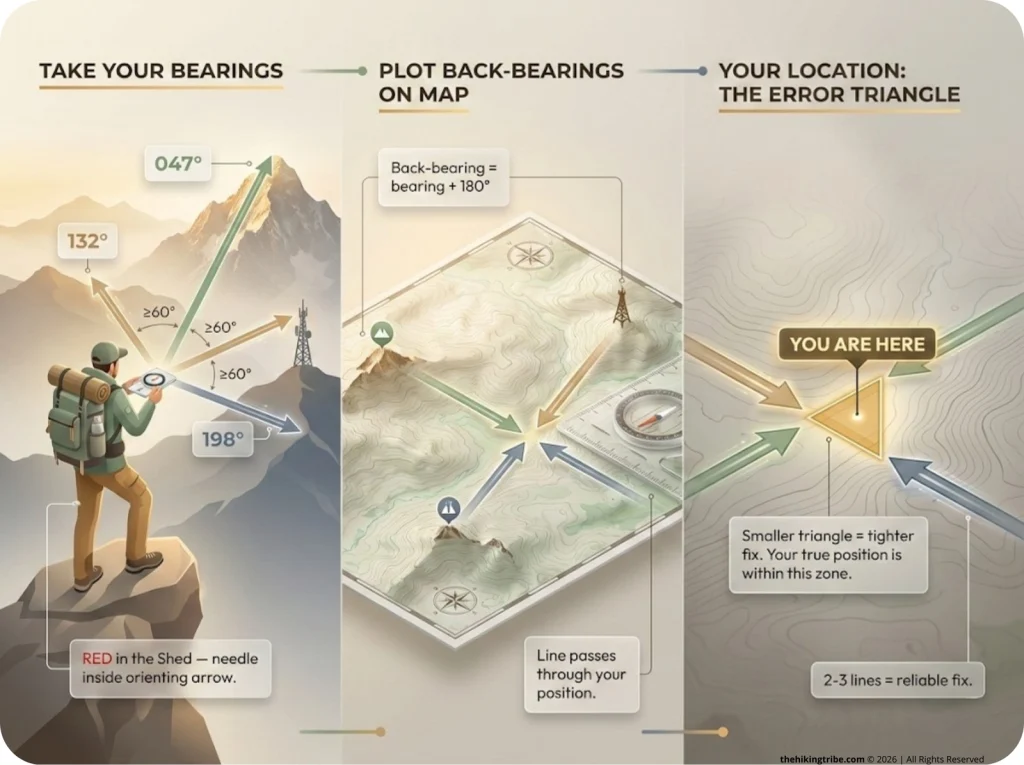
Here’s the rule that separates a tight fix from garbage: your landmarks need to be separated by at least 60 degrees from each other. Ideally closer to 90. If they’re too close together angularly, your plotted lines will run nearly parallel, and the point of intersection becomes a vague zone instead of a pin on the map. At 2-3 miles distance, even small angle measurements get amplified.
If you can’t positively identify a certain landmark on your map, don’t use it. A wrong landmark gives you a wrong position — which is worse than no position at all.
Step 2 — Take Your Bearings
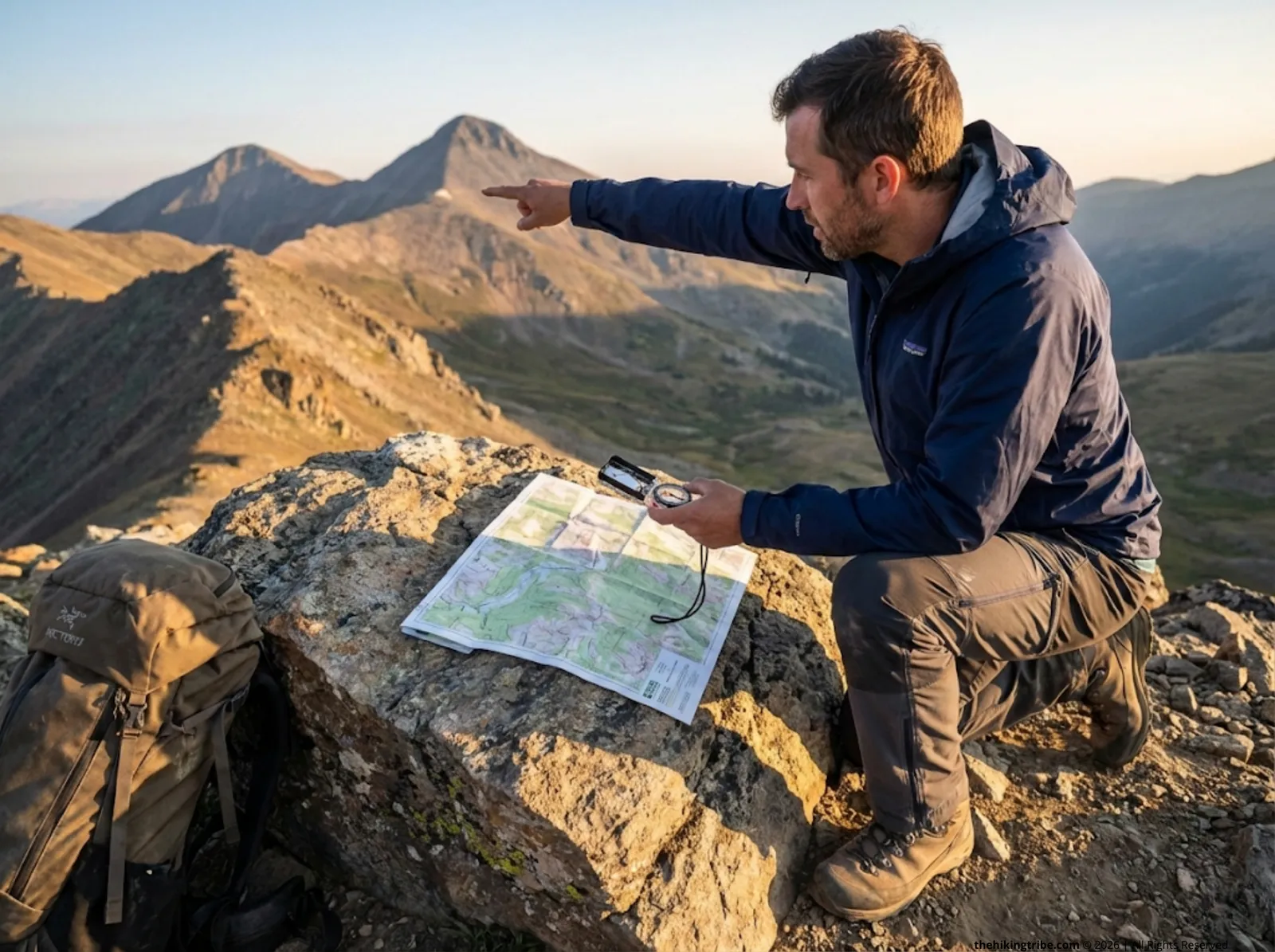
Hold your compass level at chest height. Point the direction-of-travel arrow directly at your first landmark. Now rotate the bezel until the magnetic compass needle sits inside the orienting arrow — red end of the needle inside the red outline arrow. Hikers call this “RED in the Shed.” That phrase exists because it works, and it’s how every basic navigation course teaches the step.
Read the bearing at the index line. That’s your magnetic bearing to the landmark. Write it down. Then repeat for each additional landmark. Don’t rely on memory — stress and cold make you forget numbers fast.
Pro tip: Use binoculars or your phone’s zoom camera to confirm landmark details before committing to a bearing. A communication tower that’s actually a water tank will ruin your fix.
Step 3 — Adjust for Declination and Plot
If your compass has adjustable declination already set, skip the conversion — your bearing is map-ready. If not, apply the correction: subtract for east, add for west.
Now orient the map to magnetic north. Place the compass edge on the landmark symbol on your map. Rotate the entire compass body until the orienting lines run parallel to the map’s north-south meridian lines. Draw a line from the landmark back toward your general area — that’s your back bearing plotted on the map, and it passes through your current position.
Repeat for your second and third landmarks. Your actual location is at or near the intersection of lines where those bearings cross. Resources like the TeachEngineering triangulation activity break down the geometry behind why this works, if you want the deeper explanation.
If you want a deep understanding of how magnetic declination affects every step of this process, read our breakdown on magnetic declination explained in detail.
Reading the Error Triangle (And When to Start Over)

What the “Cocked Hat” Tells You
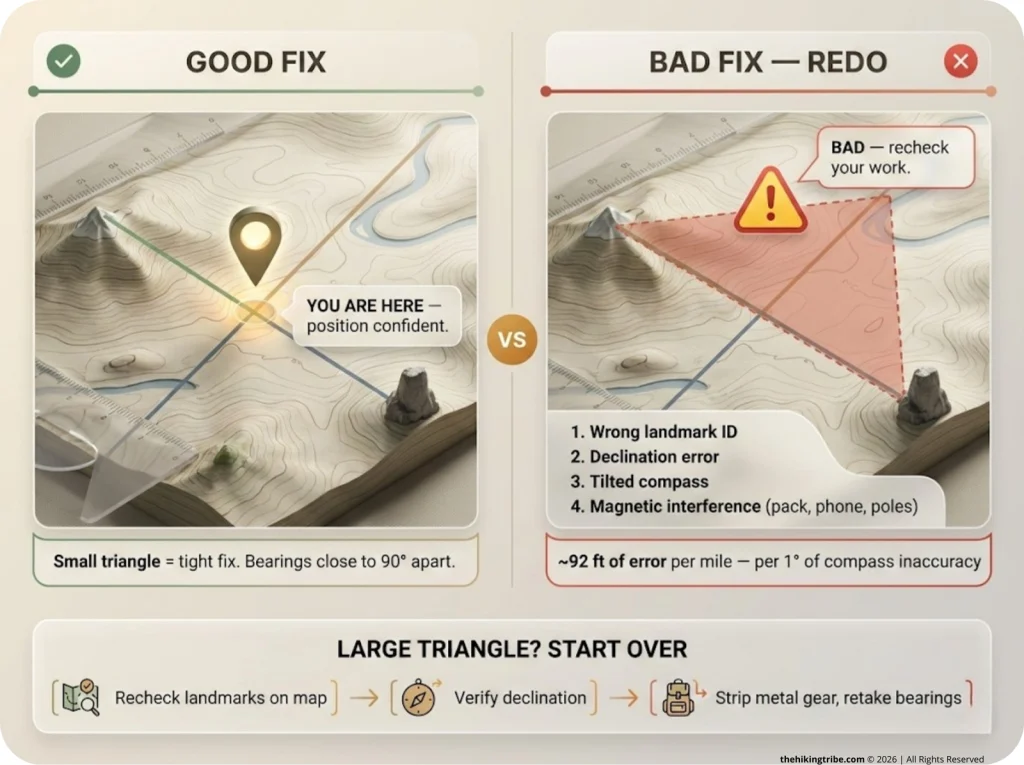
With three bearings plotted, the lines almost never cross at a single clean point. Instead, they form a small triangle — what navigators call the “cocked hat” or error triangle. That’s normal, and it’s actually useful information.
A tight triangle means your bearings are close. Your actual location is inside or very near that triangle. With a handheld compass at practical distances of one to three miles, you can typically pin your position within 100 to 300 yards in clear conditions. Each degree of bearing error translates to roughly 92 feet off-course per mile to the landmark — so accurate bearing measurements matter more the farther away your landmarks are.
Large Triangle? Don’t Trust It — Redo
A large triangle isn’t just imprecise — it’s a warning sign. Something went wrong, and the most common culprits are: wrong landmark identification (you aimed at the wrong peak), declination error (you forgot or miscalculated the correction), compass held tilted (bubbles in the housing should be level), or magnetic interference from metal near the compass.
Fix it by starting over. Recheck your landmark IDs against the map. Verify your declination. Strip off your pack — trekking poles, phones, and even belt buckles generate enough magnetic pull to skew the compass needle. Retake your bearings from scratch.
If the triangle stays large after a second clean attempt, the conditions may not support reliable resection. That’s when you switch to terrain association — matching what you see on the ground to the map, using handrails and backstops instead of compass bearings. Knowing how to read topographic maps effectively is what makes that backup plan work.
Shortcuts and Field Hacks for Faster Position Fixing
One Bearing + a Known Linear Feature
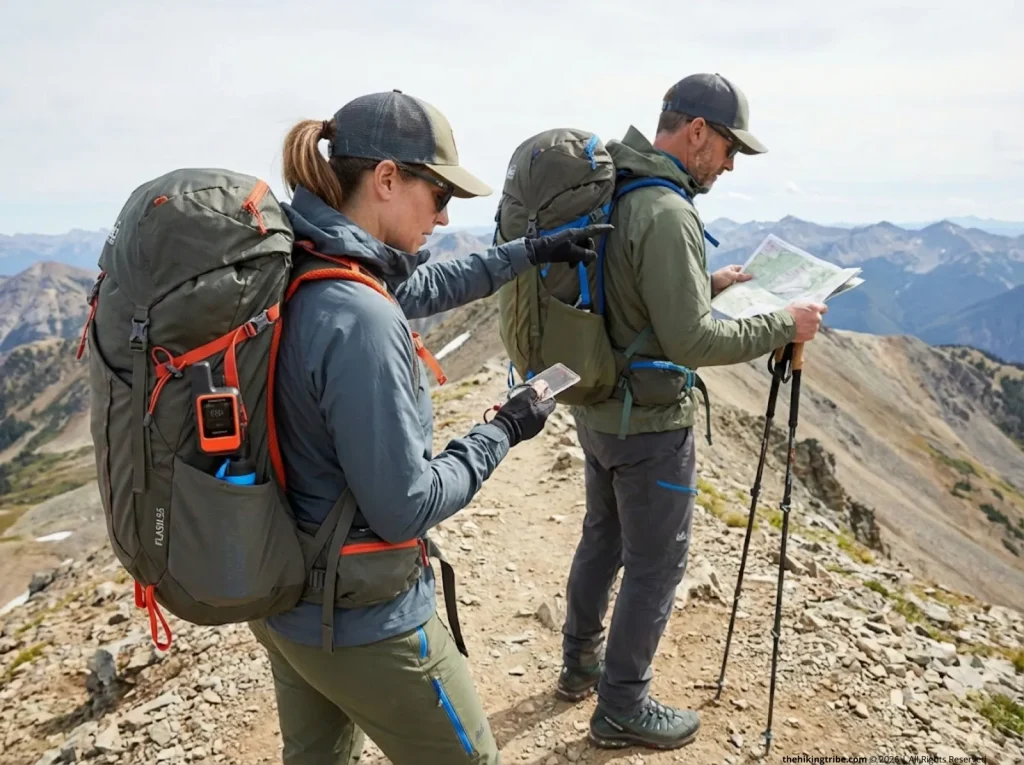
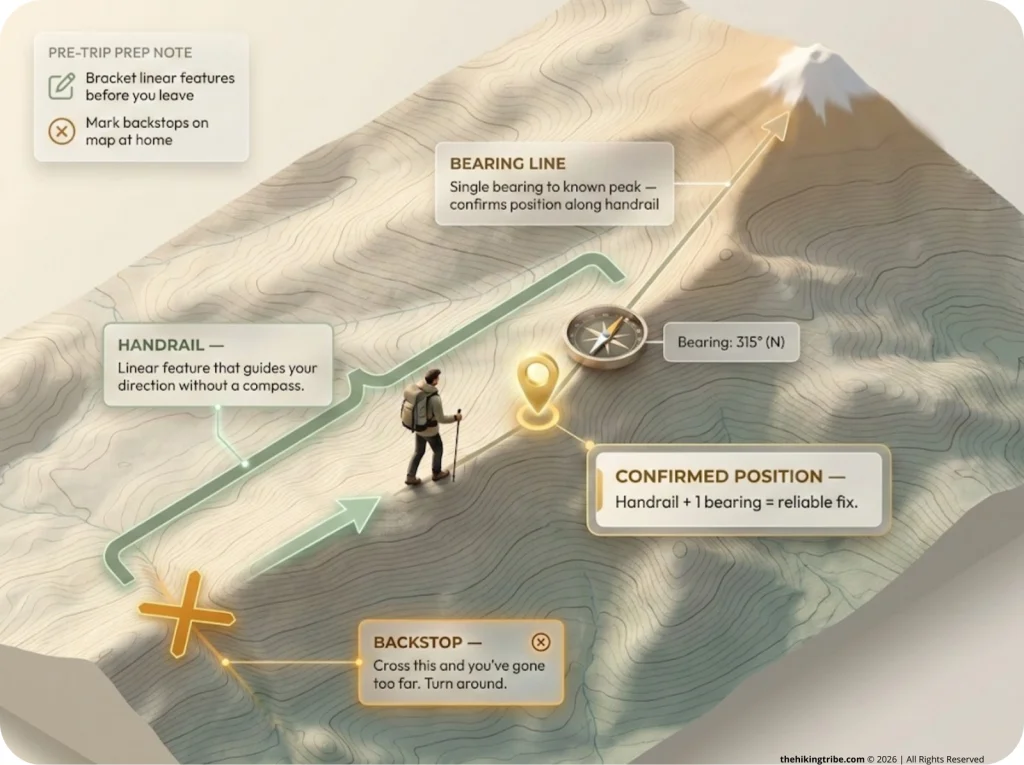
Here’s the 2-bearing method shortcut I use more than full triangulation on actual trips. If you’re standing on or near a known linear feature — a trail, a ridge, a river, any continuous line on your map — you only need one bearing to a distant landmark.
The bearing line crosses that linear feature at a single point. That point is your position. No second bearing needed, no error triangle to interpret. It’s faster, simpler, and works when visibility limits you to one clear landmark.
On a John Muir Wilderness trip last fall, I used a single ridge handrail and one bearing to a named peak to confirm my camp location in an open valley. Total time: about two minutes. Full 3-bearing refinement would have taken ten and given me a position that was only marginally more precise.
Pro tip: Combine terrain association first, compass second. Before you pull out the compass, look around and try to match what you see to the map. Annotate your map before the trip — bracket handrails, mark backstops. Reserve full resection for when everything else fails.
Terrain Association First, Compass Second
The best navigators I’ve hiked with hardly ever pull out a compass. They read terrain features to orient without one — matching contour shapes, drainage patterns, and elevation changes to the map as they move. The compass comes out only when the terrain gets ambiguous: featureless basins, multiple similar-looking ridges, or poor visibility.
Annotate your topo map before you leave the car. Bracket linear features that run parallel to your route. Mark an X on backstops — features that signal you’ve gone too far. When you’ve done that homework, staying oriented barely requires the compass at all. It’s the foundation of solid offline navigation skills and backcountry hiking navigation.
When Triangulation Fails — And What to Do Instead
Conditions That Break Position Fixing
This is the part most guides skip, and it’s the part that matters most when you’re actually lost. Resection requires positive visual identification of distant landmarks. That means it fails — completely — in at least five situations.
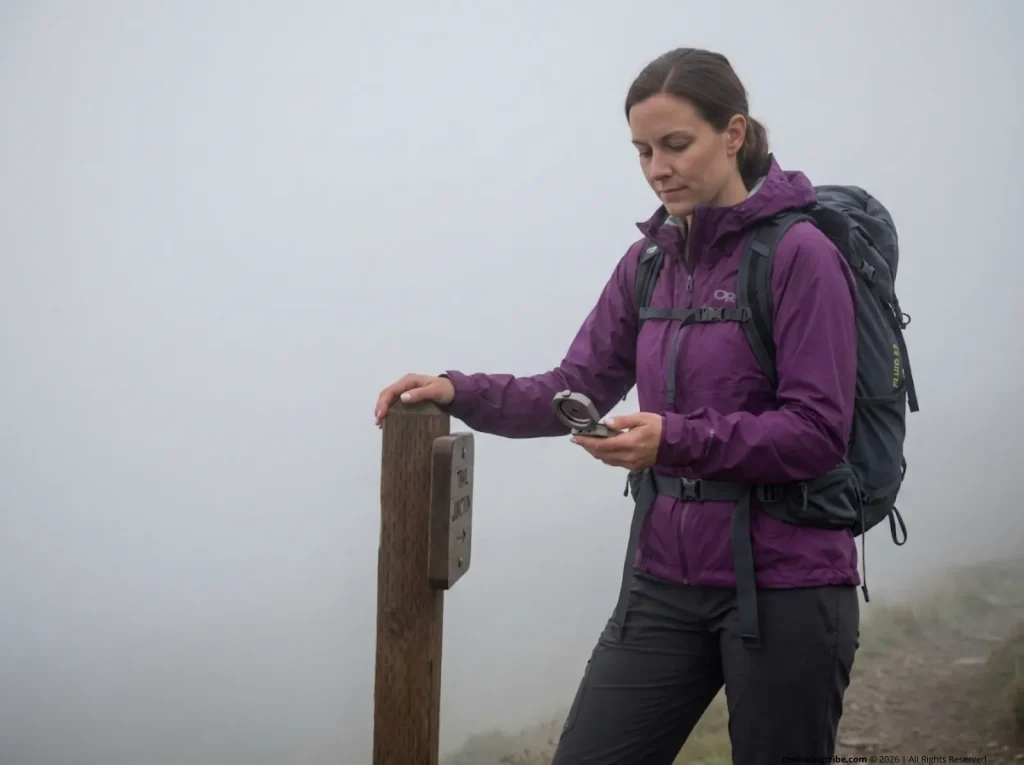
Dense forest canopy blocks your view of anything beyond the trees immediately around you. Fog, heavy rain, and whiteout conditions reduce visibility below usable range. Magnetic interference from trekking poles, phones in pockets, or vehicles nearby skews the needle by several degrees. Night removes your ability to identify landmarks. And sometimes the feature you’re looking at simply doesn’t appear on your map edition.
If any of these are true, the compass stays in your pocket. Don’t force a fix when weather limitations won’t support one. A bad position is worse than honestly admitting you don’t have one.
The Bailout Protocol
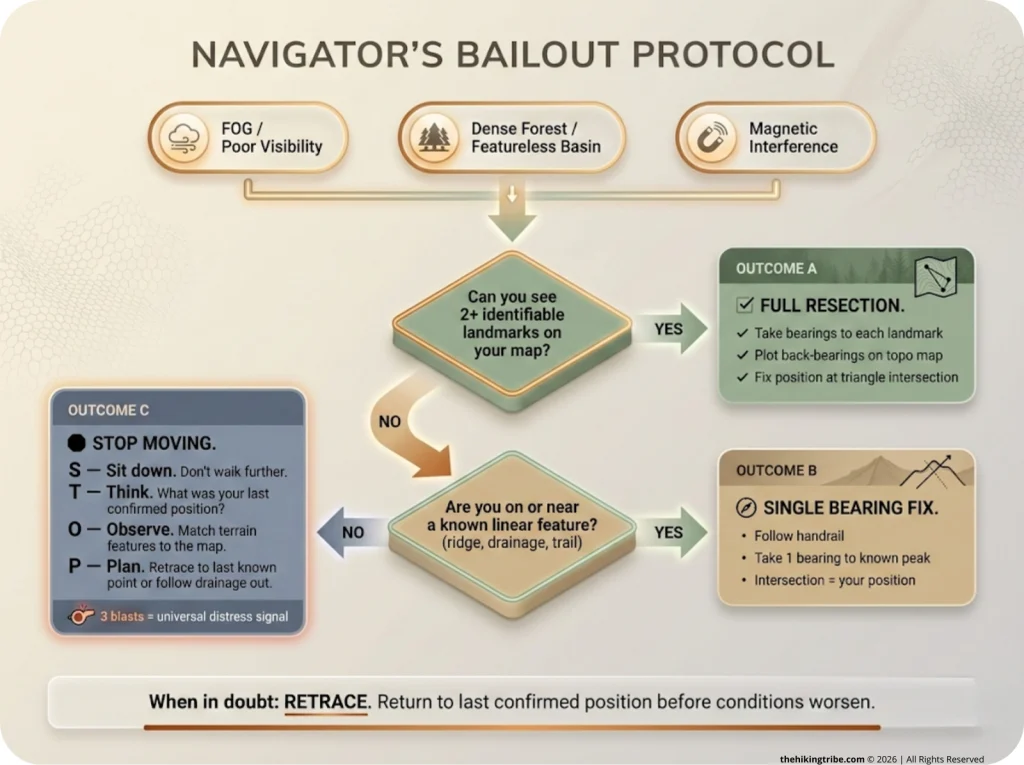
If resection won’t work AND terrain association fails: stop moving. Right now. Don’t keep walking hoping something looks familiar, because that’s how a “slightly confused” situation becomes a genuine emergency.
Return to your last confirmed position — turn around and retrace your steps. Follow a known linear feature — a drainage, a ridge, a trail — to a recognizable intersection. If you’re fully disoriented, use the S.T.O.P. protocol: Sit, Think, Observe, Plan.
And if you need help, three whistle blasts is the universal distress signal. Carry a real whistle, not the toy on your sternum strap. We cover the full emergency sequence in our hiker’s emergency guide.
Pro tip: Practice resection on every summit where you already know your exact spot. Build the muscle memory before you need it. The summit of a known peak with a clear view and no stress is the best classroom you’ll ever find.
Conclusion
Three things separate someone who carries a compass from someone who can actually use one. First, pick landmarks at least 60 degrees apart that you can positively identify on both the terrain and the map. Second, correct for declination every single time — a few degrees of error at trail distances puts you hundreds of yards off. Third, know when this method works and when it doesn’t — fog, forest, and magnetic interference break it, and you need a bailout plan.
Honest truth: most of the time you won’t need full three-bearing resection. One bearing plus a known handrail gets you located faster. Terrain association handles the rest. But when the weather closes in, the phone dies, and nothing looks right — that’s when the skill you practiced on clear-day summits saves you.
Print a topo map of your next trail. Bring your compass. Find a summit with a view, and fix your position right there, where you already know exactly where you are. That first successful fix on known ground will stick with you permanently.
FAQ
What is the difference between triangulation and resection?
Resection means fixing your own unknown position using bearings to known landmarks. Triangulation technically means locating an unknown point from two known positions. In hiking, both terms are used interchangeably — use whichever you prefer, everyone on trail knows what you mean.
How many landmarks do you need to triangulate your position?
Two landmarks give you a single intersection point — your approximate position. A third landmark creates an error triangle that confirms your accuracy. Three is ideal; two is the working minimum.
Can you triangulate with only one landmark?
Yes — if you are on a known linear feature like a trail, ridge, or river. One bearing to a distant landmark crosses that feature at a single point, giving you your location without a second bearing.
What if the lines form a triangle instead of a single point?
That is the error triangle or cocked hat, and it is normal with three bearings. A small triangle means you are accurate — your position is inside it. A large triangle means recheck your landmark IDs, verify declination, remove metal from near your compass, and retake bearings.
How do you adjust declination for triangulation?
If your compass has built-in adjustable declination, set it once before your trip using NOAA’s online declination tool. If correcting manually, subtract east declination and add west declination to convert your magnetic bearing to a true bearing before plotting bearings on the map.
Risk Disclaimer: Hiking, trekking, backpacking, and all related outdoor activities involve inherent
risks which may result in serious injury, illness, or death. The information provided on The Hiking Tribe is for
educational and informational purposes only. While we strive for accuracy, information on trails, gear, techniques,
and safety is not a substitute for your own best judgment and thorough preparation. Trail conditions, weather, and
other environmental factors change rapidly and may differ from what is described on this site. Always check with
official sources like park services for the most current alerts and conditions. Never undertake a hike beyond your
abilities and always be prepared for the unexpected. By using this website, you agree that you are solely
responsible for your own safety. Any reliance you place on our content is strictly at your own risk, and you assume
all liability for your actions and decisions in the outdoors. The Hiking Tribe and its authors will not be held
liable for any injury, damage, or loss sustained in connection with the use of the information herein.
Affiliate Disclosure: We are a participant in the Amazon Services LLC Associates Program, an
affiliate advertising program designed to provide a means for us to earn advertising fees by advertising and linking
to Amazon.com. As an Amazon Associate, we earn from qualifying purchases. We are also an official affiliate partner
of Black Diamond Equipment via the AvantLink network. If you click on a Black Diamond affiliate link and make a
purchase, we may earn a commission at no additional cost to you. We also participate in other affiliate programs and
may receive a commission on products purchased through our links. Additional terms are found in the terms of
service.