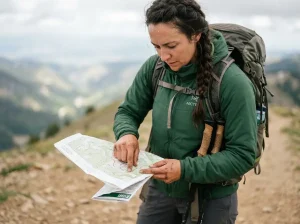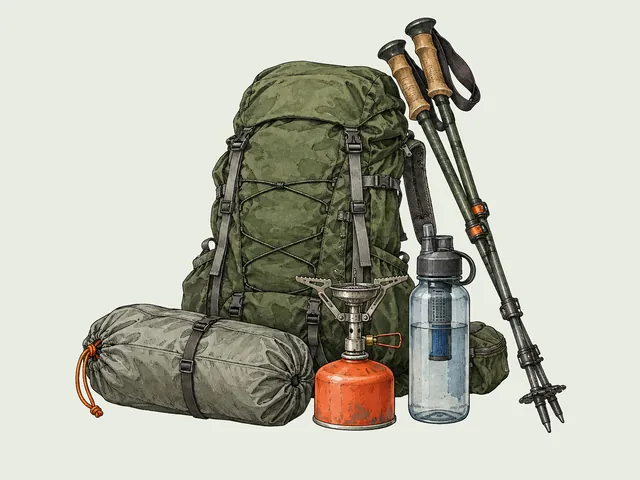
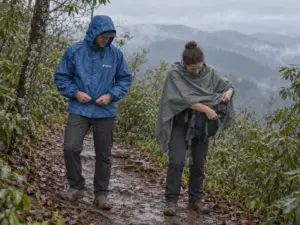
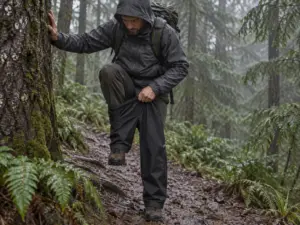

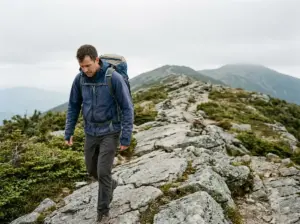
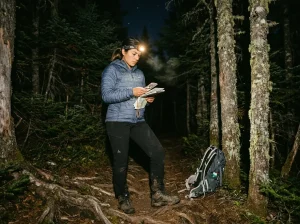
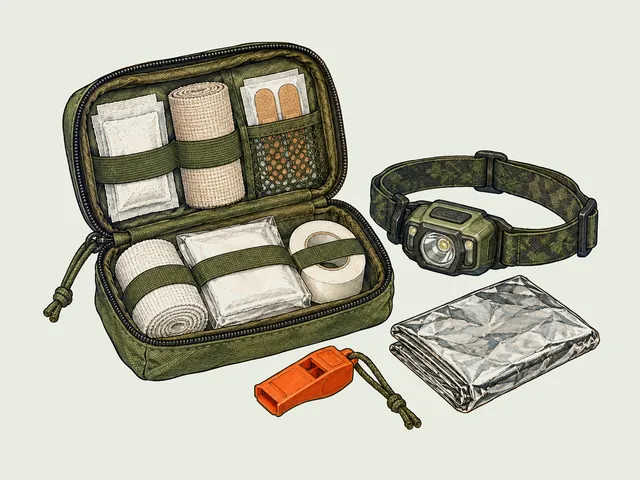



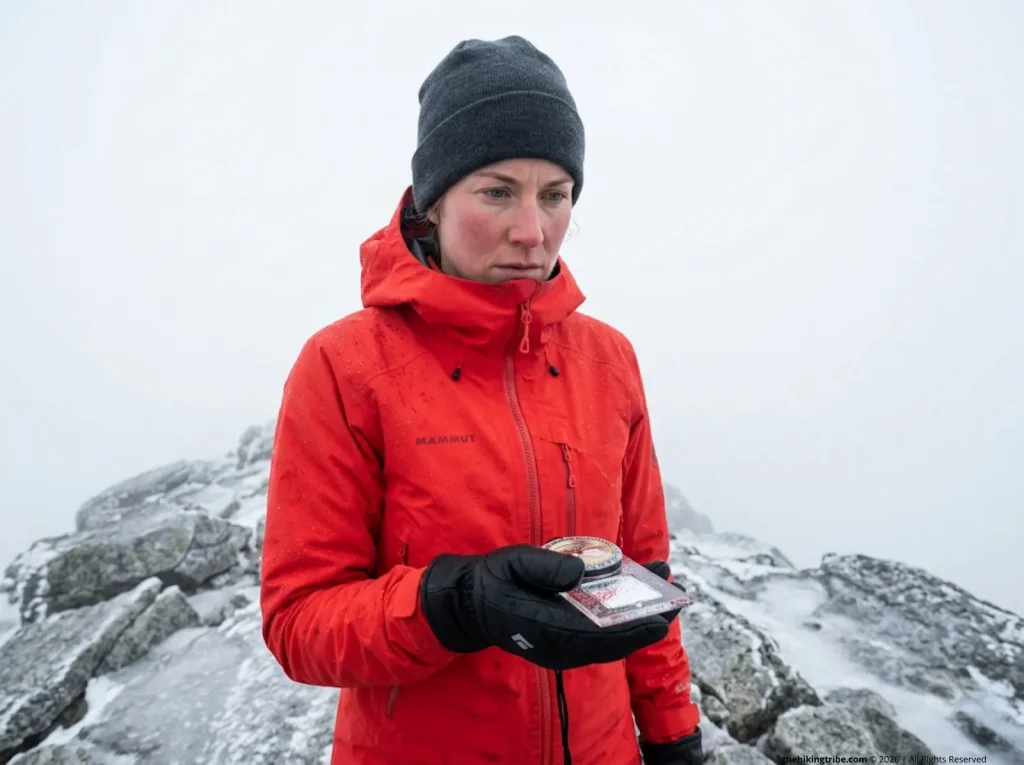
The clouds descended across the ridge so fast that the “moderate” trail vanished under a wall of white before I could even stop to grab my map. Suddenly, the silence of the alpine basin was deafening, the horizon was completely gone, and a sickening wave of vertigo kicked in. Knowing how to navigate in fog and handle zero-visibility weather events is the critical threshold that separates a confident mountaineer from a tragic search-and-rescue statistic. This guide breaks down the advanced analog mechanics, the rules of altimeter contouring, and the exact protocols you need to self-rescue when the environment goes fully blind.
⚡ Quick Answer: When caught in zero-visibility fog, stop immediately to prevent getting further off-route. Use the leapfrog technique with a baseplate compass to maintain a straight bearing, and track your distance manually using a pace count and ranger beads. Ignore auditory illusions that distort directional sound, and never abandon your planned bearing for an easier downhill route unless you are escaping an active hazard.
The Psychological and Biological Reality of the Whiteout
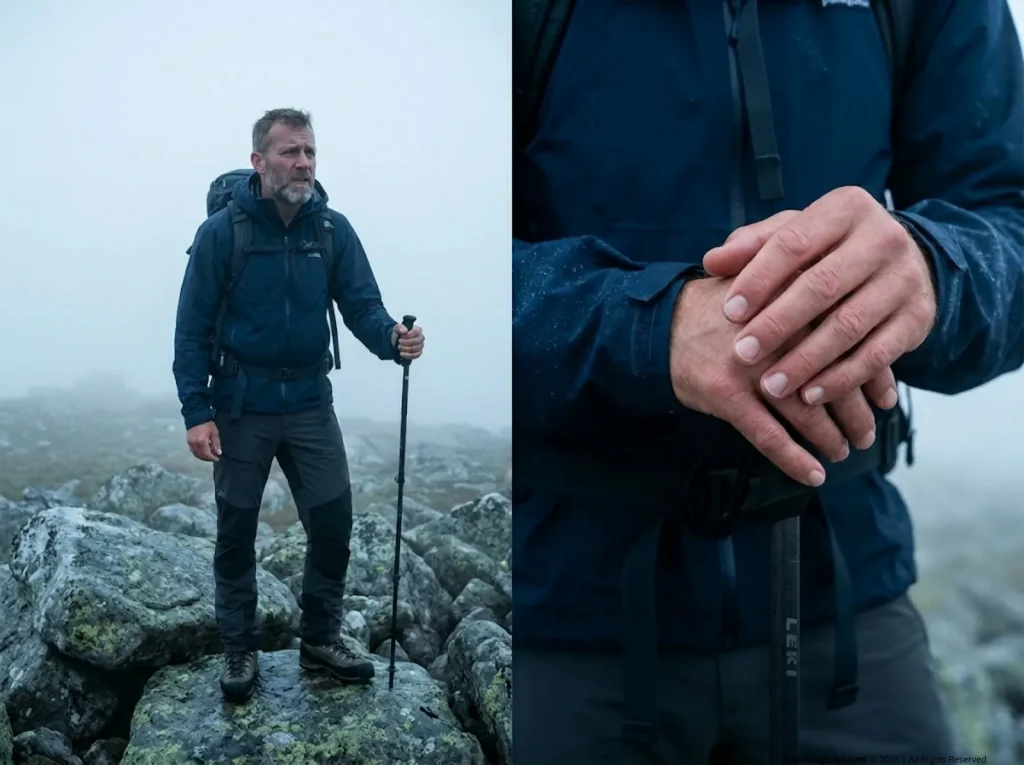
When you lose visual reference points, your brain panics. We rely so heavily on our eyesight that losing it in the backcountry triggers immediate physical responses that work against our survival.
The Whiteout Syndrome and Sensory Deprivation
If you hike long enough, you will eventually experience a true heavy fog. When visibility drops to absolute zero, hikers often fall victim to sensory deprivation. Your eyes search frantically for a horizon line that isn’t there, throwing off your inner ear and causing extreme vertigo. Some call this the whiteout syndrome. Your balance vanishes, making flat ground feel steep and steep slopes look like flat snowfields.
Without visual anchors, your mind tries to fill in the blanks. High-altitude environments combined with exhaustion can even trick you into swearing you see a trail junction or a cabin just out of reach. You have to actively fight your own panic and trust your instruments over your gut feelings.
Acoustic Illusions and Sound Distortion
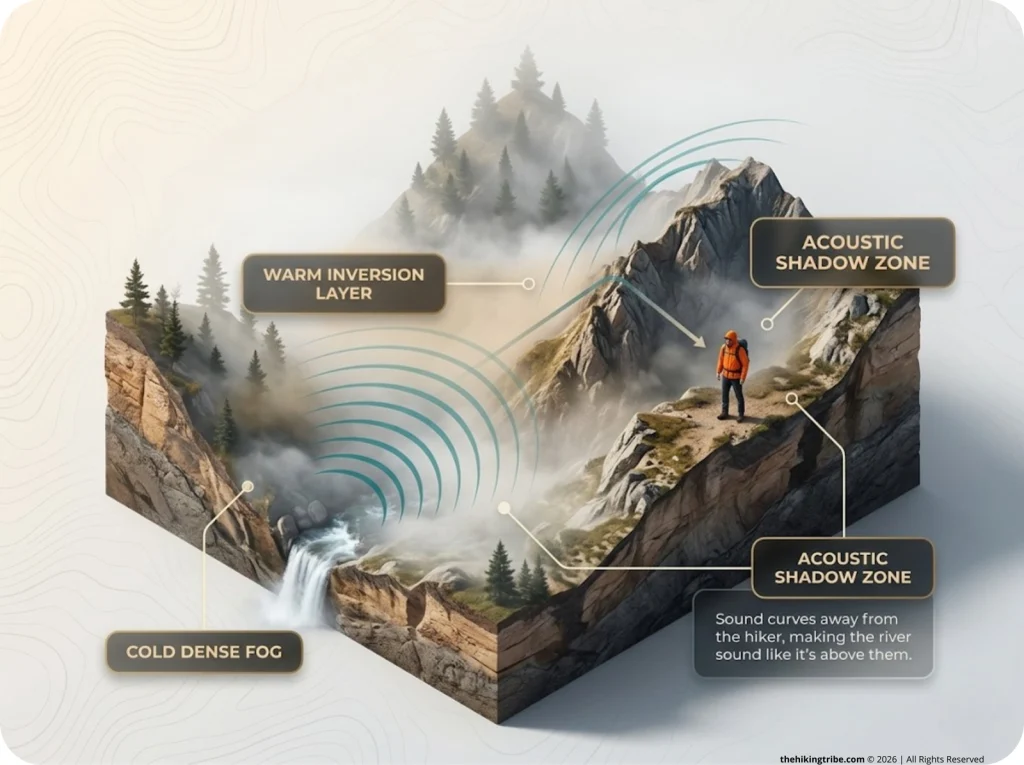
Fog acts like a giant, damp sponge that completely ruins auditory navigation. The dense moisture in the air absorbs high-frequency sounds, while thick atmospheric layers create “shadow zones.” This means the roar of a river down in the valley can bounce off the fog layers and sound like it’s coming from directly above you.
Pro tip: When a whiteout hits, do not trust your ears regarding the location of a road or stream; the wet atmosphere and air temps are actively lying to your brain.
If you hear water or voices, do not blindly walk toward the sound. The damp air plays tricks on your directionality, and you will likely walk right off a drop-off chasing an acoustic ghost.
The Downhill Bias: Why Hikers Get Lost
Scared hikers do dangerous things. When the trail disappears, instinct screams at us to simply walk downhill to find safety or water. According to the ISRID database, panicked hikers exhibit a dangerous “downhill bias.” They stop checking their topographic maps and instead scramble blindly down drainages that inevitably end in impassable waterfalls or sheer cliffs.
You must fight the urge to take the path of least resistance. Safety groups agree that you should never start abandoning your bearing just because going downhill feels easier. Stick to your plotted route unless an immediate physical threat like a rockfall forces you off it.
The “Stop and Assess” Emergency Protocol
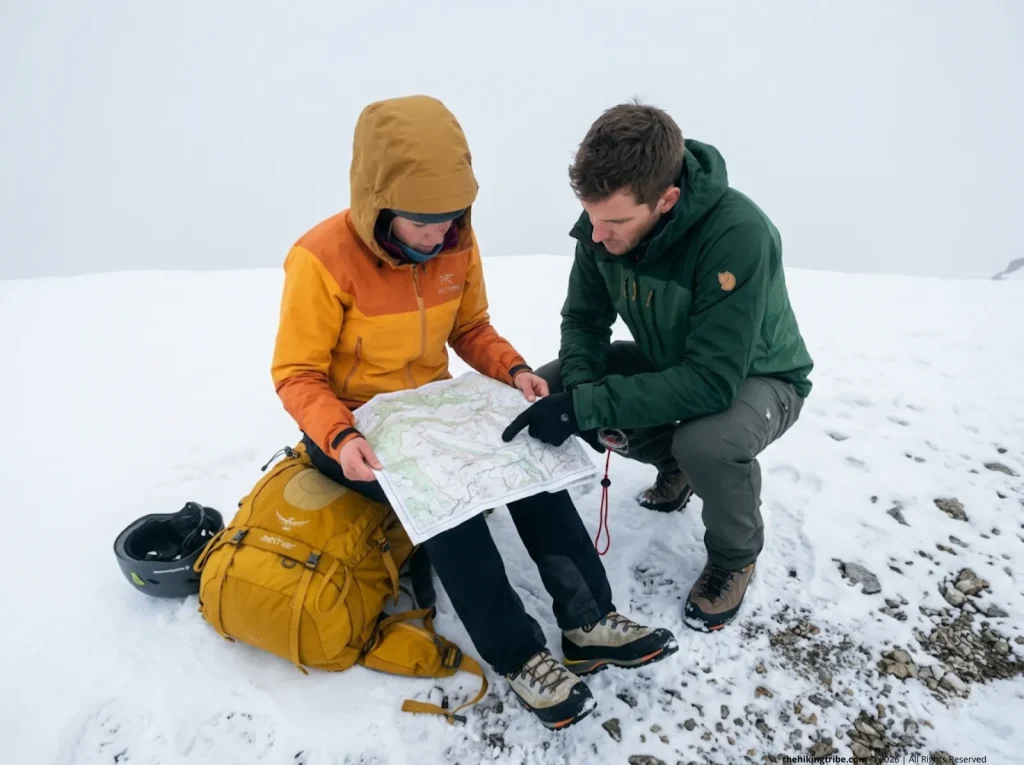
Trying to hike your way out of a problem usually makes it worse. When the fog rolls in thick, you need a rigid protocol to anchor yourself.
Immediate Triage: Anchoring Your Position
The immediate response to a sudden whiteout is to stop moving forward and physically plant yourself at your last known location. Mountain leaders teach the 5 Ds (or previously the 4 Ds): Direction, Distance, Duration, Description, and Destination. Before taking another step, you need to know exactly where you are on the map.
If you just keep walking in low visibility, your margin of error explodes with every step. You turn a small navigational hiccup into a massive search grid for the local rescue teams.
Identifying Catching Features and Handrails
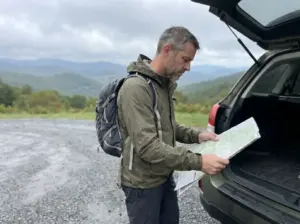
Sit down on your pack, pull out your map, and look for a catching feature. This is a massive, unmissable landmark like a lake, a sheer ridge, or a major river that runs perpendicular to your compass bearings. It acts as an emergency backstop. If you hit that feature, you know you have gone too far.
You should also look for handrails—linear features like fences, streams, or distinct tree lines that you can follow safely even when you have short sight lines of only ten feet. SAR officials note that an uninjured hiker is statistically much more likely to be rescued if they stop and construct a shelter near water rather than wandering blindly through the brush.
Maximizing Your Probability of Area (POA)
If you keep moving without a solid plan, the area rescuers have to search grows rapidly. Establishing a hard coordinate fix via triangulation before you move minimizes this problem. Even in poor conditions, getting a bearing on two distinct peaks right before the fog completely closes in gives you a fighting chance.
Pro tip: In extreme late-season conditions, sit on your pack to insulate your core from the frozen ground while doing your compass math. You lose heat fast when you stop moving.
Analog Navigation Mechanics: Walking the Blind Bearing
Your phone will eventually die. When the screen goes black, your survival depends entirely on old-school analog fail-safes.
The Mechanics of the Leapfrog Method
Staring straight down at your compass needle while walking guarantees two things: you will take a bearing that drifts left or right, and you will eventually trip on a rock and smash your face.
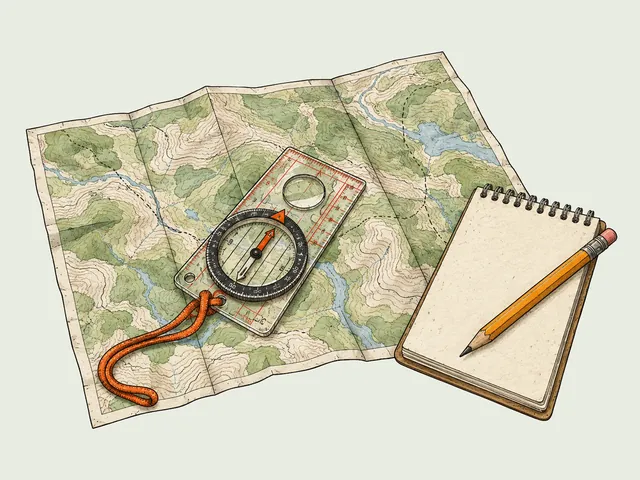
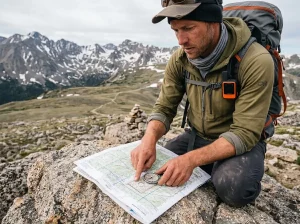
Instead, you need the leapfrog technique. One person stands perfectly still, holding the compass to point the direction of travel. The second person acts as a scout, walking out into the fog until they are barely visible. The person holding the compass motions them left or right until they are perfectly aligned with the baseplate bearing. Once aligned, the compass holder walks to the scout, and you repeat the process.
Back Bearings and Magnetic Interference
The scout isn’t just a marker; they also need to check the work. They should turn around and shoot a reciprocal back bearing toward the person holding the compass. If you are walking 90 degrees East, the scout should see you at 270 degrees West. If the numbers don’t line up, something is wrong.
Often, diverging bearings indicate local magnetic interference. Iron ore inside the boulders around you can pull a compass needle completely off target. Be incredibly careful with your own gear, too. Holding a metal ice axe or a smartphone right next to your chest while keeping the compass flat will cause massive needle drag.
Solo-Leapfrogging and Aiming Off
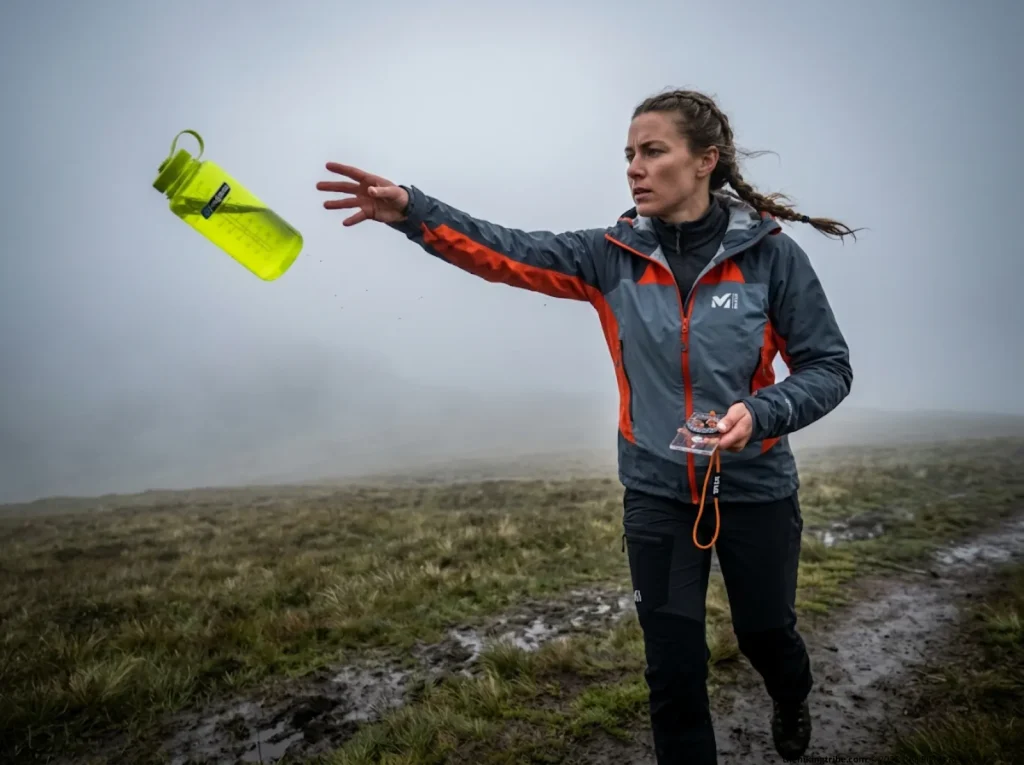
If you are hiking alone and get caught in the soup, you can’t send a partner ahead. You have to adapt by solo-leapfrogging. Set your compass bearing, and throw a brightly colored object—like a bright stuff sack or an orange water bottle—as far as you can see along that exact line. Walk to the object, pick it up, shoot the line again, and throw it again. It is tedious, but it keeps you walking in a mathematically straight line.
You also need to practice aiming off. If you know your camp sits on a stream, do not aim directly for the camp. Deliberately aim your compass ten degrees to the left of the camp. That way, when you finally hit the water, you know with absolute certainty that you must turn right to find your tent.
Distance Tracking and the Tactile Abacus
Walking the right direction is useless if you don’t know when to stop walking. You need a reliable way to measure distance covered across the ground.
Adjusting Naismith’s Rule for Whiteouts
Naismith’s Rule calculates rough pacing allowing you to estimate how long a leg of your journey will take based on a flat 5 kilometers per hour, plus an extra hour for every 600 meters of ascent. But zero-visibility conditions destroy your normal hiking speed.
When you can barely see past your trekking poles and have to constantly check the map, you need to multiply your time estimates by 1.5 or even 2. Relying purely on time to guess your location in steep terrain is a fantastic way to walk right past your turn-off. Always calculate rough pacing using physical steps, not just the clock.
Establishing Your Custom Pace Count
To track exactly how far you have walked, you need to know your pace count. Go to a flat, known 100-meter stretch of trail or a football field. Count every time your left foot hits the ground. For most average-height hikers, 100 meters takes roughly 65 double-steps.
Once you hit the trail, keep counting. Every time you hit 65 left-foot strikes, you know you have covered 100 meters. But remember that thick mud, deep snow, or heavy brush shrinks your stride length. In severe conditions, your pace count might jump to 80 or 90 strikes per 100 meters.
Tactile Tracking with Ranger Beads
Your brain is the first thing that fails when you get cold and stressed. You will forget your pace count. This is where pacing via beads saves the day.
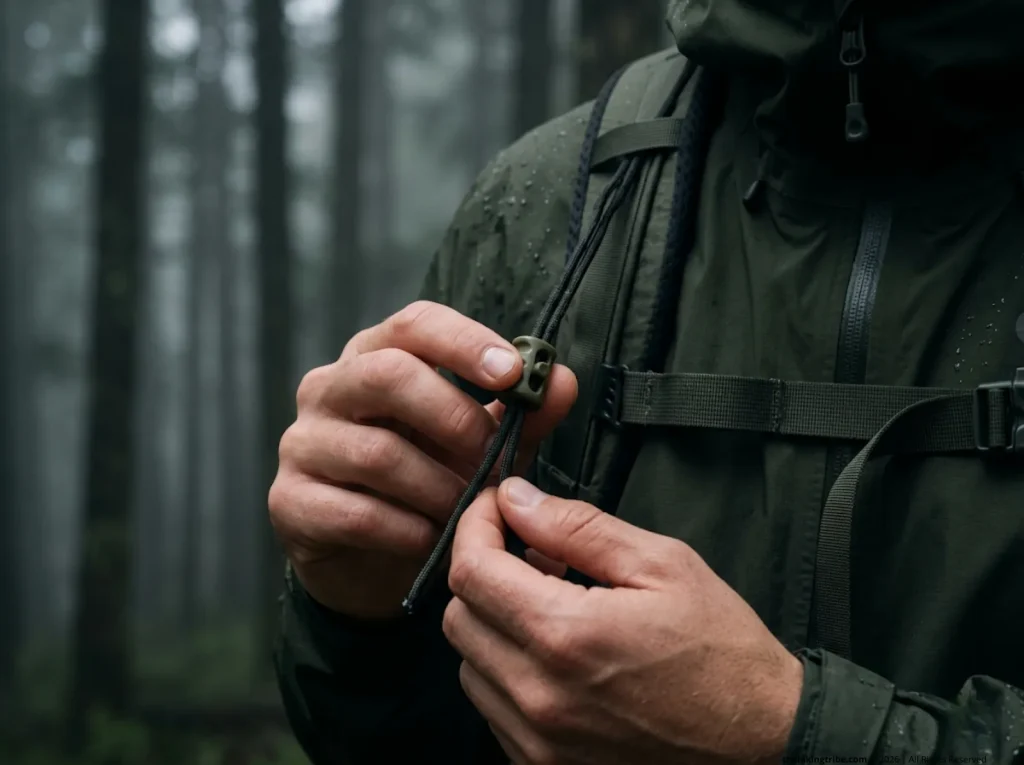
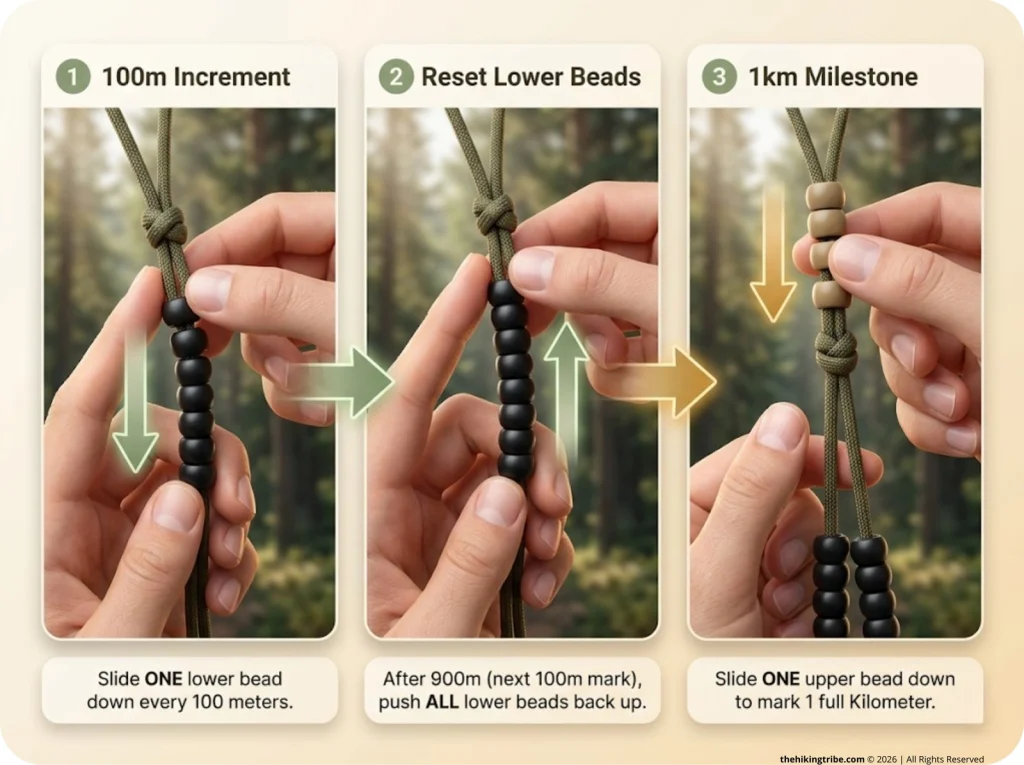
Ranger beads act as a durable, tactile abacus. The tool uses a paracord lanyard with nine beads on the bottom and four on the top. Every time you walk 100 meters, pull one bottom bead down. When you pull all nine down and finish the next 100 meters, you slide them all back up and pull one top bead down to mark one full kilometer. The physical action of moving the bead bypasses your exhausted memory giving you hard data on how far you have traveled.
Pro tip: Don’t chase perfect numbers—aim for consistent cadence. Ten minutes of practice on a known 100-meter track is enough to make distance tallying automatic.
Using an Altimeter as a Three-Dimensional Compass
Many hikers think of navigation as a flat sheet of paper. But when the mountains vanish, you have to navigate the vertical plane just as strictly as the horizontal one.
The Mechanics of Safe Contouring
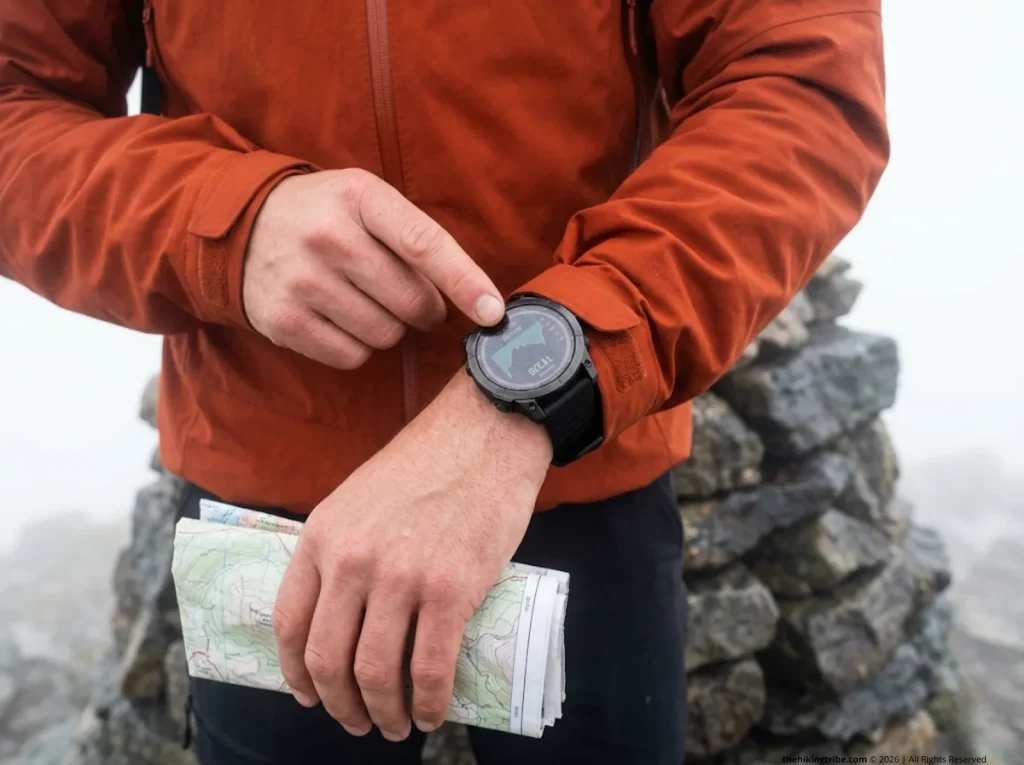
An altimeter watch acts as a vertical compass. Let’s say you are trying to bypass a dangerous, sheer cliff that you can no longer see. Instead of trying to find a trail around it, you read your map and find a safe elevation contour line below the cliffs—say, 8,200 feet.
You hike up or down until your watch reads exactly 8,200 feet. Then, you walk sideways along the slope, keeping the watch glued to that exact number. This is called contouring, and it ensures you stay parallel to the slope without accidentally drifting up into the cliff bands or down into steep ravines.
Barometric Drift: The Invisible Threat
Your watch does not actually know how high up you are. It figures out your altitude by reading the barometric pressure. This creates a massive problem because approaching storms create extreme ‘barometric drift.’
A massive pressure drop—like a heavy snowstorm rolling in—tricks the watch. The falling pressure tells the sensor that the air is getting thinner, making the watch display that you are gaining altitude even if you are sitting still. Conversely, a rising high-pressure system will show a false descent.
Calibration Checkpoints on the Trail
If you don’t account for this drift, your altimeter data becomes dangerous garbage after a few hours. You must prioritize altimeter safe-zone calibration.
Every time you hit a known spot on the map—like a signed trail junction, a summit peg, or a marked lake—you must stop recalibrating the altimeter watch to match the map’s stated elevation.
Pro tip: If you know a severe storm is rolling in, calibrate your altimeter slightly lower than your actual elevation to artificially buffer the impending pressure drop.
Optical Solutions and Technology Fail-Safes
When the ambient light starts dropping and the whiteout turns slate gray, pulling out your flashlight often makes things much worse. You have to adapt your light source to the moisture in the air.
Preventing Headlamp Glareback
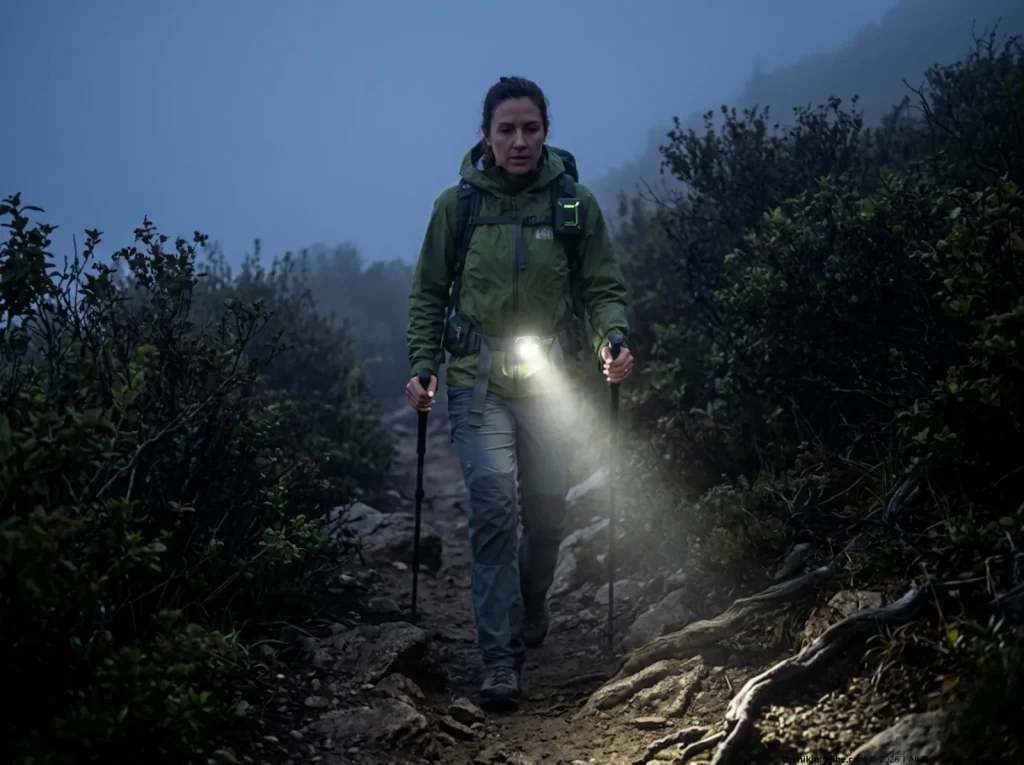
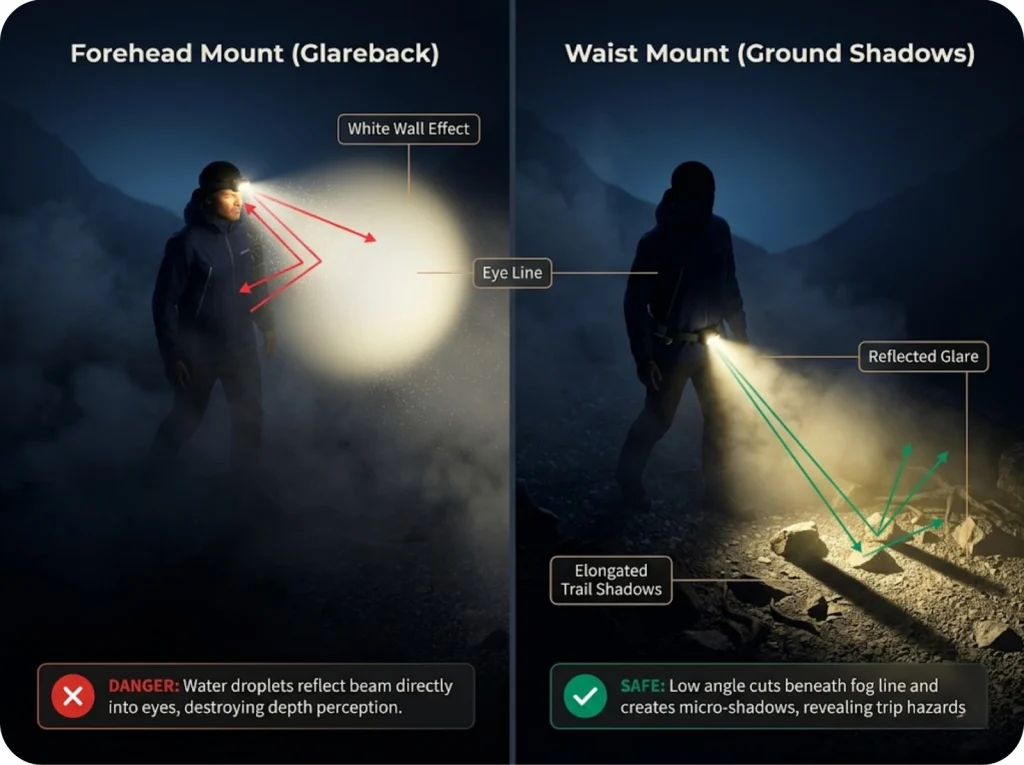
Turning a 1000-lumen headlamp onto its highest setting inside a cloud is blinding. The thick water droplets cause light scattering, bouncing the beam directly off the fog and straight back into your pupils. You create a solid, glowing white wall inches from your face.
The fix is headlamp repositioning. Take the lamp off your head and buckle it around your waist or hold it down by your hips. By dropping the beam angle, the light hits the rocks and roots and casts long micro-shadows across the ground. This simple change instantly restores your ground-level depth perception.
Preserving Core Battery Life
Modern digital tools like Gaia GPS or mapping apps that use what3words and UTM coordinates are fantastic backups. But leaning on a smartphone exclusively during freezing moisture events is asking for trouble.
Touchscreens freeze or stop recognizing wet fingers, and below-freezing temperatures sap lithium-ion batteries rapidly. Cold batteries die rapidly. Keep your phone or dedicated GPS unit buried deep under your armpit layers. Let your core body heat keep the battery chemistry warm, only pulling the unit out to verify the bearings you already shot with your Suunto compasses.
The Role of Satellite Communicators
When your manual navigation fails, the snow buries your catching features, and you enter a zero-visibility decision flowchart where every option feels dangerous, you need outside help.
Devices like the Garmin inReach are non-negotiable insurance policies. Rescue groups like the Edale Mountain Rescue constantly deal with hikers who waited too long to call for help, allowing hypothermia to set in before pressing the SOS button. If you are thoroughly lost and walking blindly risks a fatal fall, hunker down in your emergency bivvy, hit the button, and stay put.
Conclusion
A sudden whiteout turns casual trails into a real hazard, meaning your survival hinges on proactive thinking rather than reactive panic. By mastering the sequence of stopping to triangulate, sliding your ranger beads, and ignoring the auditory illusions of the fog, you keep control of the environment. Before your next big alpine push, step off the trail in a local park and practice shooting a back bearing. It could genuinely be the skill that saves your life.
FAQ
Can you use a smartphone GPS in dense fog?
Yes, GPS signals generally cut through fog effectively because they operate on frequencies that aren’t blocked by water vapor. However, extreme cold weather often accompanies fog, which can instantly kill a smartphone battery or cause the touchscreen to fail, so a physical compass is still mandatory.
What is the Leapfrog method of navigation?
It’s an advanced technique used to walk in a perfectly straight line when there are no landmarks visible. The navigator stays fixed holding a compass bearing while a partner walks out to the edge of visibility; the navigator directs the partner left or right to align with the bearing, then walks to the partner to repeat the process.
Why does my altimeter change when I haven’t moved?
Your altimeter is tracking barometric pressure, which naturally fluctuates with the weather. If a storm is rolling in, the atmospheric pressure drops, tricking the watch into displaying a false gain in altitude.
How do you walk straight when you’re alone in a whiteout?
You use the solo-leapfrog technique. You take a precise compass bearing, throw a bright object (like a brightly colored stuff sack or a rock) as far as you can see along that exact line, walk directly to it, and repeat the process.

I've spent more than a decade researching hiking gear and trail technique. I read the specs, the forum threads and the long-term reviews, and every pick here comes with what it gets wrong.
End of the trail
You read every mile of this one. Here's where the trail goes next.