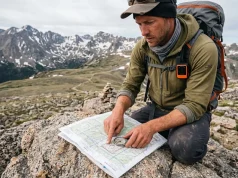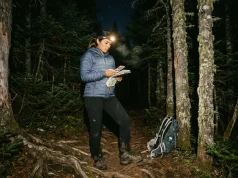

In this article
The GPS screen on my unit went black three days into a trek through the Blue Range Primitive Area. The batteries were dead. To make matters worse, the iron-rich rock in that specific range was making the compass needle of my magnetized compass swing wildly. It was unreliable. But as I looked up from the useless electronics, I realized the ridge line under my boots hadn’t changed. It remained an absolute truth.
Wilderness navigation is not just about following a digital line on a screen. It is a conversation with the three-dimensional terrain itself. When you learn to read the geometry of the earth, you stop fighting the hills and start flowing with them. You learn to translate the flat language of a paper topo map into the real-world terrain of ridges, saddles, and spurs.
I have spent the last two decades teaching mountaineering students that reliance on batteries is a liability. True skill lies in pattern recognition. This shift from dependence to understanding is what separates a passive hiker from a master land navigator.
In this guide, we will cover:
- Saving Energy: How the ground you choose affects the energy cost of your movement.
- Decoding the Map: Mastering the “Rule of Vs” and the “Fist Method.”
- Moving Fast: Using “Handrails” and “Catching Features” to stay on track.
- Verifying Your Spot: Why an altimeter is your best friend when the lensatic compass stays in your pocket.
Why is terrain association superior to simple compass reliance?
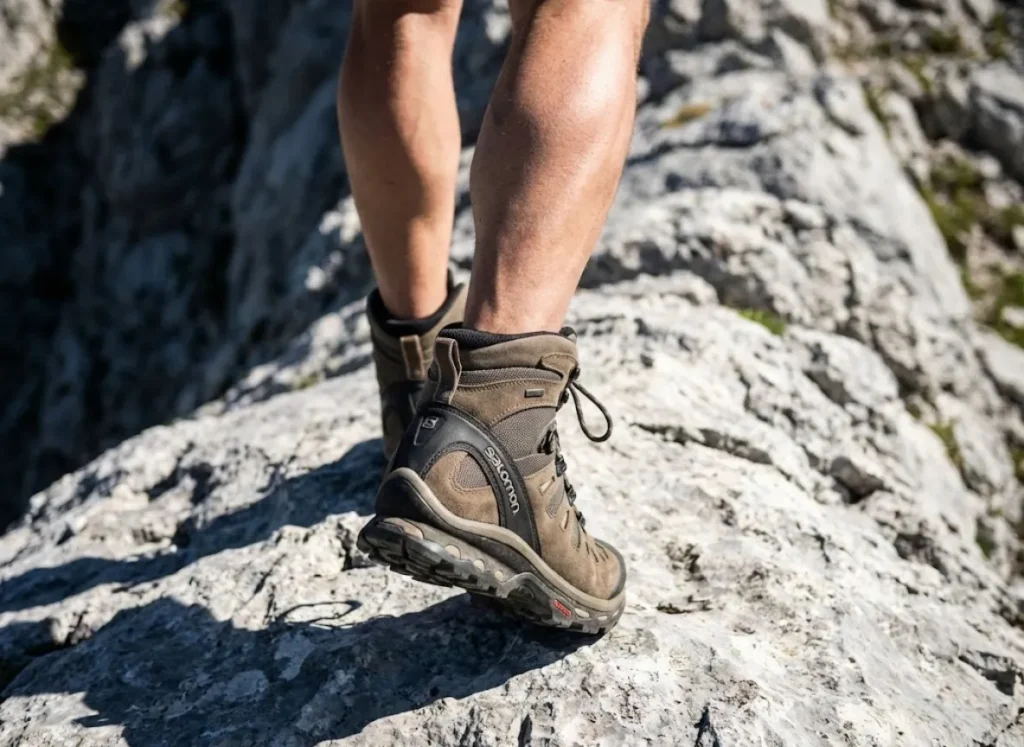
Terrain association is better because it focuses on saving your energy. A compass bearing might tell you the shortest distance between two points, but the land dictates the smartest path.
How does reading terrain save metabolic energy?
Experienced land navigators prioritize “Ridge Walking” over walking in straight lines. If you simply follow a compass bearing, you will inevitably fight against the terrain features. You might end up dropping into thick brush or scrambling up loose rocks.
Research shows that moving through swampy depressions or loose rock can require 3.5 times more energy than walking on a hard-packed ridge. This isn’t just about comfort. It is about safety and endurance. Efficient hikers, like Andrew Skurka, emphasize this navigation logic to maintain high daily mileage.
By reading the USGS maps to identify easier open terrain, you can choose a route that might be longer in distance but much “cheaper” in effort. This is a critical factor when learning how to calculate hiking time using Naismith’s Rule. Rough ground destroys standard timing estimates.
This approach minimizes the stop-and-go motion required when bushwhacking through dense vegetation or navigating uneven slopes. Your body works harder on uneven terrain because your stabilizer muscles have to fire constantly to keep you upright.
Pro-Tip: Always choose the “long way round” if it keeps you on a spur or ridge. A direct line through a valley floor usually results in a “vegetation tax” that slows you to less than 1 mile per hour.
Effective terrain association acts as a shield for your body. It allows you to bypass exhausting valleys in favor of wind-swept spurs. For more on the science of movement, you can review research on the biomechanics of walking on uneven terrain from the National Institutes of Health.
How do you decode the 3D world on a 2D map?
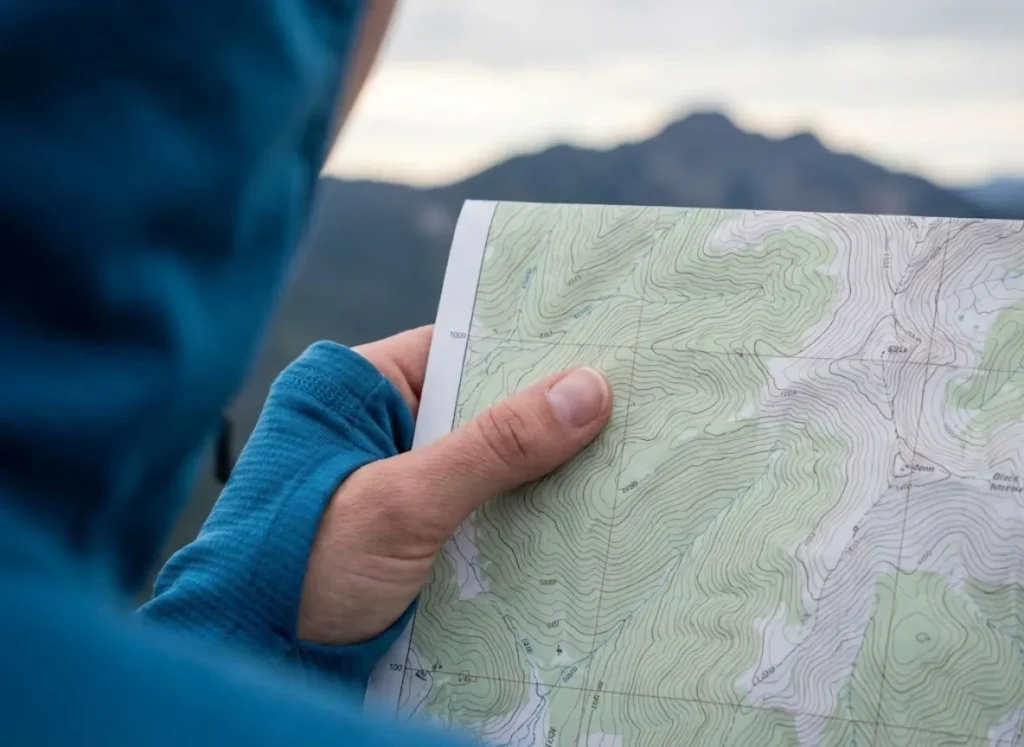
Decoding a map requires understanding that the lines are just symbols. Cartography uses these symbols to render a 3D ghost of the mountain on a flat piece of paper. You must look past the lines to see the shape they represent.
What do contour lines actually tell you about slope and shape?
Contour lines are the main alphabet of topographic maps. They connect points of equal elevation. The spacing between these lines, known as the contour interval, tells you how steep the slope is.
If lines are stacked closely together, it warns of a steep slope or a cliff. If the spacing is wide, it means the ground is a gentle slope and good for walking. Map colors also help: brown lines indicate elevation, green denotes vegetation, blue marks water, and black indicates man-made features.
Index contours are the thicker, labeled lines. They serve as your anchors. Between them, you will see finer intermediate contours, and on very flat ground, dashed supplementary contours. These allow you to quickly calculate how much elevation you will gain or lose without counting every single tiny line. Modern maps, like those on Gaia GPS, often use LiDAR and DEMs (Digital Elevation Models) to create incredibly accurate USGS 7.5-minute quads at a 1:24k scale.
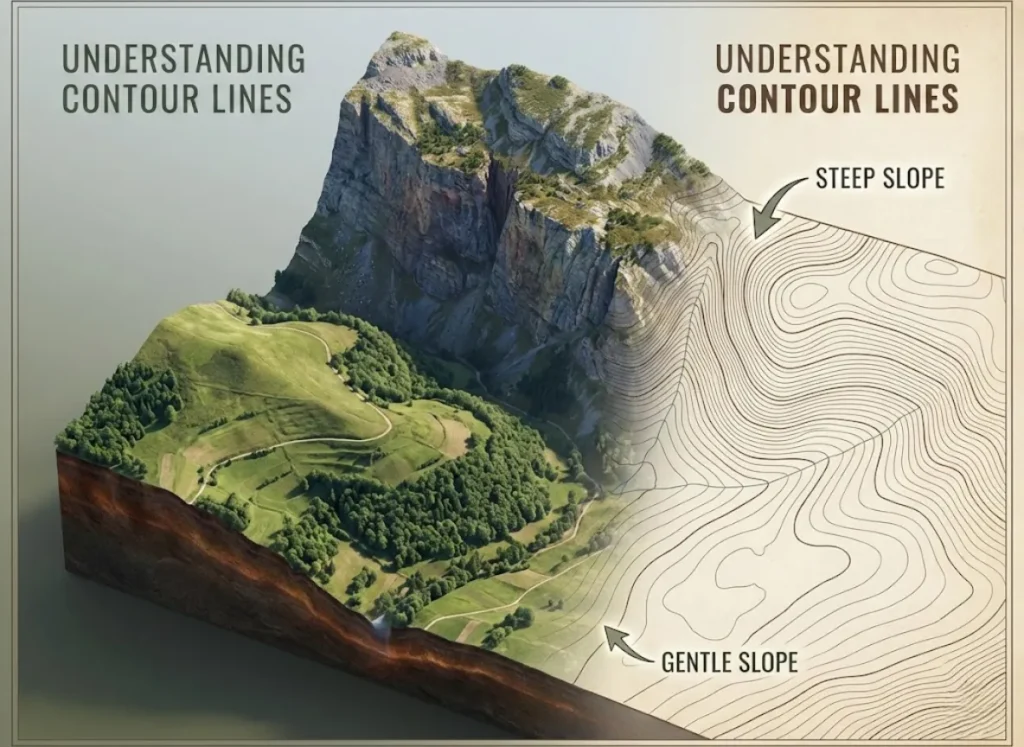
The most critical pattern to master is the “Rule of Vs.” This helps you tell the difference between water features and earth features.
When contour lines form a V-shaped contour pointing uphill (toward higher numbers), they indicate a Draw or Valley. This is where water cuts into the land, creating a concave slope.
On the other hand, when the V or U shape points downhill (toward lower numbers), it signifies a Spur or Ridge. These areas represent where the earth bulges outward in a convex slope. They usually offer drier footing and better views. For a deeper look at these rules, check our topographic map guide for hikers.
You can also reference the U.S. Geological Survey’s guide to topographic mapping for the official government standards on symbology used by the U.S. Geological Survey (USGS).
What are the five major terrain features you must recognize?
All complex terrain is made up of five major terrain features: Hill, Valley, Ridge, Saddle, and Depression.
- The Hill appears as closed circles inside each other, like a wedding cake. This is a high point, such as Mount Whitney or Pu’umakanaka.
- The Valley is defined by U-shaped contours pointing upstream. It often contains water.
- The Ridge is a line of hills and high ground.
- The Saddle is the hourglass-shaped low point between two hills. It is often used as a pass.
- The Depression is a low point surrounded by higher ground, looking like an egg pan on the map, often marked with tick marks pointing inward.
To memorize these instantly, land navigators use the “Fist Method” visualization. Clench your fist and look at the back of your hand. Another popular mnemonic is “Hidden Valley Saddle Ranch Dressing” (Hill, Valley, Saddle, Ridge, Depression).
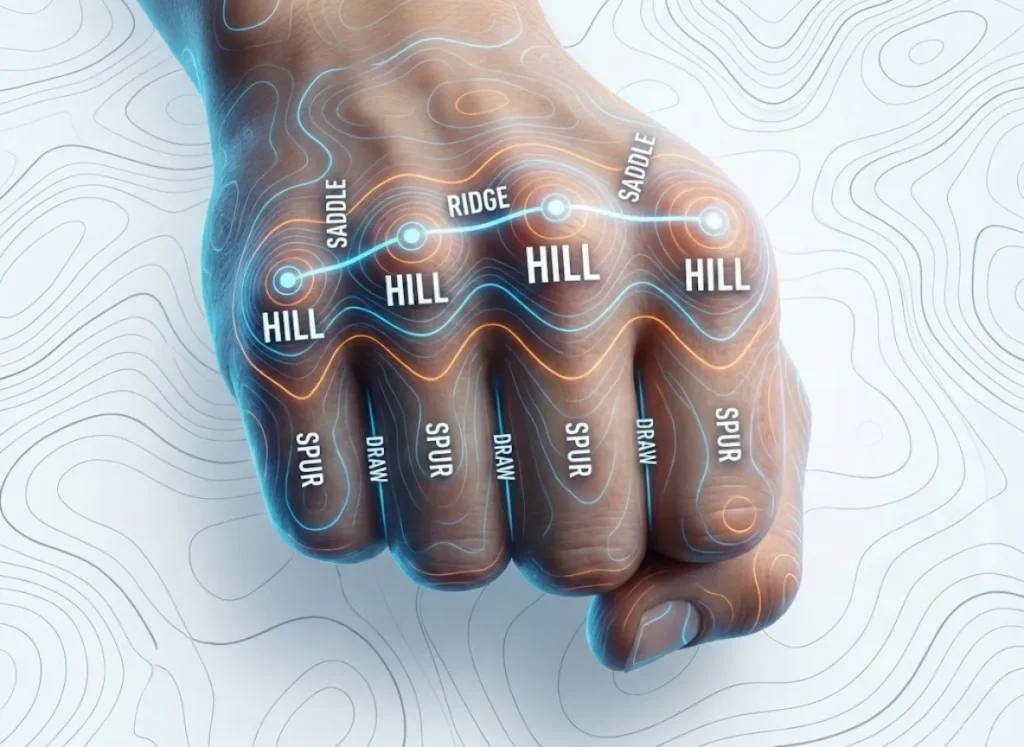
Your knuckles represent Hills. The line of knuckles forms a Ridge. The spaces between knuckles are Saddles. The gaps between your fingers are Draws running off the ridge.
This simple trick reinforces the alternating nature of the ground. You rarely move from a spur to a spur without crossing a draw. Just as you cannot move from finger to finger without crossing a gap. This is the foundation of mastering analog navigation skills.
For military definitions of these features, refer to The US Army Field Manual 3-25.26 on Map Reading and Land Navigation. Soldiers trained on task 071-com-1001 identify terrain use these exact definitions.
How do minor features like spurs and draws dictate your route?
Precision land navigation relies on knowing the difference between minor terrain features like Spurs and Draws.
Spurs are short, sloping ridges that jut out from the main mountain. Draws are the small gullies between them where water would flow, like the small creeks feeding into Prairie Branch. Spurs are generally better for travel. They offer firm ground, thinner vegetation, and better views to verify your location.
Draws, by contrast, act as funnels. They collect debris, dense brush, and wind. They often turn a short distance into an exhausting struggle where you burn extra energy.
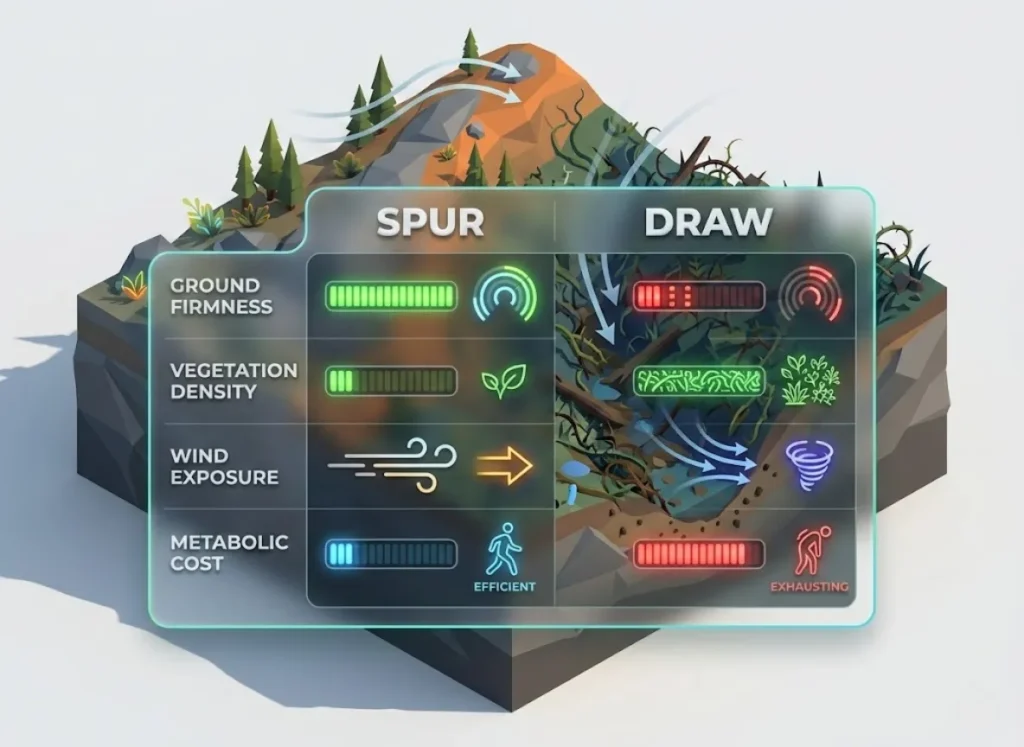
Mixing these up is a common error. When you are walking down a mountain, you must be careful not to drift from a Spur into a Draw. The effort required to walk through a Draw can be double that of a Spur on the hiking efficiency scale.
Recognizing the sharp V-shaped contours of a Draw versus the rounded U-shaped contours of a Spur prevents you from getting stuck in deadfall or arriving at a cliff. This knowledge is vital to prevent becoming lost, injured, or stuck in the wilderness.
Canadian Search and Rescue teams highlight this in their guide on trail markers and navigation. They note that misinterpreting drainage features is a leading cause of hikers getting lost.
How do you orient yourself using only the land?
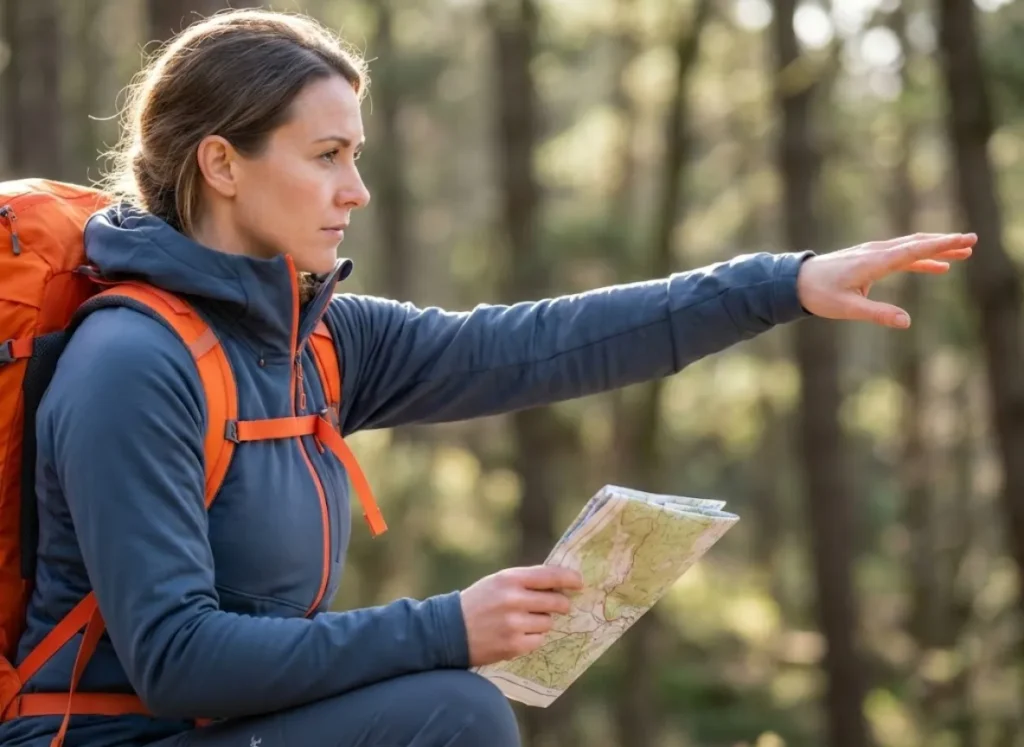
Orientation is simply the process of aligning your map with the world around you. You want “up” on the paper to point to the reality in front of your face.
How do you “set the map” to reality?
To orient a map without a compass, you must rotate the paper until the Map North aligns with True North (or generally North in the physical world). This makes the map reading intuitive.
Without a compass, you do this by “Inspection.” Look for two prominent major landmarks—such as a distant peak and a river bend—that are visible both on the ground and on the map.
Rotate the map and your body together. Do this until the imaginary line connecting the symbols on the paper matches the angle of the real-world objects.
This technique reduces mental fatigue. You don’t have to constantly think about “left” or “right” or do mental gymnastics. The map matches what you see. This is useful in areas like Quetico Provincial Park, where a canoe trip requires constant visual confirmation of islands and shorelines.
Verification is key. Once the map is set, check a third point. Does it match up? If so, you are oriented. This visual method bypasses the technical confusion often associated with magnetic declination explained, avoiding the math of East declination or West declination. However, understanding the difference between Grid North and Magnetic North remains important if you bring a Suunto MC-2 compass back into the mix.
For a standard protocol on this, see the Ordnance Survey’s beginner’s guide to reading a map.
How do “handrails” and “catching features” prevent you from getting lost?
A Handrail is a long, linear feature. It could be a ridge, a stream like Robinson Creek, or a power line. It runs parallel to your route.
By keeping a ridge on your right shoulder, for example, you can move fast. You don’t need to constantly check a device. You just keep the feature on your right.
This technique reduces the mental effort of navigation. It allows you to focus on your footing and hydration while maintaining a general direction.
A Catching Feature is your safety net. This is a distinct barrier (like a road, river, or cliff) located past your objective. It acts as a backstop.
If you hit the catching feature, you know immediately that you have gone too far. This gives you the confidence to move aggressively without worry.
Pro-Tip: Before stepping off, always identify your catching feature. Say it out loud: “If I cross the logging road, I have gone too far.”
Psychologically, catching features stop you from worrying about distance. They prevent the panic that sets in when you feel like you should have arrived by now. These are essential natural navigation techniques that every hiker should master.
The Australian Bushwalking Manual on navigation techniques offers excellent examples of how to use these features in thick brush.
What gear supports terrain association skills?
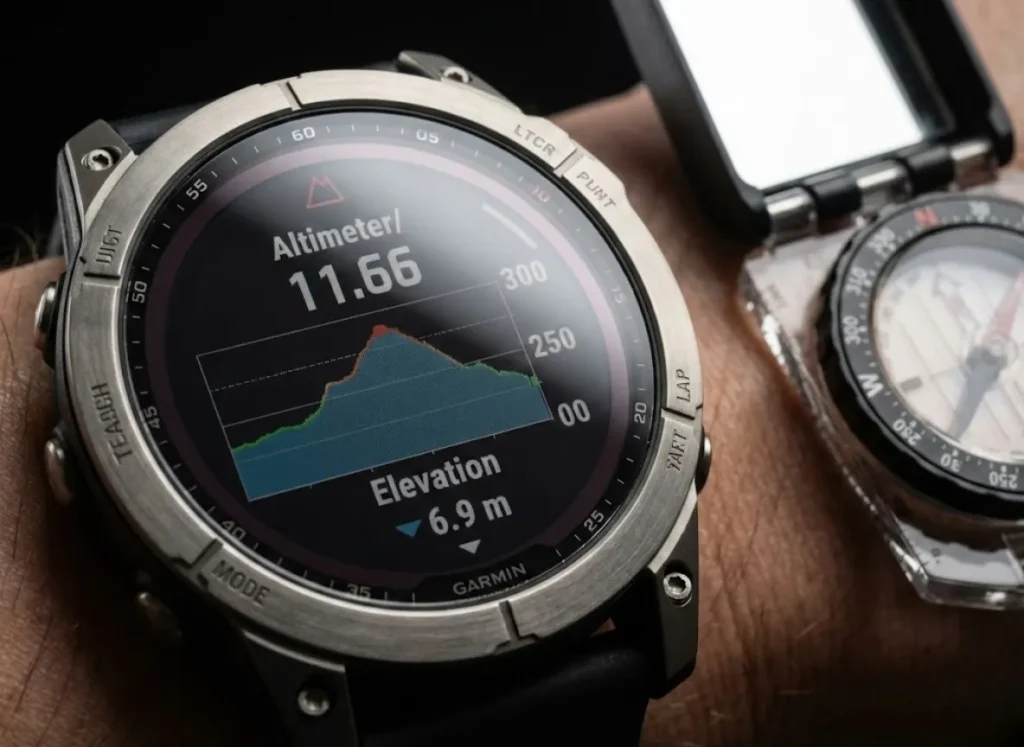
Even when navigating “without a compass,” you still need tools to verify what your eyes are seeing. The goal is to prove to yourself that you are where you think you are.
Why are specific maps and altimeters critical for this method?
If you are navigating by terrain, you need high-quality topo maps. Standard recreational maps often lack the detail to show small “Spurs” or “Draws.” This can lead to errors. You want a USGS 7.5-minute quad or a custom print focusing on a specific Huntsville Quadrangle if that’s where you are.
An Altimeter is a very useful tool. It acts as a “vertical compass.” It allows you to pinpoint your location by matching your elevation to a specific contour line on the map.
If you are on a known trail and your altimeter reads 10,200 feet, you can find exactly where that trail crosses the 10,200-foot line on the map. This gives you an exact location without ever needing a compass bearing.
Many modern hikers utilize the best hiking watch to access these barometric functions.
A compass with a sighting mirror, like the Suunto MC-2, is still useful, even if you aren’t using the magnetic needle. You can use it as a sighting tool to line up features accurately. Some advanced navigators also carry a military protractor and a GB2 lens for fine detail work on the map, especially when plotting coordinates using MGRS (Military Grid Reference System) or UTM (Universal Transverse Mercator).
Finally, practice “Thumbing the Map.” Keep your thumb pressed on your current location on the paper. Move it as you walk. This ensures your mental map is updated in real-time with every step. Resources like ITS Tactical or the Gray Bearded Green Beret channel often demonstrate these techniques. For more on using these tools together, read The Mountaineers blog on wilderness navigation.
Conclusion
Terrain association is not just a backup skill. It is a strategy for saving your energy. It allows you to choose the easiest routes, saving your body from unnecessary strain.
By mastering the shape of the land—using the “Rule of Vs” and the “Fist Method“—you turn flat lines into a real world. You stop looking at the map as a picture and start using it as a blueprint.
Using features like “Handrails” for speed and “Catching Features” for safety allows for confident movement through the wilderness.
Next time you are on a familiar trail, put the GPS away. Try to “thumb the map” and predict the next rise or dip before you see it. Share your experience with learning the “Fist Method” in the comments below.
FAQ – Frequently Asked Questions
What are the five major terrain features on a map?
The five major features are Hill, Valley, Ridge, Saddle, and Depression. A helpful mnemonic to remember them is Hidden Valley Saddle Ranch Dressing (Hill, Valley, Saddle, Ridge, Depression).
How do you read V-shaped contour lines?
The Rule of Vs states that V-shaped contours always point uphill when they represent a stream or valley. This is because water cuts into the land. Conversely, U or V shapes that point downhill represent a ridge or spur (earth bulging out).
Can you navigate without a compass if you have a map?
Yes, by using a technique called Map Orientation by Inspection. You align recognizable major landmarks on the ground with symbols on the map. This allows you to know where you are and which way to go based solely on the shape of the surroundings.
What is a handrail in land navigation?
A handrail is a linear feature—like a river, ridgeline, road, or power line—that runs parallel to your desired route. You can follow this feature to guide your movement without needing to constantly check a compass dial.
Risk Disclaimer: Hiking, trekking, backpacking, and all related outdoor activities involve inherent
risks which may result in serious injury, illness, or death. The information provided on The Hiking Tribe is for
educational and informational purposes only. While we strive for accuracy, information on trails, gear, techniques,
and safety is not a substitute for your own best judgment and thorough preparation. Trail conditions, weather, and
other environmental factors change rapidly and may differ from what is described on this site. Always check with
official sources like park services for the most current alerts and conditions. Never undertake a hike beyond your
abilities and always be prepared for the unexpected. By using this website, you agree that you are solely
responsible for your own safety. Any reliance you place on our content is strictly at your own risk, and you assume
all liability for your actions and decisions in the outdoors. The Hiking Tribe and its authors will not be held
liable for any injury, damage, or loss sustained in connection with the use of the information herein.
Affiliate Disclosure: We are a participant in the Amazon Services LLC Associates Program, an
affiliate advertising program designed to provide a means for us to earn advertising fees by advertising and linking
to Amazon.com. As an Amazon Associate, we earn from qualifying purchases. We are also an official affiliate partner
of Black Diamond Equipment via the AvantLink network. If you click on a Black Diamond affiliate link and make a
purchase, we may earn a commission at no additional cost to you. We also participate in other affiliate programs and
may receive a commission on products purchased through our links. Additional terms are found in the terms of
service.