In this article
I spent the first three days of a weeklong trip in the Sierras digging through my pack like a raccoon in a dumpster. Every time I needed a baselayer, I’d unpack half my gear on the ground, find it wedged under the bear canister, and shove everything back in worse than before. Somewhere around day four, I reorganized everything into three cheap packing cubes I’d been carrying unused at the bottom of the pack. The rest of the trip was a different experience.
Packing cubes work — but only if you use them right. Most hikers make the same five mistakes, and every one of them makes your hiking backpack heavier, less balanced, or harder to live out of on trail. Here’s what to fix before your next trip.
Quick Answer: The biggest packing cube mistakes hikers make are:
- Using rigid travel cubes in cylindrical hiking packs
- Stuffing everything into one oversized cube
- Ignoring weight placement and zone packing
- Mixing wet and dry gear in the same cube
- Overpacking cubes until zippers strain and fail
Why Packing Cubes Work Differently in Hiking Packs
The Shape Problem Nobody Mentions
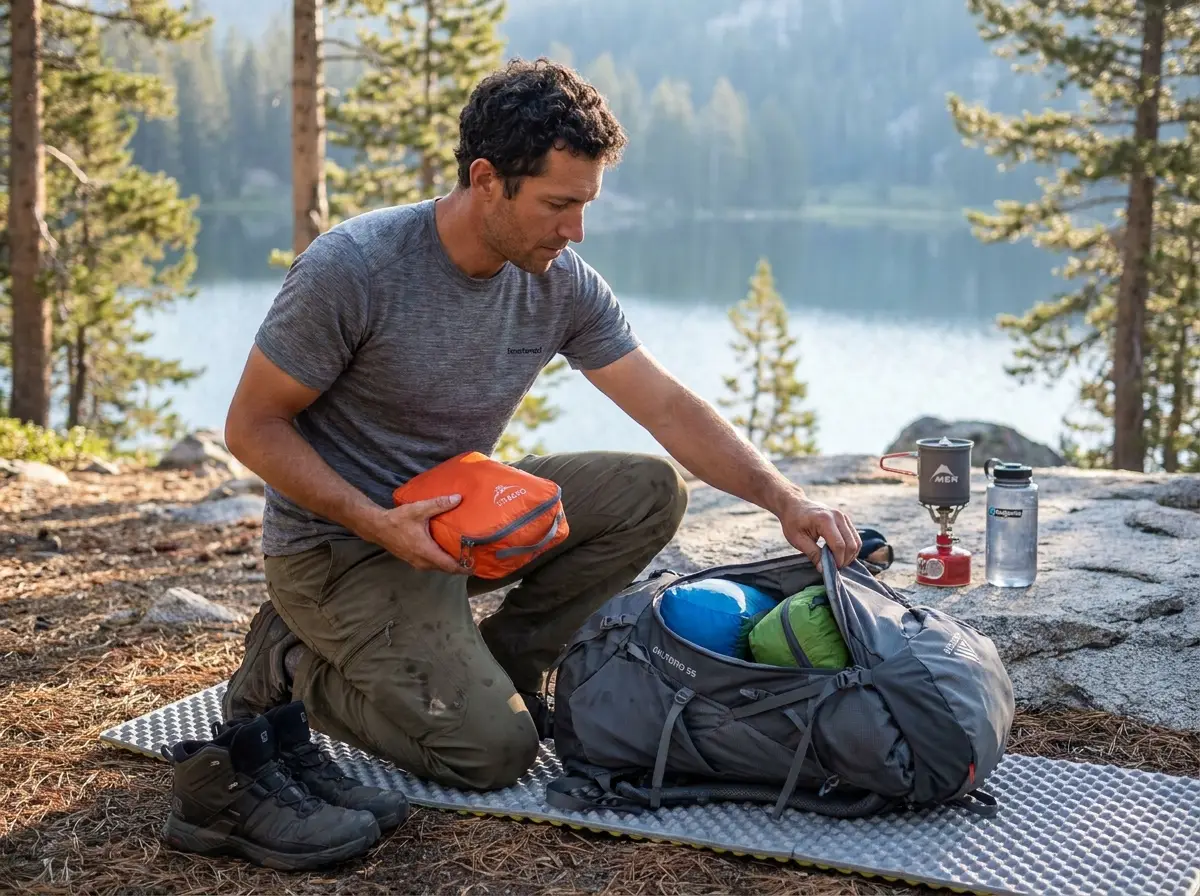
Here’s the thing travel bloggers won’t tell you: most packing cubes are designed for rectangular suitcases. They’re rigid, boxy, and they fill a flat space perfectly. A hiking backpack is not a flat space. It’s a cylinder.
When you jam a rectangular cube into a cylindrical pack, you get crescent-shaped dead space along both sides. That’s wasted volume — sometimes two to three inches per side — that you’re carrying as air. Multiply that across three or four cubes and you’ve lost a significant chunk of usable pack space.
The fix is using cubes made from soft, compressible materials that conform to the pack’s shape. Ultralight packing cubes from companies like Zpacks (DCF fabric, 0.67 oz per cube), Mountain Laurel Designs, or Granite Gear use thin, packable fabrics that mold around other items instead of fighting the pack walls.
How the Three-Zone System Changes Everything
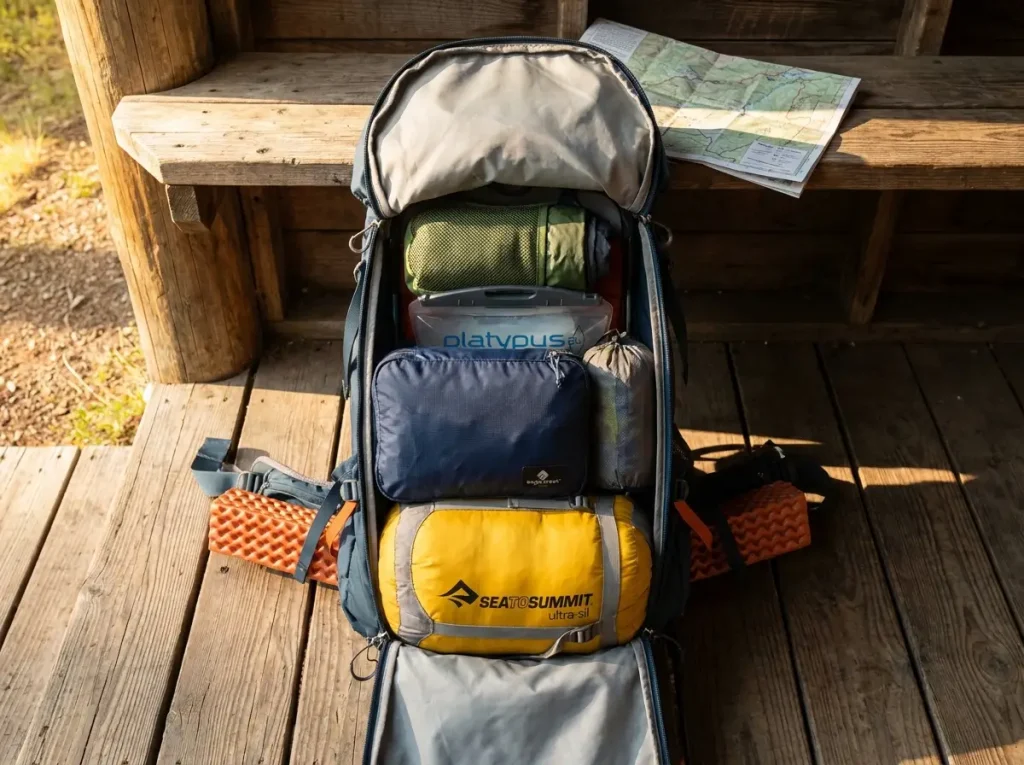
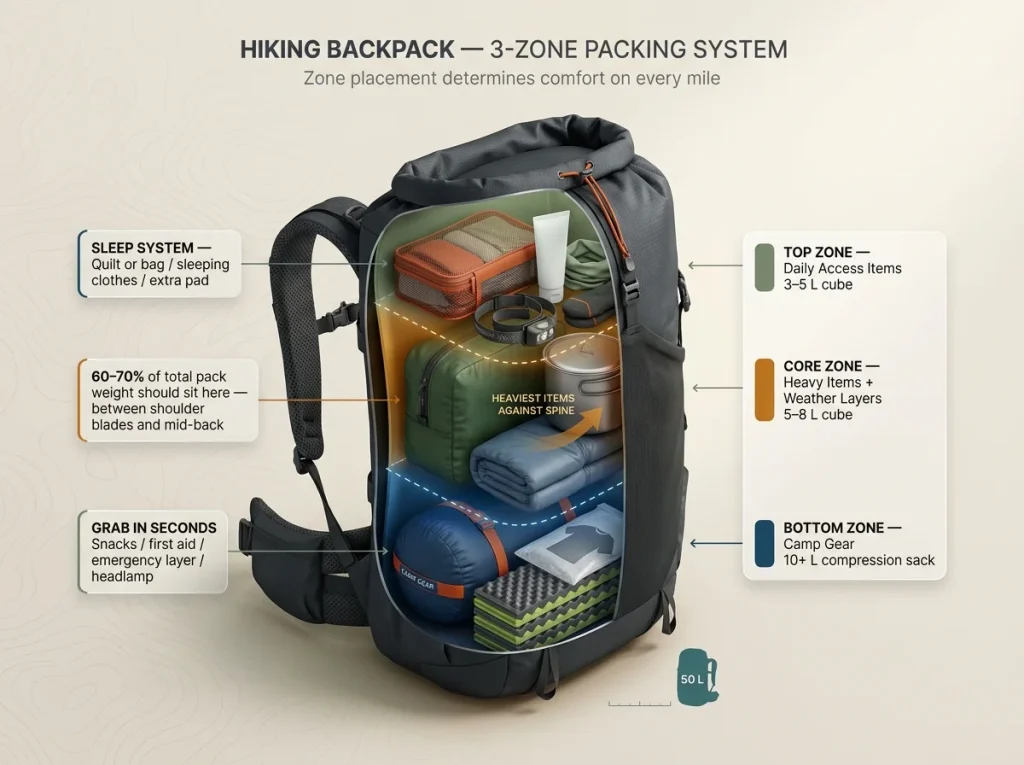
Every well-packed hiking backpack follows the same basic physics: heavy items go in the core zone close to your spine, light bulky items go at the bottom, and frequently accessed items go on top. About 60–70% of your pack’s total weight should sit between your shoulder blades and your mid-back.
Packing cubes make this system easier to maintain because each cube becomes a zone. Instead of playing Tetris with loose items every morning, you grab your three cubes, drop them in order, and you’re packed.
The zones stay consistent. The weight distribution stays consistent. Your pack feels the same at mile 1 and mile 15.
If you want to understand how pack weight affects your hiking — and where the real trade-offs are — there’s a deeper breakdown in our guide to the real weight vs comfort trade-off in hiking gear.
Pro tip: Label your cubes with a piece of medical tape and a Sharpie: “top,” “core,” and “bottom.” After two trips it becomes muscle memory and you won’t need the labels. But for the first few trips, the visual reminder keeps you from stuffing the heavy food cube on top out of laziness.
The Right Cube Sizes for Each Pack Zone
Small Cubes for Daily Access (Top Zone)
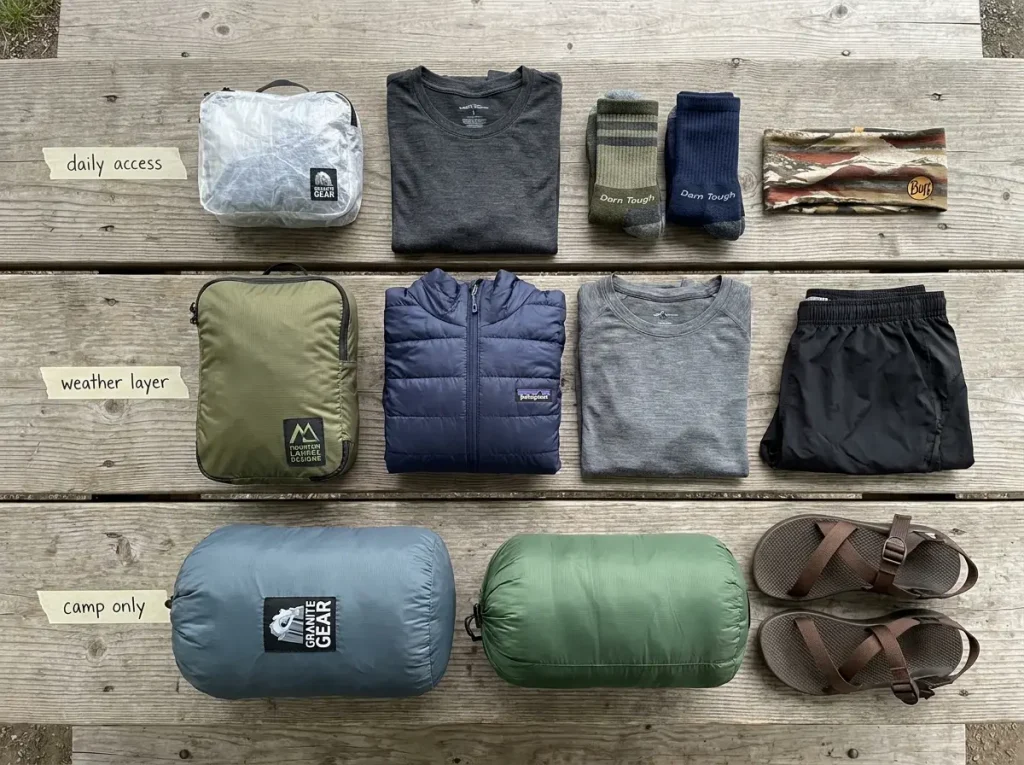
A small packing cube — roughly 3 to 5 liters — sits at the top of your pack and holds the items you reach for during the day. Merino underwear, a spare pair of socks, a Buff, sunscreen, and your headlamp fit here. This cube should be the lightest in your pack and the first thing you can grab when you open the top.
Color-coding helps. Pick a distinct color for this cube — orange, red, something that stands out immediately when you look into the pack. You want to spot it in two seconds, not dig for it.
Medium Cubes for Weather Layers (Core Zone)
A medium cube — 5 to 8 liters — holds your insulation and weather layers. A compressed down jacket, a rain shell, a merino long-sleeve baselayer, and a lightweight pair of sleep shorts. This cube sits in the core zone, close to your back, where the weight matters most for balance.
Compression cubes earn their keep here. A cube with a secondary compression zipper can squash a puffy jacket down to about 60% of its loosely packed volume, and that recovered space translates directly to a better-balanced load. The extra ounce of the compression mechanism is worth it for this one cube.
Large Cubes or Compression Sacks for Camp Gear (Bottom Zone)
The bottom of your pack holds gear you won’t touch until camp: your sleeping bag or quilt, your sleeping pad if it’s not strapped outside, and any camp-only clothes. A large compression sack — 10+ liters — works better than a packing cube here because you want maximum compression and you’re not accessing this gear mid-hike.
Some hikers skip the cube entirely for this zone and just use a dry bag that doubles as pack liner. A 20-liter DCF dry bag keeps your sleep system waterproof and compresses into the bottom of the pack without the structure of a cube. For anyone worried about wet weather, this is the most weight-efficient approach.
If your pack frame is starting to barrel or your foam is compressing unevenly, that bottom zone load might be the cause. Five signs your hiking backpack needs to be replaced covers the structural red flags worth checking.
Mistake #1 — Using Travel Cubes in a Cylindrical Pack
Why Rigid Cubes Cost You Volume
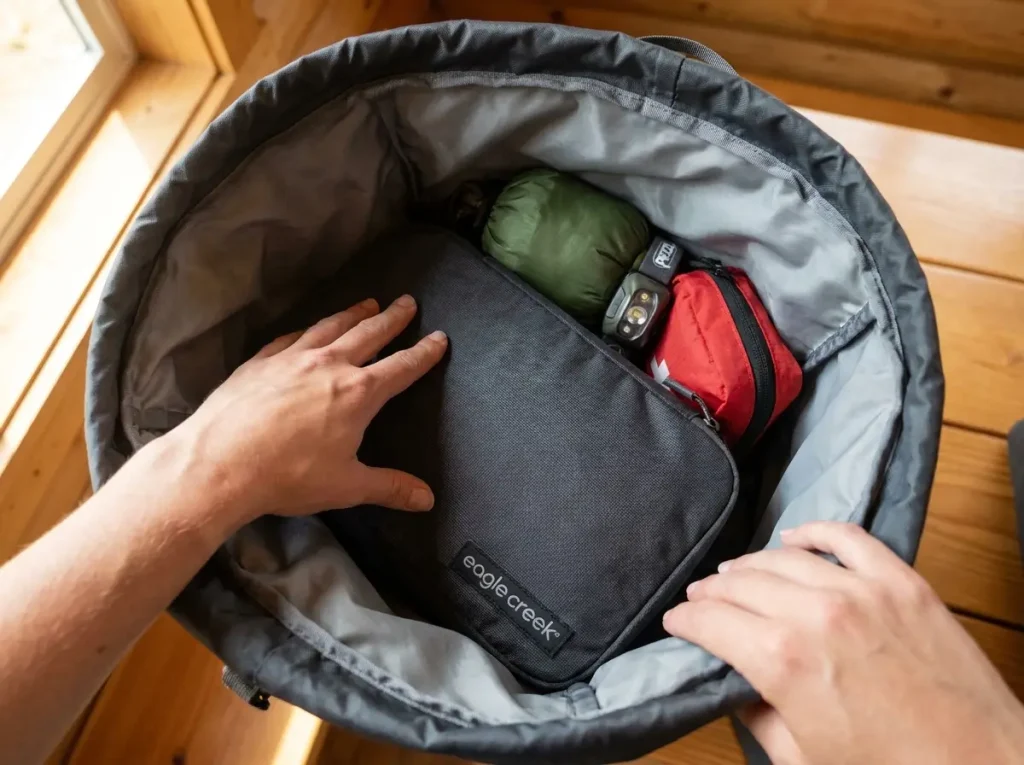
Rigid-sided packing cubes — the kind with structured panels and reinforced corners — were built for suitcases. They hold their rectangular shape even when half-full, and that’s a feature in a hard-sided bag. In a top-loading cylindrical hiking backpack, that feature becomes a problem.
A rigid medium cube that measures 10″ × 7″ × 4″ won’t bend to follow the curve of a 50-liter pack’s interior. You end up with air pockets at the corners, and those air pockets can’t hold anything useful. Worse, the rigid cube prevents items around it from shifting into a natural, efficient arrangement.
What to Use Instead
Soft-sided ultralight packing cubes in DCF (Dyneema Composite Fabric) or silnylon weigh a fraction of structured travel cubes and conform to any pack shape. Zpacks DCF packing cubes weigh 0.4–0.67 ounces depending on size. A comparable Eagle Creek structured cube weighs 2.5 ounces — four to six times heavier — and wastes space in a non-rectangular pack.
If you already own rigid cubes and don’t want to buy new ones, stuff a soft item (like a puffy jacket) between the cube and the pack wall to fill the dead space. It’s a band-aid, but it works for a trip or two while you decide if purpose-built cubes are worth the investment.
For anyone dialing in their external carry system alongside their internal organization, how to attach gear to the outside of your backpack covers the physics of keeping external loads stable.
Mistake #2 — One Giant Cube Instead of Multiple Small Ones

The Modular Advantage
It’s tempting to use one big cube for all your clothes. Fewer cubes means less fussing, right? On trail, the opposite is true.
One big cube forces you to open and rummage through everything to find a single item. You pull out the cube, unzip it, dig past your sleep layers to find your rain shell, and then repack the whole thing. At 6 AM in the cold, that gets old fast.
Multiple small cubes — three is the sweet spot for most hikers — let you pull exactly the cube you need without disturbing the others. Your core zone cube stays packed in position. Your bottom zone compression sack never moves. You pull your top-zone daily cube, grab the socks, zip it back, and you’re walking in 30 seconds.
The Weight Tax Is Smaller Than You Think
Three ultralight cubes from Zpacks or MLD total roughly 1.5–2 ounces. One large Eagle Creek compression cube weighs 3.5 ounces by itself. The multi-cube approach is often lighter AND more functional than the single-cube approach.
Pro tip: On a multi-day trip, shift your cube positions as food weight decreases. On day one, your food bag is heavy and belongs in the core zone. By day five, it’s almost empty and can move to the top while your weather cube slides to the core position. This micro-adjustment keeps your center of gravity where it should be as your consumables drop.
Mistake #3 — Ignoring Weight Placement Inside the Pack
Cubes Make Bad Balance Worse if You Don’t Think
Packing cubes don’t fix bad weight distribution — they hide it. If you pack your heaviest cube at the top of your pack, the cubes make the load neat and organized. It’ll also pull you backward on every uphill step.
The physics are straightforward: heavy items need to sit close to your spine and between your shoulder blades. Your food, water, and stove go in the core zone. Light, compressible gear goes at the bottom. Frequently accessed light items go on top.
Packing cubes should enforce this system, not replace it.
If you’ve ever felt your pack pulling you backward or swaying side to side on uneven terrain, the problem is almost always weight placement, not the pack itself. A quick reorganization of which cube sits where can fix the issue in five minutes. The deep guide to how backpack suspension systems work explains why this matters mechanically.
The Side-to-Side Problem
Most hikers think about vertical zones but forget lateral balance. If your water bladder sits on the left side and your food bag is on the right, the asymmetry forces your core muscles to compensate with every step. Over 10 miles, that compensation becomes fatigue.
Pack cubes symmetrically when possible. If one side has to be heavier — say, a full Nalgene in the side pocket — shift a dense cube slightly toward the opposite side inside the pack. Small adjustments compound over long days.
Mistake #4 — Mixing Wet and Dry Gear in the Same Cube
Why It Ruins More Than One Outfit
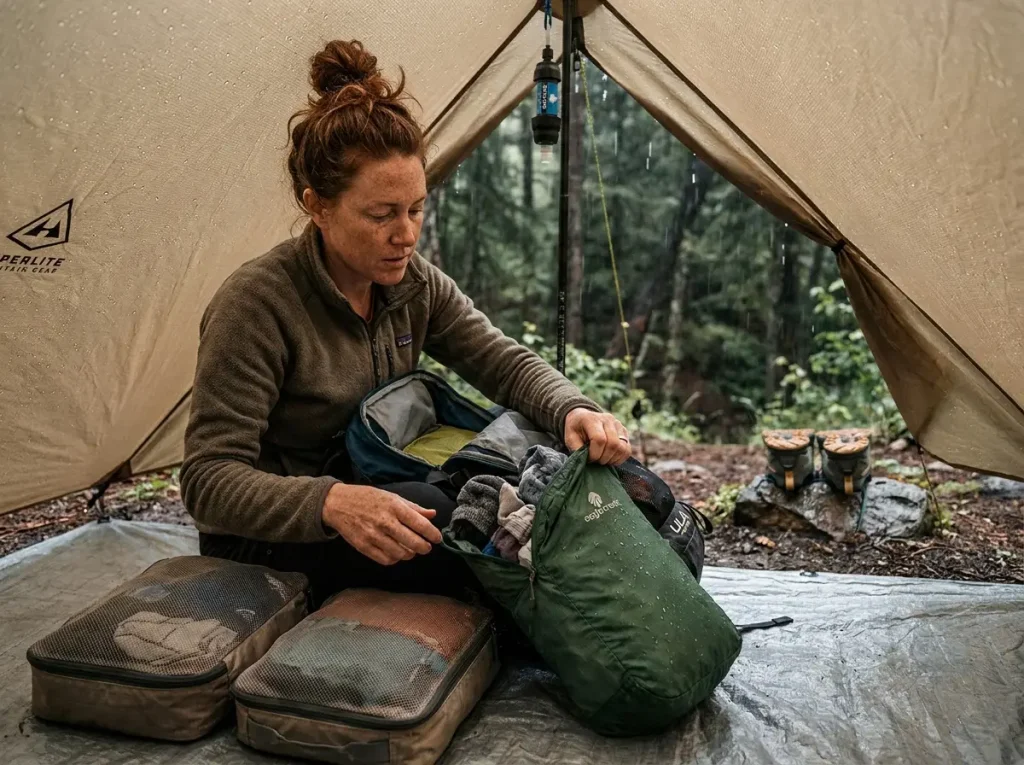
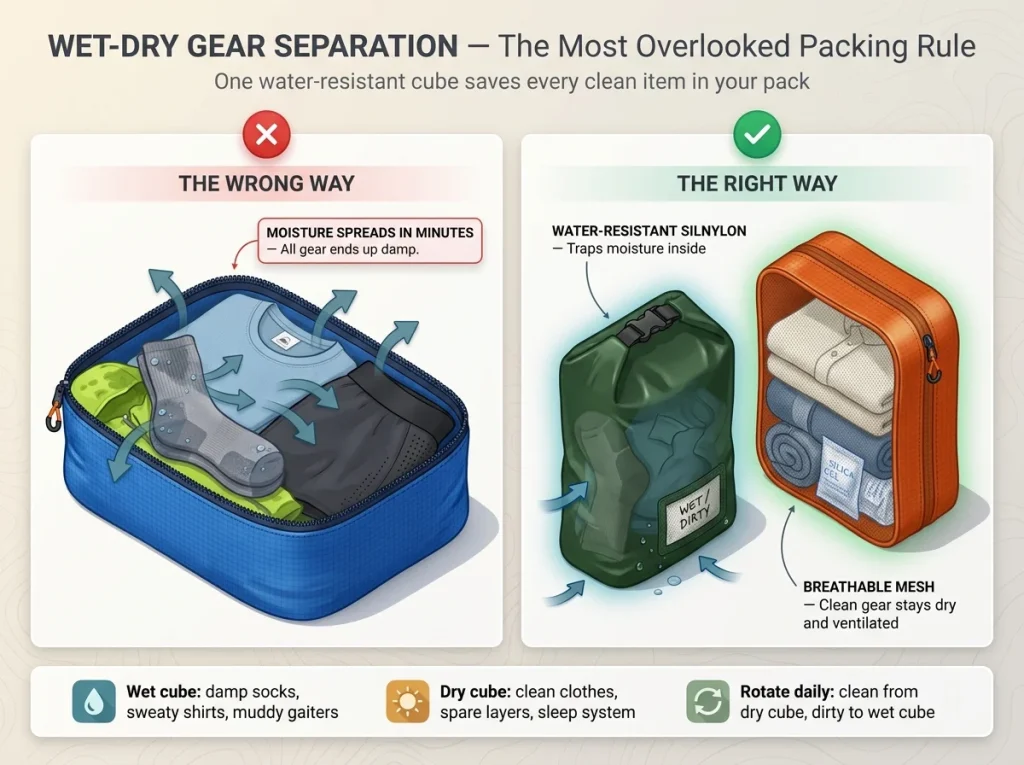
Rain happens. Stream crossings splash. Sweat-soaked shirts need somewhere to go. When wet gear goes into the same cube as dry gear, moisture spreads through fabric contact in minutes.
By the time you reach camp, your entire clothing cube smells like a gym bag and nothing is actually dry.
The standard advice is “use a dry bag.” That’s half the answer. The other half: designate one cube specifically for wet and dirty items. A water-resistant cube — like the Eagle Creek Pack-It Isolate or a simple ziplock-style DCF bag — holds damp socks, sweaty shirts, and muddy gaiters without letting moisture migrate to clean gear.
This wet cube lives at the top of your pack, not buried at the bottom. You need access to it throughout the day as items get sweaty. And at camp, it’s the first thing you pull out to hang your wet items on a line or drape them over your tent guylines.
The Dirty-Clean Rotation System
On a multi-day trip, your wet cube and your daily access cube work in rotation. Morning: pull a clean pair of socks from the daily cube. Evening: drop the worn pair into the wet cube.
When you reach a town or water source where you can wash, empty the wet cube, rinse everything, and let it dry. The clean cube replenishes and the cycle continues.
This system only works if the cubes are separate. Mixing clean and dirty clothes in one cube is the fastest way to run out of wearable clothes on a backpacking trip. It sounds obvious, but after a long day on trail, the temptation to just shove everything into one pile is strong. Separate cubes remove the temptation.
Pro tip: A handful of silica gel packets in your dry cube absorbs residual moisture from hands and condensation. They weigh almost nothing and keep your clean clothes genuinely dry. Grab them from shoe boxes — free and effective.
Mistake #5 — Overpacking Cubes Until Zippers Fail
The Compression Trap
Compression cubes invite overpacking. The secondary zipper makes you think “I can fit more” — so you stuff the cube until the main zipper strains and the fabric bulges at the seams. On trail, that overstressed zipper catches, sticks, or splits. Now you’re carrying a broken cube and a pile of loose gear.
The rule is simple: fill the cube to about 80% capacity before compressing. The compression zipper should reduce the remaining 20% of air, not fight against 40% of excess clothing. If you can’t close the main zipper without force, remove an item.
What Happens When You Push It
A burst zipper on trail means one of two cubes is suddenly useless. Your carefully organized system falls apart. Items shift in the pack, weight distribution changes, and you spend the rest of the trip stuffing loose clothes into whatever gap exists.
The long-term fix is being honest about what you actually wear on trail. Most hikers pack three shirts for a five-day trip when two would do. One pair of sleep clothes, not two. One extra pair of socks beyond what you’re wearing, not three.
If you’re already thinking about lightening your clothing load for hot weather specifically, gear choices that reduce chafing in humid conditions covers fabric selection that works double duty as weight savings and comfort.
The Verdict — When Cubes Earn Their Weight
They’re Worth It for Multi-Day Trips
On a three-day backpacking trip or longer, packing cubes pay for their weight in time saved and organization maintained. The zone system keeps your load balanced. The separation keeps your clothes dry and accessible. The consistent packing routine saves you 5–10 minutes every morning — time that adds up when you’re trying to beat weather windows or catch a shuttle.
For thru-hikers, the calculus shifts slightly. Some ultralight thru-hikers skip cubes entirely because they carry so few clothes that organization isn’t an issue — two shirts and two pairs of socks don’t need a filing system. But even the gram-counters tend to carry at least one small DCF bag for wet-dry separation during the rain — losing your only dry baselayer to moisture migration is a miserable lesson you only learn once.
Skip Them for Day Hikes
If your pack comes off at the trailhead and goes back on at the car, cubes add weight without solving a real problem. A simple stuff sack for your extra layer is plenty. The time you’d spend organizing cubes is time better spent on trail.
The honest test: if you spend more than 60 seconds looking for something in your pack on a multi-day trip, cubes will fix that. If you know exactly where everything is because you’re only carrying ten items, save the ounces.
Conclusion
Shape matters more than brand. Soft, compressible cubes that conform to your cylindrical pack will always outperform rigid travel cubes that waste space at the corners. Buy for your pack shape, not for the name on the label.
Three cubes, three zones, three seconds. Top zone for daily access, core zone for weather layers, bottom zone for camp gear. If you can’t find what you need in three seconds, your system needs work.
Keep wet and dry apart — always. One water-resistant cube for damp and dirty gear, one breathable cube for clean clothes. The rotation system works on day one and it works on day twenty. The hikers who skip this step are the ones wringing out their only dry shirt at 6 AM.
Check your current packing system before your next trip. Pull everything out, sort it into three piles by access frequency, and see if three cubes would change your morning routine. The Leave No Trace “plan ahead and prepare” principle starts with how you organize your pack — an organized hiker moves faster, leaves fewer things behind, and spends less time fumbling at campsites.
Q1 Are packing cubes worth the weight for backpacking?
For multi-day trips, yes. Three ultralight DCF cubes weigh about 1.5–2 ounces total and save 5–10 minutes of packing each morning. They also maintain weight distribution consistency that improves comfort over long days. For day hikes, skip them.
Q2 What size packing cubes fit a 50-liter hiking backpack?
A small (3–5L), medium (5–8L), and large compression sack (10+L) fit well in a standard 50-liter pack. Avoid rigid travel-sized cubes larger than 8 liters — they leave dead space in cylindrical packs and fight the pack’s natural shape.
Q3 Should I use packing cubes or stuff sacks for backpacking?
Use both for different zones. Packing cubes work best for clothing organization in the top and core zones. Compression stuff sacks or dry bags work better for the bottom zone where maximum compression and waterproofing matter more than accessibility.
Q4 How do I keep wet gear from soaking my dry clothes?
Designate one water-resistant cube for wet and dirty items. Keep it at the top of your pack for easy access. Never mix damp gear with dry clothing in the same cube — moisture transfers through fabric contact within minutes.
Q5 Do compression packing cubes actually save space?
Yes, but only for compressible items like puffy jackets and fleece layers. A compression cube can reduce a down jacket to about 60% of its loosely packed volume. For dense items like food or hard goods, compression cubes offer no benefit over regular cubes.
Risk Disclaimer: Hiking, trekking, backpacking, and all related outdoor activities involve inherent
risks which may result in serious injury, illness, or death. The information provided on The Hiking Tribe is for
educational and informational purposes only. While we strive for accuracy, information on trails, gear, techniques,
and safety is not a substitute for your own best judgment and thorough preparation. Trail conditions, weather, and
other environmental factors change rapidly and may differ from what is described on this site. Always check with
official sources like park services for the most current alerts and conditions. Never undertake a hike beyond your
abilities and always be prepared for the unexpected. By using this website, you agree that you are solely
responsible for your own safety. Any reliance you place on our content is strictly at your own risk, and you assume
all liability for your actions and decisions in the outdoors. The Hiking Tribe and its authors will not be held
liable for any injury, damage, or loss sustained in connection with the use of the information herein.
Affiliate Disclosure: We are a participant in the Amazon Services LLC Associates Program, an
affiliate advertising program designed to provide a means for us to earn advertising fees by advertising and linking
to Amazon.com. As an Amazon Associate, we earn from qualifying purchases. We are also an official affiliate partner
of Black Diamond Equipment via the AvantLink network. If you click on a Black Diamond affiliate link and make a
purchase, we may earn a commission at no additional cost to you. We also participate in other affiliate programs and
may receive a commission on products purchased through our links. Additional terms are found in the terms of
service.