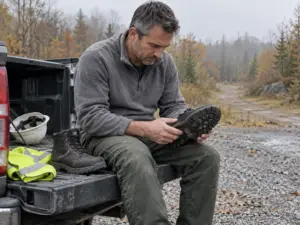
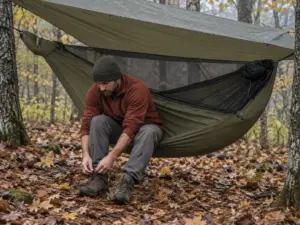
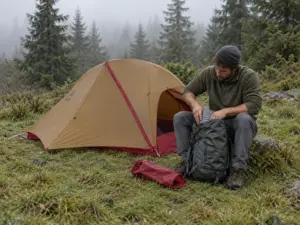
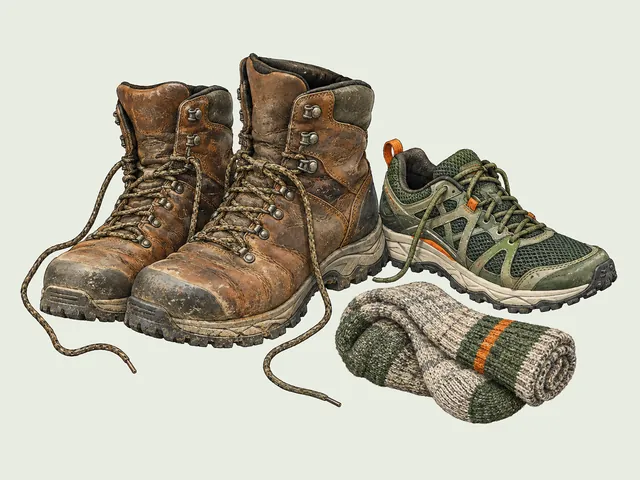
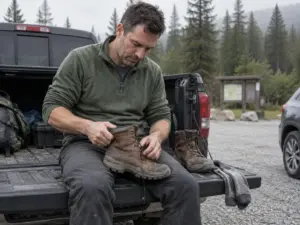
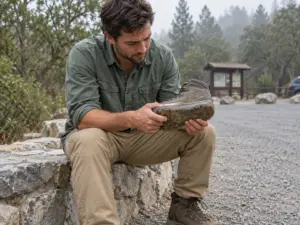
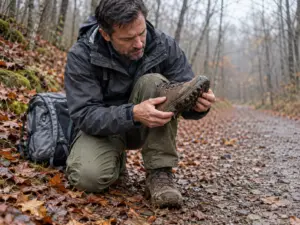
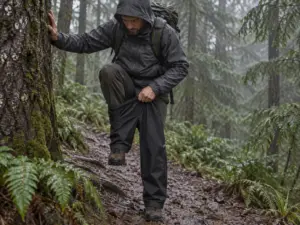


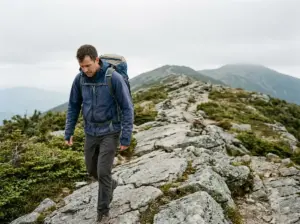
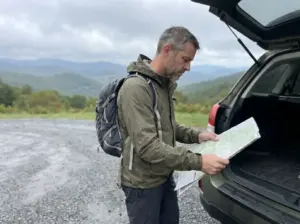

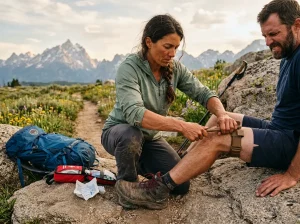

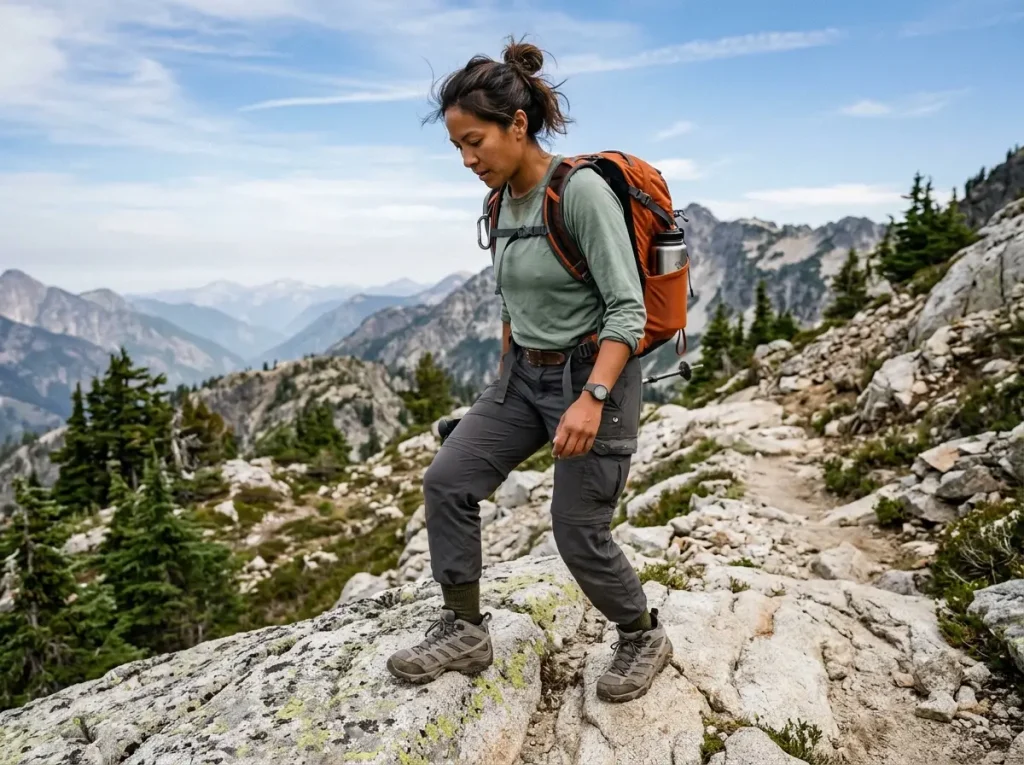
The boots felt perfect in the store. Snug, supportive, a little stiff but broken in, the salesperson promised. By mile 4 on the first real hike the right heel was on fire, and by mile 6 there was a blister the size of a quarter. If that sounds familiar, you’re in good company, because it happens to nearly every woman who sizes her hiking boots like dress shoes. After hundreds of miles in everything from featherweight trail hybrids to stiff leather backpacking boots, I’ve watched the same pattern hold every time: the wrong fit beats the wrong boot. This guide covers the six best women’s hiking boots of 2026, what actually makes a women’s last different from the generic version, and the three things nobody mentions at the gear-shop checkout.
Here’s how the six picks stack up before we get into the why behind each one.
| Boot | Best For | Weight | Waterproofing | Key Strength |
|---|---|---|---|---|
| La Sportiva TX Hike Mid Leather GTX | Best Overall | 14.2 oz | GORE-TEX | Lightest leather boot, almost no break-in |
| Merrell Moab 3 Mid GTX | Best Value | 14.5 oz | M-Select DRY | Proven all-rounder with a forgiving fit |
| Salomon X Ultra 5 Mid GTX | Best Lightweight | 12.8 oz | GORE-TEX | Trail-runner feel with ankle height |
| KEEN Targhee IV Mid WP | Best Wide Feet | 17.3 oz | KEEN.DRY (PFAS-free) | Widest toe box in the category |
| LOWA Renegade EVO GTX Mid | Best Backpacking | 18.4 oz | GORE-TEX | Resoleable build, load-hauling stability |
| Columbia Newton Ridge Plus WP | Best Budget | 12.9 oz | Omni-Tech sealed | Lowest cost of entry, flexible out of box |
What Makes Women’s Hiking Boots Actually Different
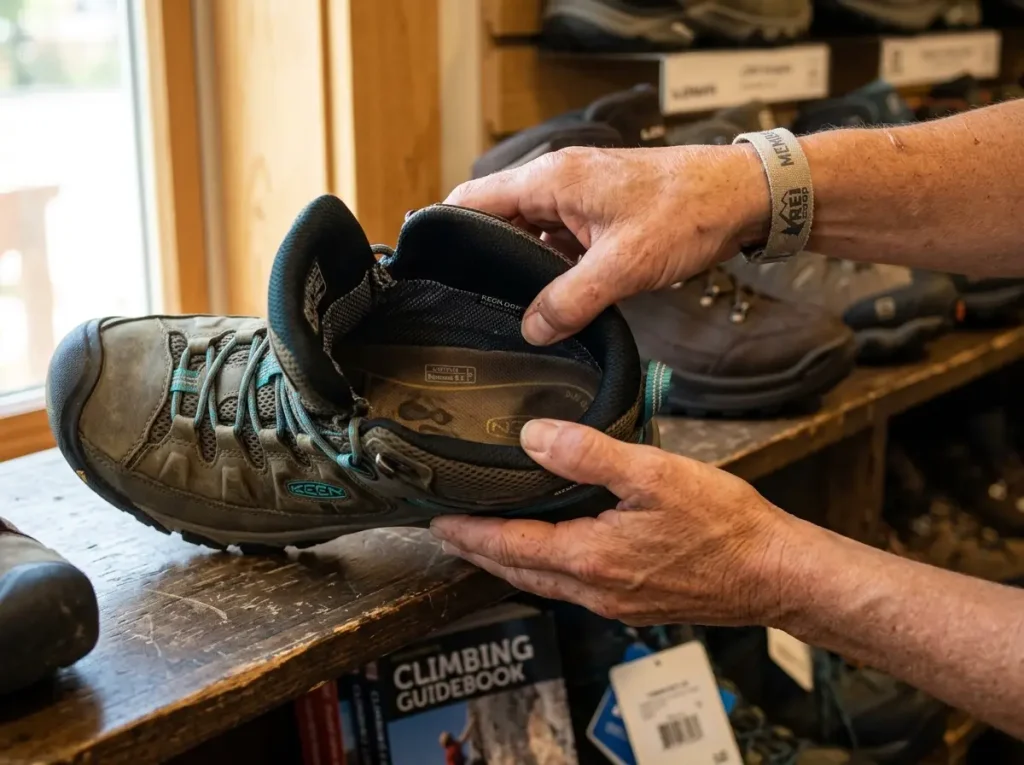
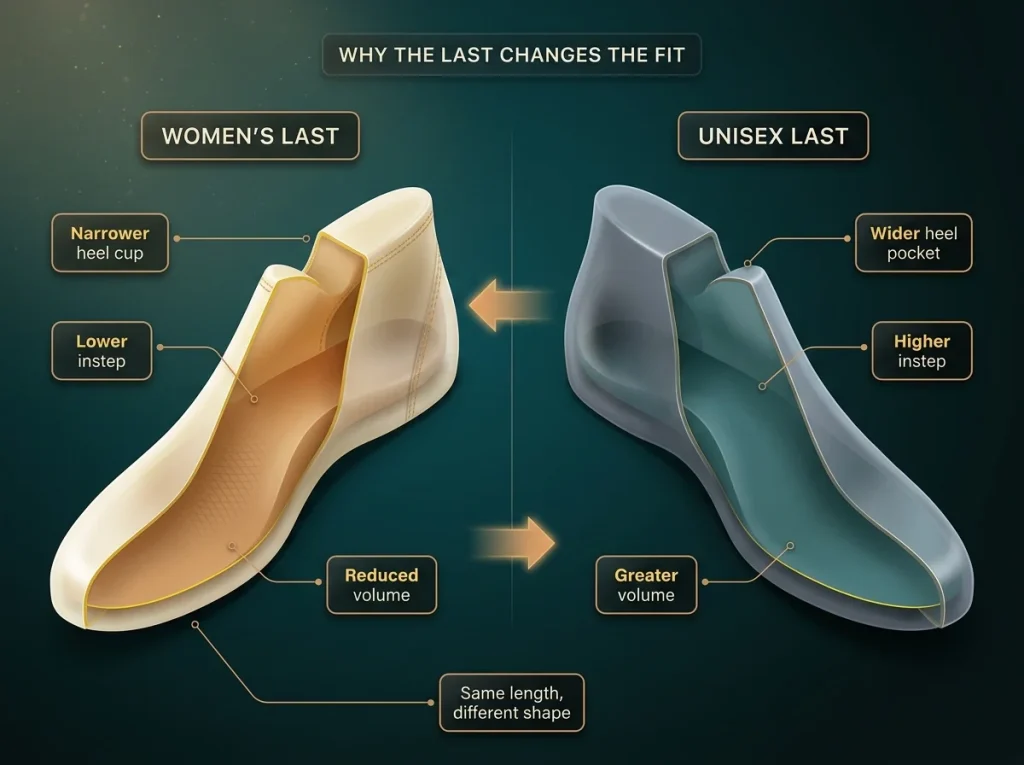
At the gear shop the conversation usually goes: “Do you want men’s or women’s?” Then everyone starts comparing weights and waterproofing and nobody says the part that actually matters. A women’s boot is not a smaller, prettier men’s boot. The last, which is the foot-shaped form the boot is built around, is engineered differently, and that difference is where most blisters are born.
Three things change on a true women’s last. The heel cup is narrower, the instep sits lower, and the overall internal foot volume is reduced. That matters because a roomy heel pocket is what lets your heel lift a half-inch with every step, and a half-inch of heel slip over a mile is a thousand tiny rubs that turn into a hot spot by lunch. If you’ve ever pulled on a unisex or men’s boot and felt your heel swimming even though the length was right, now you know why. The length was fine. The volume was built for a different foot.
Here’s the wrinkle nobody warns you about: many women have a wide forefoot and a narrow heel at the same time. That combination is the reason boot shopping feels rigged. KEEN’s wide-form last fixes the toe box but can leave a narrow heel loose. LOWA’s narrow last locks the heel but pinches a wide forefoot. La Sportiva splits the difference. There’s no universal “women’s fit,” only a last that matches your particular foot, and figuring out which end of the spectrum you fall on saves you from returning three pairs.
Then there’s volume, separate from width. A high-arch foot dropped into a low-volume boot gets pressure across the top of the instep within a couple miles. A low-arch foot in a high-volume boot gets heel slip no amount of lacing fully cures. Width is side to side; volume is the total space your foot displaces. Both have to match, and most sizing charts only talk about one of them.
The fit you should actually trust is the one you measure, not the one you feel standing still. Slide one thumb behind your heel with the boot unlaced and your foot pushed forward; one thumb-width of space means the boot isn’t oversized. Then lace up, stand on a slight downhill, and check for a thumb-width ahead of your longest toe so you have room on descents. Those two checks catch about 80% of fit problems, and they line up with the Appalachian Mountain Club’s boot fitting protocol, which has been steering hikers away from store-feel sizing for years. If you already know you sit on the narrow end of the scale, our guide to fitting hiking boots for narrow feet goes deeper on locking down a slippery heel.
If you’ve got a wide ball and a narrow heel, don’t size up to chase toe room — you’ll just move the heel slip to a bigger boot. Buy the wide-forefoot last and fix the heel with a surgeon’s-knot heel lock at the ankle hooks. I’ve talked more women out of a return that way than any other single trick.
Best Overall Women’s Hiking Boot
The “best overall” slot in most roundups just goes to whatever won last year. The La Sportiva TX Hike earns it on its own merits because it solves the contradiction every leather boot usually forces on you: real leather toughness without the 80-hour break-in that leaves your heels raw for two weeks.
Best Overall Pick — La Sportiva TX Hike Mid Leather GTX
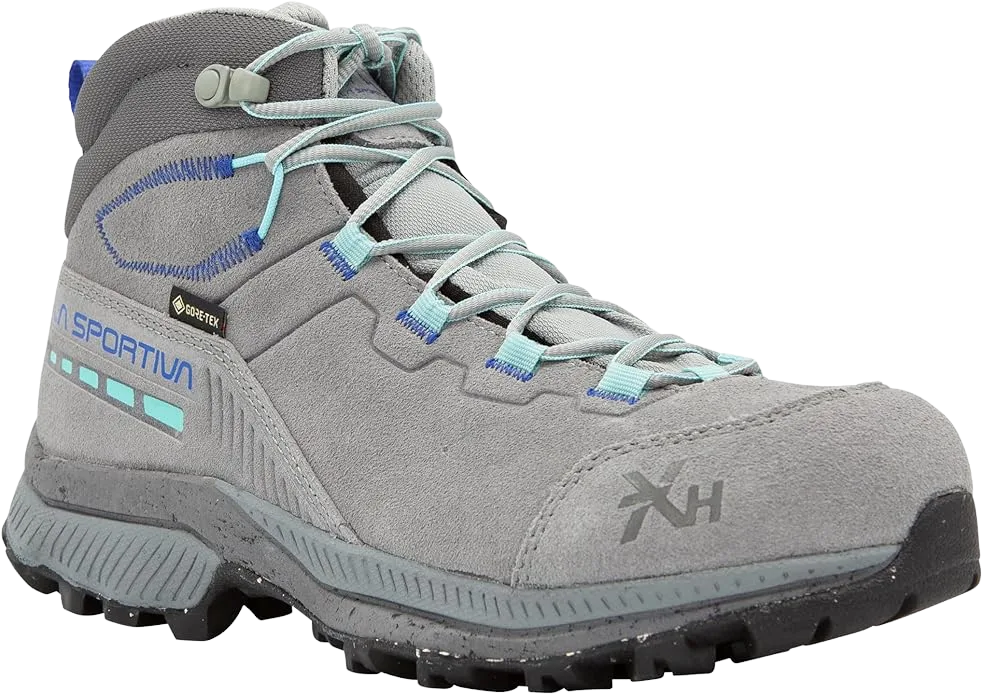
At 14.2 oz it undercuts most leather boots by a few ounces, and you feel every one of them at mile ten. Traditional leather boots run 16 to 18 oz and announce themselves on every step. The TX Hike walks more like a beefy trail shoe with a waterproof leather skin, which is exactly what a lot of day hikers actually want. The La Sportiva TX Hike Mid Leather GTX is the boot I hand to friends who say they hate “clunky” footwear but still want something that survives a rocky trail.
The Vibram Ecostep EVO outsole is the other quiet win. The lug pattern and the dedicated braking zone under the heel give you real bite on loose descents, the spot where cheaper boots turn into skis. If you care about the difference between a nubuck upper and a synthetic one, our breakdown of leather vs. synthetic construction explains why leather still wins for durability even as the weight gap closes.
What to Watch For: Summer Heat and Ankle Flexibility
Two honest cautions. First, this is a GORE-TEX boot, so on a dry 80-degree afternoon below treeline your foot’s own sweat has nowhere to go, and a waterproof boot starts working against you (more on that decision in the terrain section). Second, the ankle collar is flexible by design, which is a gift on day hikes and a limitation under a heavy pack. If you’re routinely hauling 35-plus pounds or scrambling class-4 terrain, you want something stiffer, and that’s a different boot entirely. The TX Hike is a brilliant day-hiker and a mediocre mule. Buy it for what it is.
Best Value Women’s Hiking Boot
Ten thousand Amazon reviews doesn’t make a boot perfect. It means ten thousand women put it on real trails and most of them weren’t sorry. That counts for something when you’re not yet sure how serious a hiker you’re going to become, and you’d rather not gamble a premium budget on the answer.
Best Value Pick — Merrell Moab 3 Mid GTX
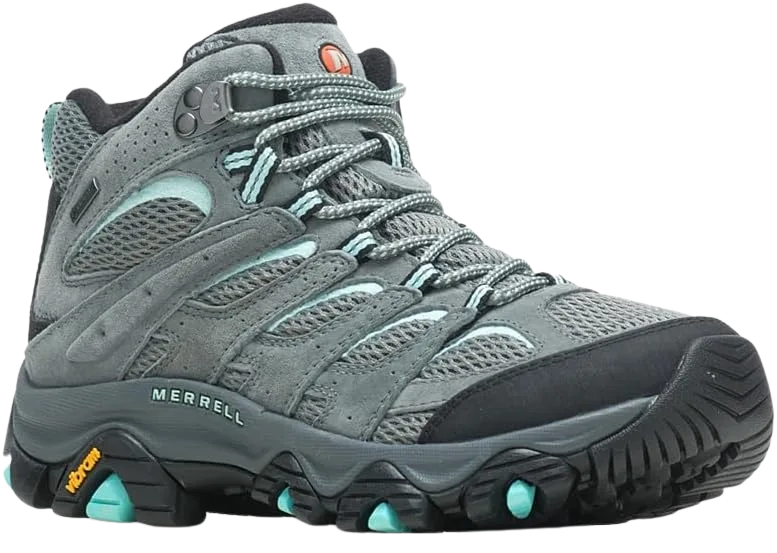
The honest trade-off lives in the membrane. M-Select DRY seals reliably but breathes less than GORE-TEX, so it’s fine for three-season trail days and less ideal for multi-day wet-weather trips where you need moisture to move out fast. The Vibram TC5+ outsole, on the other hand, is the real deal: a proven rubber compound that doesn’t harden or crumble at 400 miles the way some proprietary budget soles do. You’re getting genuine Vibram grip at an entry price, which is the whole reason the Merrell Moab 3 Mid GTX keeps showing up on experienced hikers’ feet long after they could afford fancier boots.
One catch worth knowing before you buy: the Moab 3 uses cemented construction, so it can’t be resoled. Plan on roughly 500 to 700 miles of life and treat it as a consumable, not an heirloom. Merrell also runs a touch narrow for some women, so if your feet swell on long days, read our take on when to size up hiking footwear before you commit to your street size.
Also Worth Considering: Budget Entry-Level Picks
If even the Moab is more boot than you need, the Columbia Newton Ridge Plus WP is the most honest first-serious-boot on the market. It’s flexible straight out of the box, the seams are sealed, and it lands well under the price of everything else here. The Columbia Newton Ridge Plus is the boot I point casual hikers toward when they aren’t sure they’ll stick with it. The tradeoff is durability: it’s cemented and runs lighter-duty, so expect it to wear out faster than the Moab. For someone logging under 20 miles a year, that’s a smart trade, not a compromise.
Don’t buy more boot than your mileage justifies. If you hike a handful of times a year on mellow trails, a budget boot you’ll actually replace beats a premium boot you’ll baby and outgrow. Save the splurge for when you know your feet and your trails — you’ll buy smarter the second time around.
Best Lightweight Women’s Hiking Boot
There’s a sweet spot on the trail-runner-to-boot spectrum where you get enough ankle height to keep grit out and enough stiffness to carry a 20-pound daypack, but your feet still move like feet instead of bricks in a cast. The Salomon X Ultra 5 lives right in that pocket.
Best Lightweight Pick — Salomon X Ultra 5 Mid GTX
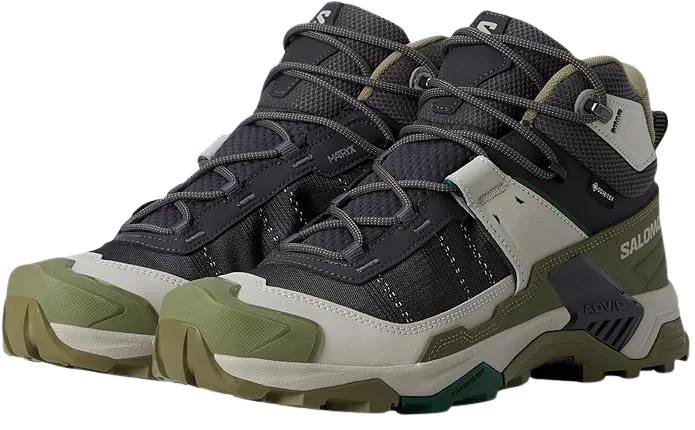
At 12.8 oz it’s four to five ounces lighter than the leather options, and over a long day that math adds up in your legs, not just on the spec sheet. The synthetic upper means almost no break-in: one or two short hikes and the Salomon X Ultra 5 Mid GTX feels like it’s been yours for a season. The Contagrip TA outsole is one of the more honestly tested grip compounds in this tier, and it holds on wet granite where lighter boots usually let you down.
Trail Runner vs. Boot: Where the X Ultra 5 Sits on the Spectrum
Think of this boot as the answer to a specific question: how do I get trail-runner mobility without trail-runner exposure? The mid-cut keeps debris and the odd ankle-deep puddle out, and the extra structure handles a daypack that a true trail runner would wallow under. What it won’t do is carry a heavy backpacking load or baby a previously sprained ankle on technical ground; for that you want more stiffness, not less. If you’re stuck between heights, our comparison on choosing between mid-cut and ankle-height footwear walks through the real trade-offs by pack weight and terrain. The same GORE-TEX summer caveat from the TX Hike applies here too, since waterproof is waterproof regardless of how light the boot is.
Best Women’s Hiking Boot for Wide Feet
Wide feet aren’t a boot problem. They’re a last problem. Most of the misery people blame on “wide feet” comes from buying a regular boot a size up instead of finding a boot with a genuinely wide last, which just trades bunion pressure on the climb for black toenails on the way down. The fix is a boot built wide from the start, and KEEN owns that category.
Best Wide-Foot Pick — KEEN Targhee IV Mid WP
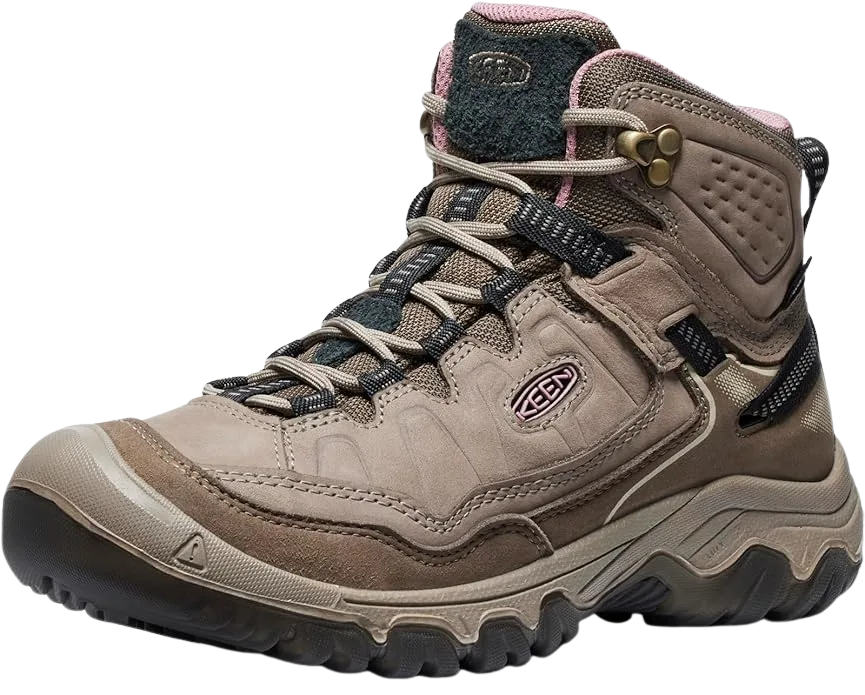
KEEN’s wide-form last gives you the roomiest forefoot in the category, and for anyone with bunions or naturally splayed toes that space is the whole game. The Targhee IV’s headline change over the III is the KEEN.DRY membrane going PFAS-free, which is a meaningful update if you hike wet ground often and care about what’s in your gear. The KEEN Targhee IV Mid WP also uses direct-attach construction, where the midsole is injected straight onto the upper instead of cemented on, so there’s no separate glue bond waiting to peel at 300 miles.
One honest caveat, and it circles back to the anatomy section: a wide toe box doesn’t mean wide everywhere. KEEN’s heel cup is only moderate width, so if you’ve got the wide-ball-and-narrow-heel combo, you may still feel some heel movement here. The heel lock lacing covered later usually settles it. And if a mid-cut boot is more than you want for your terrain, our roundup of the best hiking shoes for wide feet if you prefer low-cut footwear covers the lighter alternatives.
Other Wide-Foot Options Worth Knowing
The Targhee isn’t the only door. The KEEN Targhee IV Low drops the ankle height and a few ounces if you want the same wide last in a shoe. The Topo Athletic Trailventure 2 runs an even roomier toe box with an eVent membrane, and its anatomical shape suits hikers who like a foot-shaped boot rather than a tapered one. Both are worth a try-on if the Targhee’s heel doesn’t lock down for you. At 17.3 oz, the Targhee IV is also no featherweight, so if you’re counting ounces, weigh that comfort against the lighter picks above.
Best Women’s Hiking Boot for Backpacking
When you’re carrying 40 pounds into a backcountry camp, your boot becomes the most load-bearing piece of gear on your body. This is not the moment for a 12-ounce trail hybrid. You want structure, a stiff platform, and a sole that won’t fold over a sharp rock with your full pack pressing down. The LOWA Renegade EVO is built for exactly that.
Best Backpacking Pick — LOWA Renegade EVO GTX Mid
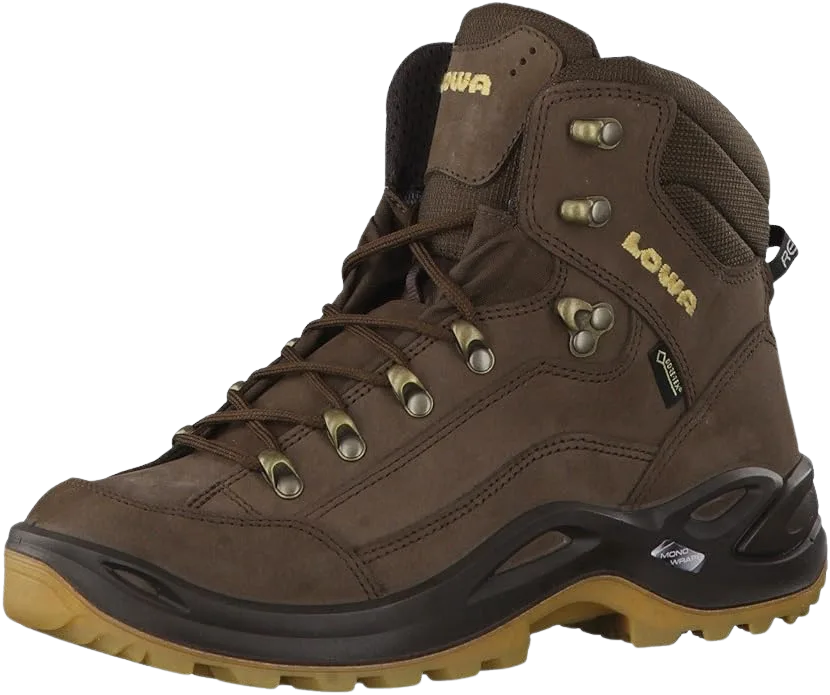
At 18.4 oz it’s the heaviest boot here, but the weight is structural, not wasted: a nubuck leather upper, a supportive PU midsole, and a near-inch-thick Vibram outsole that shrugs off sharp talus. The torsional rigidity is the real selling point. A full-length stabilizing frame and a structured ankle collar fight the ankle roll that a loaded pack makes far more likely on uneven ground. Reviewers have walked the LOWA Renegade EVO GTX Mid to Everest Base Camp blister-free, which tells you what it can do once it’s dialed in.
The Resoleability Case: When the Premium Boot is Actually Cheaper
Here’s the part that changes how you should think about price. The Renegade uses Goodyear welt construction, which means the outsole is stitched on and can be replaced when it wears out instead of throwing the whole boot away. A resole costs a fraction of a new pair, and a leather boot like this can cover 1,500 miles or more across one or two resoles. Run the numbers on cost per mile instead of the sticker, and a cemented synthetic that’s done at 500 miles actually works out more expensive over its life, even though it felt like the bargain at checkout. If you hike enough to wear boots out, the premium boot is the frugal choice.
That construction detail is worth understanding before you spend, so our explainer on Goodyear welt vs. cemented construction is a good next stop, and for the full picture on shanks, midsoles, and every other build choice, our full hiking boot buying guide covers every construction type in detail. One reality check: leather and a stiff frame mean a real break-in, 40 to 60 miles minimum. Plan two weeks of short walks before the first overnight, because nobody wants to discover a hot spot ten miles from the trailhead.
How to Choose Women’s Hiking Boots: Terrain, Load, and the GTX Decision
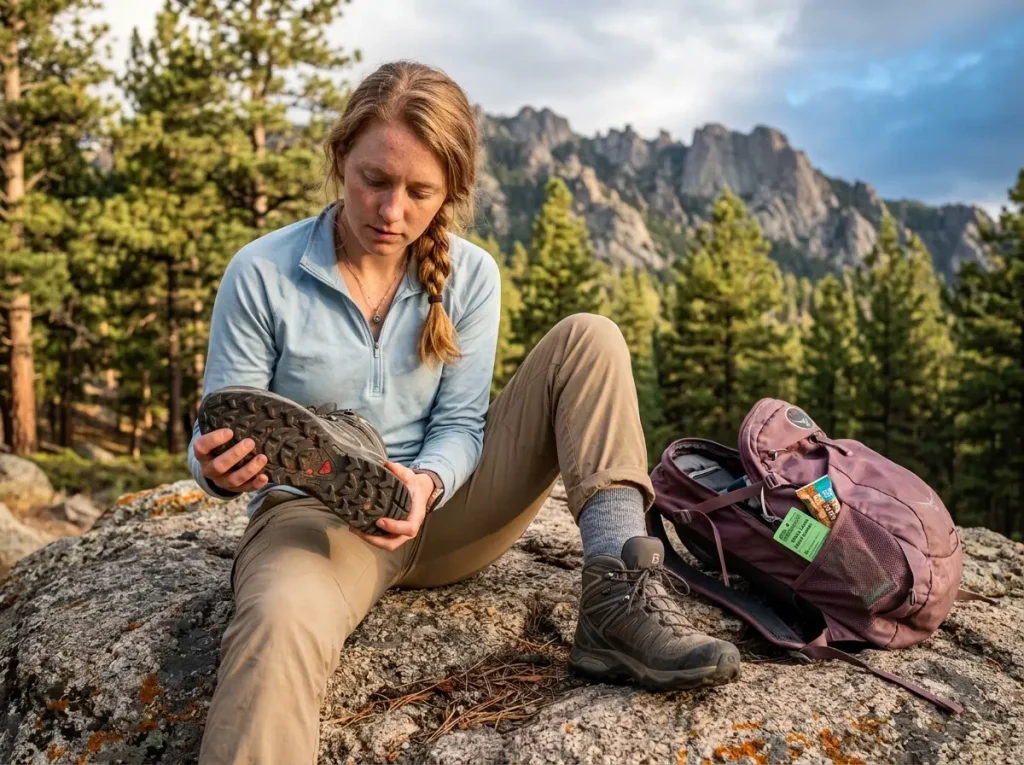
Ask “should I get waterproof?” at any gear shop and you’ll get the same reflex answer: “Yes, always.” That’s not advice. That’s how shops move the pricier version. The real answer depends on where you hike, when you hike, and whether you tend to run hot, and getting it right is the difference between dry feet and a swamp you carry around all day.
Start with terrain, because it settles most of the question. Wet coastal trails, the Pacific Northwest, and shoulder-season mountain weather make GORE-TEX worth it; you’ll cross enough water and splash through enough mud that a waterproof boot keeps your socks dry. Dry Southwest desert, California Sierra summers, and East Coast heat flip it: a non-waterproof boot breathes better and dries faster when it does get wet. Everything in between is genuinely personal preference, and anyone who tells you otherwise is selling membranes.
Now the part nobody explains, and the reason so many women end up with soaked socks on a sunny day. Above roughly 60 degrees on a dry trail, your foot generates more moisture from sweat than it ever takes on from outside. A waterproof liner has no outside water to block, so all it does is trap your sweat inside. Once that liner saturates from within, and on a warm climb it will, you’ve lost both the breathability and the waterproofing at the same time. You’re now hiking in a sealed bag of your own making. I’ve pulled off GORE-TEX boots at a summer summit and wrung out the socks, and there wasn’t a creek within a mile. If you want the full physics of it, our piece on why Gore-Tex shoes can still leave your feet wet inside breaks down the membrane behavior.
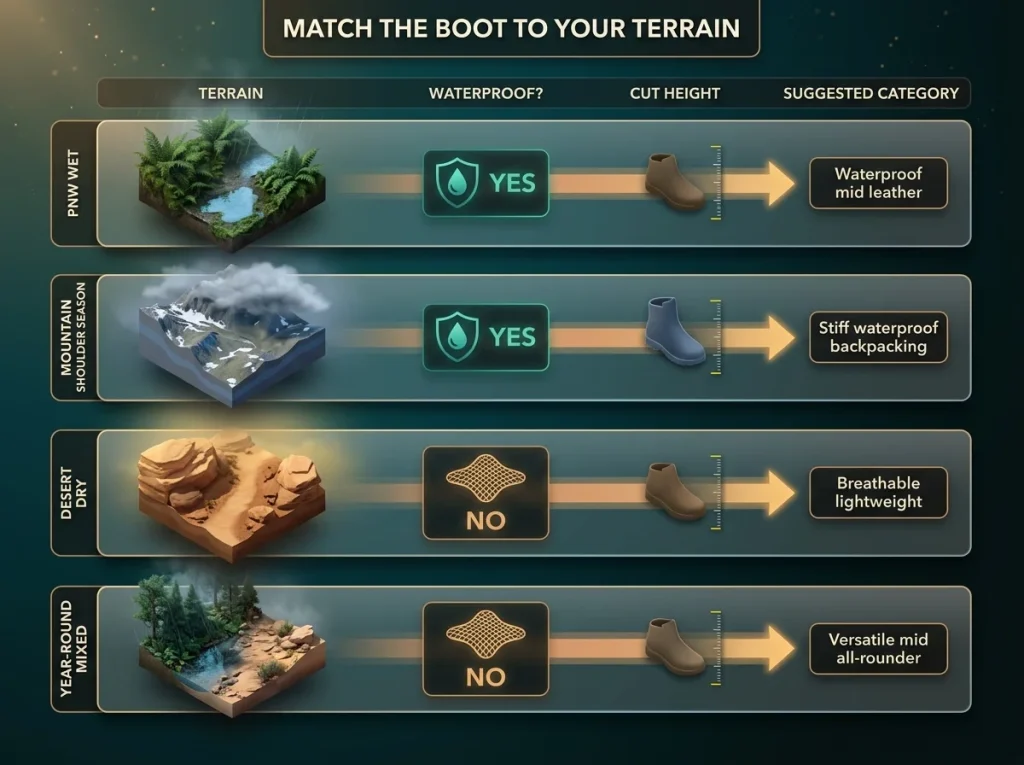
Load is the next lever. Carrying 30 pounds or more, size up a half size for swelling and prioritize torsional rigidity like the LOWA or a Salomon Quest over anything light. Under 25 pounds, a trail-hybrid like the X Ultra 5 carries the day fine. Cut height follows the same logic: mid-cut for day hiking up to about 30 pounds on moderate ground, high-cut mostly for backpacking loads and off-trail, low-cut only for easy trails with light loads.
Do the sock-wring test before you trust a waterproof boot in summer. Hike a warm uphill mile, stop, and check your socks. If they’re damp at the toe with no water around, your sweat is winning and a breathable boot would serve you better on that trail. Match the boot to your hottest hikes, not your wettest ones.
Last, the myth that sells the most boots: ankle support. Research on the subject keeps landing in the same place. High-cut boots reduce ankle sprains only marginally and don’t truly prevent them; trained peroneal muscles do far more for ankle stability than collar height ever will. Buy a tall boot for debris exclusion and load stability, not for some promise that it’ll save your ankle on a bad step. Our breakdown of the ankle support myth lays out what the studies actually show, and it’s not what the marketing implies.
Women’s Hiking Boot Fit and Sizing Guide
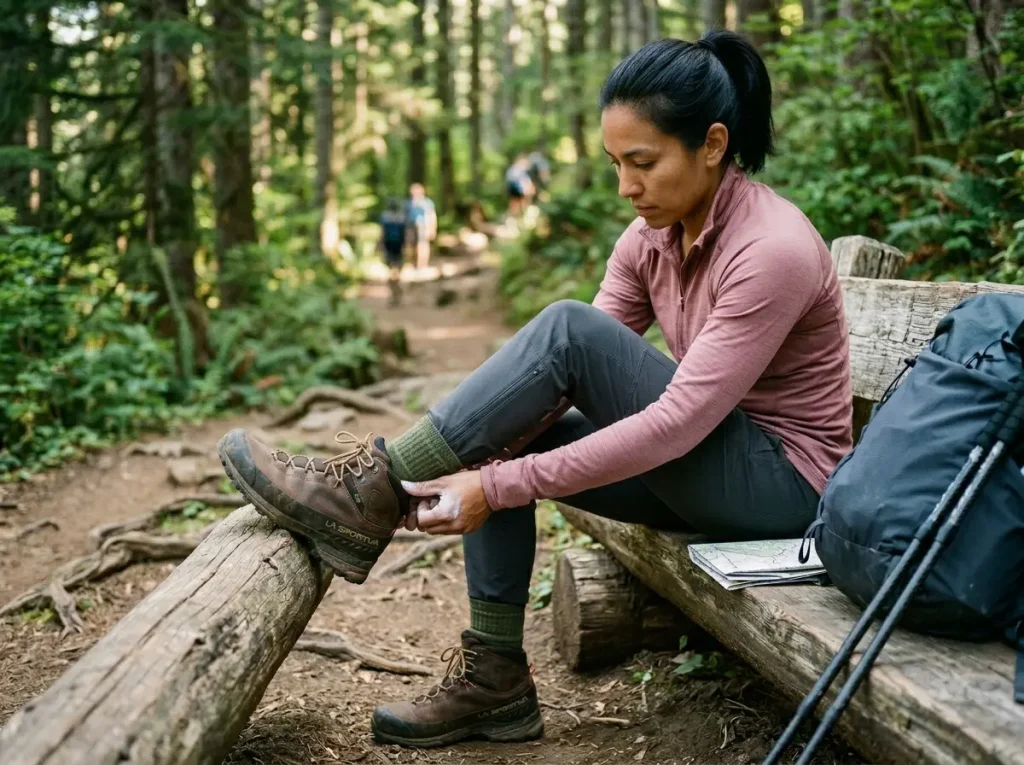
If you bought boots in your street-shoe size and they’re chewing up your heels, you probably didn’t buy the wrong boot. You bought the right boot in the wrong size, and that’s fixable before your next hike without spending another dollar. This is the section I wish someone had read to me before my first pair.
Start with the paradox, because it trips up almost everyone. The “snug feels right” instinct is correct for dress shoes and wrong for hiking boots. Size up a half size for synthetic boots and up to a full size for leather, because the boot has to swallow three things your street shoes never deal with: feet that swell over the miles, thicker hiking socks, and the simple physics of 500-plus toe contacts on any descent. A podiatrist who has fitted footwear for decades put it bluntly: more women wear their hiking boots a full size too small than wear the correct size. The store felt fine. Mile 5 on a downhill is where the truth shows up, usually as a toenail that’s about to turn black.
The fit test that matters is the two-thumb protocol, and it has nothing to do with how the boot feels standing flat. With the boot unlaced and your foot slid all the way forward, you should fit one thumb-width behind your heel; that confirms the boot isn’t oversized. Then lace up and check for one thumb-width ahead of your longest toe, ideally with your foot on a slight downhill. That’s the descent room that keeps your toes off the front wall when gravity pushes them forward.
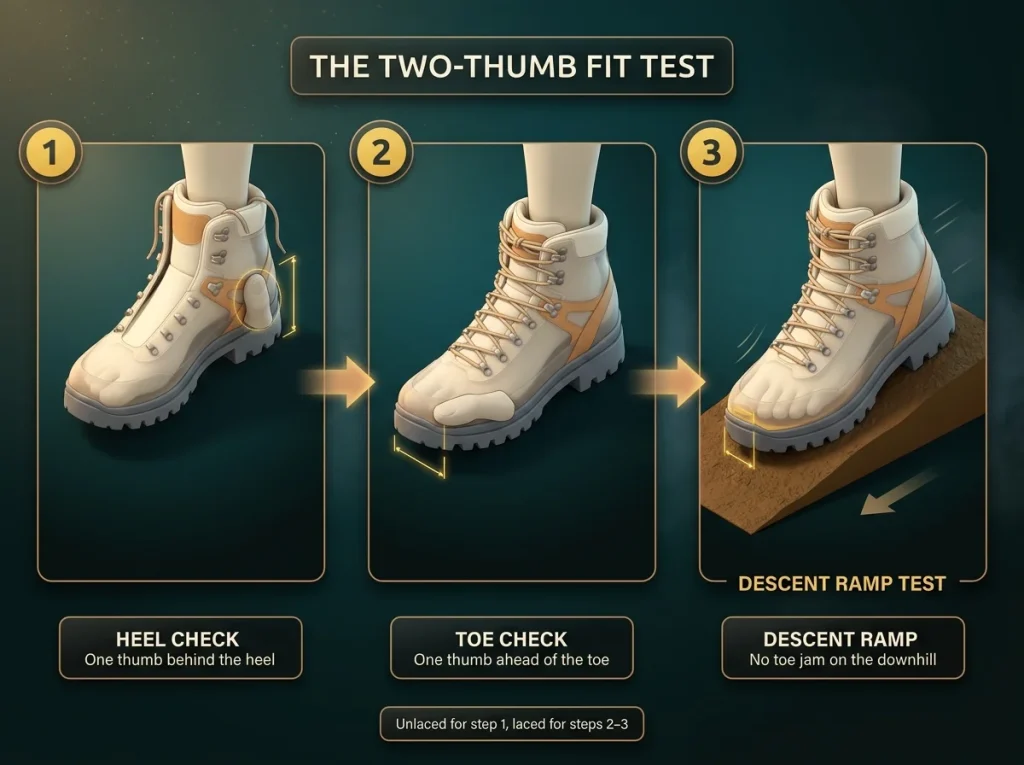
While you’re still in the store, walk down a ramp or a step. If your toes jam the front of the boot on the way down, size up, no matter how perfect it felt on flat ground. The descent test catches more fit problems than any amount of strolling around the showroom floor, because flat walking never loads your toes the way a real trail does.
Then there’s heel slip, the single most common complaint and the most over-diagnosed. First, confirm the boot isn’t simply too big using the one-thumb heel check. If the size is right and the heel still lifts, you don’t need a new boot, you need heel lock lacing: tie a surgeon’s knot at the ankle hook eyelets to create a separate, tighter zone below the ankle, then lace normally above it. That one technique settles about 80% of heel-slip cases without changing a thing about the boot. Catching the problem early matters because heel lift is friction, and friction is how blisters start, so learning to read the warning signs of a hot spot before it becomes a blister saves more hikes than any boot upgrade.
Try boots on at the end of the day in the socks you actually hike in. Your feet are at their largest by late afternoon, which is also their on-trail size. A boot that fits at 9 a.m. in thin socks can feel like a vise by mile six. Shop your feet at their biggest and you’ll never size down by accident.
Finally, respect the break-in timeline, because it varies wildly by material and ignoring it is how good boots get blamed for bad planning. The synthetic X Ultra 5 and the quick-comfort TX Hike need roughly 10 to 30 miles. The Moab 3 and the Targhee want 15 to 40. The leather, Goodyear-welted LOWA Renegade EVO needs 40 to 80 miles, full stop. Never wear brand-new leather boots on a long first hike; phase them in with short walks first. The reason behind those numbers is worth knowing, so our guide to the 80-hour break-in rule for leather hiking boots explains why nubuck and full-grain soften on different schedules.
Conclusion
Three things to carry out of here. Fit is decided by what your heel and toe box tell you, not by how a boot feels standing still in the store, so measure it with the two-thumb test and the descent walk. Waterproofing is a terrain decision, not a default, and GORE-TEX in dry summer heat works against you more often than for you. And cost per mile, not sticker price, is the honest way to compare a resoleable boot against a cemented one; the expensive boot is frequently the cheaper one in the end.
Before you buy anything, try on the boots you already own with the two-thumb test and a walk down the nearest set of stairs. You might find the pair in your closet fits better than you thought, or you’ll know exactly what to fix on the next pair. Either way, you’ll be choosing with your feet instead of a salesperson’s reflex.
Frequently Asked Questions
01How should hiking boots fit for women?
Leave one thumb-width behind your heel and one thumb-width ahead of your longest toe on a slight downhill. The boot should feel secure, not snug. Most women size up a half to a full size from their street shoe.
02What is the difference between men’s and women’s hiking boots?
A women’s last has a narrower heel cup, lower instep, and lower overall volume than a men’s or unisex last. It is not just a smaller size. That shaping is what keeps a narrower heel from slipping and rubbing.
03Do women need waterproof hiking boots?
Not always. Waterproof boots earn their place on wet, cold, or shoulder-season trails. On dry summer hikes above 60 degrees, a waterproof liner traps sweat inside and a breathable, non-waterproof boot keeps your feet drier.
04Which hiking boots are best for women with wide feet?
The KEEN Targhee IV Mid WP has the widest toe box in this roundup, built for bunions and naturally spread feet. Look for a genuinely wide last rather than sizing up a regular boot, which only shifts the pressure around.
05How long does it take to break in women’s hiking boots?
Synthetic boots break in within 10 to 30 miles, while stiff leather boots need 40 to 80 miles. Phase them in with short walks before any long hike, and never wear brand-new leather boots on a big first day.

I've spent more than a decade researching hiking gear and trail technique. I read the specs, the forum threads and the long-term reviews, and every pick here comes with what it gets wrong.
End of the trail
You read every mile of this one. Here's where the trail goes next.