
The crotch seam blew out on the second pitch of a steep scrambling route, sounding like a tree snapping in the cold. With three hours of descent left, I was one awkward high-step away from complete exposure. After years of testing outdoor gear in the backcountry, I learned the hard way that trusting the wrong fabric will leave you stranded. This hiking pants fit guide breaks down how these materials handle trail abuse, and gives you a simple testing routine you can use right in the fitting room. You will learn exactly how to verify your gear’s limits before a seam blows out and ruins your trip.
⚡ Quick Answer: True trail freedom requires the right blend of stretchy materials and smart tailoring, not just a high spandex count. You need a nylon-elastane blend with a diamond gusset and articulated knees to handle the stress of high-stepping. By running new pants through a 3-step sequence—the Sit, Squat, and Climb protocol—you can verify critical waistband stability and fabric recovery before taking them into remote terrain.
| Fabric Stretch Categories | |||
|---|---|---|---|
| Stretch Category | Key Benchmark Model | Elastane % | Primary Focus |
| Recovery Standard | Prana Stretch Zion | 5% | Long-term shape retention |
| High ROM (Range of Motion) | Outdoor Research Ferrosi | 14% | Maximum dynamic flexibility |
| Alpine Double Weave | Arc’teryx Gamma | 12% | Abrasion armor and mechanical stretch |
| Ultralight Distance | Patagonia Altvia | 4-6% | Fast wicking and low friction |
How Fabric Stretch Actually Works
Spandex Blends and Four-Way Stretch Mechanics
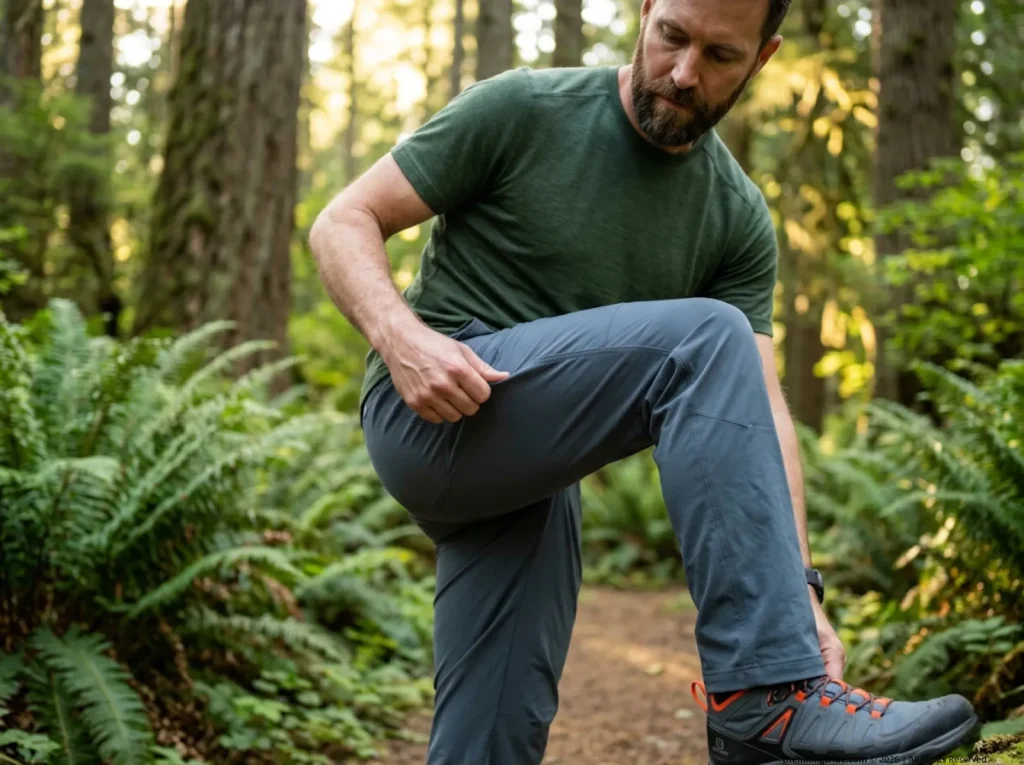
If you want pants that move naturally with your legs, you cannot rely on classic heavy canvas. Pure nylon offers solid armor against sharp rock, but it lacks the give you need for technical climbing. To solve this, brands pair nylon fibers with spandex to form a hybrid nylon-elastane blend. This combination optimizes your balance of stretch and toughness, allowing the material to expand without tearing.
A high-performance nylon-elastane blend directly targets the demands of steep, rocky trails where your knees frequently hit your chest. Understanding how a four way stretch fabric operates reveals that standard technical hiking gear usually hovers between 4% and 14% spandex. A lower elastane percentage creates a stiffer pant that handles thorns beautifully, like the classic Columbia Silver Ridge. Bumping up to 14% spandex gives you a near-legging feel with a full range of motion, ensuring that your clothing never holds your leading leg back during a heavy uphill lunge.
Some brands use 2-way stretch materials that only expand horizontally across the width of the leg. This works fine for flat dirt paths, but it binds over the knee when you try to step up onto a boulder. If you require true versatility hiking climbing, insist on materials that stretch vertically and horizontally. Premium options like Cordura fabric or specialized Schoeller fabric integrate high strength directly into multi-directional weaves.
The Snap-Back: Understanding Fabric Recovery
Many brands boast about initial flexibility, but the real test of a garment happens on day three of a sweaty backpacking trip. Elastic fibers inevitably suffer from fabric fatigue when subjected to repeated pulling and high body heat. Your pants lose their fabric recovery, meaning the spandex strings stretch out and stay that way. The industry refers to a fabric’s ability to return to its original shape as its snap-back.
A high recovery rate prevents your pants from bagging out at the knees or sagging off your hips by the end of a long ridgeline traverse. Generally, a garment with a slightly lower spandex count will maintain better long-term stretch retention. If you prioritize stretch durability over maximum flex, a tighter blend holds its shape far better over a 50-mile week. You want your trousers to offer reliable waistband stability instead of growing two sizes after a long day of moving.
To see this in action, grab a fresh pair of pants and run a quick 10-inch measurement test. Mark a 10-inch section of unsewn leg, yank it to its physical limit, hold for sixty seconds, and then let it release. Good textile engineering ensures the fabric snaps perfectly back to ten inches; anything longer indicates weakened elasticity and a poor investment.
Fabric Weight vs. Trail Warmth
Understanding a material’s thickness is just as critical as its chemical makeup. Manufacturers measure fabric weight in grams per square meter (gsm). A super lightweight pant under 150 gsm feels like wearing wind, creating a constant bellows effect that pumps hot air away from your legs as you step. These garments offer unmatched breathability, but their thin nature means they lack serious armor against granite ledges or aggressive brush.
As you transition into colder shoulder seasons, you need thicker materials pushing past 240 gsm to shield your skin from harsh winds. Heavy fabrics naturally resist bending and require more advanced tailoring to prevent stiff resistance during every stride. You will find that burly winter pants cannot rely entirely on chemical elastane to bend; they need geometric tailoring to avoid fighting your own leg muscles.
Pro-Tip: If your high-spandex pants feel like they are actively resisting your stride on a freezing morning, it is because sub-zero temperatures actually stiffen the stretchy fibers in elastane. This is precisely why mechanical weaves excel in winter alpine environments.
Architectural Design: Gussets and Articulation
The Geometry of the Diamond Gusset
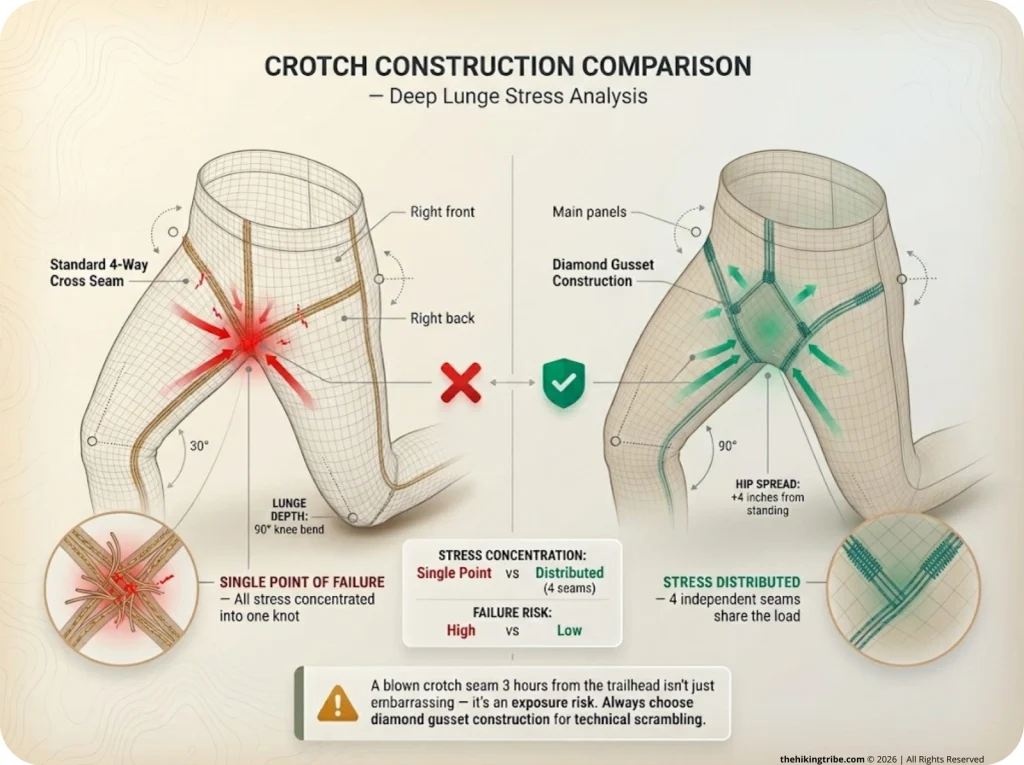
Even the most flexible fabric will fail if the seams lock it into a rigid shape. A standard four-way cross seam concentrates every ounce of tension into one heavily knotted center thread. Upgrading to a gusseted crotch inserts a separate block of fabric between the legs, redistributing sudden stress across four independent seam lines.
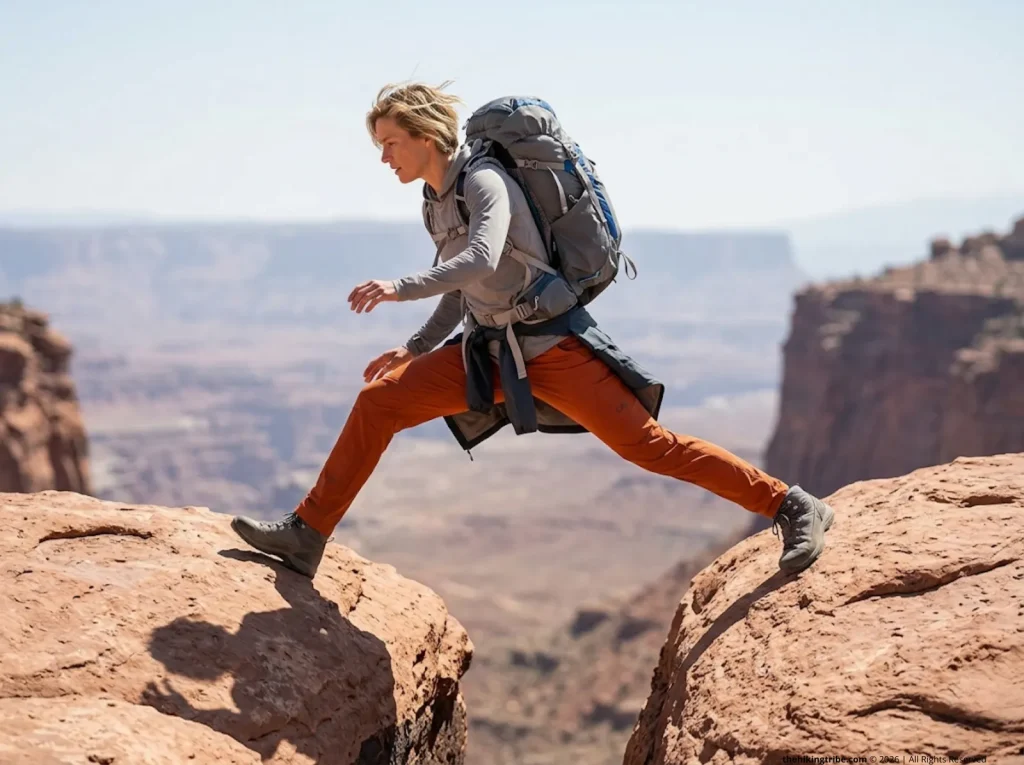
The exact gusset geometry determines how wide you can safely open your hips. A triangular gusset provides decent reinforcement, but a true diamond gusset offers the gold standard for full hip mobility. By eliminating the single weak intersection, a diamond crotch inset ensures that a sudden slip does not result in a massive tear. A proper gusseted crotch guarantees seam failure prevention and lets you comfortably cross wide gaps on a scrambling route.
When you eliminate that abrasive knot cluster between your legs, you drastically increase comfort and chafing resistance over a twenty-mile march. Never attempt a technical mountain route wearing bottoms that lack this critical piece of architecture.
The Value of Articulated Knees
In a standard straight-leg cut, raising your knee forces the fabric to pull upward from your boot laces and downward from your waistband simultaneously. Articulated knees solve this by sewing permanent darts or pleats right into the knee joint, creating a pre-bent, shaped fit. Because the fabric already mimics the natural curve of a bent leg, you experience zero resistance when stepping onto a high ledge.
This structural upgrade naturally eliminates the fatiguing drag that constantly saps your energy. Finding the correct hiking pant inseam proves critical because articulation must sit exactly over your kneecap to function correctly; if the tailoring lands on your shin, it provides no mechanical advantage. Articulated knees securely enable high-stepping without relying on the elastic limits of the nylon.
Double Weave vs. Single Nylon Construction
When temperatures drop and winds bite, single-layer summer fabrics fail to insulate. Premium brands utilize double-weave construction, which bonds a smooth, flat outer face directly to a soft inner grid. This technique provides the density to block alpine wind while relying on the unique geometry of the weave to stretch, known as mechanical stretch.
Double weaves bend and flex purely based on how their threads interconnect, producing a highly durable fabric that never loses its elastic rebound. While heavier, they feel far more substantial and protective under a climbing harness. They offer a highly non-restrictive fit without feeling flimsy. Look for a strong UPF rating on these thicker models to guarantee protection against harsh high-altitude sun exposure.
Pro-Tip: For hikers with muscular thighs, always size up in the waist for non-baggy athletic fits. Then rely on an integrated, low-profile webbing belt to lock the rise securely above your hips without sagging.
The Hiking Pant Mobility Lab: 3-Step Protocol
Step 1: The Sit Test for Waist Consistency
Marketing flyers from OutdoorGearLab or Switchback Travel cannot guarantee a product will fit your specific stride. You need a reliable fitting room test before you hand the cashier your credit card. Start by evaluating the integration between your hips and ankles using the Sitting/Rising Test (SRT), adapted directly from clinical mobility benchmarks.
Stand straight, cross your legs, and lower yourself entirely to the floor into a seated, cross-legged position without using your hands or elbows. A passing grade requires the pants to follow your descent without the waistband aggressively pulling away from your lower spine. If the fabric stops you from sitting naturally or leaves your lower back exposed to the cold wind, the rise geometry is fatally flawed.
Step 2: The Deep Squat and Depth Analysis
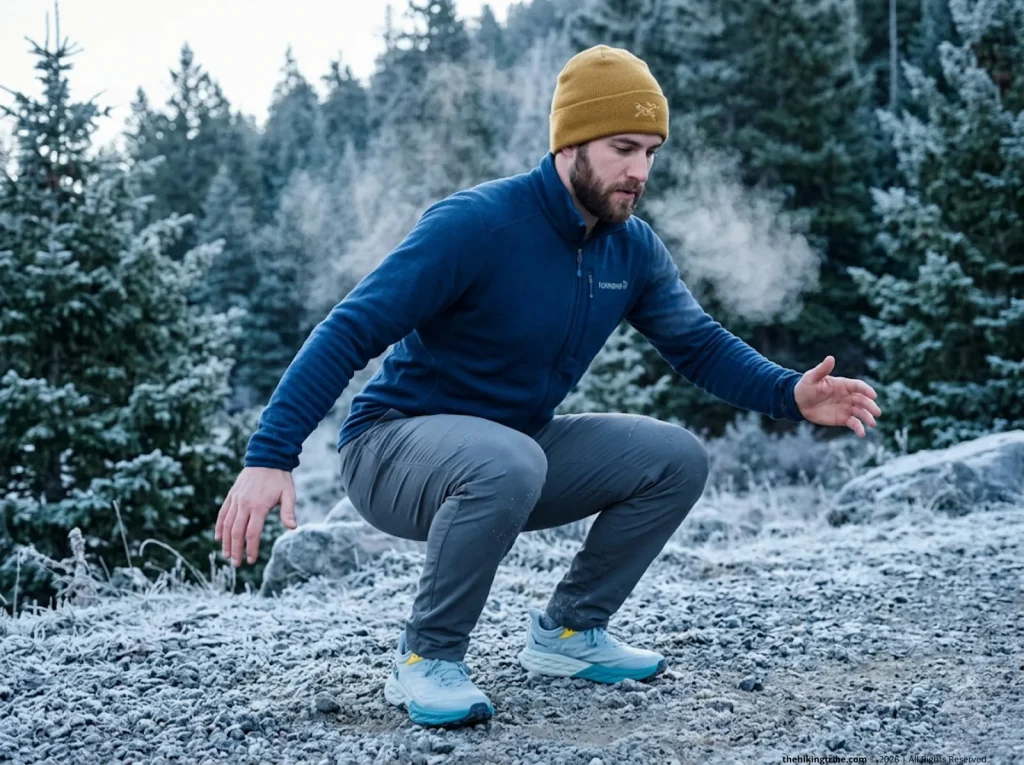
Moving solely in a straight line on flat terrain demands very little from your gear. A deep squat test validates waistband stability by forcing the fabric to accommodate the massive expansion of your glutes and quadriceps. Execute a slow, controlled squat keeping your heels firmly planted directly on the floor.
If the material aggressively locks around your kneecaps and halts your descent, the pants lack true vertical flexibility. This movement doubles as a highly effective seam stress test for the back rise. Excellent gear lets you drop into a full catcher’s stance without feeling like the rear seam is harshly tensioning against your backside. Hold this pose for a full minute to assign the garment a mental mobility score based on how restrictive it feels across your thighs.
Step 3: The Climb Test for Scrambling Ergonomics
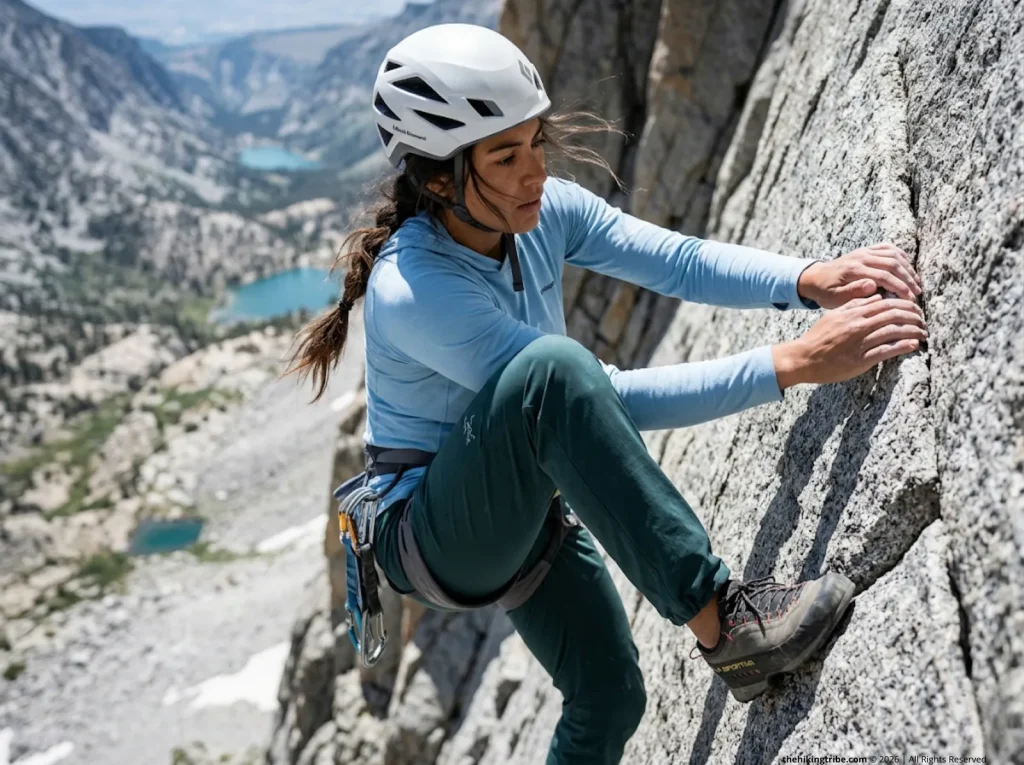
Your final check replicates the aggressive, uneven terrain found above the tree line. The high-step test simulates a dynamic mountain lunge where you must lift a single knee directly above your hip line to clear an obstacle. Prop your leading foot onto a changing room bench or high stool, leaning your weight forcefully into the elevated thigh.
Even if you prefer to roll up hiking pants to beat the heat, you still require enough built-in ankle clearance so the bottom hem never snags your calf muscle during the lift. During this lunge test, listen closely to the crotch area. The noise factor matters; if you hear an audible stretch—the distinct crackle of elastic fibers heavily protesting—the pants will absolutely fail on a real boulder field. Complete this 4-point mobility checklist to ensure your gear passes standardized 5-step stress test requirements before you trust them in the wild.
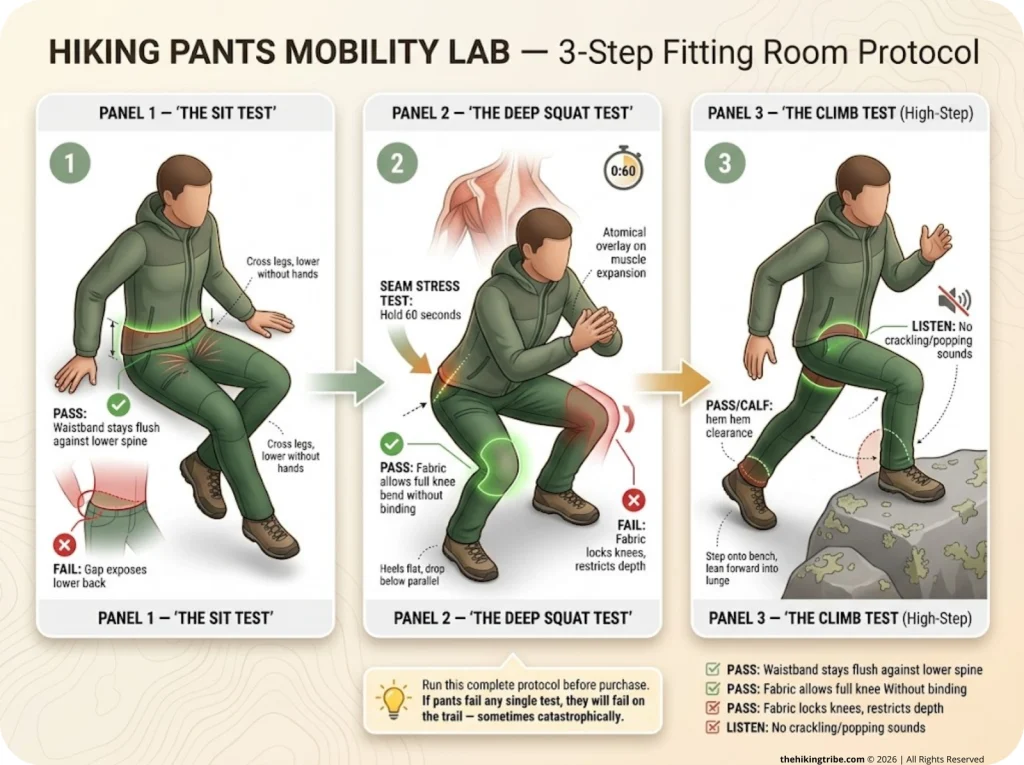
Pro-Tip: Execute the deep squat test in the fitting room and hold it for exactly sixty seconds. When you stand up, watch how quickly the knees pull back flush to your leg; if they stay baggy, leave them at the store.
Failure Analysis: Mechanics of the “Crotch Blowout”
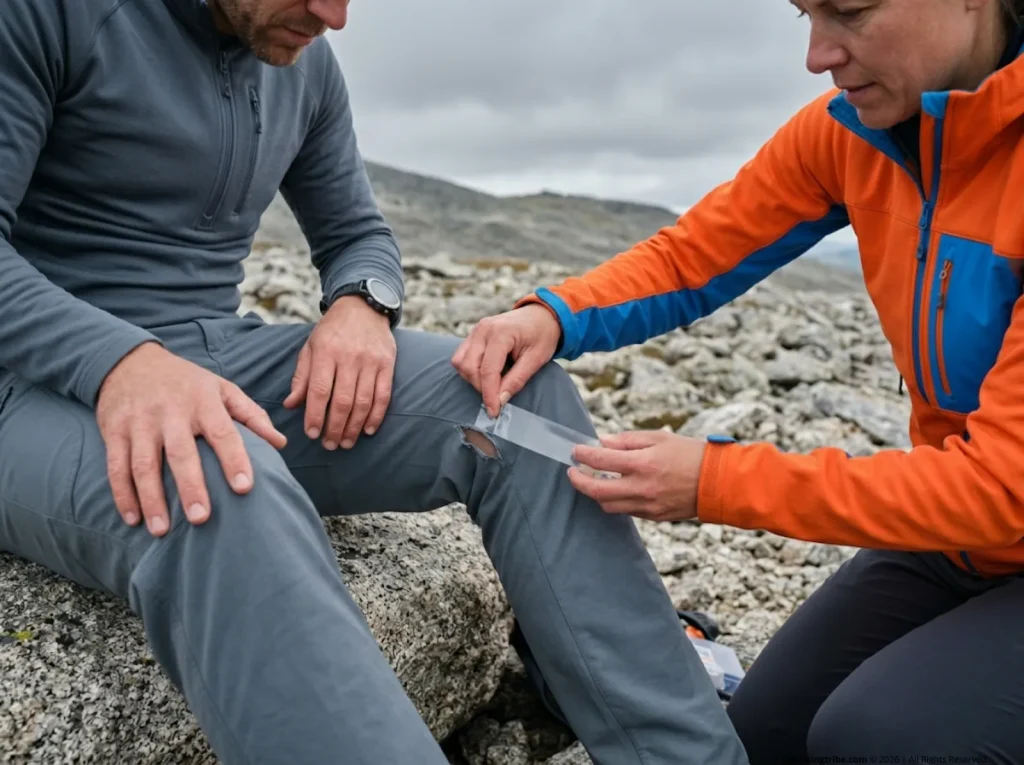
Gait Friction and Thigh Wear
We need to diagnose exactly why thick technical pants rip on the trail to prevent it from happening again. Continuous walking friction naturally grinds down the primary nylon over hundreds of miles in a muscular thighs fit. Once the strong nylon threads wear thin, only the fragile elastane strings remain, and they immediately snap under load.
A ragged, thinned-out rip sitting high on your inner thigh indicates raw abrasion failure. To guarantee proper seam failure prevention, examine your wear patterns after your first twenty miles. Preemptively applying slick nylon tape to high-friction zones preserves the foundational structure of the fabric long before it shows visual fatigue.
The False Crotch Phenomenon
Buying pants that hang way too low on your hips dramatically changes the math of how the garment handles tension. Letting the waist slide down creates a false crotch positioned several inches below your actual groin line. When you attempt an aggressive horizontal stretch, the trapped fabric cannot expand naturally and instantly locks against your upper legs.
This restriction harshly packages every pound of your body weight directly against the thin center seam connection. Seam reinforcement goes a long way, but no amount of triple-stitching or heavy welded seams will survive the brutal leverage of a dropped crotch. Lock your waistband tight at the top of your hip bones to keep the gusset completely flush against your body for maximum mobility.
Water Absorption and The Wet-Out Effect
Synthetic blends react poorly when they soak thoroughly through with rain or heavy sweat. Absorbing moisture fills the porous structure of the nylon, making the fibers expand and significantly heavying the fabric’s physical weight. A wet, plastered pant leg creates massive surface friction against your skin, multiplying the drag during every walking cycle.
This heavy drag drastically tests your basic body type compatibility because the fabric no longer slides cleanly during a step. If you regularly hike in wet, abrasive conditions, strongly vet your gear choices through a robust in-store try-on using the squat tests mentioned above. If a soaked pant fails on an exposed ridge, you drop your core temperature and compromise your stability, potentially triggering a rescue that goes against core Leave No Trace outdoor ethics.
Pro-Tip: Check for a touching-thigh gait pattern on your first hike with a new pair. If you feel excess friction, apply a lightweight nylon patch over the inner thigh seam preemptively, long before the structural nylon degrades.
Laundering and Preventive Maintenance
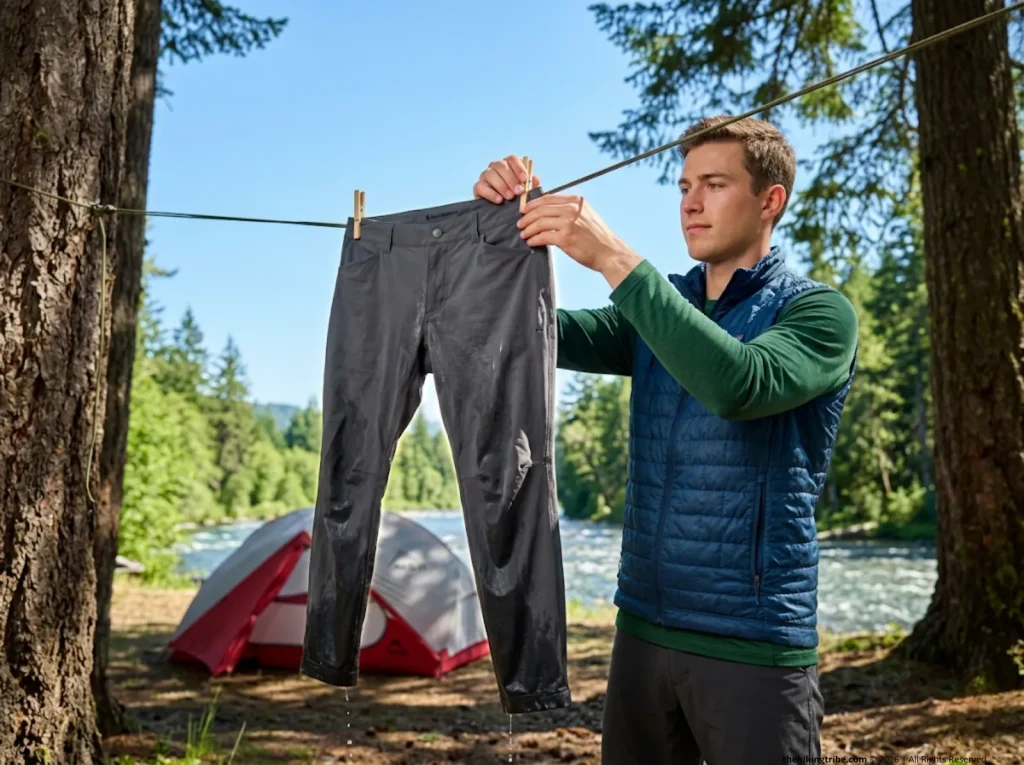
The Fatigue Impact of High-Heat Drying
Throwing your dirty pants into a scorching commercial dryer ruins the delicate elasticity engineered into the threads. Extreme machine heat directly cooks the stretchy fibers within the spandex, turning them permanently stiff and brittle. Once this heat damage occurs, your favorite hiking pants adopt a crunchy, lifeless texture.
Always wash your synthetic gear tightly zipped in cold water, and air dry them on a line out of direct sunlight. This gentle maintenance preserves the invisible springiness of the elastane and guarantees they hold their shape perfectly for years. Avoid compressing them tightly under heavy boxes inside your gear bin, as constant physical tension degrades the elastic fibers while sitting idle in storage.
DWR Coatings and Elastane Interactions
High-performance water resistance relies completely on a microscopic DWR coating applied directly to the outside face of the nylon. When water stops beading up and dropping off your legs, your pants will immediately soak through. While heat activates and revitalizes factory DWR treatments, applying an intense dryer cycle ruins the internal spandex.
Knowing how to wash gore tex safely transfers perfectly here: use a low-heat dryer setting or a careful pass with a warm iron explicitly shielded by a thick towel. This careful application reactivates the chemical coating without baking the elastane underneath.
Chemical Degradation from Fabric Softeners
Dumping liquid fabric softener into your washing machine deposits a thick, waxy chemical layer completely over the microscopic pores of your gear. While this process does not explicitly snap the spandex threads, it suffocates the foundational breathability of the nylon matrix.
This waxy film completely destroys the wicking action required to pull sweat off your skin and push it to the exterior for evaporation. Without wicking capability, your pants will trap humid swamp air against your legs, dramatically increasing chafing and general misery during high-output climbs. Stick to clean, additive-free technical washes formulated specifically for outdoor synthetics.
The Bottom Line
Technical hiking bottoms must act as a second skin, providing completely unrestricted leverage during massive vertical pushes. Your best defense against a backcountry blowout involves testing for multi-axis mobility and prioritizing a real diamond gusset over flashy spandex percentages. Run your planned apparel vigorously through the complete Sit, Squat, and Climb sequence before fully trusting your comfort and safety to them on a remote high-altitude objective. Next time you hit the trial, you will know the difference between gear that binds and gear that breathes.
FAQ
How stretchy should hiking pants be?
Stretchy hiking pants need roughly 5-14% elastane to give you enough yield for a deep squat without pulling the waistband down. Models pushing 14% feel incredibly comfortable like athletic leggings but readily lose their shape, while lower stretch models heavily prioritize rugged durability for aggressive multi-day trips.
Do hiking pants stretch out over time?
The fabric itself will never stretch gracefully; instead, the elastic fibers break down under load and lose their ability to snap back into shape. This progressive failure clearly explains why poorly constructed or heat-damaged pants rapidly become irreversibly baggy at the knees after only a few hard scrambles.
What is the best material for stretchy hiking pants?
The best material for stretchy hiking pants is a technical double-weave combination sitting around 85-95% nylon intermixed with 5-15% spandex. The heavy nylon component handles the vital abrasion survival when scraping against rock walls, while the spandex strictly dictates the maximum range of motion.
How do you fix a ripped crotch in hiking pants?
You can reinforce the area safely at home, but for a true emergency field repair, you must repair hiking pants by pressing a strong Tenacious Tape patch firmly against both inside and outside faces of the tear. Because the crotch area absorbs massive force with every single step, a standard needle-and-thread camp fix will aggressively pull through the weakened nylon mesh within minutes.
I've spent more than a decade researching hiking gear and trail technique. I read the specs, the forum threads and the long-term reviews, and every pick here comes with what it gets wrong.
End of the trail
You read every mile of this one. Here's where the trail goes next.