In this article
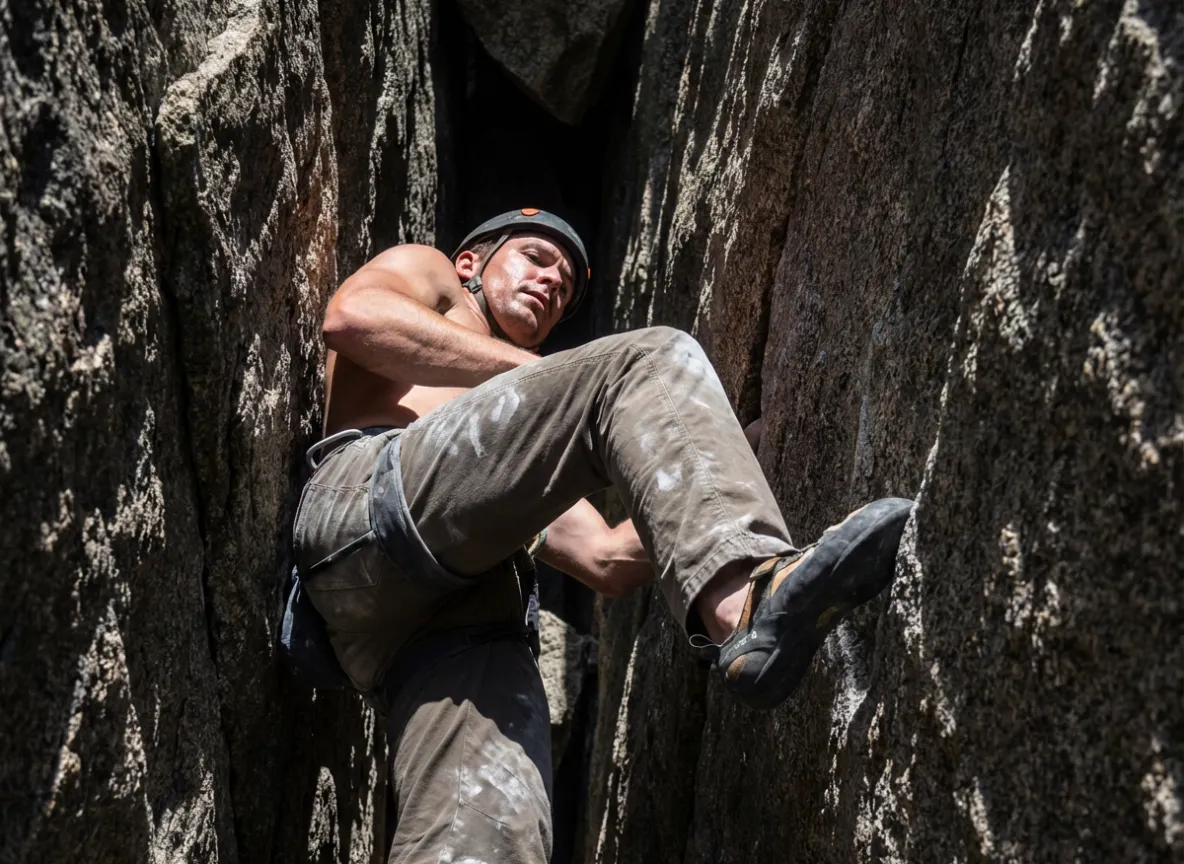
You are halfway up a granite chimney on the Crestone Needle in the Sangre de Cristo Mountains. Your left boot is smeared on a friction slab, and your right knee is driving toward your chest for a critical high step. In this moment, your pants are not just clothing; they are a mechanical component of your movement system.
If the fabric binds, you lose balance. If it shreds against the rock, you lose protection. This is the reality of the “stretch versus durability” equation. It is a critical trade-off that defines the performance of modern technical outdoor apparel. Many hikers assume that more stretch equals better performance, but material science dictates otherwise.
As an outdoor instructor, I have seen expensive performance gear fail in the field because the fabric type did not match the terrain. This guide breaks down the textile engineering of 4-way stretch, explains why higher elastane percentage often leads to faster degradation, and provides a framework for choosing the right weave for your specific objective.
What is the Engineering Behind 4-Way Stretch?
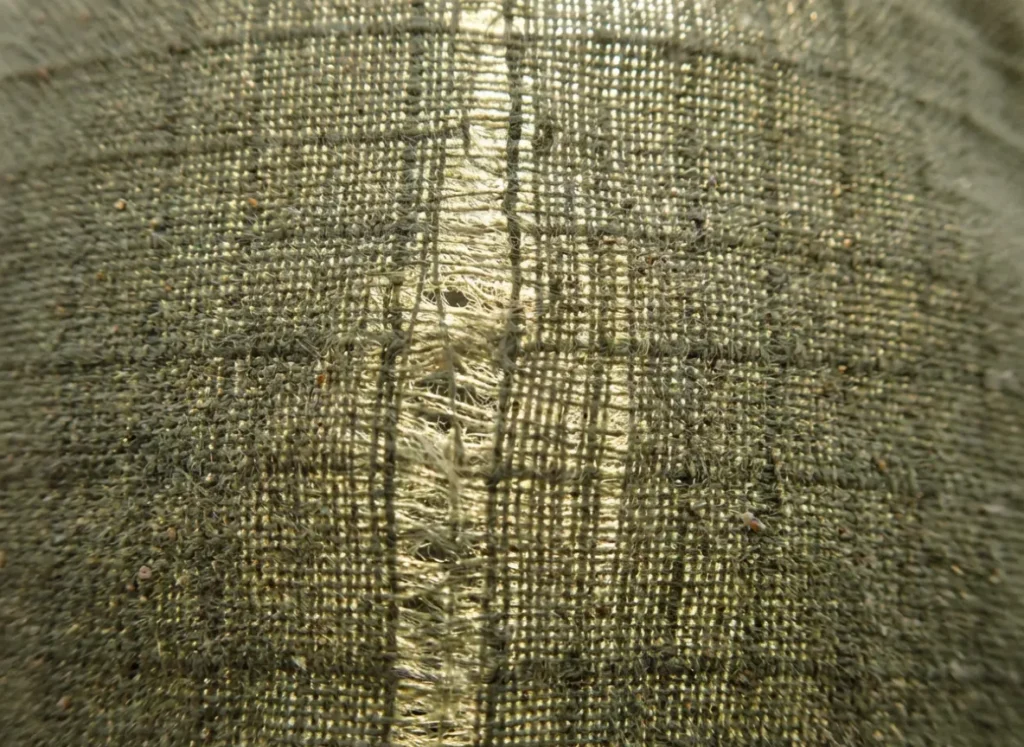
This section deconstructs the structural and chemical composition of the fabric to explain exactly how it achieves multidirectional elongation without failing.
How do Warp and Weft Dynamics Create Multi-Directional Movement?
True 4-Way Stretch engineering integrates elastomeric fibers into both the warp and the weft yarn sets, fundamentally changing the fabric’s geometry to allow for radial expansion.
To understand this, we must look at the loom. Woven fabrics consist of two yarn sets: the warp (running longitudinally, held under tension) and the weft (running transversely, shuttled across). Traditional 2-way stretch fabrics typically only incorporate elasticity in the weft, providing crosswise stretch. This allows for horizontal expansion to accommodate thigh muscle flex, but it fails to address vertical movement.
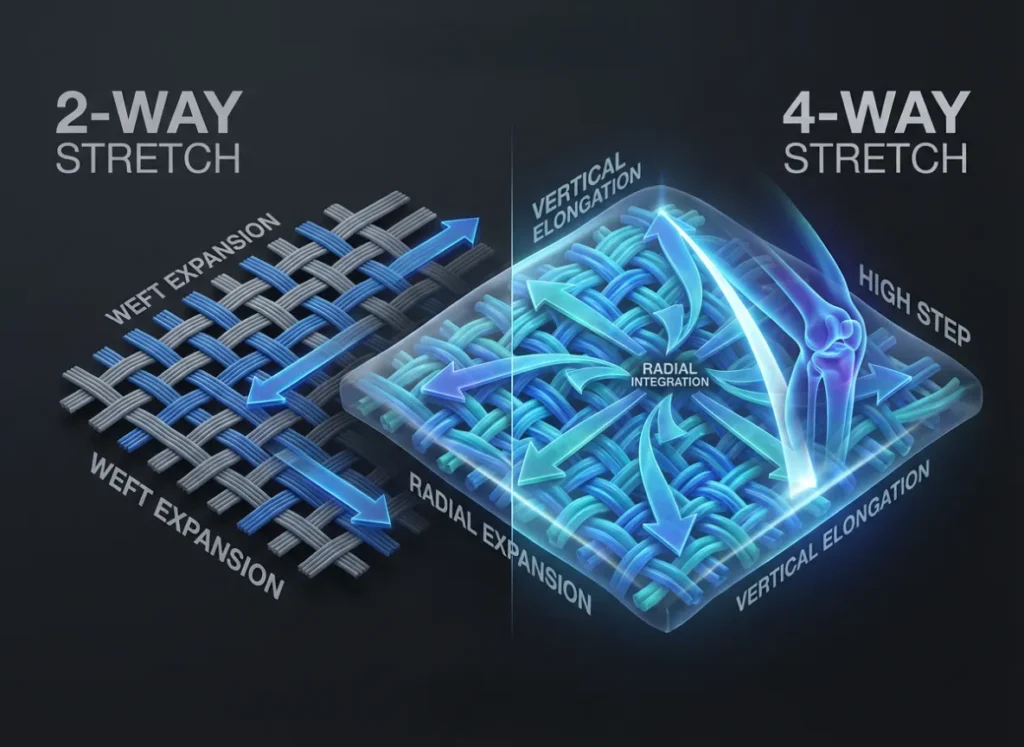
Vertical elongation, or warp stretch (also known as lengthwise stretch), is the critical differentiator for hikers. It accommodates the significant knee flexion required for steep ascents, climbing high steps, and deep lunges. Without this vertical give, the hem of the pant is pulled upward when the knee bends. This exposes the ankle and creates mechanical drag against the quadriceps.
Advanced weaves like Double Weave manage this by burying the elastane core deep within a nylon sheath. This protects the stretch component from surface friction while maintaining the specific tensile properties of elastic woven fabrics required for technical mobility. When selecting the best men’s hiking trousers, checking for this specific bi-directional elasticity—or even diagonal stretch on the bias—is essential for comfort on vertical terrain.
What Role Does Elastane Play in the Polymer Matrix?
The “stretch” engine is a polyether-polyurea copolymer known generically as Elastane (or by trade names like Lycra and Spandex).
On a molecular level, elastane consists of “soft segments” (disordered, flexible chains) and “hard segments” (rigid, crystalline anchor points). When you lunge for a foothold, tension is applied, and the soft segments uncoil and straighten. When you release that tension, the hard segments exert a restoring force to snap the polymer back to its resting state.
This snap-back mechanism is defined as Elastic Recovery (or recovery rate). Without it, your pants would suffer from deformation after a single hike. However, the “soft segments” are chemically vulnerable. Environmental stressors like UV radiation and body oils can lead to elastane thermal degradation analysis showing polymer chain scission.
Recent innovations like Mechanical Stretch (e.g., Toray Primeflex) avoid this chemical vulnerability. They use crimped, spring-shaped polyester yarns instead of rubber-like elastomers. This offers superior durability, a factor worth considering when comparing synthetic layers to natural fibers like merino wool or bamboo, where longevity is the priority.
Why Does Increased Mobility Often Compromise Durability?
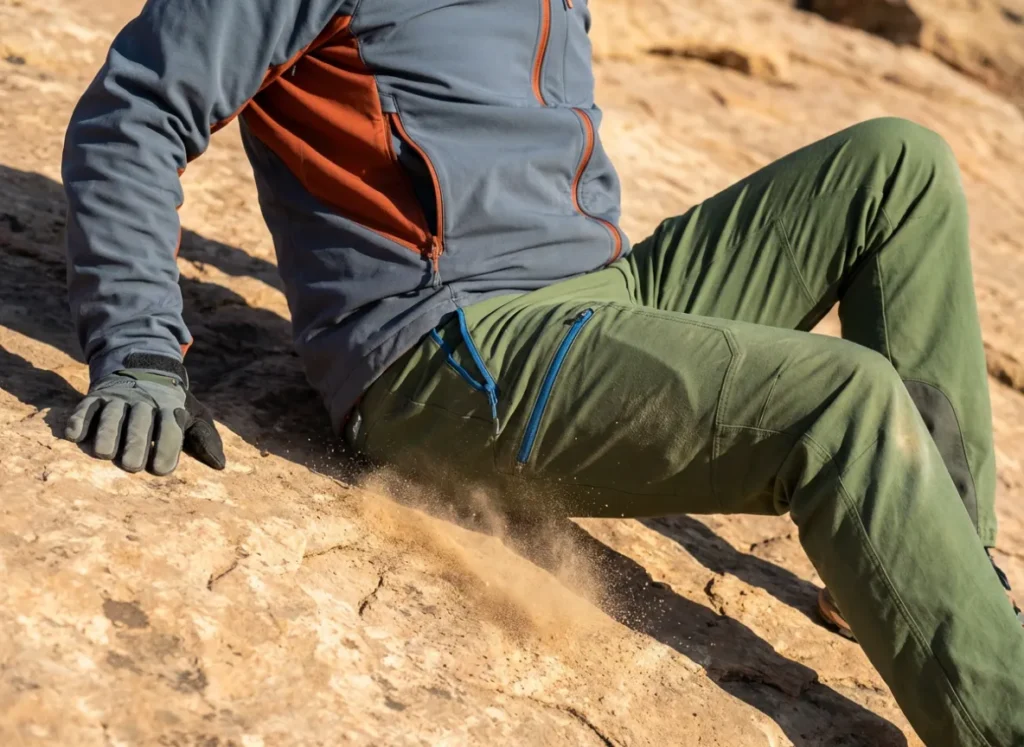
This section analyzes the inevitable trade-offs between stretch and strength, using industry-standard testing metrics to quantify failure modes.
How Does the “Abrasion Paradox” Affect Nylon and Polyester Blends?
The “Abrasion Paradox” dictates that as you increase the percentage of elastane to gain range of motion, you inevitably dilute the aggregate strength of the fabric.
Durability in hiking is often measured by Abrasion Resistance, quantified by the Martindale Abrasion Test. Nylon 6.6 fibers possess high tensile strength and impact strength, typically withstanding over 50,000 Martindale cycles. This makes them ideal for contact with rock. Polyester is inherently weaker, and Elastane is the weakest link, often failing at fewer than 5,000 cycles.
In high-friction scenarios, the exposed elastane fibers rupture first. They snap back to create surface “pilling” or fuzz (poor pilling resistance). Consequently, a rigid 100% Nylon canvas or a durable Nylon Spandex blend like Spandura will almost always outlast a high-stretch blend. This forces a difficult choice when you are scrambling on Class 3 and 4 terrain, where the risk of abrasion is highest.
The Abrasion Hierarchy
A technical comparison of fiber strength and wear resistance in outdoor gear.
Tenacity (Strength)
800–1200 MPa (Very High)
Durability Profile
Extreme. Found in tactical gear and high-end alpine pants.
Tenacity (Strength)
600–900 MPa (Moderate-High)
Durability Profile
High. The standard for quality backpacking gear.
Tenacity (Strength)
500–800 MPa (Moderate)
Durability Profile
Moderate. Excellent UV resistance, but weaker against rock friction.
Tenacity (Strength)
Very Low
Durability Profile
Weak. The structural weak point of any blend.
Why Do Stretch Fabrics Eventually “Bag Out” at the Knees?
“Bagging out” is a failure of Elastic Hysteresis, where energy is lost as heat during the stretch cycle and the fabric fails to return to its original dimensions.
This occurs when the elastane fibers suffer from permanent set, effectively “learning” the stretched shape of the knee. High-wear areas like knees and the seat are subjected to repeated, high-amplitude deformation, accelerating this fatigue. Counterintuitively, fabrics with lower elastane content (2–3%) often retain shape better than “super stretch” blends (10–15%).
In low-stretch blends, the rigid carrier fibers (nylon or cotton) bear the structural load. This prevents the elastane from being stretched into its plastic deformation range, maintaining dimensional stability. Once the “hard segments” of the polymer are compromised, the shape retention is gone. If you look at long-term reviews of men’s outdoor pants tested for durability, you will often see “baggy knees” listed as the primary reason for retiring a garment.
When Does the “Snagging Hazard” Become a Liability in the Field?
To enable stretch, wovens must have a looser construction that allows yarns to move and loop over one another, creating microscopic hooks.
These loops act as mechanical catch-points when passing through dense vegetation. Thorns, briars, and stiff branches can catch a single yarn and pull it, creating a “run” similar to a stocking. In contrast, rigid fabrics (like cotton poplin or tight nylon) present a tight, flat surface that deflects thorns rather than engaging them.
For off-trail navigation or rugged bushwhacking, the mobility of 4-way stretch becomes a liability. The “give” in the fabric allows thorns to penetrate deeper before the fabric tears. This is a key distinction when choosing between hiking pants and leggings, as the latter are almost entirely composed of snag-prone knits rather than durable reinforced wovens.
Which Fabric Construction Best Suits Your Hiking Terrain?
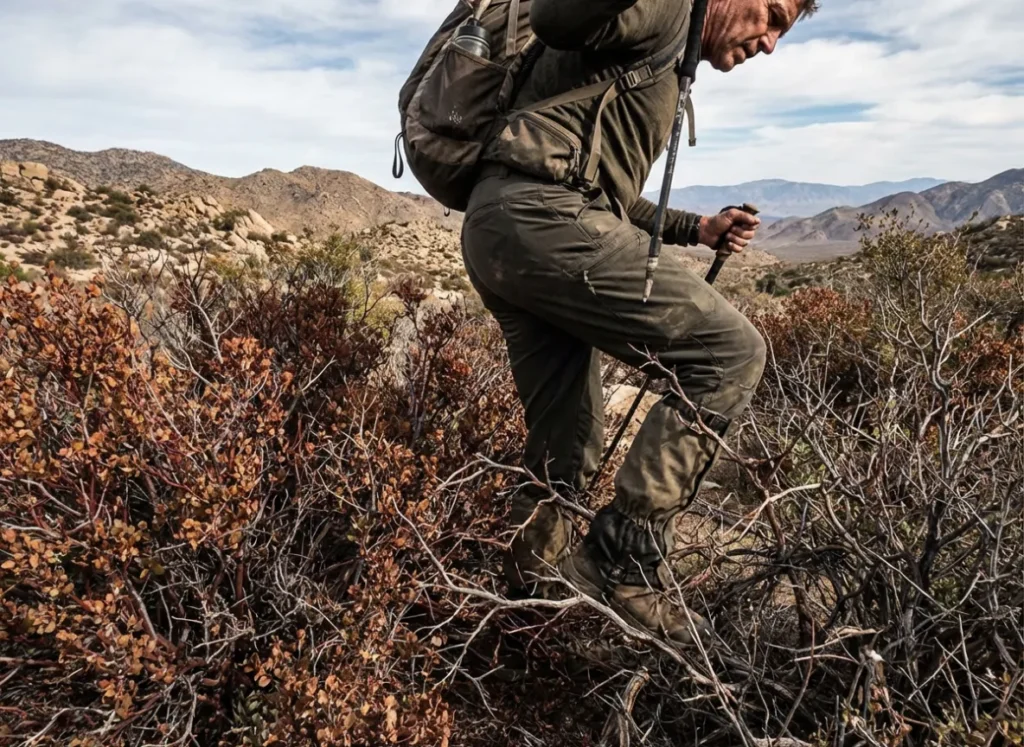
This section acts as a strategic buyer’s guide, categorizing fabrics not by brand, but by their suitability for Granite, Brush, or Trail environments.
Why is Double Weave Technology the Gold Standard for Alpine Scrambling?
Double Weave fabrics are the optimal choice for alpine environments because they use interconnected fabric layers to bury the vulnerable elastane core beneath a durable nylon face.
These fabrics, such as the legendary Tweave Durastretch 520e, are constructed with two distinct faces interconnected by binder yarns. The outer face is typically a high-denier, tightly woven Nylon 6.6 “armor” designed to resist abrasion and wind. The inner face is a textured, open-weave polyester meant to wick moisture and relies on a hydrophilic structure.
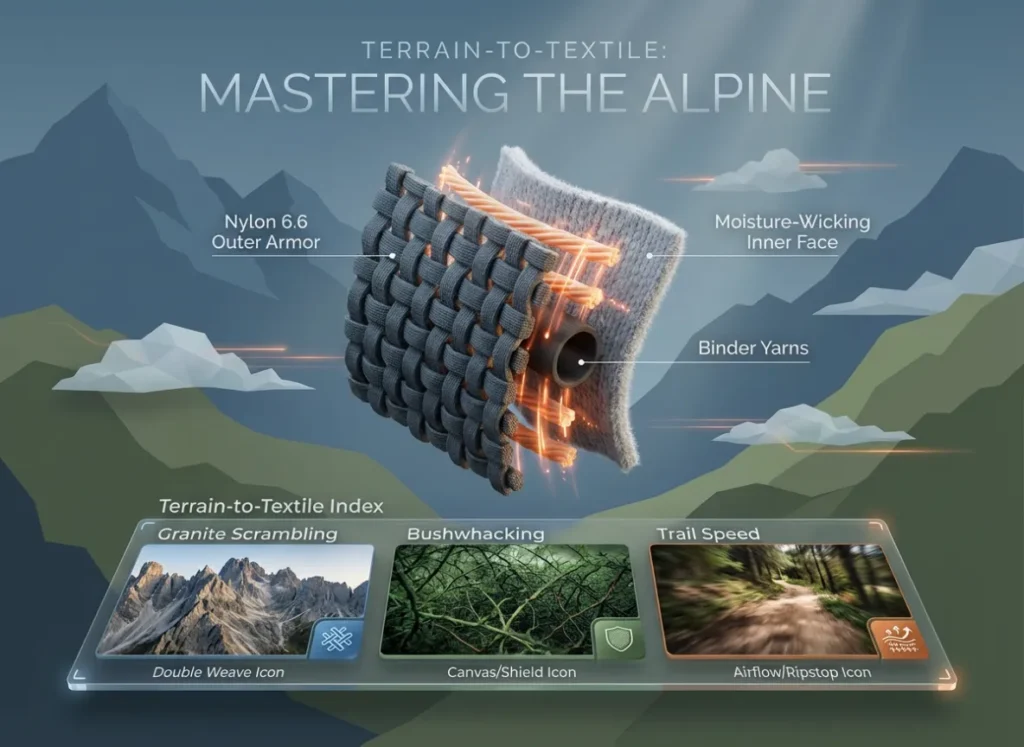
This construction creates the “Golden Ratio” for the alpinist: protection, stretch, and moisture management. Because the elastane is shielded, these fabrics can withstand contact with sharp granite that would shred a standard single-weave knit. They are widely considered essential gear for alpine scrambling where unrestricted motion is non-negotiable. Brands like Sitka, Montane (e.g., Montane Gecko series), and Revolution Race often utilize these heavier GSM (Grams per Square Meter) fabrics for their flagship mountain pants.
When Should You Prioritize Rigid Canvas Over High-Stretch Wovens?
For bushwhacking or heavy brush environments, standard 4-way stretch is a liability due to snagging; the superior choice is a Poly-Cotton Canvas or dense Nylon Canvas.
Fabrics like Fjallraven’s G-1000 rely on mechanical articulation—such as articulated fit, knee darts, and pattern drafting that incorporates garment ease—rather than fiber elasticity to permit movement. They present a hard surface that deflects thorns. This is also a favorite material for the MYOG (Make Your Own Gear) community because it is easier to sew than slippery stretch textiles.
Hybrid constructions offer a middle ground, placing rigid canvas on the front of the legs (brush guard) and 4-way stretch panels in the crotch. This “zoned” approach protects the wearer from thorns while maintaining just enough mobility to clamber over a stile or squat. You will often find this hybrid mapping when reviewing convertible hiking pants, which frequently utilize rigid nylon blends for maximum utility.
How Does Single Weave Ripstop Balance Breathability and Speed?
The ideal fabric for high-cadence movement on well-maintained trails is a Single Weave Ripstop, which prioritizes Air Permeability (CFM) over armor.
Characterized by a grid of thicker reinforcement threads (the ripstop pattern), these fabrics (like the Outdoor Research Ferrosi or fabrics from Discovery Fabrics) allow convective cooling to prevent overheating during high-output efforts like trail running or speed hiking. While they possess high elastane content for fluid movement, they lack the density of a double weave.
The “ripstop” grid prevents small punctures from becoming catastrophic tears, but the lightweight nature means they will eventually fail under heavy abrasion. They are the standard for summer trekkers and are the dominant material found in men’s hiking shorts field-tested for speed and breathability.
How Can You Extend the Lifespan of Your Stretch Gear?
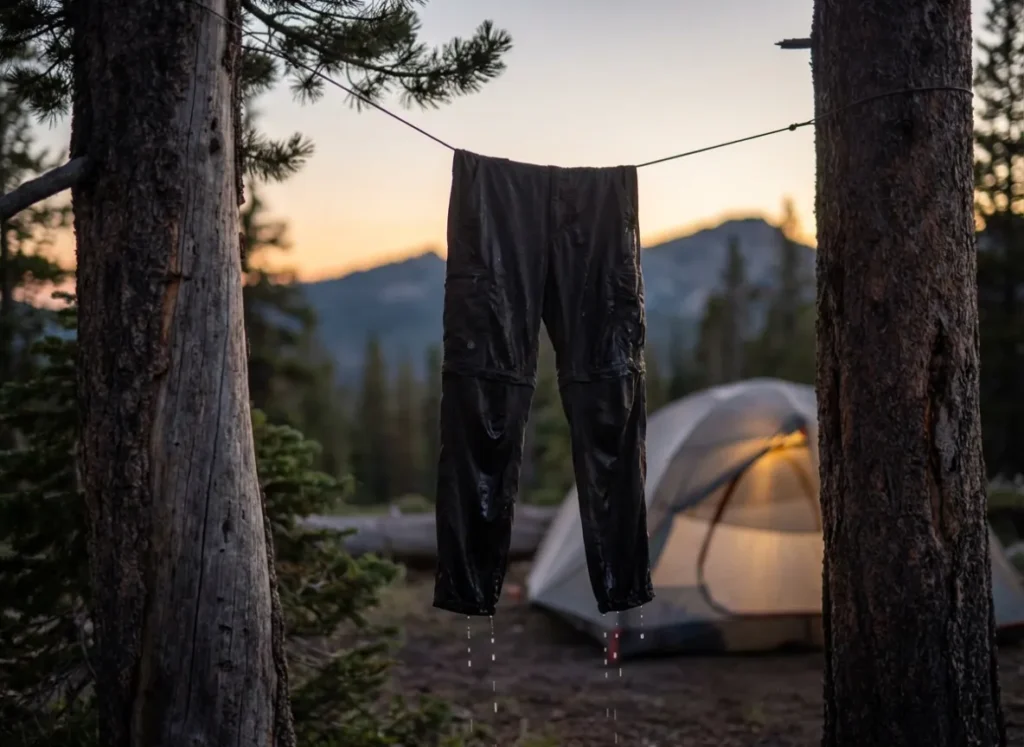
This section provides actionable maintenance protocols to prevent premature failure caused by common laundry mistakes.
Why is Heat the Enemy of Elastomeric Fibers?
Elastane is a thermoplastic-like polymer; exposure to high heat causes thermal shock, degrading the cross-links between polymer chains and destroying the modulus of elasticity.
Temperatures reached in a residential dryer (often >140°F/60°C) can melt the microscopic core of the fiber. This leads to the permanent “bagging” discussed earlier. The fibers lose their retractive force, leaving you with gear that fits poorly and functions worse.
Pro-Tip: The golden rule for stretch apparel is Line Dry Only. Gravity drying preserves the shape and prevents polymer degradation. If a dryer must be used, only the “Air Fluff” (No Heat) setting is permissible.
Adhering to strict care protocols is part of a responsible hiking gear lifecycle guide, ensuring we keep synthetic materials out of landfills for as long as possible.
How Does Fabric Softener Destroy Performance Attributes?
Fabric softeners deposit a waxy coating (cationic surfactants) onto fibers, which clogs the interstitial spaces of the weave and lubricates the elastane, causing structural failure.
On technical gear, this wax instantly neutralizes moisture-wicking capabilities and compromises DWR longevity (Durable Water Repellent). More critically for stretch fabrics, the surfactants lubricate the elastane fibers within the yarn bundle. This allows the elastane to slip out of its protective sheath, leading to “hairiness” (spandex threads poking out) and a complete loss of structural tension.
Pro-Tip: Always use a dedicated technical detergent (like Nikwax Tech Wash) that rinses away completely.
Once you have cleaned the garment properly, avoiding softeners is also the first step in learning how to restore DWR on technical fabrics, ensuring your pants repel water as well as they stretch.
The Verdict on Stretch
The “perfect” hiking pant does not exist. There is only the right tool for the terrain.
High-stretch fabrics inherently sacrifice abrasion resistance compared to rigid nylon weaves. For technical rock, the Double Weave offers the best compromise, protecting the vulnerable elastane core. For thorns and brush, Rigid Canvas remains king. For pure trail speed, Single Weave Ripstop provides the necessary airflow.
Before your next expedition, audit your gear closet using this “Terrain-to-Textile” framework. Treat your stretch gear with respect—keep it out of the dryer—and it will support your movement for years to come.
What has survived your toughest hikes? Share your experience with different fabric weaves in the comments below.
FAQ – Frequently Asked Questions
Is 4-way stretch actually durable enough for rock climbing?
Yes, but only if it is a Double Weave with high Nylon 6.6 content. Standard high-spandex knits will shred quickly against rock, whereas double weaves (like Tweave) utilize a durable outer face to protect the delicate elastic core.
Why do my hiking pants get baggy at the knees after a few days?
This is called Elastic Hysteresis, where the fabric fails to recover its shape after stretching. It is often caused by low-quality elastane or heat damage from dryers, which degrades the polymer’s ability to returns to original form.
Can I put my stretch hiking pants in the dryer?
No, you should always Line Dry technical stretch apparel. Heat above 140°F (60°C) damages the thermoplastic elastane fibers, leading to permanent bagging, loss of elasticity, and a shorter garment lifespan.
What is the difference between mechanical stretch and spandex?
Spandex uses a rubber-like chemical fiber for stretch, while Mechanical Stretch uses crimped, spring-shaped polyester yarn. Mechanical stretch is significantly more durable and won’t bag out over time, but it typically offers a smaller range of motion than spandex.
Risk Disclaimer: Hiking, trekking, backpacking, and all related outdoor activities involve inherent
risks which may result in serious injury, illness, or death. The information provided on The Hiking Tribe is for
educational and informational purposes only. While we strive for accuracy, information on trails, gear, techniques,
and safety is not a substitute for your own best judgment and thorough preparation. Trail conditions, weather, and
other environmental factors change rapidly and may differ from what is described on this site. Always check with
official sources like park services for the most current alerts and conditions. Never undertake a hike beyond your
abilities and always be prepared for the unexpected. By using this website, you agree that you are solely
responsible for your own safety. Any reliance you place on our content is strictly at your own risk, and you assume
all liability for your actions and decisions in the outdoors. The Hiking Tribe and its authors will not be held
liable for any injury, damage, or loss sustained in connection with the use of the information herein.
Affiliate Disclosure: We are a participant in the Amazon Services LLC Associates Program, an
affiliate advertising program designed to provide a means for us to earn advertising fees by advertising and linking
to Amazon.com. As an Amazon Associate, we earn from qualifying purchases. We are also an official affiliate partner
of Black Diamond Equipment via the AvantLink network. If you click on a Black Diamond affiliate link and make a
purchase, we may earn a commission at no additional cost to you. We also participate in other affiliate programs and
may receive a commission on products purchased through our links. Additional terms are found in the terms of
service.