In this article
The zipper on my left leg jammed somewhere around mile 340 on the Colorado Trail. Not stuck-for-a-minute jammed — permanently fused with trail grit jammed. I spent ten minutes on the side of a dusty switchback trying to force it, then gave up and hiked the rest of the day with one leg in pants mode and one leg flapping as shorts. That was the moment I started paying attention to how hiking pants actually fail.
I’ve put both zip-off convertible pants and roll-up cuff pants through full seasons of backpacking — day hikes, week-long trips, sandy desert, wet Pacific Northwest forest. Here’s what 500 trail miles taught me about which style holds up and which one costs you more money in the long run.
Here’s how the two styles compare at a glance:
| Zip-Off vs. Roll-Up Pants: Trail Durability Comparison | ||
|---|---|---|
| Feature | Zip-Off Pants | Roll-Up Pants |
| Durability | Zipper issues at 200–500 miles | Snap loosening at 300–600 miles |
| First Failure Point | Zipper jam from grit/sand | Snap catch on trail debris |
| Repair Cost | $30–80 (tailor) | $5 (snap setter kit) |
| Chafing Risk | High — zipper seam at thigh | Low — no hardware at flex zones |
| Weight Penalty | 2–4 oz heavier | Minimal added weight |
| DWR Wear at Knee | Accelerated by zipper friction | Normal wear rate |
How Zip Off Pants Work (and Where They Break)
The Zipper Mechanism Under Stress
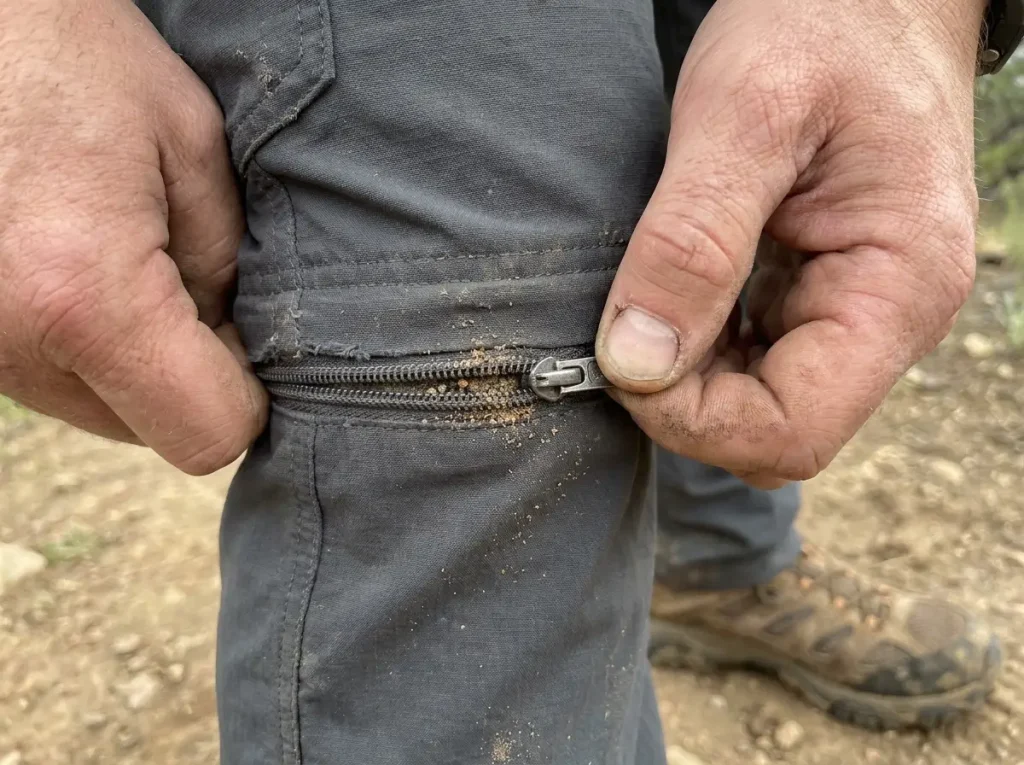
Every pair of convertible hiking pants relies on a circumferential zipper that wraps around each leg, usually just above or just below the knee. That zipper does two jobs: it detaches the lower leg to create shorts, and it holds the pant leg together during every step you take.
The problem is location. Your knee is the highest-flex point on your entire leg. Every step, every scramble, every time you step over a blowdown — that zipper bends.
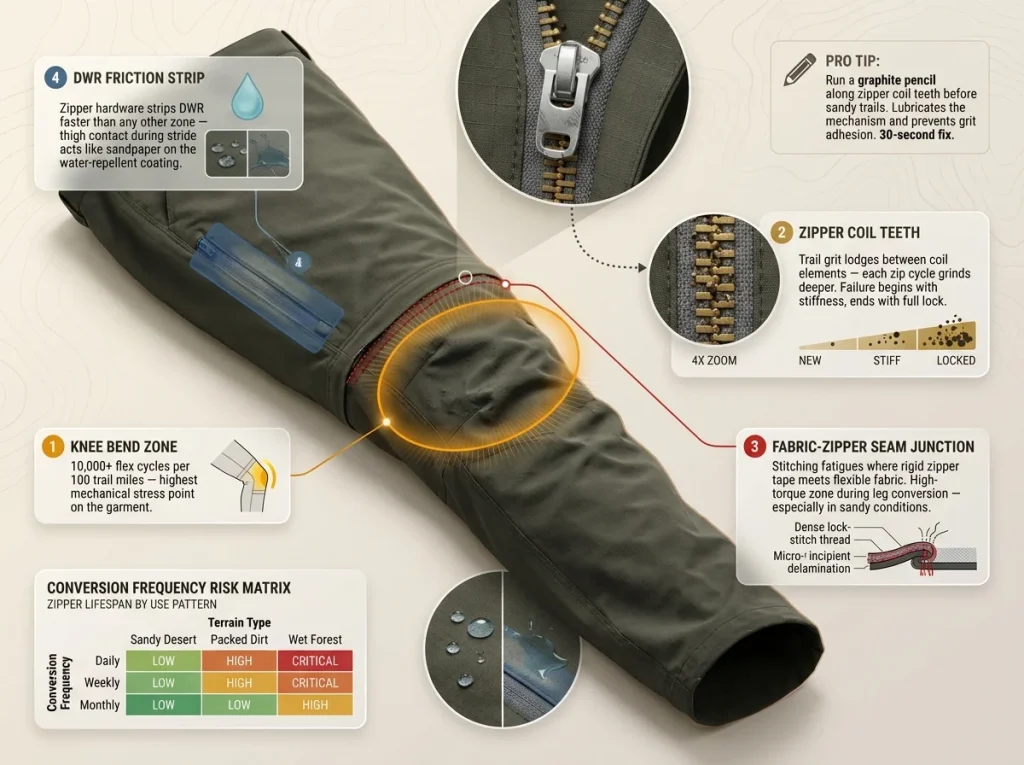
A quality YKK #5 coil zipper is rated for over 10,000 cycles in lab conditions. On trail, that number drops fast. Grit, sand, dried sweat salt, and trail dust all work their way into the coil teeth and act like fine sandpaper every time you zip or unzip.
If you use the partial-unzip ventilation trick — where you open the zipper about 50% to let air flow through without fully detaching the leg — you’re cycling that zipper far more often than someone who converts once in the morning and zips back up at night. That trick gives you about 80% of the cooling benefit of shorts, but it’s quietly shortening your zipper’s life with every unzip.
Pro tip: Before any dusty or sandy hike, run a graphite pencil along your convertible pant zippers. The graphite lubricates the coil teeth and keeps grit from bonding to the mechanism. Takes 30 seconds and can double the usable life of a zipper that sees heavy sand exposure.
Common Failure Points by Brand
Not all zip-off pants fail the same way. After comparing notes with other hikers and going through forum threads from the Camino, Backpacking Light, and PCT communities, the patterns are consistent.
Prana Stretch Zion Convertibles get high marks for fabric durability — the nylon-spandex blend resists tears and stretches without losing shape — but the zipper direction creates a weak point. One long-distance hiker rated them 4/5 on durability but only 2/5 on zip quality after 15,000+ trail miles across multiple pairs.
Columbia Silver Ridge Convertibles use thinner fabric that dries faster but tears more easily. The zippers themselves hold up reasonably well through repeated conversions, but the thin nylon fabric around the zipper tape is where you’ll see the first signs of wear.
REI Sahara Convertibles have smooth-operating zippers out of the box, with substantial fabric and reinforced seams at the hem. But one hiker reported a thigh pocket zipper jamming on a brand-new pair — bad enough that he had to slice the pocket open to retrieve his phone.
The consistent pattern: fabric quality and zipper quality are separate bets. You can get great fabric with a mediocre zipper, or a solid zipper in pants that wear thin at the seat. Finding both in one pair usually means spending north of $80.
What Trail Grit Does to Coil Teeth
Sand is the silent zipper assassin. You don’t feel it happening. Fine particles work into the coil teeth while you hike, and each zip cycle grinds them deeper into the mechanism.
After a few sandy days, the zipper feels stiffer. After a few weeks, it starts catching. Eventually, the slider can’t align the teeth at all and the whole thing locks.
This is why coastal trail hikers and desert hikers report more zipper failures than mountain hikers on packed dirt. The environment dictates the timeline more than the brand. If you’re testing gear to failure before a thru-hike, zippers should be your first stress test — zip and unzip 50 times with dusty hands to see how the mechanism responds.
Worth mentioning: Leave No Trace’s repair-before-replace philosophy applies here. A jammed zipper doesn’t mean the pants are finished. But most hikers don’t know that — they toss the pants and buy new ones.
How Roll Up Pants Work (and Their Weak Spots)
Snap, Button, and Tab Systems Compared
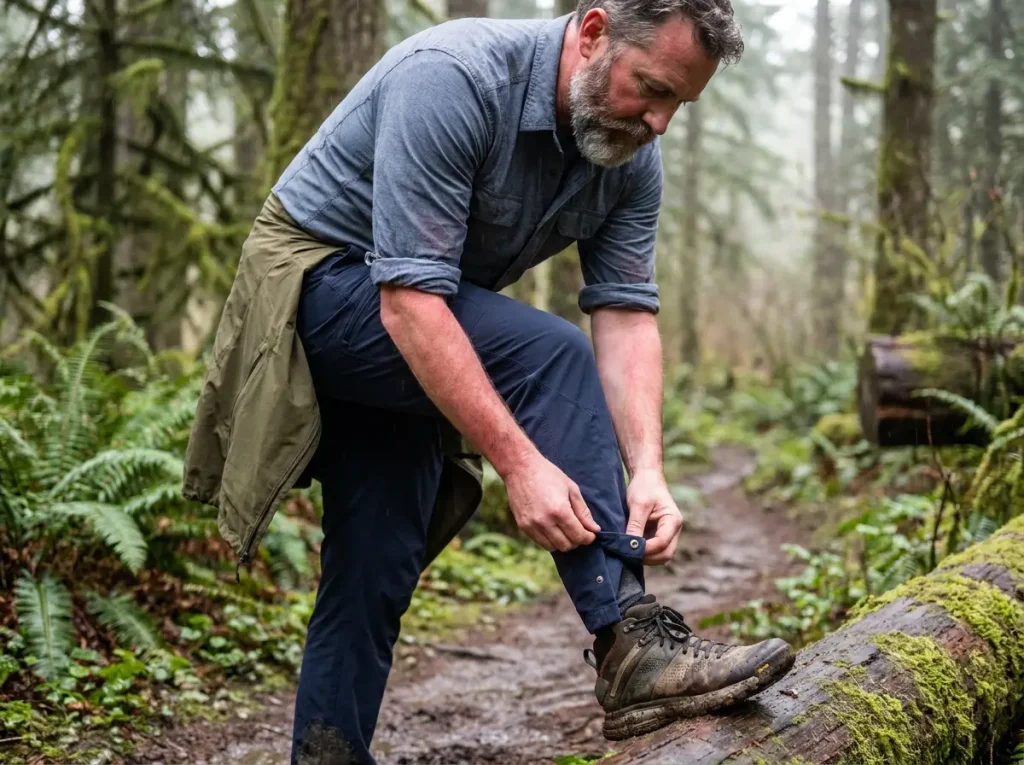
Roll-up hiking pants skip the zipper entirely. Instead, they use a cuff retention system — some combination of snaps, buttons, or fabric tabs — that holds the rolled-up hem in place at mid-calf or just below the knee.
Three main systems exist. Snap closures use a male-female snap pair sewn into the outer calf and the inside of the pant leg. They’re the most common and the quickest to use — one hand, half a second, done.
Button-tab systems use a sewn tab with a buttonhole that loops over a button on the outer leg. Slower to engage, but the button is almost impossible to break. Elastic drawcord systems use a toggle cord at the cuff that cinches the rolled fabric in place. Most secure, but adds a few grams and can catch on brush.
The beauty of all three: no hardware crosses a flex zone. Nothing sits at your knee. Nothing bends 10,000 times per hike. The retention mechanism is at the calf — a low-stress area that barely moves relative to the fabric.
Fabric Stress at the Cuff Roll
Roll-ups aren’t bulletproof. Rolling the same section of fabric in the same place, hundreds of times, creates a fold-line stress point. Over a full season of hard use, you’ll see a faint crease line where the fabric has been repeatedly compressed. On thin nylon, this can eventually become a weak spot where a tear starts.
But here’s the difference: that crease affects appearance before it affects function. Your pants will look worn at the cuff line long before they actually fail there. With zip-offs, the first sign of trouble is often a full mechanical failure — the zipper jams, and now you’re stuck.
Snaps are the weakest component in the roll-up system. They can catch on trail debris, get pulled loose by branches, or simply fatigue after hundreds of cycles. When they do fail, though, you’re left with pants that are slightly annoying (the cuff won’t stay rolled), not pants that are structurally compromised. Big difference.
If you’re wondering how roll-up pants behave under a loaded pack, how pack hip belts interact with pant waistbands matters more than the cuff system. A good elastic waistband handles the hip belt pressure regardless of what’s happening at the ankle.
Pro tip: If your roll-up snaps are getting loose, squeeze the male snap slightly with pliers before each season. That tightens the fit and buys you another year. It’s a 10-second fix that most people don’t think of.
The Durability Showdown After Real Trail Miles
Zipper Lifespan vs Snap Lifespan
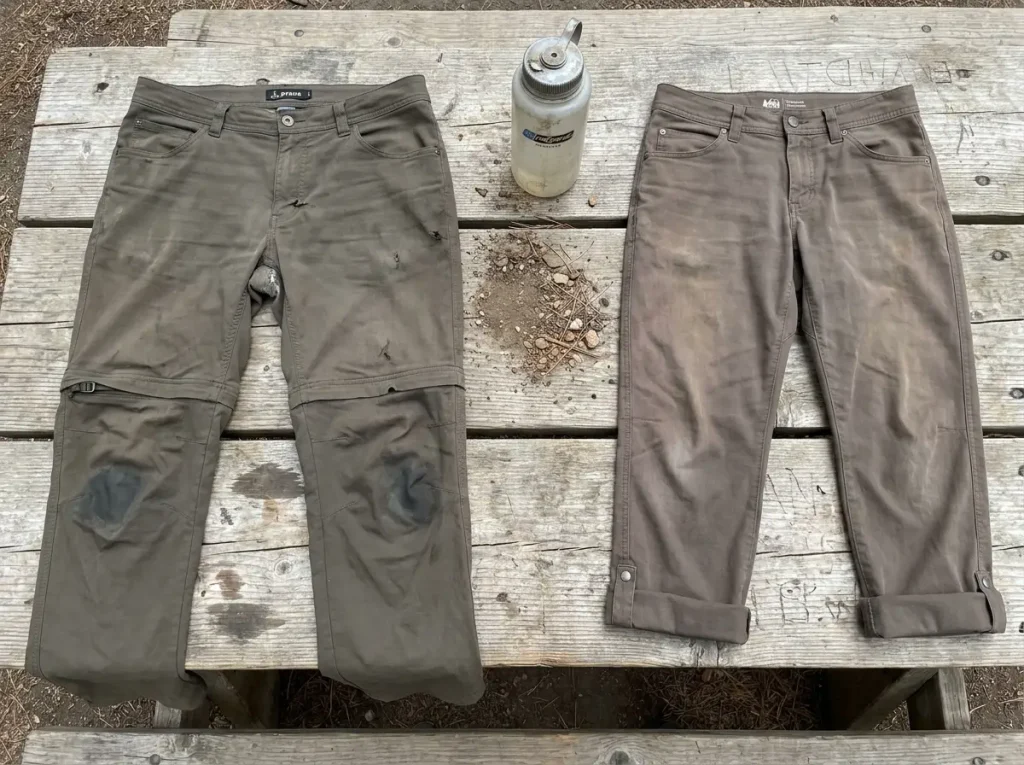
Based on forum reports, gear reviews, and my own experience: zip-off zippers start showing issues between 200 and 500 trail miles, depending heavily on terrain and brand. Sandy desert trails accelerate failure. Packed mountain dirt is gentler. YKK-equipped pants sit at the higher end of that range; budget zippers from no-name brands can fail in a single trip.
Snap closures on roll-up pants typically loosen between 300 and 600 miles. The snap still works — it just doesn’t click as firmly. The functional failure point (snap won’t hold at all) is further out, often past 800 miles. And when a snap does fully fail, you can replace it yourself.
The math is straightforward: roll-ups have a longer average lifespan before first failure, and the failure mode is less disruptive when it happens.
Fabric Wear Patterns That Differ by Style
Here’s something nobody talks about in the comparison articles: convertible pants wear asymmetrically. The upper portion — everything above the zipper line — sees more hours of active use than the lower legs. You wear the tops as shorts, you sit on them, you slide across rocks on them. The tops wear out before the bottoms.
One thru-hiker put it bluntly: “The seat of my zip-offs was see-through before the zippers even failed.” Meanwhile, the detached lower legs were sitting in his pack being used as pillow stuffing, barely showing any wear.
Roll-up pants wear evenly because the entire garment stays together. The knee area still sees the most abrasion — that’s true for any pant style — but there’s no asymmetric aging to deal with.
The DWR Stripping Problem Nobody Mentions
DWR coating wears off fastest at the highest-friction zones: knees, seat, and inner thighs. On convertible pants, the zipper seam adds a third friction element at the knee area. Every time your thigh brushes past the zipper tape while walking, it strips a tiny amount of DWR from the surrounding fabric.
After one full season (roughly 100–150 trail days), the area around a convertible pants zipper will visibly wet-out in light rain while the rest of the pant still beads water. On roll-up pants, the knee area wears at the normal rate because there’s no hardware creating additional friction.
If you know how to test whether your DWR coating is still working, do the sprinkle test on the knee area specifically. That’s where convertibles lose water resistance first, and it’s the spot most people forget to check.
Pro tip: Reapply DWR spray specifically to the 6-inch band around each zip-off zipper seam at the start of every season. That targeted application takes five minutes and addresses the exact zone that fails first. You can skip the rest of the pant — the non-friction areas hold their coating much longer.
Repair Economics — What a Fix Actually Costs
Zipper Repair vs Replacement Price
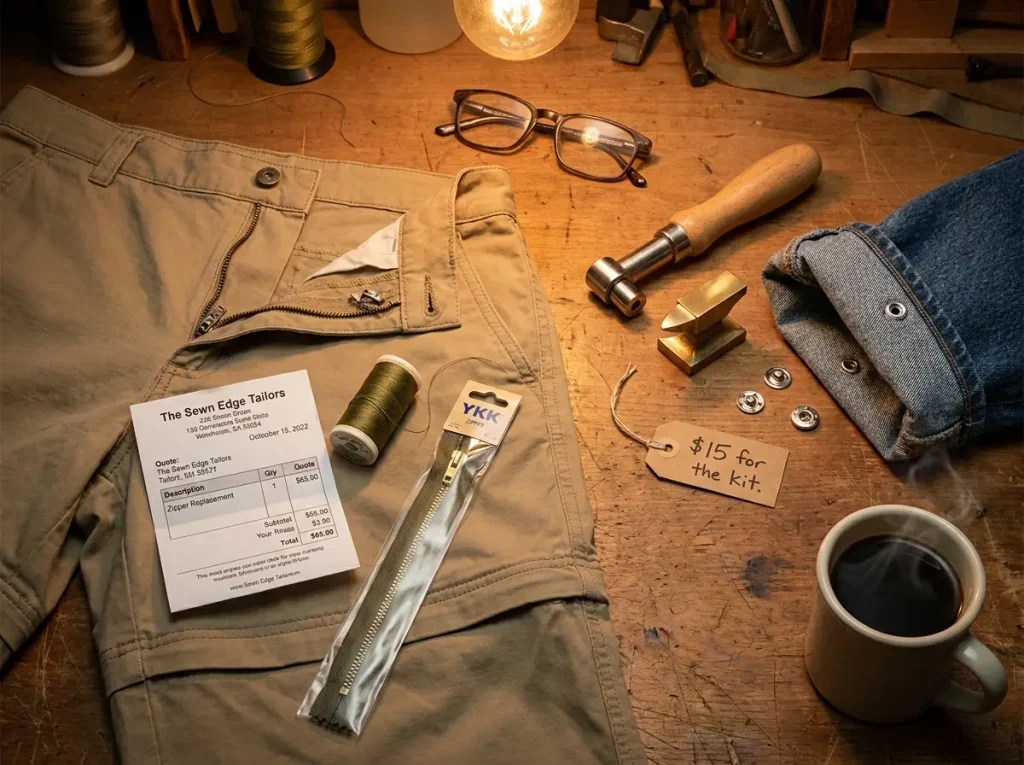
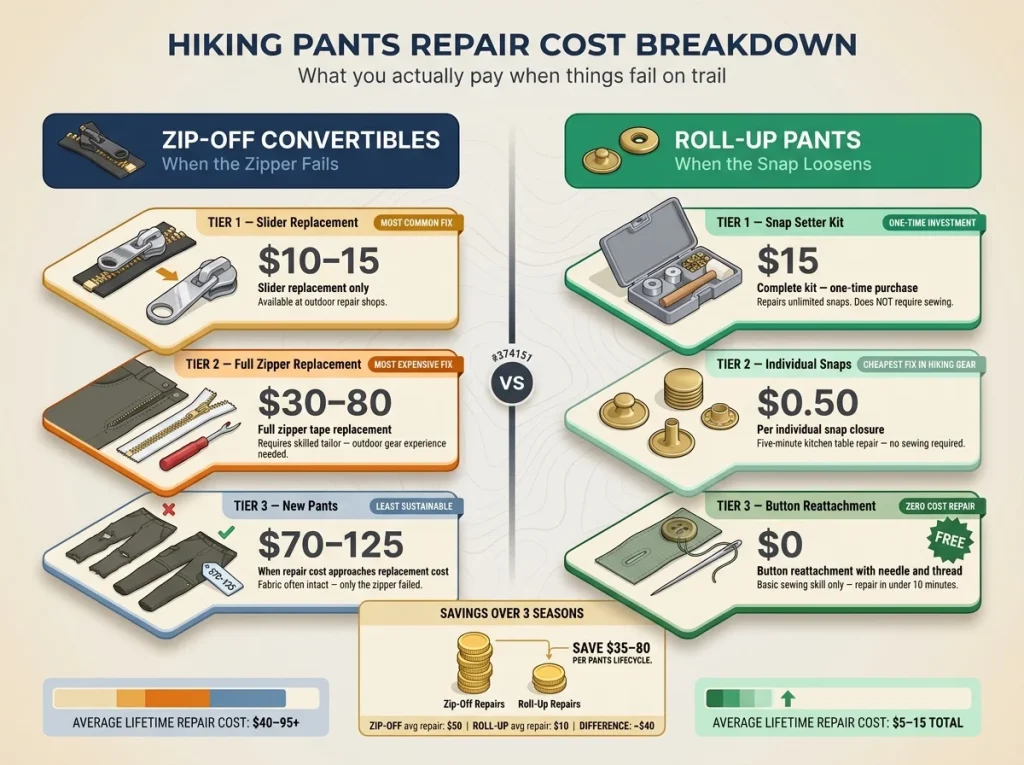
When a zip-off zipper fails, you have three options. A slider replacement — where the old slider is swapped for a new one — runs $10–15 if you can find a repair shop that stocks the right size. A full zipper replacement, where the entire zipper tape is removed and a new one sewn in, costs $30–80 depending on the tailor and whether they have experience with outdoor gear. Specialty outdoor repair shops like Sew Alpine or Rainy Pass Repair charge at the higher end but do cleaner work on technical fabrics.
For context: a new pair of mid-range convertible pants costs $70–125. A full zipper repair can run half the cost of replacement pants. Most hikers don’t bother — they see a broken zipper and assume the pants are finished.
They’re not. A good tailor can replace a pant leg zipper in an hour. The pants come back with full functionality and the rest of the fabric — which was fine — gets to keep doing its job. If the fabric is still in good shape but the zipper is shot, repair is the clear move.
Snap Fixes You Can Do at the Kitchen Table
Roll-up snap repair is a different world. A snap setter tool kit costs about $15 and comes with a setting die, anvil, and a handful of replacement snaps. Each individual snap costs roughly $0.50. The total repair takes five minutes and requires zero sewing skill.
You pull the old snap. You position the new one. You smack it with the setter. Done.
That’s a 6-to-16-times cost difference compared to a zipper repair, depending on whether you need a slider fix or full replacement. Over the life of multiple pairs of pants, the savings stack up — especially for thru-hikers who burn through gear seasonally.
If you’re already comfortable with fixing a zipper on trail without a sewing kit, a snap setter is an even easier skill to pick up. No needle, no thread, just metal and force.
Comfort and Chafing Over Long Days
The Knee Zipper Problem
The zipper on convertible pants creates a stiff ridge of hardware that wraps around your thigh. On a day hike, you might not notice it. On day three of a backpacking trip, it starts making itself known.
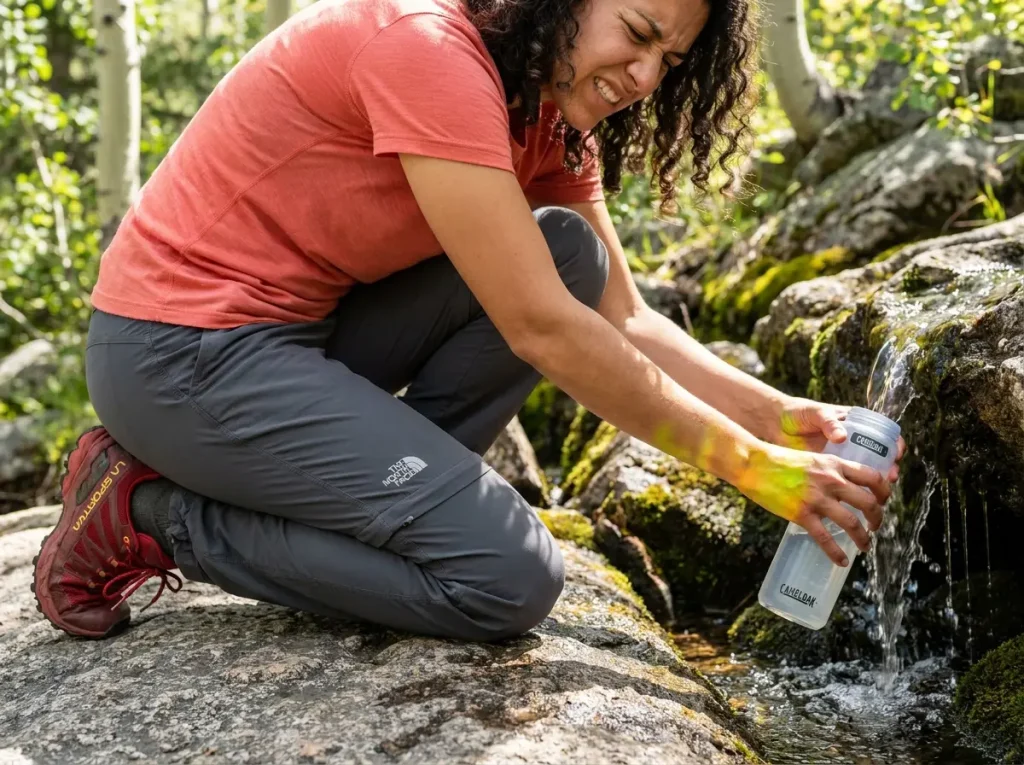
The chafing pattern is predictable. Inner thigh contact with the zipper tape causes irritation during long-stride hiking, especially on uphill stretches where your thighs swing past each other. Kneeling on the zipper — to filter water, tie a boot, stake a tent — puts hard metal directly against your kneecap through a thin layer of fabric. One hiker on the Tahoe Rim Trail reported his inner thighs were raw after two weeks, and he didn’t have particularly thick legs.
Sand and grit make it worse. When fine particles coat the zipper teeth, the mechanism becomes abrasive on top of rigid. You’re now rubbing skin against what amounts to fine-grit sandpaper with a metal spine.
Some brands address this with a fabric flap that covers the inner side of the zipper. It helps, but it’s a patch on a design problem — the flap shifts during movement and doesn’t fully protect the skin underneath, especially when you’re sweating.
Rolled Cuff Bulk Under Gaiters
Roll-up pants aren’t chafe-free by default. When you roll a thick nylon fabric cuff three or four times, the resulting bundle at your calf can feel tight and bulky, especially if you’re wearing gaiters over it. Some hikers describe it as a tourniquet sensation when the rolled cuff plus gaiter compress the calf muscle during extended downhill sections.
The fix is simple: don’t over-roll. One or two folds at the ankle gives you airflow without the bulk. You lose a few inches of ventilation length compared to a full mid-calf roll, but the comfort trade-off is worth it. If you’re hiking in conditions where chafing in humid conditions is a concern, the roll-up’s lack of rigid hardware at the thigh makes a noticeable difference over a full day.
The bottom line: zip-offs create a permanent friction element you can’t remove short of converting fully to shorts. Roll-ups add temporary bulk that you control by how much you roll. One problem is designed in. The other is user-adjustable.
Weight, Packability, and the Trail Versatility Trade-Off
What the Extra Zippers Add to Your Pack Weight
Two circumferential zippers, a pair of zipper pulls, reinforced zipper tape at both seams, and the detachable leg cuffs add roughly 2–4 ounces to a pair of convertible hiking pants compared to an equivalent roll-up in the same fabric weight. That doesn’t sound like much until you’re counting ounces for a thru-hike.
The Prana Stretch Zion Convertible weighs 15.1 ounces. The Marmot Transcend Convertible comes in at 10.85 ounces. Columbia’s Silver Ridge sits at 9.45 ounces — but that’s in a thinner, less durable fabric that explains the weight savings. Comparing apples to apples in the same fabric weight, the zippers cost you about 2 ounces.
When you detach the legs, those zip-off pieces become dead weight in your pack unless you find a use for them. The most popular trail hack: stuff them loosely inside a stuff sack with a puffy layer to create a makeshift pillow. It works surprisingly well, and it’s the one scenario where carrying the extra weight actually pays off.
For anyone deep into the real weight vs comfort trade-off in hiking gear, roll-up pants win the numbers game. Zero added hardware, zero detached pieces floating around your pack, and the same ventilation benefit when you roll the cuffs.
When Zip-Offs Earn Their Keep
I don’t want to bury this: zip-offs have a real use case. If you’re doing variable-weather day hikes where you genuinely switch between pants and shorts three or more times in a single outing — alpine starts that warm up fast, shoulder-season hikes where morning fog burns off into direct sun — the full conversion is more practical than rolling and unrolling.
The key word is “genuinely.” Most hikers who buy convertibles never convert them. Forum after forum, the same pattern: “I bought zip-offs and the legs haven’t come off in six months.” If that’s you, you’re carrying extra weight and extra failure points for a feature you don’t use. Roll-ups give you 70–80% of the ventilation benefit with none of the mechanical risk.
The Verdict — Which Style to Buy for Your Next Trip
Pick Zip-Offs If…
You do frequent day hikes in variable weather where you switch between pants and shorts multiple times per outing. You want the clean look and feel of actual shorts rather than rolled cuffs. You’re willing to maintain the zippers (lubrication, cleaning) and accept the higher repair cost when they eventually fail. You don’t put serious miles on any single pair — weekend warriors who rotate multiple pants will stay well within zipper lifespan.
The best zip-off option right now is the Marmot Transcend Convertible if you can still find it, or the REI Sahara Convertible for a budget pick with solid zippers. Note that KÜHL removed the lower zipper from their 2025 Renegade redesign, which tells you something about where even brands see the mechanism heading.
Pick Roll-Ups If…
You’re a backpacker or thru-hiker who puts serious miles on your pants. You want fewer failure points and cheaper repairs. You rarely convert to shorts and mostly just want airflow at the calf. You hike in sandy or dusty conditions that would destroy zippers. You care about desert hiking clothing that handles heat without falling apart.
The prAna Stretch Zion II and Outdoor Research Ferrosi are both strong roll-up options with abrasion-resistant nylon and functional snap tabs. Look for articulated knees and a gusseted crotch — those features matter more for longevity than the cuff system.
If you’ve owned convertibles for the past three seasons and you’ve never actually zipped the legs off during a hike, you already know the answer. Buy the roll-ups.
Conclusion
Roll-up pants outlast zip-offs because they have fewer mechanical failure points and no zipper-DWR friction interaction at the knee. The math supports it: fewer components means fewer things that break, and when something does fail, a snap replacement costs $5 versus $30–80 for a zipper fix.
Most hikers who buy convertibles never convert them. That’s not a guess — it’s the consistent finding across every hiking forum thread on the topic. If you’re carrying zip-off hardware you never use, you’re paying a weight and durability tax for a feature that sits idle.
Buy for how you actually hike, not how you imagine you’ll hike. If you switch between pants and shorts three times on a day hike, zip-offs earn their keep. If you roll your cuffs at the trailhead and forget about them until you’re back at the car, roll-ups are the smarter long-term investment.
Check your current pants. If the legs haven’t come off in the last 10 hikes, that’s your data.
Q1 Do zip-off hiking pants last as long as regular hiking pants?
No. The zipper mechanism adds a failure point that regular pants don’t have. Zip-off zippers typically show issues between 200 and 500 trail miles depending on terrain and brand quality. The fabric itself may last longer, but the zipper usually fails first.
Q2 Are roll-up pants better than zip-off for backpacking?
For most backpackers, yes. Roll-ups have fewer components that can break, weigh 2–4 ounces less, and cost far less to repair when something does wear out. They provide adequate ventilation through cuff rolling without the chafing risk of a knee-level zipper.
Q3 How long do convertible hiking pants typically last?
Fabric lifespan ranges from one to three seasons depending on use intensity and fabric quality. The zipper often fails before the fabric does. Budget convertibles may last one season of heavy use, while premium pairs with YKK zippers can go two to three seasons with proper maintenance.
Q4 Can you fix a broken zipper on convertible pants?
Yes. A slider replacement costs $10–15 at a repair shop. A full zipper replacement runs $30–80 at a tailor experienced with outdoor gear. Specialty shops like Sew Alpine handle technical fabrics well. The repair restores full function if the surrounding fabric is still in good condition.
Q5 What are the best durable convertible hiking pants?
The Marmot Transcend Convertible earned top marks for zipper quality in long-distance testing. The REI Sahara Convertible offers solid durability at a lower price. The Prana Stretch Zion Convertible has excellent fabric durability but weaker zipper quality. Avoid ultra-thin budget options — the fabric fails before the zippers do.
Risk Disclaimer: Hiking, trekking, backpacking, and all related outdoor activities involve inherent
risks which may result in serious injury, illness, or death. The information provided on The Hiking Tribe is for
educational and informational purposes only. While we strive for accuracy, information on trails, gear, techniques,
and safety is not a substitute for your own best judgment and thorough preparation. Trail conditions, weather, and
other environmental factors change rapidly and may differ from what is described on this site. Always check with
official sources like park services for the most current alerts and conditions. Never undertake a hike beyond your
abilities and always be prepared for the unexpected. By using this website, you agree that you are solely
responsible for your own safety. Any reliance you place on our content is strictly at your own risk, and you assume
all liability for your actions and decisions in the outdoors. The Hiking Tribe and its authors will not be held
liable for any injury, damage, or loss sustained in connection with the use of the information herein.
Affiliate Disclosure: We are a participant in the Amazon Services LLC Associates Program, an
affiliate advertising program designed to provide a means for us to earn advertising fees by advertising and linking
to Amazon.com. As an Amazon Associate, we earn from qualifying purchases. We are also an official affiliate partner
of Black Diamond Equipment via the AvantLink network. If you click on a Black Diamond affiliate link and make a
purchase, we may earn a commission at no additional cost to you. We also participate in other affiliate programs and
may receive a commission on products purchased through our links. Additional terms are found in the terms of
service.