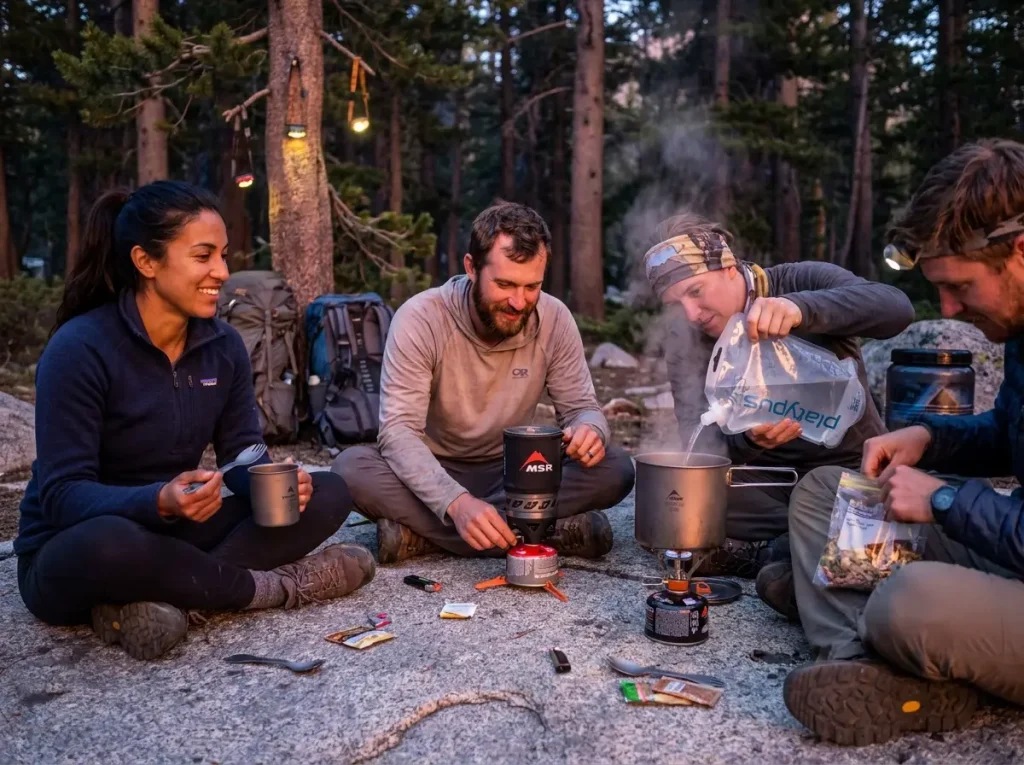
The first night is always fine. Everyone’s stoked, the food is fresh, and somebody volunteers to cook. By night three, nobody wants to haul water, the fuel situation is unclear, and whoever cooked last night is silently furious that the same person skipped cleanup again. I’ve watched it happen on dozens of group trips — the cooking system that seemed obvious at the trailhead collapses under its own lack of structure.
Group cooking logistics for 4 or more hikers isn’t about bigger pots or better recipes. It’s about systems — who carries what, when things boil, how cleanup works, and what happens when someone’s dietary restriction collides with the group plan. Here’s how to build a system that survives past night three.
Quick Answer: To organize group cooking for 4+ hikers:
- Run two stoves in parallel — one stove per four people minimum
- Split cooking gear weight evenly using a daily rotation chart
- Pre-portion all meals into labeled bags before the trip
- Assign four roles per meal: Cook, Water, Setup, Cleanup
- Calculate fuel at 0.5L boil per person per meal, minimum two canisters
- Cook and wash 200+ feet from water sources for LNT compliance
The Math Behind Group Stove Systems
One Stove Per Four People — Minimum
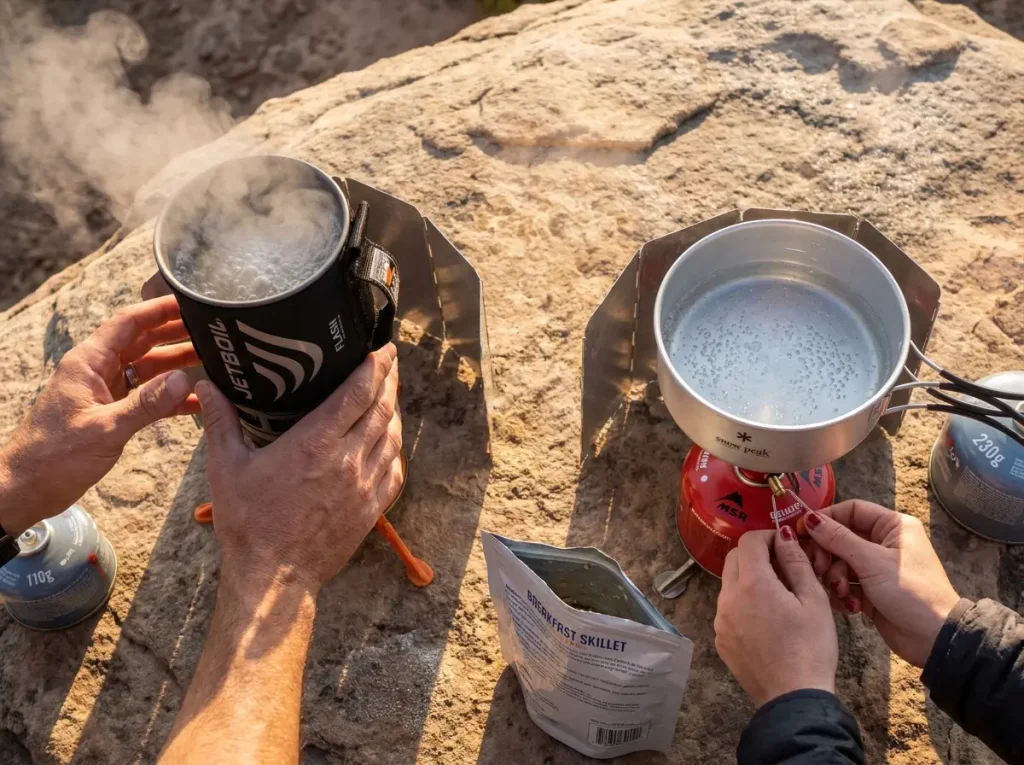
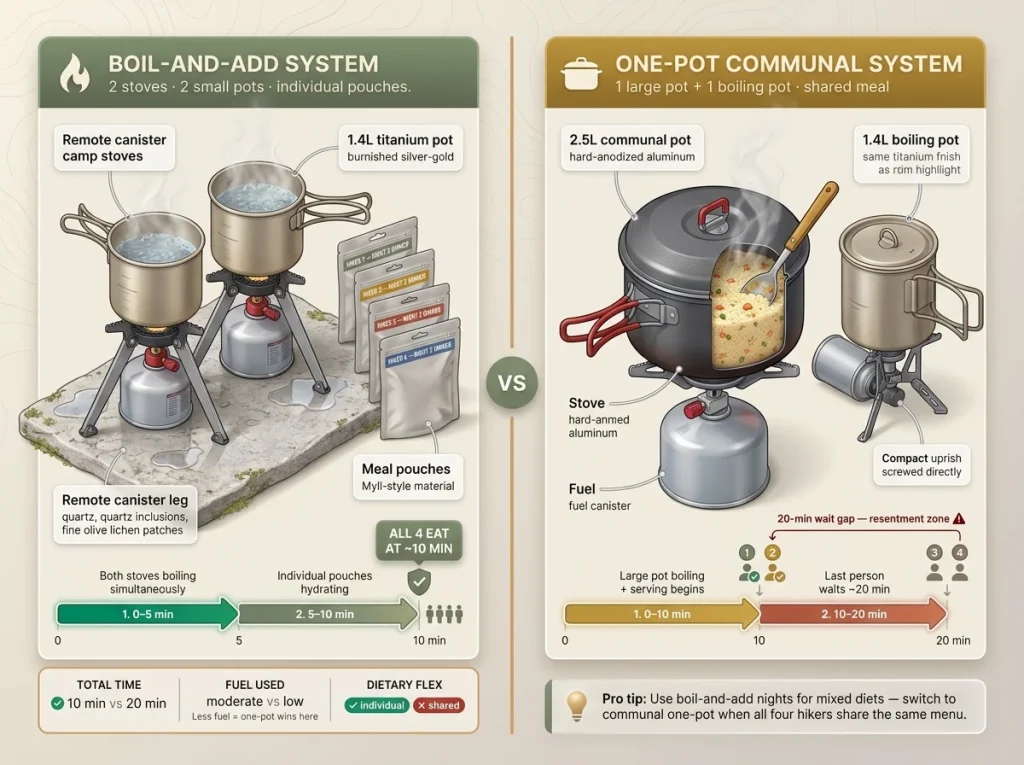
A single backpacking stove boiling 0.5L at a time feeds one person per cycle. For a group of four eating dinner, that’s four sequential boils — roughly 16–20 minutes of total boil time plus cooldown between fills. With a single stove, the last person eats 20 minutes after the first. On a cold night after 12 miles, that gap creates resentment.
The fix: run parallel cook stations. Two stoves running simultaneously cut total meal prep time nearly in half. Plan one stove and two pots for every four people in your group. A group of six needs two stoves and at least three pots.
Pot Sizing That Actually Feeds the Group
A 1L pot works for solo or duo cooking. For four people, you need a minimum 2.5L pot if you’re making a communal one-pot meal. For boil-and-add meals (add hot water to individual freeze-dried pouches), a 1.8L pot works because you’re doing sequential 0.5L boils — but again, you need two pots running on two stoves to avoid the waiting problem.
The Snow Peak Trek 1400 (1.4L) works for the secondary boiling station. A GSI Halulite 1.8L or MSR-compatible 2.5L pot handles the primary cooking. Wider pots heat more efficiently than narrow ones — better heat distribution, less scorching on one-pot meals.
Pro tip: Bring one pot with a volume marker scratched inside the rim. When you’re boiling in the dark at 8,000 feet, eyeballing “half a liter” leads to either wasted fuel or undercooked meals. A sharpie line at 500mL saves both.
Remote Canister vs Upright — What Groups Need
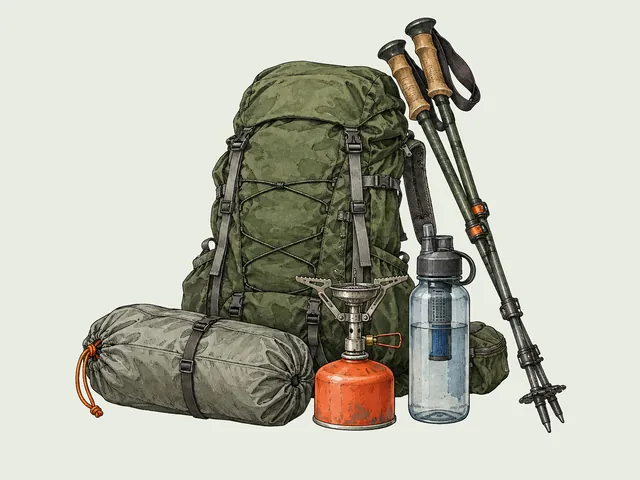
For group cooking with pots over 1.5L, a remote canister stove beats an upright canister design. The lower center of gravity keeps heavy pots stable, and the wider pot support handles larger cookware without tippy wobbling. The MSR WindBurner Duo system or a Kovea Spider handles group loads without the anxiety of a 2.5L pot balanced on a pencil-thin upright stove.
An efficient windscreen setup also matters more for group cooking because you’re running stoves longer per meal — a 30% fuel efficiency gain from wind protection translates to carrying one fewer canister across a 5-day trip.
How to Split Weight So Nobody Resents the Cook
The Equal-Ounce System
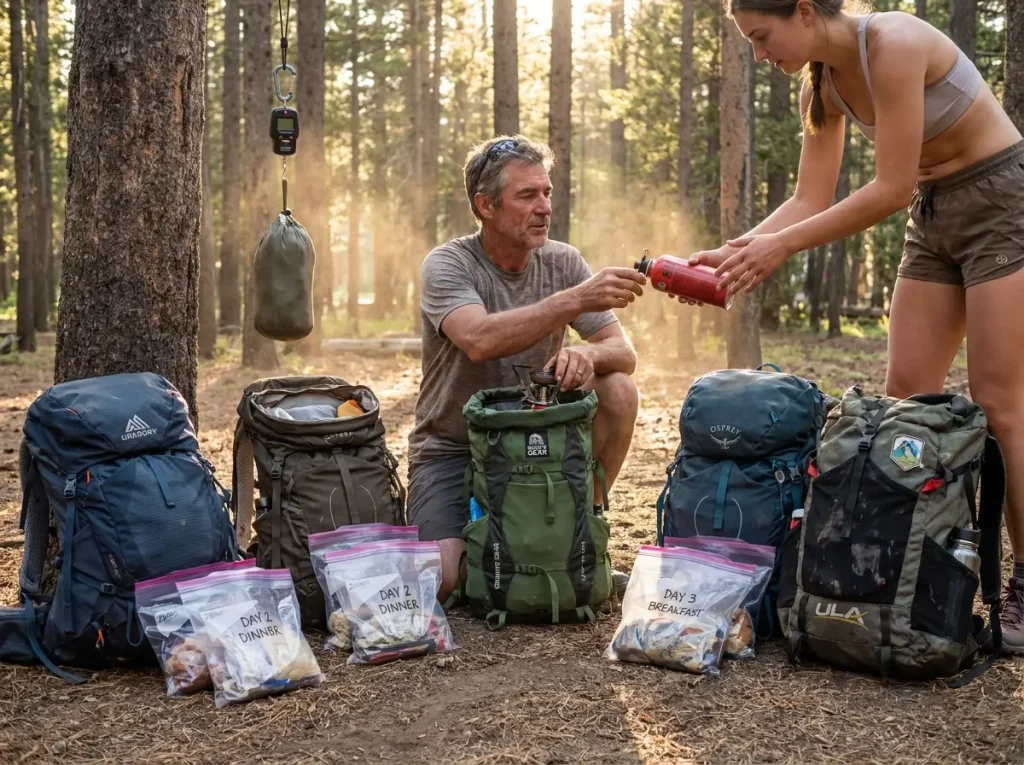
Weigh every shared item before the trip: stoves, fuel, pots, group food bags, water filter, bear canisters. Divide total group gear weight by number of hikers. Each person carries their personal food plus an equal share of communal cooking weight.
For a 4-person group on a 3-day trip, shared cooking gear typically runs 6–8 lbs total (2 stoves, 2 fuel canisters, 2 pots, utensils, windscreen, scrubber). That’s 1.5–2 lbs per person — manageable when distributed fairly.
Daily Gear Rotation
Don’t just split weight at the trailhead and call it done. Rotate the heaviest items daily. The person who carries the 2.5L pot (heaviest single item at ~12 oz) yesterday carries the lighter windscreen today. Fuel canisters get lighter each day — the person carrying fuel on day 1 has it easier by day 3.
A simple rotation chart written on a piece of tape stuck inside someone’s hiking leadership notes prevents the “I always carry the heavy stuff” argument.
Food Weight Decreases — Plan for It
Food weight drops ~1.5–2 lbs per person per day as you eat it. By day 3 of a 5-day trip, the group has consumed 6–8 lbs of food per person. If you front-loaded all the communal food weight onto two people at the start, they’re suddenly carrying much less while others haven’t shed any pack weight. Redistribute at rest days or midpoints.
Meal Planning That Scales Without Scaling Complexity
The Boil-and-Add Default
The simplest group meal system: boil water, pour it into individual portions, wait. Everyone gets exactly what they want in their own vessel. No arguments about spice levels, no accommodating the vegetarian with a separate pot, no cleaning a communal pot caked with burnt rice.
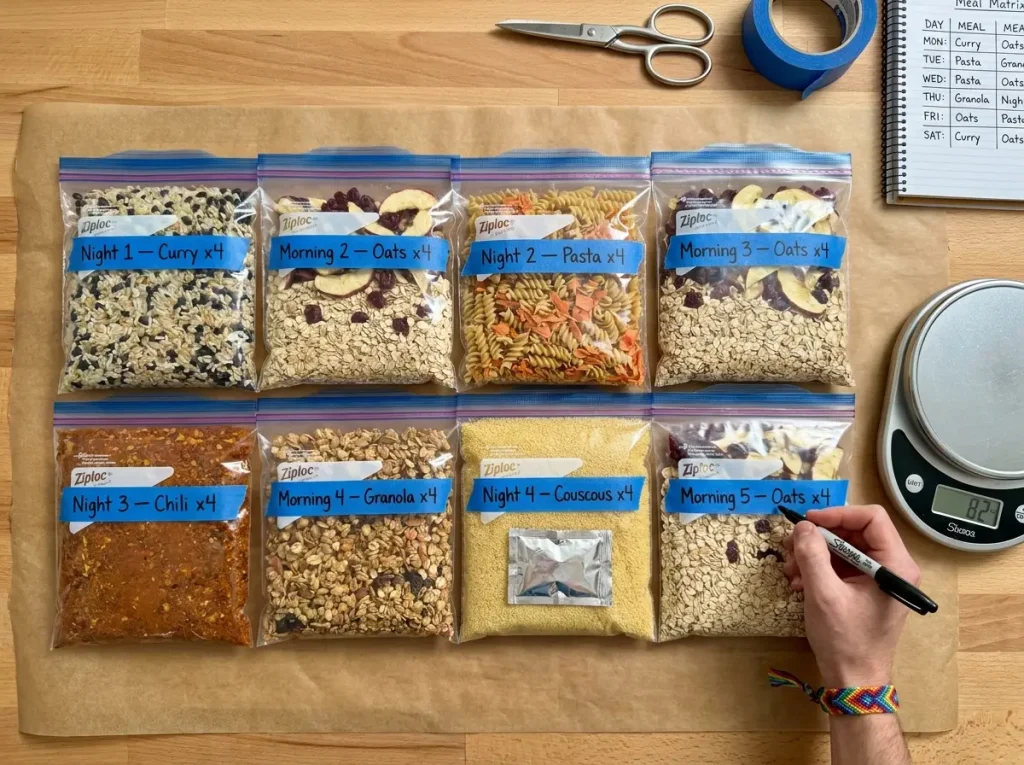
Freeze-dried pouches work but get expensive at $8–$12 per person per meal. The cheaper play: dehydrate your own meals into pre-portioned Ziploc bags before the trip. A single batch of dehydrated chili serves four for under $3 per person.
One-Pot Communal Meals — When They Work
Communal cooking works for groups with matched dietary needs who enjoy the social experience. It also saves fuel — one 2.5L pot boiling once uses less gas than four individual 0.5L boils. The trade-off is that someone has to cook it, someone has to clean the pot, and everyone eats the same thing.
Best communal group meals: couscous with dehydrated vegetables (5-min cook time), ramen with added protein (3 min), instant mashed potatoes with cheese and bacon bits (boil and stir). Avoid anything requiring sustained simmering — it burns fuel and tests patience.
Pre-Trip Portioning Eliminates Trailside Arguments
Before the trip, bag every group meal into labeled portions: “Night 2 Dinner × 4 servings” written in Sharpie on the Ziploc. Include the spice packet, the oil if needed, and the written instructions inside the bag. At camp, whoever is on cook duty grabs the correct bag and follows the card. No measuring, no debating, no “I thought you packed the garlic.”
Pro tip: Pack each day’s meals into one large stuff sack. Day 1 meals in one sack, Day 2 in another. Grab the right sack each morning and distribute — no digging through the bear canister for scattered ingredients.
The Fuel Math — How Much Gas for Four Mouths
The 0.5L-Per-Person-Per-Meal Rule
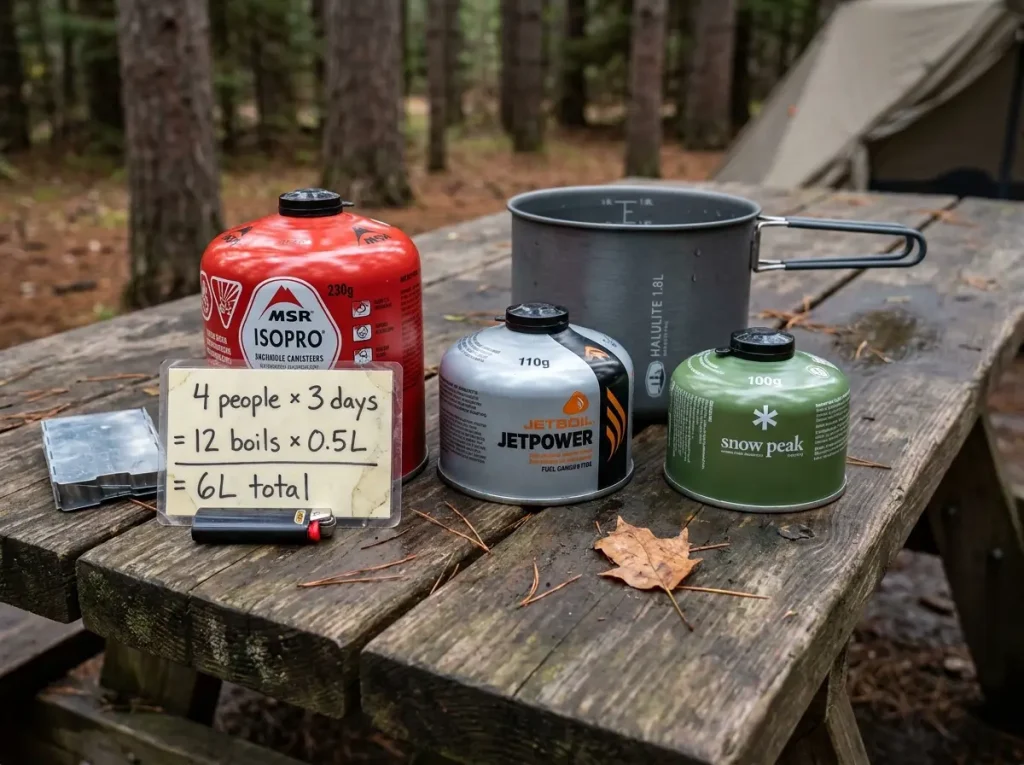
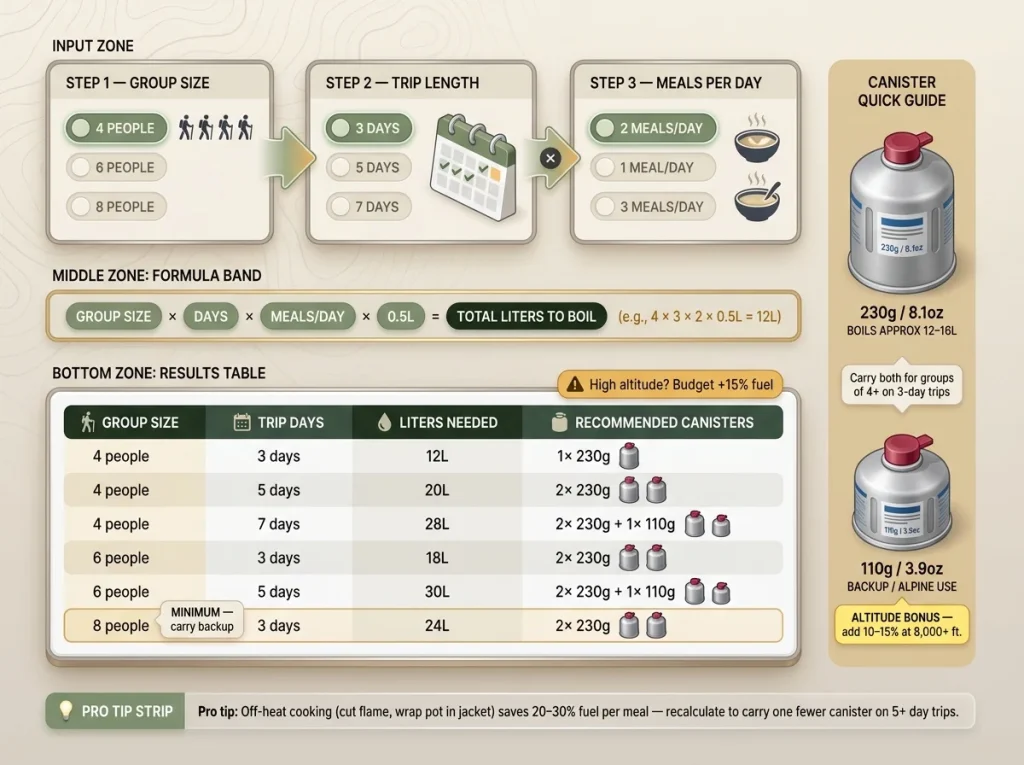
Each hot meal requires approximately 0.5L of boiling water per person. For a group of four eating two hot meals per day (breakfast + dinner) over three days, that’s: 4 people × 2 meals × 3 days × 0.5L = 12L of water to boil.
A standard 230g isobutane canister boils approximately 12–16L depending on conditions (wind, altitude, pot efficiency). So one 230g canister technically covers a 4-person, 3-day trip — but “technically” and “comfortably” aren’t the same thing.
Always Carry a Backup Canister
Cold mornings, high altitude, wind exposure, and that extra round of trail coffee all burn fuel faster than the math suggests. Carry a second 110g canister as backup for a group of four. For groups of six or more, carry two full 230g canisters.
The off-heat cooking technique extends fuel dramatically for group meals. Bring water to a boil, cut the flame, wrap the pot in a fleece or puffy jacket, and let residual heat finish the cooking. Works for oatmeal, couscous, rice, and ramen — saves 20–30% of fuel per meal.
Altitude Adjustment
Above 8,000 feet, water boils at a lower temperature and food takes longer to cook. Budget 10–15% more fuel for alpine trips. A group of four at 10,000 feet doing 3 days should carry approximately 280g total — so a 230g + 110g combination.
The Role Rotation System That Prevents Night-Three Collapse
Four Roles, Four People
The system that works after 30+ group trips: assign four distinct roles that rotate daily.
Cook — prepares the meal, manages the stove, decides when food is ready. Only person touching the cooking pot during meal prep.
Water — filters and delivers all water needed for the meal. Fills pots, fills bottles, handles the gravity filter or pump. This person also manages water source logistics and knows the 200-foot rule.
Setup — finds the cook site (flat, sheltered from wind, 200 feet from water), unpacks stoves, assembles windscreens, lays out utensils and meal bags. This person gets camp kitchen running before the cook arrives.
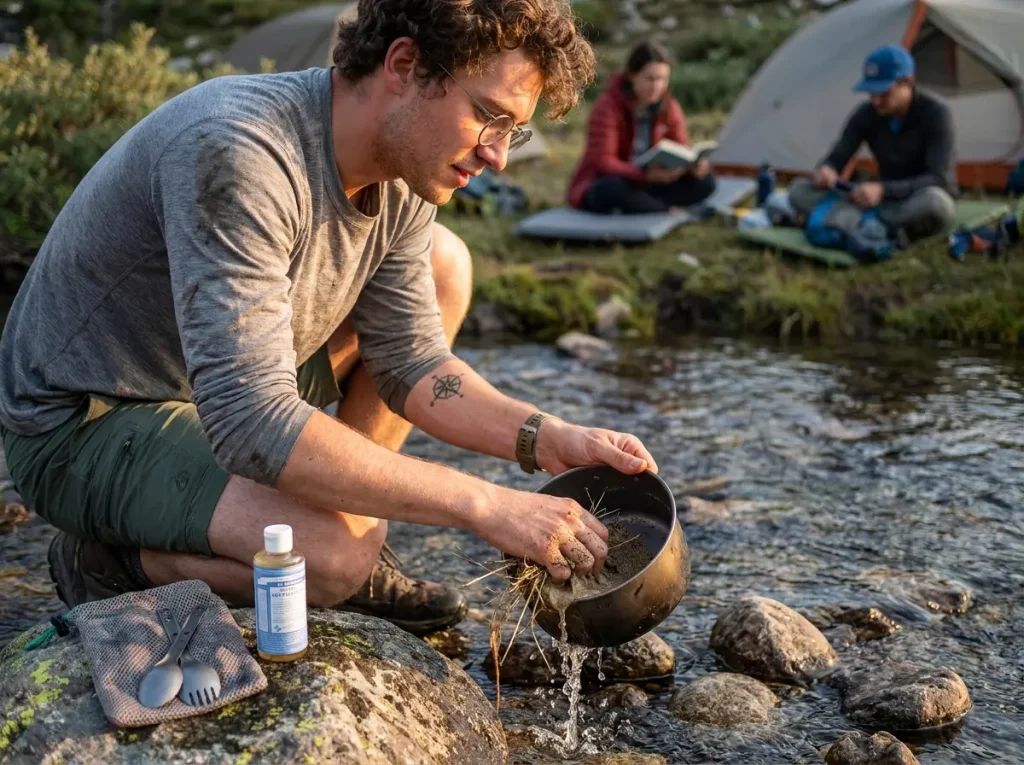
Cleanup — scrapes plates, washes pots, broadcasts grey water, packs kitchen gear back into the correct bags. This is the least popular role, which is exactly why it rotates.
Why It Fails Without Structure
Without assigned roles, the “most enthusiastic cook” does 80% of the work while everyone else stands around being useless. By night three, that person is exhausted and resentful. The rotation forces equal contribution and gives everyone a break — you only cook once every four nights in a group of four.
Pro tip: Write the rotation on a strip of duct tape and stick it to the inside of the bear canister lid. When it’s visible every time you open the food container, nobody “forgets” whose turn it is.
Handling Unequal Cooking Skill
Not everyone needs to produce a gourmet meal. The simplest solution: pair the least-experienced cook with a boil-and-add meal night. Boiling water requires zero culinary skill. The more confident cooks get the one-pot communal nights where timing and seasoning matter.
Leave No Trace Cooking for Groups — The 200-Foot Reality
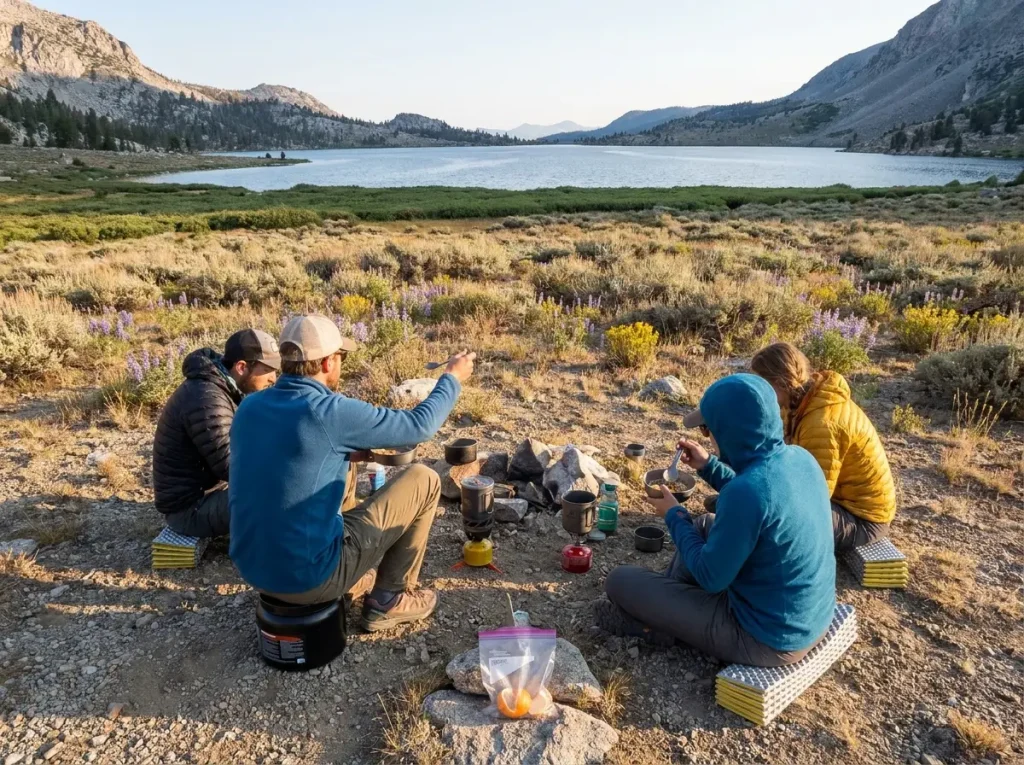
The Kitchen Footprint Problem
A solo hiker cooking dinner disturbs a 3-foot radius. Four hikers with two stoves, a bear canister open for food access, discarded food wrappers, and a water filter spread across a 15-foot kitchen zone. That footprint on fragile alpine meadow or near a water source violates Leave No Trace principles more aggressively than most group hikers realize.
Choose a cook site on durable surfaces — rock slabs, compacted dirt, gravel bars. Never set up the group kitchen on vegetation. And position the entire operation at least 200 feet (70 adult steps) from lakes, streams, and rivers. That distance protects water quality even when grey water gets spilled or broadcast imperfectly.
Grey Water Broadcasting for Groups
After washing pots without soap, you’re left with grey water containing food particles. For a group of four, that’s more grey water volume than a solo hiker produces. Strain out all food particles (pack them out), then broadcast the remaining water in a wide arc over durable ground far from camp and water. Don’t dump it all in one spot — spread it thin so it dries quickly.
Food Storage at Night
Four people means more food odor, which means more bear interest. A single BearVault BV500 holds about 4 days of food for two people — so a group of four on a 3-day trip needs two bear canisters minimum. If you’re hanging food instead, you need a hang system rated for the combined weight and a tree with suitable branches, which gets harder as food bag weight scales up.
Check local fire and camping regulations before the trip too — some wilderness areas restrict group cooking to designated sites.
When to Skip Group Cooking Entirely
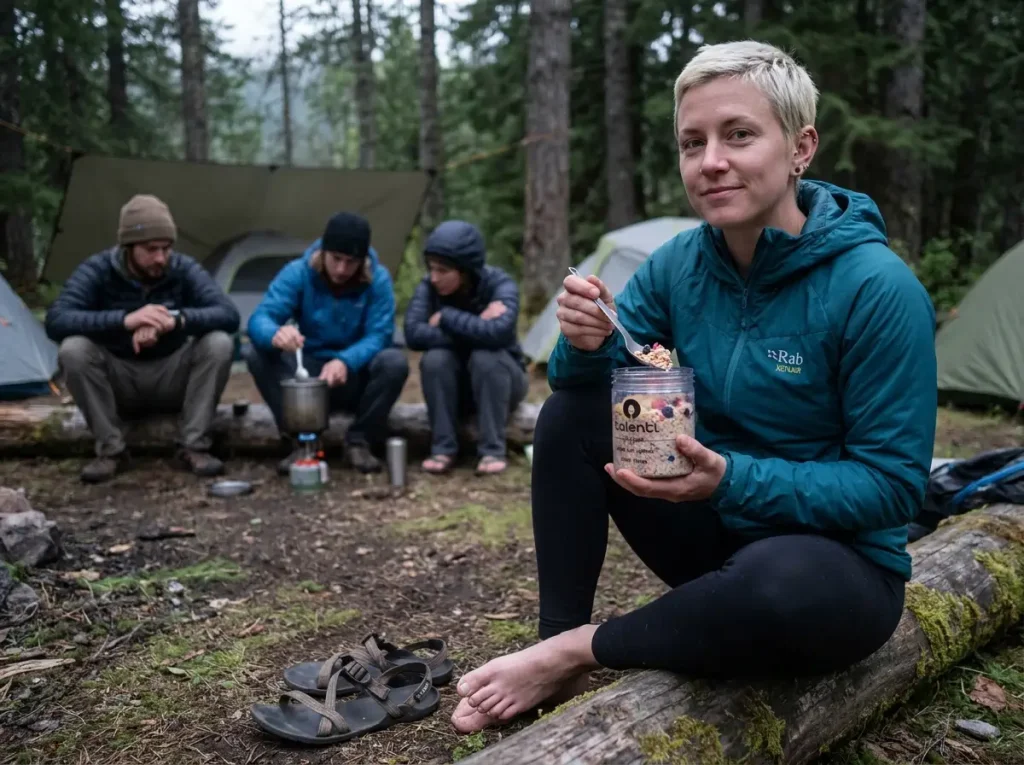
Dietary Restrictions Make It Impossible
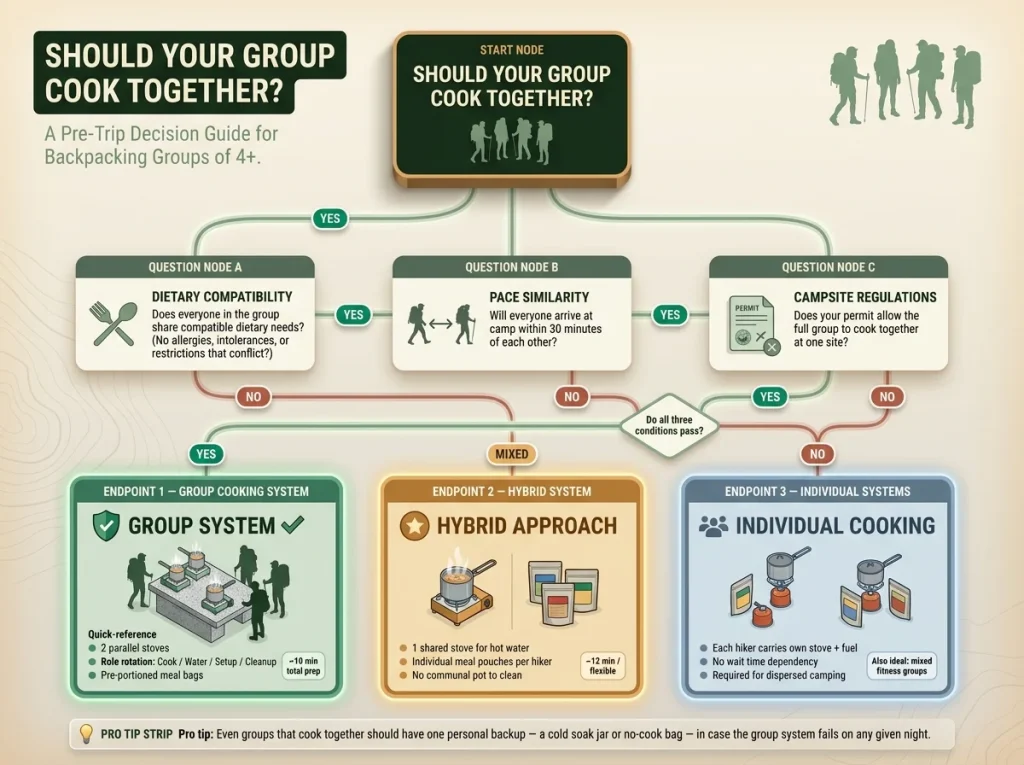
When one person is vegan, another is gluten-free, and a third is allergic to nuts, communal meals become a logistics puzzle with no clean solution. In these cases, individual cook systems are faster, simpler, and eliminate cross-contamination risk entirely. Everyone carries their own stove, their own food, and eats on their own schedule.
Pace Differences Mean Staggered Arrivals
Groups with varied fitness levels often arrive at camp 30–60 minutes apart. If the fastest hikers have to wait an hour for the slowest before anyone can eat, frustration builds quickly. Individual systems let early arrivals cook and recover while late arrivals eat when they’re ready.
Dispersed Camping Requirements
Some wilderness areas limit group size at individual campsites and require dispersed camping — parties of 4 must split into pairs at separate sites. In these cases, group cooking is physically impossible. Check permit requirements before assuming your party of six can gather at one kitchen site.
Pro tip: Even in groups that cook together, everyone should carry a personal backup option — a cold soak jar, some trail mix, or a no-cook ramen bag. If the group system breaks down (stove failure, fuel leak, cook gets sick), nobody goes to bed hungry.
Conclusion
Group cooking fails on night three because enthusiasm decays but logistics don’t simplify themselves. Build the system before the trip: assign roles, pre-portion meals, bring two stoves, calculate fuel honestly, and write the rotation somewhere visible. The groups that eat well on night five are the ones who solved the people problem — not the recipe problem.
Start your next group trip with the rotation chart taped inside the bear canister. Cook one practice meal at home with the full group to test the system. And when someone inevitably asks “what’s for dinner?” — point them to the labeled bag and the rotation schedule.
Q1 How do you plan meals for a group backpacking trip?
Pre-portion every meal into labeled bags before leaving home. Calculate 2,500–4,500 calories per person per day depending on trip intensity. Default to boil-and-add meals for simplicity, or plan one-pot communal dinners only when all dietary needs align. Bag each day’s meals together in one stuff sack for easy access.
Q2 What size pot do I need for 4 hikers?
A 2.5L pot handles communal one-pot meals for four. For boil-and-add systems, two 1.4–1.8L pots running on parallel stoves work better. Wider pots distribute heat more evenly and prevent scorching. Avoid going above 3L — the weight penalty cancels out the convenience.
Q3 How much fuel should I bring for group cooking?
Calculate 0.5L of boiling water per person per hot meal. A 230g isobutane canister boils 12–16L in ideal conditions. For four people eating two hot meals daily over three days, one 230g canister covers the minimum — but carry a backup 110g canister for altitude, cold, and wind.
Q4 How do you split food weight among hikers?
Weigh all shared food and cooking gear, divide by group size, and assign equal loads at the trailhead. Rotate the heaviest items (full fuel canisters, large pot) daily. Remember that food weight drops 1.5–2 lbs per person per day — redistribute at midpoints so early-heavy carriers get relief.
Q5 What is the best stove for group backpacking?
A remote canister stove with wide pot supports handles group cooking best. The low center of gravity prevents tippy pots, and the inverted canister option works in cold weather. The MSR WindBurner Duo and Kovea Spider are proven group options. Bring two stoves for any group over four people.
I've spent more than a decade researching hiking gear and trail technique. I read the specs, the forum threads and the long-term reviews, and every pick here comes with what it gets wrong.
End of the trail
You read every mile of this one. Here's where the trail goes next.