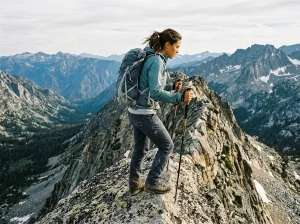
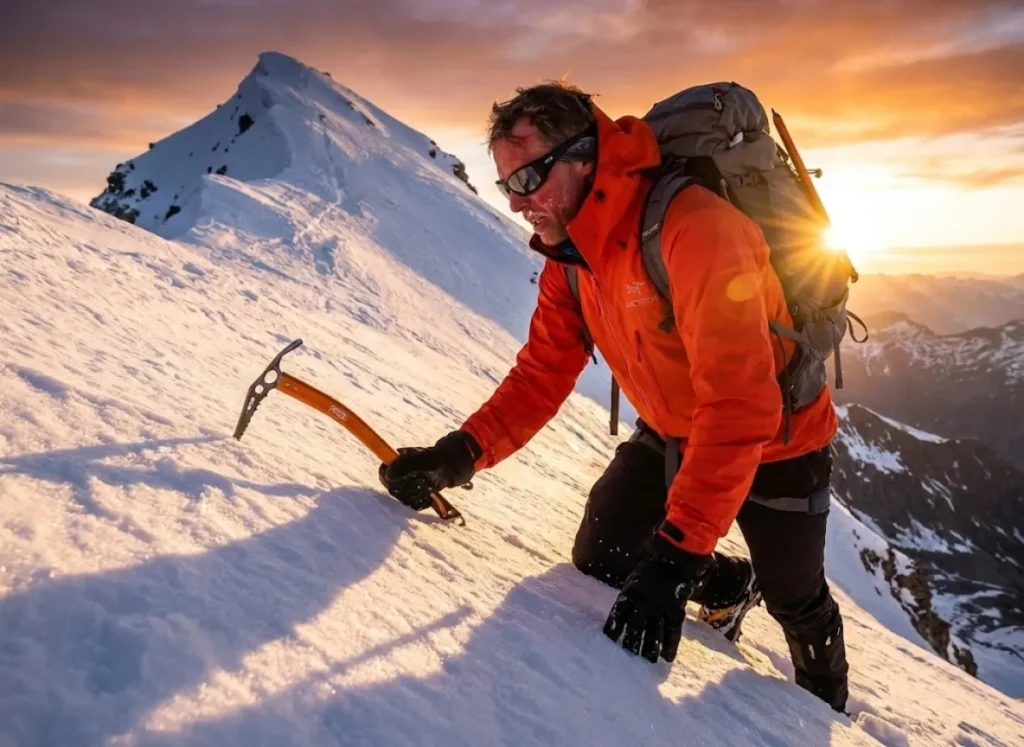
The trail vanishes under a sheet of hard spring snow or firn. The slope angle steepens past 30 degrees, and the comfortable rhythm of hiking is replaced by a gnawing tension. In this terrain, a slip is no longer a minor inconvenience. It is an acceleration event where gravity takes control within seconds.
This is the moment a hiker crosses the invisible threshold into the alpine world. Here, trekking poles become liabilities, and the ice axe becomes your primary lifeline. This tool serves as the critical hiker-to-alpinist bridge, allowing safe passage where boots alone would fail.
As an instructor who has spent years teaching mountaineering skills, I have watched confident seasonal hikers freeze when the friction of their boots fails on a degree icy slope. Owning this tool does not guarantee safety; the metal is useless without the muscle memory to wield it. This guide bridges the gap between technical winter hiking and general trekking, transforming a piece of gear into a reflex that can arrest a fall and save a life.
Why is an Ice Axe Necessary for Hikers?
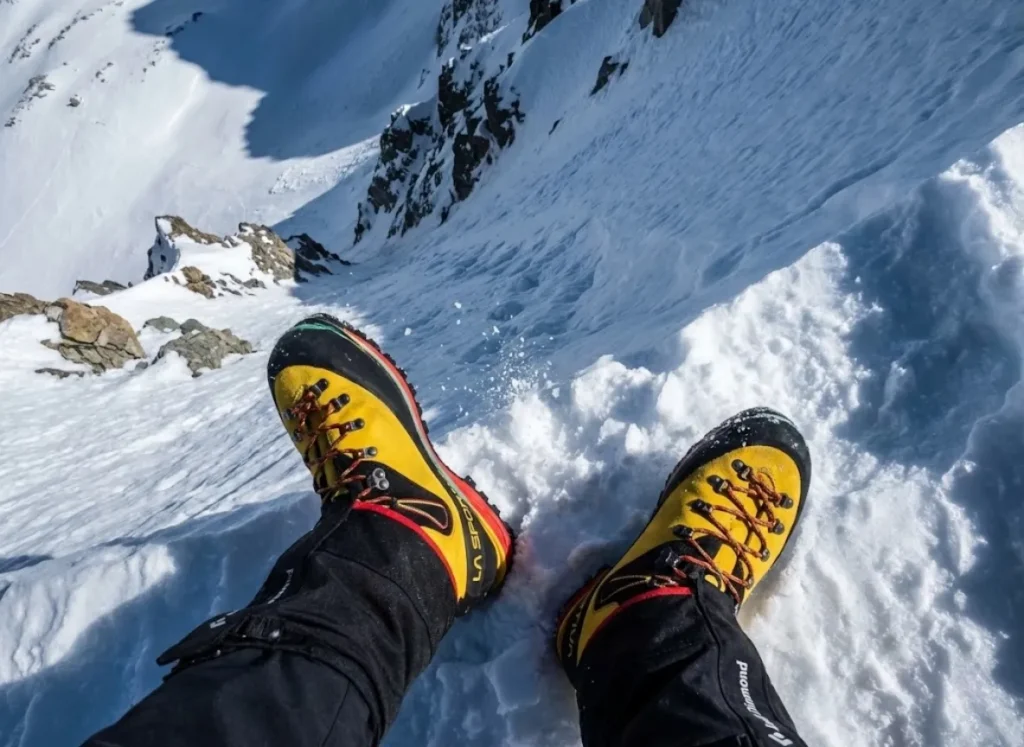
An ice axe is necessary because once a slope exceeds 30 degrees on hard snow or nevé, the coefficient of friction provided by boot rubber and clothing is insufficient to stop a fall. A mechanical brake—specifically an ice-axe brake—is required to counteract gravitational acceleration.
How does slope angle determine fall risk?
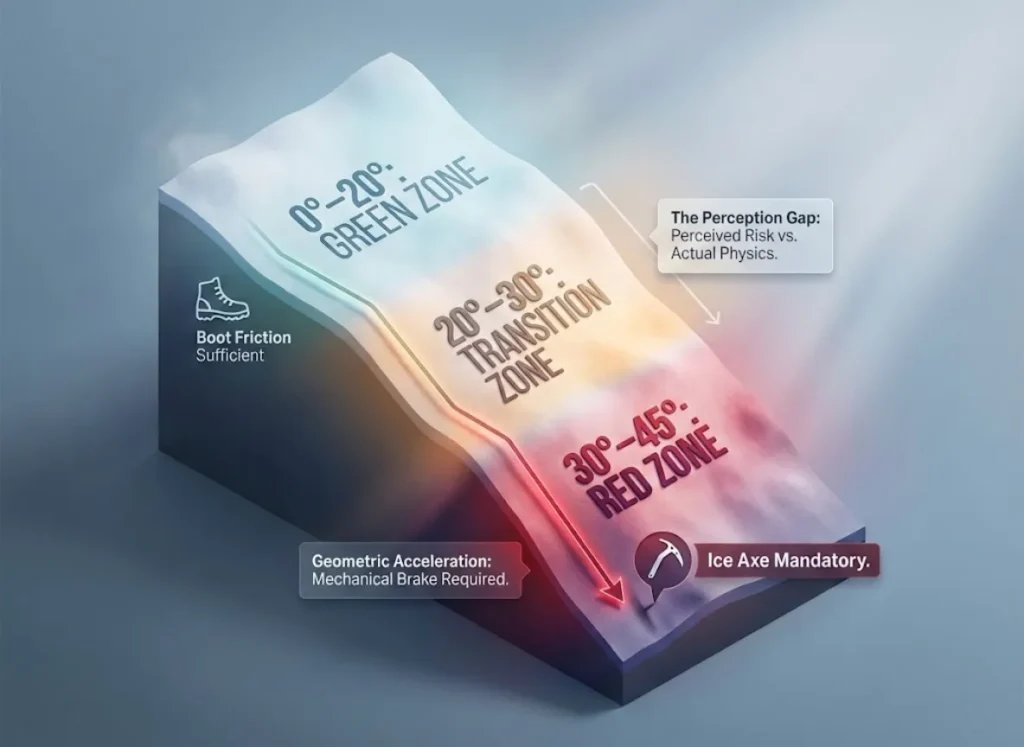
Slopes are categorized into a safety decision tree based on angle. The “Green Zone” (0°–20°) generally allows for friction stops using just your boots. However, the “Red Zone” (30°–45°) creates dangerous acceleration.
At 30 degrees, the gravitational force parallel to the slope overcomes the friction of clothing on snow. This makes a static stop impossible without a mechanical brake. Hikers must visually identify the “Transition Zone” (20°–30°). Here, terrain often looks walkable, but hard snow (nevé) can turn a minor slip into an uncontrolled slide.
This is often where accidents happen, as the perceived risk is lower than the actual physics at play. The “Slide for Life” phenomenon occurs because acceleration is geometric, not linear. A body can reach dangerous speeds in under three seconds on steep nevé.
Therefore, risk assessment regarding the run-out is critical. An ice axe is mandatory even on moderate slopes if the “run-out” (the area below) contains cliffs, rocks, or water. The ice axe provides a “positive” mechanical anchor by penetrating the surface. This contrasts with the “passive” friction of boot soles, which fails on icy surfaces.
You can see how this works by reviewing the Avalanche.org slope angle and boot penetration guidelines, which provide data on how slope angle interacts with surface hardness. Once you recognize the geometry of the risk, you must understand the engineering of the solution. This is similar to identifying exposure in Yosemite Decimal System Class 3 and 4 terrain, where the consequences of a fall dictate the gear required.
When should you transition from trekking poles to an axe?
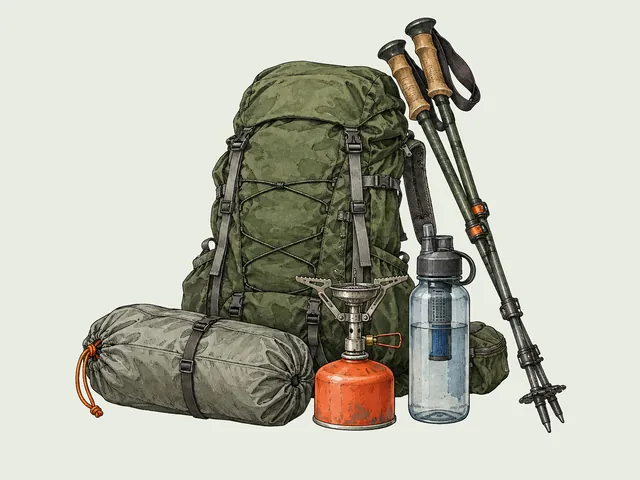
The transition should occur before the terrain feels insecure. A good heuristic is a transition trigger matrix: switch when the slope exceeds 30 degrees or when a fall would result in a slide. Hikers must fully stow trekking poles on the outside of their pack.
This frees both hands for the axe. Dangling poles on wrists are a snag hazard that can cause injury during a fall. The “One Pole, One Axe” technique is discouraged for novices. It divides cognitive attention between balance (pole) and safety (axe).
The “Cognitive Load” failure during a fall often prevents users from dropping a pole to grasp the axe with both hands, delaying self-arrest efficiency. Forensic analysis of accidents shows that delaying the switch to an axe is a primary cause of injury on routes like the Pacific Crest Trail or during early-season peak bagging.
If the snow is too hard to kick a step, crampons should be donned simultaneously with the axe deployment. According to the UIAA Safety Standards for Ice Tools, specific engineering standards differentiate a safety tool from a walking aid. Relying on poles in this terrain is dangerous, which necessitates understanding the limitations of using trekking poles downhill on ice before entering high-consequence areas.
What are the Parts of an Ice Axe and How Do They Function?
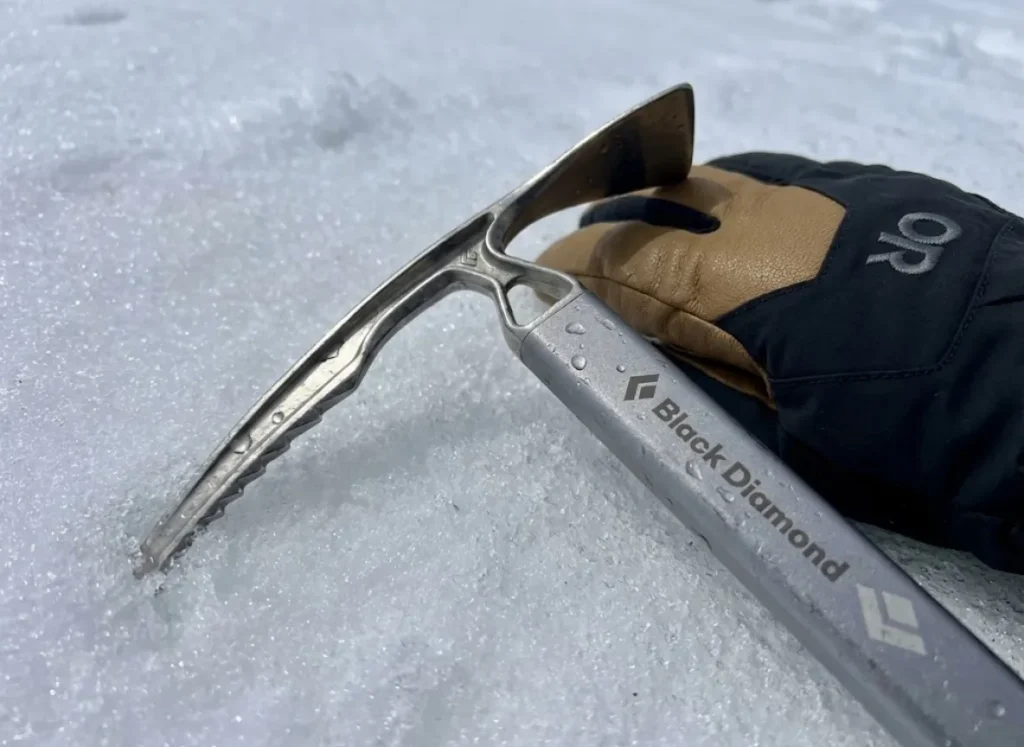
An ice axe consists of a head assembly (pick and adze), a shaft, and a spike. Modern sizing guide recommendations prioritize a shorter length (50–60cm). This length facilitates efficient self-arrest on steep slopes rather than comfortable walking on flats.
What are the key components of the head assembly?
The Pick is the sharp, toothed end designed to penetrate hard snow and ice. For hiking, a “positive curve” is essential as it naturally drives deeper when dragged. The Adze is the shovel-like component opposite the pick. It is used for step cutting in hard snow or excavating a platform for a tent.
The Head serves as the ergonomic handle for walking. Steel heads offer better penetration due to mass, while aluminum heads are for ultralight emergency use. A Spike (sometimes called a ferrule) at the bottom of the shaft is critical for the “Piolet Canne” (cane) position. It penetrates the snowcrust to provide a third point of contact.
The choice between steel and aluminum is a trade-off between “swing weight” (ability to bite into ice) and carrying weight. Hybrid axes (steel pick, aluminum shaft) are the hiker’s standard. The carabiner hole in the center of the head is used for attaching a leash. However, modern pedagogy often discourages leashes during glissading to prevent injury.
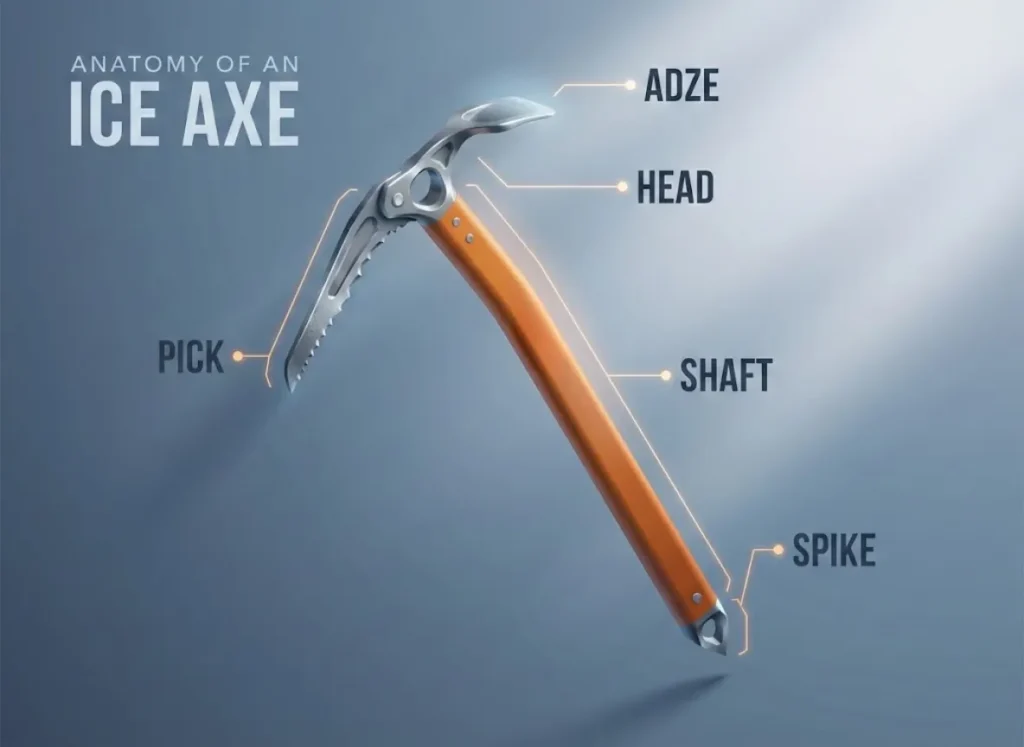
Most general mountaineering axes are B-rated (Basic Ice Axe), suitable for snow walking and self-arrest. T-rated (Technical Ice Axe) tools feature stronger shafts designed for vertical ice climbing and torque. Check the CEN ratings stamped on the shaft to ensure you have the right tool.
The National Park Service Mountaineering Handbook on Gear Selection corroborates the definition and utility of specific axe components in a rescue context. Understanding these parts is the first step in developing essential ice axe skills for hikers.
How do you choose the correct axe length?
The traditional “ankle bone” sizing rule (holding the axe and having the spike touch the ankle) is outdated. It often results in axes that are too long for steep terrain. Modern functional sizing recommends a length of 50cm to 60cm for most users. This allows for efficient self-arrest without the spike catching in the snow.
When standing upright with arms relaxed, the spike of a properly sized mountaineering axe should reach roughly to the mid-calf or top of the boot. On a steep slope (the only place you actually need the axe), the ground rises to meet your hand. This makes a long shaft (70cm+) unwieldy and forces the shoulder into an awkward, high position.
A shorter shaft brings the user’s center of gravity closer to the pick during self-arrest. This increases the leverage applied to the brake. Thru-hikers or ski-mountaineers often opt for even shorter tools (45-50cm), prioritizing packability and steep snow climbing over walking comfort.
Pro-Tip: To check sizing at home, hold the axe by the head with your arm relaxed at your side. If the spike touches the floor, it’s too long for modern mountaineering. It should end about 2-3 inches above your ankle bone.
Consult the British Mountaineering Council technical guidelines for the modern consensus on axe sizing relative to height. This is a crucial step when selecting gear for non-technical mountaineering objectives.
How Should You Hold and Carry the Ice Axe?
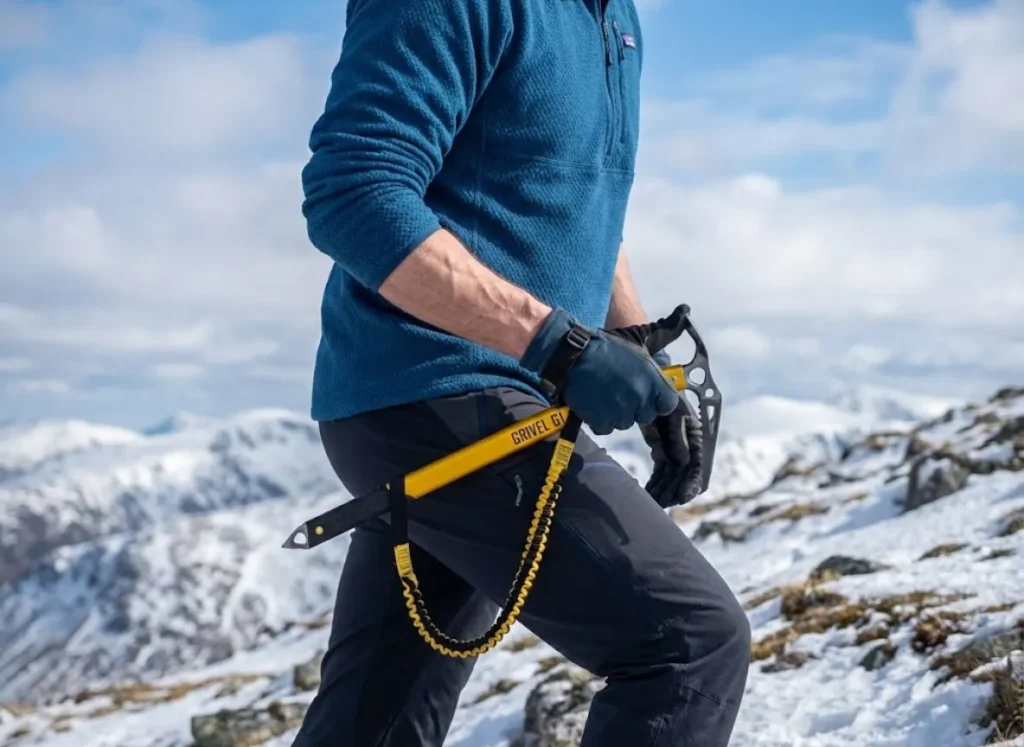
You should hold the ice axe in the “Self-Arrest Grip” (pick backward) in your uphill hand to be ready for a fall. While moving, use the Piolet Canne (cane position) technique to plunge the spike for stability.
What is the correct grip for traversing?
The Self-Arrest Grip (Pick Backward) is the default position. The hand wraps around the head with the thumb under the adze and the pick pointing backward (uphill). This grip ensures that if the user stumbles, the natural reflex to clutch the chest automatically positions the pick to drive into the slope.
The axe should always be held in the uphill hand. If you slip, you will fall into the slope, allowing you to lean into the axe for support. Avoid the “Self-Belay Grip” (Pick Forward) unless climbing very steep slopes (>45°). Transitioning to an arrest from the forward position requires a complex hand rotation that often fails under panic.
When switchbacking, the axe must be swapped to the new uphill hand at every turn. This maintains the “third leg” of stability. The wrist leash (if used) should be attached to the wrist holding the axe, but care must be taken that it doesn’t create a tripping hazard during hand swaps.
The Everett Mountaineers Safety Bulletin on Ice Axe Techniques provides institutional safety protocols regarding grip and hand positioning. This is a fundamental component of mastering essential winter hiking skills.
What is the “Piolet Canne” technique?
Piolet Canne (Cane Position) involves plunging the spike vertically into the snow with every step, using the axe as a cane for balance. The arm should be relatively straight, relying on the skeleton rather than the tricep muscle to support the weight.
This technique is most effective on moderate slopes (0°–30°) and provides a critical point of sensory feedback regarding snow density. On traverses, the spike placement should be parallel to the uphill foot, creating a stable triangle of support.
If the snow is too soft for the spike to hold, the shaft can be plunged deeper (self-belay) to engage the resistance of the shaft surface area. Mastery of this technique reduces fatigue and prevents slips. Variations like piolet ramasse (cross-body position) or piolet ancre (anchor position) are useful in steeper, softer snow.
You can view the Ortovox Safety Academy Lab on Snow Walking to see the biomechanics of the Piolet Canne on varying densities of snow. Think of this technique as an active part of carrying the 10 essentials—the gear works only if you use it correctly.
How Do You Perform a Self-Arrest?
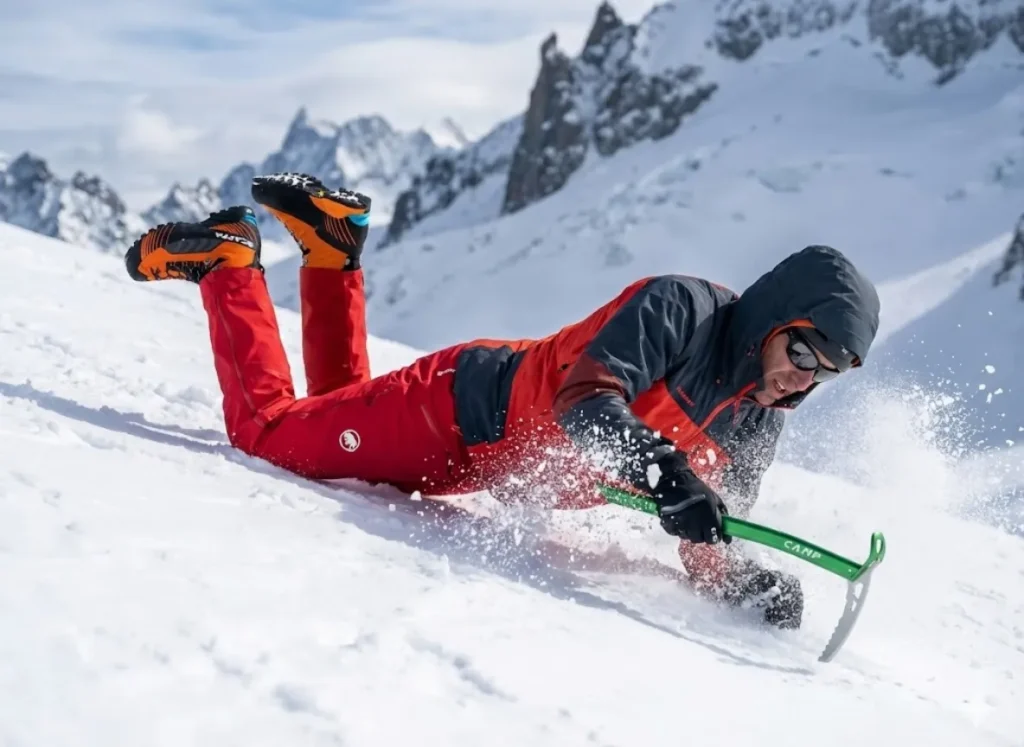
To perform a self-arrest, you must immediately drag the pick diagonally across your chest, roll your body toward the slope to get belly-down into the self-arrest position, and arch your back. Drive the pick into the snow while keeping your legs rigid (and knees up if wearing crampons).
What is the body position for a standard self-arrest?
Reaction: Immediately grasp the shaft with the free hand (near the spike). Pull the axe diagonally across the chest while jamming the pick into the snow above the shoulder.
Position: Roll toward the axe head (into the slope) to get belly-down. The body must be rigid, not limp.
Leverage: Arch the back and lift the hips/stomach off the snow. This transfers 100% of body weight onto the pick (shoulders) and toes/knees (legs).
The “Tripod Theory” dictates that only three points should contact the snow: the pick and the two feet (or knees). This maximizes pounds-per-square-inch of friction. If sliding head-first, the priority is to plant the pick to the side to act as a pivot. Swing the legs downhill before attempting the full arrest arch.
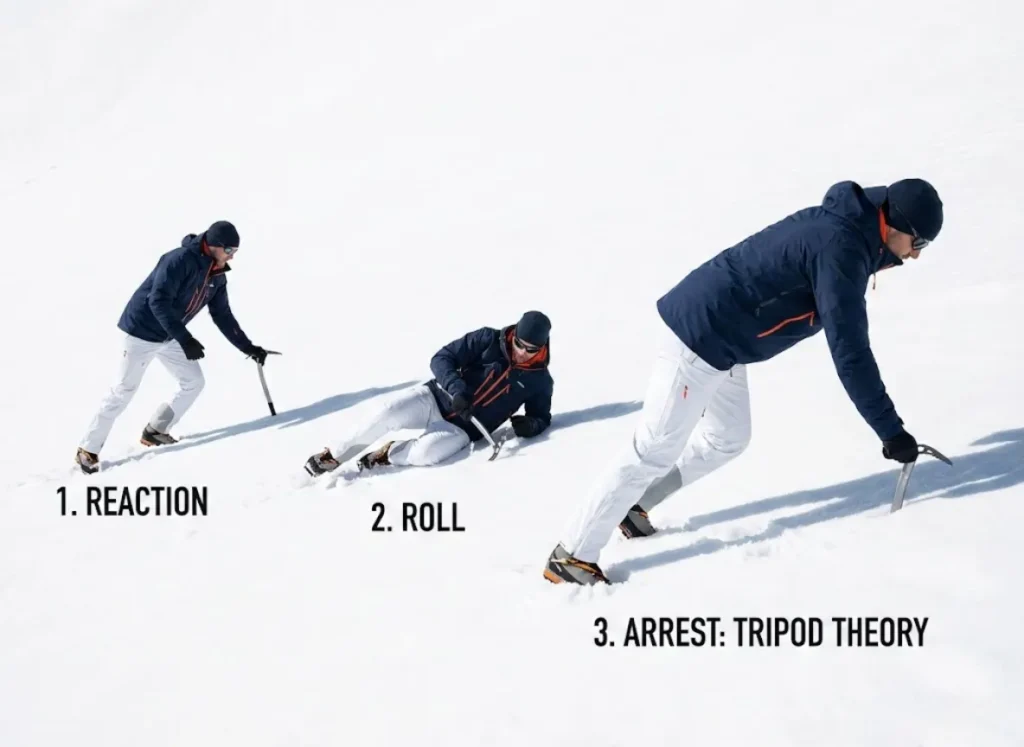
The maneuver must be aggressive. Tentative application of the pick will result in “skating” over the ice rather than biting into it. The UNLV Avalanche Safety Guidelines (Self-Arrest) provide a validated academic protocol for these physics. For a deeper breakdown, spend time reviewing our detailed self-arrest guide for every fall.
How do you arrest while wearing crampons?
CRITICAL RULE: If wearing crampons, you must lift your feet and knees off the snow while digging in the pick. The toes must act as a counterbalance, hovering in the air to prevent the front points from catching the snow surface.
Only once speed has been significantly reduced by the axe pick should the feet be lowered to assist in the final stop. If crampon points catch the ice at high speed, they act as a fulcrum. This violently flips the hiker backward (a “scorpion” fall), which can cause spinal injuries or uncontrolled tumbling.
Forensic data indicates that ankle and tib-fib fractures are common outcomes of improper ice axe/crampon technique during arrest. Hikers should practice this specific variation (“knees up”) on safe runouts until it overrides the instinct to dig in the feet.
Pro-Tip: When practicing arrests, shout “KNEES!” out loud as you roll over. The auditory cue helps override the instinct to dig your toes in for traction.
Reports from NPS Incident Reports – Mount Rainier provide forensic evidence of injuries caused by improper crampon use. This safety nuance is vital when choosing between microspikes vs. crampons.
Final Thoughts on Alpine Safety
An ice axe is a tool of consequence; its presence signals that you have entered terrain where gravity is an adversary. Respect the 30-degree rule and transition to your axe before the slope dictates it. Master the “Pick Backward” grip to ensure your reflex works in your favor.
Remember that the self-arrest is a last resort; reliable movement via the Piolet Canne is your primary defense. Above all, never dig your toes in when arresting with mountaineering boots and crampons—lift them to survive. Before your next high-altitude trek on Mount Rainier or Mount Shasta, visit a safe, snowy slope with a clear runout. Practice these arrests until they replace panic with action.
FAQ – Frequently Asked Questions about Ice Axes
Which hand should I hold my ice axe in?
Hold the axe in your uphill hand. This allows you to lean into the slope for stability and ensures the axe is positioned correctly to arrest a fall if you slip downhill toward your downhill hand.
Do I need a leash for my ice axe?
For general hiking, a wrist leash is optional and often discouraged during glissading. While it prevents losing the tool, a leash can turn the axe into a flailing projectile during a tumble. Many experts prefer going leashless or using a bungee leash on moderate slopes.
Can I use an ice axe instead of trekking poles?
No, they serve different purposes. Poles are for propulsion and balance on flat or moderate terrain, while an axe is for safety on steep snow. However, on steep slopes (>30°), you should stow both poles and use the ice axe exclusively to ensure full cognitive focus on self-arrest mechanics.
What is the difference between a hiking axe and an ice climbing tool?
A hiking axe (General Mountaineering) has a straight shaft or slightly curved shaft and is designed for walking support and self-arrest. Technical ice tools have short, aggressively curved shafts and vertical picks designed for climbing vertical frozen waterfalls or black ice, making them poor choices for general hiking.
I've spent more than a decade researching hiking gear and trail technique. I read the specs, the forum threads and the long-term reviews, and every pick here comes with what it gets wrong.
End of the trail
You read every mile of this one. Here's where the trail goes next.