










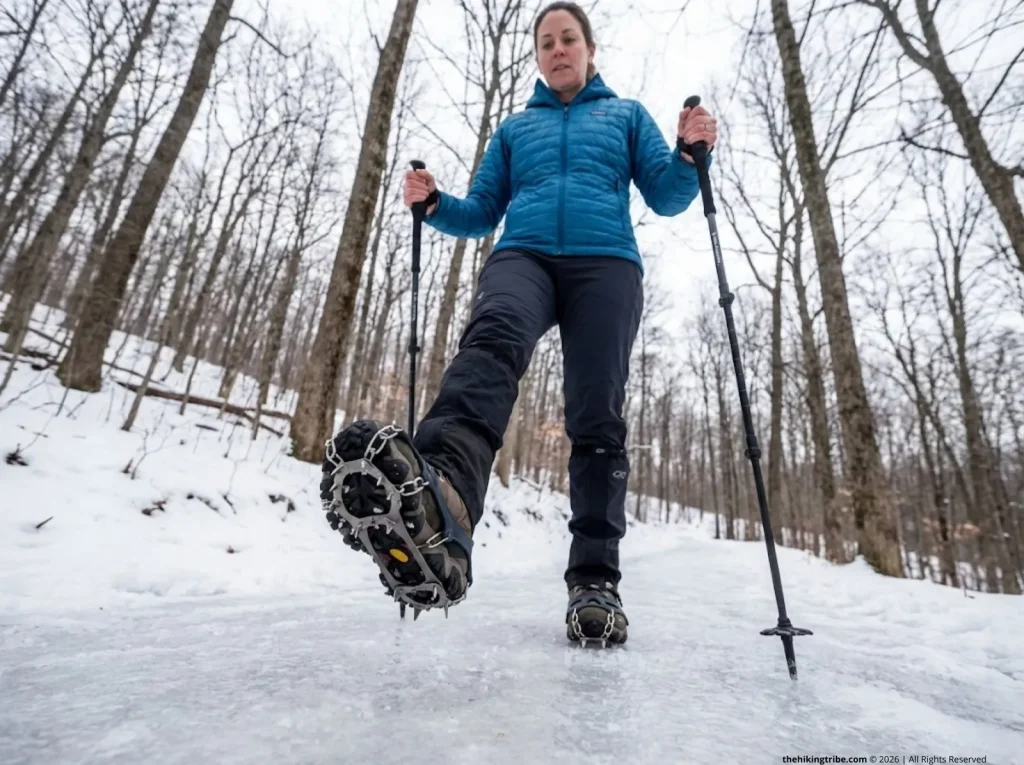
The ice hit without warning. A thin glaze over packed snow on a steep switchback in Rocky Mountain National Park, the kind you don’t notice until your foot shoots sideways. I grabbed a branch, steadied myself, and looked down at my Yaktrax coils. They were skating across the surface like dress shoes on a marble floor.
That moment ended my relationship with coils. Heart hammering, pack pulling me backward, I made a decision right there on the trail that I’d never stake my safety on a traction device designed for sidewalks. After ten years of field testing winter traction devices on icy trails across three states, I can tell you exactly where each system breaks down and why one of them has no business on a serious hiking trail.
This is a spec-by-spec, field-tested breakdown of Yaktrax coils vs. Kahtoola MICROspikes so you can pick the right traction device for your trails, your boots, and the real ice you’ll actually face.
| Traction Device Comparison | ||
|---|---|---|
| Spec | Yaktrax Walk | Kahtoola MICROspikes |
| Price | $22–$30 | $83.95 |
| Weight (Medium) | 2–5.4 oz | 11.9 oz / 338g |
| Traction Type | 1.2mm steel coils | 12 stainless steel spikes |
| Spike/Coil Specs | SkidLock coils, 360° contact | 0.41″ spikes, welded chains |
| Grip (Ice/Snow) | Packed snow only | Hard ice + packed snow |
| Durability | 1–3 seasons | 8–10+ years (field-tested) |
| Warranty | Standard | 4-year limited |
⚡ Quick Answer: Kahtoola MICROspikes outperform Yaktrax on every metric that matters for trail hiking. Their 12 stainless steel spikes (0.41″ protrusion) bite into hard ice where Yaktrax 1.2mm coils slide. MICROspikes last 8–10+ years; Yaktrax coils stretch and snap after 1–3 seasons. Yaktrax Walk ($22–30) works fine for flat sidewalks and light snow. For anything with hills, icy switchbacks, or packed national park trails, spend the $84 on MICROspikes and don’t look back.
How Traction Devices Actually Work on Snow and Ice
Coil Traction vs. Spike-and-Chain Systems
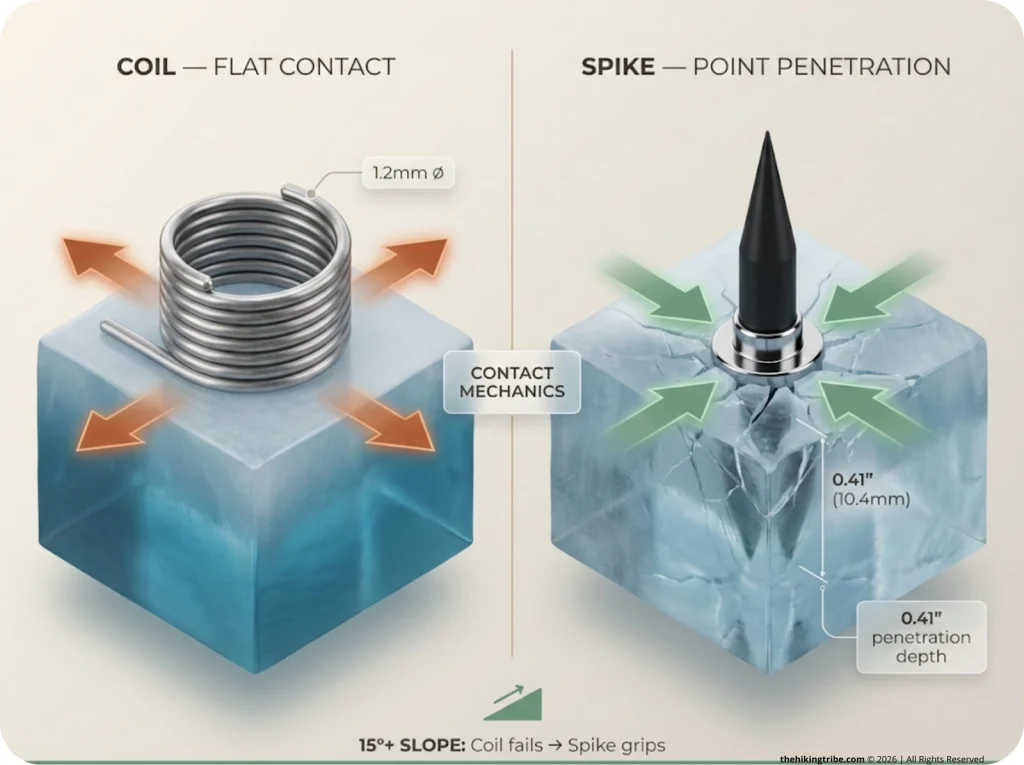
The difference between coils and spikes isn’t just about price or brand preference. It’s about how each system grips the ground, and one approach flat-out fails on real ice.
Yaktrax Walk uses 1.2 mm high-strength steel SkidLock coils wrapped in a polyelastomer frame. Those coils create grip through surface friction. They spread contact across a wide area, and on flat packed snow or pavement, that 360° contact works well enough. The problem starts the moment you hit glare ice, because there’s nothing for the coil to grab. It just slides.
Kahtoola MICROspikes take a completely different approach. Twelve heat-treated 400-series stainless steel spikes per foot, each protruding 0.41 inches (10.4 mm), connected by welded stainless chains. These don’t rely on friction. They bite into ice by physically penetrating the surface. Your weight drives each spike deeper with every step. It works regardless of how slick or hard-packed the ice is.
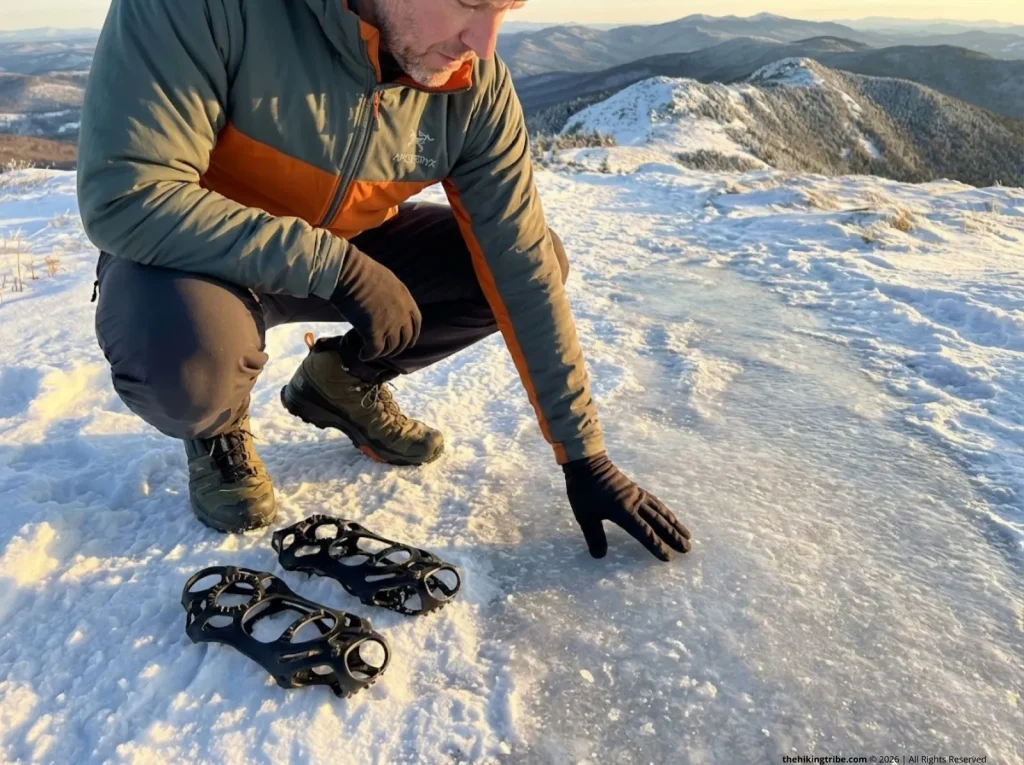
Pro tip: If you can see your reflection in the ice, coils won’t hold. That’s when you need steel points biting into the surface.
Think of it this way: coils work like a tire on wet pavement. Spikes work like crampons on a glacier. Both have a place, but you wouldn’t drive your sedan on a frozen lake and expect the same grip as studded tires.
Where Each System Excels (And Where It Breaks Down)
Yaktrax coils perform well on flat packed snow, driveways, campus sidewalks, and light mixed terrain where you’re mostly walking on relatively level ground. That’s the terrain most urban and casual walkers encounter, and for that use case, coils are genuinely fine.
MICROspikes dominate on steep packed trails, icy switchbacks, frozen creek crossings, and hard-packed national park paths. The transition point isn’t subtle. Any slope beyond roughly 15° on hard ice exposes coil limitations badly. The wide surface area that works on flat ground becomes a liability on inclines because it distributes force instead of concentrating it where it counts.
On pavement-to-trail transitions, spikes click and skitter on dry rock, which is a reason to remove them on extended dry sections. Understanding how rubber compounds interact with wet and frozen surfaces matters here too, because your boot’s outsole works in tandem with whatever traction system you strap over it.
The National Park Service winter hiking guidelines recommend traction devices whenever walking on ice and snow. That guidance is sound. But which traction device you choose matters as much as whether you wear one at all.
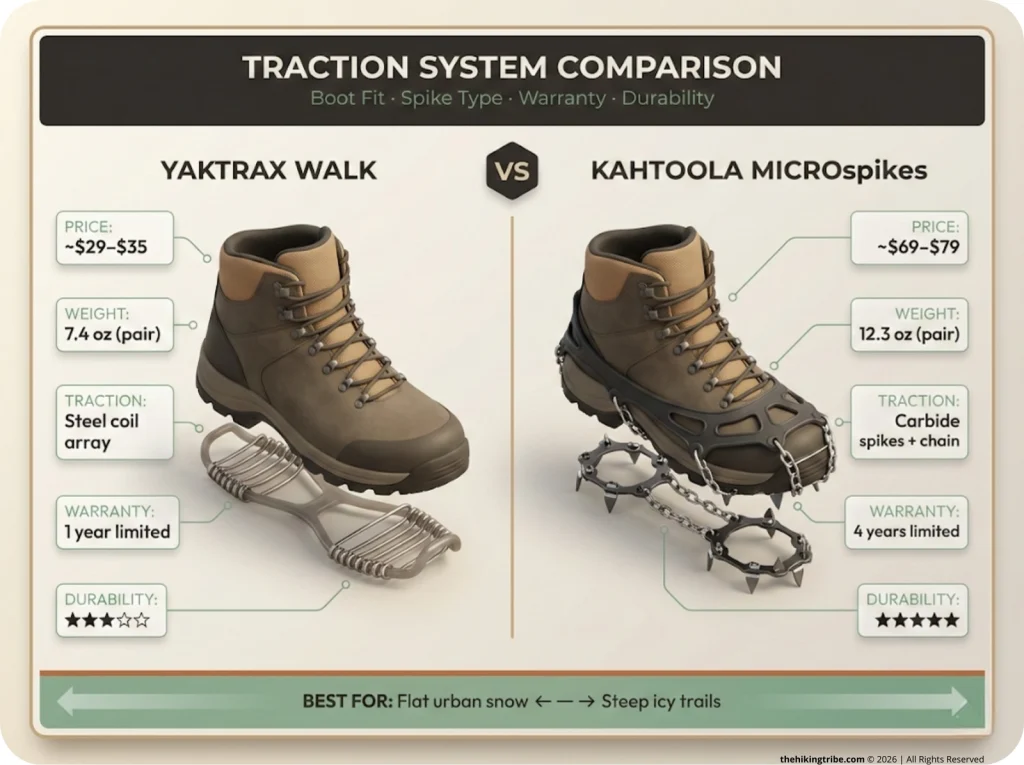
Spec Showdown — Yaktrax Walk vs. Kahtoola MICROspikes
Price, Weight, and Packability
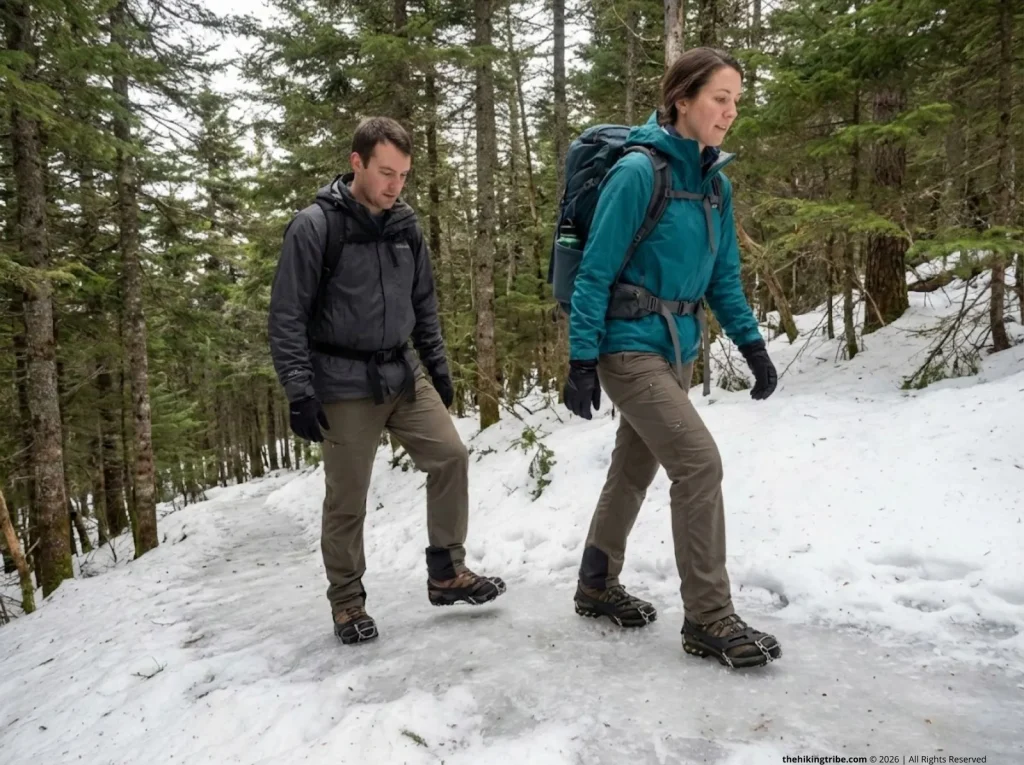
On paper, Yaktrax wins the budget category by a wide margin. The Yaktrax Walk runs $22–30 and weighs just 2–5.4 oz per pair. Roll them up and they practically disappear into a jacket pocket. That’s genuinely lightweight for a winter traction device.
Kahtoola MICROspikes cost $83.95 at MSRP and weigh 11.9 oz (338g) for a Medium pair. Packed size runs 5 × 3 × 2 inches with the included tote sack. That’s heavier and bulkier, no question.
But here’s where the math flips. MICROspikes last 8–10+ years of regular winter trail use. Field reports from experienced hikers at GirlOnAHike and NJHiking confirm this repeatedly. Yaktrax coils stretch, snap, or lose tension after 1–3 seasons rather routinely. So the $84 MICROspikes spread over 8 years costs you about $10.50 per season. The $25 Yaktrax replaced every two seasons runs $12.50 per season. The “budget” option isn’t actually cheaper.
Packability matters most for day hikers who carry traction devices in and out throughout a single hike. If your trails are mixed with long dry stretches, the lighter Yaktrax makes removal and stowing easier. But if you’re hiking all-ice routes, the MICROspikes stay on your boots the entire day and weight becomes irrelevant.
Grip, Durability, and Real-World Performance
OutdoorGearLab scores tell the story cleanly. MICROspikes earned 80/100 (Best Overall); Yaktrax Walk scored 73/100 (Best Bang for Buck). Traction on icy trails and hills carries 30% of the total score weight, and that’s where the gap widens.
Treeline Review’s 2026 update awarded MICROspikes “Best for Hiking” after a decade of Colorado field testing. Their reviewer Dean Krakel described them as the “best balance of mixed terrain performance; durable, comfortable, easy to use.” That matches my own experience across dozens of icy national park trails.
Durability is where things get ugly for Yaktrax. GirlOnAHike recounts switching to MICROspikes after Yaktrax coils break easily on her first serious icy hike. The same pair of MICROspikes was still going strong 8 years later. I’ve personally replaced two sets of Yaktrax. My MICROspikes have outlasted both combined with zero signs of retirement.
Harness, Fit, and Boot Compatibility
The elastomer harness on MICROspikes stays flexible down to -22°F (-30°C). That matters because rubber compounds stiffen in cold, and a stiff harness slides off your boot. The MICROspikes harness maintains a secure fit on mid-cut hiking boots like Oboz Bridger Mid, Salomon Quest, and Merrell Moab. It also pairs well with gaiters, which prevent snowballing between the harness and boot.
Yaktrax Walk uses a thinner rubber frame that stretches permanently in repeated cold cycles. Several field reports describe the device slipping off mid-hike after the rubber loses its snap. That’s not a minor annoyance. A traction device that falls off on ice is worse than wearing nothing, because you’re now stopping to fix it on the most dangerous part of the trail.
Pro tip: Size your MICROspikes snug. Stretch the elastomer harness over your boot, then wiggle it to seat the chains properly against the sole. If it feels loose in the store, it will absolutely fall off on the trail.
Kahtoola backs the product with a 4-year limited warranty on purchases after August 1, 2025. Yaktrax doesn’t offer comparable coverage. That warranty gap tells you something about how each manufacturer views the durability of their own product.
If you’re building a winter kit, understanding winter hiking boot insulation and compatibility helps you choose boots that work well with both traction devices and gaiters as an integrated system.
When Yaktrax Coils Fail (And The Safety Risk on Remote Trails)
The Coil Breakage Problem
This section isn’t about bashing Yaktrax. It’s about understanding what the product was engineered to do and what happens when you push it beyond that design envelope.
Yaktrax coils are rated for light snow and flat surfaces. They’re not built for the lateral forces generated on steep icy trails. The failure mode is predictable: coils stretch under repeated stress, lose tension gradually, and eventually snap. That snap often happens mid-hike, on exactly the section where you most need traction.
When a coil breaks on a remote winter hiking trail, you’re left with one working device, or possibly none, and potentially miles from the trailhead on terrain that caused the failure in the first place. GirlOnAHike described returning her Yaktrax after the first serious icy hike because “the coils couldn’t grip anything steeper than a sidewalk.” That’s blunt, but it’s accurate.
The core issue isn’t that Yaktrax makes a bad product. The Yaktrax Walk is a perfectly good tool for its intended use case. The mistake is treating a sidewalk tool like a mountain tool. You wouldn’t wear running shoes on a Class 3 scramble and blame the shoes when you slip.
Assessing When Coils Are (And Aren’t) Enough
Yaktrax Walk and Pro remain solid choices for flat packed snow, driveways, campus paths, low-angle park loops, and light-duty dog walks. If your “winter hiking” means a paved path through a city park after a snowfall, coils handle that fine.
Switch to MICROspikes when your trails include icy hills, switchbacks, packed snow with ice underneath, exposed ridgeline approaches, or multi-day winter hikes in national parks. The decision rule is simple: if the terrain makes you slow down or grab for branches, coils aren’t enough.
Treeline Review notes that the Yaktrax Diamond Grip (with tungsten carbide studs) is an upgrade over basic Walk coils, giving better bite on hard surfaces. But even Diamond Grip falls short of spike-and-chain systems on aggressive ice. Studs help, but they’re not spikes.
Pro tip: If you insist on using Yaktrax for anything beyond flat paths, carry backup zip ties. One broken coil can destabilize the entire frame, and zip ties can hold it together long enough to get you back to the trailhead.
For a broader view of what goes into a safe winter setup, the complete winter hiking gear and safety checklist covers everything from layering systems to navigation tools.
Trail Ethics and Your Spikes — The LNT Factor Nobody Mentions
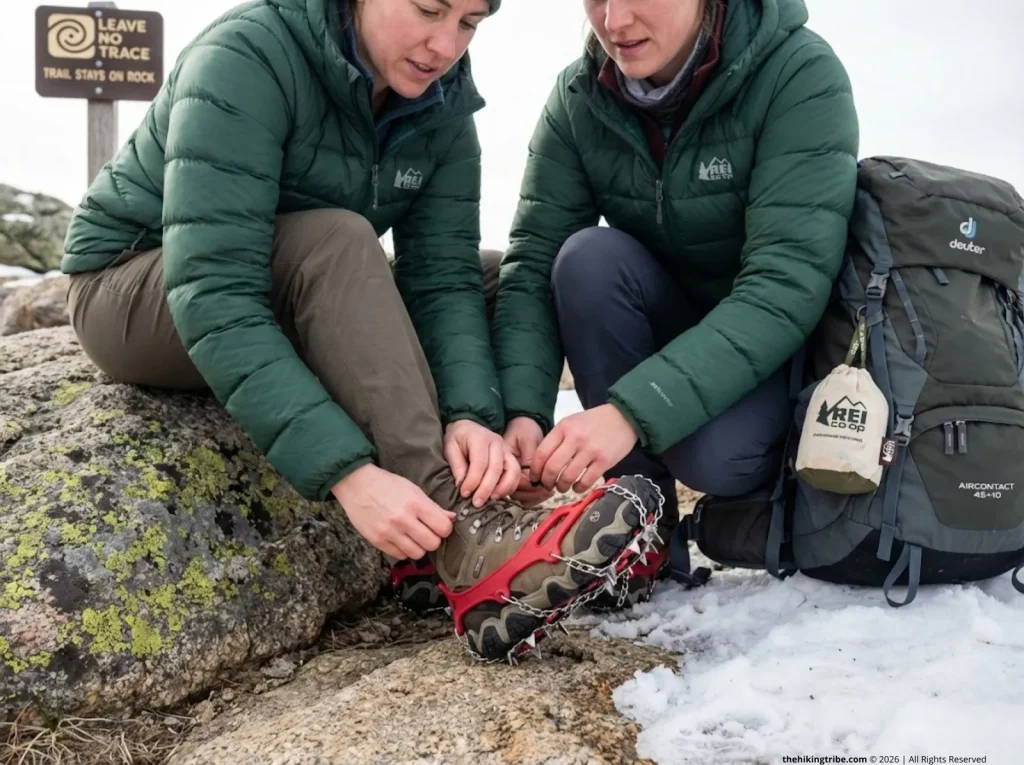
Here’s something no other traction device comparison mentions: what your spikes do to the trail itself. Every competitor review focuses exclusively on what the device does for you. None of them ask what it does to the ground you’re walking on.
Spike Impact on Fragile Winter Trails
Stainless steel spikes dig into trail surfaces. On frozen snow and solid ice, the impact is minimal. The ice re-forms behind you, and the trail is none the worse. But winter hiking trails aren’t all ice, all the time.
On thawing sections, thin-snow areas, and exposed ground, spikes chew into roots, disturb cryptobiotic soil crusts, and tear into alpine vegetation. This accelerates trail erosion in ways most hikers never think about. Spikes left on dry rock also dull your spike tips faster, which cuts their grip on snow and ice over time.
Ironically, coils have a lighter footprint on fragile surfaces. This is one area where Yaktrax’s gentler grip is actually an advantage. The debate isn’t just “which grips better” but “which grips better without tearing up the trail.”
Mid-Hike Removal — When and How
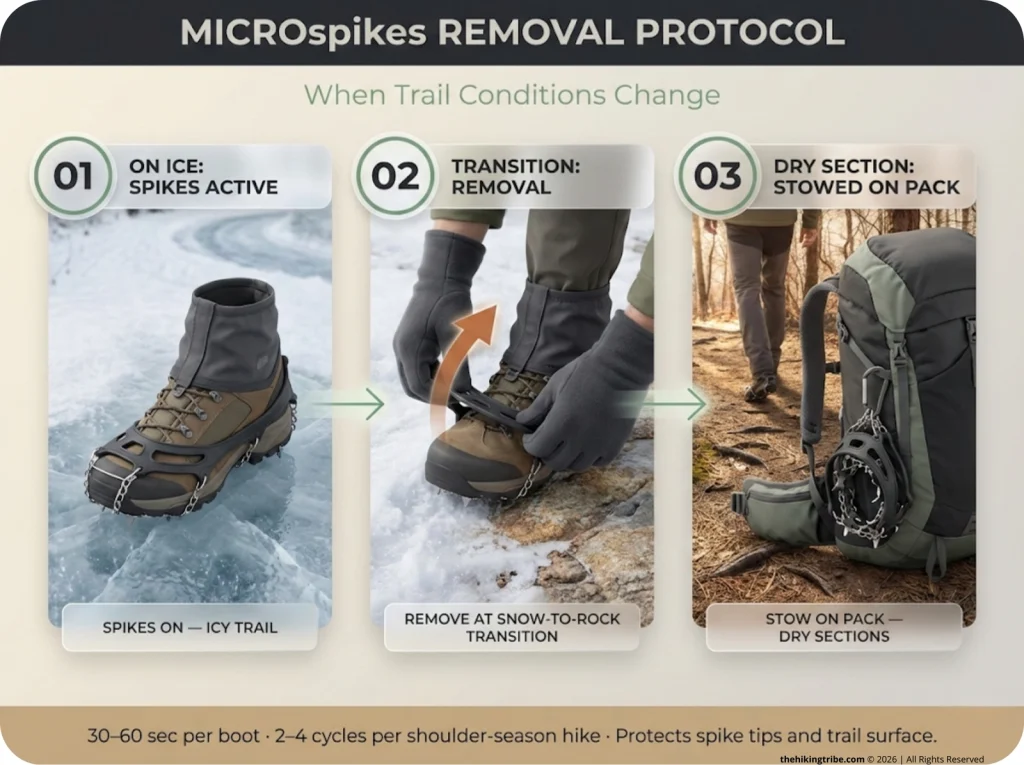
Remove traction devices when you transition from snow and ice to dry rock, exposed pavement, boardwalks, or bare dirt. On mixed terrain trails common in shoulder-season national parks, plan for 2–4 removal and reapplication cycles per hike.
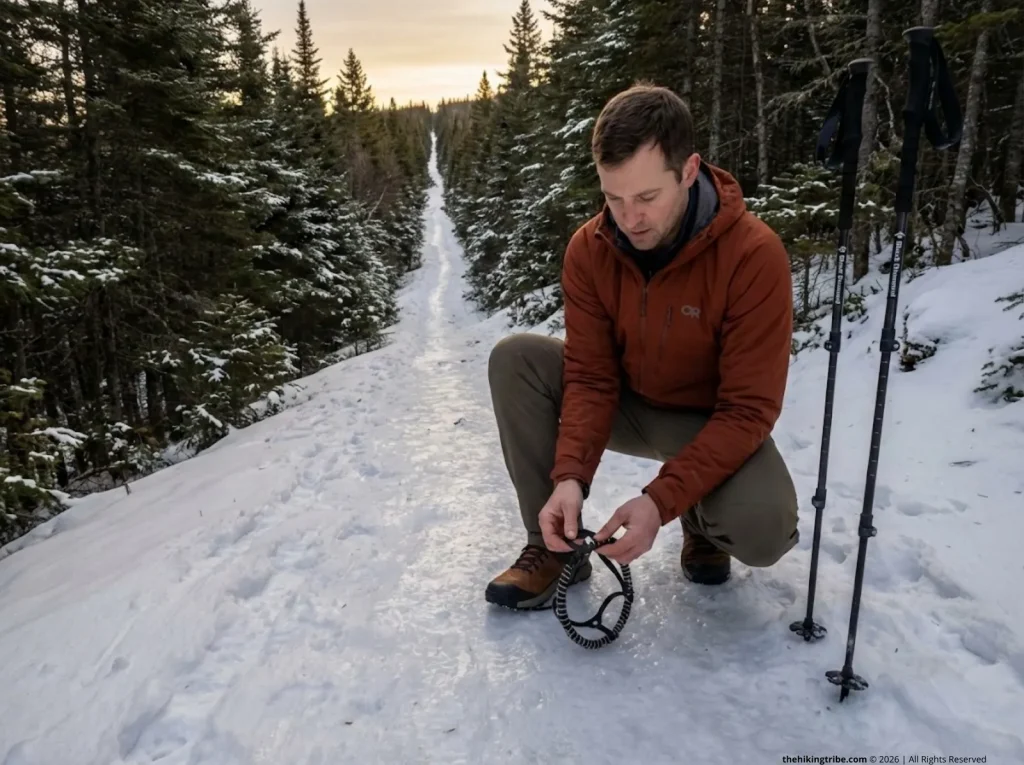
The MICROspikes elastomer harness makes on-and-off relatively quick, maybe 30–60 seconds per boot once you’re practiced. Cold fingers and gloves add difficulty, but it becomes routine. Carry your devices clipped to your pack or stowed in the included tote during off-sections. Don’t let them rattle loose against your pack.
The US Forest Service winter safety recommendations emphasize responsible trail use in winter conditions, but the specific question of when to remove on pavement remains underaddressed in official guidance. As committed hikers who care about the trails we use, the practice should be straightforward: spikes on for ice, spikes off for dirt.
Pro tip: Leave spikes on for dry rock and you’ll dull the tips in a single season. Remove them on pavement and bare ground sections. Your spikes and the trail will last longer for it.
For a deeper look at responsible winter trail use, the full Leave No Trace framework for winter trails covers everything from campsite impact to waste management in snow.
Building Your Winter Traction Kit — Boots, Gaiters, and Progression
Boot and Gaiter Pairing for Maximum Grip
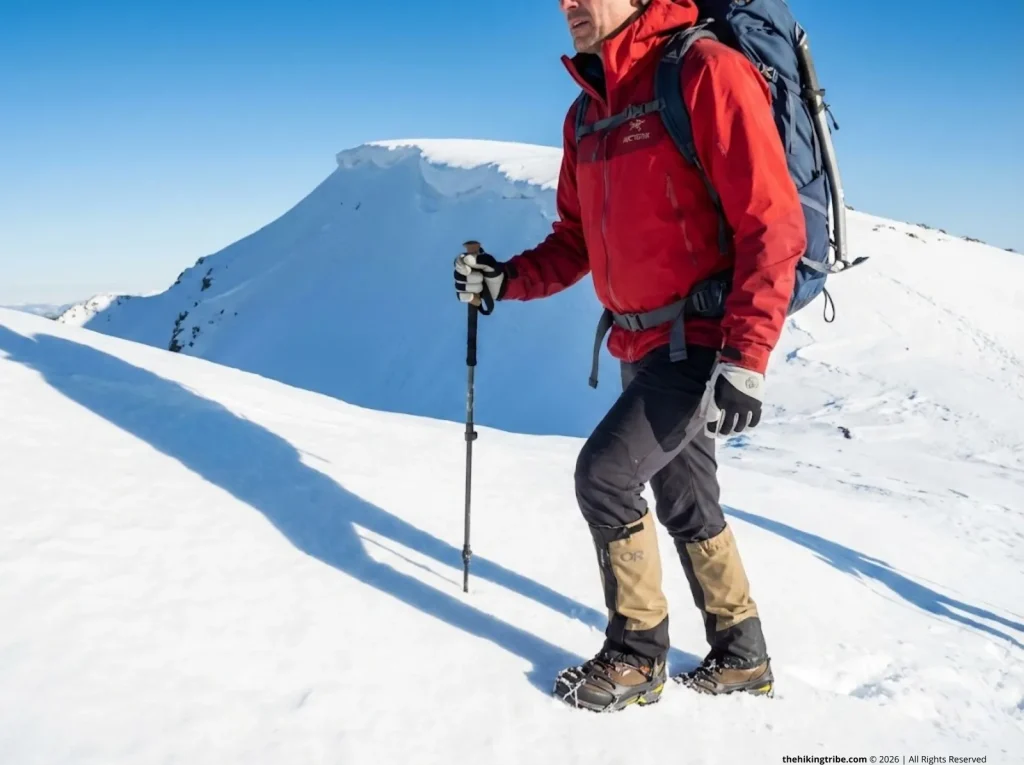
MICROspikes fit best on mid-cut hiking boots with stiff soles. The rigid platform gives spikes a stable base that doesn’t flex or shift underfoot. Oboz Bridger Mid, Salomon X Ultra 4 Mid GTX, and Lowa Tibet GTX all provide the kind of stiff sole and secure upper that MICROspikes need.
Flexible trail runners or soft-sole shoes let spikes shift with every step. The result is reduced grip confidence and a nagging sensation that the device is about to slide off. Can you run MICROspikes on trail runners? Technically yes. Should you? Not if you want the full benefit of the system.
Gaiters close the system. Knee-high gaiters for deep powder, ankle-height for packed trails. They prevent snow from packing between the harness and boot, which loosens fit over time. On Oboz Bridger Mids with OR Crocodile gaiters, MICROspikes feel locked in. Zero shift, zero snow intrusion, even across 8 hours of mixed-terrain hiking.
For choosing the right gaiters for winter conditions, gaiter height and material matter as much as the traction device itself.
Yaktrax Walk pairs acceptably with any shoe including sneakers, because coils don’t need a rigid platform. That flexibility is a feature for urban use, but it offers no trail advantage whatsoever.
When to Graduate from MICROspikes to Light Crampons
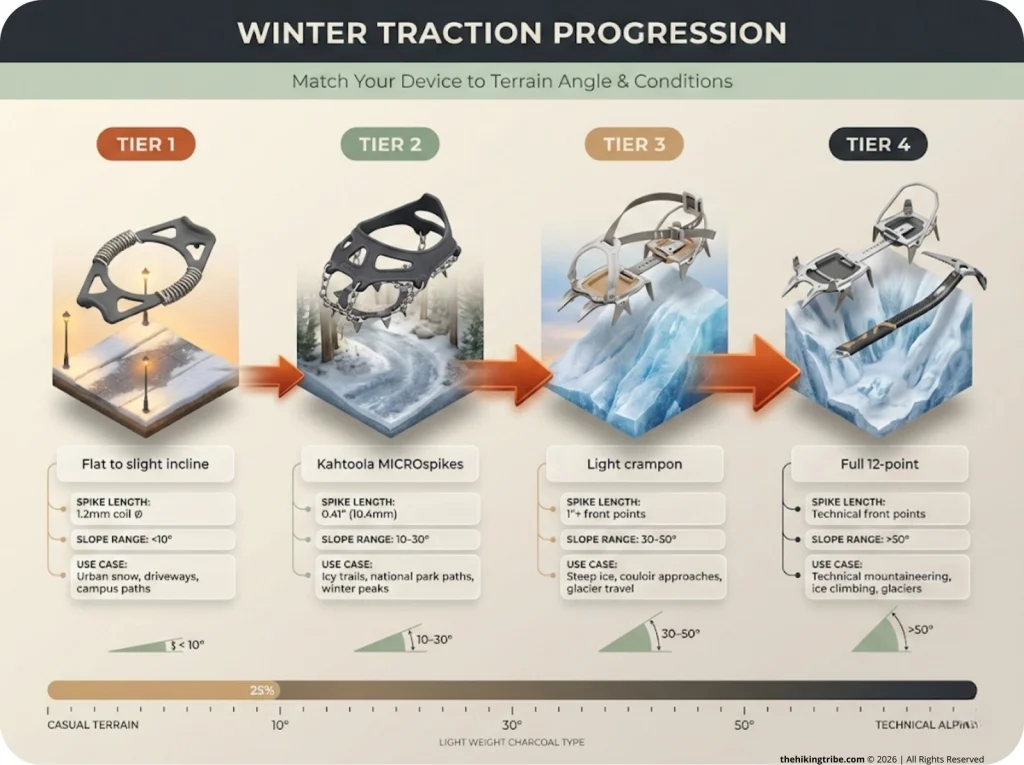
MICROspikes with their 0.41″ spikes handle packed snow, hard ice, and moderate slopes. That covers roughly 90% of winter hiking terrain. For most dedicated trail hikers, MICROspikes are the endpoint.
Once terrain involves steep hard ice above 35°, glacier travel, or couloir approaches, you need front points. Light crampons like the Kahtoola KTS or Black Diamond Distance Spike offer 1″+ front points and a stiffer frame that locks onto mountaineering-compatible boots. They’re heavier, less versatile on flat trails, and require stiffer boots than most hikers own.
The progression runs like this: casual snow (Yaktrax) → icy trails (MICROspikes) → steep ice and alpine terrain (light crampons) → technical mountaineering (full crampons + ice axe). Most hikers settle at the MICROspikes level and never need to progress further. That’s perfectly fine. It covers national park icy trails, winter peak approaches, and multi-day winter hikes without crampon weight or hiking boot compatibility requirements.
If you’re wondering where exactly that MICROspikes-to-crampons line falls, microspikes vs. crampons: when to make the switch breaks it down by terrain angle, spike length, and boot stiffness requirements.
Conclusion
Three things matter when choosing between Yaktrax and Kahtoola MICROspikes for winter hiking trails:
Yaktrax coils are built for sidewalks. MICROspikes are built for trails. Use the right tool for your terrain. The coil system works fine on flat packed snow and pavement, but it fails on anything steep, icy, or remote.
The price gap disappears over time. At $10.50 per season over their 8+ year lifespan, MICROspikes actually cost less per year than $25 Yaktrax replaced every other season. The “budget” choice isn’t budget if you keep buying new ones.
Remove traction devices on dry sections. Your spike tips and the trail surface both benefit. This is the LNT practice that every other gear review skips, and it’s the mark of a hiker who cares about the trails themselves, not just what the trails can do for them.
Next time you face an icy switchback, you’ll know exactly what’s under your boots and why it’s there. Gear up for the terrain you’ll actually hike, not the terrain you hope for.
FAQ
Are Yaktrax good enough for winter hiking?
Not for serious trail hiking. Yaktrax coils work on flat packed snow and sidewalks, but they slip on steep icy trails and break under repeated stress. For anything beyond casual winter walks, MICROspikes are the safer and more reliable choice.
How long do Kahtoola MICROspikes last?
Field-tested users report 8–10+ years of regular winter trail use. The stainless steel spikes and welded chains resist wear far longer than Yaktrax coils, which typically stretch or snap within 1–3 seasons.
Can I wear MICROspikes with trail runners?
Yes. The elastomer harness fits most footwear. However, soft-sole trail runners allow spikes to shift underfoot, reducing grip confidence. Mid-cut hiking boots with stiff soles provide the most stable platform for aggressive traction.
Do MICROspikes damage trails?
On frozen snow and ice, impact is minimal. On thawing soil, exposed roots, or dry rock, spikes can cause surface damage and accelerate erosion. Remove on pavement and dry sections to protect trail surfaces and preserve spike sharpness.
When should I upgrade from MICROspikes to crampons?
When your terrain includes steep hard ice above 35°, glacier travel, or couloir approaches. MICROspikes with 0.41 spikes handle 90% of winter hiking. Crampons are for the remaining 10% of technical terrain that most hikers never encounter.
I've spent more than a decade researching hiking gear and trail technique. I read the specs, the forum threads and the long-term reviews, and every pick here comes with what it gets wrong.
End of the trail
You read every mile of this one. Here's where the trail goes next.