In this article
The moment you realize something is wrong isn’t a dramatic collapse on the trail. It’s subtler than that. At mile 6 of a 14-mile traverse that started at 5 AM still cool, you notice a strange lightness behind your eyes. You’re dry. Your synthetic shirt wicks beautifully — sweat disappears the instant it touches the fabric. But your skin is burning. You’re not cooling down. The shirt is doing exactly what the marketing promised, and the desert is still winning. That’s when you understand that wicking is a marketing word, not a physics term — and in zero-humidity heat, it can genuinely put you in serious trouble.
I’ve spent seven days on the Hayduke, sections of the White Rim, and enough canyon country to know that most clothing decisions hikers make in the desert are based on coastal-climate logic that doesn’t survive contact with arid thermodynamics. This guide breaks down the actual physics — evaporative cooling, the chimney effect, flash evaporation, and why the fabric system you build matters more than any single garment.
⚡ Quick Answer: In desert heat, your body cools itself almost entirely through sweat evaporation — but very low humidity causes flash evaporation, where sweat turns to vapor before it pulls heat from your skin. The fix is a loose-fitting system that promotes convective air exchange (the chimney effect), not tight wicking fabrics. Skip the compression fit, choose high-airflow fabrics with UPF 25–30, add a wet cotton bandana at your neck, and never wear waterproof boots in dry desert terrain.
Why Your Body Fails Before Your Energy Does — The Physics of Desert Heat
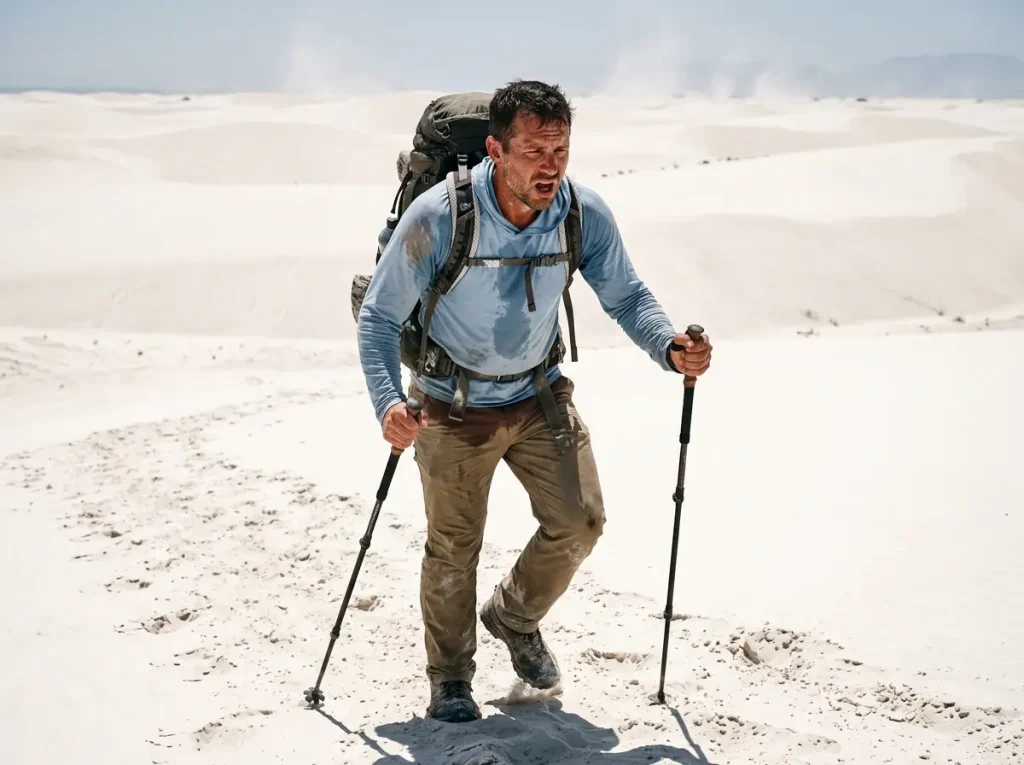
Here’s where everyone gets it wrong. You hydrate correctly, you start early, you’re wearing technical gear — and you still overheat. The problem isn’t effort. It’s thermodynamics.
In any environment below body temperature, your skin loses heat through radiation and convection to the cooler air around you. Once ambient temperatures climb above approximately 35°C (95°F), that gradient reverses. Radiation — which normally handles nearly half your heat loss — becomes a source of heat gain instead. Your body drops down to one option: evaporative cooling through sweat.
This is where the desert specifically bites. Relative humidity in Mojave and canyon country environments often sits below 15%. That massive vapor pressure deficit (VPD) means sweat evaporates almost immediately upon contact with air. Sounds efficient, right? It’s the opposite. When sweat undergoes flash evaporation — converting to vapor before it can conduct heat away from the skin surface — the cooling effect is lost to the atmosphere, not to your body. Your skin stays dry. You feel fine. Your core temperature keeps rising.
A 2025 study documented another trap: humid air directly above your skin from sweat is roughly 1.6% lighter than dry ambient air. In still conditions, this creates what researchers call “dueling buoyancy” — the thermal and humidity buoyancy forces partially cancel each other, creating a stagnation zone around your body that suppresses evaporation by an estimated 30%. In canyon environments with minimal airflow, this is the physics behind that sudden, overwhelming wave of internal heat when the wind dies. It’s real, and it’s being studied seriously for the first time.
The practical takeaway: in the desert, skin that feels dry means your thermoregulation is failing — not succeeding. Sustained evaporation at the skin surface is the goal.
According to the molecular thermodynamics of sweat evaporation research, each gram of sweat that evaporates properly removes about 2,430 joules of heat from the body. That’s a lot of thermal work — and the desert’s flash evaporation mechanism steals most of it.
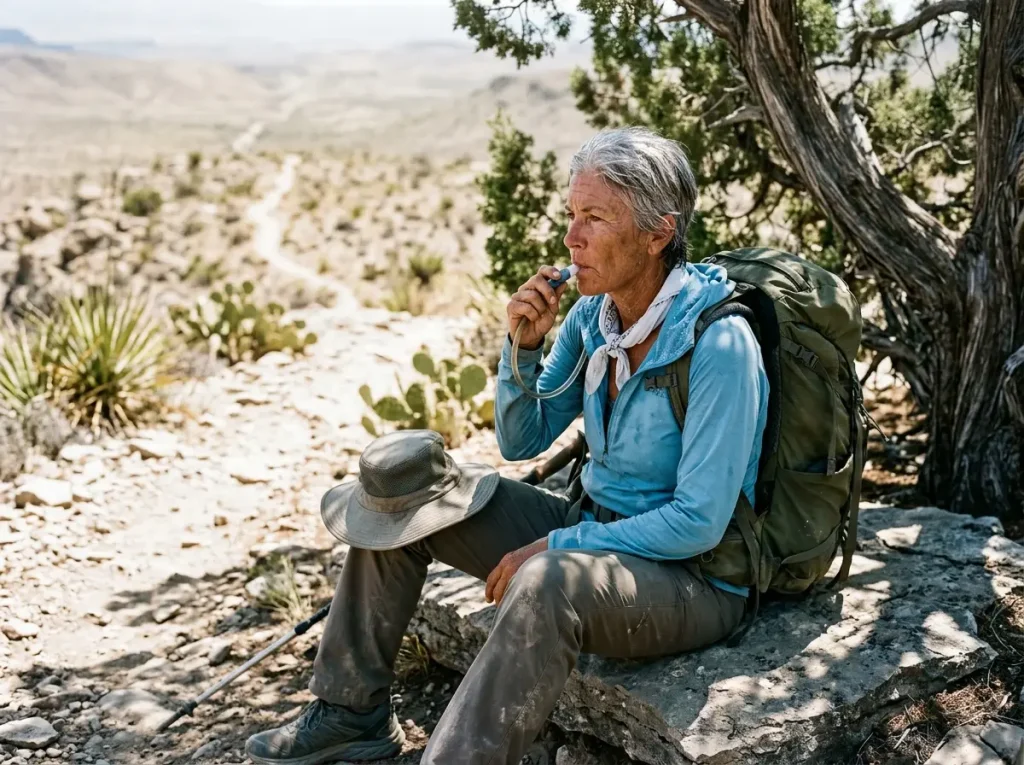
After seven days on the Hayduke, I stopped trusting “cool and dry” as a comfort signal. I started carrying a wet bandana around my neck not for comfort — for thermoregulation. One damp piece of cotton was outperforming a $140 shirt by keeping evaporation where it belonged: at my skin surface, not six inches above it.
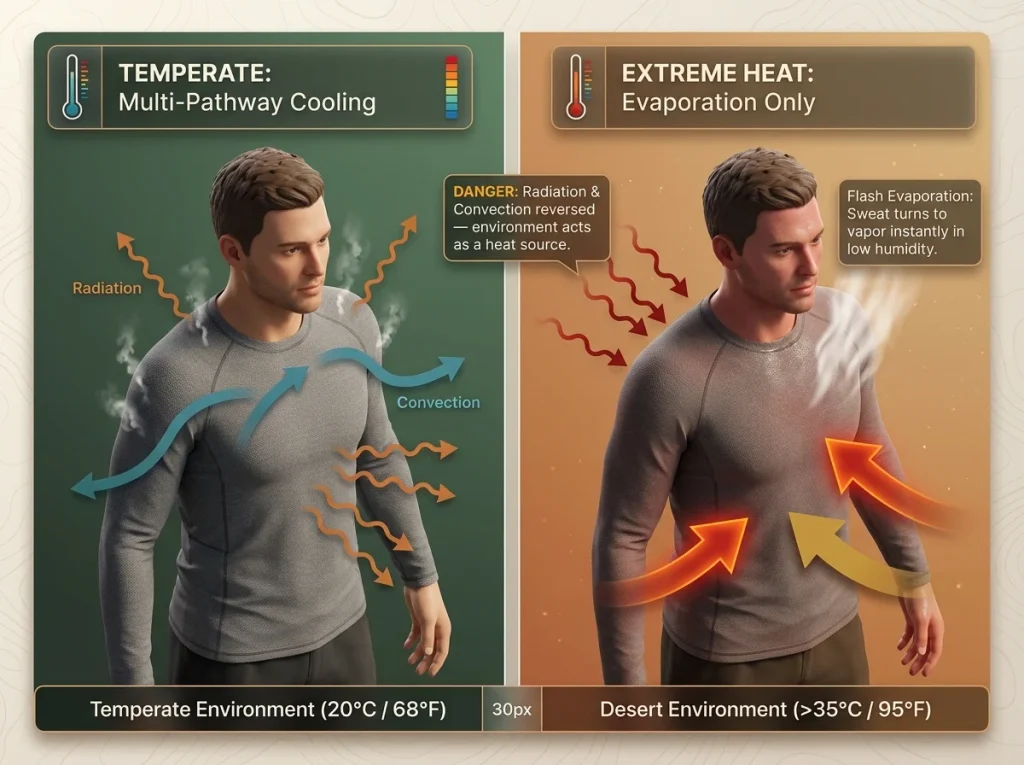
Pro Tip: In the desert, if your skin feels completely dry during heavy exertion, that’s a warning sign — not a sign the gear is working. Add a wet bandana at your neck to force evaporation back to the skin level.
The Architecture of the Cooling System — Fit, Weave, and the Chimney Effect
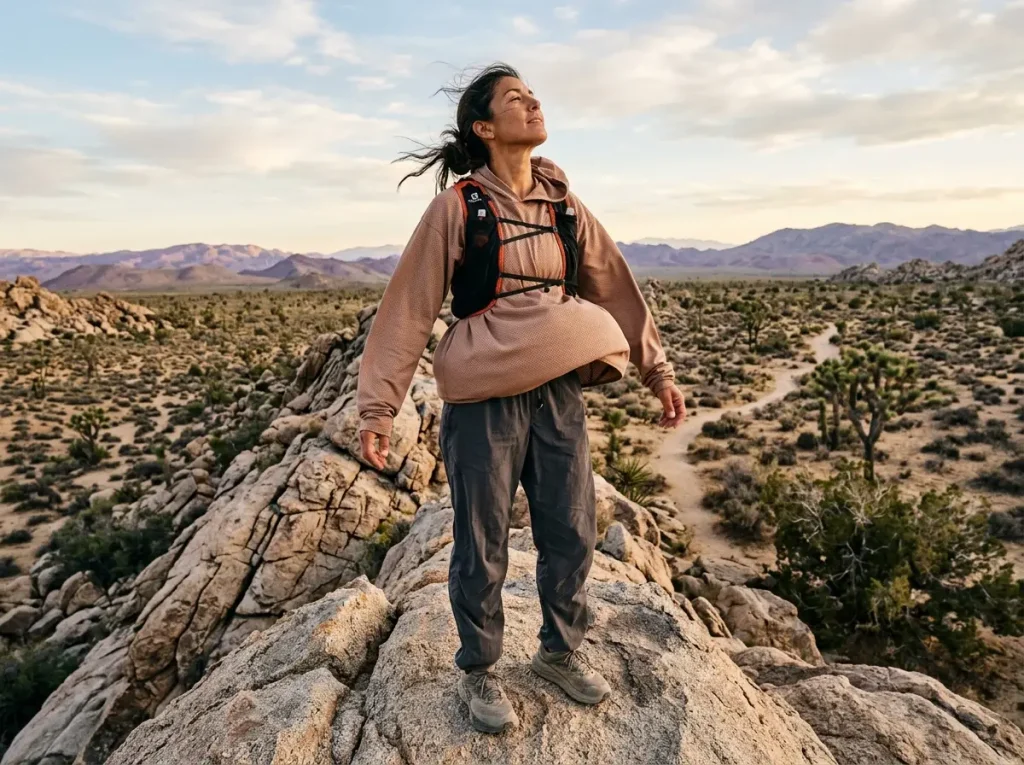
Most hikers shop for desert shirts by looking at the UPF number on the tag. That’s the wrong question.
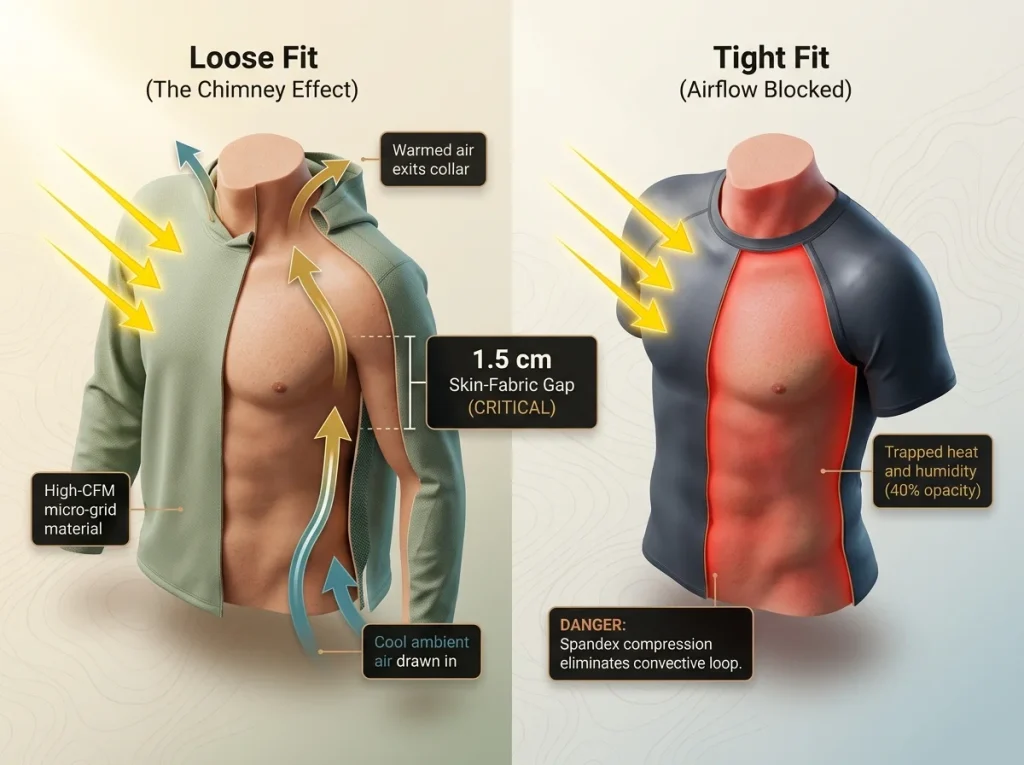
How sun hoodies cool you in extreme heat depends less on material specs and more on garment architecture. The chimney effect is the mechanism that actually moves heat off your body when radiation and convection have reversed against you. Solar radiation heats the outer fabric, the air inside the shirt warms and rises, exits at the collar and cuffs, and draws cooler ambient air in from below the hem — a continuous convective loop across your skin. It works. The Bedouins have been running this system for centuries. Research on traditional loose robes from arid cultures shows the wearer achieves identical net heat gain whether the robe is black or white, because the chimney effect dissipates the additional absorbed radiation before it reaches the skin.
The ventilation gap required for this effect to function is approximately 1.5 cm between fabric and skin. Compression garments — spandex blends, athletic fits, anything with significant stretch — eliminate that gap entirely. They press warm, humid air against your skin and hold it there. In desert heat, tight-fitting technical gear is not a comfort tradeoff. It’s a safety problem.
There’s a second mechanism reinforcing this: the bellows effect. As you walk, the motion of loose-fitting clothing physically pumps stagnant air out of the microclimate around your body and pulls dry ambient air in. Every stride becomes a ventilation cycle. This is why “dance pants” — loose, high-airflow nylon bottoms — have become standard among long-distance desert hikers. The fabric moves, and the air moves with it.
Weave Density vs. CFM — The UPF Trade-Off They Don’t Tell You
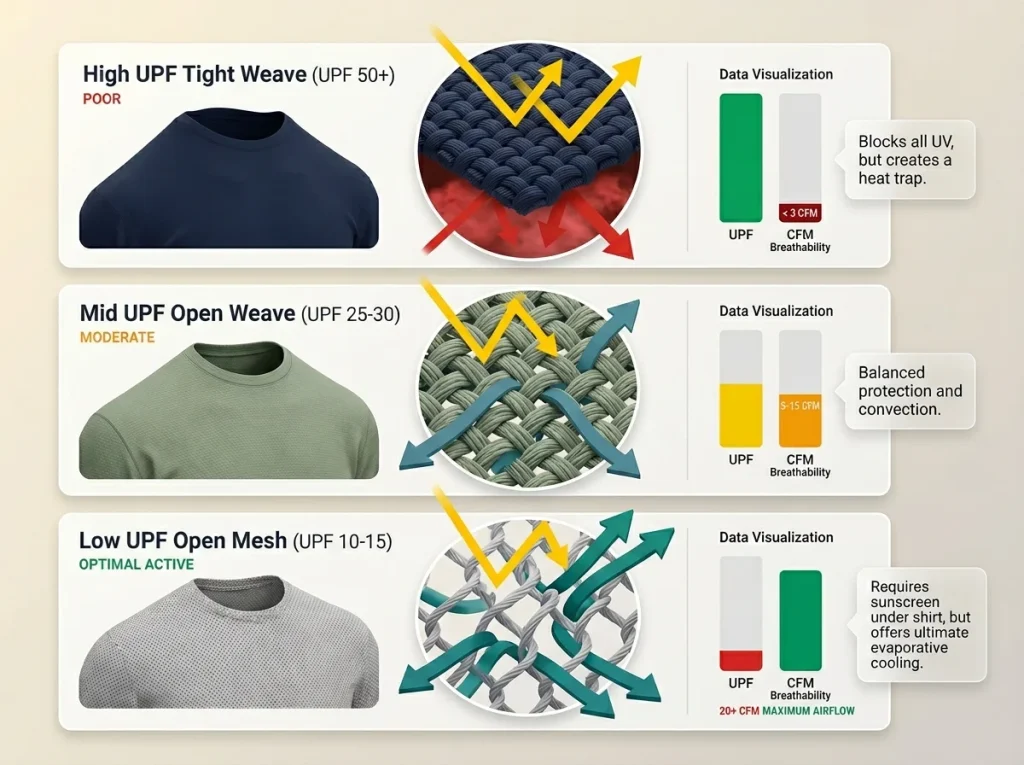
The engineering conflict between sun protection and breathability is real, and nobody at the gear store is going to explain it to you. UV protection comes from weave density — tighter weave means fewer gaps for UV photons to pass through. A UPF 50 garment allows only 2% of UV radiation to reach skin.
But tighter weave means lower air permeability (measured in CFM, cubic feet per minute). Technical field tests on sun hoodies show that high-UPF fabrics consistently fall below 2–3 mph equivalent air permeability. Open-weave fabrics can achieve 15–20 mph wind-through rates — but carry UPF ratings in the 15–25 range.
For high-exertion hiking between 9 AM and 5 PM in exposed terrain, a UPF 25–30 shirt with high CFM outperforms a UPF 50+ shirt in actual thermal stress reduction. Compensate for the lower UV protection rating with a wide-brim hat and an umbrella on shade-free traverses. You can do the CFM breath test before buying anything: hold the fabric to your lips and exhale gently. If you feel significant resistance, that shirt is built for UV blocking, not desert cooling.
Pro Tip: Pre-treat fabrics with a UV-absorber textile additive before a major desert trip. It can boost UPF rating by 5–15 points without meaningfully impacting air permeability — the best of both worlds.
The Material Science of Desert Fabrics — What Actually Degrades Out There
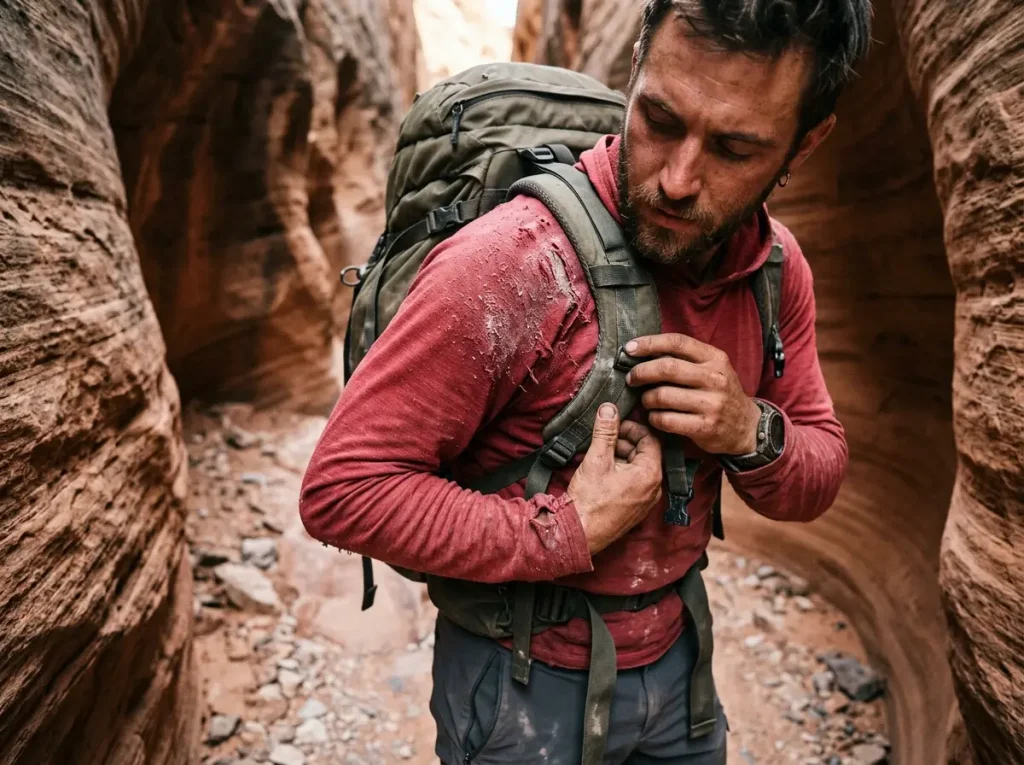
Here’s something no competitor guide tells you, and it cost me a $150 sun hoodie to learn: alkali dust eats synthetic fabric.
Desert basins in the Mojave, Great Basin, and canyon country carry high concentrations of sodium hydroxide and calcium carbonate in surface dust. When this alkaline compound mixes with acidic sweat on your skin and clothing, it creates a chemically active solution that attacks polyester fibers at the molecular level. The process is called alkaline hydrolysis — the breakdown of the polymer chains at the fiber surface.
Research published in MDPI covering environmental exposure effects on polyester sportswear materials demonstrates that polyester fibers under mechanical stress in alkaline conditions can lose a significant portion of their strength within a single week of sustained exposure. For a hiker, that mechanical stress comes from pack straps grinding against a sweaty, dust-covered shirt. Specifically: shoulders and the hip/waist contact zone where the pack creates friction.
This isn’t a defective gear problem. It’s a chemistry problem. By day four in the Escalante, my Outdoor Research Echo showed significant shoulder pilling under where the pack sat. The Himali Eclipse survived structure a bit better but showed moderate shoulder degradation. Nothing came out of that week pristine.
Merino wool does better under these conditions. Wool fibers are protein-based (keratin), not synthetic polymer chains — alkaline hydrolysis works differently on wool than it does on standard polyester. However, wet merino loses strength through a different failure mode, so pack strap friction is still a problem in high-sweat conditions.
Recycled polyester garments have an additional vulnerability: the polymer chains have already been shortened by processing heat cycles, making them more susceptible to further degradation.
A note on stewardship: alkali-accelerated hydrolysis increases microplastic shedding from synthetic fabrics into the fragile desert ecosystem. Ephemeral desert water sources concentrate these particles, and desert wildlife drinks from them. Avoid washing gear at desert springs. Use a Guppyfriend microplastic filter bag when doing any trail laundry, and stay well clear of water sources.
Pro Tip: If you’re planning a week-long desert traverse, reinforce pack contact zones on synthetic shirts with Tenacious Tape before you leave. The chemistry is predictable — protect accordingly.
Knowing when that shirt is finally done is a different skill. Diagnostic tests for when technical garments need replacement are worth running before a major trip, not after the shoulder finally fails at mile 40.
The Cotton Exception — When the “Cotton Kills” Rule Breaks Down
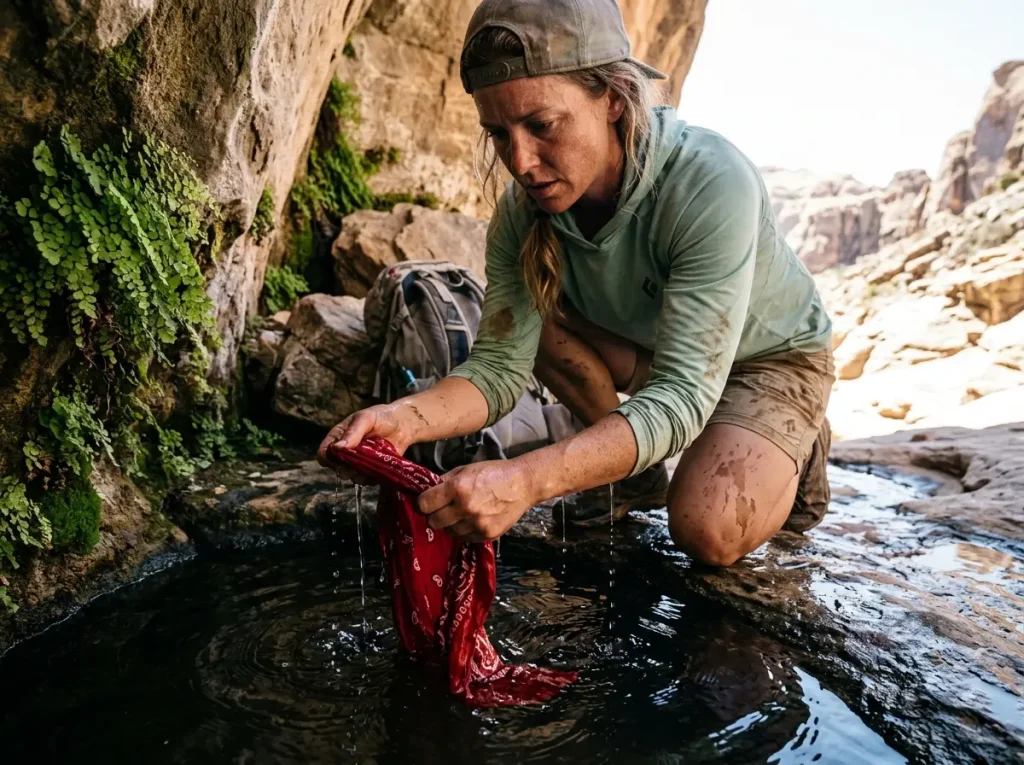
“Cotton kills” is a cold-weather survival rule. It is not a physics law. In zero-humidity desert heat, it needs a serious reexamination.
The rule comes from cold, wet environments where cotton’s moisture retention strips body heat dangerously fast. In the desert, where low humidity below 15% RH causes flash evaporation to strip the cooling effect before it reaches your skin, cotton’s moisture retention becomes a feature. Cotton can absorb up to 27 times its weight in water, functioning as a thermal reservoir that holds sweat against the skin and ensures the latent heat of vaporization is drawn from body tissue over a sustained period — not lost to the air above the shirt.
This is the swamp cooler effect, and experienced desert trekkers rely on it deliberately. Soak a cotton bandana, a lightweight cotton buff, or a wide-brim hat at a water source. The external water evaporates from the cotton and pulls heat directly from your skin. Field data from the American Hiking Society’s hot weather hiking hydration and cooling protocols validates this approach — evaporative cooling at the skin surface measurably reduces microclimate temperature around the head and neck, particularly when targeting the neck where the carotid arteries run close to the surface.
We stopped at every pothole and spring on the White Rim to re-soak our bandanas. At 105°F ambient, that wet bandana was the single most effective cooling intervention in the entire kit. It cost $4.
The physics here are worth understanding before you make your system decision. The thermal conductivity of wet cotton versus wool explains the moisture retention differences at the molecular level — when each material’s absorption profile actually works in your favor.
The catastrophic caveat is the evening transition. Desert temperatures drop 15–20°C within 2–3 hours of sunset in many canyon environments. A hiker still in wet cotton when that drop hits is now wearing a garment with significantly higher thermal conductivity than dry fabric — meaning it conducts body heat away to cold air far more efficiently than dry insulation would. Wet cotton is a midday active layer and nothing more. Before the daily temperature swing exceeds 10°C from peak, get out of it, dry it, and swap to dry synthetics or dry Merino.
Pro Tip: Re-wet your cotton cooling layer every 20–40 minutes in low-humidity conditions. When it feels dry, the thermal intervention has ended. Also: never sacrifice drinking water for evaporative cooling when your next source is uncertain.
Building the Desert System — What Goes on Your Body and When
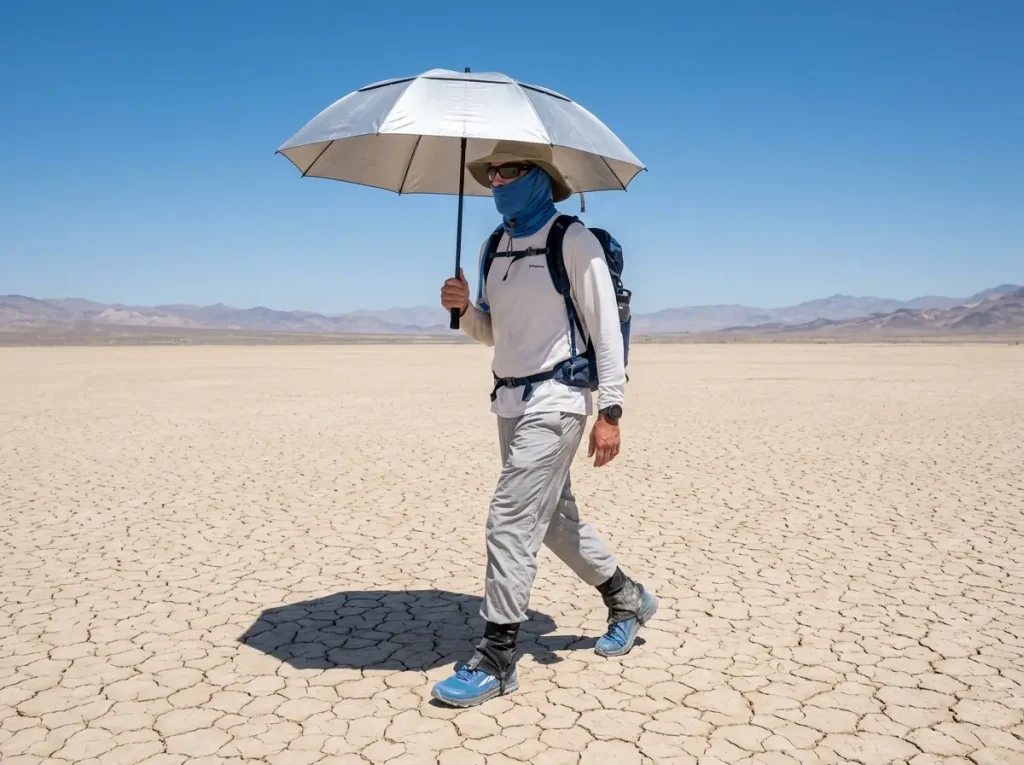
A desert clothing system isn’t a collection of good individual garments. It’s a modular thermal assembly that answers three distinct phases: cool morning and evening, peak midday active, and the cold night transition.
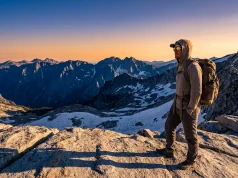
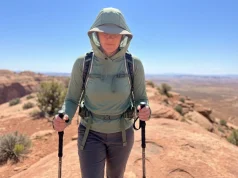
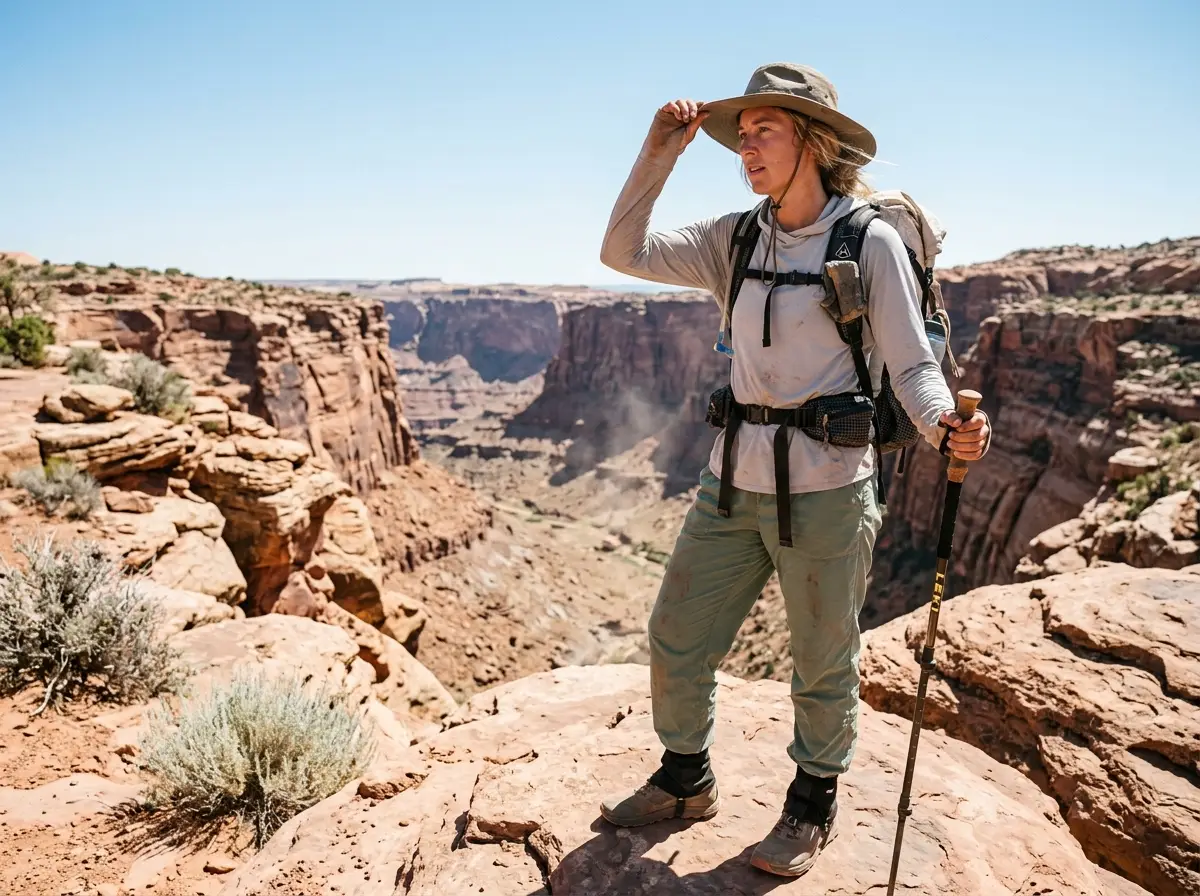
Upper Body (Midday Active Layer): A low-UPF (25–30), high-CFM sun hoodie worn loose. Sun hoodies should have thumb loops to maintain wrist coverage on exposed terrain — UV exposure to the dorsal hand accumulates fast on long traverses. Air permeability beats UV rating during peak exertion hours.
Lower Body: Lightweight nylon pants under 8 oz, loose enough for the bellows mechanism to function — not convertibles, which add zipper bulk. Long pant protection reduces heat rash risk, prevents UV exposure on the legs, and allows convective cooling in the lower body microclimate. On waterless traverses or exposed canyon sections, a 7–9 oz reflective hiking umbrella reduces solar radiation load on the body measurably, cutting sweat rate and water consumption.
Headwear: A wide-brim hat with at least 3 inches of brim circumference on all sides is non-negotiable in open desert terrain. The soaked wide-brim hat doubles as both UV shielding and evaporative cooling — the highest impact-per-ounce intervention in the kit.
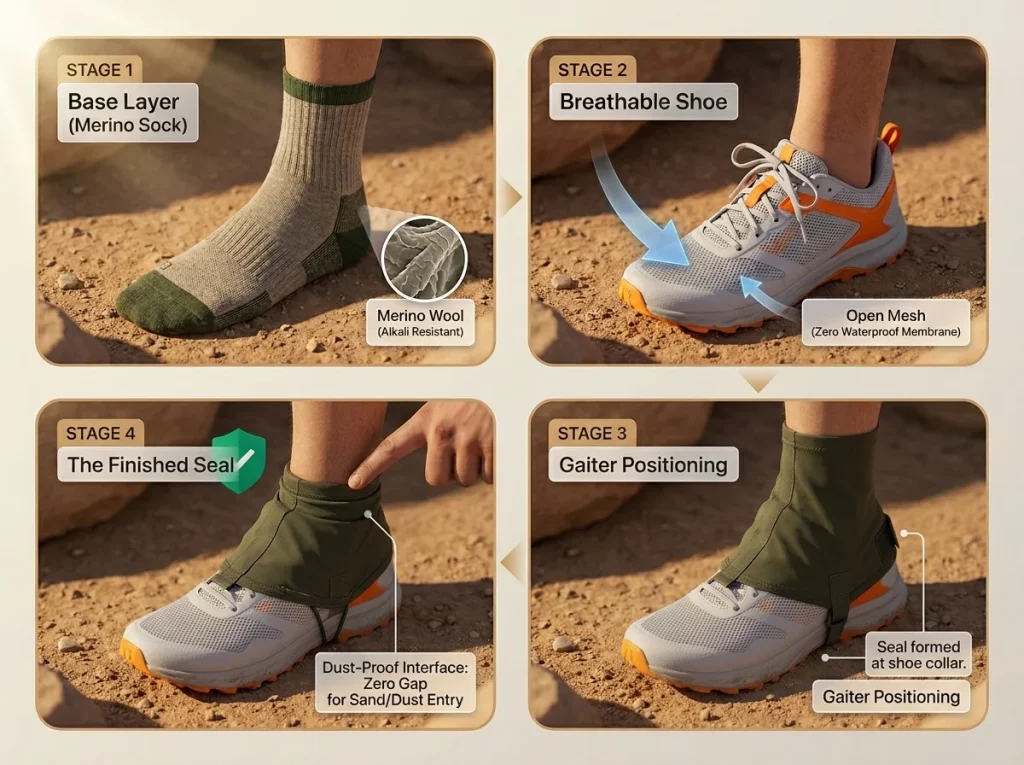
Footwear and Sock System: This is where most desert hikers actually fail. Non-waterproof, breathable mesh trail runners are the technical standard for dry desert terrain. Gore-Tex and similar waterproof membranes operate by vapor pressure differential — they pass sweat vapor outward only when the internal vapor pressure exceeds external. In ambient temperatures above 105°F with ground surface temperatures exceeding 150°F, that gradient can reverse, sealing moisture inside the boot. Maceration, severe blistering, and skin breakdown follow.
Pair mesh trail runners with lightweight desert ankle gaiters that seal the shoe-ankle interface against infiltrating alkali dust. Merino wool or bamboo blend socks resist structural breakdown when saturated with salt and sand better than standard synthetics. Clean socks at every reliable water source to remove embedded alkali crystals — salt crystal embedded in sock fibers is a mechanical abrasive that destroys skin from the inside out. For matching desert gaiters to your boot type correctly, the fit matters as much as the material choice.
Evening Transition Kit: A fleece or alpha-material grid piece for rapid warmup as you come off the trail. A down or synthetic insulation layer kept meticulously dry, packed at the top of your pack lid — accessible, not buried. Never use it as a hiking layer while actively sweating. The rule is simple: pack the puffy where you can grab it in 10 seconds, and keep it that way.
The Safety Matrix — Matching Clothing Systems to Heat Index Tiers
Heat exhaustion and heat stroke are not the same thing, and the clothing decisions that contribute to each are different.
Heat exhaustion happens when the cooling system gets overstressed — typically cold, clammy skin, nausea, headache, weak rapid pulse, and continued sweating. Core temperature is elevated but not yet critical. Move the person to shade, elevate legs, apply wet cooling to pulse points at the wrists, neck, and groin, and rehydrate with electrolytes.
Heat stroke is where the hypothalamus fails to regulate temperature. Core temperature rises above 40°C (104°F). Mental status change — confusion, irritability, slurred speech — is the definitive threshold. Mortality rates for untreated heat stroke range from 20–70% depending on response time. This is a trail evacuation, not a shade-and-rest scenario. Aggressive cooling via cold water immersion or ice at the groin and armpits is the priority, not waiting to see if symptoms resolve.
One common wrong assumption: heat stroke victims must be dry. They can still be sweating. The failure is thermoregulatory — the body cannot lose heat fast enough, regardless of whether sweat is still flowing.
A critical detail about hydration monitoring: urine color is a lagging indicator in extreme vapor pressure deficit conditions. Insensate respiratory water loss through the lungs during heavy exertion can create hazardous dehydration while urine still appears light-colored. Drink on a schedule, not on thirst. Follow NIOSH heat stress prevention recommendations as the baseline standard: minimum 750 mL per hour of active desert hiking under moderate conditions, with electrolyte supplementation mandatory once you’re above 500 mL per hour to prevent hyponatremia.
The clothing-condition matrix by heat index tier:
| Heat Index & Clothing Priority Guide | ||
|---|---|---|
| Heat Index Tier | Conditions | Clothing Priority |
| Tier 1: 85–95°F | Moderate exertion | High-CFM sun hoodie, loose pants, wet bandana optional |
| Tier 2: 95–105°F | High exertion, low humidity | High-CFM system mandatory, wide-brim hat, wet bandana active, umbrella if no shade |
| Tier 3: 105–115°F | Direct sun traverses | Maximize convective cooling + shading; water-soak shirt if available; micro-break protocol |
| Tier 4: >115°F | Beyond recommended activity zone | Do not hike in direct sun; reassess itinerary; cotton-wet layering only in shade |
The clothing system and the hydration strategy are not independent decisions in the desert. For electrolyte balance and hyponatremia prevention on desert hikes, the shared entity is heat stress prevention — apparel and hydration must be managed together.
I encountered a hiker on the Escalante at 3 PM: black cotton jeans, gray cotton t-shirt, no hat. Cold skin, splitting headache, weak grip. Classic heat exhaustion presentation. A liter of electrolyte solution and 40 minutes in shade later, they were walking again. They weren’t ignorant — they just hadn’t been told the physics.
Conclusion
Three things to carry out of this:
Wicking is not cooling. In low-humidity desert heat, fast-drying fabrics move moisture away from your skin before it can conductively cool you. The chimney effect and active air exchange are your actual cooling mechanisms. Build your system around air movement, not tag claims.
Architecture beats material. A loose, lower-UPF shirt with high air permeability outperforms a tight UPF 50+ shirt in active desert conditions. The 1.5 cm ventilation gap between skin and fabric is where the real work happens. Compression kills convection.
The desert punishes cargo cult clothing. Cotton kills in cold rain. Cotton works in zero-humidity heat — if you manage the evening transition risk. Alkali dust degrades polyester. Gore-Tex traps heat in your boots. Nothing performs the same in the desert as it does in every other environment. Know the physics, build your system accordingly.
On your next desert approach or red-rock traverse, run the CFM breath test on your sun hoodie before you pack it. If you feel significant resistance, leave it at home and find something with more airflow. The desert will show you the difference — ideally not on mile 12.
FAQ
Is it better to wear long or short sleeves in the desert?
Long sleeves are cooler in direct desert sun — but only with a loose fit and sufficient air permeability. A loose, high-CFM long-sleeved sun hoodie creates the chimney effect that actively cools the arm microclimate, while simultaneously blocking solar radiation that would heat skin through a short sleeve. Tight long sleeves eliminate the ventilation benefit and perform worse than short sleeves.
What color is best for desert hiking clothing?
Light colors have a real advantage on exposed terrain by keeping fabric temperature lower and reducing the heat introduced to the chimney-effect airflow. However, the Bedouin paradox shows that loose robes produce identical net heat gain for the wearer regardless of color — because garment architecture overwhelms color physics. Practical rule: light colors when fabric is fitted; loose architecture matters more than color when the garment has proper chimney geometry.
Are jeans okay for desert hiking?
No. Denim is heavy with high thermal mass, has virtually no air permeability, produces no chimney effect, absorbs alkali dust into the weave, and dries extremely slowly. Denim typically offers UPF 5–10 while adding substantial heat retention. A basic nylon pant at 4 oz outperforms jeans on every relevant desert metric.
How much water should I carry for desert hiking?
Minimum 750 mL per hour of active hiking under moderate conditions — more in Tier 3+ heat above 105°F. A hiker can be hazardously dehydrated in high-VPD conditions while still producing light-colored urine, because insensate respiratory water loss bypasses the kidney filtration system that determines urine concentration. Drink on a schedule, not on thirst. Add electrolytes at any hydration rate above 500 mL/hour to prevent hyponatremia.
What’s the biggest mistake hikers make with desert footwear?
Wearing waterproof boots. Waterproof membranes route sweat vapor outward only when vapor pressure inside exceeds pressure outside — in 105°F ambient heat with ground surface temperatures above 150°F, that gradient can reverse, sealing moisture inside the boot. The result is maceration and severe blistering. Non-waterproof, breathable mesh trail runners paired with lightweight desert gaiters are the technically correct choice for dry desert terrain.
Risk Disclaimer: Hiking, trekking, backpacking, and all related outdoor activities involve inherent
risks which may result in serious injury, illness, or death. The information provided on The Hiking Tribe is for
educational and informational purposes only. While we strive for accuracy, information on trails, gear, techniques,
and safety is not a substitute for your own best judgment and thorough preparation. Trail conditions, weather, and
other environmental factors change rapidly and may differ from what is described on this site. Always check with
official sources like park services for the most current alerts and conditions. Never undertake a hike beyond your
abilities and always be prepared for the unexpected. By using this website, you agree that you are solely
responsible for your own safety. Any reliance you place on our content is strictly at your own risk, and you assume
all liability for your actions and decisions in the outdoors. The Hiking Tribe and its authors will not be held
liable for any injury, damage, or loss sustained in connection with the use of the information herein.
Affiliate Disclosure: We are a participant in the Amazon Services LLC Associates Program, an
affiliate advertising program designed to provide a means for us to earn advertising fees by advertising and linking
to Amazon.com. As an Amazon Associate, we earn from qualifying purchases. We are also an official affiliate partner
of Black Diamond Equipment via the AvantLink network. If you click on a Black Diamond affiliate link and make a
purchase, we may earn a commission at no additional cost to you. We also participate in other affiliate programs and
may receive a commission on products purchased through our links. Additional terms are found in the terms of
service.