
In this article
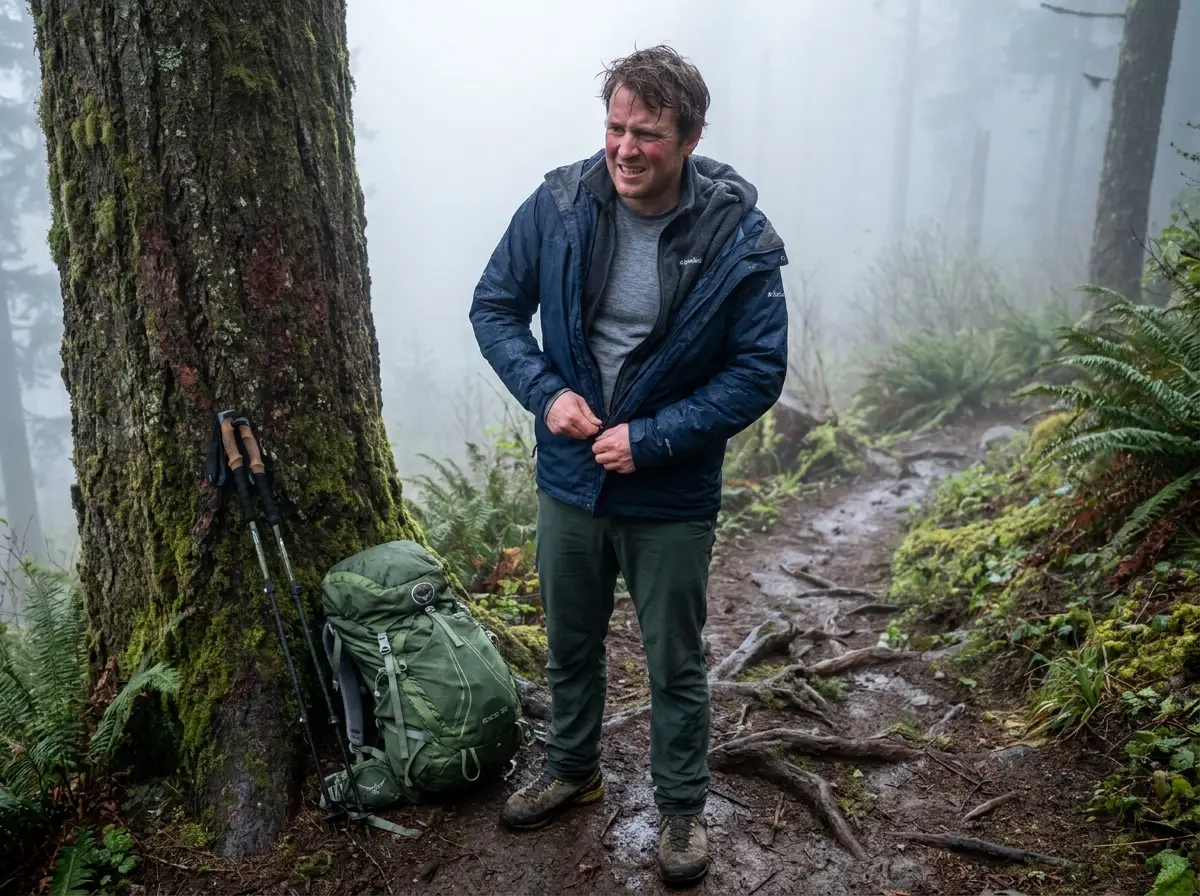
I bought a 3-in-1 jacket before my first serious shoulder season trip. The sales pitch was perfect — one jacket, three configurations, every weather condition handled. By mile four on a rainy 45°F ridge, the liner was bunched at my shoulders, cold air was running straight up my chest through the zipper gap, and I was sweating underneath fabric that refused to breathe. I wore the shell piece exactly twice after that trip. The fleece liner became a car blanket.
That experience taught me something every experienced hiker figures out eventually: 3-in-1 jackets solve a marketing problem, not a trail problem. Here’s why most hikers abandon them — and what actually works.
Quick Answer: Most hikers ditch 3-in-1 jackets because the zip-in design creates air gaps that leak warmth, the attached mid-layer can’t adapt to changing conditions, and the shell component uses budget membranes that wet out faster than dedicated rain shells. Separate layers cost more upfront but outperform in every hiking scenario except casual day walks in stable weather.
How 3-in-1 Jackets Actually Work (The Mechanics)
The Zip-In System
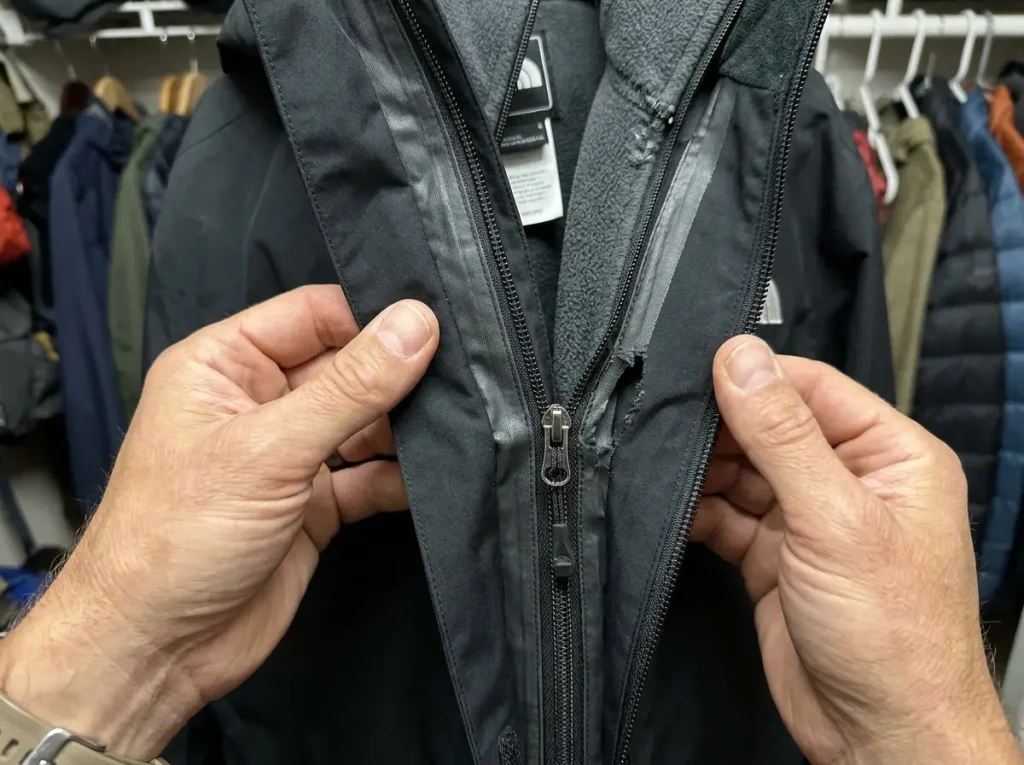
A 3-in-1 jacket combines two pieces: an outer waterproof shell and an inner insulated liner (usually fleece or synthetic fill). The liner zips into the shell through a secondary zipper track that runs behind the main front zipper. You get three “configurations” — shell only, liner only, or both together.
The concept sounds efficient. Buy one product, cover three temperature ranges. In the gear store, it makes complete sense.
What Actually Happens When You Zip Them Together
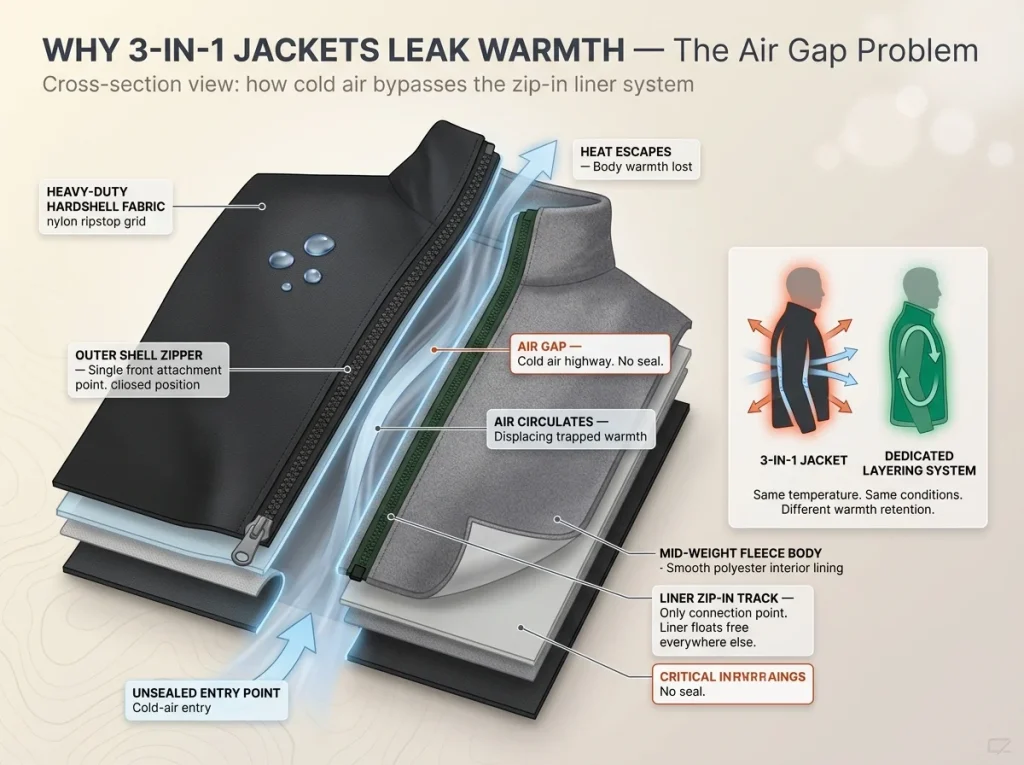
The liner attaches to the shell at a single connection point — the front zipper. There’s no attachment at the shoulders, sides, or back. When you move, hike uphill, or reach for a trekking pole, the liner shifts independently from the shell. It bunches at the shoulders. It rides up at the waist. The two layers pull against each other because they’re only anchored in one place.
More critically, because the liner’s zipper sits behind the shell’s zipper without full integration, the inner layer is never fully sealed. There’s a vertical channel from hem to collar where air flows freely between the two layers. On a calm day, you barely notice. On a windy ridge, that channel becomes a cold highway up your torso.
The Membrane Compromise
Dedicated rain shells from brands like Arc’teryx and Outdoor Research use high-performance waterproof-breathable membranes — Gore-Tex, eVent, or proprietary 3-layer constructions with fully taped seams. These membranes allow water vapor from your sweat to escape while blocking rain.
Most 3-in-1 jackets use budget waterproof coatings or lower-tier membranes to keep the total price competitive. The result: they keep rain out initially but “wet out” faster in sustained precipitation and breathe noticeably worse when you’re hiking uphill and generating heat.
The Air Gap Problem (Why You Get Cold)

Physics of the Single-Point Attachment
The three-layer system that outdoor professionals use works because each layer sits flush against the next. Your base layer wicks sweat to your mid-layer. Your mid-layer traps warm air. Your shell blocks wind and rain from disrupting that trapped air.
A 3-in-1 breaks this chain. Because the liner floats freely inside the shell — connected only at the front zipper — wind can enter through any unsealed gap and circulate between the layers. The warm air your body generates doesn’t stay trapped. It gets displaced by cold air that slides in through the connection points, the hem, and the cuffs.
The Wind Chill Factor
On a calm trail through a valley, this matters less. On an exposed ridge with 20 mph winds, the air gap becomes a serious heat loss pathway. Your body is producing heat, but the jacket system is failing to retain it because the architecture has built-in leaks that a properly layered system eliminates.
The kicker: you feel cold but you’re also damp underneath because the budget membrane isn’t venting your sweat efficiently. Cold plus damp is how hypothermia situations begin on trails that aren’t objectively freezing.
Why You Can’t Fix It
Some hikers try to solve the air gap by sizing down the shell for a tighter fit. This restricts arm movement and compresses the liner, reducing its insulation value. Others layer a separate mid-layer under the 3-in-1 liner, which defeats the entire purpose of buying the combination jacket. The design problem is structural — it’s not a fit issue you can adjust around.
Pro tip: If you already own a 3-in-1, unzip the pieces and use them separately. The shell works as a backup rain layer. The fleece liner works for camp. Stop trying to make them work together — they won’t.
The Mid-Layer Prison (One Size Doesn’t Fit All Conditions)
Why Flexibility Matters More Than Convenience
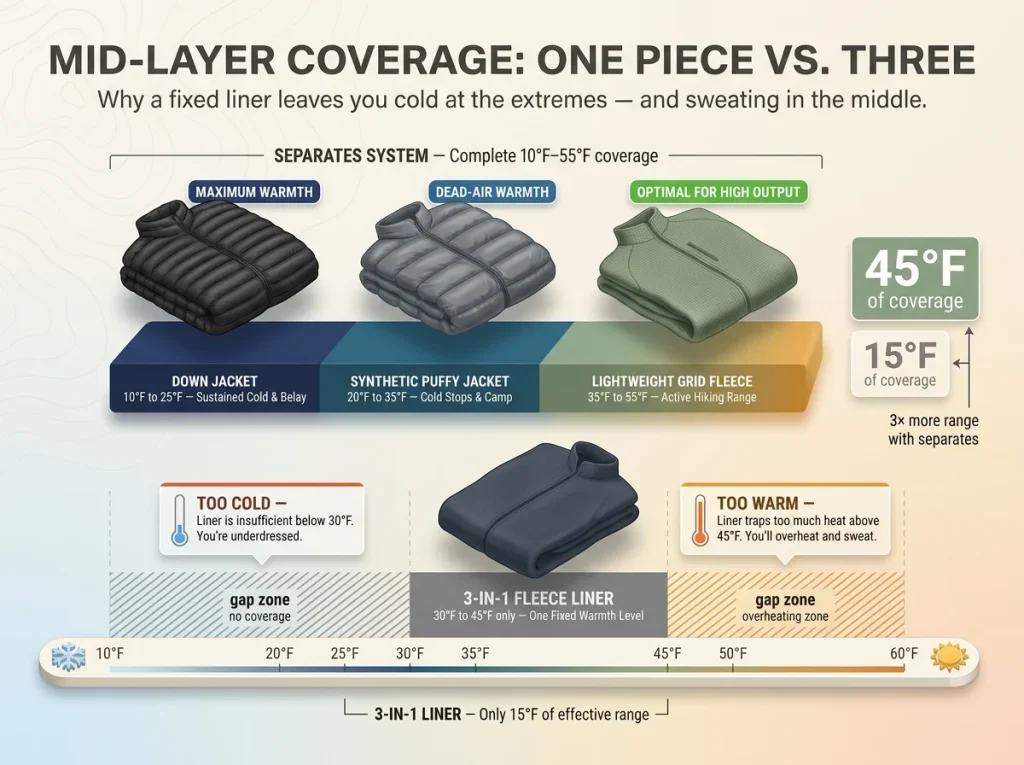
The biggest problem with a 3-in-1 jacket isn’t the air gap — it’s being locked into one insulation weight for every situation. Your 3-in-1 comes with one liner. That liner has one warmth rating. On the trail, conditions change constantly.
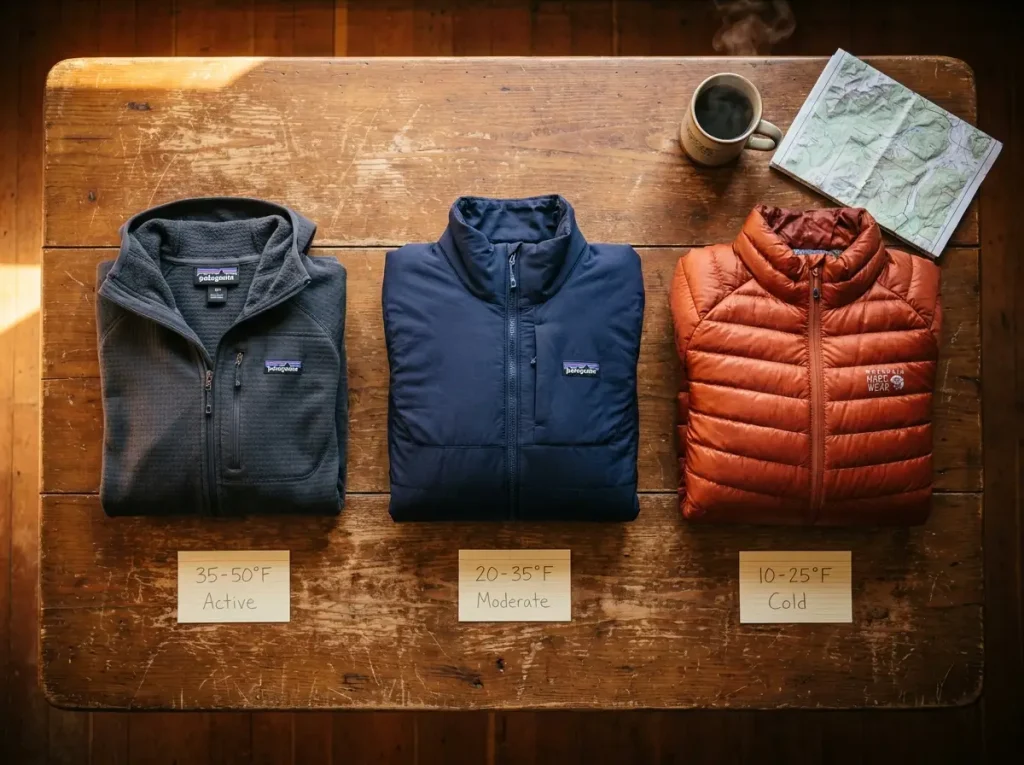
A 35°F morning that warms to 60°F by noon requires different insulation than a steady 25°F winter hike. With separate layers, you swap your mid-layer to match: a lightweight fleece for the warming day, a puffy for the cold one, a wind shell with no insulation for high-output uphills.
With a 3-in-1, you get the liner or nothing. Too warm? Remove the liner entirely and have just the shell with no insulation. Too cold? Add more layers underneath the already-bunching liner system. Neither option is efficient.
The “Active Hiking” Problem
Hiking generates significant body heat — especially on uphills with a loaded pack. Experienced hikers follow the “start cold” rule: begin your hike feeling slightly chilly because you’ll warm up within 10 minutes.
A 3-in-1 liner is typically a medium-weight fleece or synthetic fill designed for standing still or walking slowly. For active hiking, it traps too much heat too quickly. You start sweating. The budget membrane doesn’t vent the moisture. You overheat, unzip, dump heat, get chilled, zip up, overheat again. It’s a temperature regulation rollercoaster that proper layering avoids entirely.
The Vanity Problem Nobody Mentions
Most 3-in-1 liner jackets look terrible worn alone. They’re cut to fit inside a shell, not as standalone jackets. The sleeves are too narrow. The hem is too short. The aesthetic is “inner layer that escaped.” Forum hikers consistently report using their 3-in-1 liners as pajamas or car blankets because they’re too awkward to wear as actual jackets. That’s money spent on a piece that serves one function poorly.
When a 3-in-1 Actually Makes Sense

Casual Day Hikes in Stable Weather
If your hiking is flat nature trails, state park loops, and paved greenways — and the weather forecast is reliable — a 3-in-1 jacket handles the job. You’re not generating enough heat to overwhelm the membrane. The wind isn’t fierce enough to exploit the air gap. The convenience of one jacket genuinely outweighs the performance compromises.
Travel and Urban Use
A 3-in-1 makes good sense for travel where you need rain protection and warmth in a single packing unit. Walking European cities in November, sightseeing in variable weather, commuting in mixed conditions — these are situations where the 3-in-1’s convenience is real and the performance gaps don’t matter.
Budget-First Buyers
If your total jacket budget is under $150 and you need both rain protection and insulation, a quality 3-in-1 from Columbia or The North Face delivers more coverage per dollar than a single dedicated shell at the same price. The performance compromises exist, but having both pieces is better than having only one piece that’s better.
Who Should Skip It
Anyone hiking above treeline, in shoulder season weather, on multi-day trips, or in sustained rain. Anyone who hikes hard enough to sweat on uphills. Anyone who needs their gear to perform when conditions get serious. For those hikers, the 3-in-1 is a liability dressed up as a value.
The Separate Layering System (What Works Better)
The Three Layers and What Each Does
The layering system that professional hikers and guides use breaks outerwear into three independent pieces, each with a specific job:
Base layer — sits against your skin. Its only job is moving sweat away from your body. Merino wool or synthetic fabric. Fit should be snug without constricting. Cotton is banned from this role because it absorbs moisture and holds it against your skin.
Mid-layer — sits over the base layer. Its job is trapping warm air. Fleece, synthetic puffy, or down jacket depending on temperature. This is the layer you add and remove most frequently during a hike.
Outer shell — sits on top of everything. Its job is blocking wind and rain from disrupting the warm air your mid-layer is trapping. A dedicated rain shell with a high-performance membrane breathes better and waterproofs longer than any 3-in-1 shell.
Why Separates Win on Trail
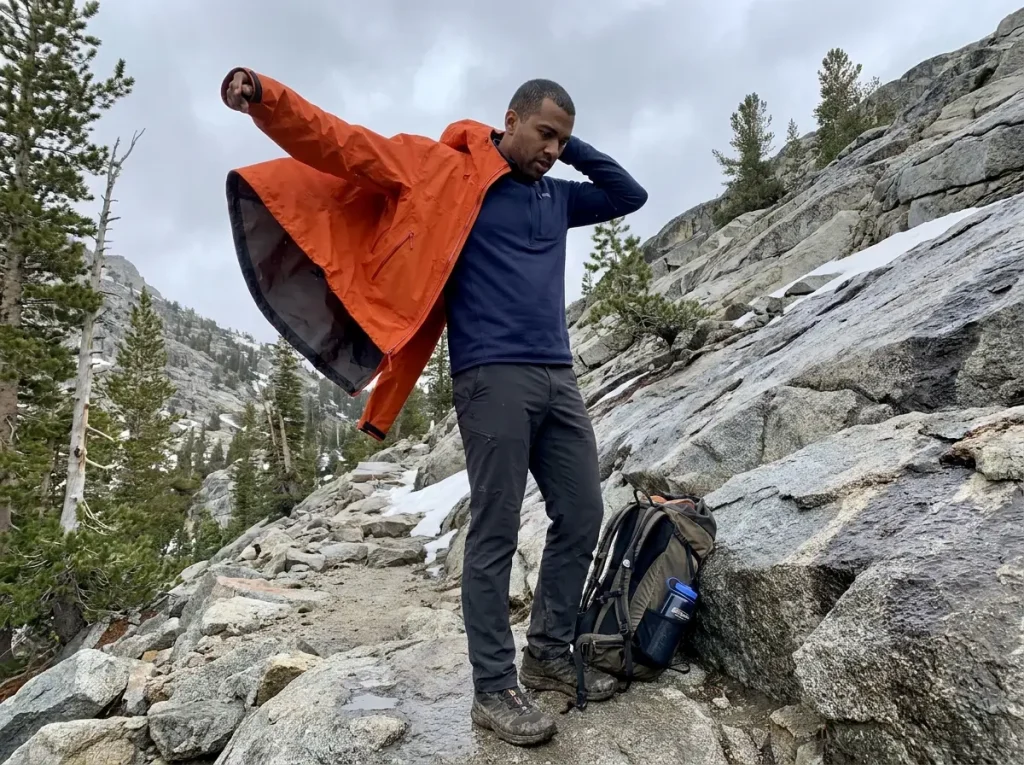
Each layer works independently. On a cool morning, you wear all three. When the sun comes out and you warm up, you strip the mid-layer and stash it in your pack — takes 30 seconds. When you stop for lunch and cool down, add it back. When rain hits, throw the shell over whatever you’re currently wearing.
A 3-in-1 can’t do this. Its two pieces are designed to work together. Separating them means you’re choosing between “just the shell” or “just the liner” — neither of which is optimized for standalone use.
The Breathability Advantage
A dedicated shell with Gore-Tex or similar membrane and pit zips allows water vapor to escape efficiently. You hike uphill, you sweat, the membrane lets that moisture through. A 3-in-1 shell with a budget coating traps moisture. After an hour of uphill hiking, you’re wet from the inside — which is the exact problem a rain jacket is supposed to prevent.
The Appalachian Mountain Club recommends a layering approach specifically because it allows you to fine-tune your microclimate by adding or removing individual layers as conditions change — something a fixed 3-in-1 system physically can’t match.
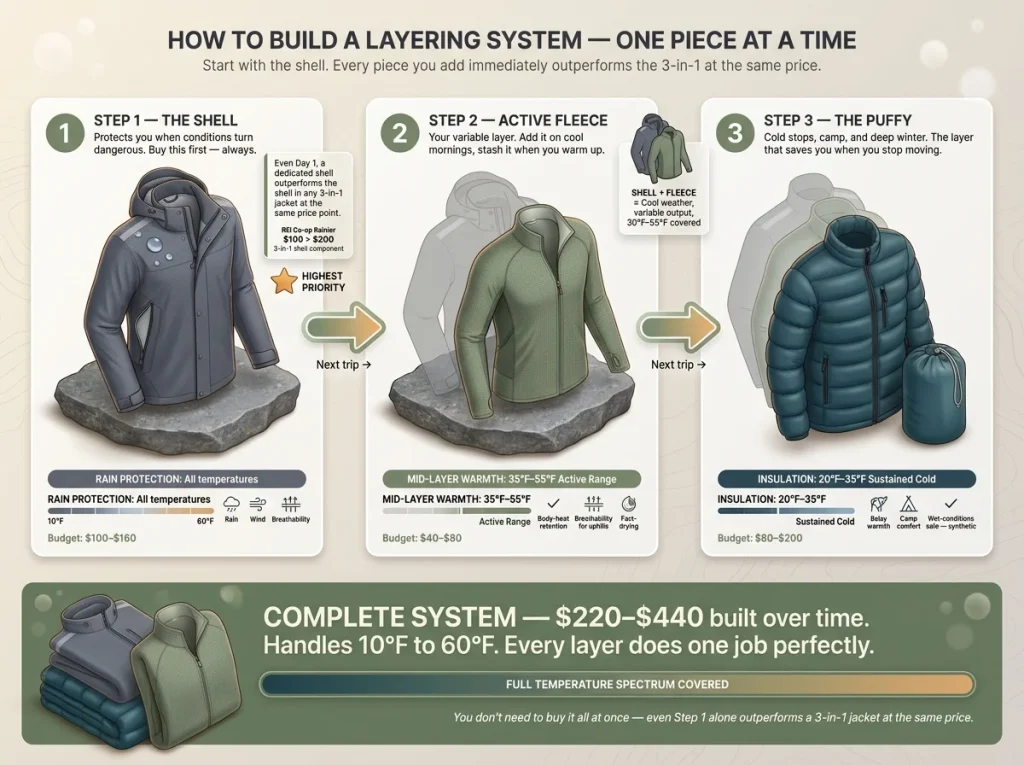
Pro tip: Start your collection with a quality rain shell first. A $100 REI Co-op Rainier or similar dedicated shell outperforms the shell component of a $200 3-in-1. Add a $40 fleece and a $60-$100 synthetic puffy over time. You’ll spend more total but each piece does its job fully.
Cost Breakdown (The Math Nobody Does)
The Sticker Price Illusion
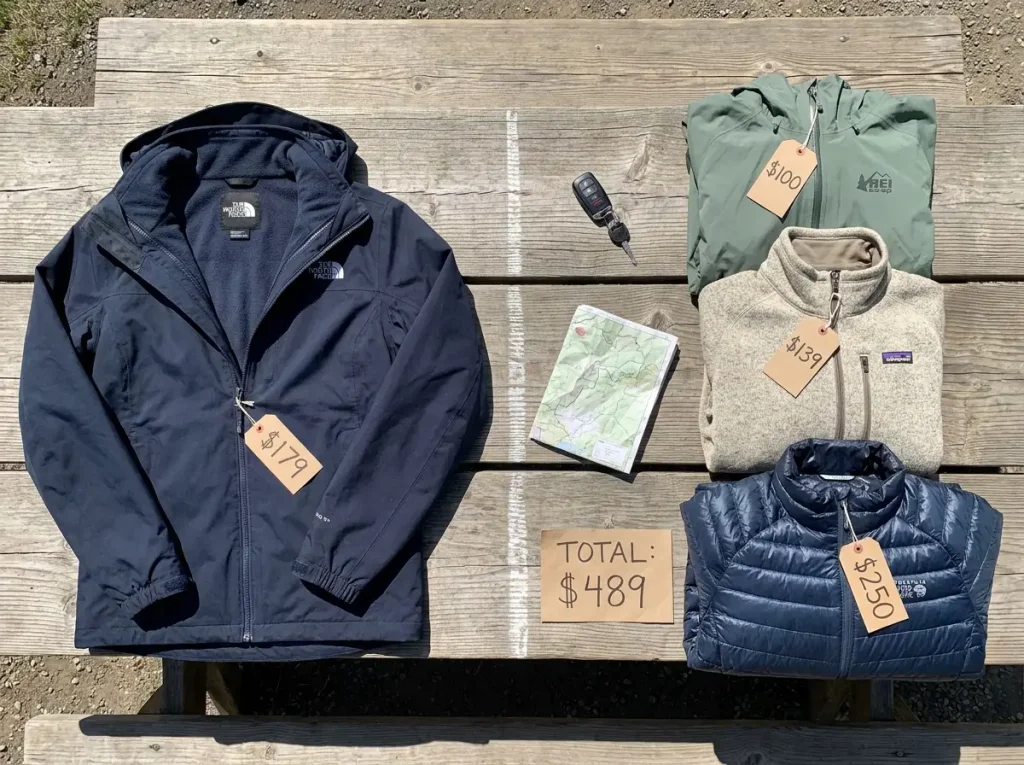
A solid 3-in-1 jacket costs $120–$200. Three separate layers cost $250–$400 total. At the register, the 3-in-1 looks like a bargain.
But trail gear doesn’t work on sticker price — it works on cost per use and replacement cost.
The Replacement Math
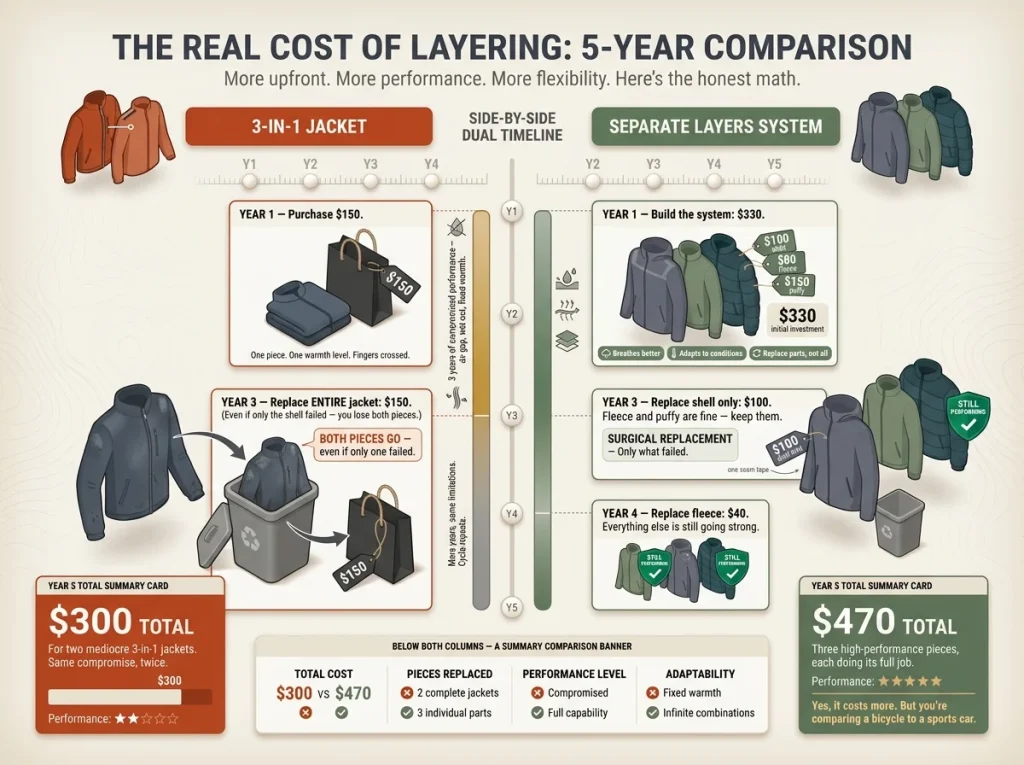
When one component of a 3-in-1 fails — the DWR coating wets out, the fleece pills flat, the zipper mechanism jams — you replace the entire jacket. Both pieces go, even if only one failed. At $150 per replacement, that adds up.
With separates, you replace only the piece that failed. Your shell’s DWR died after three years? Replace the $100 shell. Keep your $80 fleece that still works perfectly. Your down puffy got a rip that you patched but it’s losing loft? Replace just the puffy. The other pieces live on.
The Real Numbers
Over five years of regular hiking:
A 3-in-1 replaced once at year 3: $150 + $150 = $300 total for two quality levels that both compromise
Separates with one shell replacement at year 3 and one fleece replacement at year 4: $100 (shell) + $80 (fleece) + $150 (puffy) + $100 (shell replacement) + $40 (fleece replacement) = $470 total for five years of high-performance protection where each piece does its job properly
The separates cost more, but you’re comparing a mid-tier experience to a high-performance one. And the separates give you three distinct combinations for different conditions — the 3-in-1 gives you three mediocre versions of the same compromise.
Pro tip: Watch for end-of-season sales in March and September. Last year’s shell colors drop 30–40%. The membrane and construction don’t change — only the color. A $400 Arc’teryx Beta for $250 is a better long-term investment than two $150 3-in-1 jackets.
How to Build Your Own Layering System
Base Layer — The Foundation
Get a merino wool or synthetic base layer that fits snug. This is non-negotiable — it’s the piece that keeps sweat off your skin and prevents that clammy feeling that leads to chills when you stop moving. Budget around $40–$70.
Top picks: Smartwool 150 Merino, Patagonia Capilene Midweight, REI Co-op Merino Midweight. All three wick moisture, resist odor on multi-day trips, and fit under any mid-layer without bunching.
Mid-Layer — The Variable Piece
This is where the 3-in-1 system fails hardest, and where separates shine brightest. You need at least two mid-layers over time:
Lightweight fleece or grid fleece ($40–$80) for active hiking in 35–55°F. Breathes well, dries fast, and works when you’re generating heat on uphills. Patagonia R1, Black Diamond CoEfficient, or a budget REI Co-op fleece all handle this role.
Synthetic puffy ($80–$200) for cold stops, camp, and sustained cold below 35°F. Mountain Hardwear Ghost Whisperer, Patagonia Nano Puff, or Arc’teryx Atom are proven picks. Synthetic fill keeps insulating when damp — down doesn’t, unless it’s treated with a hydrophobic coating.
Outer Shell — The Shield
A dedicated 2.5-layer or 3-layer rain shell with fully taped seams. Look for pit zips for ventilation and an adjustable hood that fits over a helmet or a fleece hood. Budget $100–$300.
The Mountaineers recommend choosing a packable, highly water-resistant shell with minimal insulation as your outer layer — because insulation is the mid-layer’s job, not the shell’s.
REI Co-op Rainier ($100), Outdoor Research Helium ($160), or Arc’teryx Beta ($400) cover the range from budget to premium. All three outperform the shell component of any 3-in-1 at comparable price points.
Building Over Time
You don’t need to buy everything at once. Start with the rain shell — it’s the piece that protects you when conditions turn serious. Add a fleece for your next trip. Save for the puffy when winter approaches. Within a season, you’ll have a system that handles everything from a 70°F summer rain squall to a 15°F winter ridge — and every combination in between.
Conclusion
The 3-in-1 jacket solves a retail problem — one SKU, one purchase, one decision. It doesn’t solve a trail problem. The zip-in air gap leaks warmth on windy ridges, the fixed mid-layer can’t adapt to changing conditions, and the budget shell wets out when you need it most.
Separate layers cost more upfront but let you match your insulation to the actual conditions, replace only the piece that fails, and breathe properly when you’re working hard on the trail.
Buy a 3-in-1 for light day hikes and travel. Build a layering system for everything else. Your body will tell you the difference at mile four.
Q1 Is a 3-in-1 jacket worth it for hiking?
For casual day hikes on easy trails in stable weather, a 3-in-1 offers decent value. For serious hiking involving steep terrain, variable weather, or multi-day trips, separate layers outperform in warmth retention, breathability, and adaptability. Most experienced hikers switch to separates after one season.
Q2 What are the disadvantages of 3-in-1 jackets?
The zip-in liner connects at one point, creating air gaps that leak warmth. The attached mid-layer can’t adapt to temperature changes. Budget waterproof membranes wet out faster than dedicated shells. The liner looks awkward worn alone. Combined, these compromises mean worse performance than separate layers at a similar total cost.
Q3 Is it better to buy separate layers or a 3-in-1 jacket?
Separate layers win for performance, flexibility, and long-term value. Each piece does its job fully — wicking, insulating, or waterproofing — without compromise. A 3-in-1 wins only on initial purchase simplicity. Over five years, separates cost roughly $170 more but deliver significantly better trail protection.
Q4 Are 3-in-1 jackets warm enough for winter hiking?
Most 3-in-1 jackets fall short for serious winter hiking because the air gap bleeds heat and the fixed liner often isn’t insulated enough for sub-freezing temperatures. Winter hiking requires a heavy insulation layer plus a shell that seals completely against wind — conditions that demand a dedicated layering system.
Q5 How does a 3-in-1 jacket compare to a layering system?
A layering system uses independent base, mid, and shell layers that you add or remove based on conditions. A 3-in-1 locks two of those layers together with a single zipper connection. The layering system adapts to temperature changes in 30 seconds. The 3-in-1 gives you all-or-nothing options that rarely match actual trail conditions.
Risk Disclaimer: Hiking, trekking, backpacking, and all related outdoor activities involve inherent
risks which may result in serious injury, illness, or death. The information provided on The Hiking Tribe is for
educational and informational purposes only. While we strive for accuracy, information on trails, gear, techniques,
and safety is not a substitute for your own best judgment and thorough preparation. Trail conditions, weather, and
other environmental factors change rapidly and may differ from what is described on this site. Always check with
official sources like park services for the most current alerts and conditions. Never undertake a hike beyond your
abilities and always be prepared for the unexpected. By using this website, you agree that you are solely
responsible for your own safety. Any reliance you place on our content is strictly at your own risk, and you assume
all liability for your actions and decisions in the outdoors. The Hiking Tribe and its authors will not be held
liable for any injury, damage, or loss sustained in connection with the use of the information herein.
Affiliate Disclosure: We are a participant in the Amazon Services LLC Associates Program, an
affiliate advertising program designed to provide a means for us to earn advertising fees by advertising and linking
to Amazon.com. As an Amazon Associate, we earn from qualifying purchases. We are also an official affiliate partner
of Black Diamond Equipment via the AvantLink network. If you click on a Black Diamond affiliate link and make a
purchase, we may earn a commission at no additional cost to you. We also participate in other affiliate programs and
may receive a commission on products purchased through our links. Additional terms are found in the terms of
service.