
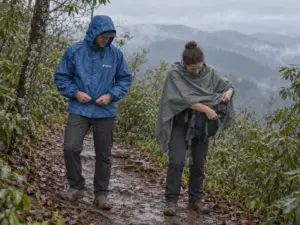
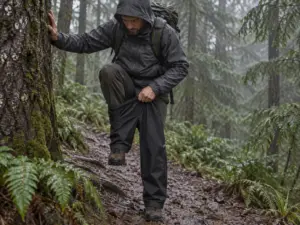


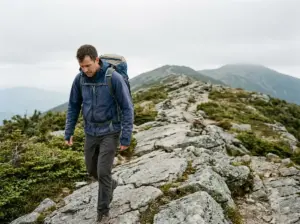
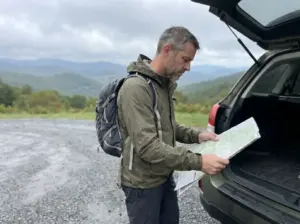

The heavy 30-liter pack was already rubbing a raw patch into my lower back, and my traditional boots responded like cement blocks on the steep 10% grade. I was struggling, grinding out the miles, when a hiker wearing a sleek vest-style harness breezed past me at a steady jog. They carried everything needed for a three-day weekend without a single bounce in their stride. That was the exact moment I realized my entire approach to wilderness travel was completely flawed.
After 15 years evaluating gear and tracking my own pacing data on the Pacific Crest Trail and remote high routes, I have seen the reality of load carriage shatter hundreds of egos. Fastpacking is not just about bringing less stuff. It is a meticulously calibrated discipline of hybrid human-powered transit that merges the cardiovascular efficiency of trail running with the self-sufficiency of ultralight backpacking.
By shedding pounds, dialing in your metabolic fuel, and rethinking how you carry water, you can abandon the grueling 10-mile trudges for fluid 30-mile excursions. Here is exactly how to strip weight safely, calculate your true vertical pacing, and confidently cover big miles without destroying your joints.
⚡ Quick Answer: Fastpacking is a high-intensity endurance activity that combines trail running techniques with ultralight overnight gear. Success depends on maintaining a fastpacking base weight of 10 pounds or less, wearing a bounce-free vest pack, and prioritizing foods with an energy density of 125 calories per ounce. It allows you to hike the steep sections, jog the flats, and run the descents.
| Backpacking vs. Fastpacking | ||
|---|---|---|
| Metric | Traditional Backpacking | Fastpacking |
| Base Weight | 15-30+ lbs | Sub-10 lbs (Max 15 lbs) |
| Average Pace | 2.0 – 2.5 mph | 3.5 – 5.0 mph |
| Daily Mileage | 8 – 15 miles | 25 – 40+ miles |
| Target Caloric Density | 100 cal/oz | 125 cal/oz |
The Biomechanics of the Fastpacking Gait
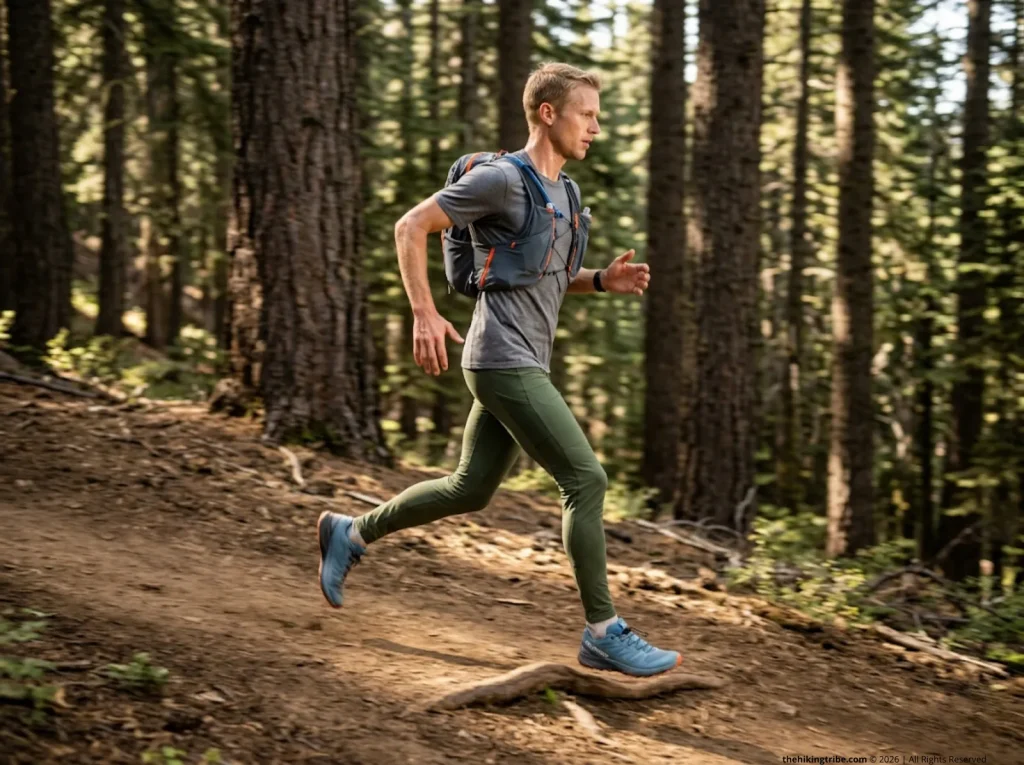
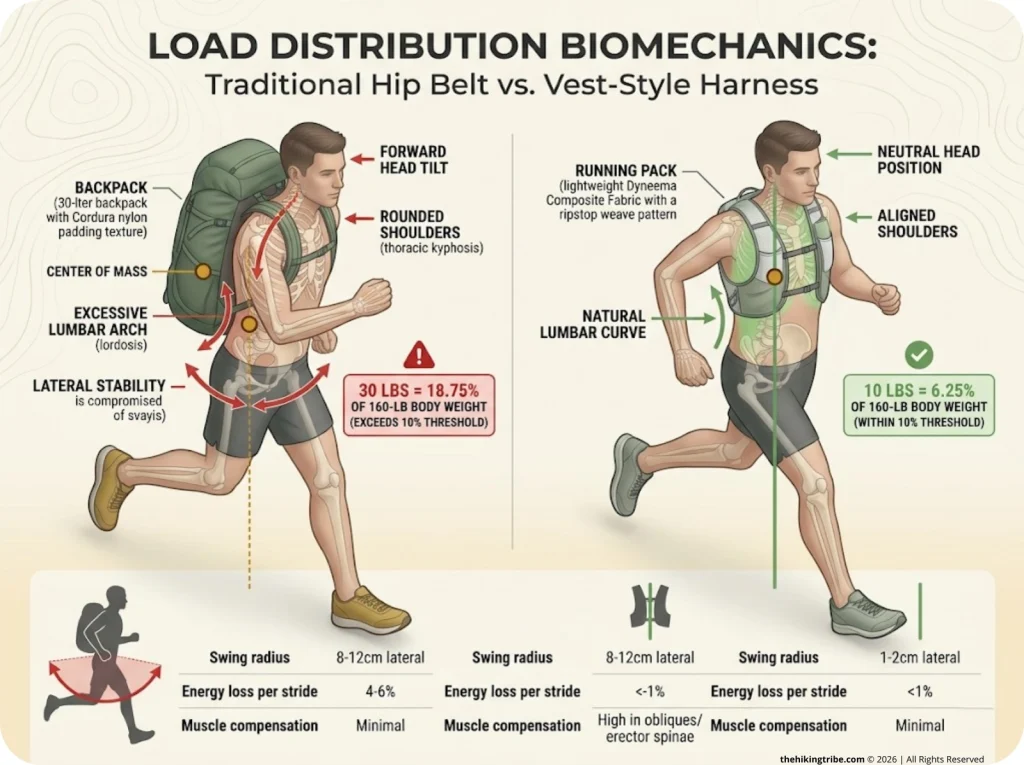
You physically cannot run effectively with thirty pounds strapped to your waist. Traditional setups fail instantly when you break into a jog because they simply cannot handle the forces involved. Pushing a pack load past 10% of your total body weight forces you to compensate. Your head tilts forward drastically, and your trunk leans back just to stay upright.
Running like this causes the pack to swing aggressively. Your core and oblique muscles act as emergency brakes with every single stride, fighting the swaying mass behind you. You pay a physical tax for every pound. For every single kilogram (2.2 lbs) of mass added to your pack, your body suffers a 1% decline in overall athletic performance.
I can tell you from brutal experience that pack bounce does not just slow your average pace. After 20 miles, a swaying pack will rub your shoulders raw, compress your nerves, and turn an epic weekend into a painful, grinding march.
Pro-Tip: Pack the heaviest, most dense items (like water and food bags) flush against the center of your back, between your shoulder blades. The closer the mass is to your spine, the less leverage it has to yank you backward.
The 10% Body Weight Threshold
When your load crosses that 10% threshold, your shoulder and neck muscles have to work nearly twice as hard. The body naturally attempts to counterbalance the rear load by pitching forward. This makes breathing harder and absolutely wrecks your stride. We know from clinical studies that exceeding this limit causes you to tire out quickly.
If you analyze the data regarding the physiological impact of backpack load on muscle fatigue, you see that your neck muscles simply get pushed past their breaking point. This means if a 160-pound hiker loads up 18 pounds to accommodate “just-in-case” gear, they immediately break the limit required for a true fastpacking gait.
You have to weigh everything down to the ounce. Knowing the exact difference between your skin-out weight and your consumable load is critical. Mastering the math of differentiating between absolute pack weight and baseline mass forces you to conduct ruthless pack shakedowns. If your kit crosses your threshold, you simply cannot run.
Conquering the Pendulum Effect
Traditional packs utilize heavily padded hip belts to transfer weight to the pelvis. That design is brilliant for walking. But it is catastrophic for running. A heavy hip belt swinging side to side will chafe your skin raw and cause deep bruising.
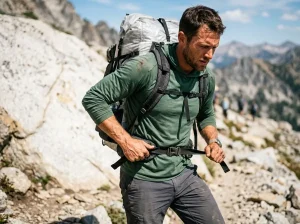
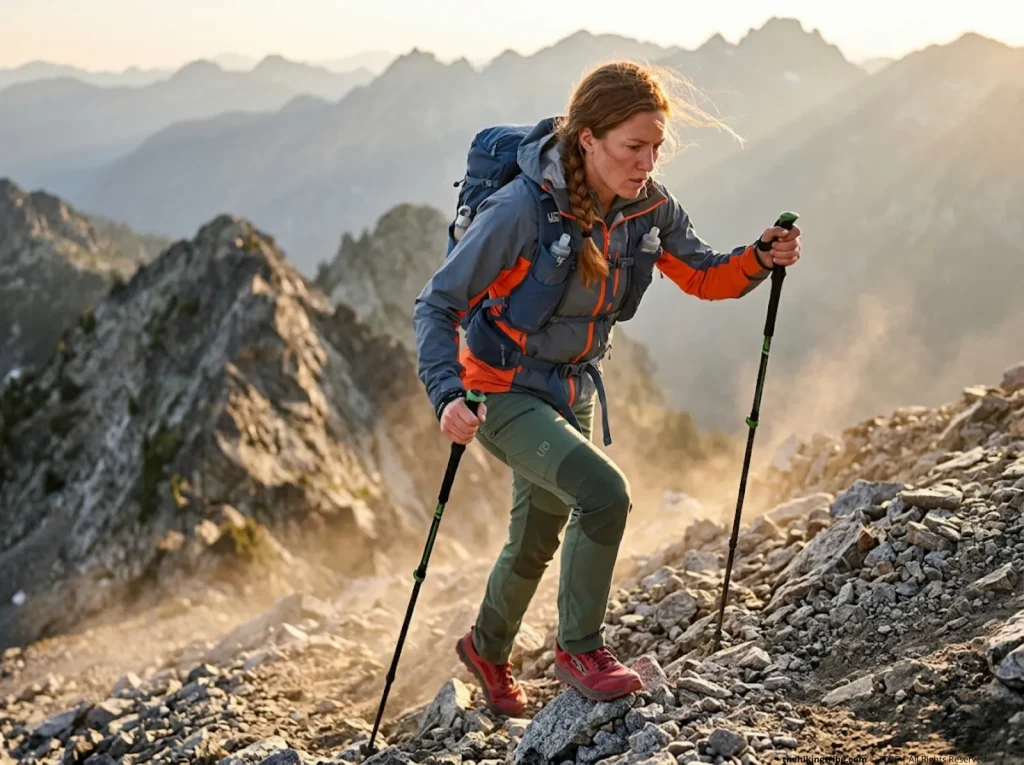
You cannot execute a smooth stride unless the mass of the pack is glued tight against the center of your ribcage. Achieving a stable, bounce-free fit requires a fundamental shift in how you carry gear. A running-vest harness anchors the load across your chest, minimizing side-to-side sway and freeing your hips to rotate naturally.
The 1:5 Rule for Footwear
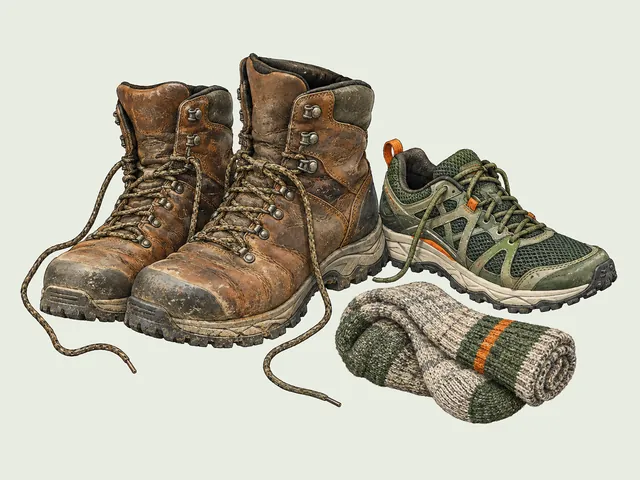
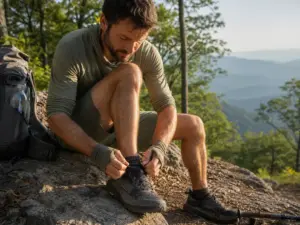
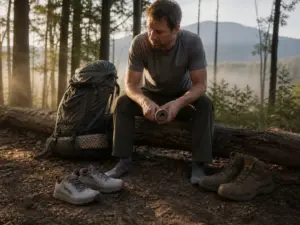
The energy cost of lifting heavy traditional boots 50,000 times a day is massive. Switching from a 3-pound set of boots to a 1.2-pound pair of lightweight trail runners is mechanically equivalent to dropping almost 9 pounds from your back. This 1:5 ratio dictates that one pound on your feet equals five pounds in your pack.
If you try to fastpack in hiking boots, you are fighting gravity at the end of a long lever—your leg. Lighter shoes like the Altra Lone Peak, a nimble Salomon, or a gripping VJ sacrifice stiff ankle support. This means the stabilization duty shifts entirely to your foot strength and your own balance on the trail. It demands stronger ankles, but the calorie savings on rocky terrain are undeniable.
The “Big Three” Gear Evolution for Big Miles
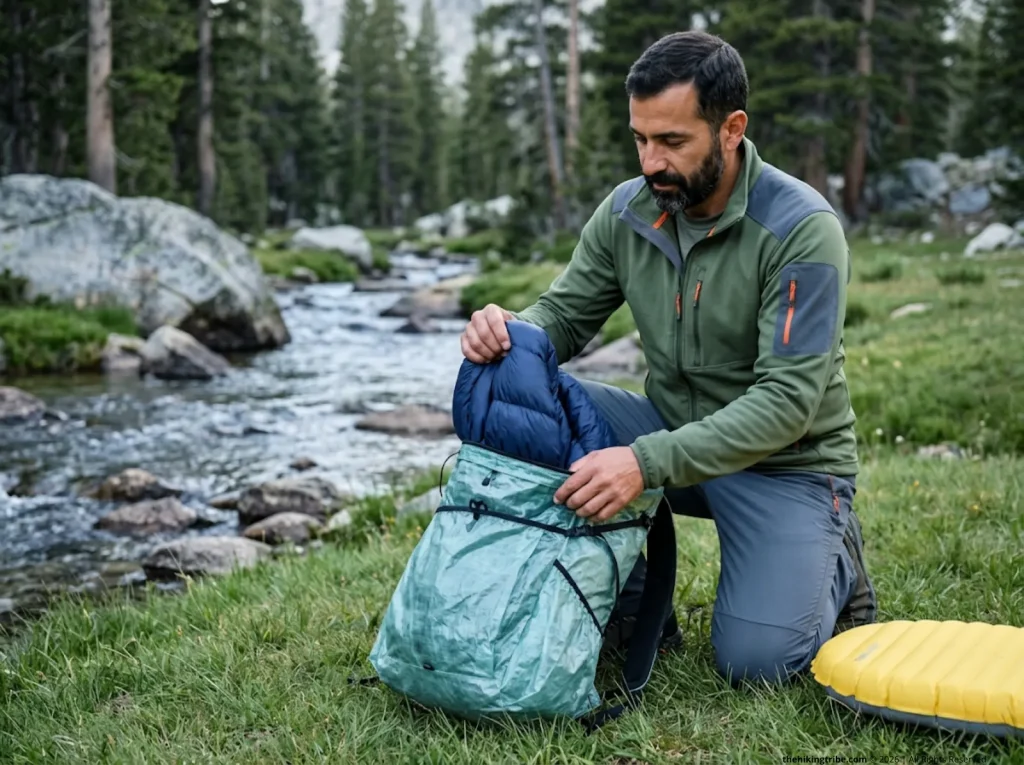
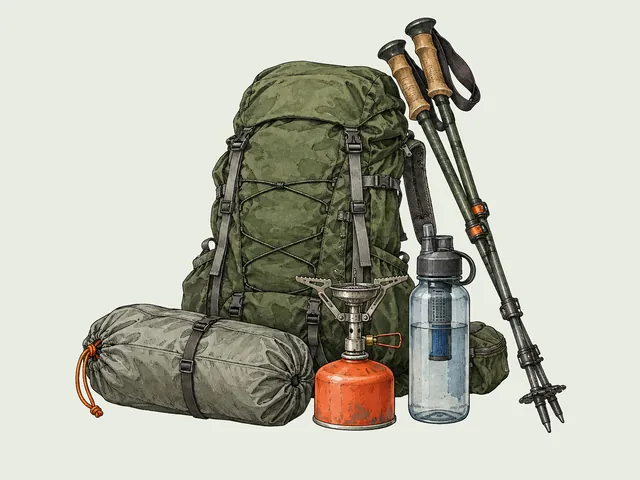
Securing a base weight under 10 pounds predominantly happens by investing in ultralight, highly technical fabrics for the “Big Three” systems: your pack, your shelter, and your sleep setup. Overbuilt traditional equipment is incompatible with big miles.
The fastpacking base weight sweet spot for a multi-day trip sits inside a pack capacity of 25 to 35 liters. Using anything larger invites the psychological trap of packing your fears. You see empty space and you naturally want to fill it with a camp chair or an extra fleece. Do not do it.
If you want to move four miles an hour without destroying your knees, your gear cannot be an afterthought. Dropping five pounds from your Big Three feels like finding a sixth gear in a car. A data-driven fastpacker scrutinizes the price-to-weight ratio of every item, ensuring that the heavy investment directly translates to higher miles per day.
The Vest-Style Harness Advantage
Vest-style harnesses integrate wide, shoulder-wrapping straps that distribute the load across your chest. Instead of thin nylon webbing digging sharply into your collarbones, the vest construction hugs your torso. Brands like Zpacks, Pa’lante Packs with their Joey model, or specialized gear from Red Paw Packs, pioneered this approach for high-mileage hikers.
The trick is load distribution. Packing heavy items too low in a vest harness will pull the fabric away from your upper back, bringing that destructive swinging effect right back into play. You also want to keep your water weight balanced on your chest.
Pro-Tip: Keep your water bottles up front in the chest pockets. Sip small amounts constantly rather than stopping to chug from a heavy bladder buried in the main compartment. It stabilizes the pack and prevents sloshing.
Quilts Over Mummy Bags
Mummy bags waste 8 to 12 ounces of material and heavy zippers underneath your body. When you lay on down insulation, it flattens out, providing almost zero warmth. An ultralight 20°F down quilt provides the exact same top and side warmth at nearly half the weight and volume.
Because an ultralight quilt is open on the bottom, the entire system relies completely on a high-end sleeping pad. You need a pad with a solid insulation rating, like the Therm-a-Rest NeoAir XLite, to prevent the cold ground from stealing your body heat. Pair a quality quilt with technical moisture-wicking apparel, and you have a sleep system built for covering serious miles-per-weekend.
Shelter Systems: DCF and Catenary Cuts
Fastpacking shelters are tension-based structures. They utilize your trekking poles—like rigid Black Diamond Carbon Z poles—to create the frame, rather than forcing you to haul heavy aluminum tent poles. You pitch them tight to the ground to slice through weather.
Dyneema Composite Fabric (DCF) offers unmatched 0.5 oz/sq yard weight ratios. Unlike older fabrics, DCF does not stretch or sag when wet from rain or heavy morning dew. If you use a Mountain Laurel Designs SoloMid, you don’t have to leave the warmth of your quilt to tighten your guylines at 2 A.M. during a storm.
If you are debating choosing between the extreme minimalism of a bivy and an ultralight tent setup, you are making the core decision of your total base weight strategy. Both keep you light and fast.
Mastering the Fastpacking Pace Matrix
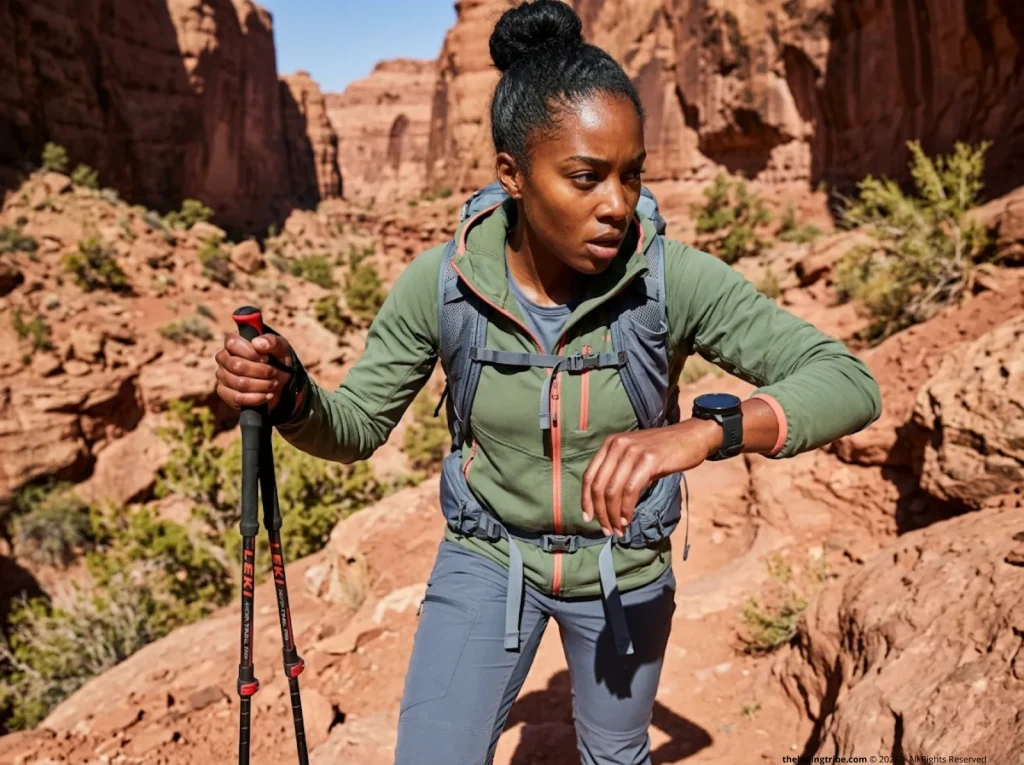
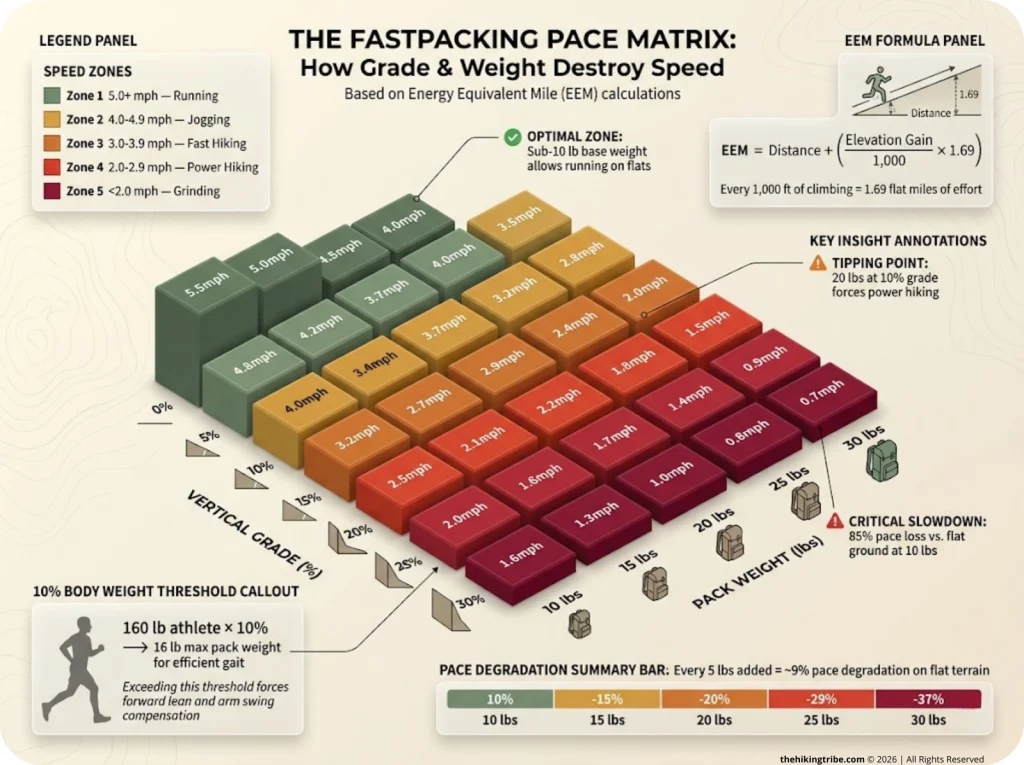
Flat-ground running speeds are completely irrelevant to high-volume mountain travel. A six-minute mile on pavement means nothing when you stare down a canyon wall. Fastpackers rely on precise, data-driven frameworks to accurately calculate their progress and expected travel time over aggressive terrain. Reviewing a detailed pace calculator table helps, but field experience counts the most.
It took me exactly one 30-mile day to realize that covering extreme distance is not about running fast. It is about relentlessly moving forward and literally never stopping to take off your pack.
You adopt the mantra of hiking the ups, jogging the flats, and running the downs. To plan these days accurately, you must respect the impact of vertical gain and use a structured mental model to predict your limits.
Energy Equivalent Miles (EEM) Explained
The Energy Equivalent Miles (EEM) concept states that every 1,000 feet of climbing demands the identical physical output as covering 1.69 flat miles. This creates a realistic picture of your actual effort.
If your planned route is 20 miles but features 6,000 feet of brutal climbing, you are effectively working a 30-mile effort. You must plan your calories and hydration according to the EEM, not the simple map distance.
By refining standard time estimations like Naismith’s Rule, you shift your mindset from generic trip planning to precision pacing. Tracking pace vs. weight requires absolute honesty about your fitness baseline before you hit the trail.
Measuring Grade Adjusted Pace (GAP)
Your Grade Adjusted Pace normalizes your expected travel speed. On flat ground with a 10-pound pack, you might easily hold 5.5 mph. But the moment you hit a steep uphill grade, that speed plummets to a power hiking grunt of 1.5 to 2.0 mph. It is an absolute performance drain.
Treat your steep downhills cautiously. Dropping altitude on a steep grade allows for a controlled run of 6.0 to 8.0 mph, but the load on your thigh muscles is extreme. Monitoring the pace degradation over elevation is the hallmark of an experienced fastpacker.
The Efficiency of “Unstopped Time”
Slipping off a traditional pack to rummage for a snack or check a map takes 4 to 6 minutes. Suffer this fate just once an hour over a 12-hour moving day, and you bleed over an hour of forward motion. That is the silent killer of daily mileage goals—the ratio of static vs. moving time.
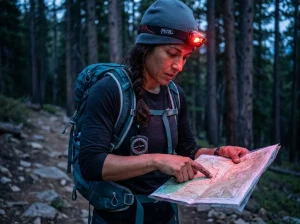
Vest-style pockets exist to end this time drain forever. Everything you need during the day—snacks, navigation, sunscreen, a water filter like the Katadyn BeFree—must be accessible without breaking your stride. Moving continuously dictates your success far more than your top running speed.
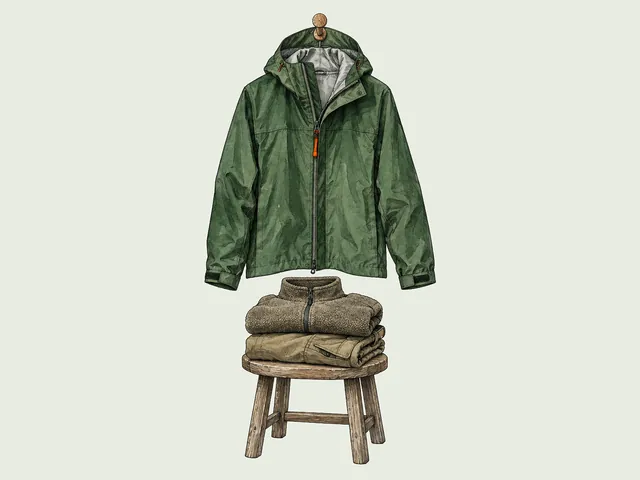
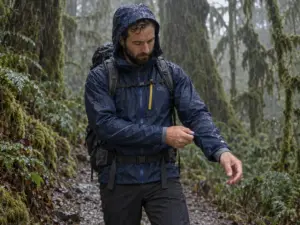
Pro-Tip: Use a lightweight, breathable rain jacket (checking the MVTR breathability rating) as an active wind shell. Adjusting the front zipper on the move to dump heat is infinitely better than stopping to dig through your pack for a slightly better mid-layer.
Fueling the 5,000-Calorie Day
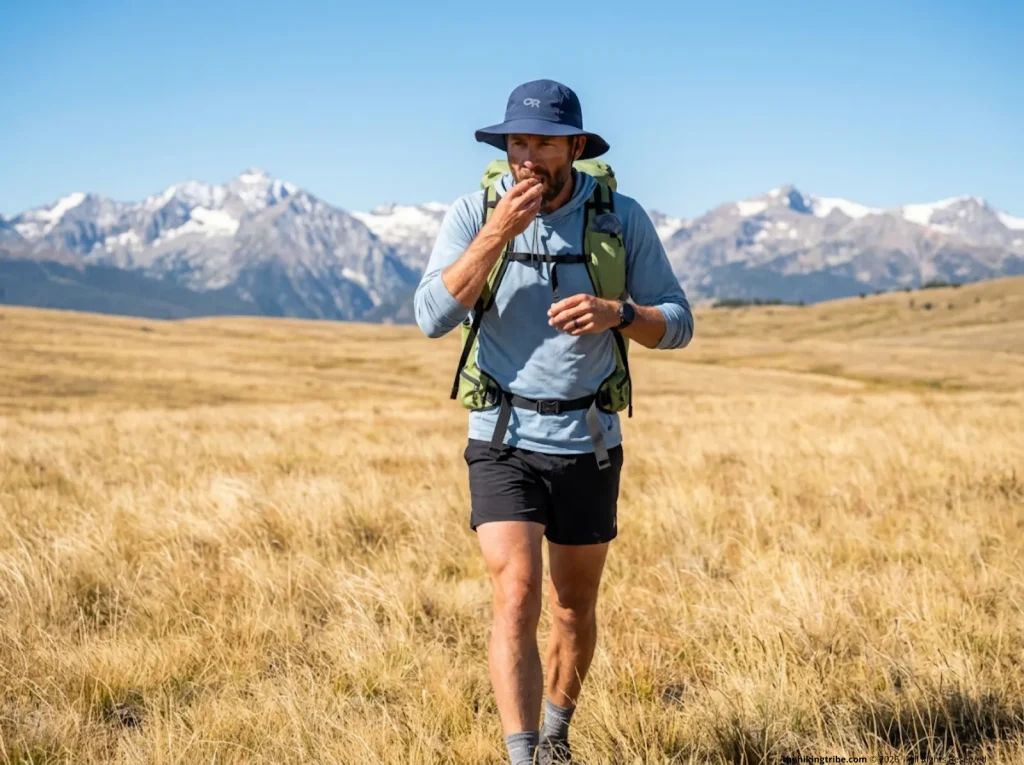
A fastpacker pushing aggressive numbers on the fastpacking pace matrix can easily burn between 5,000 and 8,000 calories over a 14-hour moving operational day. If you don’t resupply that furnace efficiently, you risk a severe physical crash.
Taking long breaks for heavy lunches redirects massive blood flow away from your working leg muscles and into your stomach. This results in a systemic energy crash shortly afterward. True backcountry endurance requires a continuous carbohydrate drip strategy instead of punctuated, large meals.
I once tried to fastpack 28 miles of the High Sierra strictly on candy and pure water. By noon, my legs felt like wet cement, and a headache from critical sodium loss nearly forced an evacuation. You need highly calculated fuel that respects severe weight limits.
Targeting the 125 Calorie-Per-Ounce Golden Ratio
To keep your gross pack weight down, your food must adhere to the 125-calorie-per-ounce density rule. Achieving this caloric density of 125 calories per ounce relies heavily on high-fat foods. Fats carry 9 calories per gram, compared to the 4 calories per gram found in proteins and simple carbs.
A backpack stuffed strictly with protein bars and heavy gels will quickly push past your base weight limits. Instead, pack bulk macadamia nuts, high-fat cured meats, and straight olive oil packets. When you ruthlessly calculate your energy density, you ensure that every ounce you carry serves a critical purpose to keep you moving.
The 80-100 Gram Carbohydrate Drip
Your body requires immediately accessible fuel to maintain a runner’s gait on steep, technical trails. You must ingest 80 to 100 grams of fast-acting carbs literally every hour you are moving.
Consistency beats large meals. Eating a massive 1,500-calorie lunch on the trail will bog you down and ruin your pace. Sip your water, munch your snacks, and climb.
Many athletes cut stove and fuel weight completely by implementing stoveless cold-soaking techniques. These no-cook food strategies keep you moving while naturally softening your heavy, dense foods in water while you hike.
Beating the 2% Dehydration Threshold
Dehydration is a dangerous gateway illness. A nominal 2% body mass loss due to sweat drastically degrades your endurance ceiling and your cognitive focus. Heat exhaustion spirals quickly when you cross this line.
If you look at the clinical data surrounding hydration status and endurance performance, it is obvious that replacing sweat with pure water causes a dangerous lack of salt in your body. Heavy sweaters must spike their water with 400 to 800mg of sodium per liter. Maintaining critical salt balance prevents the muscle cramping that ruins ultramarathons and backcountry speed records.
Strategic Risk Management & Safety Thresholds
Pursuing absolute minimalism strips away your comfort safety net. Fastpacking gear is fundamentally designed to keep you moving fast and light, not optimally warm while sitting around camp. There is a massive difference between moving efficiently and taking reckless risks that trigger search and rescue operations.
Packing unnecessary extra gear directly increases joint impact and physical fatigue. That extra weight paradoxically raises your injury risk rather than mitigating it. Clumsy feet under a heavy load snap ankles. But cutting too much weight leaves you exposed to genuine environmental hazards.
The “Shiver Bivy” Reality
Experienced athletes hunting for Fastest Known Times (FKTs) routinely pack sleeping setups that guarantee survival, not comfort. A shiver bivy means moving fast all day to generate heat, and then enduring a cold, marginally insulated night. This is the brutal reality of the minimalist philosophy.
Never compromise your dry barrier. You must store your down quilt in a reliable, waterproof stuff sack. Down acts as an incredible insulator, but if it gets soaked on a minimalist run, you have a medical emergency on your hands. This is where comfort UL diverges from pure speed chasing.
Avoiding Rucksack Palsy
Thin vest straps were never designed for prolonged heavy load bearing. If you load an ultralight vest down with 18 pounds of water and food for a long, dry stretch of trail, the straps will crush the nerve clusters in your shoulders, causing numbness in your arms.
If your route demands massive water-carries that routinely push your pack weight past that 15 to 18-pound mark, ditch the running vest. Use a lightweight pack with a real load-transferring hip belt, like those frequently reviewed by sites like SectionHiker or Adventure Alan. Protect your nerves over your ego.
Combating the “Pack Your Fears” Instinct
Beginners mistakenly pack three overlapping fleece layers or massive first aid kits “just in case.” The brutal fact is that carrying the extra three pounds of fear makes you tire faster, stumble more, and get hurt.
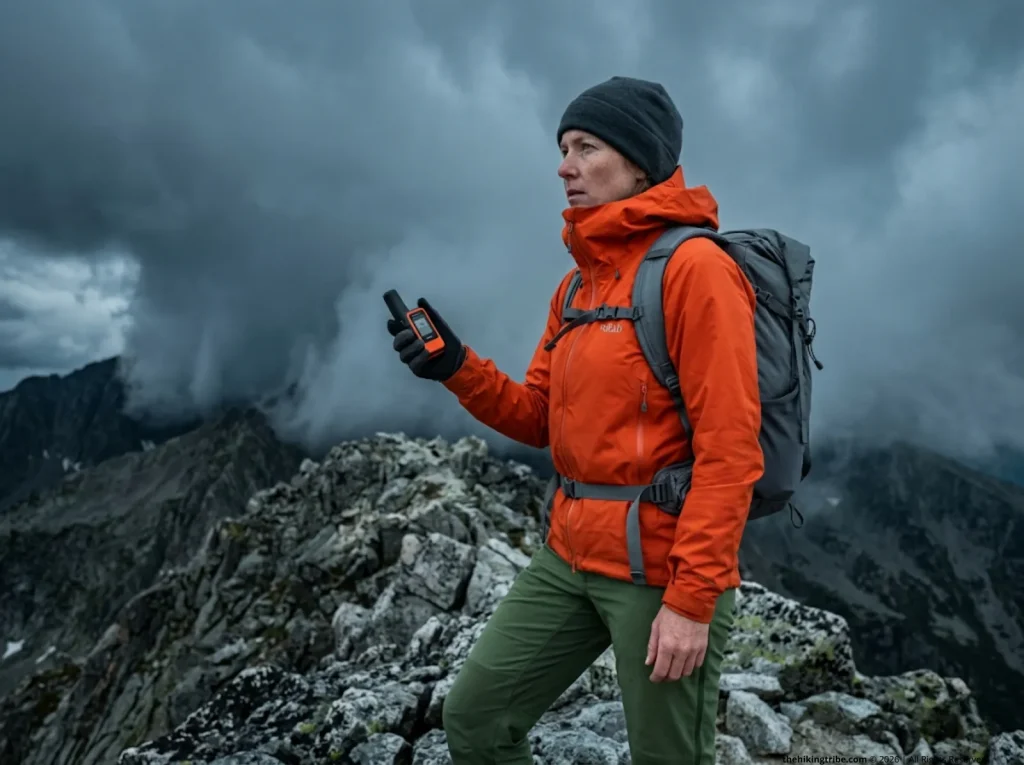
Pack what you absolutely need, relying on the hike smart safety protocols established by wilderness professionals. Because you are eliminating heavy camp extras, you must carry a lightweight satellite distress messenger like a Garmin inReach.
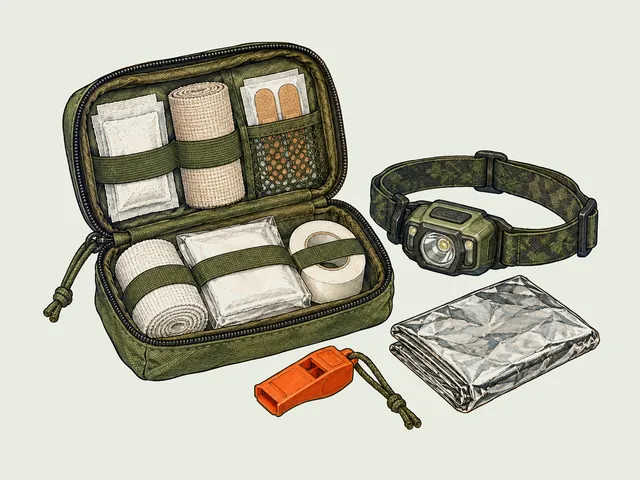
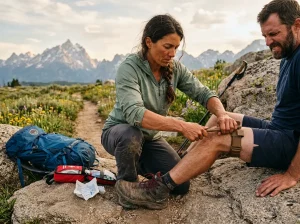
By adjusting your baseline wilderness first aid response to prioritize rapid evacuation over complex field care, you balance speed with genuine survival capability.
Conclusion
Transitioning to fastpacking means abandoning old assumptions about how we navigate wilderness terrain. By aggressively building a sub-10 pound kit, leveraging the chest-wrap balance of specialized harnessing, and feeding your body a continuous 125-calorie-per-ounce diet, you enable massive daily strides.
Pull together your lightweight packing list, calculate your exact vertical pace using the EEM matrix, and respect the biological limits of hydration and salt. The next time you hit the trailhead, you will view distance not as a barrier, but as a fast-moving opportunity.
FAQ
What is the exact difference between fastpacking and traditional backpacking?
Fastpacking merges the high-volume speed of trail running with the self-sufficient camping of ultralight backpacking. While traditional backpackers typically aim for 10 to 15 miles a day at a walking pace with a 25-pound load, fastpackers utilize specialized vest-harnesses and sub-10 pound kits to comfortably hike the ups, jog the flats, and run the downs, frequently covering 25 to 40 miles daily.
What size pack is ideal for a fastpacking trip?
The optimal fastpacking pack ranges strictly from 25 to 35 liters. A volume any larger than 35 liters tempts you to pack unnecessary items. This inevitably results in a total weight that exceeds the 15-pound mechanical limit required to maintain an efficient running gait.
How many miles a day do fastpackers actually do?
Competent weekend fastpackers typically cover 25 to 40 miles per day depending on the vertical grade adjustment. Elite endurance athletes hunting for Fastest Known Times (FKTs) can frequently push past 50 miles in a single 16-hour operational window without stopping.
What is a universally accepted fastpacking base weight?
An ideal fastpacking base weight (your kit minus food, water, and fuel) should sit firmly under 10 pounds (4.5 kg). Holding this tight threshold minimizes shoulder muscle fatigue and keeps the pack’s center of gravity completely stable during high-cadence descents.

I've spent more than a decade researching hiking gear and trail technique. I read the specs, the forum threads and the long-term reviews, and every pick here comes with what it gets wrong.
End of the trail
You read every mile of this one. Here's where the trail goes next.