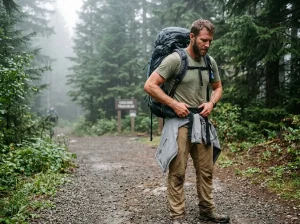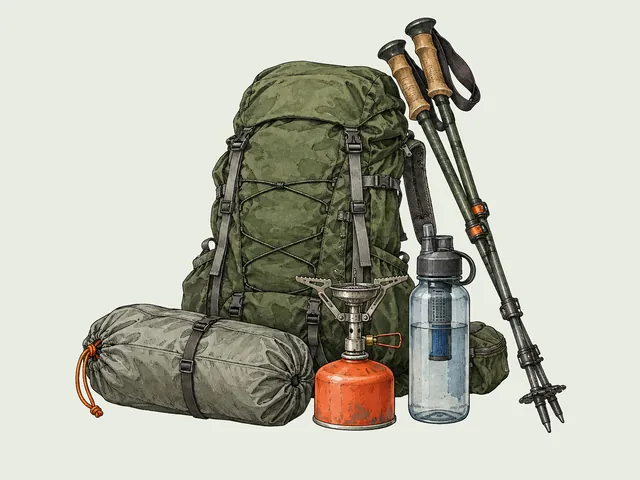










You stop for water two miles in, reach back to grab a snack off the side of your pack, and the sleeping pad you lashed on that morning is gone. No sound, no idea which switchback it bounced off at. Ask anyone who’s over-stuffed a pack: that gut-drop is how most hikers learn that knowing how to attach gear to the outside of your backpack is a real skill, not just cinching a strap and hoping. This guide walks every attachment point on your pack, the right hardware for each job, the one rule that keeps gear from disappearing, and the honest truth about what should never ride outside at all.
Start With Your Pack’s Attachment Points
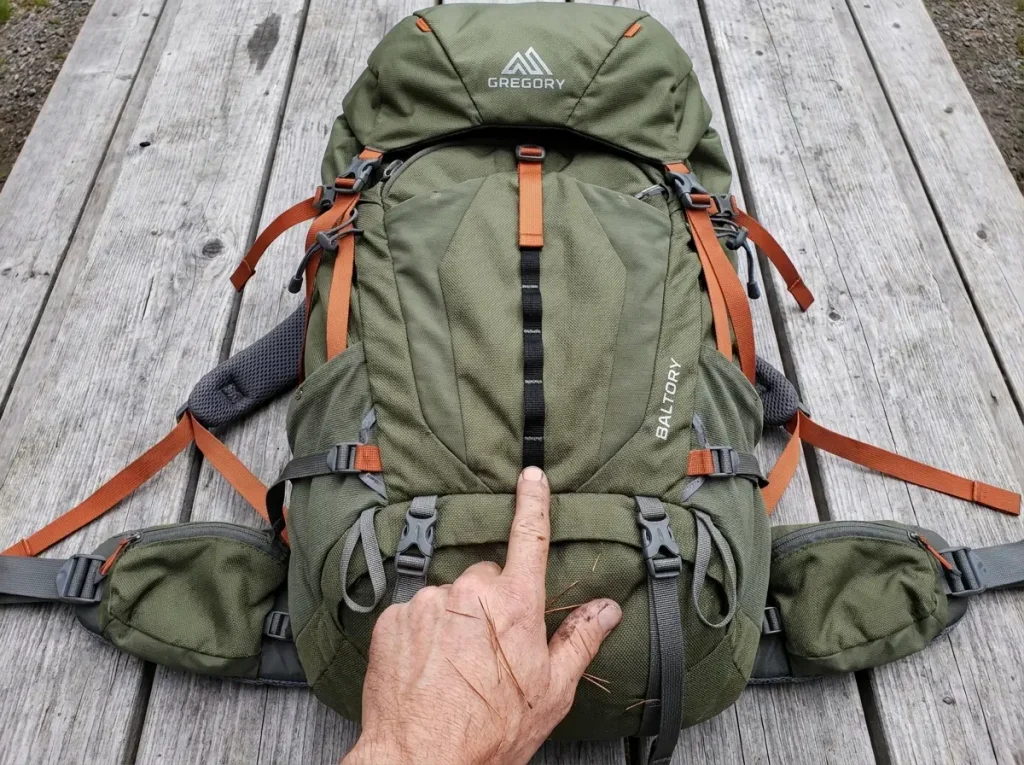
Before you buy a single accessory, learn to read the pack you already own. Most hikers ignore half the attachment points the maker built in, then bolt on gadgets they don’t need. Getting the load to ride right starts with the pack itself fitting your torso and your trip, which is the whole point of choosing the right pack for how you actually hike before you start hanging things off it.
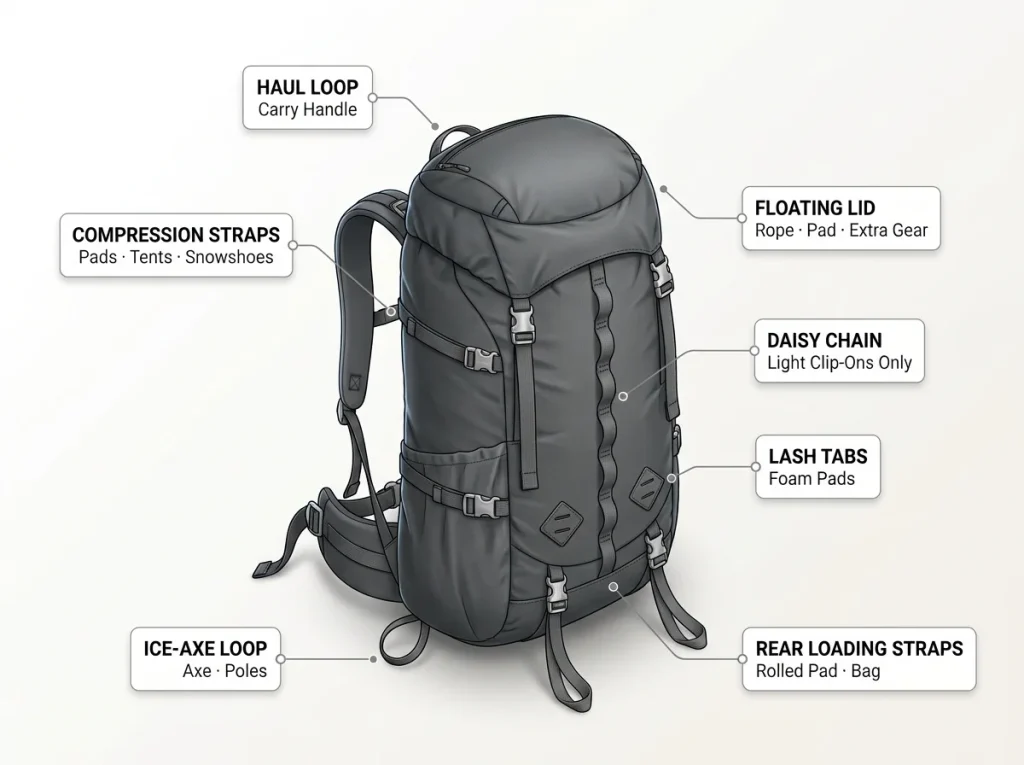
Walk your pack and name what’s there. Side compression straps squeeze the bag down and pin long items along the sides. A daisy chain or row of gear loops is that ladder of stitched webbing down the back, rated for a carabiner clip-on. Lash tabs, the little diamond patches some hikers call “pig noses,” take shock cord. Down low you’ll often find rear loading straps built for a rolled pad, a compression-sacked sleeping bag, or a tent. Up top sit the ice-axe loop, the haul loop, and the floating lid.
Each point has a job, and using it for the wrong thing is where gear works loose. A daisy chain loop is for a hard clip, not a stretchy tether threaded through it. A lash tab spreads a light load across two patches, not a heavy hang off one. The floating top lid is the quiet workhorse: it swallows a rope coil or a foam pad and rides high, where the weight helps your balance instead of dragging at your lower back. If your pack has a removable top pocket, the choice between a floating brain lid versus a roll-top changes how much you can stow up there.
Seeing where everything sits on a loaded pack is easier in motion than on paper. This REI walkthrough shows where the external points fall once the bag is full.
Compression Straps the Workhorse
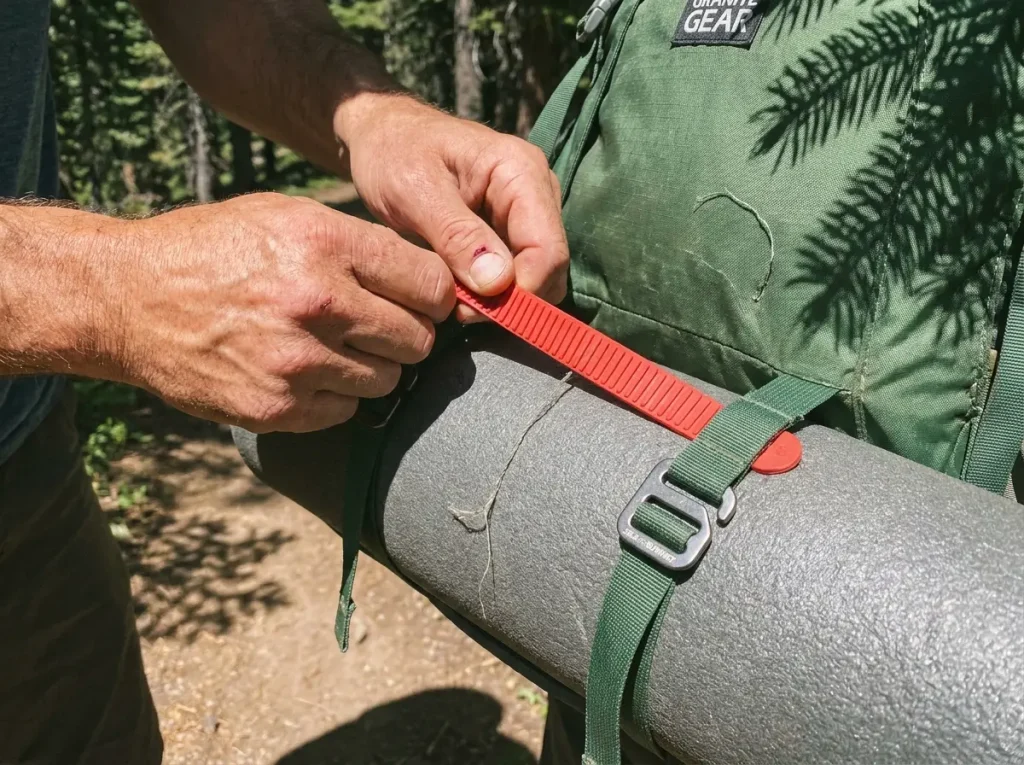
Compression straps are the most useful and most underused system on the pack. Learn to cinch them right and you’ve solved most of external carry. They’re built to squeeze the bag smaller, but they double as the best way to lash anything long and bulky flat against the load.
Use at least two straps per item, never one. A rolled foam pad or a tent bag sits horizontally under the side straps; taller loads ride vertically along the back panel where they stay close to your spine. Cinch in stages and come back to it, because a strap that feels tight when you’re standing cold slacks off after a mile of stride vibration shaking the buckle. That re-tension habit is half the battle.
Here’s where honest hardware beats brand loyalty. Fighting your pack’s built-in webbing is a losing game on a cold morning, and a cheap rubber strap often wins. The budget-friendly Voile Nano Straps are a grippy rubber loop with a stainless buckle and nothing to rattle loose, and plenty of hikers reach for them before the factory straps. For anything past a couple of pounds, a purpose-built no-stretch strap earns its keep. The Sea to Summit Accessory Strap with Hook Release uses UV-stable poly webbing rated around 220 pounds, which is the opposite of a bungee: it holds the load instead of bouncing it.
Carry two spare rubber straps even if your pack has plenty of webbing. They cost almost nothing, weigh nothing, and the day a factory buckle cracks at the trailhead you’ll be glad the fix is already in your lid.
The most common mistake here isn’t bad strapping, it’s strapping too much in the first place. A pack draped in gear usually means the bag is too small or the kit too heavy. If you’re constantly lashing the overflow on, it’s worth a look at whether you should size the pack to the trip instead of carrying the spillover on the outside.
Daisy Chains and Carabiner Clip-Ons
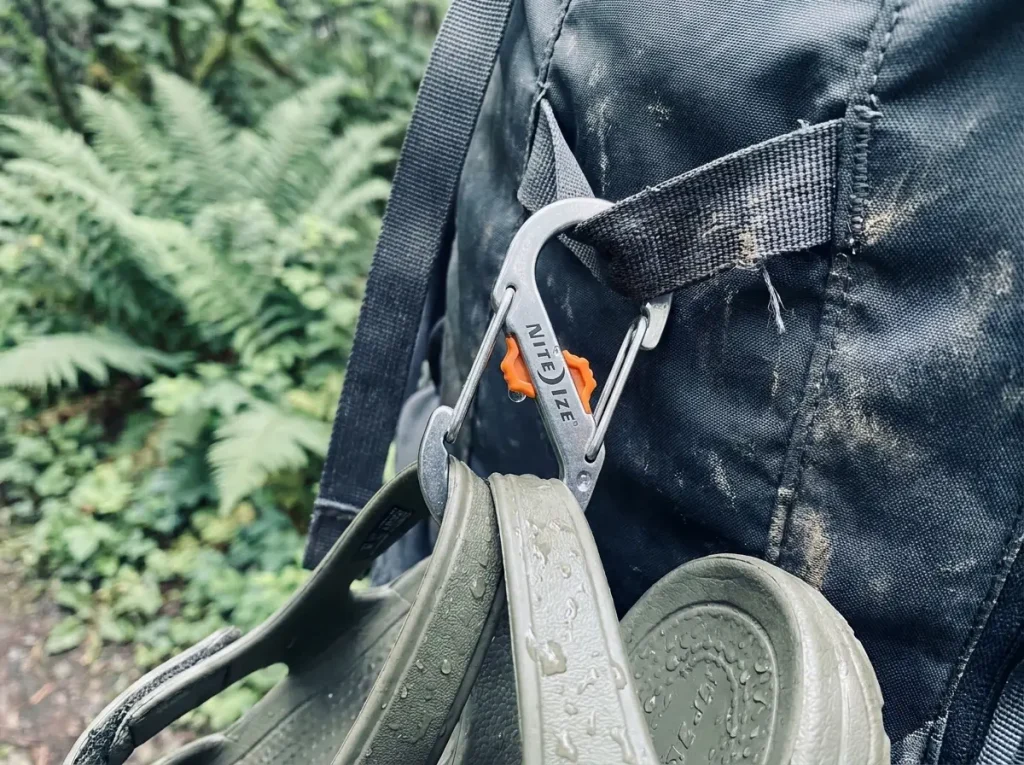
That ladder of loops down the back of your pack tempts people to clip everything to it. The daisy chain is for hard carabiner clip-ons of light, quick-access gear, and that’s the limit. Think a helmet, a pair of wet camp sandals, or a stuff sack you want to grab without opening the pack.
The carabiner matters more than people think. A wire-gate keychain biner pops open the first time it catches a branch, and now your gear is on the trail behind you. Use a real locking gate. The budget-friendly Nite Ize S-Biner SlideLock comes in a three-pack of sizes with honest load ratings stamped right on them, a number 2 at 10 pounds, a number 3 at 25, a number 4 at 75. Match the size to the load: the small one for a hat, the big one for a packed layer.
Keep clip-ons high and close to your back. Gear that dangles low and away from the pack swings into your stride and throws off your rhythm on uneven ground. The other rule is the one nobody wants to hear: don’t thread a bungee cord through a daisy chain loop and call it secured. You haven’t built an anchor, you’ve built a pendulum. For the little odds you reach for constantly, you’re better off keeping them in a hip-belt pocket than clipped out where they bounce.
Lash Tabs and Shock Cord for Foam Pads
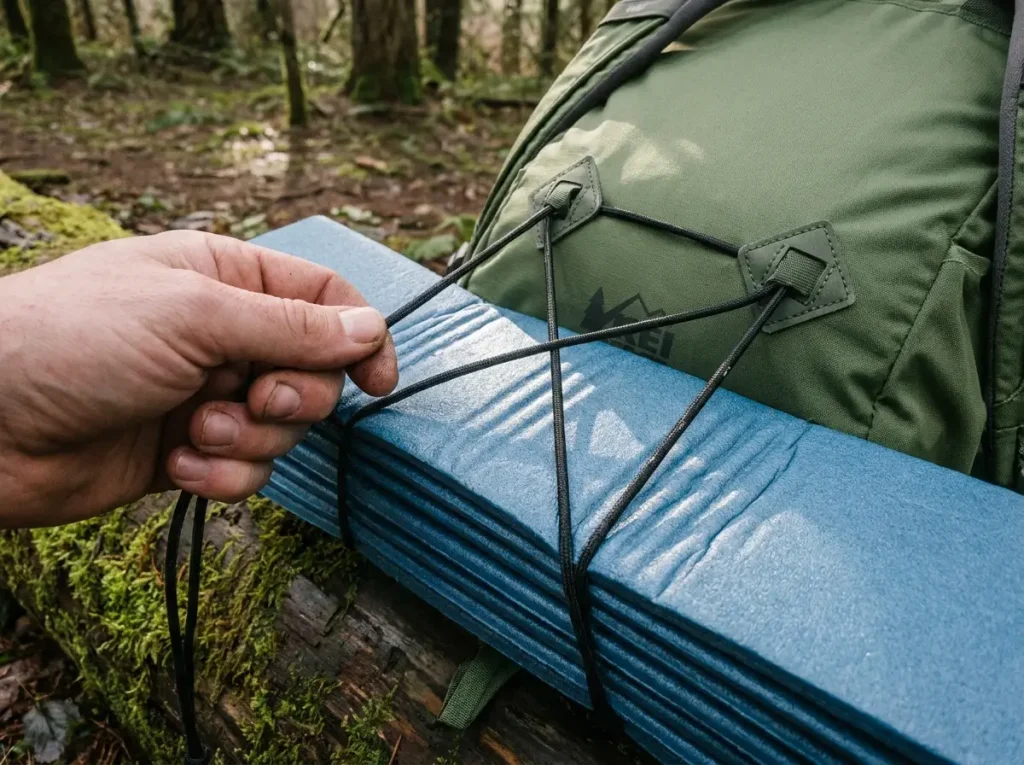
Those little diamond patches confuse everyone. They look like decoration, but lash tabs are a precise tool for one job: holding a closed-cell foam pad flat against the pack. The trick is in how you thread them, and almost no guide shows it.
Don’t run a single loop of cord through one tab. One tab is a point load, and over enough trail miles it tears out. Instead, weave the cord in a cross pattern through two tabs per end, so the tension spreads across both patches and pulls the pad flush. Use the right material too. The budget-friendly Paracord Planet 1/8″ Shock Cord is sized for exactly this, and it holds a foam pad tight without ballooning off the back panel.
One honest caveat on shock cord: this is the one place elastic belongs, tensioning a light, indestructible item that can’t hurt anyone if it shifts a little. It is never for load-bearing. A foam pad is the rare big item that genuinely belongs outside, because it’s near-weightless and you can’t really damage it. An inflatable air pad is the opposite. Lash one outside and the first branch or sharp rock punctures it, and now you’re sleeping on the ground. The air pad always rides inside the pack.
Ice Axe and Trekking Poles Done Right
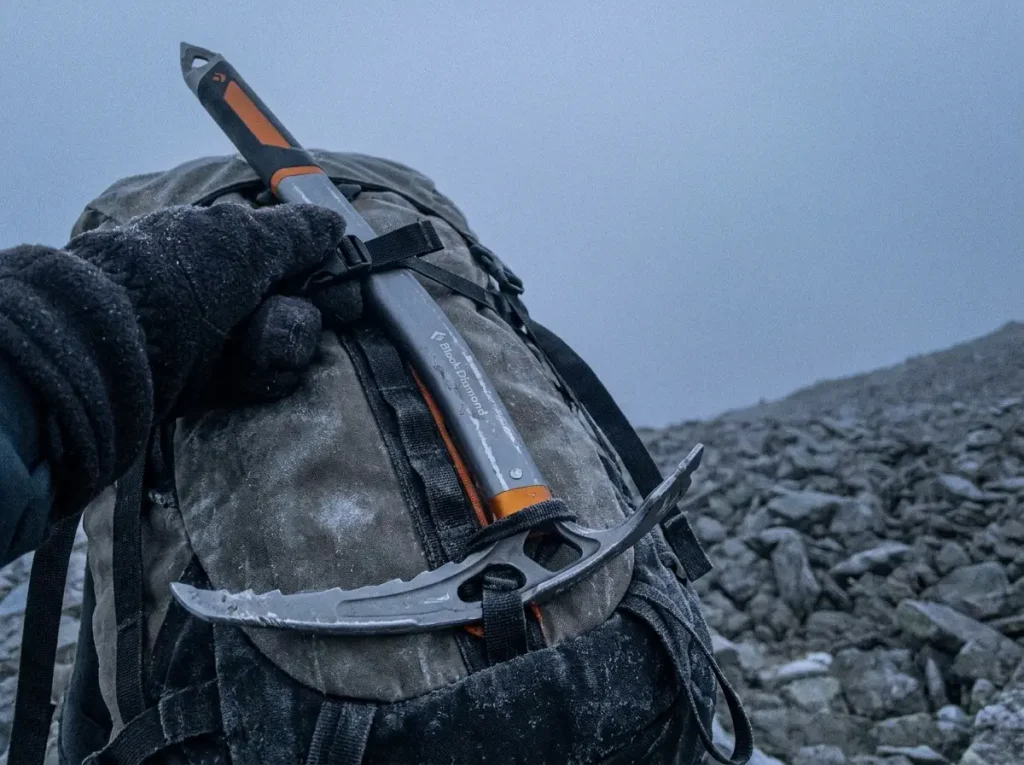
Every pack has the loop, and almost no guide shows the technique that actually keeps an ice axe or a trekking pole from working free and swinging into the back of your head. The loop alone is a pivot, not a hold. The second securing point is what does the real work.
For an ice axe, thread the head through the lower loop and cinch it down so the basket or the adze sits against the webbing as a stopper. Then pivot the axe so the spike points up, away from your neck, and catch the upper shaft under a second compression strap or bungee tab. Two points, tip up, snug. Trekking poles follow the same logic: tips up and capped, baskets seated in the loop, shafts caught at a second upper point so they can’t rattle sideways. This is the moment the poles come off your hands and onto the pack, usually on a steep scramble where you want both hands free.
Do a buckle-and-knot check at the trailhead, then again after the first mile. That first mile of stride vibration is when everything that’s going to loosen, loosens. Catch it early and it’s a ten-second fix, not a lost axe.
Winter gear follows the same rule with one addition: bag or cap the sharp edges. Snowshoes and crampons get secured at two points like everything else, but their teeth will slice the pack fabric, your hands, or a hiker behind you on a narrow trail if they ride bare.
The Three-Anchor Rule and What Never to Use
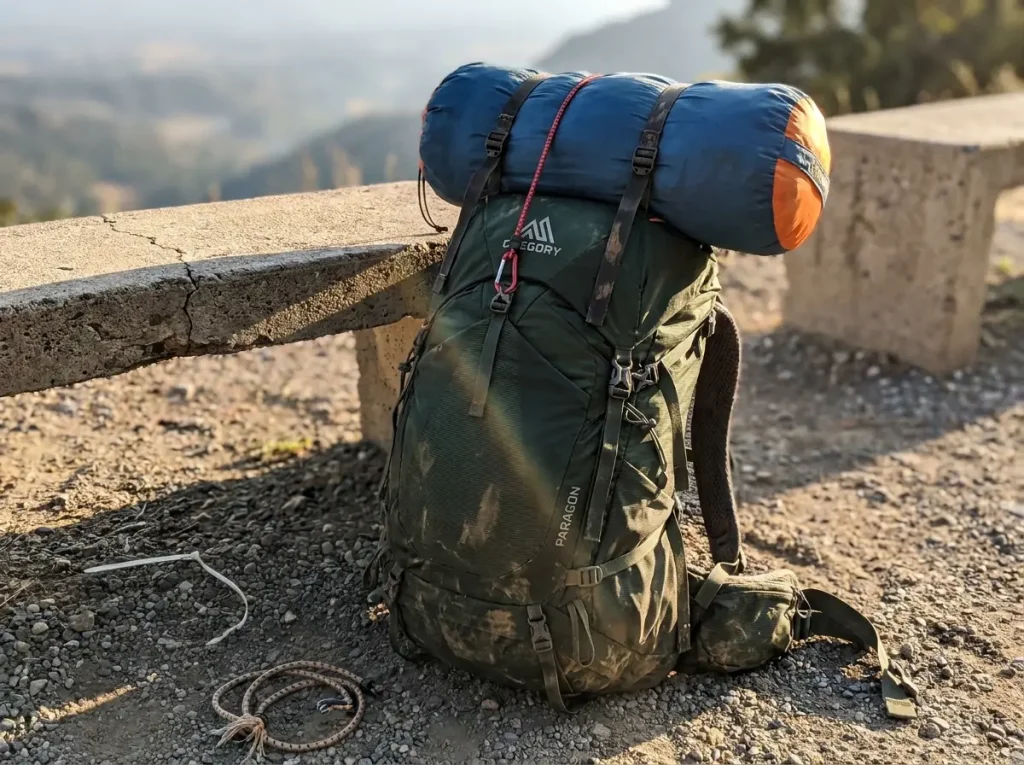
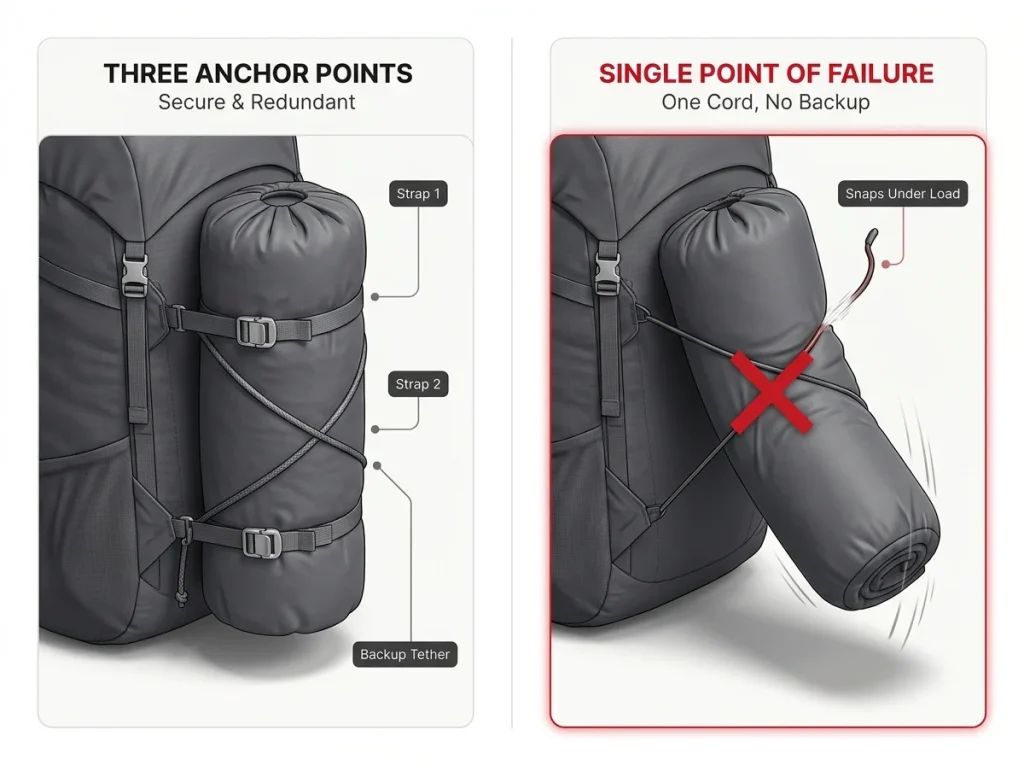
This is the section that actually keeps your gear on the pack. Everything above is method; this is the habit and the two materials you never trust with a load. The rule is simple: a minimum of three independent anchor points for any externally lashed item. Two straps plus one backup tether through a daisy chain, so no single buckle failure drops your gear. That redundancy is the whole reason a tent stays put when one strap quietly gives. Manufacturers spell out what each strap and loop is built to do, and almost none of them are rated to be the only thing holding a load.
Now the two materials to ban from load-bearing duty. Zip ties first. A standard zip tie loses more than 30 percent of its rated strength after about 600 hours of UV exposure, and it cracks at the edges as it goes. It looks fine right up until it snaps mid-stride. Treat any zip tie as single-trip at best, and never as the thing holding real weight.
Bungee cords are the sneakier failure. Elastic stores and releases shock load instead of damping it, so anything past about two pounds turns into a slow-motion pendulum that works itself loose over miles. The “give” that feels secure when you tug it is exactly the failure mode. If it stretches, it doesn’t hold.
There’s an honest truth under all of this. As Backpacker magazine puts it, if you’re regularly lashing this much gear outside, you probably need a bigger pack or less gear. The fix often isn’t better straps, it’s a shakedown of the kit so less ends up on the outside at all. While you’re at it, pulling the heaviest weight in tight to your back does more for comfort than any strap trick, which is the same balance logic behind dialing in your load lifter straps.
Balance, Waterproofing and What to Keep Inside
Even perfectly anchored gear can wreck a hike if it’s hung wrong or soaks through. Balance comes first, and weight distribution is the whole game. The heaviest externally-carried items ride closest to your spine and balanced left against right, because weight carried away from your back levers you off balance and a lopsided load wrenches one shoulder all day. A tent goes across the top of the pack, not dangling off the bottom, so the weight settles onto your hips instead of pulling at your lower back.
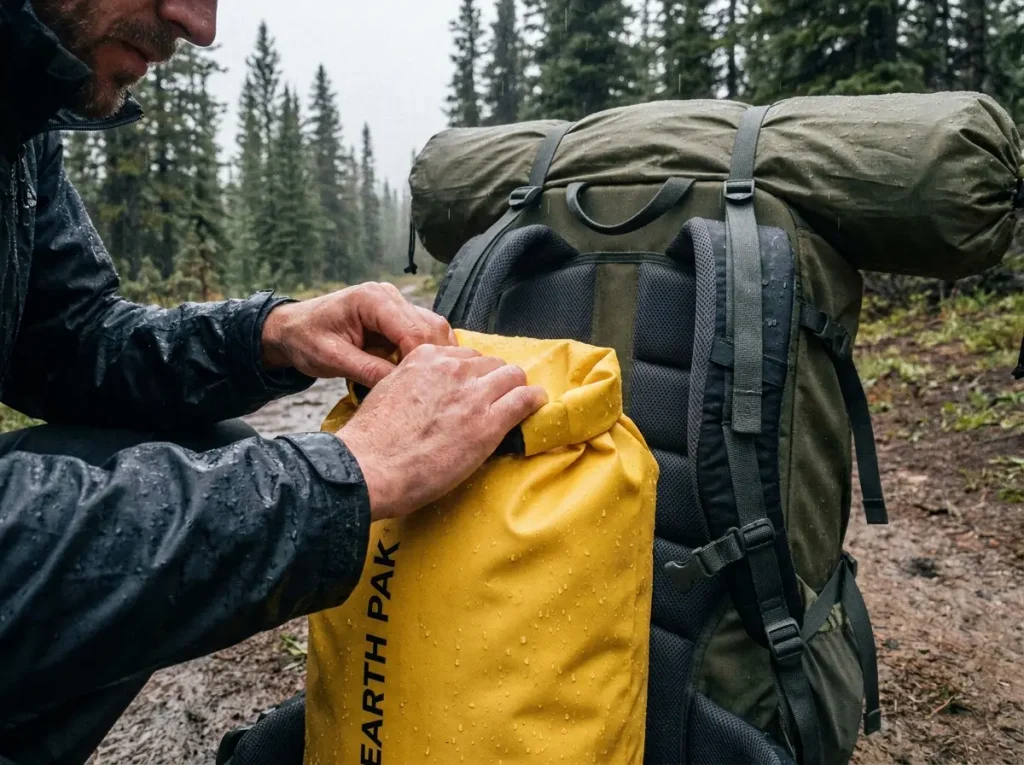
Then keep it dry. Stuff external gear into a dry bag before you lash it, because rain runs straight off a roll-top while a pack cover leaves your strapped-on gear exposed. The Earth Pak Waterproof Dry Bag seals with a roll-top closure and sheds weather without fuss. On a budget, a one-dollar trash-compactor bag does nearly the same job, which is the same thinking behind choosing a pack liner over a rain cover for the gear inside.
Wet layers want to be clipped outside so they don’t soak the pack, but they snag worse than anything. Stuff them down the inside edges of the pack against the wet wall instead, or seal them in their own bag. A puffy lost to a branch is an expensive mistake.
That leaves the honest short list of what belongs outside: a closed-cell foam pad, the tent, poles or an axe, and a few quick-access odds clipped high. REI’s own guidance lands in the same place, noting that external gear snags branches and scrapes rock, so the less you carry outside, the better. For more on full rain protection beyond a single dry bag, it’s worth building a layered waterproofing system for the pack. Everything else wants to be in the bag.
The Bottom Line
Three habits keep your gear riding where you put it. Give every external item three independent anchors, or it doesn’t go outside. Use real hardware, straps and locking carabiners, and keep zip ties and bungees off anything load-bearing. Pull the heavy weight tight to your spine, dry-bag what can soak, and let the air pad ride inside where it can’t puncture.
Before your next trip, lash your foam pad on, walk a hard mile, and re-check every buckle and knot. That one walk tells you more than any packing diagram, and it’s the difference between gear that stays put and the reach-back moment where it’s just gone.
Frequently Asked Questions
01Can I attach a tent to the outside of my backpack?
Yes. Strap the tent across the top of the pack under the lid or top compression straps, not dangling off the bottom, so the weight settles on your hips. Use at least two straps plus a backup tether, and slide it into a dry bag first.
02What materials work best for securing items to a backpack?
Purpose-built nylon or poly webbing straps with cam or hook buckles, rubber utility straps, and locking carabiners. Avoid zip ties and bungee cords for anything load-bearing, since both fail under sun exposure and shock load.
03Which items should I never attach to the outside of my pack?
Inflatable air pads, which puncture, anything heavy enough to swing, and loose wet layers that snag. Keep those inside. Reserve the outside for a closed-cell foam pad, tent, and poles or an ice axe.
04How do I keep externally attached gear dry in the rain?
Pack it in a dry bag or stuff sack before you lash it on. A roll-top sheds rain better than a pack cover, which leaves strapped-on gear exposed. A trash-compactor bag works on a budget.
05How do I keep externally attached gear from getting damaged on the trail?
Carry less outside, keep it tight to your back so it can’t swing into rock or branches, and cap or bag sharp edges like an axe, crampons, or pole tips. The fewer items lashed on, the less there is to snag.

I've spent more than a decade researching hiking gear and trail technique. I read the specs, the forum threads and the long-term reviews, and every pick here comes with what it gets wrong.
End of the trail
You read every mile of this one. Here's where the trail goes next.