
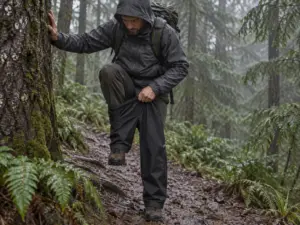
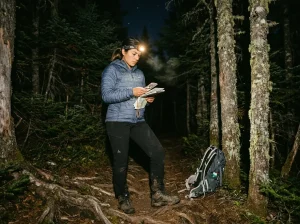
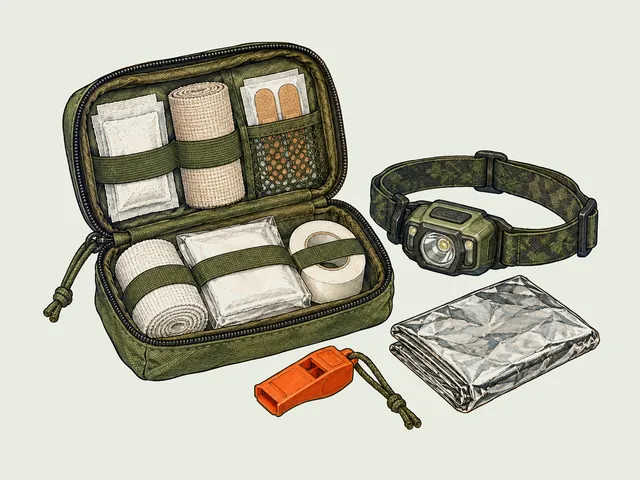

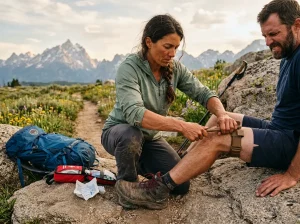
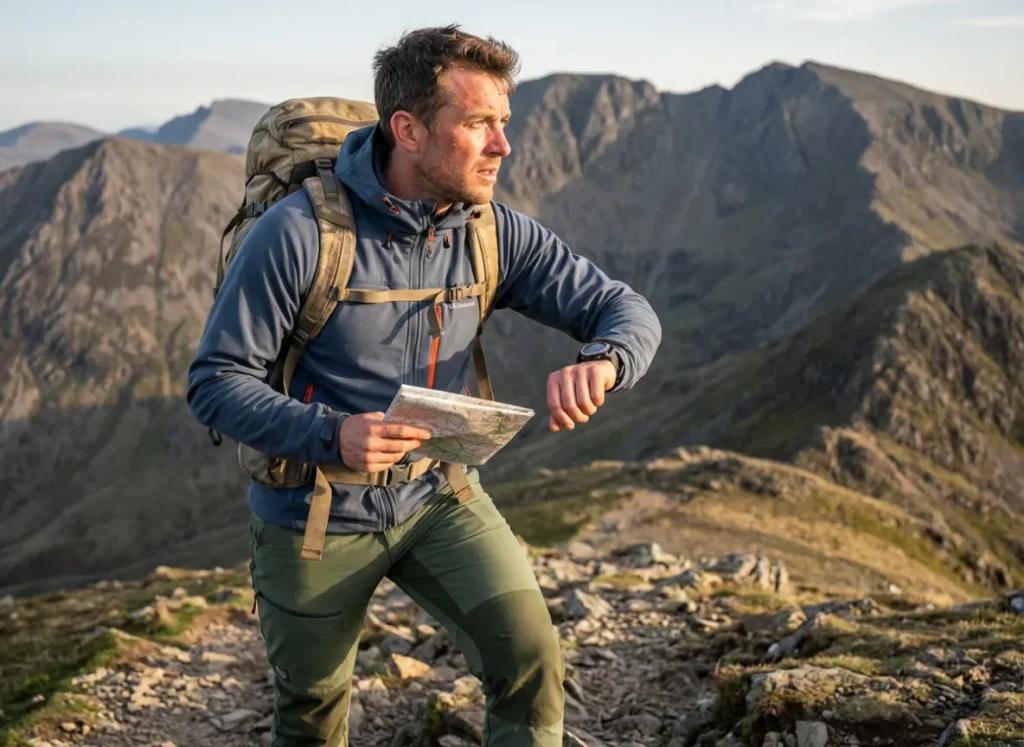
The mountain doesn’t care about your dinner plans. I learned this the hard way two decades ago on a ridge in the Cascades. The sun dropped behind the peaks, the temperature plummeted twenty degrees in an hour, and what was supposed to be a casual descent turned into a shivering, headlamp-less crawl.
That night, the difference between a comfortable hike and a rescue situation came down to the math of hiking I did—or didn’t do—at the kitchen table.
Precision in the planning phase is not just about logistics; it is the primary architecture of your survival. When you step into the wilderness, an “estimate” is a liability. You need hard data regarding trail distance and elevation.
In this guide, we are going to strip away the guesswork. We will move past the basic rules of thumb and look at how trail surface technicality, pack weight, and biomechanics alter the clock. You will learn to audit your own hiking pace, calculate “field reality,” and manage safety logistics like an expedition leader.
What is the Foundation of Hiking Time Estimation? (The Physics)
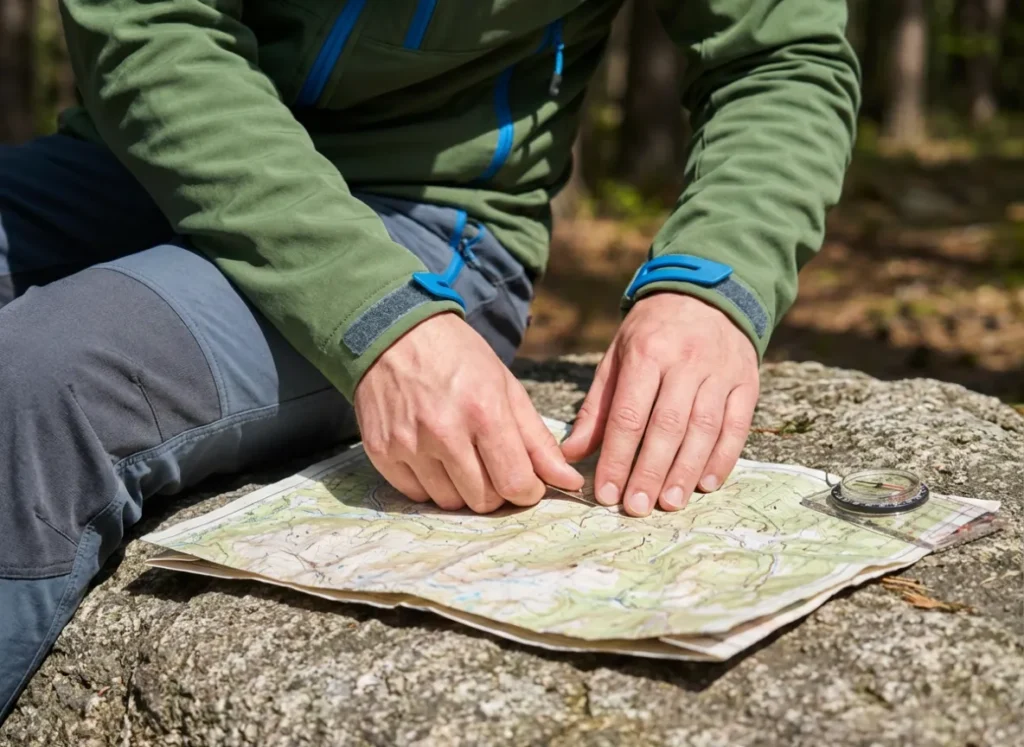
Naismith’s Rule is a calculation developed in 1892 that estimates hiking time by allowing one hour for every 3 miles (5km) of forward distance, plus an additional hour for every 2,000 feet (600m) of ascent.
How does Naismith’s Rule actually work?
William W. Naismith, a Scottish mountaineer, formulated this rule after observing “men in fair condition” traversing the Highlands. It provides the skeletal structure for almost all modern route planning. The classic formula is simple: calculate your horizontal distance time (3 mph or 5 km/h) and add your vertical penalty.
For a field calculation, I teach my students a metric shortcut: 12 minutes per kilometer horizontal + 1 minute per 10 meters vertical.
However, there is a catch. Naismith’s Rule assumes a linear relationship between effort and distance. It suggests that walking on a flat hike is always the same, regardless of what is under your boots. To understand the true cost of elevation gain, we look at Scarf’s Equivalence (the 8:1 Ratio).
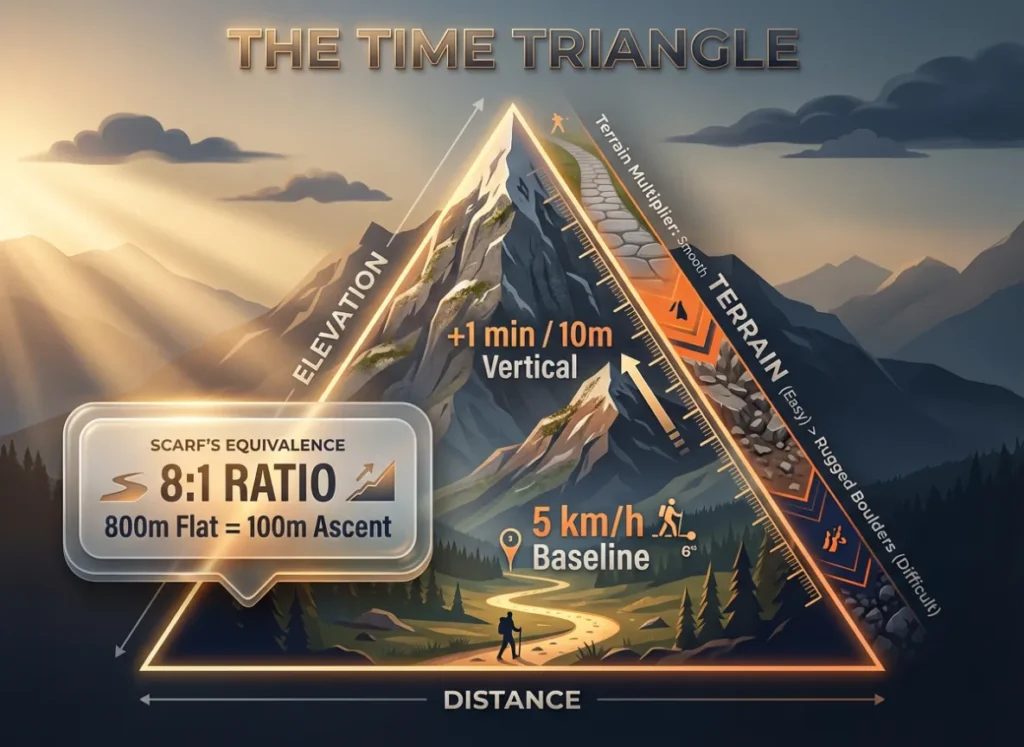
Scarf posits that 800 meters of flat walking requires the same energy as 100 meters of elevation gain. This concept helps us calculate the “Flat Equivalent Distance” (FED) to visualize total effort.
Pro-Tip: Treat Naismith’s Rule as a “best-case scenario.” It represents a fit hiker on a hard, distinct track with a light day pack. If you are carrying overnight gear, this rule will lie to you.
While Naismith provides the skeleton of the schedule, the physical effort required to maintain that schedule depends heavily on mastering sustainable pacing strategies. Without proper energy management, the math falls apart at the first steep grade.
Modern geographical fieldwork studies on Naismith’s Rule confirm its utility as a baseline. Yet, they highlight that for the average recreational hiker, the standard time base speed is often too optimistic.
How Do Terrain and Gravity Alter the Equation? (The Corrections)
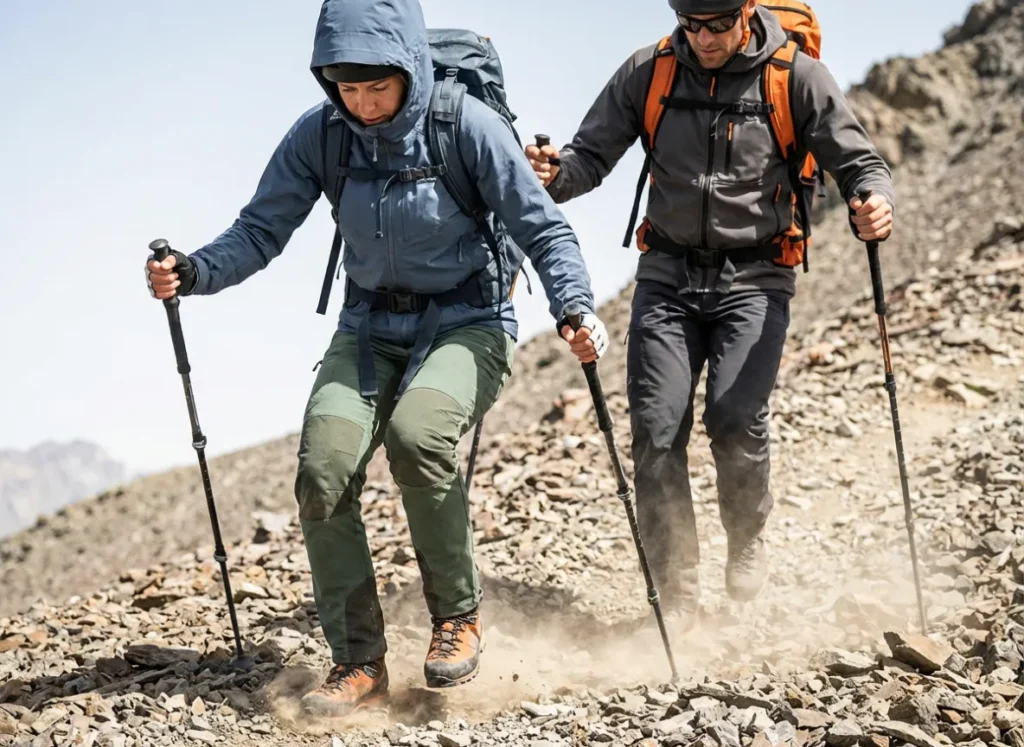
Standard hiking formulas fail on rough ground because surface drag and gravity alter your metabolic output; specific corrections (Aitken and Langmuir) must be applied to account for friction and slope angle.
Why doesn’t standard speed apply to rough ground?
If Naismith is the skeleton, the terrain is the muscle required to move it. In 1977, R. Aitken introduced a correction for surface friction. He argued that on “off-path” or rough surfaces, the base speed must be reduced from 5km/h to 4km/h. This shifts your min/mile pace from 12 minutes per kilometer to 15 minutes per kilometer.
This might seem minor, but it is a case of “Accumulation of Error.” A 3-minute difference per kilometer adds up to a full hour of delay over a 20km day.
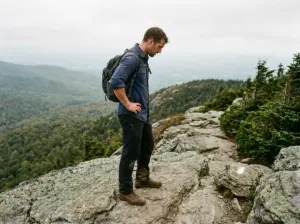
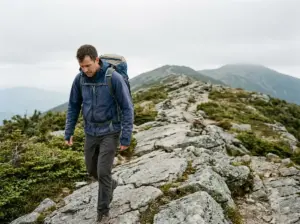
We see this clearly when comparing local trails. A mile in Shenandoah National Park is not the same as a mile in the White Mountains of New Hampshire. The latter is defined by granite slabs and roots.
Trail ruggedness—mud, scree, and tussocks—requires stabilizing muscle activation that doesn’t propel you forward; it just keeps you upright. This is why navigating Class 2 and 3 scrambling terrain creates such a massive discrepancy between map mileage and time taken.
The Tobler Hiking Function further explores this by calculating exponential decay on slopes. Research into terrain coefficients for predicting energy costs shows that walking through sand or soft snow can mathematically triple the metabolic demand compared to a hard-packed hiking trail.
How does steepness impact descent speed?
There is a dangerous myth that you make up time on the way down. This is only true on gentle slopes. Eric Langmuir’s corrections introduce the concept of the “Assist Zone” and the “Braking Zone.”
On slopes between 5° and 12°, gravity aids momentum. Here, you can subtract 10 minutes for every 300 meters of descent. However, once the slope exceeds 12°, gravity becomes an adversary. You enter the “Braking Zone.”
In this zone, your quadriceps must actively brake to prevent you from falling. This is eccentric loading, and it is physiologically expensive. On technical descents—steep steps, loose scree like you might find on the Walker’s Haute Route or Alta Via 1—you must add 10 minutes per 300 meters. This makes the descent slower than walking on flat ground.
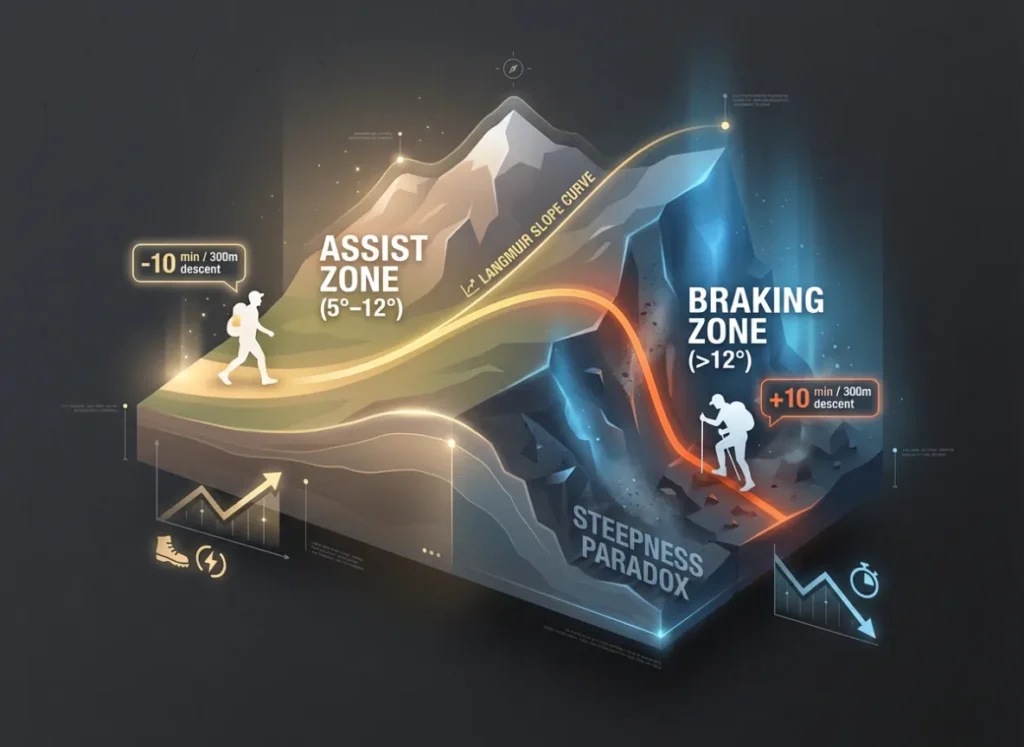
Ignoring this “Steepness Paradox” is a leading cause of after-dark rescues. Hikers often assume the return trip will be fast, only to get stuck picking their way down a cliff band in the twilight.
Pro-Tip: If the topographic lines on your map are touching, do not apply a descent bonus. Apply a penalty.
To manage the intense physical strain of these braking forces, using trekking poles for downhill stability becomes essential. They transfer the load from your legs to your arms, allowing you to maintain speed without blowing out your knees.
Military reports on the metabolic cost of walking with loads confirm that eccentric braking on steep slopes significantly increases fatigue factor, validating the need for Langmuir’s caution.
How Do Fitness and Load Change the Calculation? (The Biology)
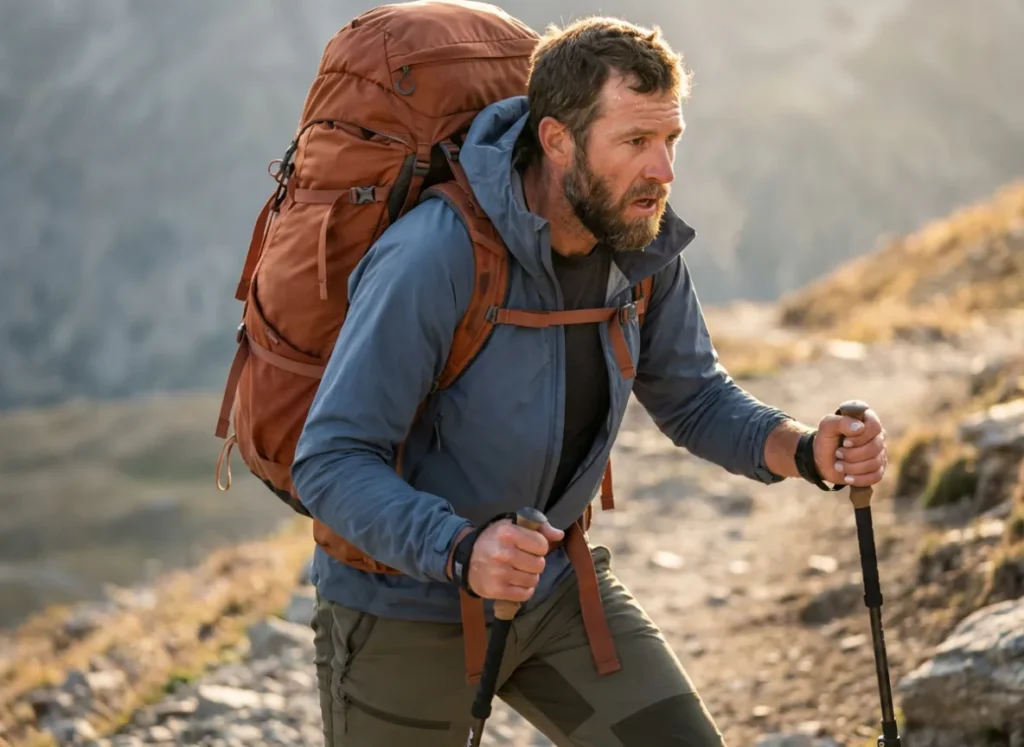
Your personal hiking time is determined by your “Hiker Type” multiplier, which is derived from the Pandolf and Tranter models that account for pack weight fatigue and aerobic capacity.
How do heavy packs and fatigue distort time?
The Pandolf Equation is the definitive model for load carriage. It reveals a “Squared Ratio” effect: the energy cost of hiking does not rise linearly with pack weight—it rises quadratically. Carrying a backpack that is 30% of your body weight is exponentially harder than carrying one that is 15%.
This leads to what I call the “Death Spiral,” modeled by Tranter’s Corrections. Tranter’s matrix adjusts time based on hike duration and fitness. It shows that unfit beginner hikers, or those carrying too much weight, see their speed degrade exponentially after 6 to 8 hours due to glycogen depletion.
If you are carrying more than 20% of your body weight, you must shift your Munter Rate (a unit of effort commonly used in the Swiss Method). For example, you might drop from 4 units/hour to 3 units/hour. This reality forces a strategic re-evaluation: applying ultralight backpacking principles isn’t just about comfort; it’s about buying yourself time and speed.
Environmental factors compound this effect. Studies on the observation of heat strain and hiking performance indicate that heat stress and altitudes above 3000m further reduce VO2 max efficiency, necessitating even more conservative time estimates.
How can you determine your personal “Hiker Type”?
You cannot rely on a guidebook written by someone else. Whether you are climbing the Mist Trail on Half Dome or tackling the NH 48, you need your own algorithm. I use the “Backyard Fitness Test” Protocol to find this number.
The Protocol:
- The Setup: Find a local hill or stairwell with roughly 300 meters (1000ft) of gain.
- The Load: Wear the pack weight you intend to carry on your trip.
- The Execution: Ascend at a sustainable, conversational pace (Zone 2 heart rate).
Once you reach the top, check your time. Compare it to Tranter’s Categories. If you took 20 minutes, you match the Naismith Standard (1.0x). If you took 30 minutes, you are an “Average” hiker with a 1.5x multiplier.
From this day forward, you apply that 1.5x Naismith multiplier to every guidebook estimate you read. If the book time says 4 hours, you plan for 6. This moves you from theoretical planning to “Real Time.”
Government research into the metabolic costs of weighted vests validates this capacity benchmarking; knowing your specific cost of transport is the only way to be accurate. Once you have your baseline, you can start implementing a hiking-specific training system to lower that multiplier before your next major expedition.
What is the Turn-Around Time (TAT) Protocol? (The Safety)
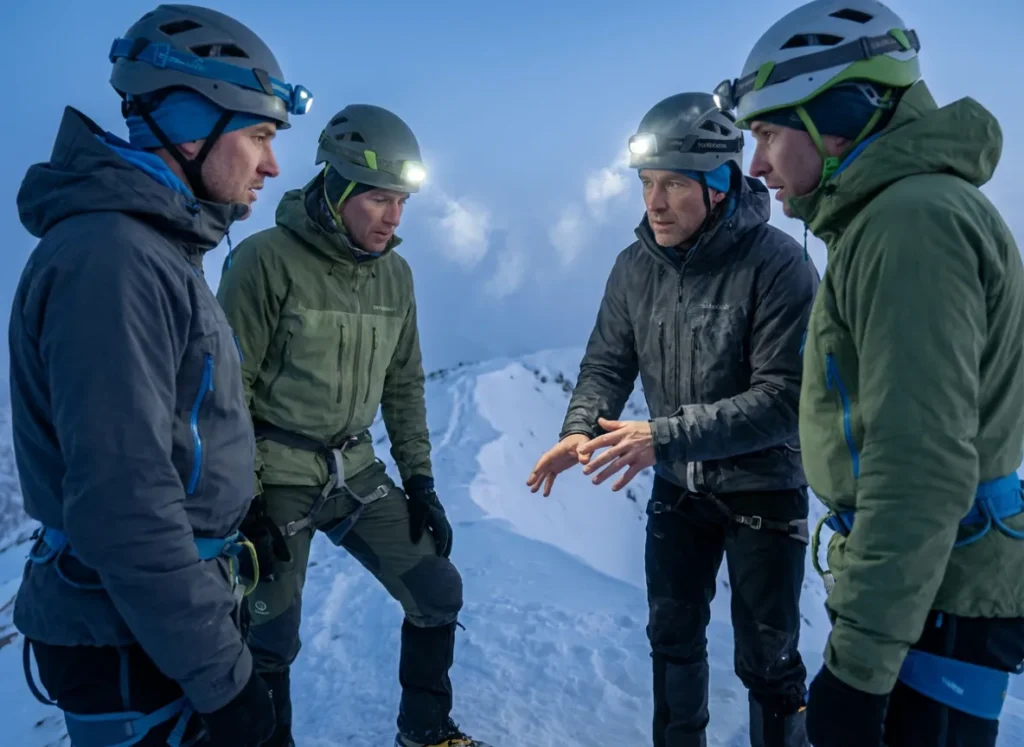
Turn-Around Time (TAT) is a non-negotiable, pre-calculated time of day when you must cease forward progress and begin your return to ensure a safe arrival before dark.
How do you calculate a safe Turn-Around Time?
Mountaineering legend Ed Viesturs lives by a simple code: “Getting to the top is optional. Getting down is mandatory.” The Turn-Around Time (TAT) is the operationalization of that code.
We use the “Daylight Budget” method. Do not calculate forward from the trailhead; calculate backward from sunset.
- Determine Sunset (e.g., 8:00 PM) based on available daylight hours.
- Subtract a Safety Buffer (1 hour). Hard stop is 7:00 PM.
- Subtract estimated return travel time.
If you have 10 hours of usable light and the hike is an out-and-back, your TAT is usually Start Time + 5 hours. However, this must be asymmetric. If the descent is technical (slower) or you are fatigued, you might need 60% of your daylight for the return.

The psychology here is critical. The decision to turn around must be made before you leave your house. If you wait until you are 300 feet from the summit to decide, “Summit Fever” and the Sunk Cost Fallacy will cloud your judgment. You will push on, and you will get caught in the dark.
Ed Viesturs on risk management highlights that the most dangerous cognitive bias is believing that being “close” justifies ignoring the clock.
Even with a rigid TAT, things can go wrong. Group size can slow you down—always apply the slowest hiker rule. That is why managing wilderness emergencies is the final layer of preparation—knowing what to do when the timeline breaks.
Which Digital Tools Best Estimate Hiking Time? (The Application)
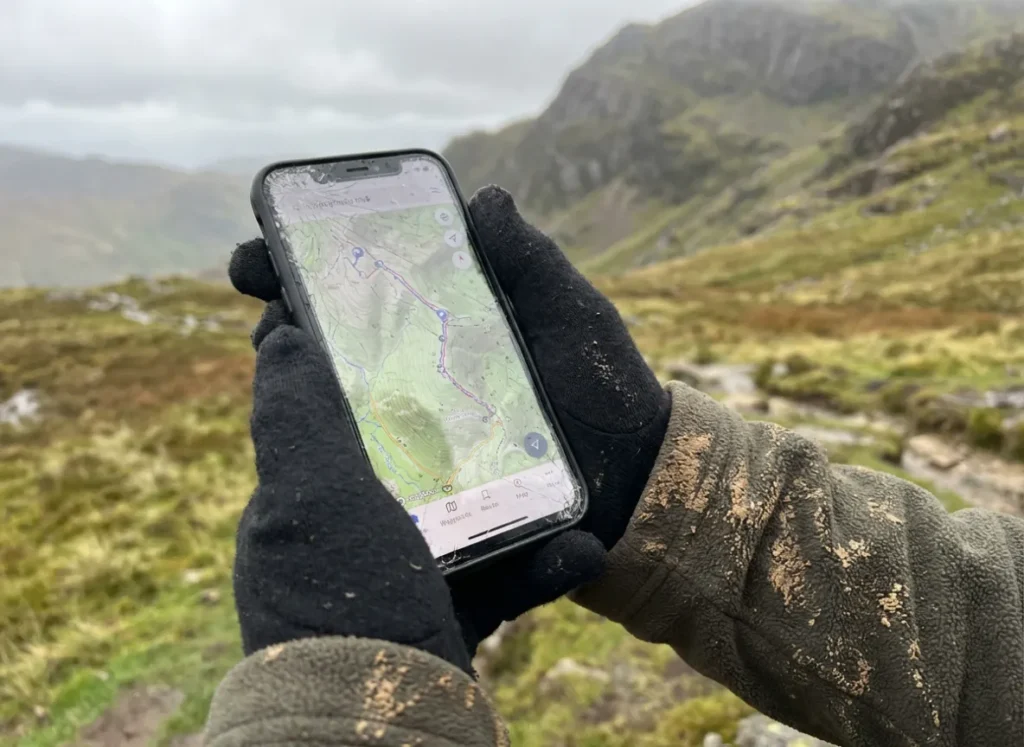
Digital navigation apps use varying algorithms to estimate time; CalTopo offers the most professional granular control, while AllTrails and Gaia GPS rely more on user averages and dynamic pacing.
How do AllTrails, Gaia GPS, and CalTopo compare?
In the modern era, we often outsource our math to our phones. But you need to know what the “Black Box” is doing.
AllTrails relies heavily on crowd-sourced data. It displays “Moving Time,” which filters out pauses for lunch, photos, or tying shoelaces. This often results in estimates that are 20-40% too fast for casual groups. If AllTrails says 4 hours, that is 4 hours of pure motion, not a 4-hour day out.
Gaia GPS offers a feature called “Pace Tracking.” It updates your ETA in real-time based on your current speed. This is a form of dynamic re-calculation that is useful in the field, but less helpful for planning at home since it doesn’t know your fitness level yet.
CalTopo remains the professional standard. It explicitly integrates the Munter Method and uses National Land Cover Database (NLCD) terrain data to adjust for vegetation and slope. It allows you to input your specific speed profiles.
In the Northeast, TrailsNH is another valuable resource that aggregates trip reports to give you a TrailsNH estimate based on recent conditions, effectively crowdsourcing trail difficulty ratings.
Adjusting distance using vertical factors in GIS is complex science. My recommendation? Use CalTopo on your desktop for the planning phase to get the math right, and use Gaia GPS for execution in the field.
Regardless of the software or interactive calculator, never trust an app estimate without cross-referencing your personal Naismith multiplier. When choosing the best hiking apps of 2025, prioritize those that allow you to customize the pace settings to match your “Backyard Fitness Test” results.
The Takeaway
The wilderness is an honest environment. It does not grade on a curve.
- Naismith’s Rule (1 hour per 3 miles + 1 hour per 2000 ft ascent) gives you a baseline, but it assumes a level of fitness and terrain quality that rarely exists in the wild.
- Rough terrain (Aitken) and steep descents (Langmuir) act as friction coefficients that can easily double your travel time.
- The “Backyard Fitness Test” is the only reliable way to calibrate guidebook estimates to your actual physiology.
- Turn-Around Time (TAT) is a safety deadline calculated backward from sunset, designed to save you from your own ambition.
Before your next expedition, take the “Backyard Fitness Test.” Calculate your personal multiplier. When you stand at the trailhead, you won’t just be hoping to make it back before dark—you’ll know exactly when you will.
Share your “Real Time” vs. “Book Time” results in the comments below. Let’s help each other benchmark our pace.
FAQ – Frequently Asked Questions
Does Naismith’s Rule include breaks?
No, Naismith’s Rule calculates pure moving time. You must add a Rest Budget to the final estimate based on your break frequency. A standard practice is to add 10 minutes for every hour of hiking, plus a longer break for lunch.
Why does my GPS app say the hike will be shorter than I calculated?
Most apps display Moving Time based on user averages, filtering out rest stops, photo breaks, and gear adjustments. For planning purposes, always look for Total Time or apply your own personal buffer (usually +20%) to the app’s prediction.
How does pack weight affect hiking speed?
Energy cost increases with the square of the load ratio. Carrying 30% of your body weight is significantly harder than carrying 15%. Generally, you should reduce your estimated time by 1 Munter Unit (approx. 25%) for heavy backpacking loads compared to day-hiking loads.
At what slope angle does walking downhill become slower?
According to Langmuir, descent speed slows down once the slope exceeds 12 degrees. Beyond this point, the need to brake with your legs increases fatigue factor and reduces pace, requiring you to add time rather than subtract it.
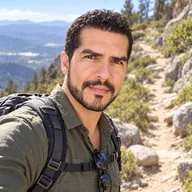
I've spent more than a decade researching hiking gear and trail technique. I read the specs, the forum threads and the long-term reviews, and every pick here comes with what it gets wrong.
End of the trail
You read every mile of this one. Here's where the trail goes next.