In this article
Most guys buy a men’s hiking backpack the way they buy a TV: bigger number, better deal. That instinct is exactly how you end up limping out of a weekend trip with thirty-eight pounds of stuff you never touched. Ask anyone who’s logged real trail time and the same truth comes up every time, the pack that fits your torso beats the pack with the best spec sheet. This guide ranks the men’s packs actually worth your money by trip type, then shows you how to size one to your frame so it carries the load where it belongs.
What Makes a Backpack a “Men’s” Pack
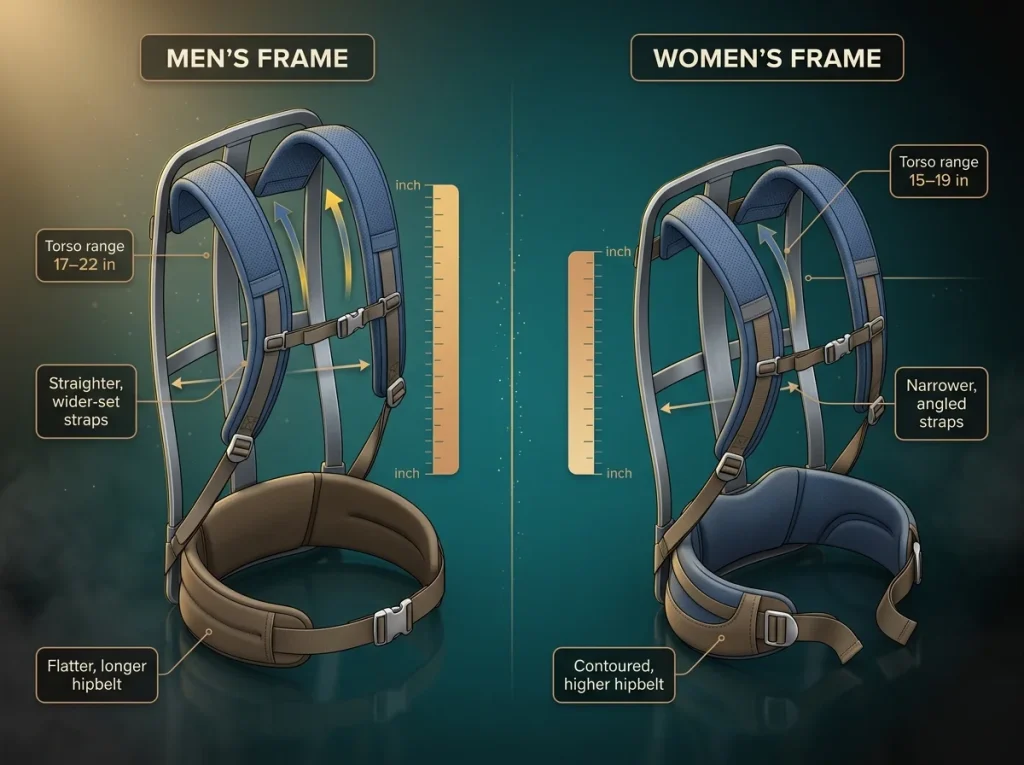
Here’s where most buyers go wrong before they ever reach a checkout: they think “men’s” is a color and a size run. It isn’t. A men’s frame is an engineering spec built around a longer torso length, straighter and wider-set shoulder straps, and a flatter, longer hipbelt. Those three things decide whether a loaded pack rides like part of you or like a sack hanging off your shoulders.
Women’s frames solve a different shape. They run shorter in the torso, the straps sit narrower and angle in more at the neck to clear a different collarbone, and the hipbelt is contoured for a higher waistline and wider hips. The reason is geometry, not marketing. A pack is supposed to sit with the hipbelt wrapping the top of your hip bones, and people are not built to one template.
Buy the Fit, Not the Label
This is the part nobody at the shop says out loud: a guy with a short torso, under about 17 inches, is often fit better by a women’s or a unisex adjustable frame. The label on the pack does not care what it says when the hipbelt lands two inches too low. If you’re a shorter or narrower-framed man, the women’s-specific frames built around a shorter torso and higher waist are worth trying before you force a men’s Small that still doesn’t sit right.
Most adults measure somewhere between 15 and 22 inches in the torso, with the majority landing 15 to 19. That range is exactly why “men’s” and “women’s” exist as separate frames instead of separate stickers.
When the Frame Geometry Actually Matters
The taller you load a pack and the more weight you put in it, the more the frame geometry shows up. At a light overnight load most frames feel fine for the first mile. Push past 30 pounds, or hike past hour three, and a frame that doesn’t match your back starts grinding at the same two spots: the front of your shoulders and the small of your back. That’s the moment you learn whether you bought fit or bought a sticker.
What Size Pack You Actually Need by Trip Length
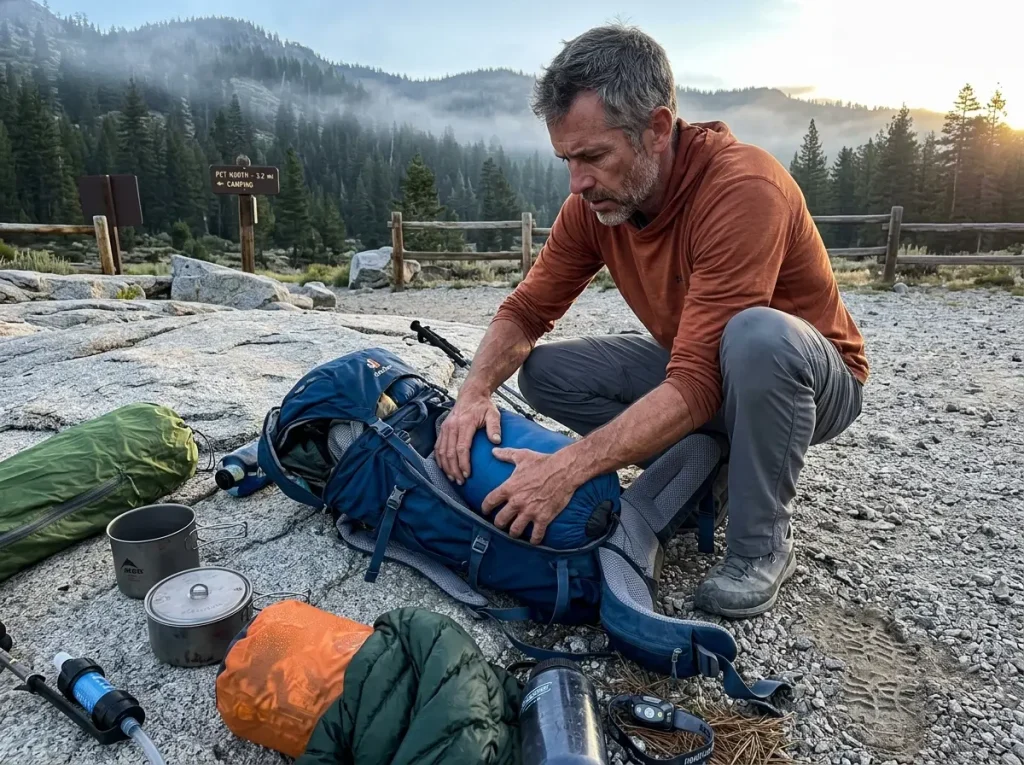
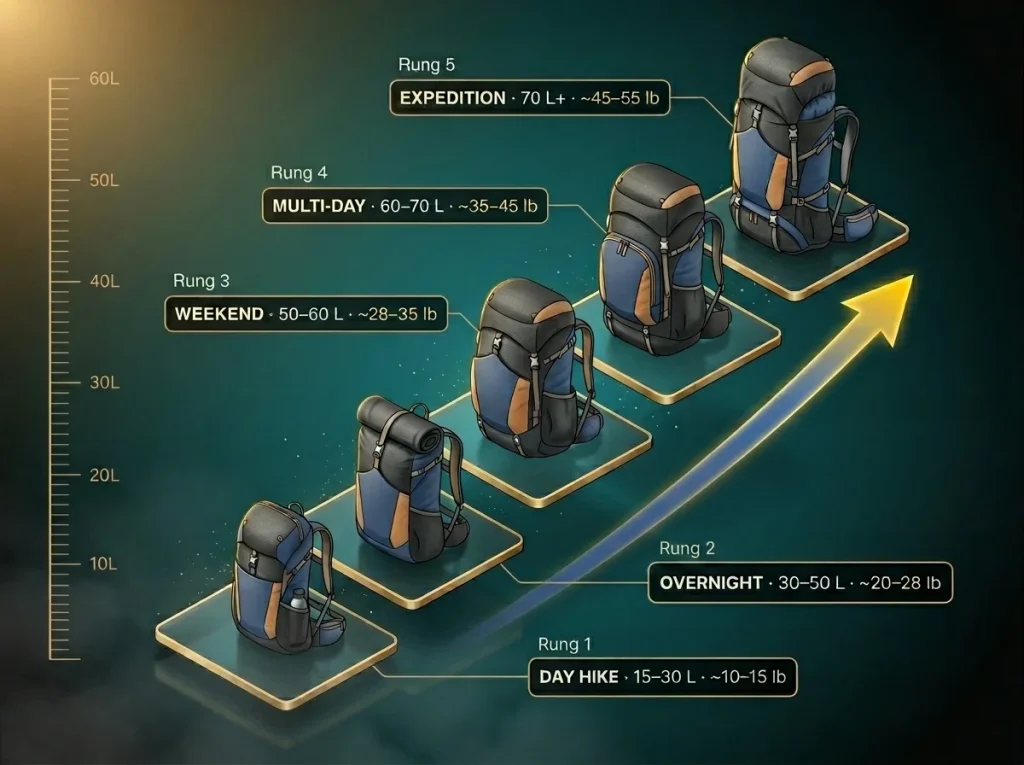
The single most common buying mistake is grabbing more liters “to be safe.” A bigger pack does not save you. It just gets overpacked to fill the space, because the space is there. Match your capacity to how many nights you sleep out, not to how big the pack looks on the wall.
Size to Your Trip, Not Your Fear
The working numbers are simple. Day hikes need 15 to 30 liters. Overnight and weekend trips run 30 to 50 liters. A multi-day trip of three to five nights fits in 50 to 60 liters. Only an extended trip of six-plus nights, or a winter load with bulky insulation, genuinely needs 60 to 70 liters or more. A weekend almost never needs more than 50.
There’s a story that comes up constantly in hiking forums: the guy who bought a 70-liter pack so he’d never run out of room, filled every liter because he could, and carried 38 pounds of gear he never touched on a two-night trip. The bigger pack was its own trap. If you want to understand how the same kit fits an overnight versus a full weekend load, that’s the real lesson hiding inside the liter number.
When you’re stuck between two sizes, buy the smaller one. A pack with less room forces you to pack lighter, and lighter is the upgrade that actually changes how a trip feels. Veterans track their base weight, the pack plus gear minus food, water, and fuel, precisely because the smaller number is the goal.
Day Pack or Backpacking Pack
The honest dividing line sits around the overnight. If you’re out for a day and carrying water, snacks, a layer, and the ten essentials, a daypack does everything you need and weighs nothing on your back. The moment you add a sleeping bag, a shelter, and a stove, you cross into real backpacking-pack territory, where a frame and a load-bearing hipbelt stop being optional. If you’re genuinely unsure where a daypack stops being enough and a real backpacking pack starts, size to the longest trip you’ll actually do twice a year, not the one you do once.
How to Size a Pack to Your Torso and Fit-Test It at Home
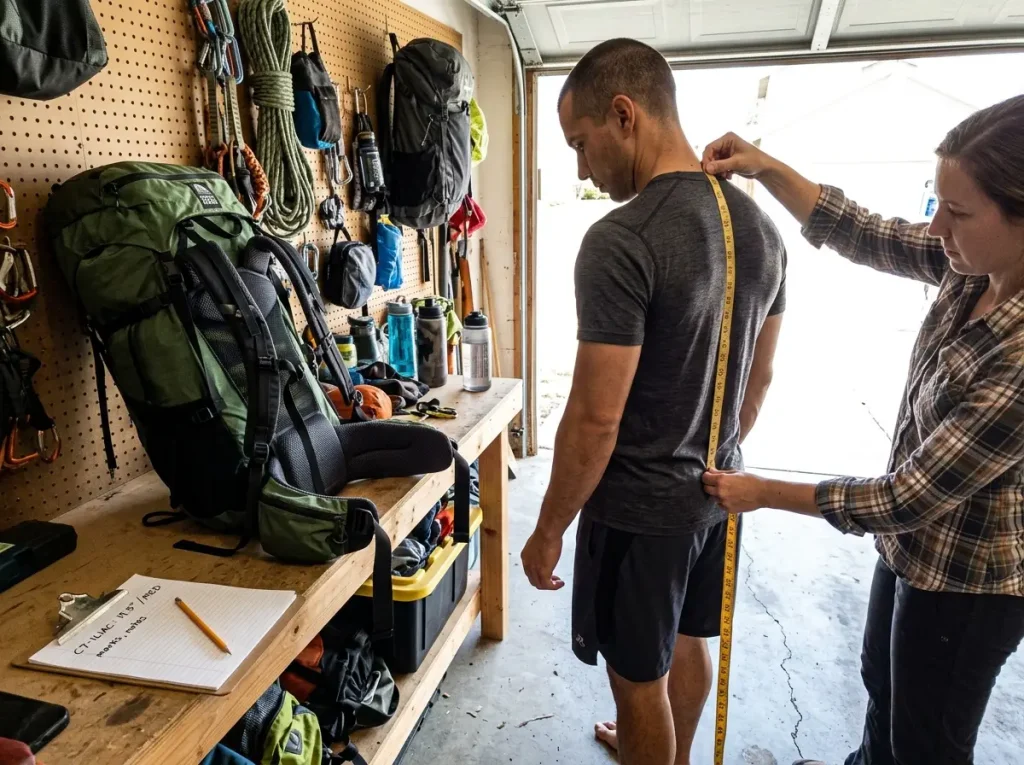
An empty pack fits everyone. A loaded one tells the truth. Before you trust any size chart, understand that torso length, not your height, is what decides your frame size. A tall guy can have a short torso, and a shorter guy can have a long one. The tape measure settles it.
Measure Your Torso, Not Your Height
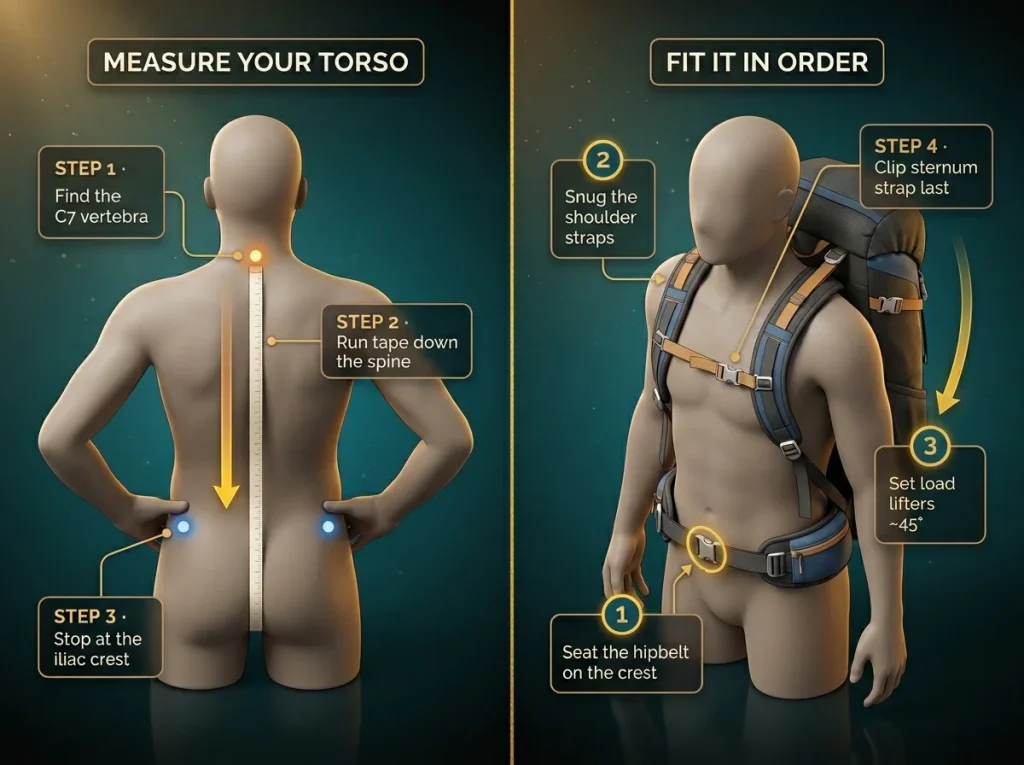
To find your number, tilt your head forward and feel for the bony bump at the base of your neck, the C7 vertebra. Then run a soft tape straight down your spine to the iliac crest, the top of your hip bones, which you find by putting your hands on your hips with thumbs pointing back. That measurement, not your shoe size or your jacket size, maps to Small, Medium, or Large on every brand’s chart. The full walk-through for measuring your torso length from the C7 vertebra down to the iliac crest is worth doing once and writing down.
One rule saves a lot of pain: if you land exactly on a size border, like 15, 17, 19, or 21 inches, size up. A pack that’s one size short jams the hipbelt below your crest, and that’s the start of every “it hurts no matter what” story on the trail.
The At-Home Fit Test
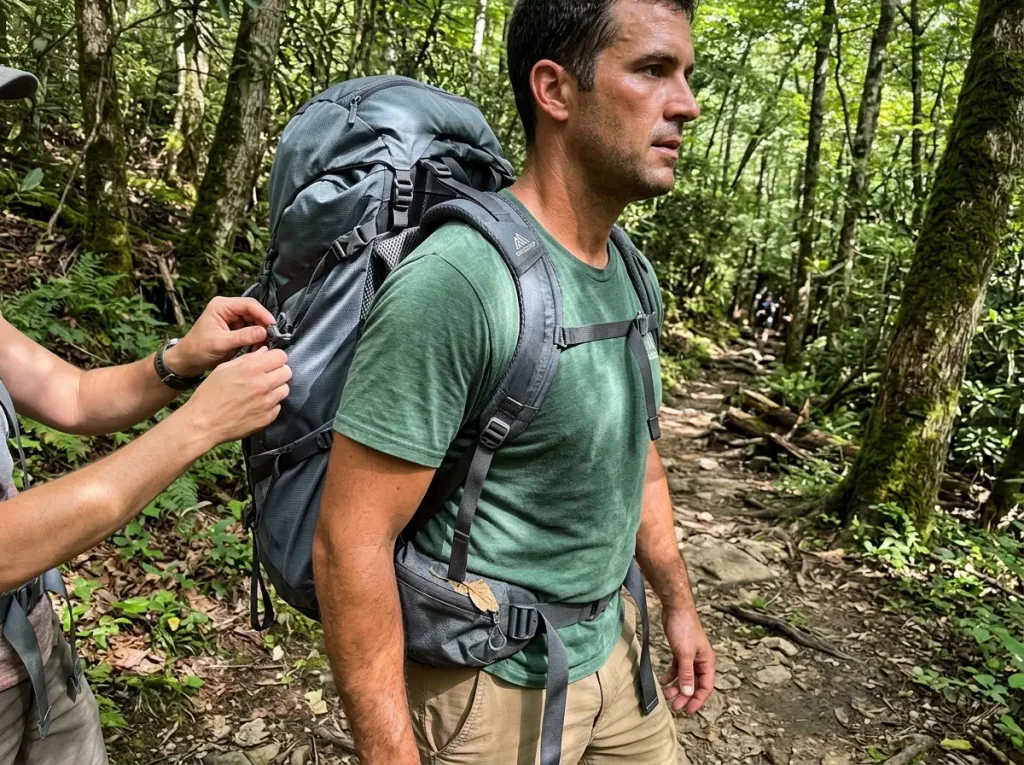
Here’s the test the shop won’t run for you. Load the pack to about 30 pounds, because an empty pack lies. Then set the fit in a strict order, and the order matters more than any single strap.
- Seat the hipbelt first, centered so the padding wraps the top of your iliac crest, and cinch it firm.
- Snug the shoulder straps until they hug, without pulling weight off your hips.
- Set the load lifters to roughly 30 to 45 degrees, snug but never cranked tight.
- Clip the sternum strap last, and leave it loose enough to breathe on a climb.
When it’s right, the weight distribution lands where it should, with about 75 to 80 percent riding on your hips and the shoulder-strap anchors sitting one to two inches below the top of your shoulders. If the anchors float way above or below that, your torso size or hipbelt height is off. Getting the load-lifter straps set to roughly 45 degrees, snug but never cranked tight is the small adjustment that quietly fixes a pack that “felt fine in the store.”
The number one reason a pack “hurts no matter what” is a hipbelt riding below the iliac crest. The pack sags, the weight dumps onto your shoulders, and you spend the day blaming the straps. Raise the hipbelt onto the crest first. The fix is almost always belt height, not strap tension.
Adjustable-torso packs, like the Osprey Atmos and Aether, the Gregory Baltoro and Paragon, and the Granite Gear Blaze, let you fine-tune that fit at home over a few evenings. Fixed-torso ultralight packs don’t give you that second chance, so for those you have to nail the size the first time.
Best Men’s Hiking Backpacks by Use Case
Seven packs, each the honest pick for one kind of hiker. You don’t need all of these. You need the one that matches the trips you actually take. Every pack below is named by its men’s frame; where the same pack ships in a women’s version, it’s noted so a reader buying for a partner lands on the right page. Prices move constantly, so the buttons send you to Amazon for the live number.
Best Overall: Osprey Atmos AG 65
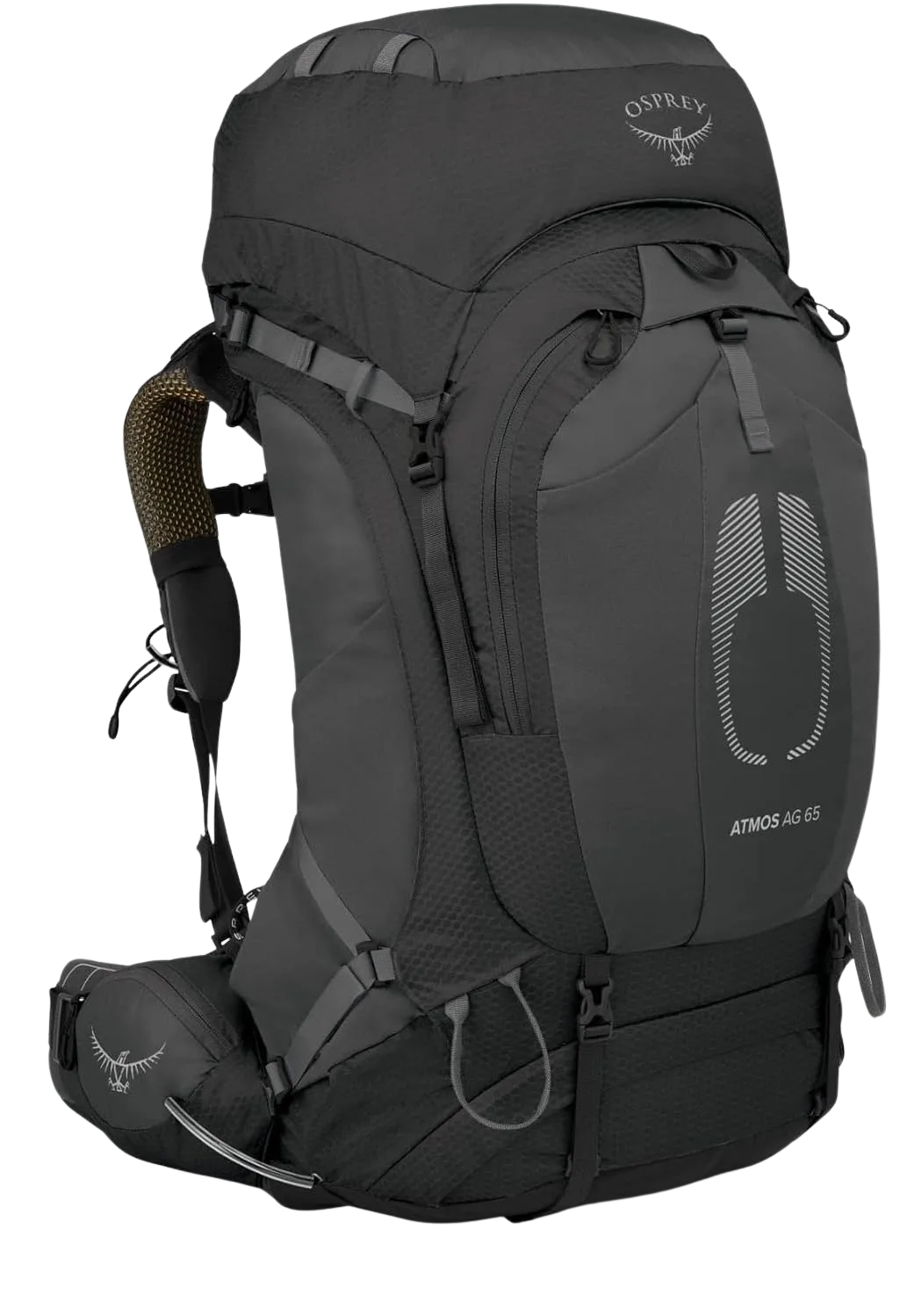
If you want one pack that handles the widest range of three-season trips and forgives a sizing mistake, this is it. The suspended-mesh back panel is the difference you feel on a hot climb, where a foam-backed pack turns your shirt into a sponge. It’s a premium pack, and it earns the tier by carrying a loaded weekend kit like it’s half the weight. Buying for a partner? The women’s version is the Osprey Aura AG 65, the same pack on a shorter-torso frame.
Best Heavy Hauler: Gregory Baltoro 65
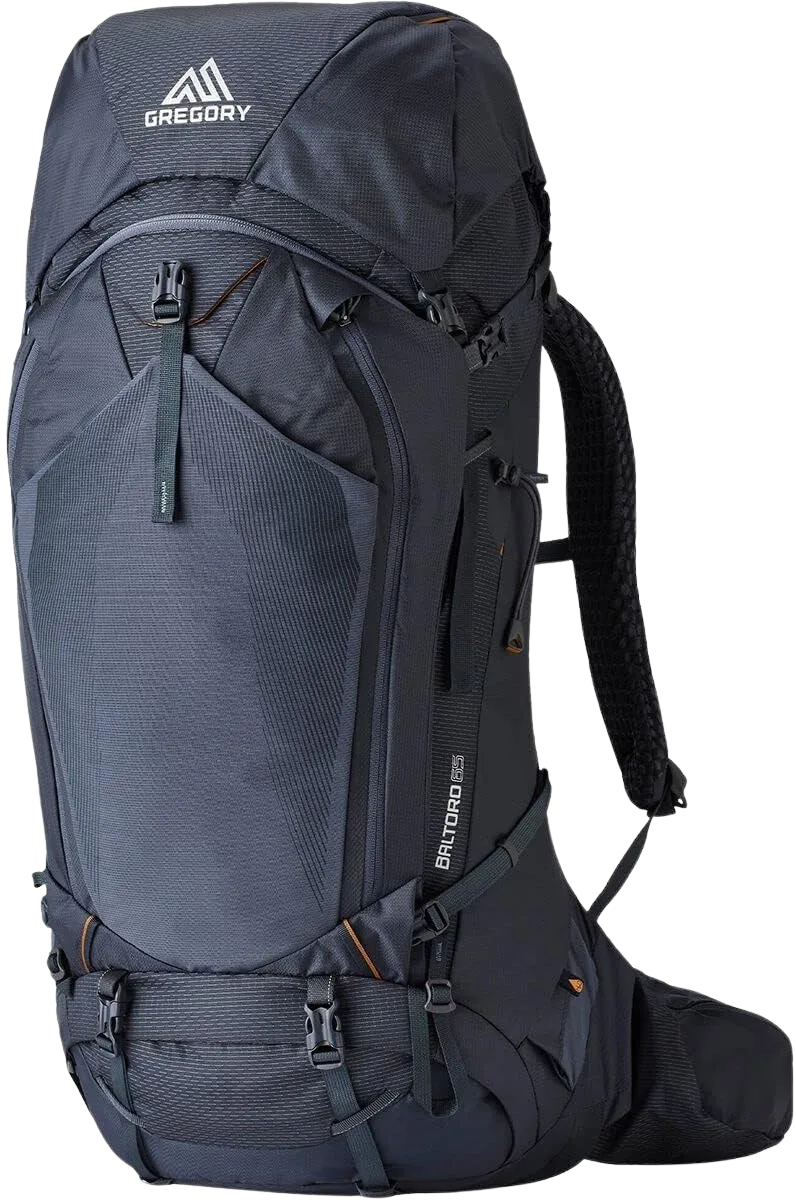
This is the pack for the trip where the weight is non-negotiable: early-season loads with extra layers, a bear canister and five days of food, or a basecamp haul. Gregory’s lineup splits cleanly between the plush Baltoro and the lighter Paragon, and if you want the full breakdown of Gregory’s lineup for every type of hike, that’s the easiest way to pick between them. The women’s equivalent is the Gregory Deva 70.
Best All-Rounder: Gregory Paragon 58
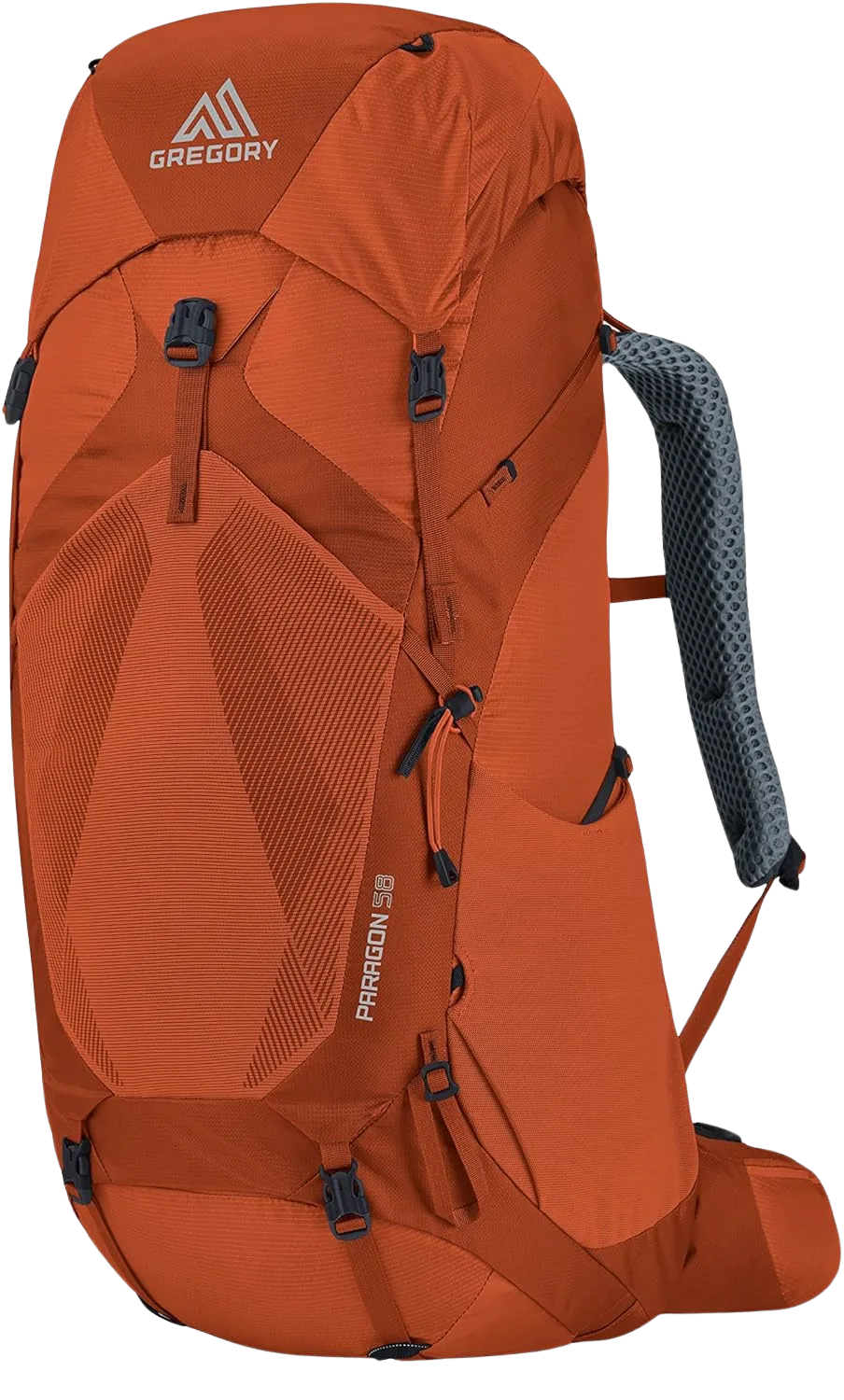
If the Atmos is the pack you splurge on, the Paragon is the pack you settle on and never regret. It hauls a full weekend kit, scales up to a light multi-day load, and the adjustable torso means it fits a range of builds right out of the box. The women’s version is the Gregory Maven 55.
Best Adjustable: Osprey Aether 65
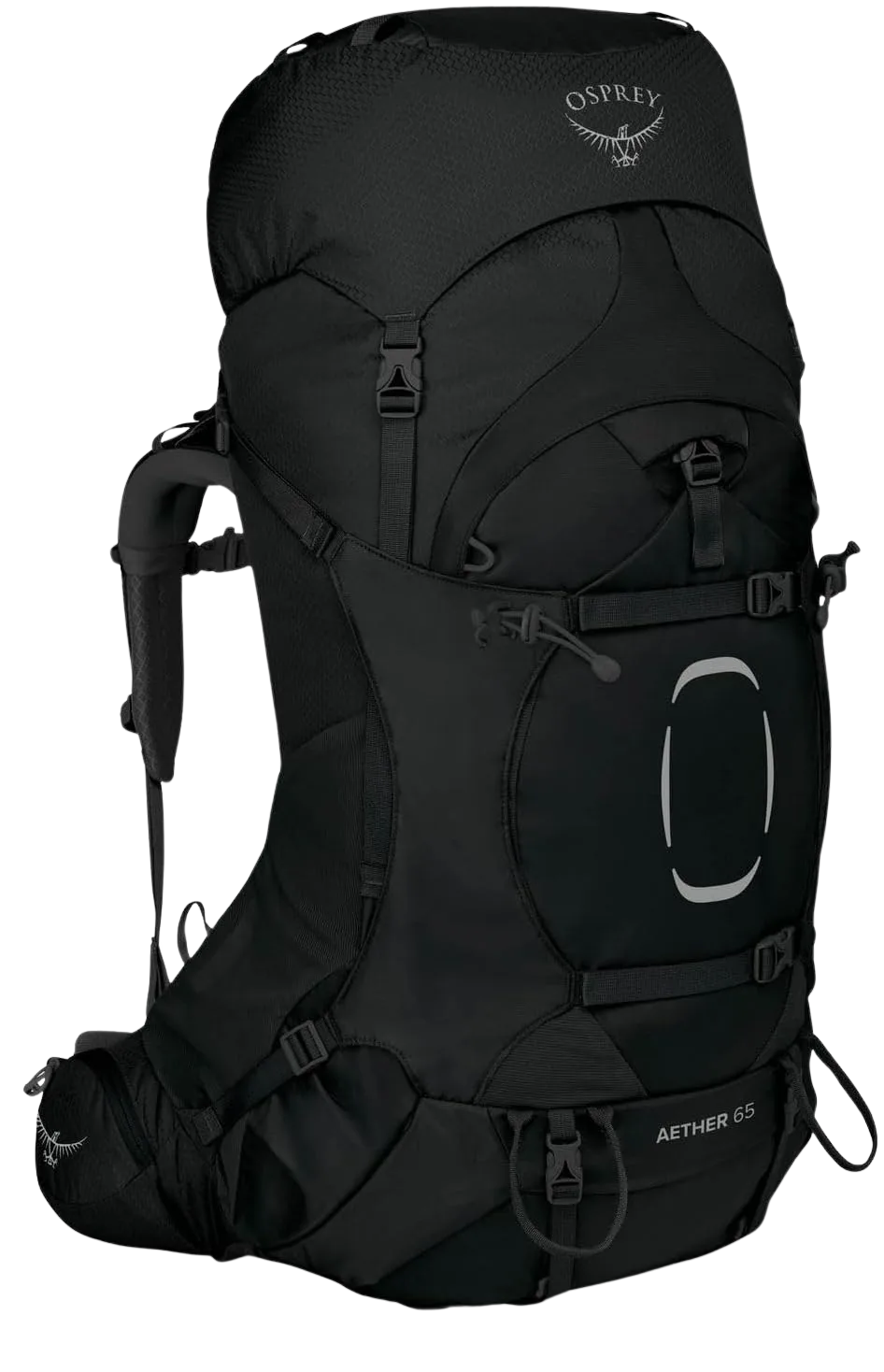
The Aether is what you reach for when fit has always been the problem. The Fit-on-the-Fly system lets you shape both the harness and the hipbelt to your build, which is a real advantage if you sit between standard sizes. It overlaps with the Baltoro on big loads, so choose the Aether if customizable fit matters more to you than the Baltoro’s plush carry. The women’s version is the Osprey Ariel 65.
Best Lightweight: Osprey Exos 58
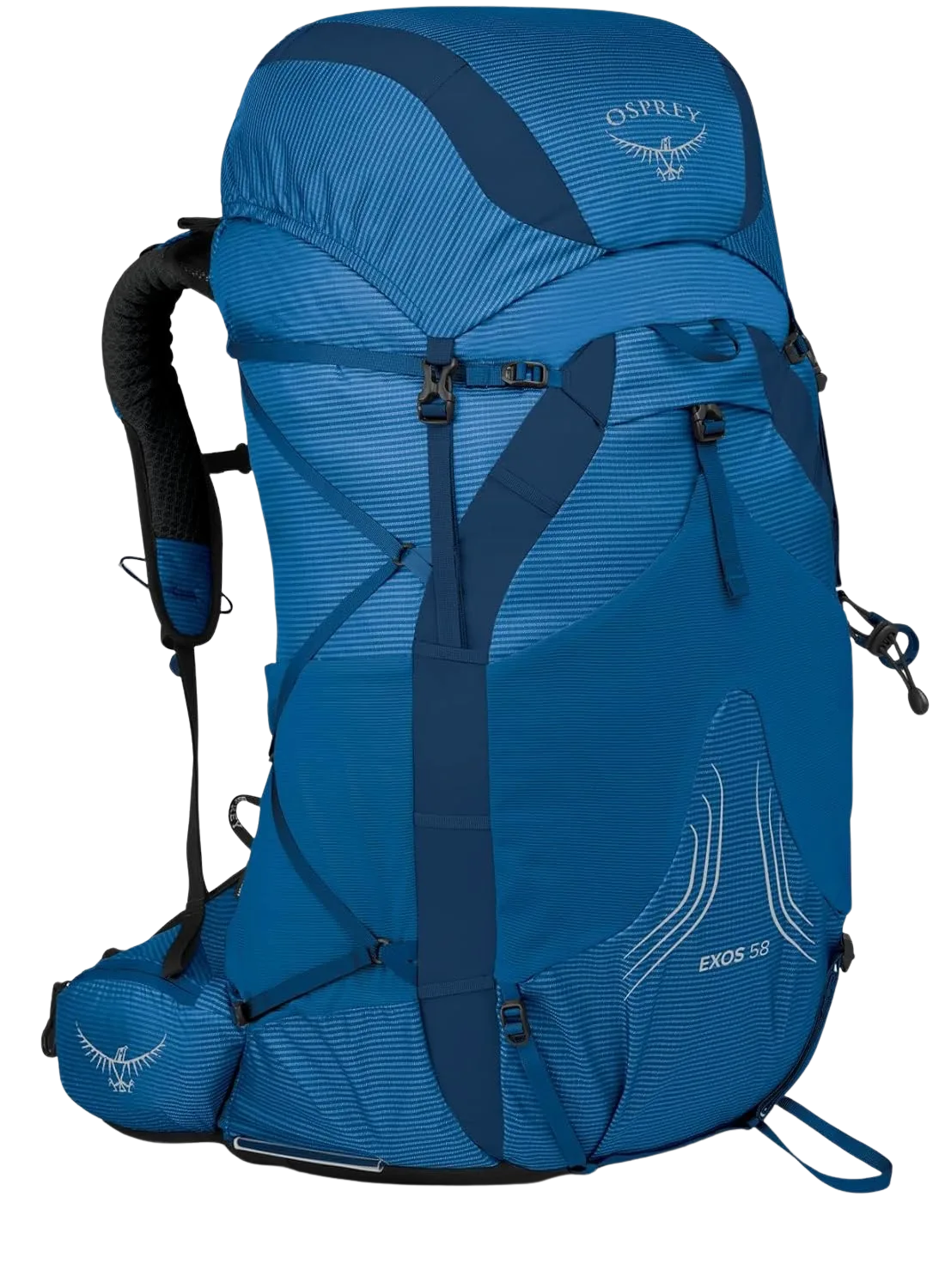
Pick the Exos if you’ve already trimmed your kit and want the pack to stop being the heaviest single item on your back. The catch is honesty: a lighter frame carries less weight before it starts to complain, so this is a pack for hikers who pack light on purpose. Some sizes run a fixed torso, so getting the size right the first time matters more here than on an adjustable pack. The women’s version is the Osprey Eja 58.
Best Value: Granite Gear Blaze 60
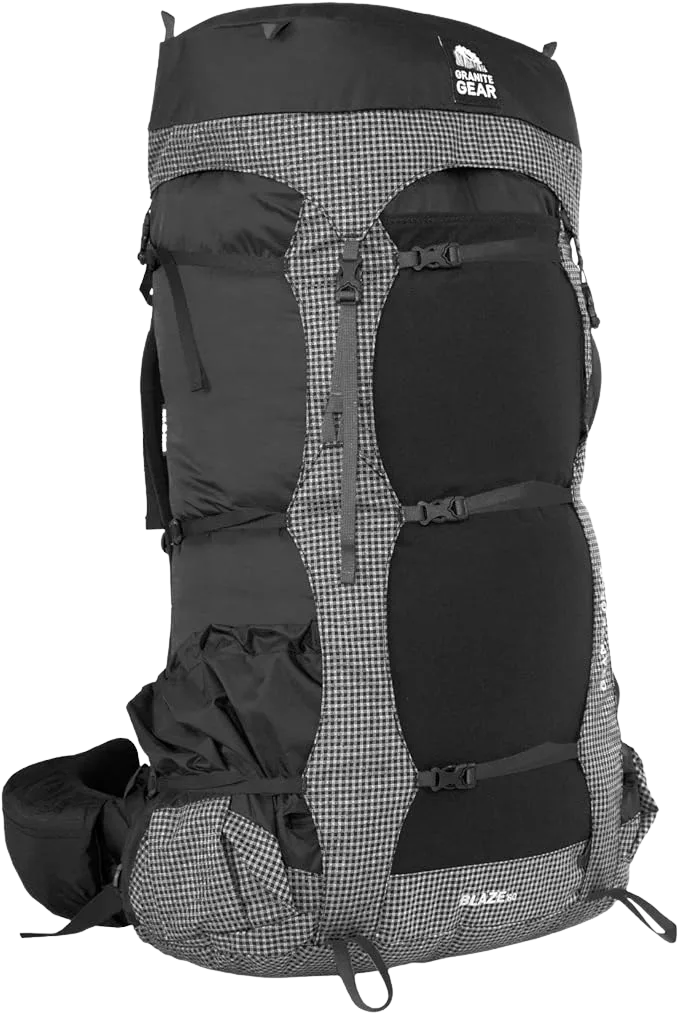
The Blaze is the bridge between budget and premium, and it’s the pack to point a value-minded buyer toward first. It carries a serious load, the frame adjusts to your back, and it weighs a pound or two less than the flagship haulers. If you want to step even lighter and cheaper, Granite Gear’s Crown3 60 trades some of the Blaze’s load support for less weight and a lower price. The Blaze also ships in a women’s frame.
Best Expedition: Deuter Aircontact Core 65+10
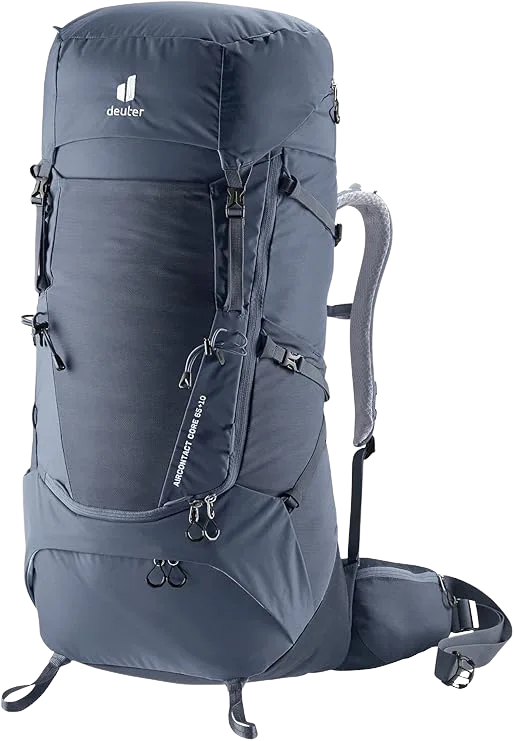
Reach for the Aircontact Core when the trip is genuinely big: long backcountry routes, infrequent resupply, or a load you can’t trim any further. The expandable collar buys you ten extra liters when you need them and packs down when you don’t, and the tough body holds up to seasons of hard use. The women’s version is the Deuter Aircontact Core 60+10 SL.
Suspension, Ventilation, and Weight Explained
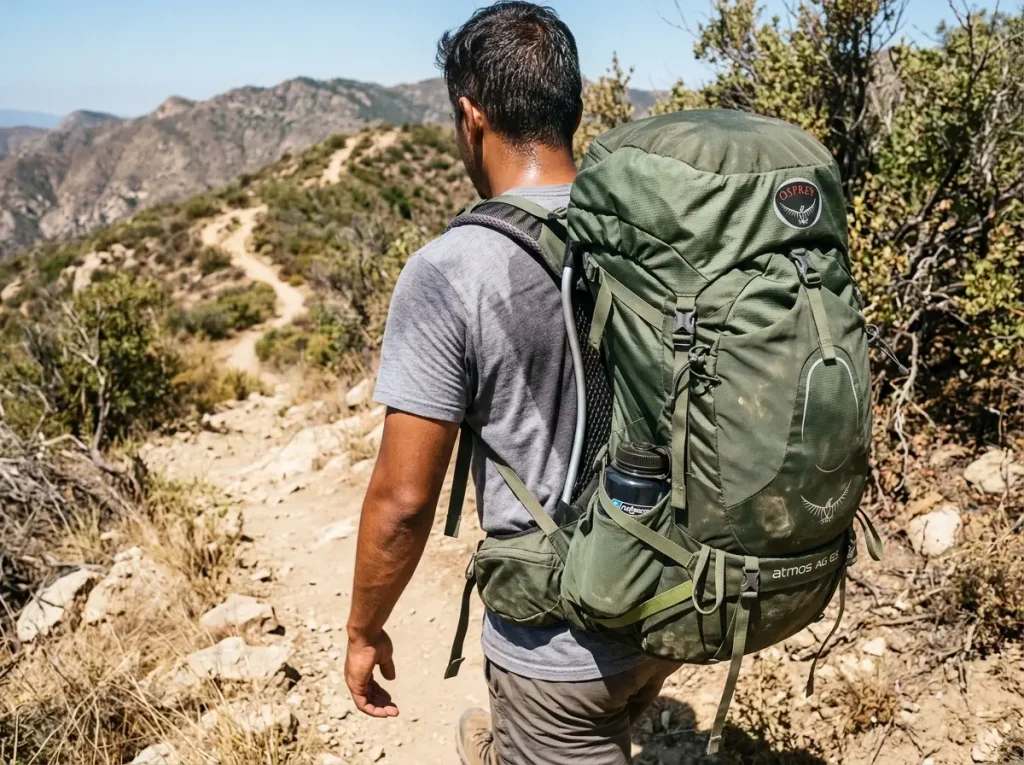
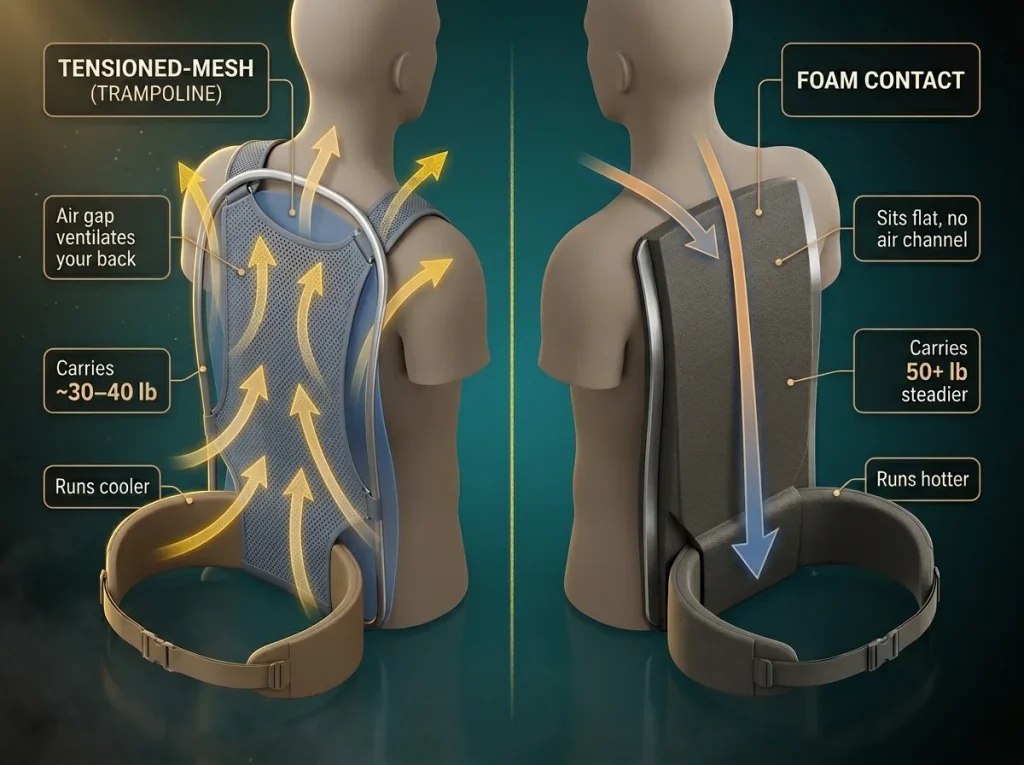
Every brand has a trademarked name for the same two ideas. Osprey calls it AntiGravity or AirSpeed, others call it a trampoline back, and the marketing makes it sound like each one is unique. Strip the names away and a pack’s suspension comes down to a simple choice that changes how it carries.
A suspended tensioned-mesh back panel, the trampoline style, stretches a sheet of mesh across a frame so it stands off your spine. Air flows through the gap, which keeps your back cooler, and it carries 30 to 40 pounds comfortably. A foam contact back sits flat against you instead. It runs hotter because there’s no air channel, but that direct contact moves 50-plus pounds more steadily, which is why heavy haulers use it. Understanding how each suspension type moves the load from your shoulders onto your hips is what lets you read past the brand names.
The Weight Tradeoff Nobody Escapes
Pack weight runs a wide range, from ultralight packs near 1.9 to 2.1 pounds, like the Exos stripped down to about two pounds, up to heavy haulers at 4.9 to 5-plus pounds, like the Aether at roughly 4.9. The pounds in a heavy hauler are not waste. That’s frame and padding, and it’s the reason the pack can carry 50-plus pounds without crushing you.
Here’s the trade you can’t get around: you don’t get airflow, big-load support, and minimal weight all at once. Pick the two that match your trips and let the third go. An ultralight hiker gives up plush carry for a light frame. A heavy hauler gives up grams for load support. The all-rounder packs sit in the middle on purpose.
On a lightweight pack, the removable top lid, what hikers call the brain, is often the first thing to cut. Stripping the lid and a few extras off a pack can shed close to a pound for free. Just know your fixed-torso ultralight pack won’t let you adjust the fit afterward, so size it right before you trim it.
Key Features Worth Checking
Beyond fit and frame, a few features separate a good hiking backpack for men from a frustrating one. Every pack here is an internal-frame pack, where an aluminum or composite frame inside the pack transfers the load down to the hipbelt. That frame is the part doing the real work, so the features built around it are what you actually live with day to day.
Run through this short checklist before you buy:
- A removable top lid, or brain, you can strip off to shave weight on lighter trips.
- Hipbelt pockets and water-bottle pockets you can reach without taking the pack off.
- A hydration sleeve and port sized for a hydration bladder.
- A sleeping bag compartment with a bottom zip, if you prefer a divided pack.
- A rain cover, included or sold separately, plus trekking pole attachment loops.
None of these make or break a pack on its own. A missing hydration sleeve or an awkward hipbelt pocket is the kind of small daily annoyance that wears on you by day three, so check the list against the trips you actually take.
Materials, Durability, and the Advertised-vs-Real-Volume Catch
What Denier Actually Tells You
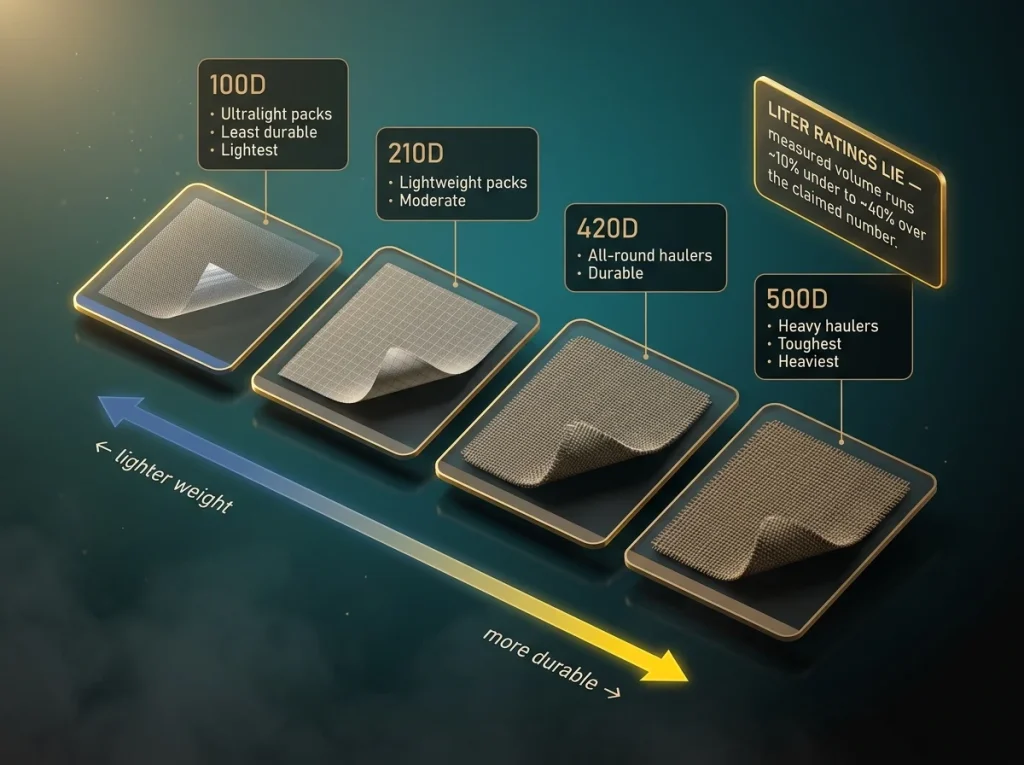
Pack fabric is graded in denier, the weight of the thread used to weave it. Lightweight packs use thin 100D or 210D ripstop nylon to save grams, while burly haulers use 420D or 500D high-tenacity nylon, often a brand like Robic, where they expect abrasion. The trade is the same one as everywhere else: lighter fabric saves weight, heavier fabric lasts longer against granite and brush, and at the ultralight extreme a few packs skip nylon for Dyneema composite to cut grams even further.
Now the part almost no buying guide tells you. Liter ratings lie. Independent testing has found that a pack’s measured volume can run anywhere from about 10 percent less to nearly 40 percent more than its advertised volume, and every pack tested was off by at least 10 percent. A “60-liter” pack from one brand can hold what another brand calls 45 liters, or 70.
Why the Liter Number Can’t Be Trusted
No agency forces a single volume test, so brands measure however they like. Some count only the main compartment. Others add the lid, the side pockets, and the hipbelt pockets into the total. That’s how two packs both stamped “65L” can swallow completely different amounts of gear. The fix is to stop cross-shopping on the sticker and compare real fit and real load instead, which is the whole point of the at-home fit test earlier.
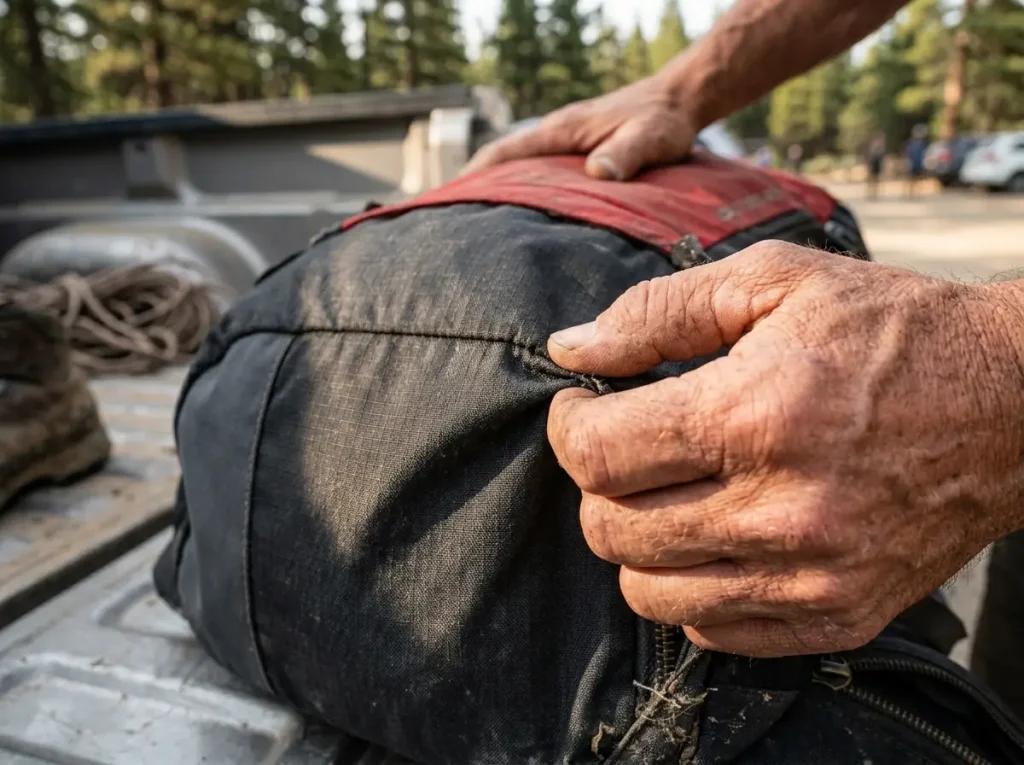
Durability shows up in predictable places. Packs almost always fail at the hipbelt seams, the bottom fabric that drags on rock, and the zipper sliders, not in the middle of a panel. Learning the signs a pack is worn past the point of carrying weight safely saves you from a blowout three days from the trailhead.
How Much to Spend on a Men’s Hiking Backpack
Search “best men’s hiking backpack” and the results push you straight at premium Osprey and Gregory packs like there’s no other answer. There is, and most weekend hikers don’t need the priciest pack on the page. The honest version of this advice starts with our complete guide to choosing a hiking backpack without wasting money, because the goal is the right pack, not the most expensive one.
When a Cheaper Pack Is Enough
A sub-premium pack carries a weekend just fine when your load stays under about 30 pounds and your trips are short. It only wrecks a trip when you push 40-plus pounds onto a weak frame and the hipbelt can’t move the weight to your hips. That’s the real line: not price, but load versus frame.
What the Extra Money Actually Buys
A good place to spend less is the REI Co-op Flash 55 or the Trailmade 60. They’re honest value packs that carry a weekend comfortably, and because they’re an REI house brand, you won’t find them on Amazon. Granite Gear’s Blaze and Crown3 sit in the same bridge zone between budget and premium.
When you do pay up, the extra money buys specific things: an adjustable torso, a better-built hipbelt, lighter frame materials, and a longer usable life. None of it is magic. The math that justifies a premium pack is simple. One pack that lasts ten seasons beats three cheaper packs that fail in three, both for your wallet and for the gear that ends up in a bin.
Conclusion
The best men’s hiking backpack isn’t the one with the biggest number on the spec sheet. Match your liters to the nights you actually sleep out, not to the fear of running out of room. Size the pack to your torso and get the hipbelt onto your crest, because fit beats brand every time a loaded pack hits the trail.
For most hikers the Osprey Atmos AG 65 is the pack that does the most things well, but your trips decide your pick: a heavy hauler for big loads, an ultralight frame for trimmed kits, a value pack when the budget is the constraint. Before you buy anything, measure your torso and load a pack to 30 pounds in the store. The fit test costs nothing and saves a season of shoulder pain. A pack you can carry comfortably is also the one you’ll actually use to pack your trash back out, which is the quiet part of doing this right.
Frequently Asked Questions
01What size hiking backpack does a man need?
Match liters to trip length: 15 to 30 liters for day hikes, 30 to 50 for overnighters and weekends, and 50 to 60 for multi-day trips. Torso length, not height, decides the frame size you buy.
02What is the difference between a men’s and women’s hiking backpack?
A men’s frame has a longer torso range, straighter and wider shoulder straps, and a flatter, longer hipbelt. Women’s frames run shorter with contoured straps for a higher waist. It is geometry, not color, so a short-torso man often fits a women’s frame better.
03Is a 65L backpack too big for hiking?
For day hikes and most weekends, yes, a 65L pack just invites overpacking. Save 60 to 65 liters for multi-day trips of three or more nights, or for bulky winter loads. A 45 to 50-liter pack covers most weekend hiking comfortably.
04What is the best men’s hiking backpack brand?
No single brand wins for everyone, but Osprey and Gregory lead on fit and load support, with Granite Gear and Deuter strong on value and expedition carry. The best brand is whichever one’s frame matches your torso.
05How do you measure torso length for a backpack?
Tilt your head forward, find the bony C7 vertebra at the base of your neck, then measure straight down your spine to the iliac crest, the top of your hip bones at a thumbs-back line. That number, not your height, maps to Small, Medium, or Large.
Risk Disclaimer: Hiking, trekking, backpacking, and all related outdoor activities involve inherent
risks which may result in serious injury, illness, or death. The information provided on The Hiking Tribe is for
educational and informational purposes only. While we strive for accuracy, information on trails, gear, techniques,
and safety is not a substitute for your own best judgment and thorough preparation. Trail conditions, weather, and
other environmental factors change rapidly and may differ from what is described on this site. Always check with
official sources like park services for the most current alerts and conditions. Never undertake a hike beyond your
abilities and always be prepared for the unexpected. By using this website, you agree that you are solely
responsible for your own safety. Any reliance you place on our content is strictly at your own risk, and you assume
all liability for your actions and decisions in the outdoors. The Hiking Tribe and its authors will not be held
liable for any injury, damage, or loss sustained in connection with the use of the information herein.
Affiliate Disclosure: We are a participant in the Amazon Services LLC Associates Program, an
affiliate advertising program designed to provide a means for us to earn advertising fees by advertising and linking
to Amazon.com. As an Amazon Associate, we earn from qualifying purchases. We are also an official affiliate partner
of Black Diamond Equipment via the AvantLink network. If you click on a Black Diamond affiliate link and make a
purchase, we may earn a commission at no additional cost to you. We also participate in other affiliate programs and
may receive a commission on products purchased through our links. Additional terms are found in the terms of
service.