





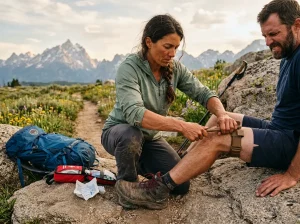
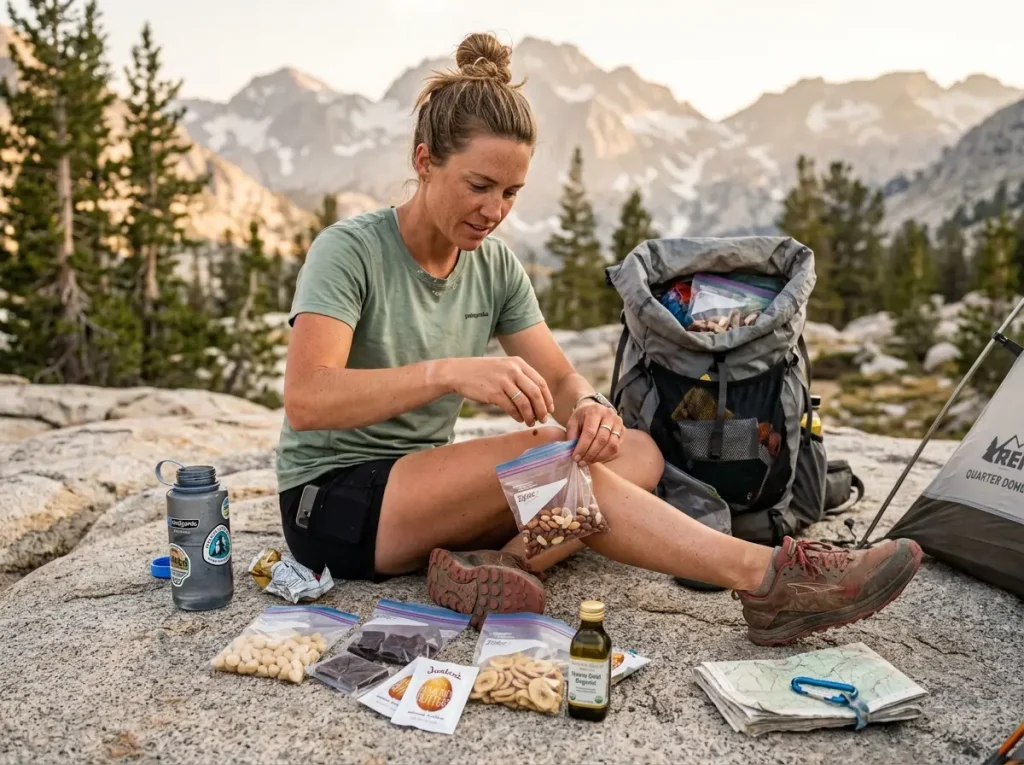
You’re standing in a gas station at some trail town, turning over every package to read the nutrition label. Your pack is already too heavy, your next resupply is four days out, and you need to fit 14,000 calories into a space smaller than a shoebox. I’ve done this math at enough resupply stops to have it memorized — and the answer isn’t “grab trail mix and go.”
After years of multi-day carries where I’ve tracked every ounce, I’ve learned that the difference between a comfortable food carry and a miserable one comes down to one number: calories per ounce. Here’s exactly which snacks deliver the most energy for the least weight, ranked with real numbers, plus the temperature and packability factors nobody else mentions.
Here’s how the top calorie dense trail snacks compare at a glance:
| High-Density Backpacking Snacks Compared | |||
|---|---|---|---|
| Snack | Cal/Oz | Best For | Survives Heat? |
| Olive oil | 240 | Dinner booster | Yes |
| Macadamia nuts | 200 | Pure density | Yes |
| Pecans | 200 | Omega-rich snacking | Yes |
| Peanut butter packets | 190 | All-day fuel | Mostly |
| Walnuts | 185 | Sustained energy | Yes |
| Dark chocolate (85%) | 170 | Afternoon boost | No (melts >85°F) |
| Peanuts (salted) | 170 | Budget + sodium | Yes |
| Almonds | 165 | Versatile base | Yes |
| Nature Valley bars | 152 | Quick grab | Yes |
| Dried banana chips | 147 | Crunchy carbs | Yes |
| Coconut flakes | 185 | Mix-in booster | Yes |
| Dried dates | 80 | Sustained low-GI energy | Yes |
Why Calories Per Ounce Is the Only Number That Matters
The Fat Math Behind Caloric Density
Every gram of fat delivers 9 calories. Every gram of carbohydrate or protein delivers 4. That single fact explains why a handful of macadamias outweighs a bag of pretzels in energy value despite being a fraction of the volume.
This isn’t nutrition advice for your daily life. On trail, where you’re burning through 3,000 to 5,000 calories a day and carrying every gram on your back, fat-heavy foods aren’t indulgent they’re efficient. The Appalachian Mountain Club’s calorie research confirms that the highest calorie trail foods are almost universally fat-dominant.
Pro tip: Stop thinking about “healthy” vs “unhealthy” on trail. Think about energy delivered per ounce carried. You’re a furnace burning everything you feed it within hours.
What 125 Calories Per Ounce Actually Means for Your Pack
Here’s the math that changed how I pack food. If you’re carrying 2.5 pounds of food per day (a typical long-distance target), your daily calorie intake depends entirely on average caloric density:
At 100 cal/oz, that’s 2,500 calories from 2.5 lbs — probably a deficit. At 125 cal/oz, that’s 3,125 calories — functional. At 150 cal/oz, that’s 3,750 calories — comfortable surplus for big days.
Every 25 cal/oz improvement in your average gives you 625 extra calories per day at the same weight. Or put differently — you can carry less food for the same energy. That’s the connection to dialing in your overall pack weight that most hikers miss. Food weight IS gear weight.
How Daily Burn Rate Sets Your Food Budget
A 160-pound hiker carrying a 25-pound pack over moderate terrain burns roughly 400 to 600 calories per hour of actual hiking. Multiply that across six to eight hours of movement, add your resting metabolism, and you’re looking at 3,500 to 4,500 calories on a typical backpacking day.
In cold weather, that number climbs. A NOLS study found hikers burned 34% more calories at temperatures between 15 and 23°F compared to mild conditions. Your food bag needs to account for weather, not just miles.
The practical takeaway: build your food system around 125+ cal/oz foods, carry 2 to 2.5 pounds per day, and you’ll cover most hiking scenarios without running a deficit.
Nuts and Seeds — The Calorie Density Champions
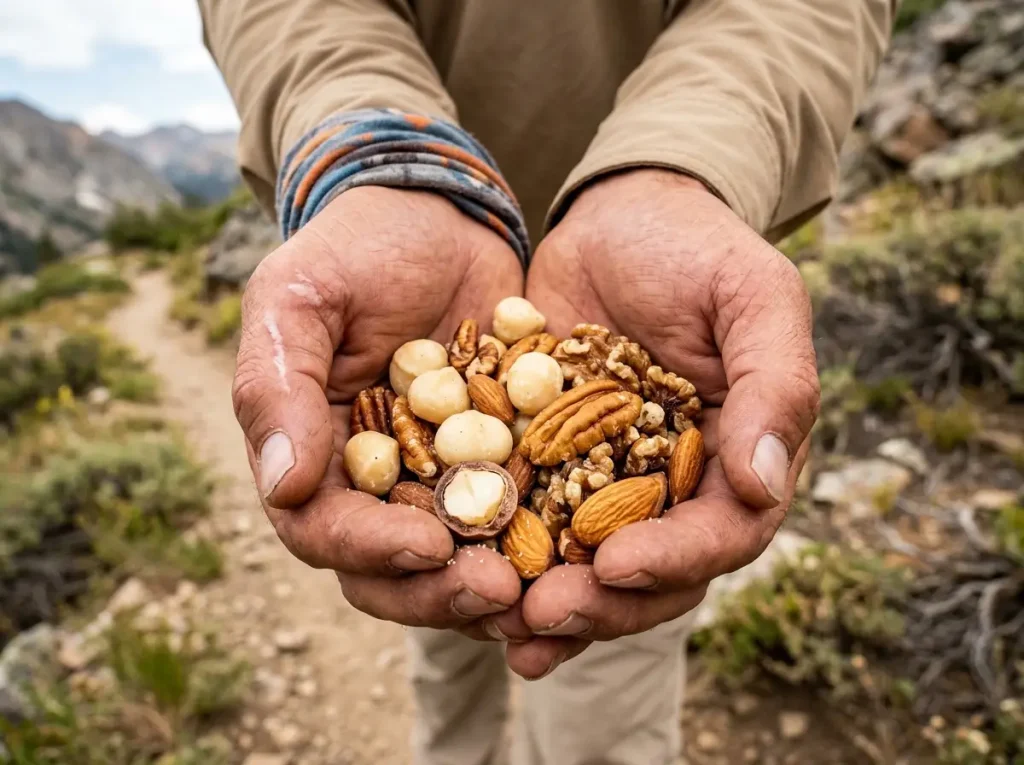
Macadamias and Pecans (200 Cal/Oz)
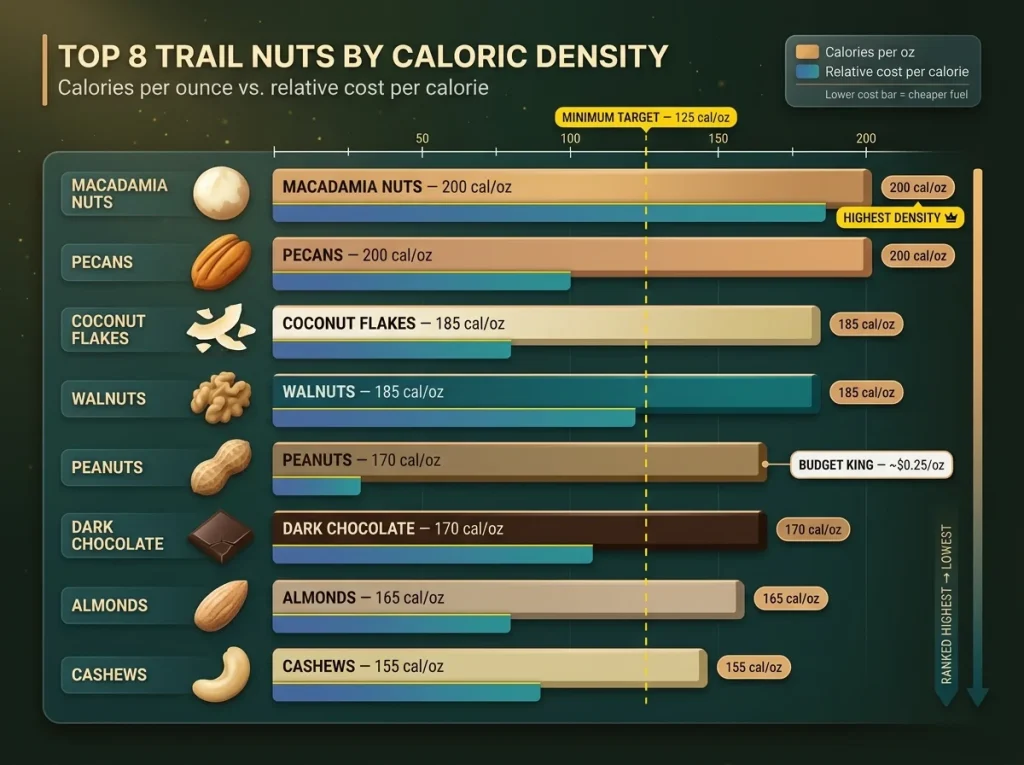
Nothing you can buy at a grocery store beats macadamias and pecans for raw caloric density in a ready-to-eat format. Two hundred calories per ounce means a quarter-pound bag delivers 800 calories — roughly four hours of moderate hiking fuel in something that fits in your palm.
Macadamias are 75% fat by calorie, which is exactly what you want for sustained energy without the digestive strain of heavy protein processing. They don’t crush easily, don’t melt, and taste good on day seven when everything else triggers flavor fatigue.
The catch: cost. Macadamias run $1.50 to $2.00 per ounce at most grocery stores. For a 5-day carry where you need 12,000+ snack calories, that adds up fast.
Pro tip: Buy pecans in bulk from warehouse stores — they hit 200 cal/oz at roughly half the price of macadamias and have a richer flavor that holds up better to repetition.
Walnuts and Brazil Nuts (185-190 Cal/Oz)
Walnuts pack 185 calories per ounce with the bonus of being the highest plant source of omega-3 fatty acids. On long hikes where joint inflammation creeps in around week two, that’s not trivial.
Brazil nuts hit 190 cal/oz but come with a quirk — they’re enormous. Three Brazil nuts fill the same space as fifteen almonds. For bear canister packing, where volume matters as much as weight, that’s a disadvantage. For hip-belt pocket snacking, it’s actually convenient. Three nuts, 100 calories, done.
Almonds, Peanuts, and Cashews (160-170 Cal/Oz)
Almonds sit at 165 cal/oz — not the density champion, but arguably the best all-around trail nut. They’re sturdy enough to survive bear canister compression, available everywhere for replacing electrolytes you’re sweating out in salted versions, and neutral enough to mix with anything.
Peanuts at 170 cal/oz are the budget king of trail food. Salted peanuts from a gas station cost roughly $0.25 per ounce and deliver both calories and sodium replacement. On a thru-hike budget, that math matters more than the 30 cal/oz gap between peanuts and macadamias.
Cashews (155 cal/oz) rank lower but offer the highest carbohydrate ratio among nuts — useful if you want faster-burning energy for steep morning climbs.
Nut Butters and Oils — Maximum Calories, Minimum Weight
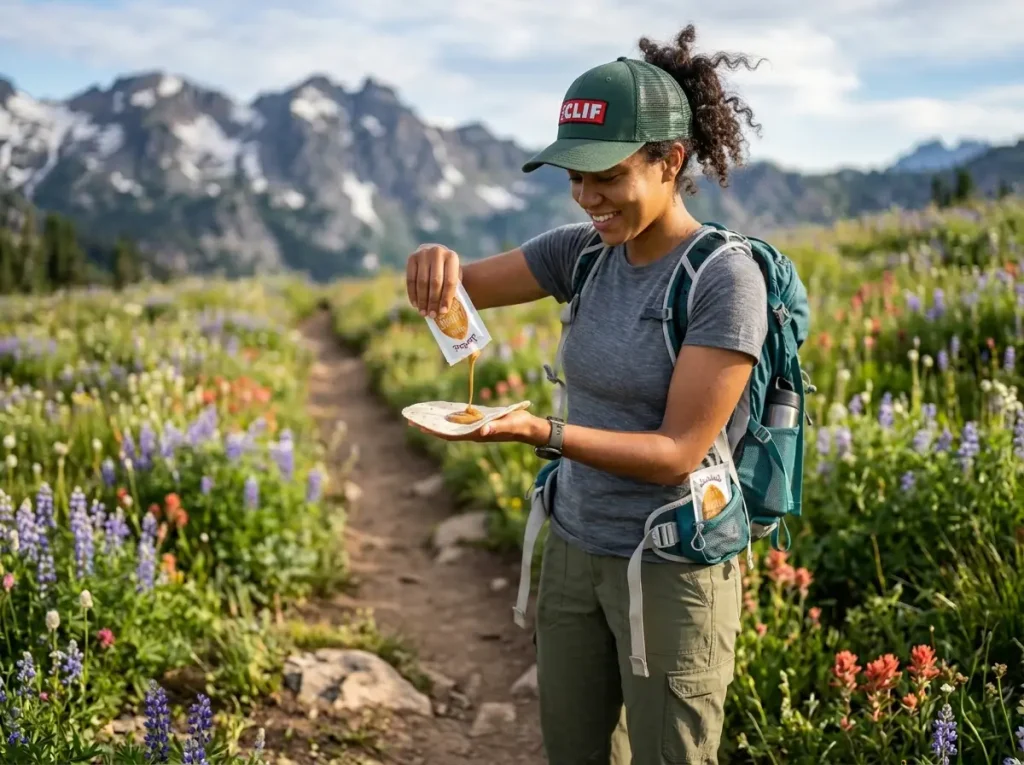
Peanut Butter Packets vs Bulk (190 Cal/Oz)
Peanut butter in squeeze packets might be the single most efficient trail snack delivery system ever invented. A Justin’s Classic packet weighs 1.15 ounces and delivers 200 calories. You can eat it straight, squeeze it on a tortilla in thirty seconds flat, or mix it into oatmeal without dirtying a spoon.
Bulk peanut butter in a small jar hits the same cal/oz but with a weight penalty from the container and a mess risk that every thru-hiker learns to regret exactly once. The packets cost more per ounce but save weight in packaging and eliminate the sticky-jar-lid-in-your-pack problem entirely.
Olive Oil as a Calorie Multiplier (240 Cal/Oz)
At 240 calories per ounce, olive oil is the undisputed caloric density champion of any food you’ll carry. One tablespoon added to a ramen dinner adds 120 calories with zero extra cooking time and virtually no weight.
The trick most thru-hikers learn by week two: buy single-use packets from restaurant supply stores or Amazon. They weigh next to nothing, can’t leak, and turn a 300-calorie instant dinner into a 500-calorie one. Add it to adding oil to your Jetboil dinner and you’ve just solved your calorie deficit without adding pack weight.
Pro tip: Carry 4-6 olive oil packets per day of hiking. At 120 calories each, that’s 480-720 bonus calories that weigh under 3 ounces total. No other food delivers that ratio.
Coconut Oil and Ghee for Cold Weather
Coconut oil stays solid below 76°F, which makes it a winter hiking secret weapon. In summer it’s a leaky mess, but from October through April it behaves like a calorie-dense butter that won’t spoil. At 240 cal/oz (same as olive oil), you can slice off chunks and eat them straight or melt them into hot meals.
Ghee (clarified butter) hits 240 cal/oz with an indefinite shelf life — no refrigeration needed, no spoilage risk even in July. The taste adds richness to bland backcountry dinners that no olive oil can match.
Chocolate, Dried Fruit, and Candy — When Sugar Works
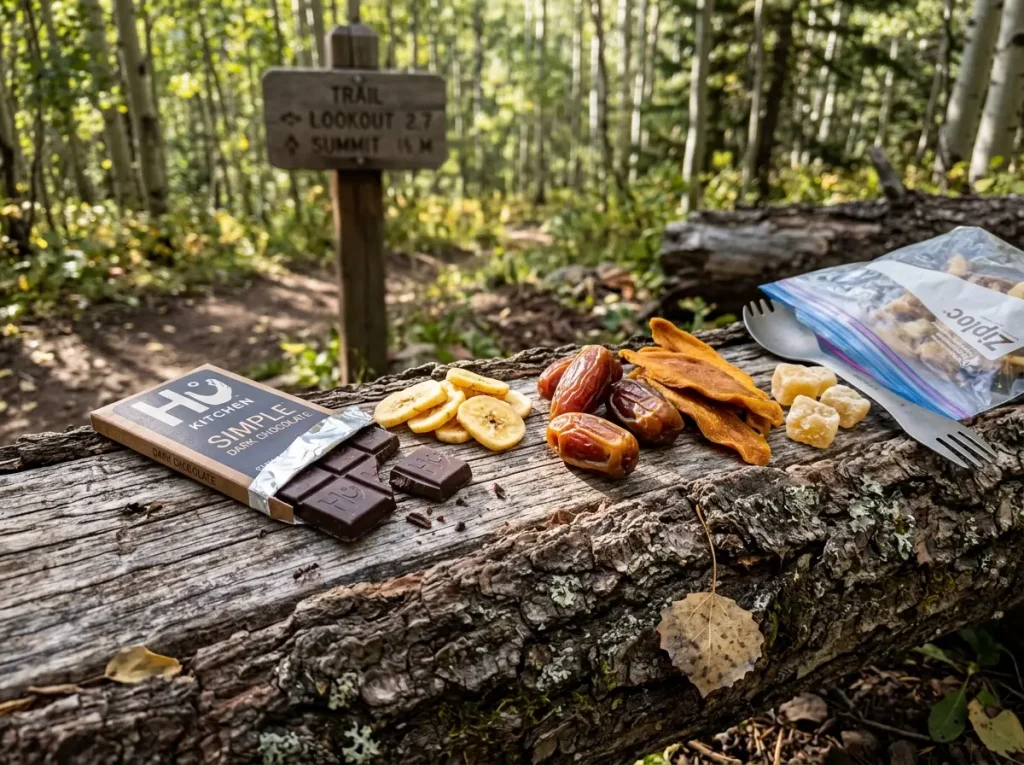
Dark Chocolate (150-170 Cal/Oz)
Dark chocolate at 85% cacao delivers 170 calories per ounce with the added benefit of magnesium — a mineral you’re depleting with every sweaty mile. It tastes good on day one and still tastes good on day twelve, which puts it ahead of most snacks for long carries.
The problem is obvious and unavoidable: chocolate melts above 85°F. In a summer desert section, it becomes a brown puddle inside whatever bag you packed it in. This isn’t a minor inconvenience — it’s a structural failure that ruins other food it touches.
Winter hiking? Carry as much dark chocolate as you want. Summer? Leave it home or accept the mess.
Dried Banana Chips and Coconut Flakes (145-185 Cal/Oz)
Dried banana chips at 147 cal/oz are underrated. They’re crunchy (a rare texture on trail where everything tends toward soft and chewy), loaded with potassium, and completely temperature-stable. They won’t freeze in winter or melt in summer.
Coconut flakes at 185 cal/oz are a hidden gem. Mix them into trail mix, sprinkle them on oatmeal, or eat them straight. They’re the lightest calorie-dense food by volume that doesn’t require packaging like oil does.
Most dried fruits — raisins, cranberries, apricots — land between 75 and 95 cal/oz. That’s below the 125 cal/oz threshold. They taste good and provide quick sugar, but they’re dead weight if density is your priority. Use them as flavor additions to nuts, not as standalone snacks.
Why Dates Beat Candy Bars for Sustained Energy
Dates sit at only 80 cal/oz, which puts them below the density threshold on paper. But they have a quality that pure numbers miss: despite tasting intensely sweet, dates have a low glycemic index. They release energy slowly rather than spiking your blood sugar and crashing you thirty minutes later.
A Snickers bar at 135 cal/oz gives you a fast sugar hit — useful for the last push up a steep switchback. But an hour later your energy drops below where it started. Dates at 80 cal/oz sustain energy for two to three hours without the crash.
The practical move: carry dates for sustained afternoon energy and save the candy for the final push to camp. Timing matters more than total calories when you’re managing energy across a full hiking day.
Bars, Jerky, and Commercial Snacks — Real Numbers
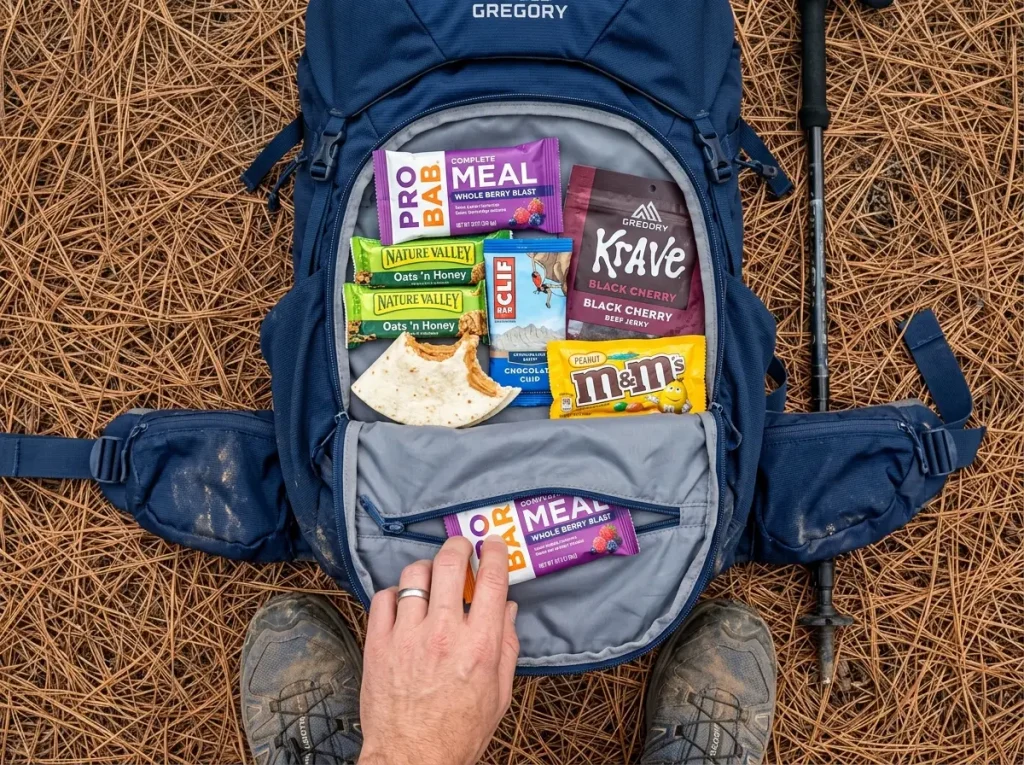
Which Bars Actually Hit 125+ Cal/Oz
Most energy bars marketing themselves as “trail fuel” land between 95 and 115 cal/oz. That’s below the threshold where they’re earning their weight in your pack.
The honest numbers:
ProBar Meal — 125 cal/oz. The only bar I’ve found that consistently hits the threshold while delivering a mix of fats, protein, and carbs.
Nature Valley Oats ‘n Honey — 152 cal/oz. Cheap, available at every gas station, and surprisingly calorie-dense. They crumble to pieces in your pack but the calories survive intact.
CLIF Bar — 105 cal/oz. Below threshold. Fine for day hikes where weight doesn’t matter. On a multi-day carry, you’re better off with the same weight in nuts.
KIND bars — 110-130 cal/oz depending on variety. The nut-heavy ones (Dark Chocolate Nuts & Sea Salt) hit closer to 130.
Jerky’s Hidden Problem (High Protein, Low Density)
Jerky sounds like a trail food champion — lightweight, shelf-stable, high protein. The reality: most beef jerky lands at 80 to 115 cal/oz. All that protein is great for muscle recovery, but protein delivers only 4 calories per gram. You’re carrying weight for repair material, not fuel.
For the same weight as a bag of jerky, a bag of pecans gives you nearly double the calories. Carry jerky for the protein and flavor variety, but don’t count on it as a calorie-density workhorse.
Tortilla Wraps as a Vehicle (Not Just a Food)
A flour tortilla delivers roughly 90 cal/oz on its own — nothing special. But its value isn’t in its own calories. It’s the delivery system that makes other calorie-dense foods edible without cooking or utensils.
Tortilla + peanut butter packet + honey stick = 350+ calories in sixty seconds, no stove, no cleanup, no dishes. That combination averages around 160 cal/oz for the assembled snack. Tortillas also survive temperature extremes better than bread, don’t mold for days, and compress flat in a pack.
For hikers who want to skip the stove weight entirely, making your own calorie-dense trail food with tortilla-based wraps is the simplest cold-soak alternative.
Temperature and Packability — What Nobody Tells You
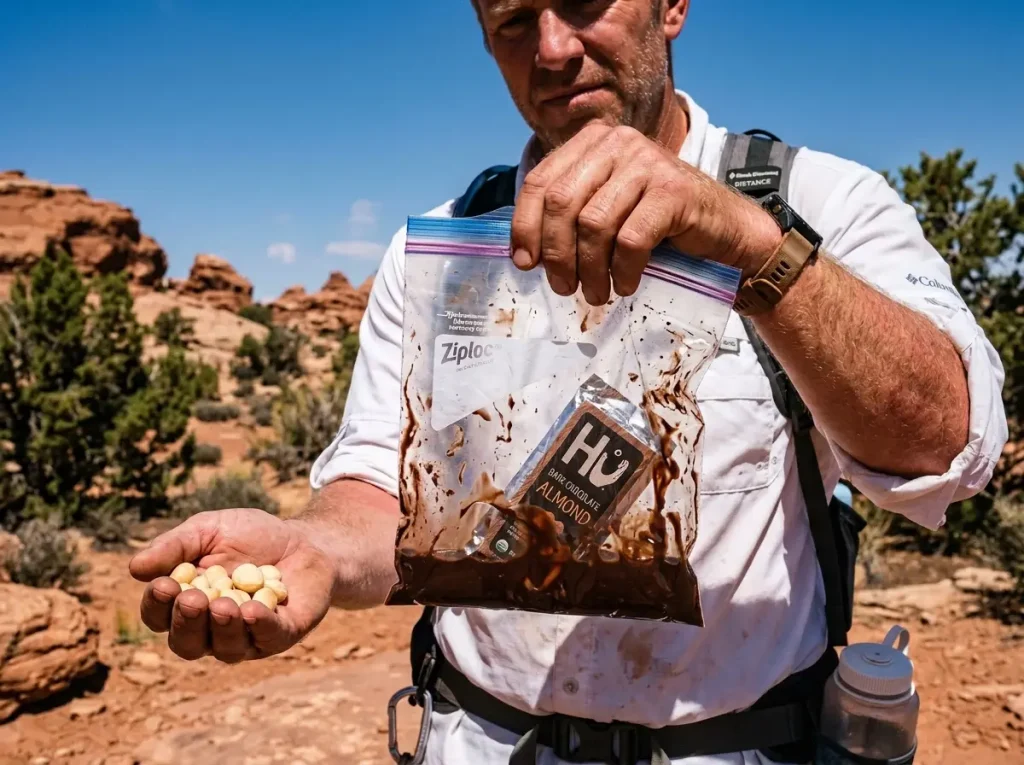
Summer Trail Snacks That Survive the Heat
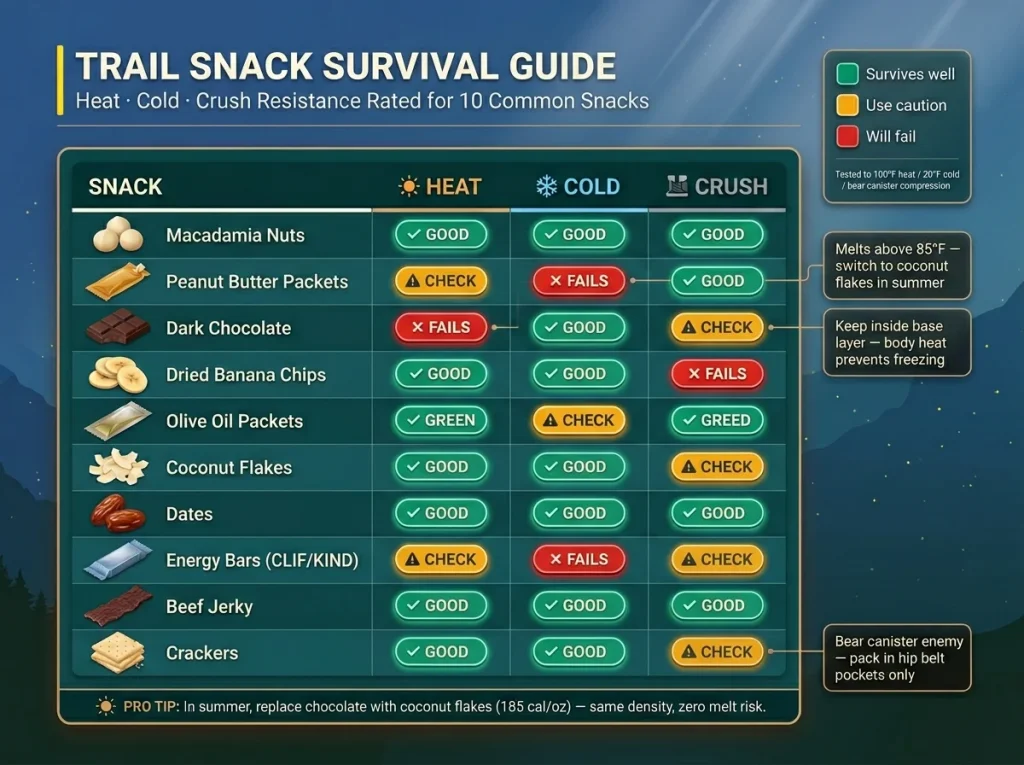
Above 85°F, your snack options narrow fast. Here’s what survives a full day in a sun-exposed pack:
Heat-proof (no issues above 100°F): Nuts (all varieties), dried banana chips, jerky, hard cheese (individually wrapped), tortillas, nut butter packets (consistency changes but stays edible), crackers, dried dates.
Heat-sensitive (problem above 85°F): Chocolate (any variety), granola bars with chocolate coating, soft cheese, anything with yogurt coating.
The USDA food safety guidelines for hikers put the hazard zone at 40-140°F for bacterial growth. Hard salami and hard cheeses can handle several days without refrigeration. Fresh meats and soft cheeses become risky after two hours in heat above 90°F.
Pro tip: In summer, swap chocolate for coconut flakes (185 cal/oz, zero melt risk). Same fat density, completely temperature-stable, lighter per volume.
Winter Snacks That Won’t Freeze Solid
Below 20°F, a different problem appears. Nut butter becomes a solid brick. Energy bars turn into hockey pucks that can crack a tooth. Even water bottles freeze overnight.
What still works frozen: nuts (texture unchanged), dark chocolate (actually easier to eat when cold), dried fruit, hard cheese, salami. These foods have either low moisture content or high fat content that prevents the texture change freezing causes.
What fails: nut butter packets (won’t squeeze), most bars (rock hard), any food with high moisture content.
The workaround for nut butter: keep packets inside your base layer while hiking. Your own warmth keeps them squeezable. At night, toss tomorrow’s snacks into the foot of your sleeping bag.
Crush-Proof vs Fragile (Bear Canister Reality)
If you’re carrying a bear canister — required in much of the Sierra, parts of the Rockies, and Adirondacks — volume matters as much as weight. Some calorie-dense foods waste space.
Bear canister-friendly (dense, compact, crush-proof): Nut butter packets, olive oil packets, hard cheese blocks, dried dates, tortillas (stack flat), coconut oil blocks.
Bear canister enemies: Crackers (crushed instantly), banana chips (shatter), loose trail mix (wastes air space between pieces), granola bars in bulky wrappers.
Pack your canister tight with dense, flat, crush-proof items. Save fragile snacks for hip-belt pockets or days when you’re not in canister-required territory. Ultralight pack organization applies to your food system too.
Building Your Snack System — A Sample Day
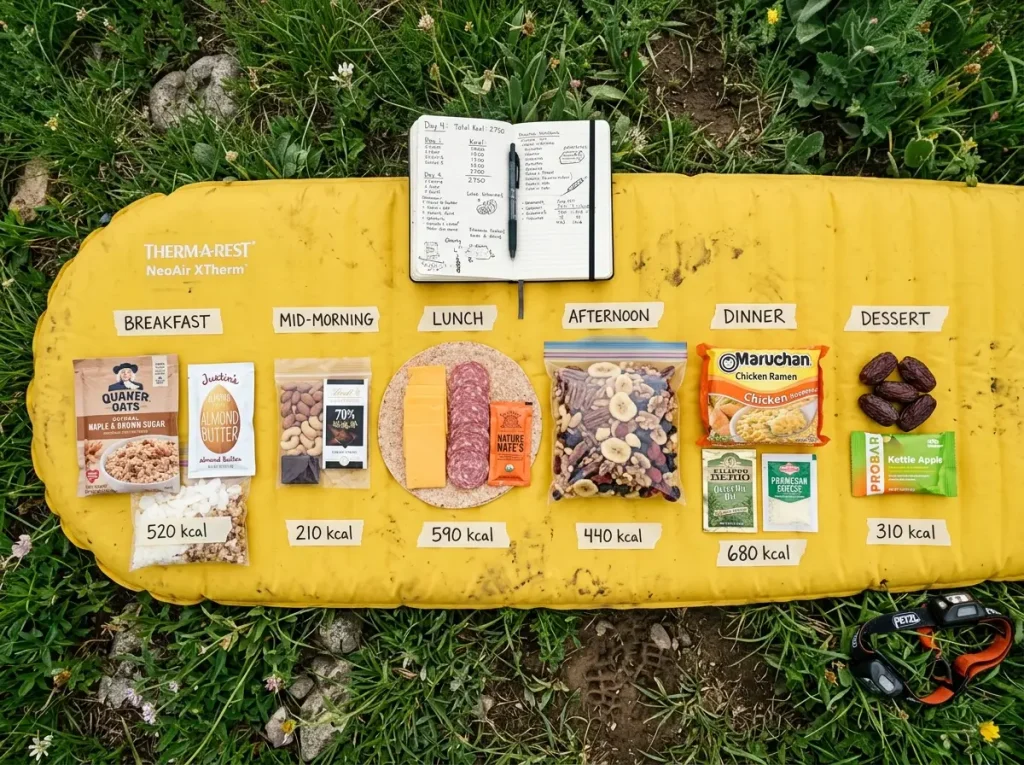
The All-Day Grazing Approach
The worst eating strategy on trail is three big meals. Your energy crashes between them, digestion competes with hiking effort during them, and you waste time stopping to cook twice during peak daylight.
The better approach: eat something every 60 to 90 minutes. Small amounts, consistently, all day. Keep your blood sugar steady instead of spiking and crashing. This is why hip-belt pockets and shoulder strap pockets exist — snack access without stopping.
Thru-hikers call this “grazing” and it works because you process small amounts of food more efficiently than large boluses. Caloric density matters even more for fastpacking where you literally cannot stop for meals without losing pace.
3,500-Calorie Day from Grocery Store Staples
Here’s a real day of trail food totaling roughly 3,500 calories at an average density of 140 cal/oz:
Breakfast (700 cal, 5 oz): Instant oatmeal packet + 1 PB squeeze pack + 1 oz coconut flakes + 1 honey packet
Mid-morning (400 cal, 2.5 oz): Handful of pecans (1.5 oz) + 3 dates (1 oz)
Lunch (550 cal, 3.5 oz): Flour tortilla + 1 PB packet + 1 oz dark chocolate chips
Afternoon snack (450 cal, 2.5 oz): Mixed almonds and macadamias (2 oz) + dried banana chips (0.5 oz)
Dinner (900 cal, 6 oz): Ramen packet + 2 olive oil packets + 1 oz parmesan + cheese slice
Evening (500 cal, 3 oz): ProBar Meal bar + 3 dates
Daily total: ~3,500 calories at roughly 25 oz (1.56 lbs). Average density: 140 cal/oz.
That’s significantly lighter than the “standard” 2.5 lbs/day most planning guides recommend — because every item was chosen for density, not convenience.
Cost Breakdown — Budget-Friendly Fuel
The day above costs approximately $9 to $11 at a regular grocery store. Compare that to packaged freeze-dried meals ($8-15 per dinner alone) and the math is obvious.
Long-distance thru-hikers eating commercial dehydrated meals spend $20-25 per day on food. The grocery store approach using calorie-dense staples runs $8-12 per day for equivalent calories.
Over a 5-month thru-hike, that’s a savings of $1,500 to $2,500 — enough to cover most of your gear budget. Peanuts, olive oil, tortillas, and instant noodles aren’t glamorous, but your wallet and your pack weight both benefit.
Conclusion
Three things to remember next time you’re standing in that gas station reading labels.
First, target 125 calories per ounce minimum for every food item in your pack. Anything below that is dead weight you’re hauling uphill for free. Nuts, nut butters, oils, and coconut flakes are your foundation.
Second, build a system, not a menu. All-day grazing with a mix of fast energy (dates, chocolate) and sustained fuel (nuts, oils) keeps you moving without bonking or crashing.
Third, factor in the conditions. Temperature, packability, and cost matter as much as raw cal/oz numbers. The best snack on paper means nothing if it’s chocolate soup in your pack or a frozen brick you can’t bite.
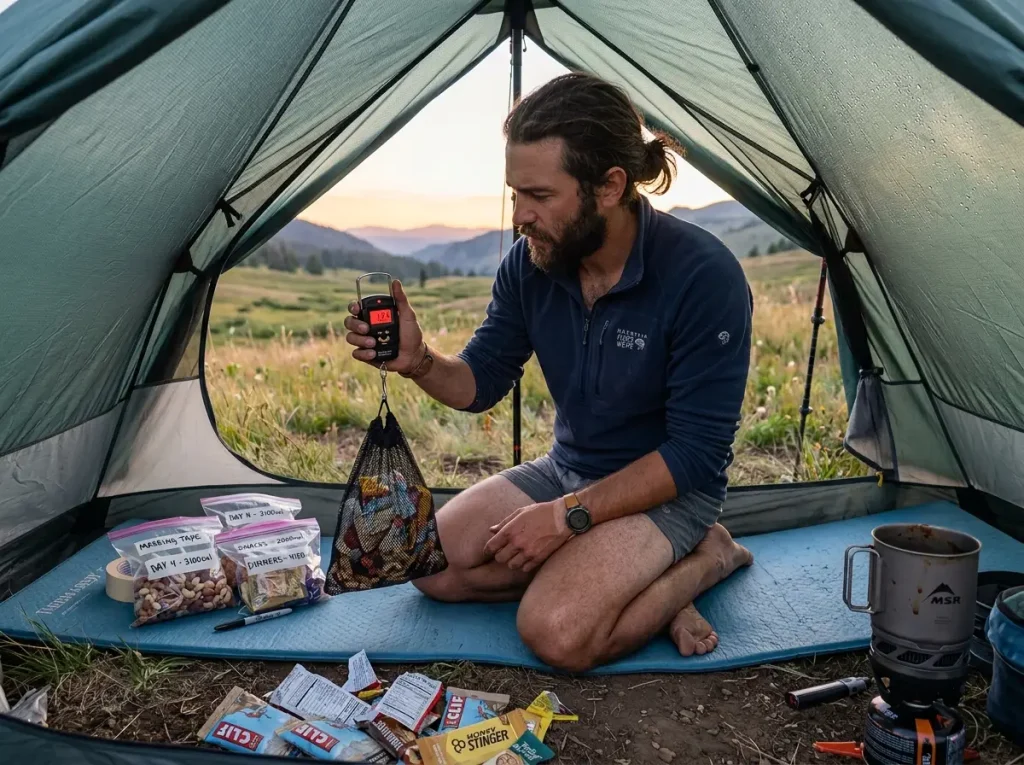
Weigh your current food bag this weekend. Divide total calories by total ounces. If your average is below 125 cal/oz, you now know exactly where to upgrade.
Q1 What is the best calorie to weight ratio food for backpacking?
Olive oil at 240 calories per ounce has the highest calorie-to-weight ratio of any packable trail food. For ready-to-eat snacking, macadamia nuts and pecans lead at 200 calories per ounce with no preparation needed.
Q2 How many calories per ounce should backpacking food have?
Target at least 125 calories per ounce for multi-day trips. Foods below 100 cal or oz are adding weight without proportional energy. Most thru-hikers aim for 125 to 150 cal or oz as their average across all carried food.
Q3 What snacks do thru-hikers actually eat every day?
Salted peanuts, peanut butter packets, tortilla wraps, dark chocolate, and olive oil packets make up the core of most thru-hiker snack systems. These combine high caloric density with availability at small-town gas stations and grocery stores along trail.
Q4 How many calories do you burn backpacking per day?
Most backpackers burn between 3,000 and 5,000 calories per day depending on terrain, pack weight, and build. A 160-pound hiker with a 25-pound pack covering 15 miles with moderate elevation burns roughly 4,000 to 4,500 calories.
Q5 Is trail mix actually calorie dense?
Standard grocery store trail mix averages 130 to 140 cal or oz — decent but below pure nuts. The dried fruit, pretzels, and candy pieces dilute the density of the nut content. Build your own mix heavy on macadamias, pecans, and coconut flakes to hit 170+ cal or oz instead.

I've spent more than a decade researching hiking gear and trail technique. I read the specs, the forum threads and the long-term reviews, and every pick here comes with what it gets wrong.
End of the trail
You read every mile of this one. Here's where the trail goes next.