
In this article
You are four miles into a steep climb on the Four Pass Loop. It’s 40°F out and drizzling—that miserable kind of cold rain. You put on your expensive waterproof technical shell to stay dry, but twenty minutes later, you feel that familiar, clammy slide of sweat down your back.
You aren’t leaking from the outside. You are soaking yourself from the inside due to moisture accumulation.
A wet base layer in these conditions is dangerous. Most hikers blame their rain shell for “failing,” but the reality is simpler. You are generating more heat than your layering system can handle.
In my twenty years teaching mountaineering, I’ve seen strong climbers hit a wall simply because they overheated, soaked their insulation, and then froze the second they stopped moving. The difference between a bad day and a great hike often comes down to a fourteen-inch pit zip under your arm. It is the only reliable bridge between your hot body and the cold air outside to regulate core temp.
Why do “breathable” waterproof jackets fail during high exertion?

Marketing teams have spent millions convincing us that WPB fabrics (Waterproof/Breathable) are magic. They claim materials like Gore-Tex ProShell or eVent membrane can block a storm while letting your moisture vapor pass right through. But human thermodynamics has strict rules, and no ad campaign can change them.
Why does my sweat get trapped inside even high-end gear?
The reason your jacket stops breathing is simple. For moisture to move through a membrane, there needs to be a difference in humidity. Moisture naturally wants to move from a wet place to a dry place.
However, during heavy rain or when you are working hard in a damp forest, the air outside is 100% humid. This creates a traffic jam. Because the air outside is just as wet as the air inside your jacket, the MVTR (Moisture Vapor Transmission Rate) drops to zero. It doesn’t matter if you are wearing a premium Haglofs L.I.M Lark or a Montbell Peak; if the pressure is equal on both sides, the chemical “breathability” stops working.
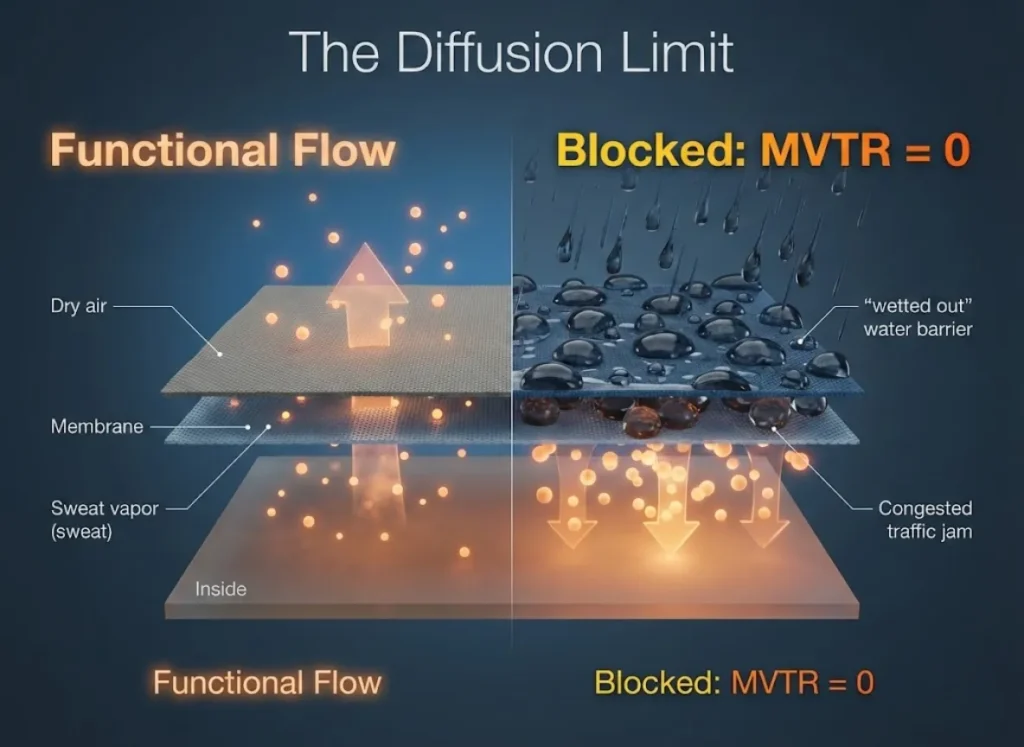
This problem gets worse when the jacket suffers from “wetting out.” This happens when the outer fabric soaks up water and looks dark because the DWR (Durable Water Repellent) coating has failed. That layer of water acts like a wall, blocking the pores that are supposed to let steam escape, regardless of the fabric’s hydrostatic head rating.
At this point, research on exercise under heat stress indicates that high humidity negates evaporative cooling. Your high-tech shell essentially becomes a plastic bag, creating a sauna effect.
When the fabric physically cannot breathe, you are left with a sealed container. This is why analyzing the Gore-Tex vs eVent performance data is useful for dry climates, but in a downpour, mechanical venting via pit zippers is the only way to get moisture out.
How does the physiology of the armpit influence core temperature?
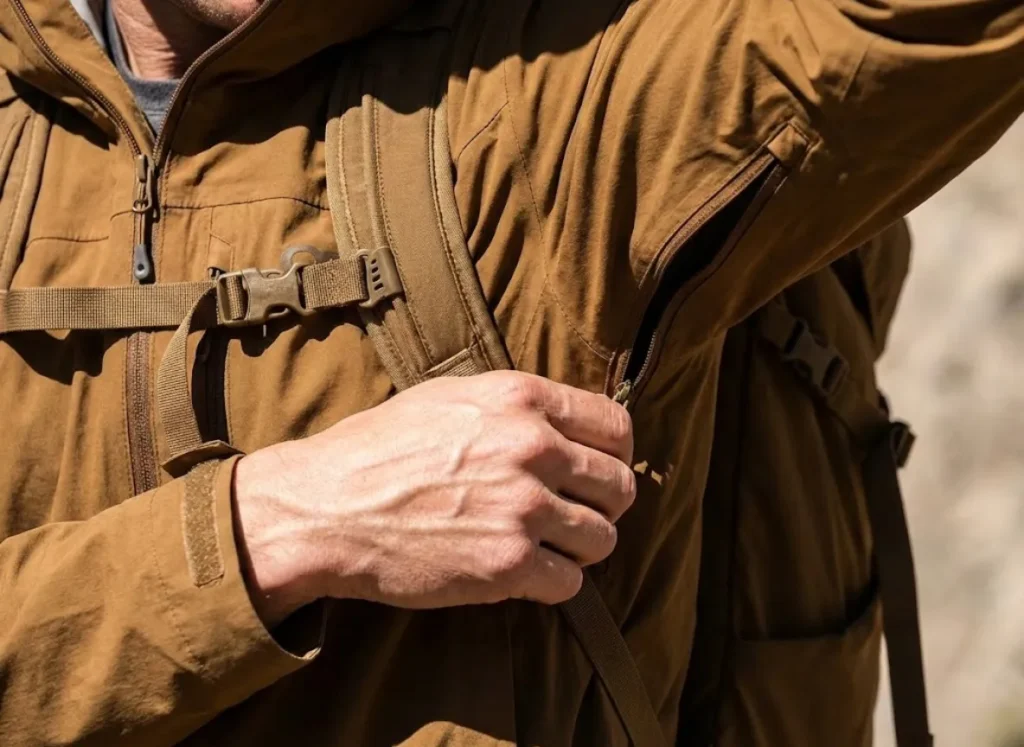
We focus on the underarm vents not because they are convenient, but because of physiological placement. Thermal mapping shows the armpit is a biological weak point. Understanding your own anatomy explains why active ventilation here is more effective than just unzipping the front of your jacket.
Why is the axillary region a critical “heat sink” for the body?
Your armpit houses the axillary artery, a massive vessel that carries a lot of warm blood from your heart to your arms. Unlike the arteries in your legs, which are buried under thick muscle, this artery runs very close to the skin.
This creates a perfect window for temperature control. By exposing this area to cool air, you cool the blood right before it returns to your heart. This lowers your overall core temperature much faster than trying to cool down through your back or chest, which are insulated by muscle and fat.
Pro-Tip: If you feel your hands swelling slightly while hiking, it’s often an early sign of overheating. Your body is pumping blood to your extremities to dump heat. Open your pit zips immediately, even if you don’t feel “hot” yet.
Your armpit is essentially a heat factory. Covering this area with a jacket that has no core vents creates a trapped pocket of hot air that can overheat your whole system. A computational assessment of axillary artery perfusion confirms that this area is a thermal highway for blood flow science. If you block it, you trap heat at the source. This is why mastering the science of layering means looking at your clothes as a ventilation system to maintain homeostasis.
What happens when sweat glands in the pit are blocked?
The human armpit is a swamp waiting to happen. It is packed with sweat glands and lymph nodes. But remember, sweat only cools you down if it evaporates ( evaporative cooling). It needs to turn from liquid to gas to take heat away from your skin.
When your arm is pinned against your side by a jacket, the air in that micro-environment instantly becomes 100% humid. Evaporation becomes impossible. Your body, sensing the heat buildup, keeps sweating to try and cool down. This leads to dehydration and wet layers.
The danger comes when you stop hiking. That warm liquid turns cold instantly. This “after-drop” pulls heat from your core, raising the risk of hypothermia. You must prevent your active layer from getting wet in the first place. If you are already looking up treating hypothermia on the trail, you have likely ignored your pit vents for too long.
How does mechanical ventilation utilize physics to clear moisture?
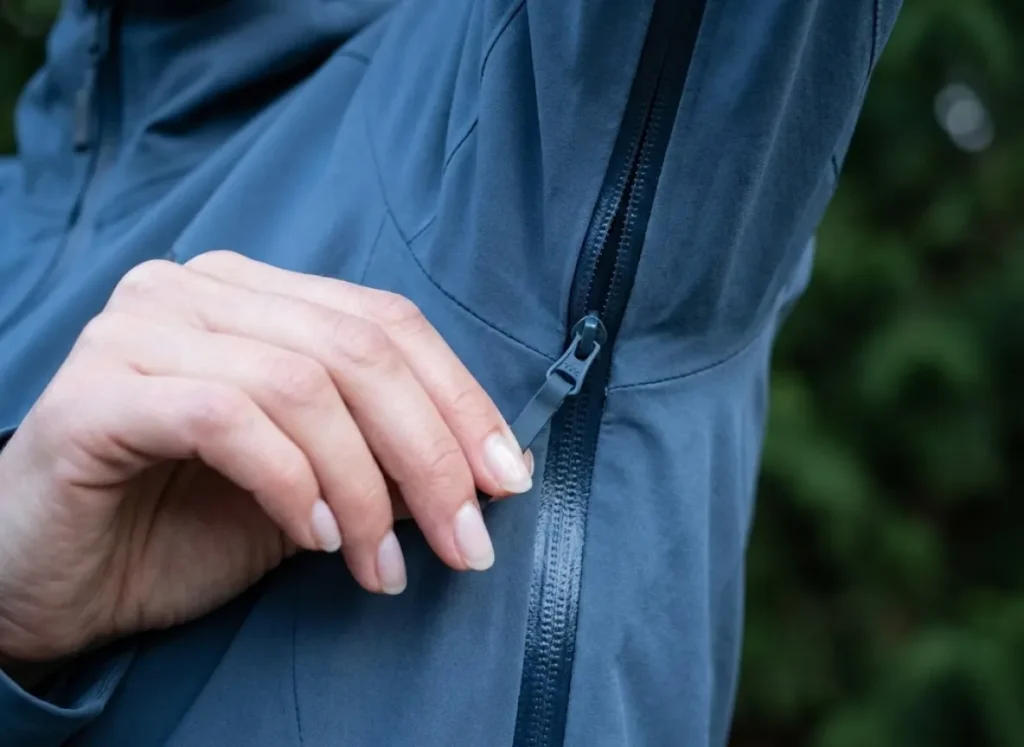
Fabric breathability relies on moisture slowly drifting through the material. Active ventilation—opening a hole—relies on airflow. Airflow is fast, aggressive, and works regardless of how wet it is outside.
What are the “Chimney” and “Bellows” effects in hiking gear?
To move air, we use two simple concepts. The first is the Chimney Effect. Heat rises. By loosening the bottom of your jacket and opening the pit zips, you create a draft. Cool air sucks in from the bottom, and hot, moist air shoots out the top pit vents.
The second is the Bellows Effect. This uses your movement. As you swing your arms and twist your body, you squeeze the air inside your jacket. This actively pumps air in and out of the side zips.
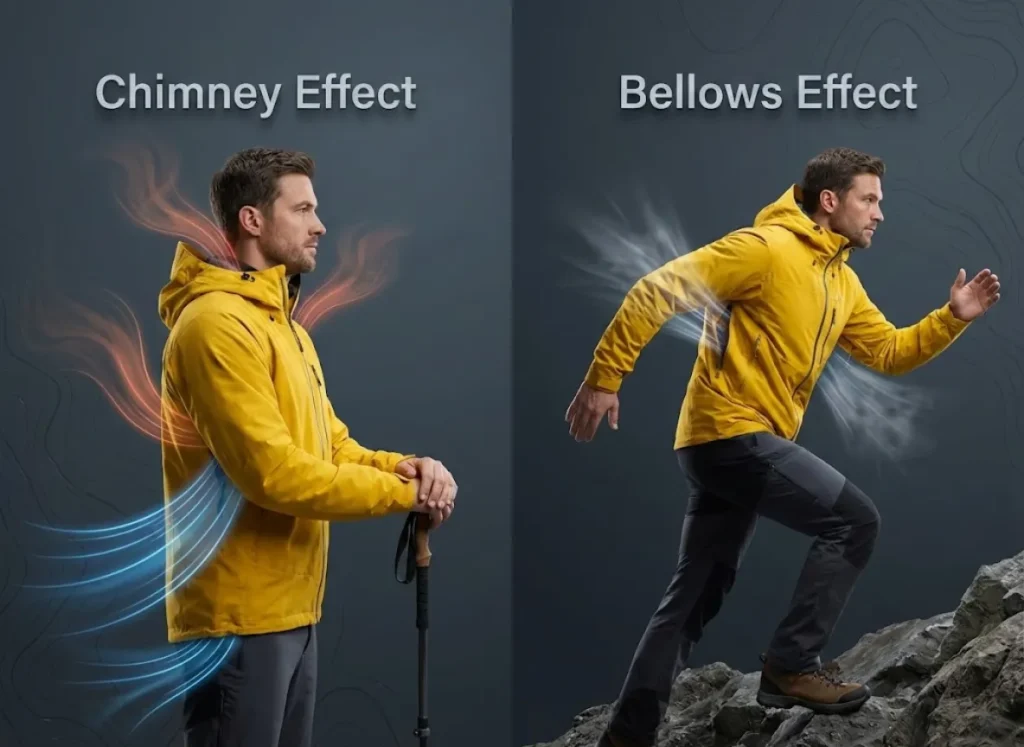
Unlike fabric breathability, which is passive, mechanisms of dry heat loss via convection move large amounts of air ( convective heat loss). You can “flush” your jacket instantly by pumping your arms during a steep climb. This reliability is why, when choosing the best rain jacket for hiking, I always look for big vents over fancy fabric claims.
How do “TorsoFlow” vents differ from standard pit zips?
Standard pit zips are usually small, about 10–12 inches. They are common on standard gear like the Marmot PreCip Eco, Columbia Watertight II, or the Arc’teryx Zeta SL. They work, but they have limits. Some brands, like Outdoor Research, use “TorsoFlow™” vents (seen on the Outdoor Research Celestial or Foray). These unzip from the bottom hem all the way up to the bicep.
This design lets you open the entire side of the jacket. It effectively turns a hard shell jacket into a poncho. This gives you maximum airflow across your sides while the hood and shoulders still protect you from rain.
Pro-Tip: Use “Poncho Mode” when wearing a heavy pack. Unzip the sides fully and pull the front panel of the jacket over your backpack’s hip belt. This prevents the belt from blocking airflow at your waist and allows massive ventilation up your torso.
This is a huge advantage for backpacking in humid weather. Standard zips often get pinched shut by backpack straps. Full-side vents allow you to modify skin blood flow and local temperature efficiently. When you are choosing a backpacking backpack, check how the straps sit on your jacket. If the hip belt covers your vents, you are going to overheat.
Note: Some ultralight jackets, like the original Outdoor Research Helium II, skip these vents to save weight. While light, they often suffer from poor airflow management during active use. Conversely, pairing a vented shell with a grid fleece like the Patagonia R1 or The North Face FutureFleece maximizes the effectiveness of rapid heat dumping.
Advanced Shell Ventilation Hierarchy
Comparison of moisture management technologies from passive diffusion to unrestricted mechanical airflow.
Mechanism: Diffusion
Relies on humidity gradients. Vapor molecules move through solid or microporous barriers (Gore-Tex, H2No). Best for total windproofing.
Limitations & Verdict
High failure risk in 100% humidity or when face fabric wets out. Low efficiency in wet conditions; requires mechanical vents to prevent overheating.
Mechanism: Nano-Convection
Millions of microscopic holes allow direct air passage. Found in Futurelight and Pertex Shield Air. Constant airflow aids diffusion.
Performance Score: 5/10 to 9/10
Great for consistent output like ski touring. Superior to standard diffusion but lacks the “dump” capability of open mechanical vents.
Mechanism: Bellows Effect
10–14 inch underarm apertures. Arm movement pumps air in while the chimney effect exhausts heat. Essential for 3-layer shells.
Protection & Score: 7/10
High reliability. Works regardless of humidity. Prevents internal sweat saturation even if minor water ingress occurs in horizontal rain.
Mechanism: Poncho Mode
Hem-to-bicep zippers allow the jacket to drape over pack straps. Creates a massive intake vent at the waist for unrestricted airflow.
Verdict: 10/10
Near-zero heat retention while moving under load. Negates the “clammy” feel of fabrics physically. Ideal for high-exertion mountaineering.
Final Thoughts
We often look for the “perfect” fabric that keeps us dry, but in high exertion situations, that fabric does not exist. The laws of physics mean that in heavy rain or sweat, breathable membranes stop breathing.
Comfort comes from managing your heat manually. By using the natural heat dumping power of your armpits and the airflow of zippers, you can control your temperatures. Adopt the “Start Warm, Vent Early” rule. Don’t wait until you are sweating to unzip. Manage your heat as carefully as you manage your water supply, and you will arrive at camp drier and warmer.
For more insights on building a solid layering system, explore our library of hiking gear guides to refine your kit for the next trip.
FAQ – Frequently Asked Questions about Pit Zips and Core Temp Regulation
Do pit zips allow rain to enter the jacket?
It is physically possible, but your arm usually acts like an awning, blocking most direct rain. A few drops of rain getting in is much better than soaking yourself with sweat from the inside because you didn’t vent.
Can I use pit zips instead of taking off a layer?
Yes. This is often better than stopping to take clothes off because you can keep moving. This technique, called dumping heat, lets you wear your shell comfortably for longer periods.
Are new fabrics like Futurelight a replacement for pit zips?
For steady, moderate activity like skiing, air-permeable fabrics (like The North Face Futurelight or Pertex) are great. But for stop-and-go hiking or backpacking in humid rain, mechanical pit zippers are still the only way to guarantee airflow when the fabric gets soaked.
What is the best way to use pit zips with a backpack?
Make sure your backpack straps aren’t pinching the zip shut. Use Poncho Mode if your jacket allows it (draping the front over the hip belt). Open the pit vents before you feel hot to stop sweat from building up in the first place.
Risk Disclaimer: Hiking, trekking, backpacking, and all related outdoor activities involve inherent
risks which may result in serious injury, illness, or death. The information provided on The Hiking Tribe is for
educational and informational purposes only. While we strive for accuracy, information on trails, gear, techniques,
and safety is not a substitute for your own best judgment and thorough preparation. Trail conditions, weather, and
other environmental factors change rapidly and may differ from what is described on this site. Always check with
official sources like park services for the most current alerts and conditions. Never undertake a hike beyond your
abilities and always be prepared for the unexpected. By using this website, you agree that you are solely
responsible for your own safety. Any reliance you place on our content is strictly at your own risk, and you assume
all liability for your actions and decisions in the outdoors. The Hiking Tribe and its authors will not be held
liable for any injury, damage, or loss sustained in connection with the use of the information herein.
Affiliate Disclosure: We are a participant in the Amazon Services LLC Associates Program, an
affiliate advertising program designed to provide a means for us to earn advertising fees by advertising and linking
to Amazon.com. As an Amazon Associate, we earn from qualifying purchases. We are also an official affiliate partner
of Black Diamond Equipment via the AvantLink network. If you click on a Black Diamond affiliate link and make a
purchase, we may earn a commission at no additional cost to you. We also participate in other affiliate programs and
may receive a commission on products purchased through our links. Additional terms are found in the terms of
service.