











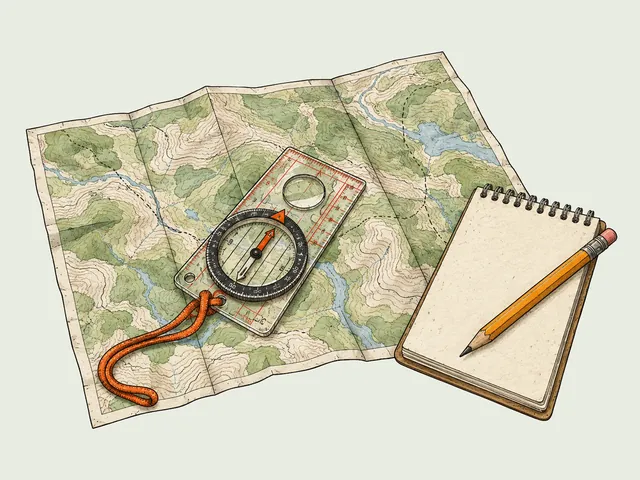



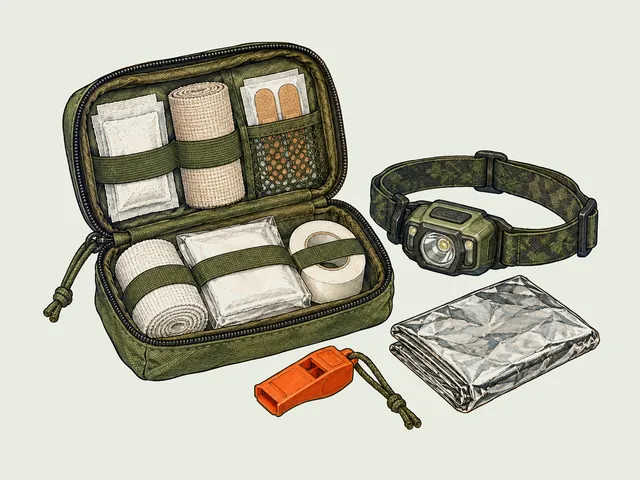




You’re eyeing a fast loop this weekend, and you’re stuck between a featherweight running vest and the daypack already sitting in your closet. Most people agonize over capacity charts and strap diagrams to settle this. They’re solving the wrong problem. The choice almost never comes down to the spec sheet, and it comes down to one thing nobody prints on the hangtag: your pace. Ask anyone who’s run their flasks dry two hours into a hot, exposed trail with the car still a ridge away. Here’s the decision rule that actually works, the real water and capacity limits of each, and concrete picks for the vest, the daypack, and the hybrid most fast hikers end up wanting.
Here’s how the two systems stack up before we get into which one your pace actually calls for:
| Feature | Running Vest | Daypack |
|---|---|---|
| Capacity | Around 5 to 12L | 15 to 25L and up |
| System weight | Very light (roughly 8 to 12 oz) | Heavier (1.5 to 3 lb) |
| Water carried | Front soft flasks, about 1 to 1.5L comfortably | Bladder plus bottles, 2 to 3L+ |
| Waist support | Thin bounce strap, no load transfer | Real hip belt carries weight on your hips |
| Bounce at a jog | Locked to the torso, minimal | Shifts and jostles once you run |
| Hot-day comfort | Full-torso wrap traps heat | Ventilated back runs cooler |
| Best for | Actual running, short fast loops | Loaded, long, or hot all-day hikes |
What Actually Sets a Running Vest Apart from a Daypack
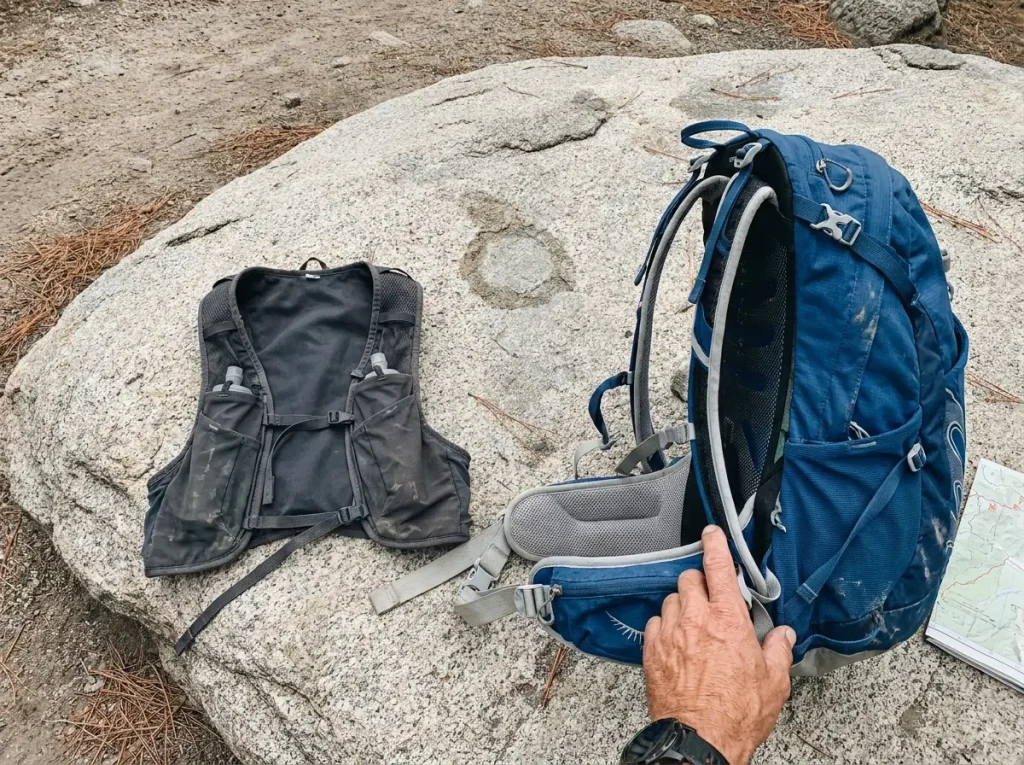
Strip away the marketing and these are two genuinely different tools, not two sizes of the same thing. Knowing what each one physically does is the whole game, because once you see it, the right choice gets obvious fast.
The Running Vest, Defined
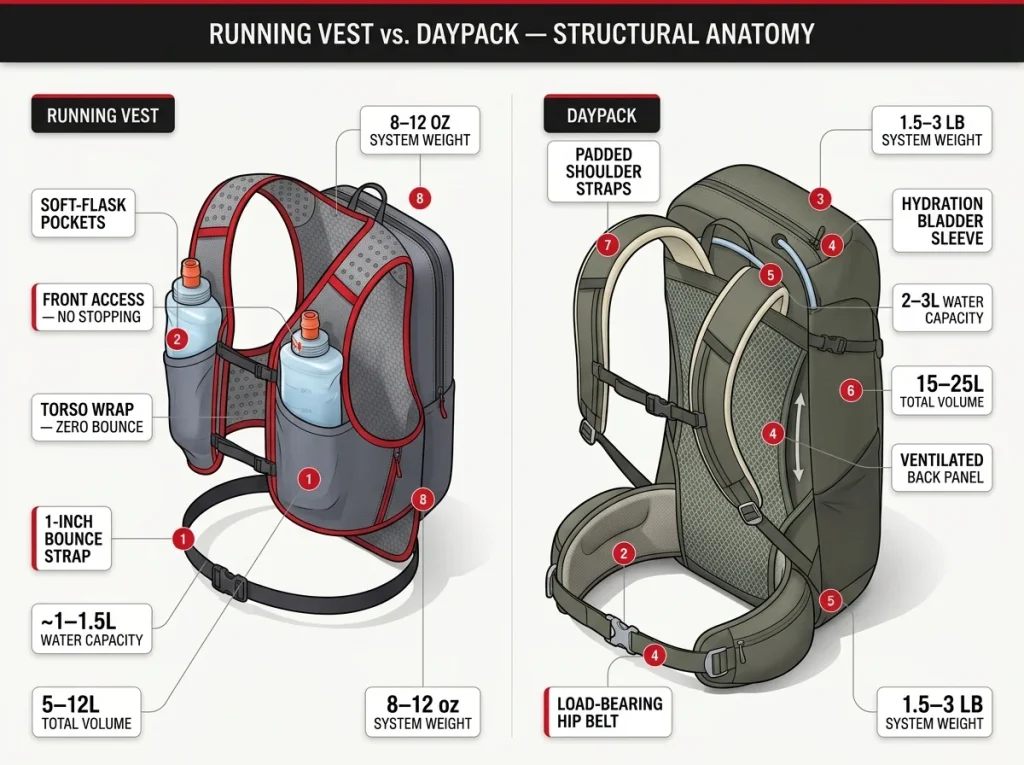
A running vest, sometimes sold as a hydration vest or running backpack, is a snug harness that wraps your whole torso, usually holding 5 to 12 liters. Your water rides up front as soft flasks, those collapsible bottles tucked into the chest pockets, and two 500ml flasks give you roughly a liter within easy reach. The build is frameless and feather-light, often 8 to 12 ounces empty. The point of the design is that it moves with your body and barely registers that it’s there.
That front access is the vest’s signature trick. You can drink, grab a gel, or stash a phone without breaking stride, the kind of grab-without-stopping convenience a vest is built around.
The Daypack, Defined
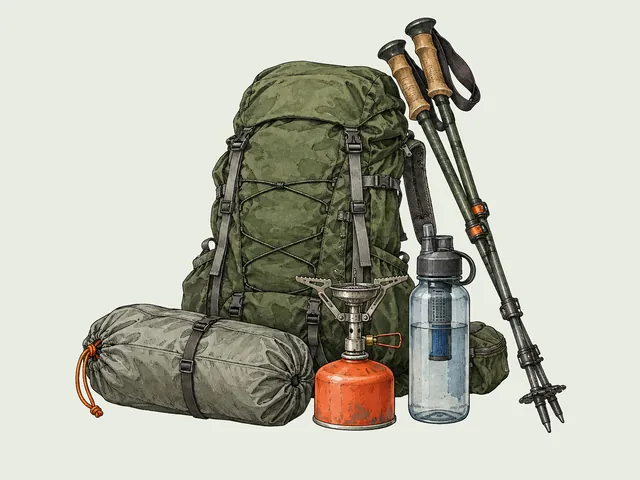
A daypack runs 15 to 25 liters or more, with padded shoulder straps, a ventilated back panel, and an actual load-bearing hip belt. That extra volume swallows a 2 to 3 liter bladder plus layers, food, and the rest of your kit with room to spare. It rides higher and heavier, but it carries real weight without punishing your shoulders.
The cooler, ventilated back is the daypack’s quiet advantage, and it matters more than people expect on an exposed climb in the sun.
That Thin Waist Strap Is Not a Hip Belt
Here’s where a lot of folks get fooled. Many running packs have a thin, roughly one-inch waist strap, and people crank it down expecting their shoulders to get some relief. It never comes. That webbing is a bounce strap, built to stop the pack from jostling when you run, and it does nothing to transfer load to your hips. A true hip belt is a different animal, the way a real suspension system moves weight off your shoulders and onto the strongest part of your body.
So you’ve got a spectrum: minimalist vest on one end, loaded daypack on the other, and a middle ground most people don’t know exists yet. Picking well here is really just one decision inside the bigger skill of choosing a hiking backpack that fits.
The One Question That Decides It, Are You Actually Running?

Forget the spec war for a second. The fastest way to settle the vest-versus-daypack argument is to answer one honest question: am I actually running, or just hiking fast? That single answer does more work than any comparison chart, and it’s the thing experienced trail folks ask before they say a word about liters. This fast-but-not-racing zone goes by a few names, fastpacking and speed hiking among them, and it’s exactly where the question gets interesting.
The 3.5 MPH Line
There’s a rough threshold where the math flips. Under about 3.5 mph, in real power-hiking territory, a daypack rides just fine and you barely notice the weight shift. Once you start jogging the flats and shuffling the ups, that same pack turns against you. The honest gut-check from people who do this a lot is simple: if your feet are leaving the ground in a real running gait, you want a vest. If they’re not, you have options.
What Bounce Actually Does to You
Bounce is the pack shift and jostle that makes running with the wrong load miserable. It’s not just annoying. Every step, the weight lifts and drops against your back and shoulders, breaking your rhythm and rubbing the same spots raw mile after mile. A vest kills bounce by hugging your ribs so the load moves as one piece with you. A loaded daypack can’t, no matter how hard you cinch it, though setting the sternum strap at the right height buys you a little stability at a brisk walk.
The Removable Belt Proves the Point
Want proof the line is about pace and not specs? Look at how the best vest-harness packs are built. They give you a removable waist belt, on for running to control bounce, off the moment you downshift to fast-hiking. The gear itself is telling you the truth: the decision tracks your speed, not the number on the tag.
Do the gut-check on your actual trail, not your intentions. Plenty of hikers buy a vest for the “running” they plan to do, then walk the whole thing and wish they had pockets for layers and lunch. Pick for the pace you really move at, not the one you mean to.
The Running Vest, Who It’s Really For
A vest is glorious for the right job. It shines on genuine trail running, short fast loops, and water-rich trails where you don’t need to haul three liters at once. The torso wrap delivers zero bounce, a fit that breathes with you, and that front-flask access you can use on the move.
It has a ceiling, though, and it’s worth knowing before you buy. The same wrap that locks out bounce traps heat against your chest, and the flask water runs out faster than you’d think on a hot day. Size it by your chest but leave room for a base layer, or you’ll find the chafe on a sweaty exposed climb that nobody warned you about.
The Premium Vest, Salomon Active Skin 12
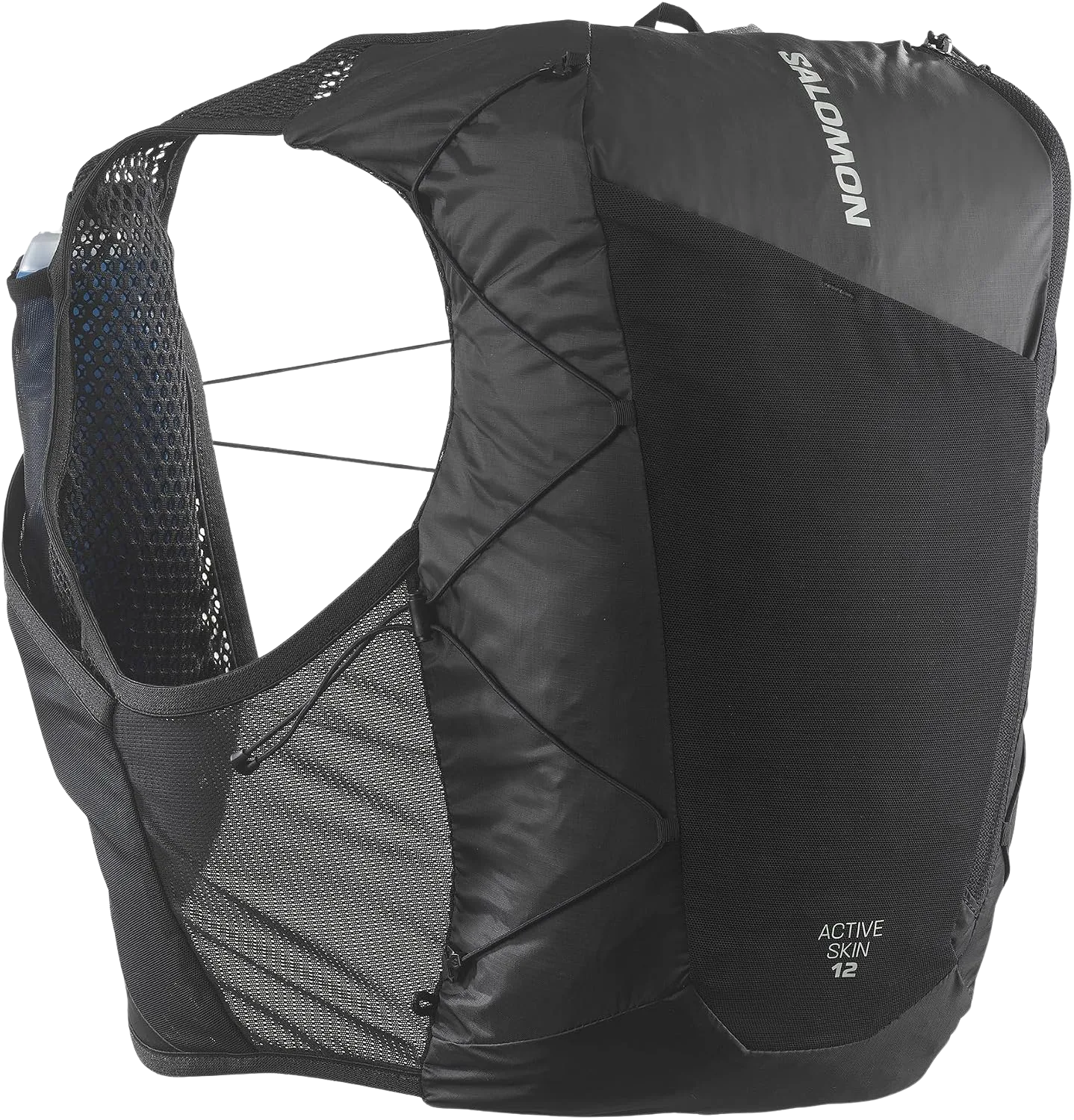
The Active Skin 12 is the vest a lot of trail runners measure everything else against. The 12 liters is generous for the category, enough for a wind shell and snacks alongside the flasks, while the harness stays glued to your back over rough ground. It earns its premium spot on fit, and you feel it on the first descent when nothing shifts.
The Value Vest, Nathan TrailMix 12
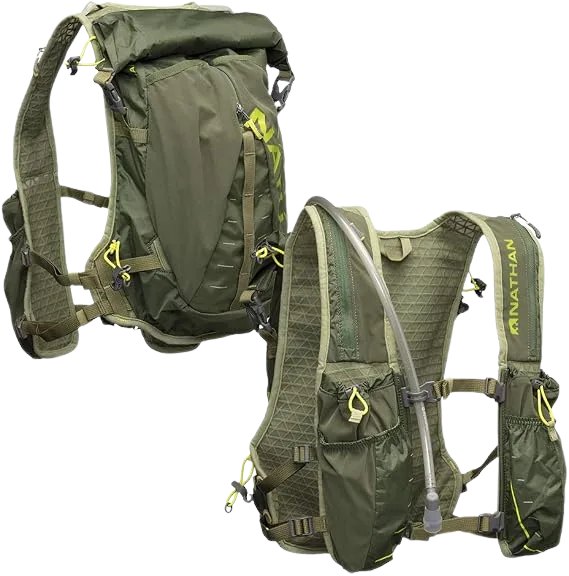
What makes the TrailMix the budget vest worth starting with is the included hydration bladder. Where a flask-only vest leaves you around a liter, the 2L reservoir nudges you into safer territory for a longer fast hike. The fit isn’t quite as locked-in as the Salomon over technical ground, but for most people testing whether they even like a vest, it’s the honest place to start.
The Daypack, Capacity, Load, and a Cooler Back
The daypack is the unglamorous workhorse, and it quietly wins the hard days. It’s the right call when you’re carrying real weight: a loaded day, longer mileage, a hot exposed trail, or any hike where you need two to three liters of water plus layers, food, and the Ten Essentials. None of that fits in a vest.
The real hip belt is the difference-maker. It puts the bulk of the load on your hips so your shoulders aren’t doing all the work by lunch, and the ventilated back panel keeps air moving where a vest would have you soaked. If you tend to carry a lot, the daypack isn’t the boring choice, it’s the comfortable one.
When a Daypack Wins
Match your liters to the trip, not your ambition. Ten to twenty liters is the day-hike sweet spot, and you only need to push toward thirty if you’re hauling lots of layers or flexing toward a light overnight. Buying more volume than you’ll fill just adds weight and tempts you to overpack. If you want to dig into the size question, whether you really need a 20L or a 30L is worth a closer look, and so is knowing where a daypack ends and a backpacking pack begins.
Try the daypack already in your closet before you spend a dime. If it rides okay at your real pace, you don’t need a vest at all. The cheapest good pack is the one you already own, and there’s no commission line that changes that.
The Ventilated Daypack, Osprey Talon 22 and Tempest 20
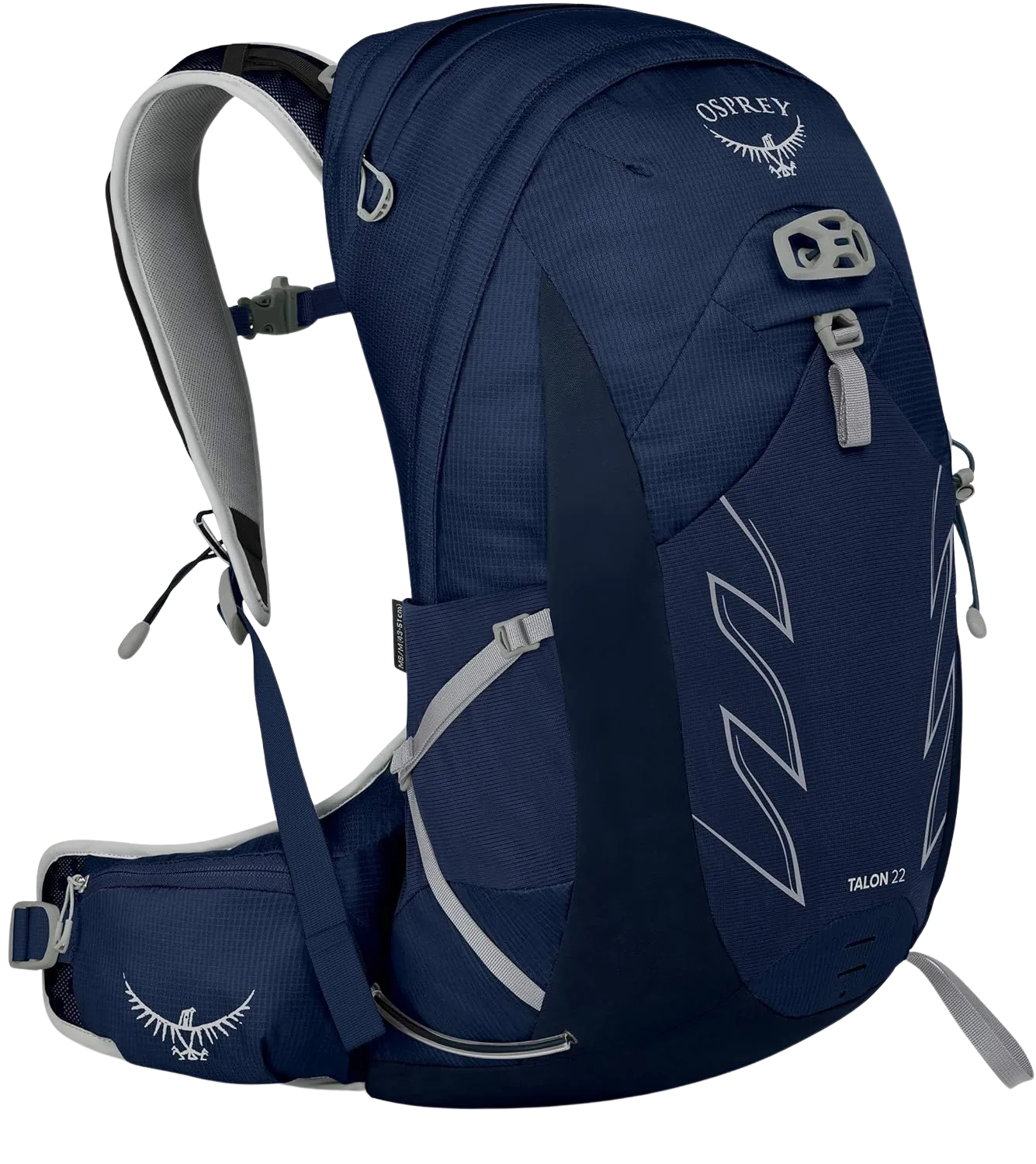
The Talon and Tempest line has been a default day-hike recommendation for years, and the reason is balance. You get enough capacity for a full day with water and layers, a back that breathes, and a belt that actually works, all without the bulk of a backpacking pack. It’s the pack most loaded fast-hikers should reach for.
The Budget Daypack, ZOMAKE 25L
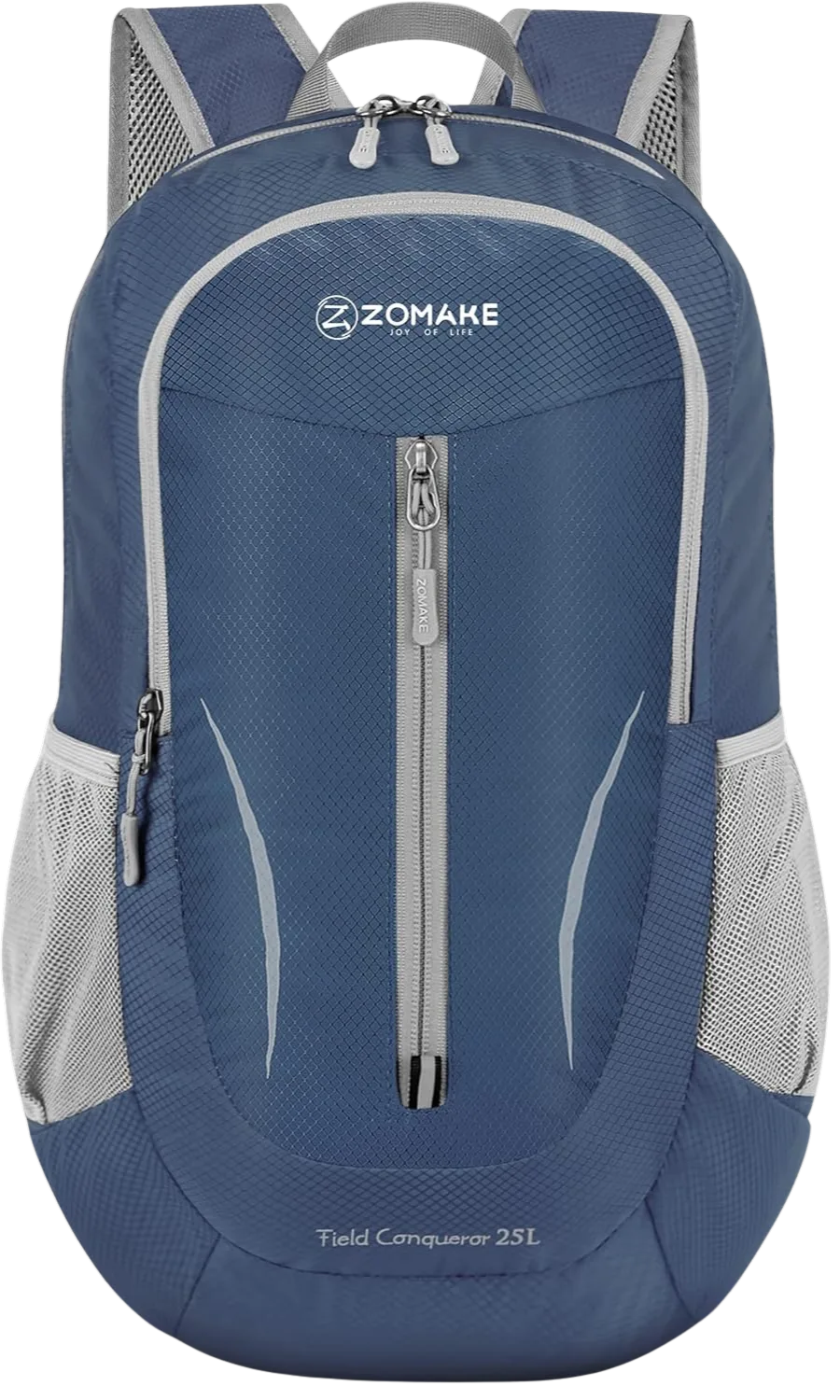
If money is the deciding factor, the ZOMAKE proves you don’t need to spend much to get out the door. It won’t carry a heavy load in comfort, but for a casual fast hike with a couple of liters and a snack, it’s plenty, and it disappears into a pocket when you’re done.
The Water Math That Quietly Breaks the Vest
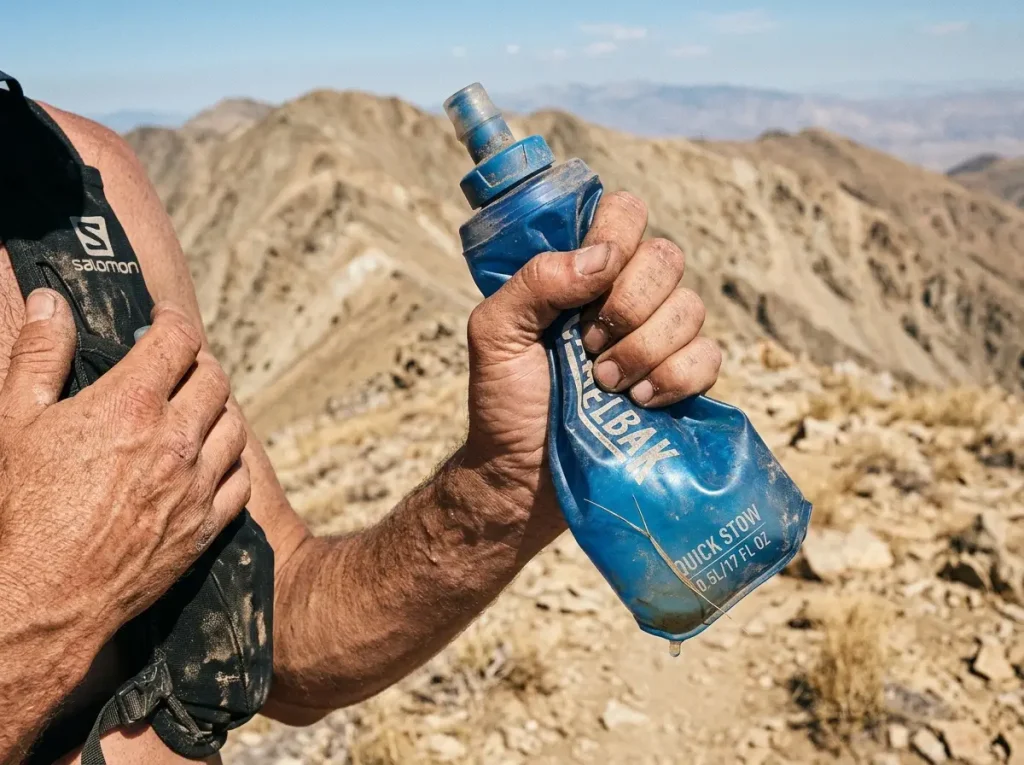
Here’s the gotcha nobody advertises. A vest can feel perfect for the first two hours, then your flasks run dry with no creek in sight and you’re still hours from the car. It isn’t a fit problem or a fluke. It’s arithmetic, and it’s the single most common reason the vest is the wrong call.
Start With the Per-Hour Math
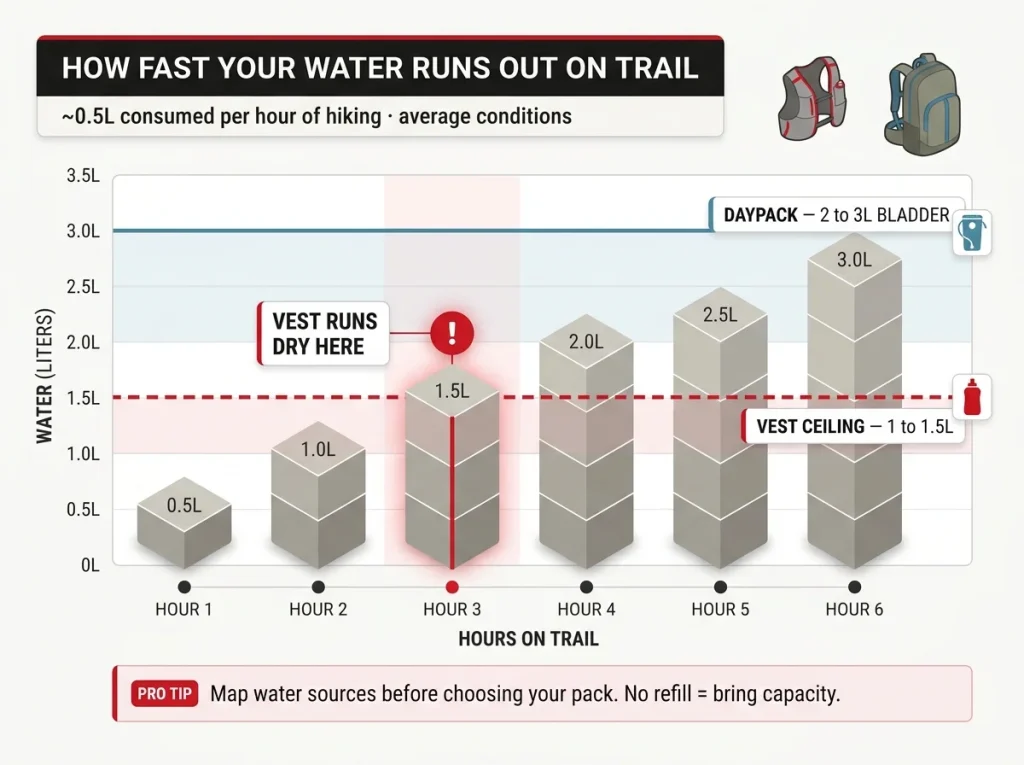
On an average day, you’re drinking roughly half a liter for every hour you’re moving, and a hot, strenuous pace pushes that toward a full liter an hour. REI’s hydration guidance puts the baseline near half a liter per hour, which is the number to plan around. Most hikers need two to three liters across a day, and a hot dry day blows past three.
Where the Vest Runs Dry
Now run the numbers against a vest. Two 500ml soft flasks give you about a liter, maybe a liter and a half if you stuff a small bladder in back. On a four-hour hot loop with no water source, you need two liters or more, and the vest simply can’t carry it. No amount of comfort fixes a water deficit. This is why the heat that quietly spikes how much you actually drink can turn a lovely vest into a liability by mile four.
The Refill Workaround
There’s a real out, and it’s about the trail, not the pack. On a water-rich route, a lightweight filter lets you run a vest and top off at every creek, so the low capacity stops mattering. On a dry ridgeline with nothing to filter, that strategy collapses and capacity wins, which means a daypack or a hydration pack built around a bigger reservoir. Read the water on your route before you trust your flasks.
Map your water before you pick your pack. Pull up the route, find the reliable creeks or springs, and count the dry stretch between them. A long carry with no refill is the clearest signal there is to leave the vest home and bring capacity.
Don’t Let “Fast” Talk You Out of the Ten Essentials
A fast hike is still a hike, and the mountain doesn’t grade on speed. The temptation with a minimal vest is to leave behind the gear that keeps a small problem from becoming a serious one. That’s the hidden cost of going ultra-light, and it’s worth facing head-on before you size down.
The Ten Essentials Are Systems, Not Items
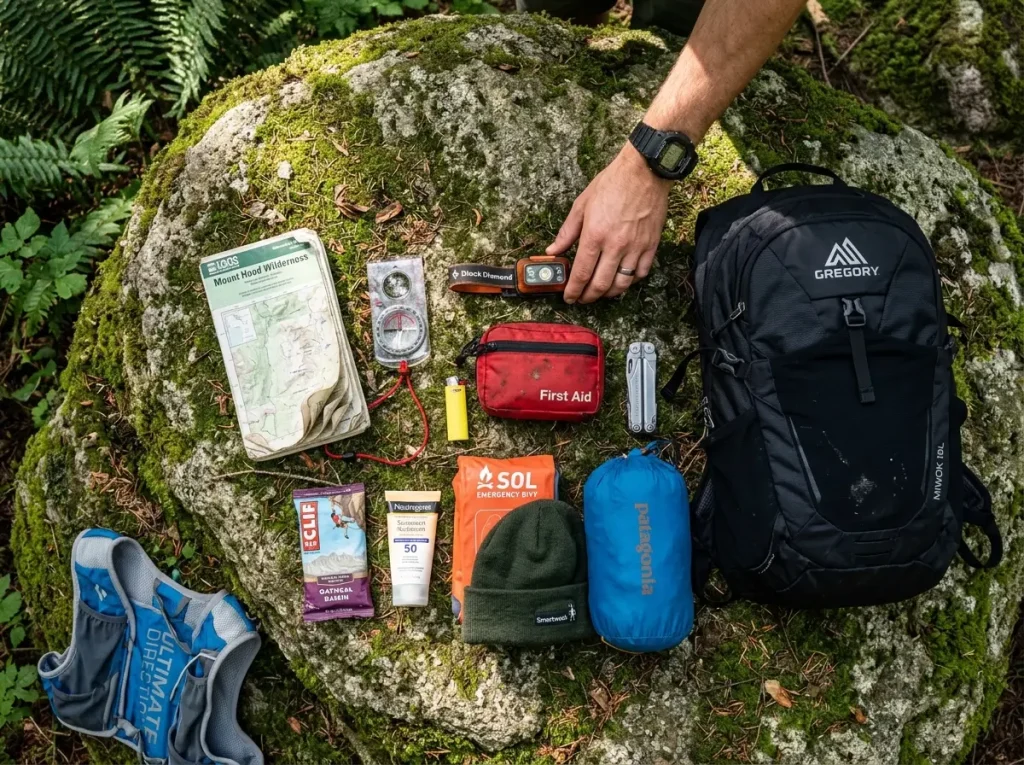
The smartest way to think about preparedness is as systems, not a packing list. The National Park Service still lists the Ten Essentials for any day hike: navigation, hydration, nutrition, insulation, illumination, first aid, fire, tools, sun protection, and emergency shelter. A “fast” day hike needs every one of those systems just as much as a slow one, and you can walk through a full day-hiking checklist of those ten systems to see how light each one can actually be.
What a Sub-10L Vest Forces You to Drop
Try to stuff ten systems into a sub-10-liter vest and something gives. Usually it’s the insulation, the headlamp, the first aid, or the emergency shelter, the exact things you’ll want if the weather turns or you roll an ankle near dusk. The vest didn’t lie to you, it just doesn’t have the room. Going minimal is a choice, and the cost is preparedness, so make it with open eyes.
The Heat Nobody Warns You About
There’s a comfort tradeoff too. The full-torso wrap that kills bounce also traps heat and sweat against your chest and ribs, and on a hot exposed day that wrap feels like a wet blanket. A daypack’s open, ventilated back wins outright in those conditions. So “fast” should change your pace, not your preparedness: fit the Essentials first, then choose the smallest system that genuinely holds them. For a lot of hikers, that math is exactly what nudges them toward the middle option.
The Honest Middle, Why a Run-Hike Pack Is the Real Answer
Nobody selling you a clean “vest or pack” choice wants to admit this, but most people doing fast day hikes want neither extreme. They want the thing in between, and it exists: the run-hike pack, a vest-style harness built onto a real 15 to 25 liter body. It’s the honest answer the spec wars skip right over.
What a Run-Hike Pack Actually Is
Picture a vest’s bounce-free harness and front-pocket access stretched over enough capacity to hold two liters of water, your full layering system, and the Ten Essentials, with a removable waist belt you snap on for running and pull off for fast-hiking. You get the vest fit and the daypack’s room in one pack. It lives at the frameless, ounce-counting end of the pack spectrum, so it stays light while carrying a real day’s load.
The Hybrid Pick, Black Diamond Distance 22
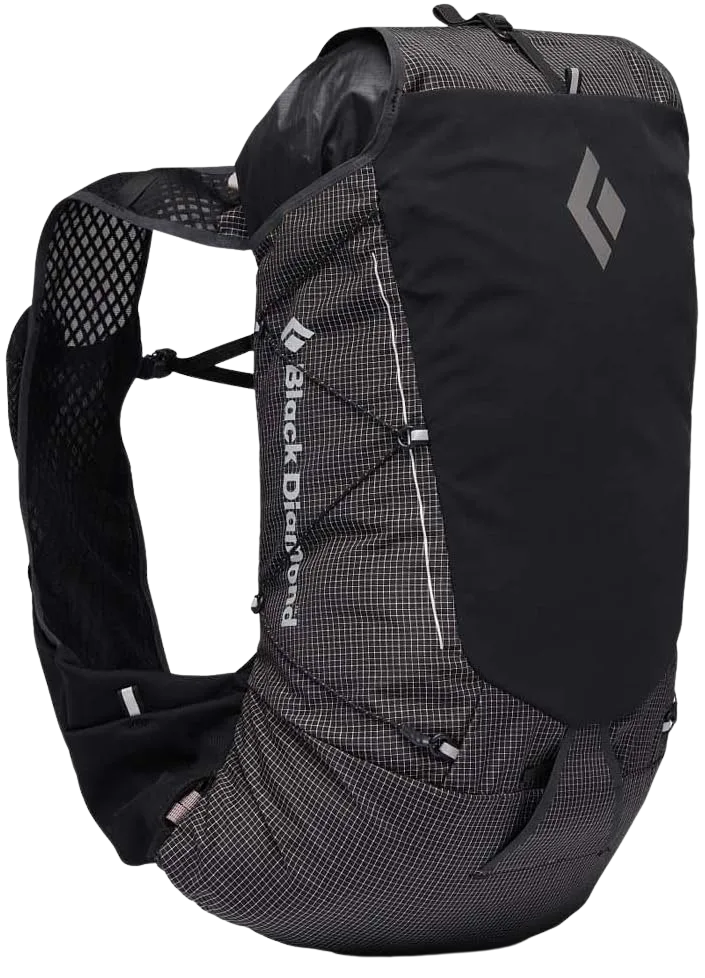
The Distance 22 is the pack that ends the argument for most people. It gives you the snug, drink-on-the-move feel of a vest with enough room that the water math and the Ten Essentials stop being a problem. If you mostly fast-hike with the occasional jog, this is the one I’d point you to first.
Who Should Skip the Hybrid
It isn’t for everyone, and pretending otherwise would be a sell. True racers chasing every ounce and minute should go with a pure vest. Hikers hauling heavy loads on long all-day efforts need the genuine hip-belt load transfer only a full daypack delivers. And the hybrid costs more than a basic daypack while carrying less than a big one, so you’re paying for the fit. If the fit is what you need, it’s worth it. If it isn’t, save your money.
Conclusion
Stop comparing spec sheets and answer the one question that matters: how fast are you really moving? If you’re genuinely running, a vest wins. If you’re fast-hiking with water and gear, the run-hike hybrid is almost always the smart middle. If you’re loaded, long, or out in the heat all day, the daypack and its real hip belt earn their keep.
Two things settle the rest. Run the water math before you trust a vest, because no fit fixes an empty flask. And remember that “fast” changes your speed, not your Ten Essentials, so fit your survival systems first and pick the smallest pack that carries them. Figure out your honest pace on your next loop, then start with the pack already in your closet before you spend a thing.
Frequently Asked Questions
01Can you use a running vest for hiking?
Yes, a running vest works well for short, fast hikes on trails with reliable water. Its limits are capacity and heat, so it struggles on hot, dry, or loaded days when you need to carry two liters or more plus layers.
02How many liters do you need for a day hike?
Ten to twenty liters covers most day hikes comfortably. Push toward 25 or 30 liters only if you carry lots of layers, extra water, or flex toward a light overnight. More capacity than you’ll fill just adds weight.
03Can a running vest carry the Ten Essentials?
Barely, and often not all of them. A sub-10-liter vest forces you to drop insulation, first aid, or emergency shelter when space runs out. A 15 to 25 liter run-hike pack holds the full Ten Essentials while keeping a vest-like fit.
04Is a running vest better than a daypack for day hikes?
Neither is better overall, it depends on your pace. A vest wins if you’re actually running on water-rich trails. A daypack wins for loaded, long, or hot days. For most fast hikers, a hybrid run-hike pack beats both.
05Do you need a hip belt on a daypack for day hiking?
For light loads under about fifteen pounds, a hip belt is optional. Above that, a real load-bearing hip belt moves weight onto your hips and saves your shoulders. The thin waist strap on a running pack only controls bounce, it does not transfer load.

I've spent more than a decade researching hiking gear and trail technique. I read the specs, the forum threads and the long-term reviews, and every pick here comes with what it gets wrong.
End of the trail
You read every mile of this one. Here's where the trail goes next.