In this article
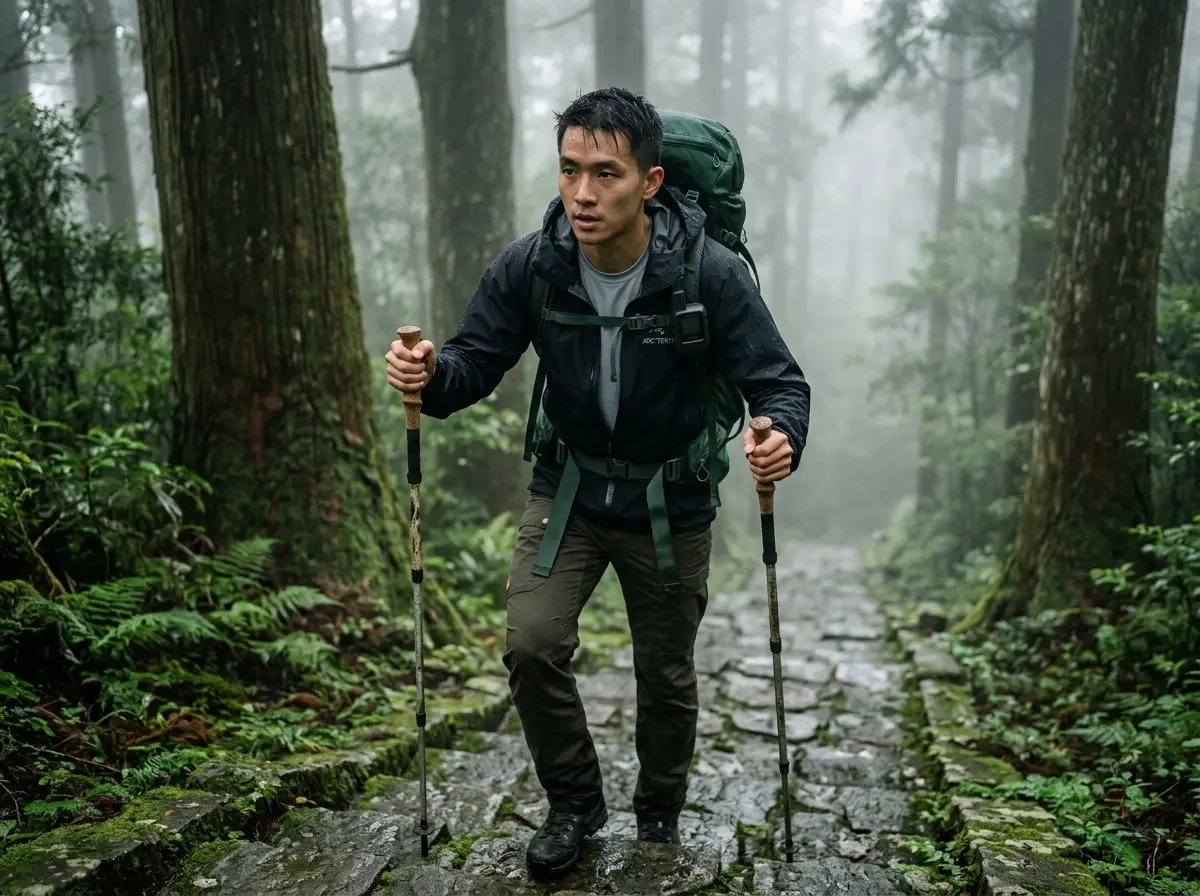
The descent off Takijiri-oji had been punishing — 3,000 feet of vertical in six miles, pouring rain since dawn. My trail runners were hydroplaning on every flagstone, each step a controlled fall. A local pilgrim shuffled past in a yellow cape and rubber boots, steady as a monk in a storm. He glanced at my shoes, shook his head once, and kept walking. I didn’t need to speak Japanese to understand: I was not prepared for this mountain.
The Kumano Kodo is self-guidable, but only if you approach it as someone who respects the terrain. The Nakahechi is perfectly realistic for fit recreational hikers. The Omine Okugakemichi is a scrambling mission requiring a specific résumé. That distinction matters more than anything else in this guide.
⚡ Quick Answer: Yes, you can hike the Kumano Kodo without a guide. The Nakahechi has numbered signposts every 500 meters with solid English translations. Book 180 days in advance through the Kumano Travel system or you won’t find a bed. Wear a Vibram Megagrip outsole — anything else turns the ancient stone steps into a severe slip hazard in the rain. The Omine Okugakemichi is a completely different proposition: Class 2–4 scrambling and 8,931 meters of total elevation gain require scrambling proficiency, not just fitness.
Choosing Your Route — The Technical Difficulty Breakdown
Most people treat all Kumano Kodo routes as variations of the same walk. They aren’t. Consider the three main options as a progression scale: one route is realistic with solid fitness, one requires serious navigation chops, and one requires a scrambling résumé. Starting in the wrong category is how rescue calls happen.
The Nakahechi (Imperial Route) — Realistic but Not Easy
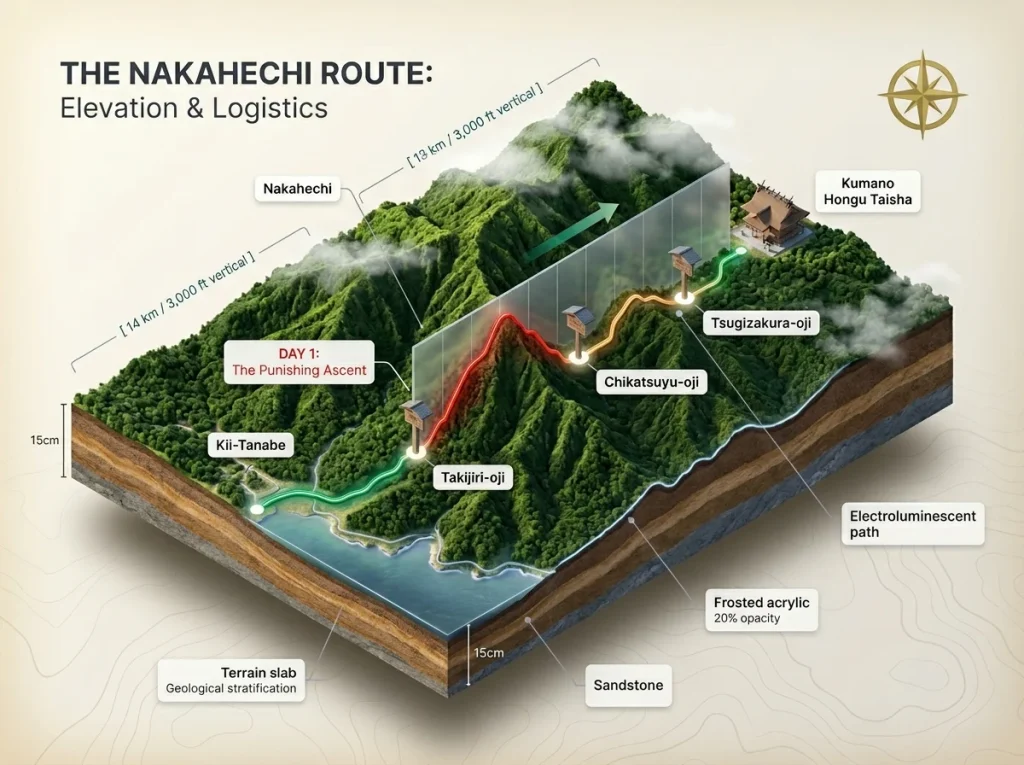
The Nakahechi runs approximately 40 km along ancient stone steps — ishidatami laid during the Heian period. They are intact, genuinely gorgeous, and in the rain, they are treacherous. Day 1 from Takijiri-oji to Chikatsuyu gains over 3,000 feet across 14 km. That’s twice the per-kilometer elevation rate of the Camino Primitivo.
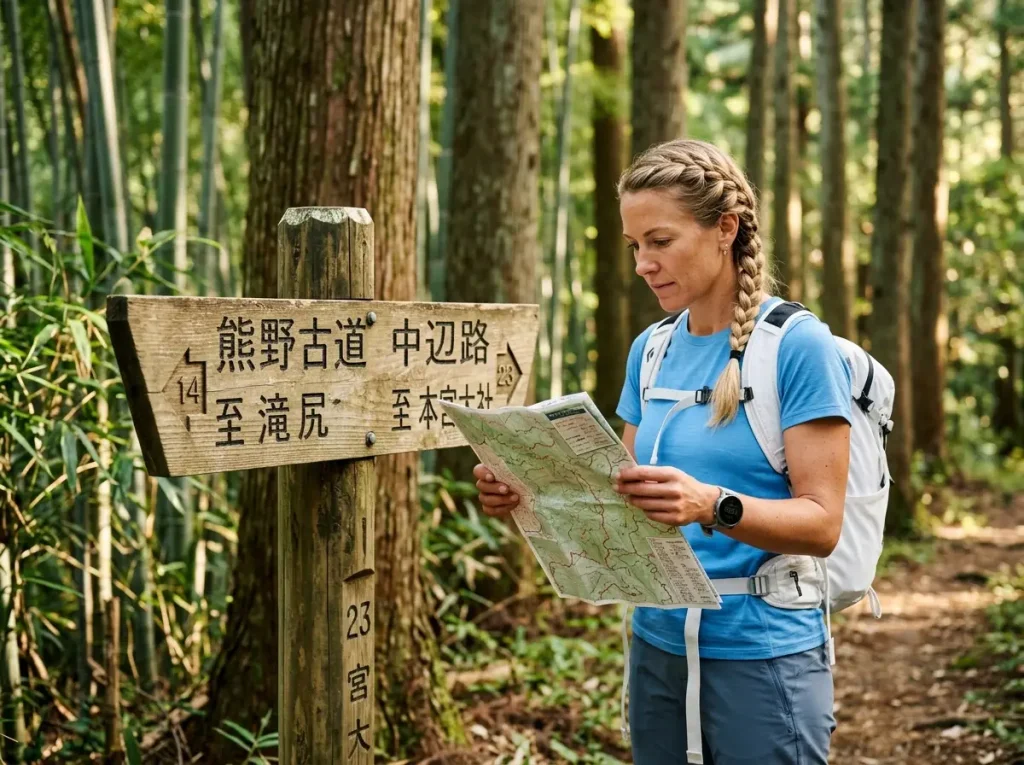
Navigation here is forgiving. Numbered signposts sit every 500 meters with English translations, so route-finding is rarely an issue. Your main challenges are traction on wet stone and pace management on steep descents. Start no later than 7 AM from Takijiri. The mossy stone steps slow you to a crawl in the rain, and there’s no making that time back. The main gateway is Kii-Tanabe Station via the JR Kuroshio Line from Osaka. Read up on how to research a trail before you go to understand what sustained elevation on heritage stone actually demands from your gear. These routes are registered as a UNESCO World Heritage site for a reason — they are preserved, not modernized.
Pro tip: Bring a lightweight trekking pole in each hand for the descents. The moss-covered Heian-era stones have zero edge grip. Poles turn a scary controlled-fall descent into a manageable one. Most international hikers show up with one pole or none. The Japanese pilgrims always use two. Copy them.
The Kohechi and Iseji — When the Navigation Gets Real
The Kohechi runs roughly 70 km and crosses multiple passes above 1,000 meters. There are no vending machines between villages. Some sections are full-day climbs. Download robust offline topographical maps and bring a fully dedicated power bank just for your phone. If your digital map dies near Omine Pass, there are no immediate bail-out trails to get you back to civilization quickly. When you miss a turn here, the fallback is often an expensive 45-minute taxi ride to the nearest station. Navigation errors on this route don’t end your afternoon; they end your day entirely.
The Iseji offers 160 km of coastal and cobblestone terrain with massive bamboo forest sections. It sits at a lower elevation but requires a much longer endurance duration. Both routes demand genuine route-finding competence. During spring snowmelt, Kohechi’s Omine Pass sections develop icy patches that require microspike-grade traction.
The Omine Okugakemichi — A Different Class of Mission
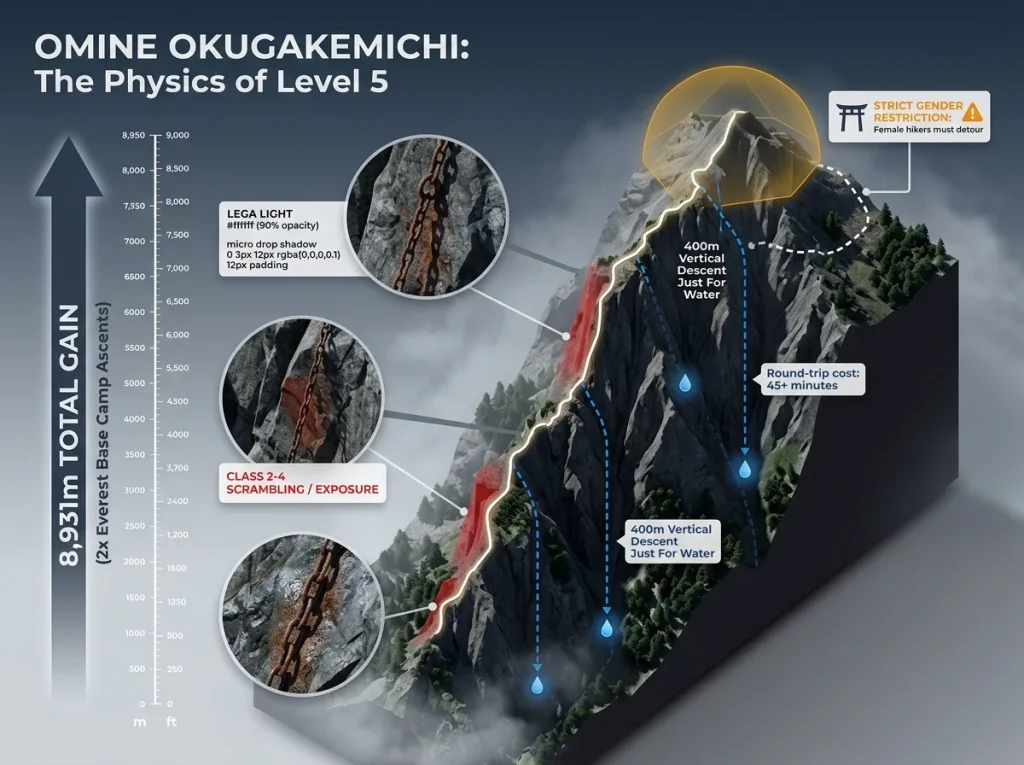
At 105 km with 8,931 meters of total elevation gain (nearly two Everest base camps worth of vertical), the Omine Okugake is rated Difficulty Level 5. That’s the maximum rating. The terrain features serious Class 2–4 scrambling with fixed chains and ladders bolted into cliff faces. Route markers are pink tape, which vanishes quickly in the thick mountain fog that the Kii Peninsula generates on a weekly basis.
There is also an enforced safety restriction: the peak of Mt. Omine carries an official gender restriction for religious reasons tied to Shugendo practice. This is not a guideline — it is strict policy. Female hikers planning this route need to plan a workaround in their itinerary before they even buy flights.
Treat the Omine as a multi-day scramble, not a standard hike. If you’ve never led Class 3 terrain with a loaded pack, do the Nakahechi first. You can check the Wakayama Prefecture’s official Omine route specifications for the full technical breakdown.
The Logistical Sequence — How to Book Without Losing Your Trip
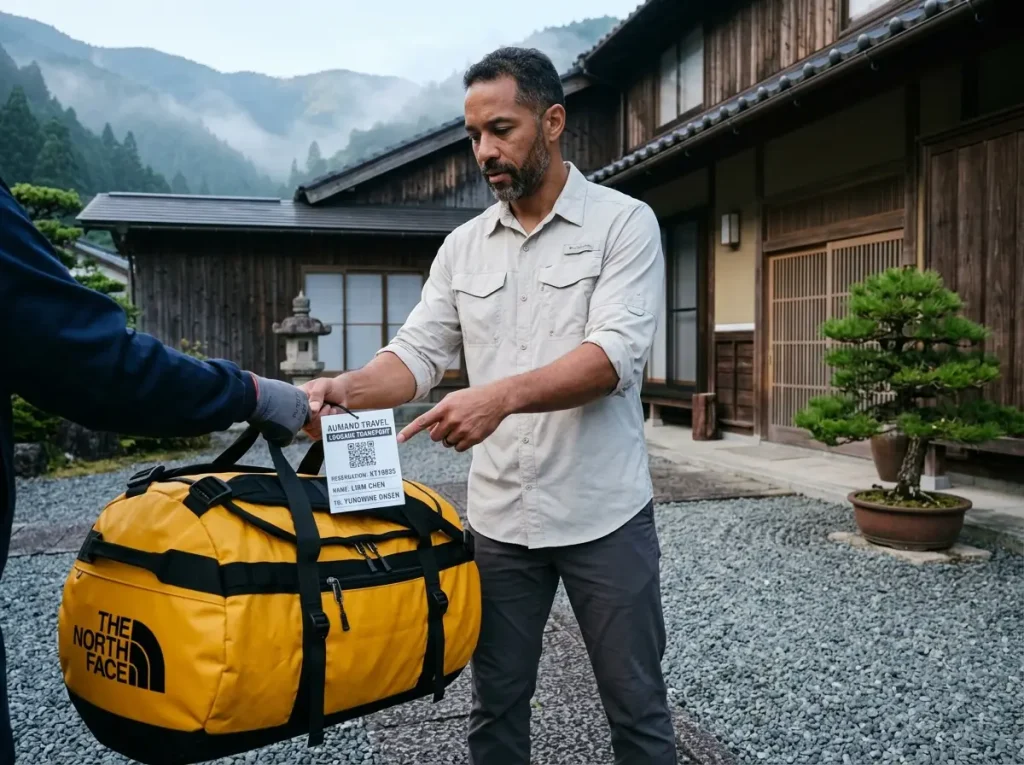
On the PCT or the Camino, flexibility is an asset. You show up, figure things out, and adjust on the fly. On the Kumano Kodo, flexibility is exactly how you end up sleeping outside in the rain. Wild camping is stringently regulated on the primary routes to protect the UNESCO heritage zones. That leaves you entirely dependent on minshuku and ryokan beds — and those beds are strictly finite.
The 180-Day Rule and Why It Is Non-Negotiable
The Kumano Travel reservation system punishes procrastinators. You submit a reservation request, then you wait — sometimes up to one month for processing during peak seasons like April and October. When confirmation finally drops, you have exactly 48 hours to pay. Miss that window, and they delete your entire itinerary.
For October beds, 180 days of lead time is the baseline requirement. Top beds disappear within 48 hours of opening. Emergency requests take up to a week to process. Review the official meal code and safety guidelines alongside your international trekking visa requirements prior to locking in your dates.
Take a screenshot of your confirmation the split second it arrives. Once that payment link expires, you’re out of luck.
The Luggage Shuttle — Specs, Limits, and Failure Points
The luggage shuttle service provided by the Tanabe City Bureau makes the Nakahechi viable for sensible hikers. It moves your main pack between guesthouses while you hike with a 20-liter daypack. “Slackpacking” is the only rational strategy for this trail. Hauling a massive expedition pack over 3,000 feet of Day 1 vertical gain is not a badge of honor. It is pure avoidable suffering.
The shuttle runs on unforgiving limits. The maximum weight is 25 kg. Maximum dimensions cap at 160 cm combined (length plus width plus height). The tags are printed in Japanese, provided by the bureau when you book. If your bag is overweight or oversize, transport is refused at pickup, not at booking. You find out at the trailhead, staring at your heavy pack at 6 AM.
Pro tip: Pack everything that is not mission-critical into your shuttle bag. On the trail you only need water, food, first aid, rain gear, and your camera. Everything else goes in the bag the shuttle moves. Pilgrims have always operated this way — carry only what the immediate day demands.
Meal Codes — Fueling Performance, Not Preference
Minshuku and ryokan meals are pre-ordered through a Type A–E dietary code system specified when you book. It dictates the protein you will have available to repair your muscles after a 30+ km day.
Type A (no meat, but includes fish, eggs, and dairy) gives you the highest protein load. It is the default recommendation for anyone hiking the Nakahechi or Kohechi. Type B drops the fish but keeps eggs and dairy. Type E is strictly vegan — no animal products, no fish-based dashi broth. If you end up starving on the trail because you didn’t understand the Type E code meant a plate of cold mountain vegetables and rice with zero heavy proteins, you cannot buy jerky at the local shrines. You eat what you booked, meaning you must carry your own supplemental snacks.
Traditional shojin ryori (monk’s cuisine) runs extremely heavy on carbohydrates. Carry BCAAs for muscle repair on the Omine or Kohechi, regardless of your food code. Confirm your Type code when booking, because hosts cannot change it when you arrive exhausted at dusk.
Technical Terrain Analysis — The Physics of Wet Rhyolite
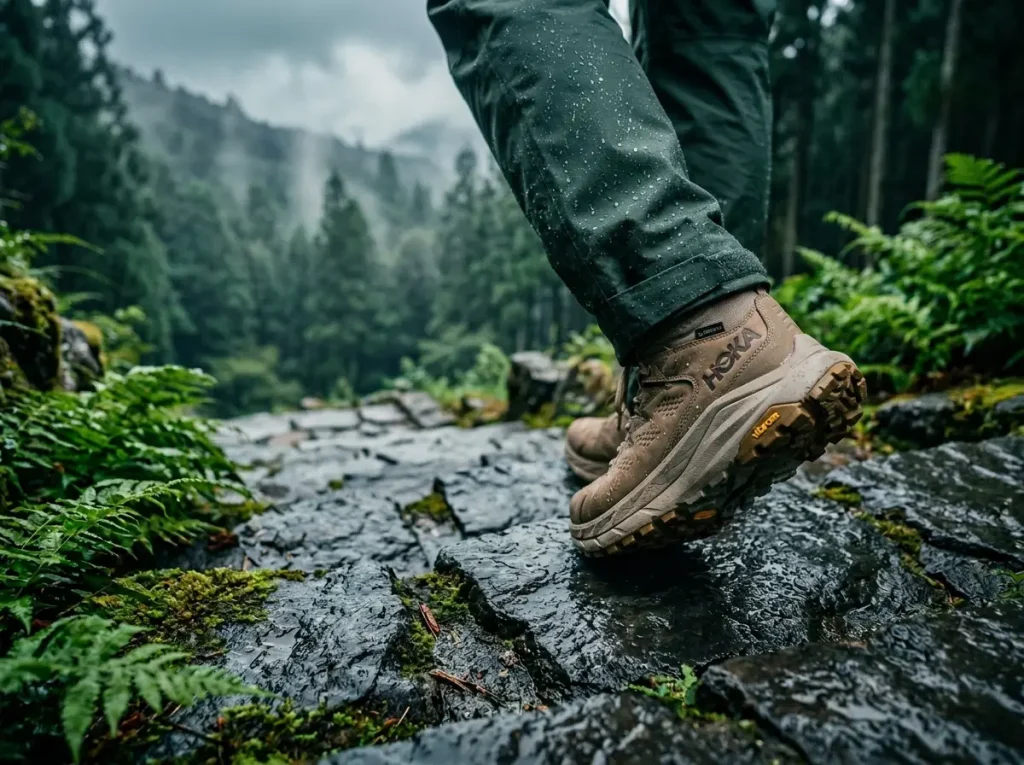
Here is the detail that fair-weather hikers skip: the Kumano Kodo is not just a trail surface problem. It is a geology problem.
What the Stones Are Made Of (And Why It Matters)
The ishidatami stones are dacite and rhyolite — old, extremely hard volcanic rock that resists wear. That is why they have survived a thousand years of foot traffic. It is also why they naturally polish down to a near-glass finish from millions of boots. Underfoot in a downpour, a well-worn flagstone handles exactly like wet marble.
The Kii Peninsula sees massive moisture from the ocean. Historical rainfall metrics from the Japan Meteorological Agency show an average of 211 mm in June alone. That constant dampness feeds a slick layer of moss and algae. On wet dacite covered in this slick film, friction drops to practically zero. On a 20-degree incline, stiff trail rubber produces what the community universally calls the “banana peel effect.”}
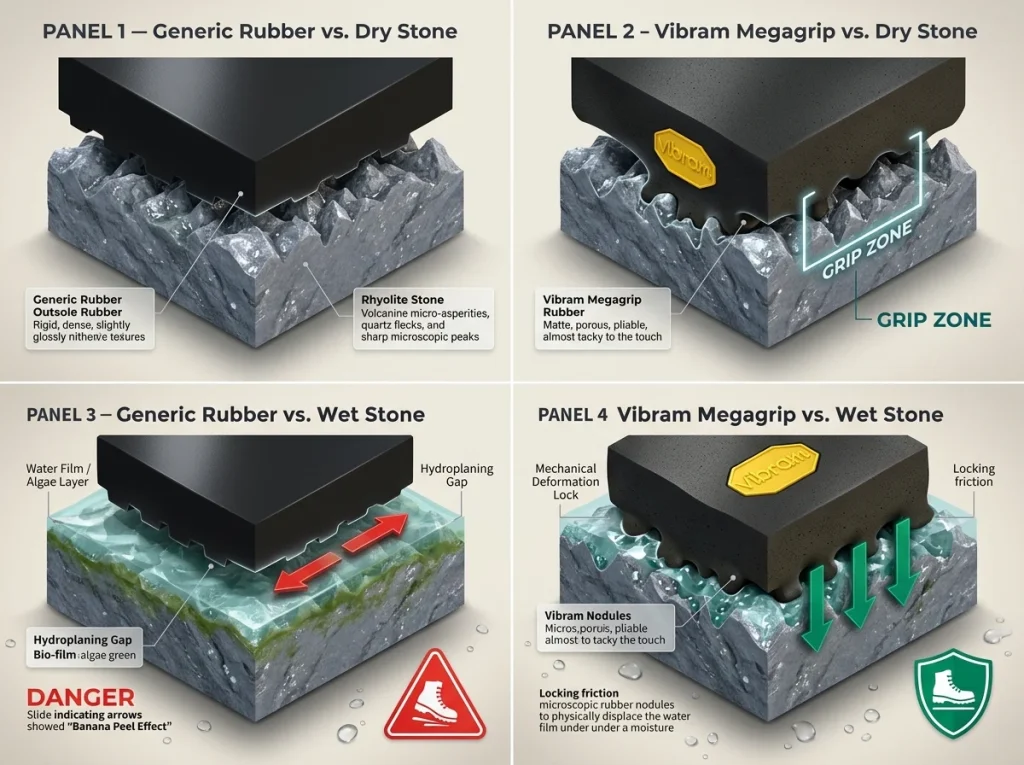
The Outsole Decision — What Your Boot’s Rubber Actually Does
Generic, stiff hiking rubber fails on wet stone because it’s too hard to conform to the tiny textures of the surface. A stiff compound just hydroplanes across slick dacite. Vibram Megagrip, on the other hand, is a soft compound that physically deforms into the rock’s tiny grooves. That is what generates traction. It is the compound chemistry, not the big aggressive lugs.
Many popular shoes are simply too rigid. The only genuine recommendation for descending Nachisan in a Kii rainstorm is a mid-cut boot with Vibram Megagrip. Boot height matters tremendously here, providing necessary ankle support on tilted, off-camber flagstones. Check our field tests on which rubber grips wet rock to see exactly how different compounds perform when slip hazards are severe.
The Humidity Problem — Why Your Rain Gear Will Fail You Here
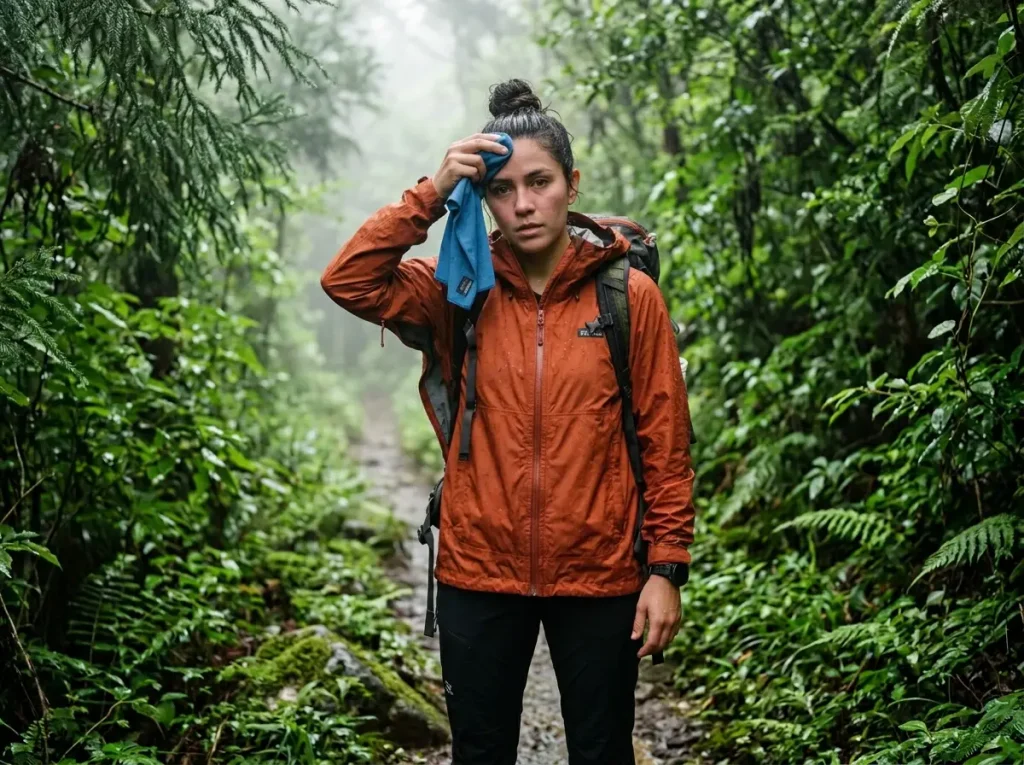
I watched a hiker on Day 2 near Chikatsuyu-oji physically wring sweat out of his $600 waterproof shell while it poured outside. He swore the jacket was leaking. It wasn’t.
The Green Tunnel Effect and Membrane Failure
The Kii Peninsula’s dense forest canopy creates “the Green Tunnel” — a closed, humid microclimate that traps massive amounts of heat right against your skin. In this specific environment, breathable membrane jackets stop working completely.
Waterproof jackets exhaust sweat by pushing vapor from high-pressure inside the jacket to lower-pressure outside the jacket. That works perfectly in typical dry mountain air. But when outside humidity hits 90% in the Green Tunnel, the pressure equalizes. Vapor transfer halts. Sweat severely accumulates inside the shell. This isn’t a defect; it is the Gore-Tex breathability paradox we documented previously. Your expensive rain shell effectively becomes a wearable plastic bag.
Mechanical Venting Over Membrane Technology
The correct field strategy is one the Japanese pilgrims figured out long ago: use an umbrella. Walking in steady rain with a strong trekking umbrella allows for full system airflow. It’s not a weak choice; it is highly efficient physics. For hikers who refuse to use an umbrella, carry a featherweight wind shell and vent it aggressively between storms. Huge pit zips and mesh pockets matter far more than waterproof ratings on this trail.
Waterproof socks face the exact same pressure problem. Mesh trail runners with side drainage handle stream crossings much better than fully sealed footwear. At 34°C in August with punishing humidity, the neck and wrist seals of a jacket trap the most heat, so open them up. Control your core temperature, not your dampness. You are going to get wet either way.
Pro tip: Pack a small microfiber towel specifically to wipe condensation off the inside of your rain jacket during breaks. Your physical sweat will coat the inside of your membrane shell far faster than rain gets in. Wiping the interior resets the humidity level against your skin.
Biological Risk Management — Leeches, Hornets, and Hazards
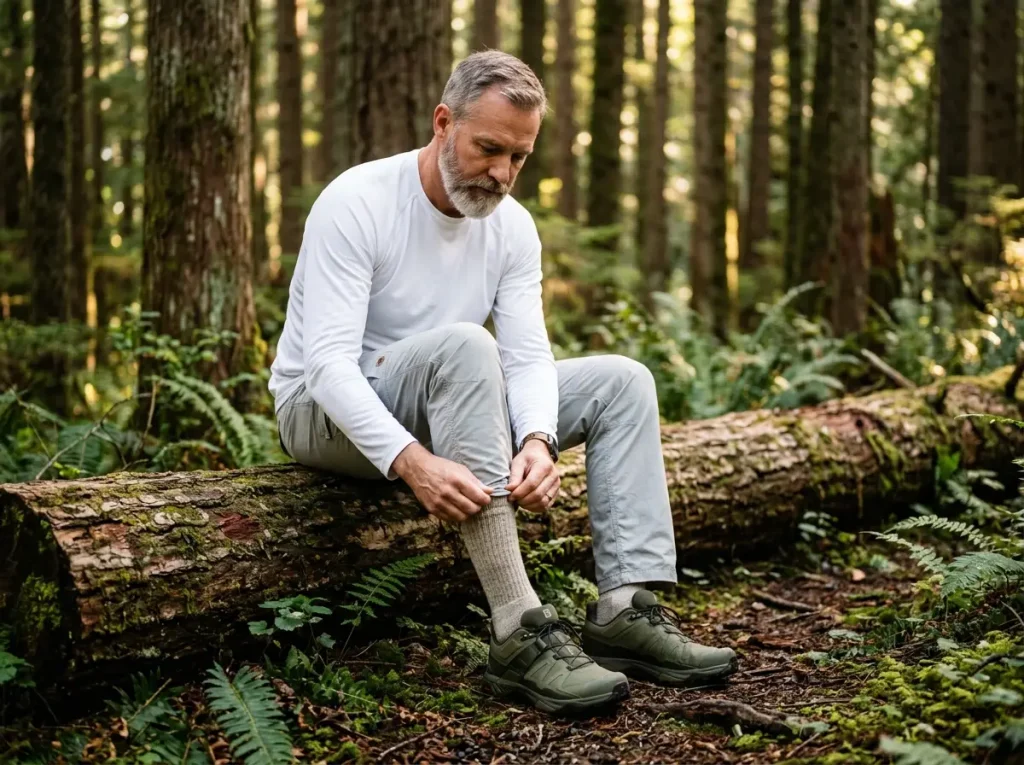
Hiking the Kumano Kodo solo means you are your own medical officer. Two dominant threats in the Kii Peninsula demand proactive protocols, not just casual awareness.
Yamabiru Defense — The Credit Card Protocol
Yamabiru (mountain leeches) are fiercely active from May through September. The massive oversight most foreigners make is thinking leeches only crawl up from the mud. They do, but they also drop directly from overhanging branch foliage. Brush your hat brim and the top of your pack regularly.
The real skill here is Active Scanning — spotting their distinct inch-worm movement on the forest floor before they attach. Train your eyes to watch the leaf litter right in front of your boots, and you will catch them early.
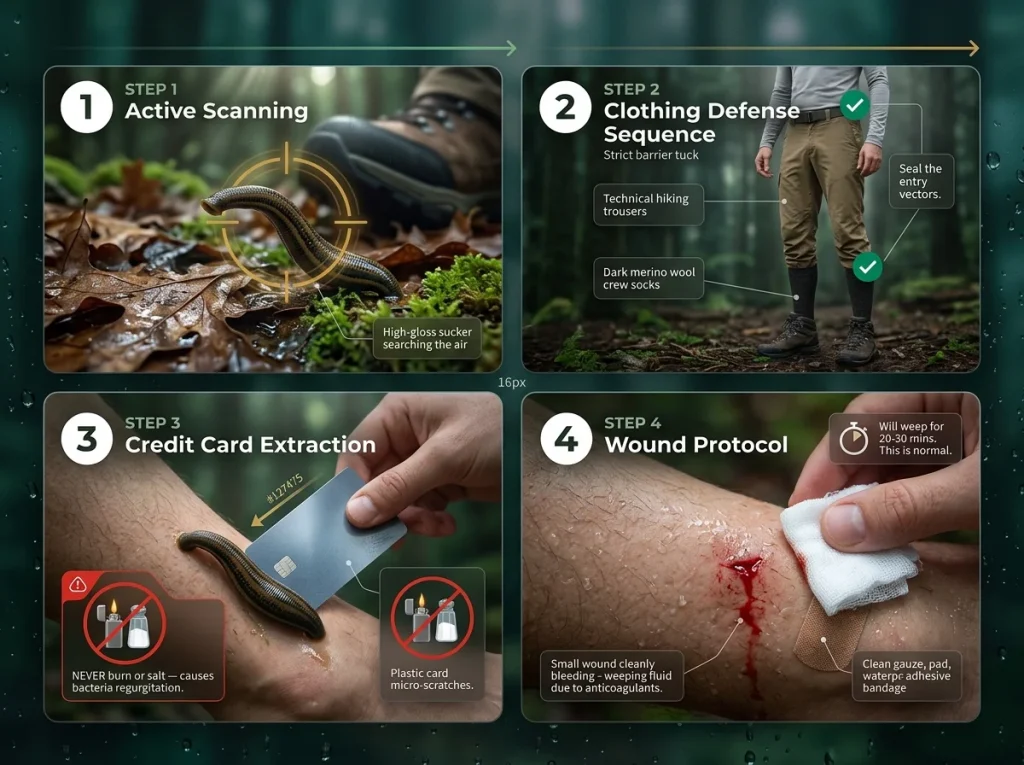
For mechanical defense: tuck your trousers inside your socks, and your shirt inside your trousers. For chemical defense: hit your boots and lower legs with heavy DEET or a malic acid spray. If one gets past the defenses and latches on — do not use salt, and do not use a lighter. Both methods horrifically stress the leech, causing it to vomit gut bacteria straight into your injury. Instead, slide a firm credit card fast under the mouth sucker to break the vacuum seal, then flick it off. The injury will continue weeping for 20 to 30 minutes due to the anticoagulant in their saliva. That is normal. Wipe it clean and cover it.
Pro tip: Keep a credit card easily accessible in a hip pocket, not buried deep in your main pack. When a leech grabs the sensitive skin between your toes, you don’t have the luxury of time to dig through waterproof stuff sacks.
Asian Giant Hornet — Color, Chemistry, and the Clicking Warning
The Asian giant hornet (Vespa mandarinia) causes more fatalities in Japan annually than bears and venomous snakes combined. This is a grounded data point, not fiction. Their venom contains potent compounds that severely damage muscle tissue. In a mass stinging event, that broken-down tissue enters your circulatory system and overloads your kidneys. As detailed in the clinical guidance on Asian giant hornet venom toxicology, suffering 10 or more stings is an immediate medical emergency requiring fast evacuation.
Color matters immensely because these hornets evolved to target large, dark-furred mammals like bears. Dark hats, dark packs, and dark jackets put you right in their threat profile. Wear white or light gray on your head and torso. Go completely unscented — fragrant deodorants, scented sunscreens, and sweet food odors draw scouts fast.
If a hornet hovers intentionally for more than two seconds or rhythmically clicks its mandibles at you, it is guarding its territory. Withdraw slowly backward. No sudden arm flails. Absolutely never run. Running guarantees a pursuit. If the worst happens, having wilderness first aid protocols for backcountry emergencies memorized is your only lifeline.
The Omine Okugakemichi — What Level 5 Actually Means
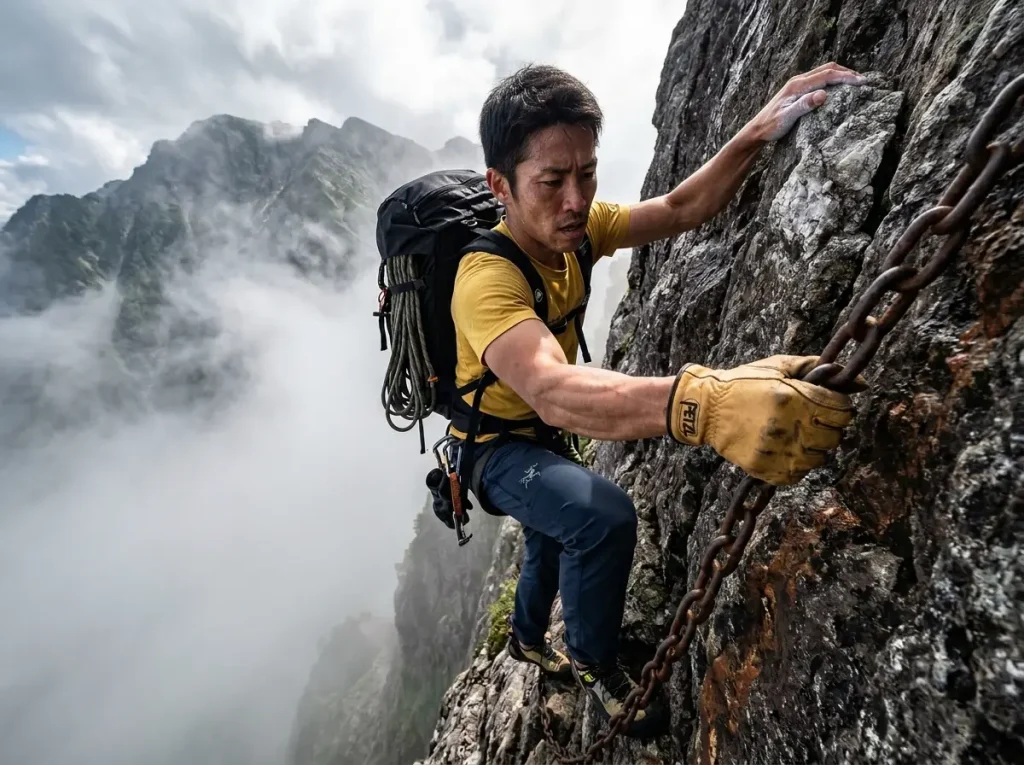
The number 8,931 doesn’t mean much simply reading it off a screen. To put it in perspective: that is more total elevation gain than doing two complete ascents straight from Everest base camp. It is spread across 105 km of brutal high ridgeline, with water sources sitting 300 to 400 vertical meters straight down off the main trail.
Scrambling, Fixed Chains, and the Water Bottleneck
The Omine Okugakemichi plays by entirely different rules than the rest of the network. The route forces you through steep Class 2–4 scrambling sections, heavily reliant on rusted fixed chains and vertical ladders on deeply exposed cliffs. Route markers are small pieces of pink tape, which turn totally invisible the moment the peninsula’s fog rolls over the ridge. Bring physical backup maps and a compass. GPS is an aid to your analog skills, never a replacement.
The water situation is gnarly. Streams run hundreds of meters below the actual ridgeline. Every single time you need to refill, it costs you roughly 45 minutes of steep technical descent, followed by a punishing re-ascent. You are burning massive metabolic energy just to hydrate. Carry a 3-liter hydration bladder at a minimum and pre-calculate exactly where you will drop down for water. Read up on acclimatization and exertion on multi-day ascents; hauling water up 400-meter ravines saps your reserves profoundly by Day 3.
Navigation and Pre-Trip Requirements
In zero visibility fog, ridge navigation becomes a slow game of leapfrog: identify a solid terrain feature 20 meters away, move to it, then identify the next one before moving again. Your compass heading and altimeter are everything here. A satellite two-way communicator is mandatory since cellular signals vanish on the ridge. Give your emergency contact your granular itinerary and establish a strict 24-hour check-in rule before you leave town.
Night hiking anywhere near the chain sections carries an unacceptable risk of a severe fall. Build highly conservative daily mileage goals from the very start.
Three Things to Take Off This Trail
Route choice dictates your odds more than your gear. The Nakahechi is fully self-guided feasible if you wear the proper footwear and honor the 180-day booking lead time. The Omine Okugakemichi is a serious scrambling mission that requires a veteran’s résumé. Acknowledging which one you are actually equipped for is the smartest safety choice you will make.
Your logistical planning is your ultimate safety buffer. A sloppy booking error on this trail doesn’t mean you get a bad room; it means your trip gets canceled. Know the rigid shuttle weight limits (25 kg, 160 cm max dimensions), confirm your specific meal code (Type A fuels recovery best), and nail that 48-hour payment window. These aren’t just administrative hurdles. They are the strict framework that makes independent hiking here possible.
Finally, your footwear’s rubber compound is a non-negotiable safety tool. Slogging down wet dacite at a 20-degree angle, the difference between Vibram Megagrip and generic hard rubber is the stark difference between a controlled hike and a painful evacuation. Pick a mid-cut boot with a soft, grippy compound. Every other gear fuss is secondary.
You need to respect the physics of the environment before you check flight prices. Identify the exact rock type, respect the seasonal rainfall volume, and bring the specific gear rated to survive it. The Kumano Kodo will happily teach you these lessons the hard way if you let it. Now you know them before you ever step off the train at Kii-Tanabe.
FAQ
Can you hike the Kumano Kodo without a guide?
Yes. The famous Nakahechi route features well-placed numbered signposts every 500 meters. It is fully self-guidable for strong hikers equipped with mid-cut traction boots and the discipline to handle a 180-day logistical booking window. Conversely, the Kohechi and Omine Okugakemichi demand severe backcountry navigation and technical scrambling skills. On those routes, a guide is a powerful safety asset, not a luxury.
How difficult is the Kumano Kodo compared to the Camino de Santiago?
The per-kilometer elevation gain on the Nakahechi is roughly three times that of the Camino Frances and twice that of the Camino Primitivo — and Nakahechi is considered the easiest Kumano option. The terrain type is also vastly harder: you are walking on slick, ancient volcanic stone steps under heavy rain, rather than gentle gravel tracks in mild weather. Strong fitness transfers over, but the technical demands of the terrain do not.
What is the best month to hike the Kumano Kodo?
October is the optimal sweet spot. You get lower humidity, reasonable temperatures around 18–23°C, heavily reduced leech action, and stunning autumn foliage. Steer clear of June, which dumps 211 mm of peak rainfall and unleashes the most severe leech and hornet activity. Avoid August entirely unless you want to court heat exhaustion in 34°C temperatures packed with 90% humidity. November offers a great secondary window right before the frigid cold snaps hit the Kohechi passes.
Where do you sleep on the Kumano Kodo?
You sleep in traditional minshuku (family-run guesthouses) and ryokan, all of which must be booked through the centralized Kumano Travel reservation system. Wild camping is strictly prohibited along the main routes to protect the UNESCO cultural zones. You need to submit requests 180 days before your intended start dates for the peak seasons. Remember that the system processes requests manually — it is a queue, not an instant live booking platform.
Do you need to speak Japanese to hike the Kumano Kodo independently?
Not for the physical walking part. Nakahechi trail signage uses clear English translations. However, handling guesthouse meals, checking in, and managing shuttle baggage logistics require a bit of pre-arranged communication. The Kumano Travel website handles the bulk of this in English during booking. The sharpest language gap hits at remote minshuku check-ins. Carry a simple printed card in Japanese clearly explaining your specific dietary code and any allergies, and hand it to your host upon arrival.
Is the Kumano Kodo safe for solo female hikers?
Yes, the Nakahechi route is overwhelmingly safe for solo female hikers from a personal security standpoint. Violent crime in rural Japan is exceptionally rare. The true threats are entirely environmental—leech bites, hornet territory, and aggressive slick-rock paths. However, be absolutely mindful of the strict gender restriction on Mt. Omine if you plan to tackle the Omine Okugakemichi route. It is fiercely enforced, and female hikers must plan an alternate bypass.
Risk Disclaimer: Hiking, trekking, backpacking, and all related outdoor activities involve inherent
risks which may result in serious injury, illness, or death. The information provided on The Hiking Tribe is for
educational and informational purposes only. While we strive for accuracy, information on trails, gear, techniques,
and safety is not a substitute for your own best judgment and thorough preparation. Trail conditions, weather, and
other environmental factors change rapidly and may differ from what is described on this site. Always check with
official sources like park services for the most current alerts and conditions. Never undertake a hike beyond your
abilities and always be prepared for the unexpected. By using this website, you agree that you are solely
responsible for your own safety. Any reliance you place on our content is strictly at your own risk, and you assume
all liability for your actions and decisions in the outdoors. The Hiking Tribe and its authors will not be held
liable for any injury, damage, or loss sustained in connection with the use of the information herein.
Affiliate Disclosure: We are a participant in the Amazon Services LLC Associates Program, an
affiliate advertising program designed to provide a means for us to earn advertising fees by advertising and linking
to Amazon.com. As an Amazon Associate, we earn from qualifying purchases. We are also an official affiliate partner
of Black Diamond Equipment via the AvantLink network. If you click on a Black Diamond affiliate link and make a
purchase, we may earn a commission at no additional cost to you. We also participate in other affiliate programs and
may receive a commission on products purchased through our links. Additional terms are found in the terms of
service.