






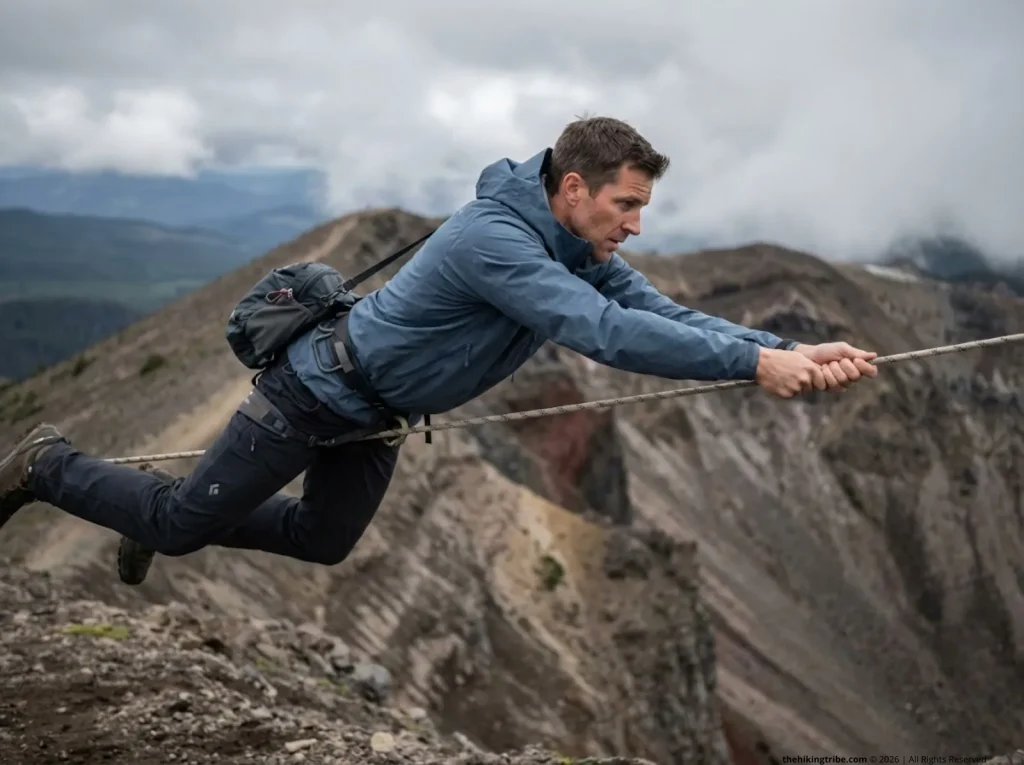
Halfway across the eroded bank on the Timberline Trail, your forearms are screaming. The fixed rope is slick with morning dew, your gloves are slipping, and your knuckles have gone white around a line you’re not sure was inspected this season. The pack on your back feels like a pendulum swinging you sideways toward a drop you’d rather not think about. You’re not falling—but you’re not moving, either.
After years of field-testing scrambling rope techniques across Class 3 ridges, eroded traverses, and alpine approaches in the Cascades and Sierra, I’ve watched dozens of strong hikers freeze in exactly this spot. The problem is never strength. It’s technique. And the fix is simpler than most people expect.
This guide breaks down the whole-body body mechanics, minimalist gear, and progressive training drills that turn white-knuckle panic on a fixed rope into smooth, core-driven movement—whether you’re lowering off an eroded ridge or hauling yourself across a sagging Tyrolean traverse with a loaded pack.
⚡ Quick Answer: Stop pulling with your arms alone. Clip in to the fixed rope with a short quickdraw (12–15 cm) and a backup sling, position your body horizontally with your head forward, remove your pack and tow it behind via a daisy chain, then pull hand over hand using your core muscles in a sit-up rhythm. This distributes the work across your largest muscle groups instead of burning out your forearms in 90 seconds.
Why Fixed Ropes Humble Strong Hikers
The Grip Fatigue Trap
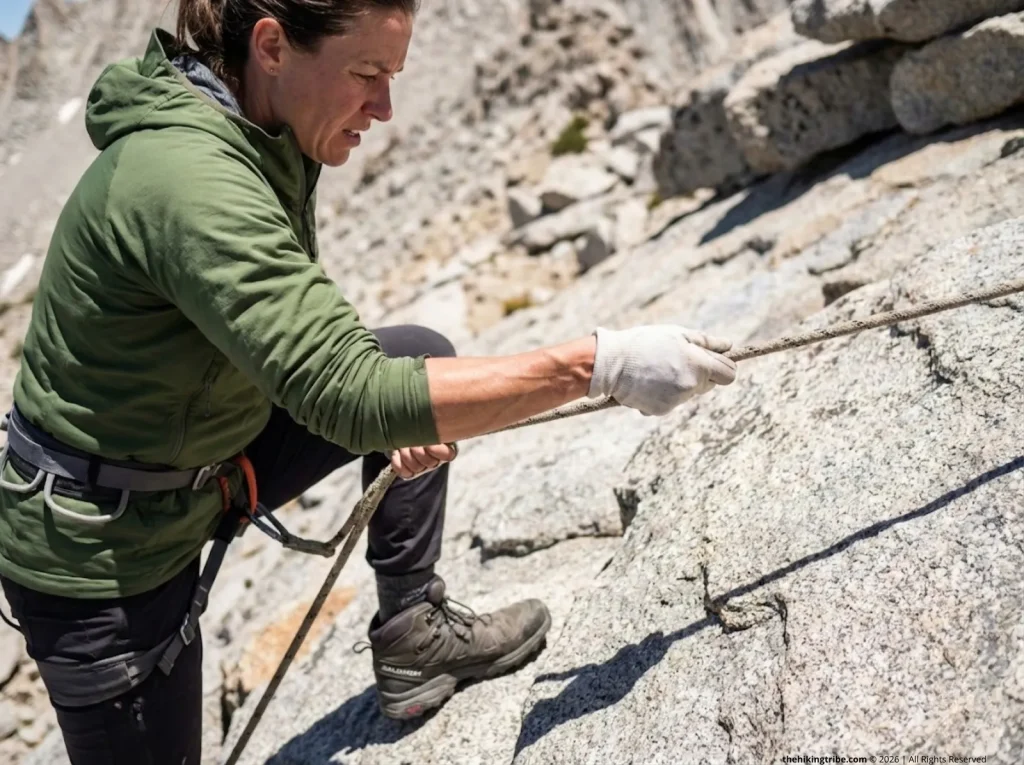
Your forearm flexors are small muscles designed for precision, not sustained heavy pulling. Under maximum grip load, they fatigue within 60 to 90 seconds. Once the burn sets in, recovery on the rope is nearly impossible—your hands start to slip the harder you squeeze.
That’s white-knuckling. It’s tensing every muscle from shoulder to fingertip out of fear, which paradoxically weakens your hold faster than a relaxed, rhythmic pull ever would. Most hikers default to an arms-only approach because that’s how they climb ladders or haul themselves onto ledges. But a fixed rope rewards horizontal pulling mechanics, not vertical.
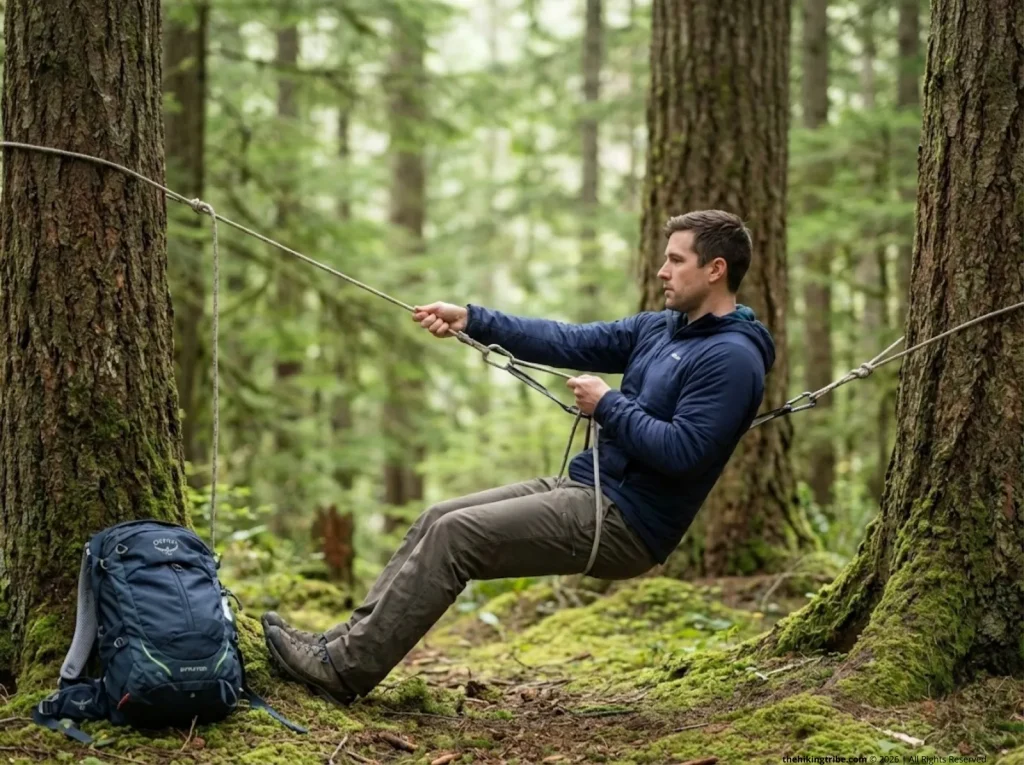
The fix lives in your torso. Your core makes up the biggest chunk of your body—engaging it through a sit-up rhythm roughly doubles your effective pulling power without demanding more from your forearms. On sagging ropes, that rhythm lifts your lower body to cut drag. On taut lines, it generates forward momentum with less effort per stroke.
Here’s the gap nobody fills: climbers learn these mechanics in harness training during their first season. Hikers encounter fixed lines only when they’re already committed on a ridge, with no practice and a 35-pound pack pulling them backward. This is a transition from hiking to technical terrain that catches people off guard because the progression feels sudden, not gradual.
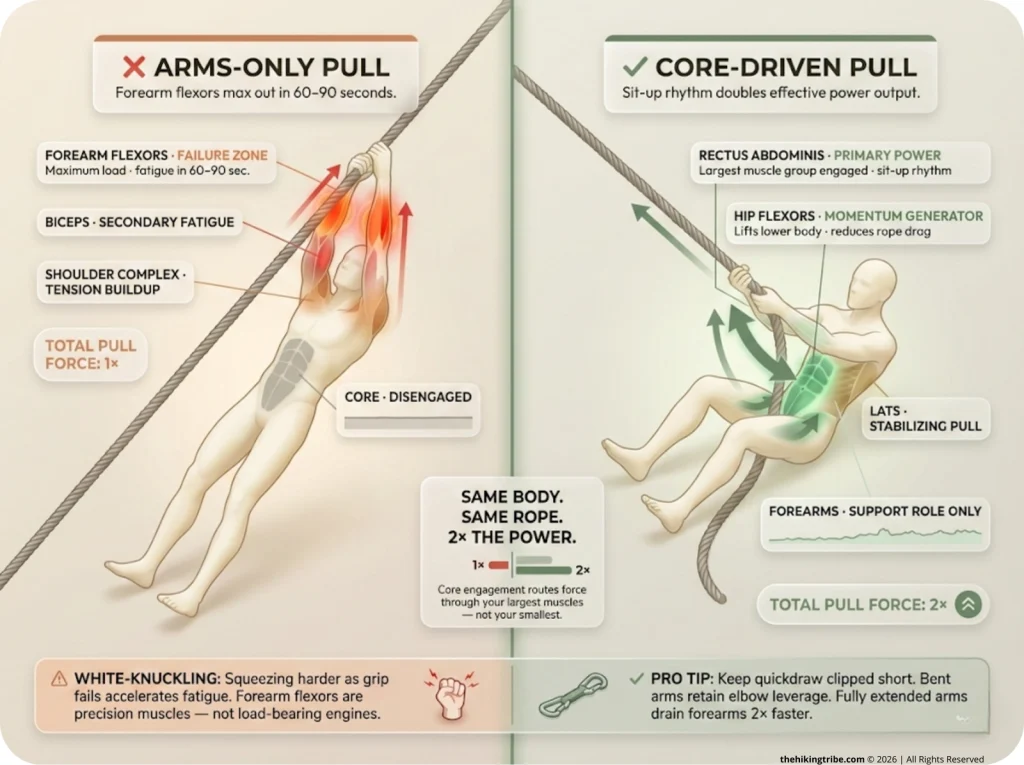
Pro tip: Keep your quickdraw clipped short so your arms stay bent and powerful. Fully extended arms drain your forearms twice as fast because you lose all leverage at the elbow.
Why Core Changes Everything
Bruce Hildenbrand, writing for Climbing Magazine, describes the rhythm this way: “Use the forward motion and pull hand over hand. It helps to use your core with each pull… Repeat this and settle into a rhythm.” That sit-up motion transfers the load from your small forearm muscles to your abdominals and hip flexors—big muscle groups built for sustained effort.
On a sagging rope, the technique looks like a controlled crunch: pull with stacked hands, lift your lower body toward the rope with your abs, glide forward on the momentum, then relax for a micro-rest before the next stroke. On a taut line, it’s more of a rowing cadence—arms pull while the core stabilizes and drives you forward.
The difference between these two approaches is the difference between being pumped out after 30 feet and covering 100 feet feeling controlled. According to alpine hiking fall statistics and injury mechanisms, fatigue-related incidents on technical terrain are a leading cause of mountain injuries. Your core is the insurance policy your forearms can’t provide.
Gear That Keeps You on the Line
The Clip-In System: Primary and Backup
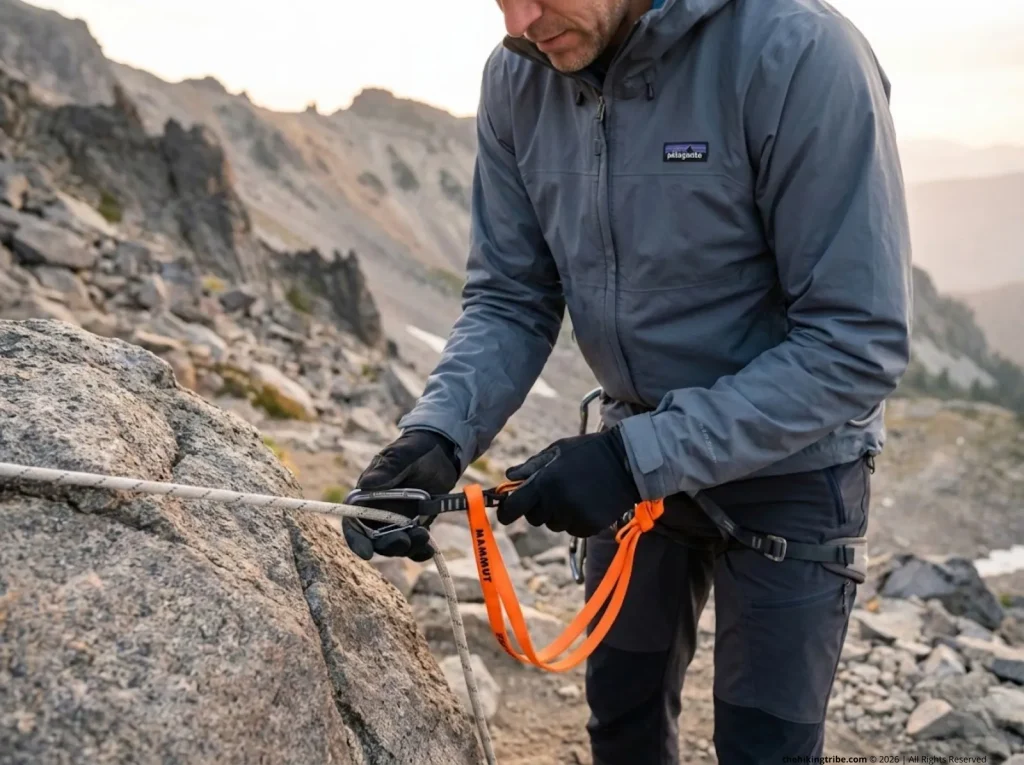
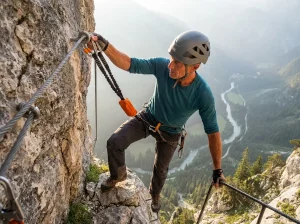
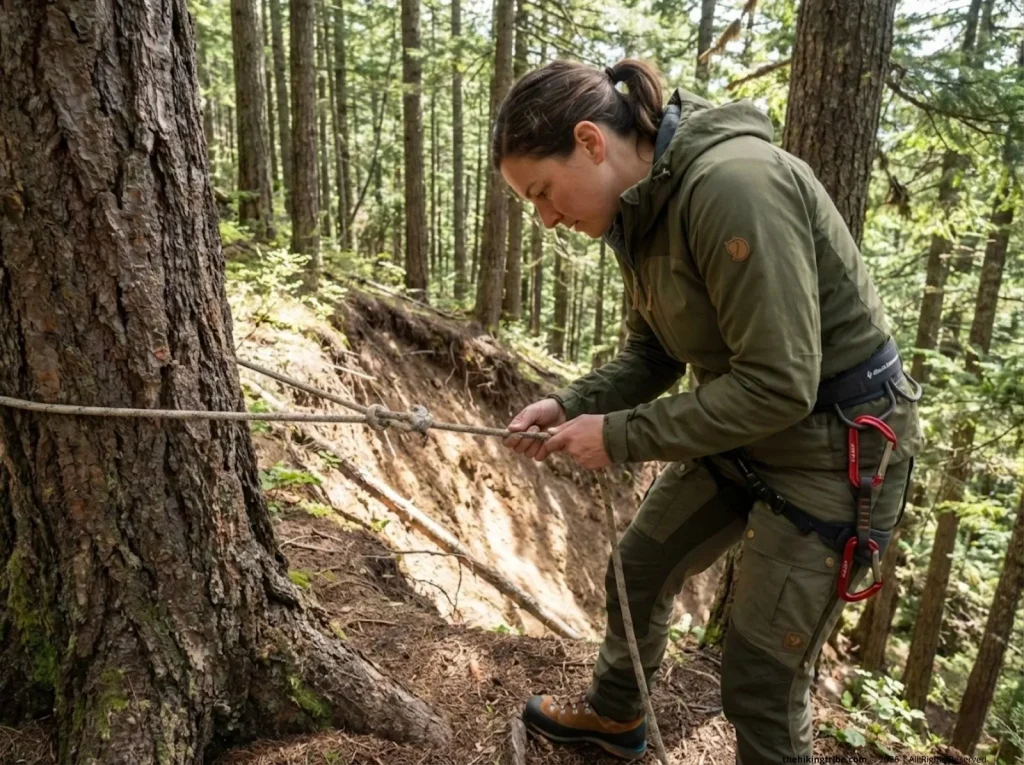
Two points of attachment. That is the non-negotiable rule on any fixed rope. Your primary connection is a short quickdraw—12 to 15 cm—linking your harness belay loop to the rope. Keeping it short holds your body close and your arms bent, which is where they generate the most power.
Your backup is a longer sling (60 to 120 cm) with a locking carabiner, clipped to the rope ahead of your primary. If the primary gate opens against the rope, shifts, or the rope rolls under your weight, that safety backup catches you before a full fall. Never rely on a single attachment point—documented fatalities from single-clip failures on fixed lines reinforce why, as outlined in UIAA alpine skills on securing fixed ropes for short steep sections.
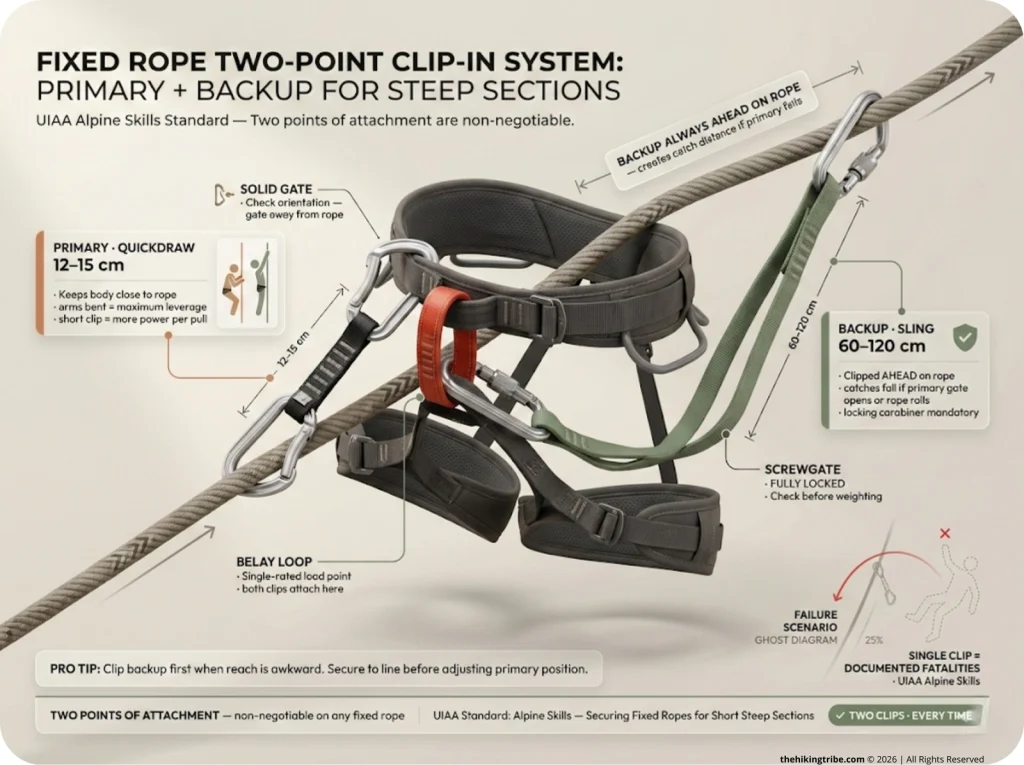
Pro tip: Clip the backup first when the reach is awkward. It’s easier to adjust your primary once you’re already secured to the line.
Hiker-Specific Minimalist Setups
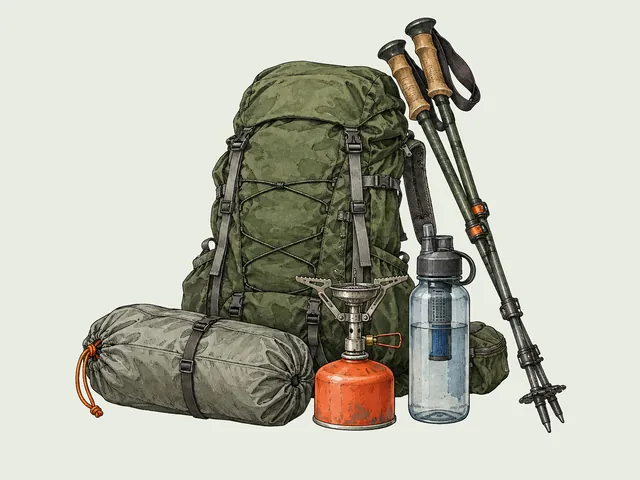
You don’t need a full climbing harness for a 20-meter eroded handline. For short sections on scrambling terrain, a lightweight trekking belt or minimalist gear harness alternative, a single 120 cm sling, and two locking carabiners covers the essentials. Total additional weight: 250 to 400 grams.
Daypack webbing or accessory cord (8–9 mm static) can substitute for a proper daisy chain for pack towing on sub-60-meter sections. Gloves are non-negotiable—rough rope or steel cables will shred bare skin within minutes. Lightweight belay gloves add 30 to 50 grams of pack weight and save your palms entirely.
For scramblers getting serious about technical ridges, the only piece worth adding beyond this kit is a helmet. Here’s where choosing a climbing helmet that fits under a pack hood becomes relevant—protection on the same Class 3–4 terrain where fixed ropes appear.
The Hand-Over-Hand Sequence, Step by Step
Before You Clip In: Anchor Check and Pack Removal
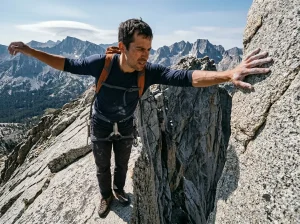
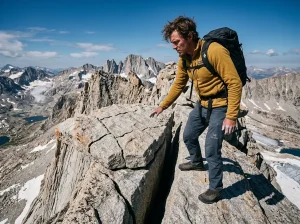
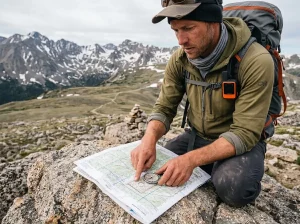
Inspect every anchor point before committing your weight. Look for frayed rope, loose bolts, unstable rock anchors, and sun-rotted webbing. On temporary line handlines set by other groups, test gradually—lean first, then load—before going full commitment. This is the same logic behind testing handholds for stability before committing weight on any technical scramble.
Remove your backpack. Clip in to your harness via a daisy chain or sling so the pack trails behind you. A 30-pound pack on your back during a traverse acts like a pendulum, shifting your center of gravity behind and above you, forcing your arms to compensate for every swing. Tow the pack behind you and the rope becomes a highway, not a wrestling match.
Secure loose straps on the pack. Anything that catches on the rope or catches wind becomes drag you’ll pay for with forearm fatigue.
Body Position and the Baseball Bat Grip
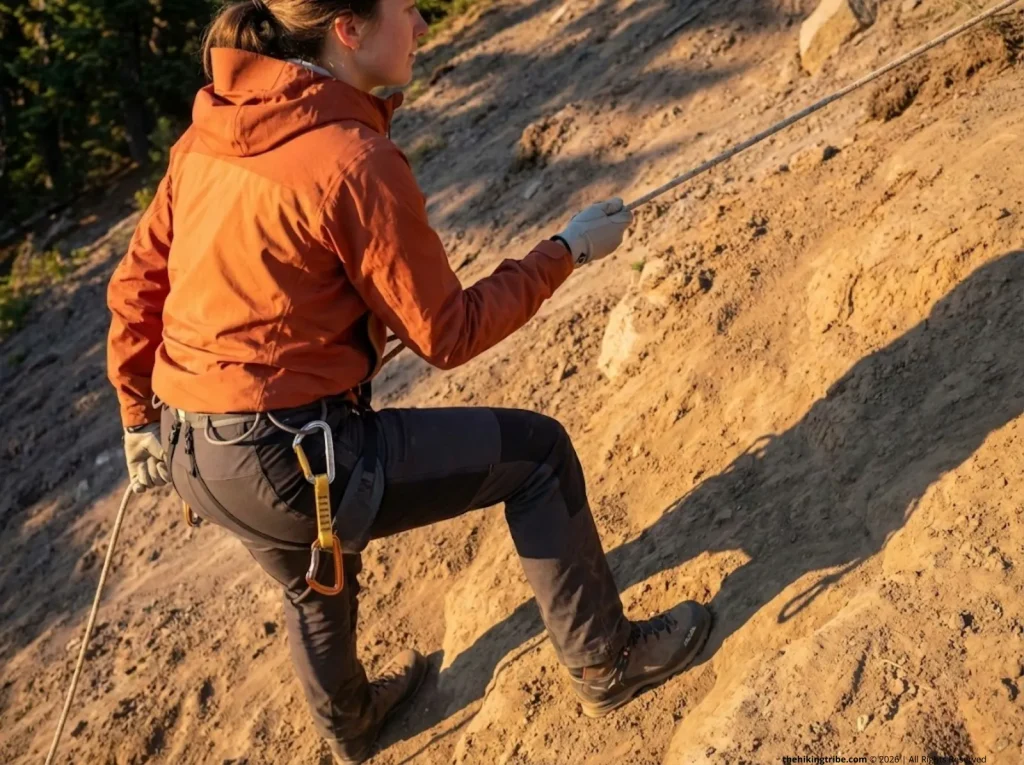
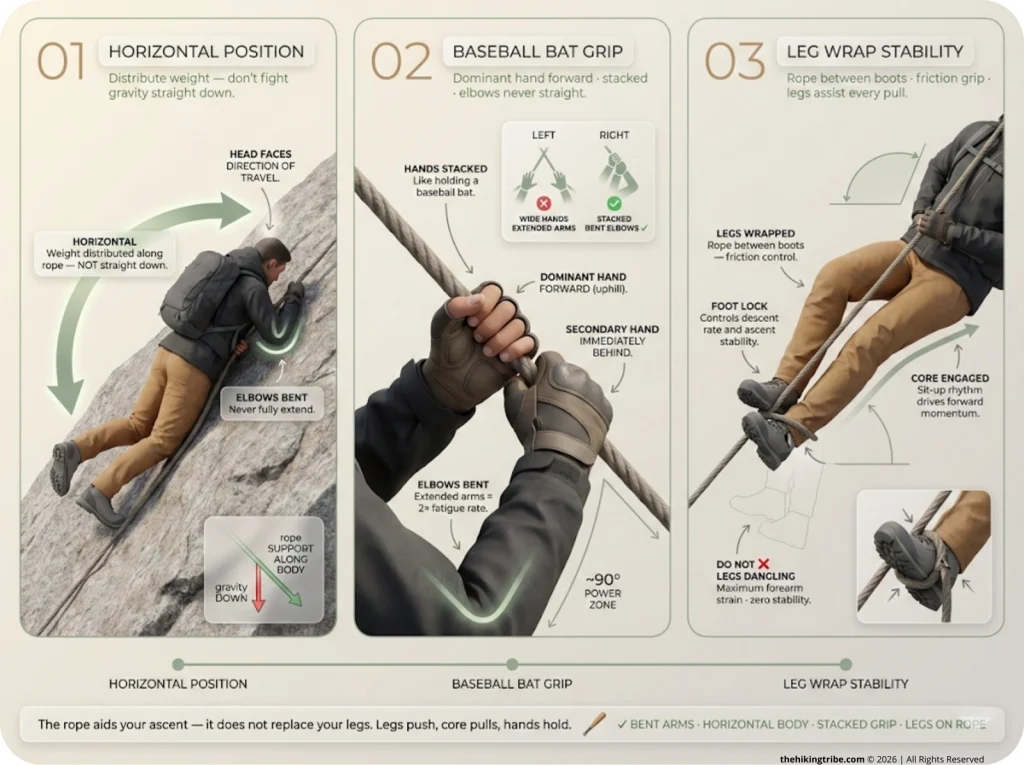
Lie horizontal with your head facing the direction of travel—that’s your horizontal body position. This distributes your weight along the rope instead of fighting gravity straight down. On a steep handline near vertical position, face the slope, grip the rope overhead, and walk your feet up while pulling—the rope aids your ascent, it doesn’t replace your legs.
Your hands stack on the rope “like holding a baseball bat“—dominant hand forward, other hand immediately behind. That’s the baseball bat grip. Keep elbows bent at all times. Fully extended arms lose leverage and fatigue roughly twice as fast as bent ones.
Core-Driven Rhythm and Momentum
Push off straight from the anchor with your feet to generate your initial momentum push-off. Push horizontally—not up, not down. An upward push creates a bounce that wastes energy. A downward push drops you into the sag.
From there, settle into the pull-lift-glide rhythm. Pull with stacked hands, lift your lower body with your abs in that core sit-up rhythm, glide on the momentum, then relax for a heartbeat before the next stroke. On sagging lines, this is your lifeline—it lifts your lower body out of the drag zone that would otherwise stall you cold.
Your legs can either wrap around the rope for stability (slower, more stable) or hang free for speed and momentum (faster, demands more core). Choose based on fatigue management and exposure. After a full day of hiking with a loaded pack, wrapping is the safer bet.
The video above demonstrates practical handline technique on real trail terrain—anchor selection, lean-back descent, and glove use for grip protection. Watch the body angle and foot placement closely. That’s what a controlled fixed rope descent looks like when someone isn’t fighting the rope. You can also reference Yosemite National Park guidelines on cable sections for managed fixed-rope protocols on high-traffic routes.
Three Terrain Scenarios Where Technique Changes
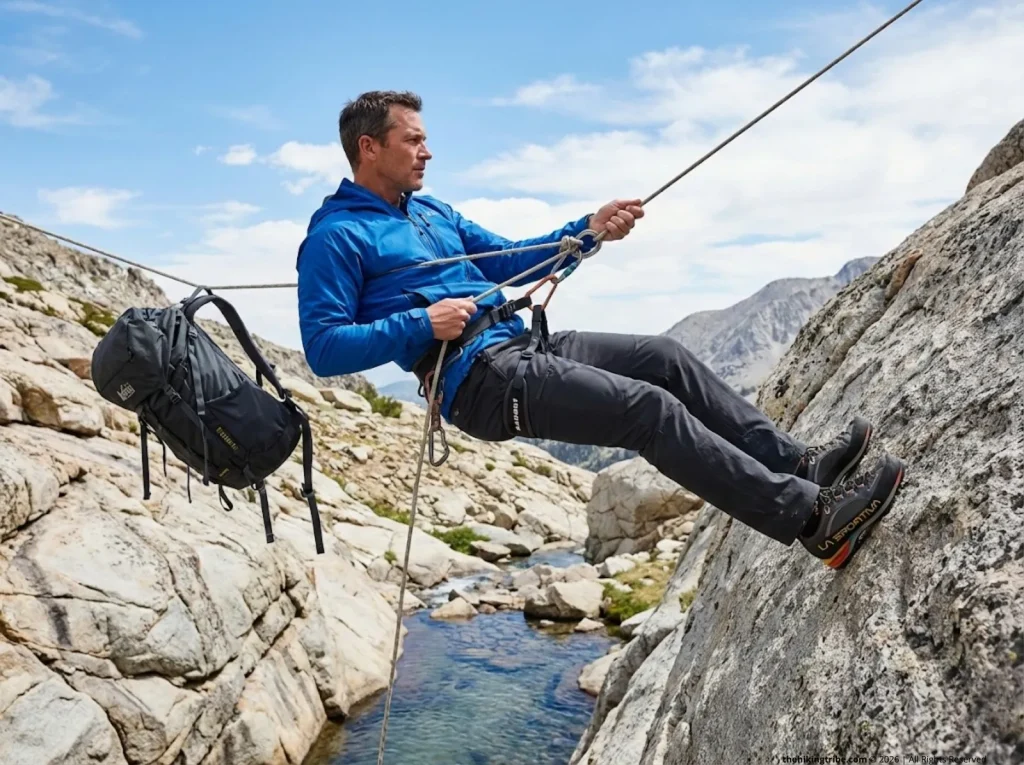
The base mechanics stay the same, but terrain changes the details. Recognizing which scenario you’re facing starts with reading Class 3 terrain markers to anticipate fixed-rope sections before you’re already committed.
Horizontal Tyrolean Traverse
The classic: full horizontal body position, head forward, legs wrapped or hanging. This technique originated in the Dolomites in the late 19th century for approaching spires and crossing voids. Pack towing is mandatory here—wearing it turns a manageable traverse into an endurance test.
On long traverses (30 meters or more), micro-rest every 8 to 10 pulls by pausing with legs wrapped and arms relaxed for 5 to 10 seconds. The Lost Arrow Spire approach in Yosemite is a well-known example, though most hikers encounter shorter versions on alpine approaches and Sierra scrambles.
Eroded Ridge Handline Descent
Face the slope, lean back into the rope, walk your feet down. The rope controls your descent speed—your crushing grip stabilizes, it doesn’t bear the full load. Keep your center of gravity low and close to the slope. Standing upright on an eroded bank invites a slip that suddenly loads the rope with your full body weight.
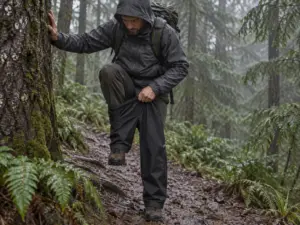
Trail reality: the Mt. Hood Timberline Trail fixed ropes on eroded dirt banks near Eliot Creek are exactly this scenario. Hikers encounter them without warning around a bend in the trail, often wet, often without gloves. This is where safety preparedness matters most.
Short Vertical Fixed-Line Ascent
Grip the rope overhead with stacked hands, step and pull in rhythm. For sections under 10 meters, the hand-over-hand technique is faster and lighter than rigging ascenders. Use your legs to push your body upward while your hands stabilize—most of the work is legs, the rest is arms.
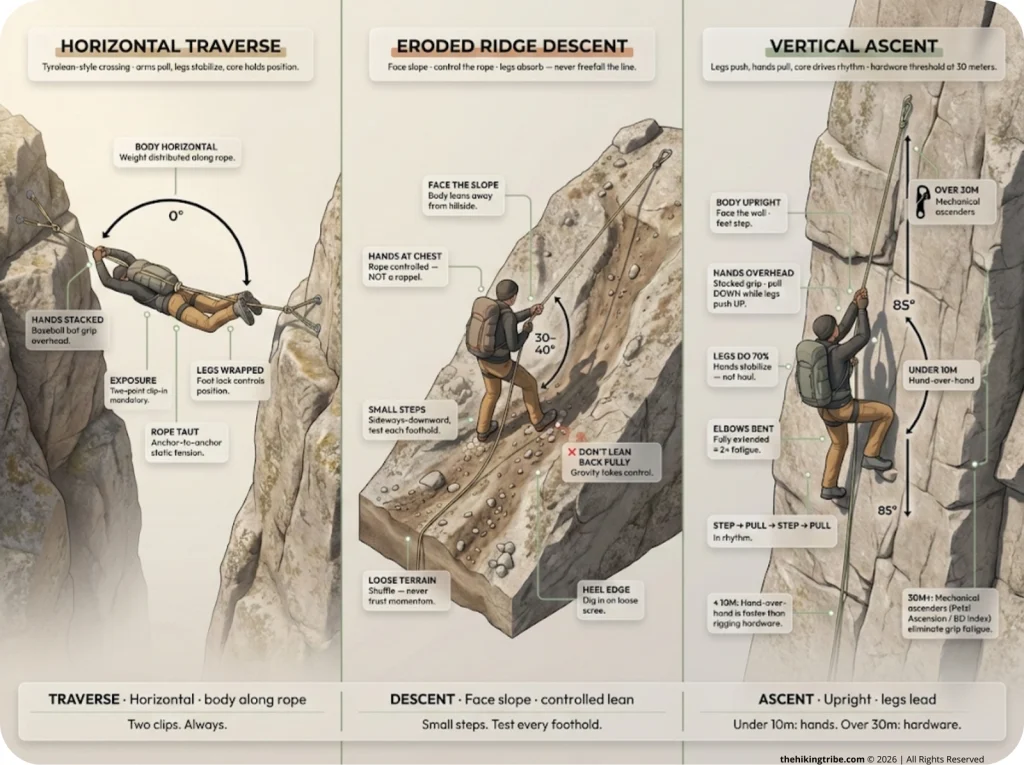
For longer pitches beyond 30 meters, mechanical ascenders like the Petzl Ascension or Black Diamond Index eliminate grip fatigue entirely. The technique is sometimes called traditional jugging in climbing circles. The Mountaineers handbook recommendations for fixed-rope terrain set the threshold at roughly 30 meters for when hardware earns its weight.
Safety Mistakes That Send Hikers Sliding
Single-Point Attachment and No Backup
This is the number one preventable error on fixed ropes. One carabiner. One clip. No redundancy. If that gate opens against the rope or your biner shifts on a rocky edge, there is nothing between you and the fall.
The fix is simple and weighs less than a granola bar: always clip a backup sling ahead of your primary attachment before loading the rope. Never trust unmaintained or unknown fixed ropes without thorough anchor inspection—they can fail without warning. Single-point failures have caused fatalities that a 40-gram sling would have prevented. Always have bailout options planned before you commit to any fixed-rope section.
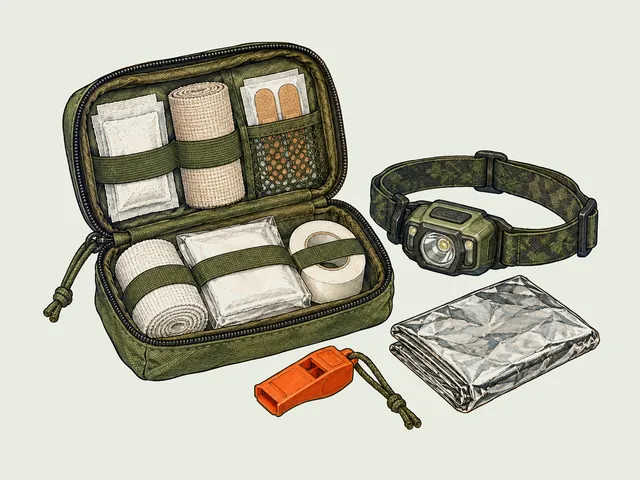
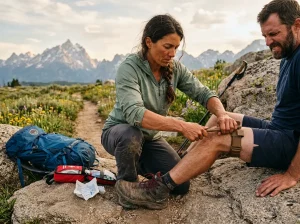
If something does go wrong on a fixed-rope section, having a plan for what comes next matters as much as the prevention itself. That’s where wilderness first aid when you’re miles from help fills a gap most technique guides skip entirely.
Wearing the Pack on the Traverse
Your pack shifts your center of gravity behind and above you, forcing your arms to compensate for 20 to 40 pounds of swinging, shifting weight with every pull. The result: forearm fatigue doubles, rhythm breaks, and you start white-knuckling within 20 feet.
The fix: remove the pack, clip it to your harness via a daisy chain, and let it trail. Even on short handlines, the difference is immediate. The common objection—”It’s only 20 feet, I’ll keep the pack on”—is exactly when complacency produces a fall.
Pushing Off Wrong and Bouncing the Rope
An upward or downward push from the anchor creates a pendulum effect that throws off everything. On a traverse with a second person, your bouncing can break their rhythm entirely.
Push straight out. Horizontally. Along the rope’s axis. That initial momentum carries you into the pull rhythm without wasting energy bouncing up and down. According to NPS wilderness fixed-rope safety practices, controlled movement and communication between traversers are critical on any shared line.
Pro tip: On a two-person traverse, wait until the first person reaches the far anchor and signals “off rope” before the second clips in. Shared rope means shared bouncing, and shared bouncing means shared problems.
Train for the Ridge Before You’re on It
The general hiking fitness foundation described in the complete hiking training system for strength and endurance forms the base. But fixed-rope work demands specific upper-body conditioning and muscle memory that trail miles alone won’t build. Think of this as your practice progression—ground drills first, short handlines second, loaded traverses last.
Ground-Level Rope Drills
String a thick rope between two trees at waist height. Practice the clip-in sequence: primary quickdraw, backup sling, test the anchor. Do it until the movement is automatic. On a ridge, fumbling with hardware while adrenaline surges is where fear amplifies mistakes.
Then hang from the low rope (feet still touching the ground) and practice the core sit-up rhythm. Pull with stacked hands, lift with abs, glide, relax. The first dozen attempts feel awkward. By the twentieth, the rhythm is smooth enough to feel natural.
Practice pack removal and daisy chain attachment in the same session. Clip, unclip, tow, repeat. Muscle memory built in a park at sea level transfers directly to the ridge at 8,000 feet.
Short Handline Progression
Graduate to a 10 to 20 meter handline on a moderate slope—Class 2 to 3 terrain. Practice descent and ascent carrying a loaded pack. Time yourself: the first run will feel hesitant; by the fifth, the hand-over-hand rhythm should be sustainable for the full length.
Train with the same gear you’ll carry on the real hike. Same gloves, same slings, same carabiners, same harness or trekking belt. Gear familiarity eliminates one more variable on the day that matters.
Upper-Body Conditioning for Loaded Traverses
Dead hangs build grip strength endurance—what climbers call static grip strength. Hold for 30 to 60 seconds and build from there. If you can’t hold a dead hang for 30 seconds, you’re not ready for a loaded traverse—build that baseline first.
Farmer’s carries—50 meters with 25-plus pounds in each hand—build the shoulder and forearm stamina that prevents pump-out. That kind of functional arm strength is hard to fake on the rope. Adding rope-pull drills while wearing a 20 to 40 pound pack simulates the real experience better than any gym machine. Pulling a loaded sled or resistance band while engaging core replicates the hand-over-hand drill mechanics you’ll use on the ridge.
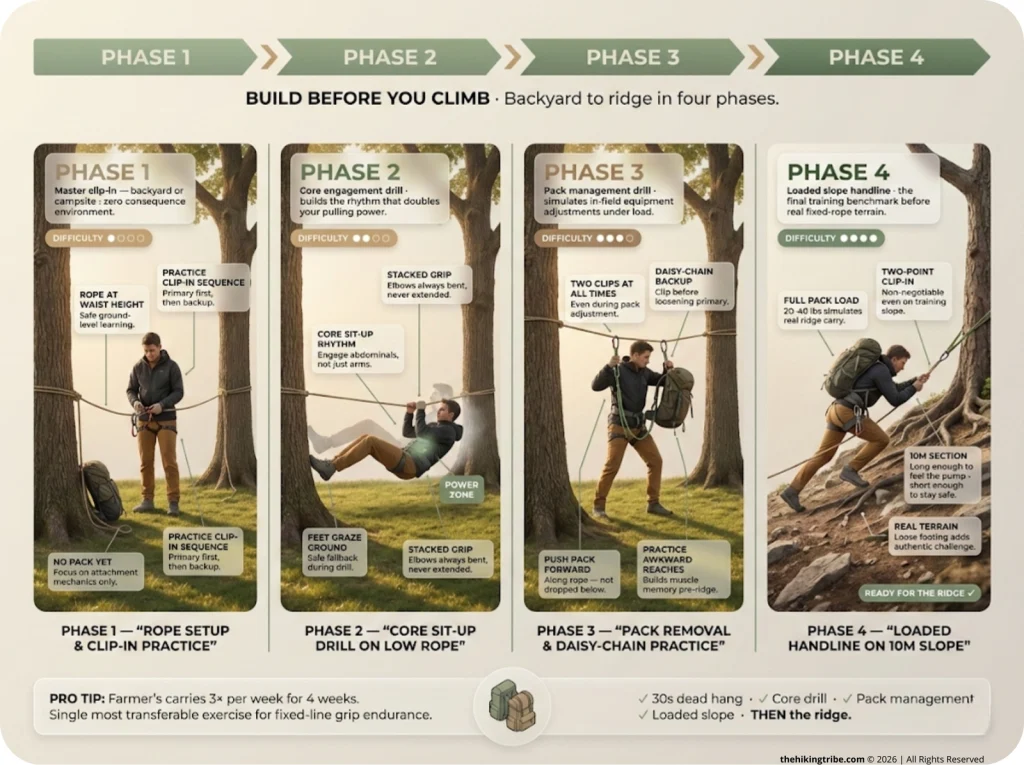
Pro tip: Farmer’s carries done three times per week for four weeks will noticeably improve your grip endurance on the rope. It’s the single most transferable exercise for fixed-line work.
Leave No Trace When You Leave the Line
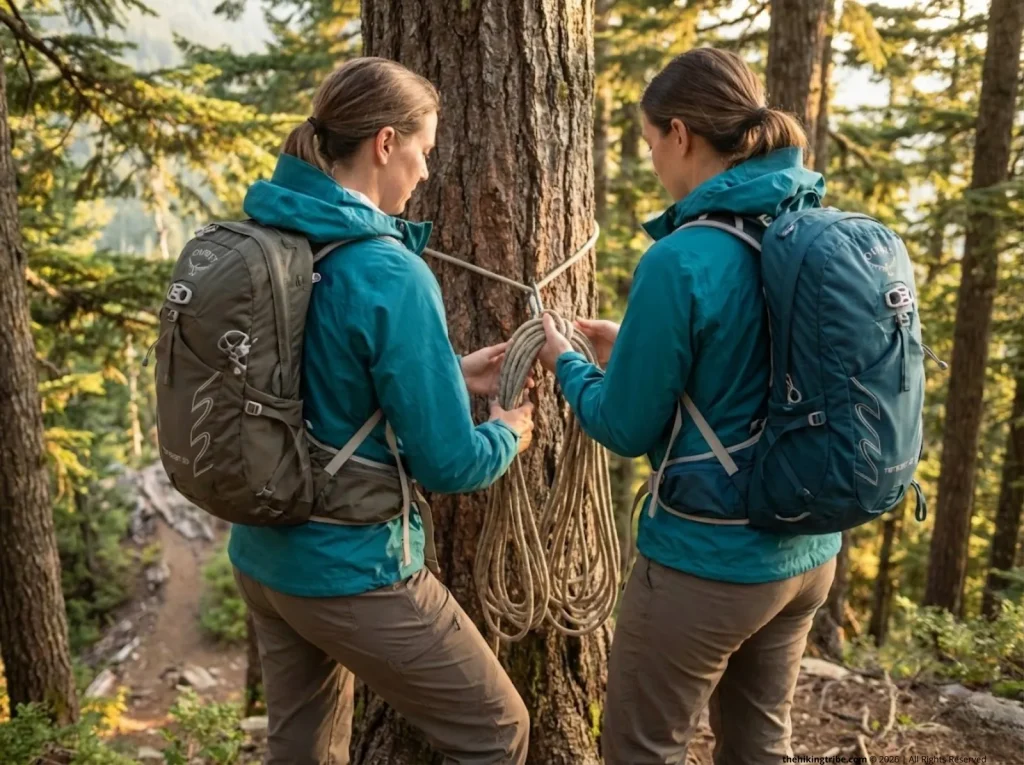
Remove Temporary Lines After Use
If your group installed a temporary line handline on public land, take it down completely after everyone is across. Abandoned rope is both litter and a hazard—sun-rotted cord that looks functional can fail under the next hiker’s weight without warning.
Check local regulations before installing anything. Some National Forest and BLM areas prohibit fixed installations entirely. NPS sites generally prohibit them except on managed routes like the Half Dome cables. The full breakdown of stewardship expectations is covered in the full Leave No Trace ethics guide beyond the 7 Principles.
Minimize Anchor Damage on the Approach
Use natural anchors—trees, rock horns—with padding (a pack towel or scrap webbing) to prevent bark stripping or rock scarring. Never drill bolts or hammer pitons without explicit agency approval. On heavily used erosion handlines sections, follow established routes to avoid trampling adjacent vegetation and compacting new soil paths.
The ridge will be there for the next group. Leave it cleaner than you found it.
Conclusion
Three things will change everything about how you handle a fixed rope on the ridge.
First, let your core do the pulling. Stacked hands, bent arms, and an abdominal sit-up rhythm replace the death grip that fries your forearms in 90 seconds flat.
Second, clip two points, not one. A short quickdraw primary and a longer sling backup weigh less than a granola bar and eliminate the single point of failure that has killed experienced climbers, let alone hikers.
Third, practice on the ground before the ridge decides for you. Ground drills, progressive handline work, and farmer’s carries build the muscle memory that fear steals when you’re looking at a 50-foot drop.
String a line between two trees this weekend. Clip in. Practice the sit-up rhythm. Tow the pack. Get the sequence into your muscles—because the ridge won’t wait while you figure it out.
FAQ
How do you perform a Tyrolean traverse hand over hand?
Clip a short quickdraw from your harness belay loop to the fixed rope, add a backup sling, then lie horizontal with your head facing the direction of travel. Pull yourself hand over hand using your core muscles—not just your arms—with hands stacked like a baseball bat grip, settling into a pull-lift-glide rhythm.
What gear do you need for a fixed rope traverse as a hiker?
At minimum: a lightweight harness or trekking belt, one short quickdraw (12–15 cm), one 60–120 cm sling with a locking carabiner for backup, a daisy chain or sling for pack towing, and lightweight gloves. Total additional weight runs 250 to 400 grams.
Is hand-over-hand better than using ascenders on fixed ropes?
For short sections under 30 meters—the typical handline on a hiking scramble—the hand-over-hand method is faster, lighter, and requires less gear. For pitches longer than 30 meters, mechanical ascenders like the Petzl Ascension eliminate grip fatigue entirely and are worth the added weight.
How safe is crossing a fixed rope on a ridge?
Safety depends on technique and redundancy. With proper dual-point attachment, anchor inspection, core-driven pulling, and pack removal, fixed-rope crossings are routine. The danger comes from single-clip attachment, arms-only pulling, and trusting ropes without inspection.
How do I set up a temporary handline for scrambling?
Wrap a static rope (8–9 mm) around a solid natural anchor like a tree or rock horn, pad it with webbing to prevent bark damage, and run it down the scramble section. Test with body weight before committing. Remove all gear after use following Leave No Trace principles—abandoned rope is both litter and a hazard to the next hiker.
I've spent more than a decade researching hiking gear and trail technique. I read the specs, the forum threads and the long-term reviews, and every pick here comes with what it gets wrong.
End of the trail
You read every mile of this one. Here's where the trail goes next.