In this article
The wind hit the ridge at 38 mph. My phone screen had gone dark 40 minutes ago — battery dead — and the cairns that marked the trail down were buried under 14 inches of new snow. I was wearing a cotton base layer. My water filter had frozen solid in my pack. I had 90 minutes of daylight left. This was a “beginner” trail in November, and I was a very stupid intermediate hiker who thought he knew what he was doing.
That trip didn’t end me. But not because I was prepared — I got lucky. And luck is a terrible strategy in sub-zero terrain.
This article gives beginners the actual checklist serious winter day hike planning requires — not a generic gear list, but a framework that explains why each item matters and what happens if you skip it. By the end, you’ll understand the physics, biology, and weather mechanics that keep people alive in cold conditions, and you’ll know exactly how to plan, gear up, and make go/no-go safety matrix decisions before you ever leave the trailhead.
⚡ Quick Answer: Successful winter hiking essential gear checklist planning starts with three things you probably don’t have yet: a hard turnaround time set on your watch, a lithium battery in your headlamp, and your water filter inside your jacket instead of your pack. The physics of survival in winter aren’t complicated, but they’re unforgiving. Get the forecast from NOAA, calculate your 1/3 daylight margin, wear moisture-wicking synthetics (never cotton), and file a trip plan with someone who isn’t hiking with you. That’s the short version. The rest of this article explains why each piece matters.
Before You Go — The Winter Planning Protocol
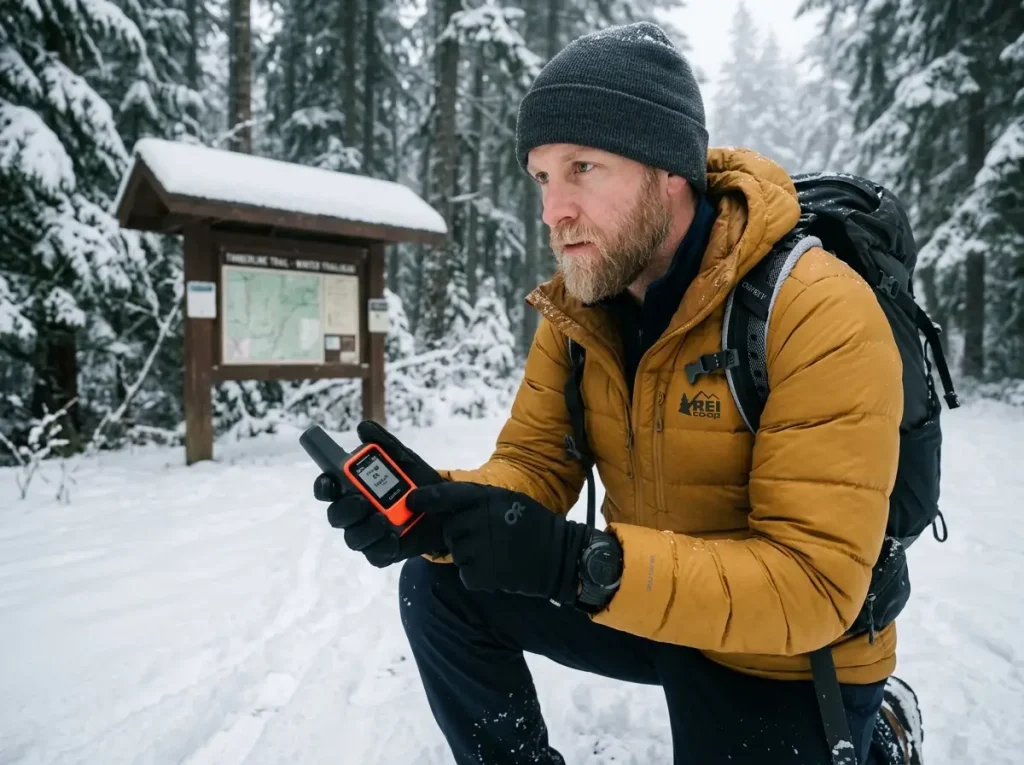
Most winter hiking mistakes get made the night before the hike, not on the trail. By the time you’re standing at the trailhead shivering, it’s too late to fix them.
Reading the forecast the right way
Not all forecasts are created equal. The temperature your weather app shows you is the air temperature at roughly shoulder height in a sheltered area. Your exposed face on a ridgeline at 3,500 feet is a different story entirely.
Start with NOAA’s Wind Chill Index and Safety Chart. What matters isn’t just the temperature — it’s the combined effect of temperature and wind on exposed skin. A forecast of 20°F with 20 mph winds produces a wind chill of -4°F, where exposed skin can freeze in under 30 minutes. That’s the physics of convective heat loss stripping your body’s boundary layer faster than it can regenerate.
Second, account for the Environmental Lapse Rate: temperature drops approximately 3–5°F for every 1,000 feet of elevation gain. The trailhead forecast doesn’t tell you what the summit feels like. Check mountain-specific forecasts at mountain-project.com or yr.no.
Also watch your cloud types. Lenticular clouds signal high winds aloft; cumulonimbus buildups mean conditions can deteriorate in under an hour. When in doubt, understand how to research a trail before you go — weather patterns, approach details, and bailout options should all be part of your research before you commit.
Pro-Tip: Check the wind chill prediction twice — once the night before and again the morning of. If wind speed increased by more than 10 mph overnight, re-evaluate the objective. A summit that looked manageable at 9 PM may be a serious problem at 6 AM.
Calculating a hard turnaround time (the 1/3 Rule)
In the Northeast, sunset can arrive before 4:30 PM in deep winter. You cannot hike out of darkness safely through knee-deep snow. This isn’t a matter of a good headlamp — post-holing in the dark is how ankles break.
The professional solution is the 1/3 Rule, and it’s the single non-negotiable piece of safety planning and daylight margin calculations: allocate 1/3 of your available daylight to reach the objective, 1/3 for the return, and 1/3 as a safety buffer. If you haven’t reached the halfway point by the time your first third expires, you turn around. No argument. No “just a little further.”
Build the turnaround time into a watch alarm — because it’s too easy to let the pull of the summit override good judgment when you’re moving well. Also remember that winter pace is 30–50% slower than summer. Post-holing, microspike drag, and heavy layers all extract a tax. Factor it in before you leave.
Sharing your trip plan (the SAR protocol)
Before you leave, file a trip plan with a contact who is not on the trail with you. The plan should include your expected route, trailhead location, turnaround time, and a “trigger time” — the exact moment at which your contact should call Search and Rescue if they haven’t heard from you.
Sixty percent of hiking injuries happen to casual hikers due to lack of preparation. A trip plan costs you about five minutes and is the single highest-leverage safety act you can complete before any winter outing. If you carry a Garmin inReach or SPOT, test the check-in button before you leave. Don’t discover it needs charging at the trailhead.
If you’re planning to go solo, understand the trip plan protocol SAR teams actually want before your first winter outing alone. The details — vehicle photo, photo of your map with your intended route drawn on it — actually matter for search efficiency.
The Winter Layering System — What Actually Keeps You Alive
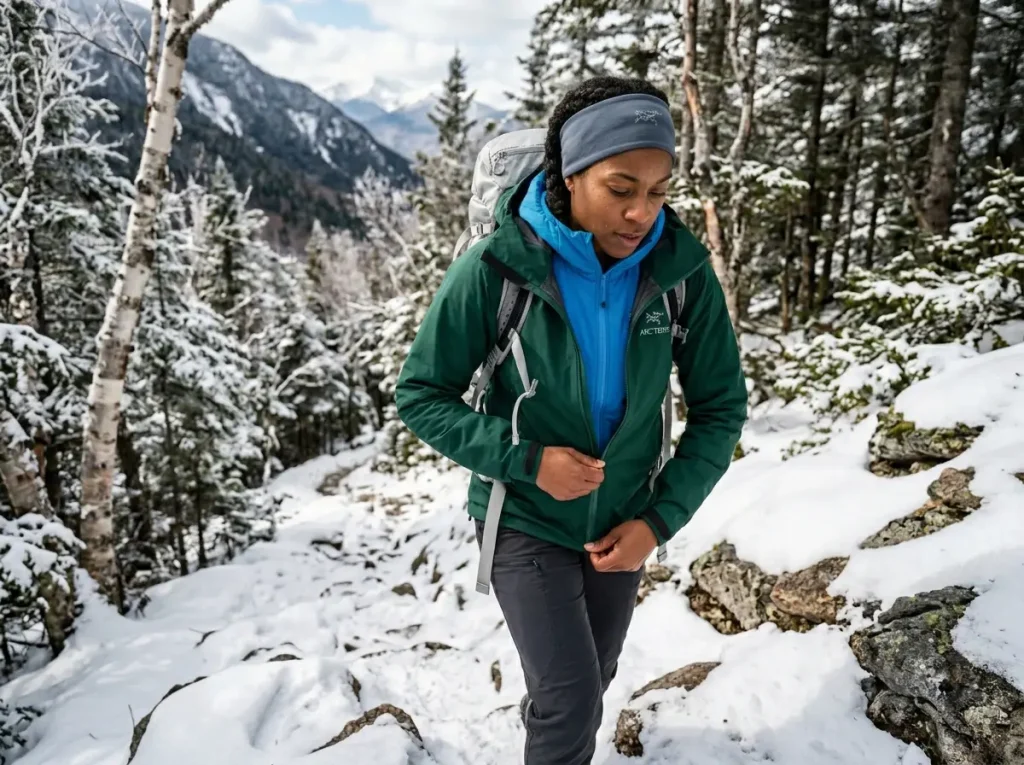
Every piece of advice about winter clothing boils down to one physics problem: your body generates heat, and your clothing’s job is to trap that heat while moving moisture away from your skin. When your clothing fails at either task, the physics turn against you fast.
The physics of “cotton kills” (and synthetic vs. merino)
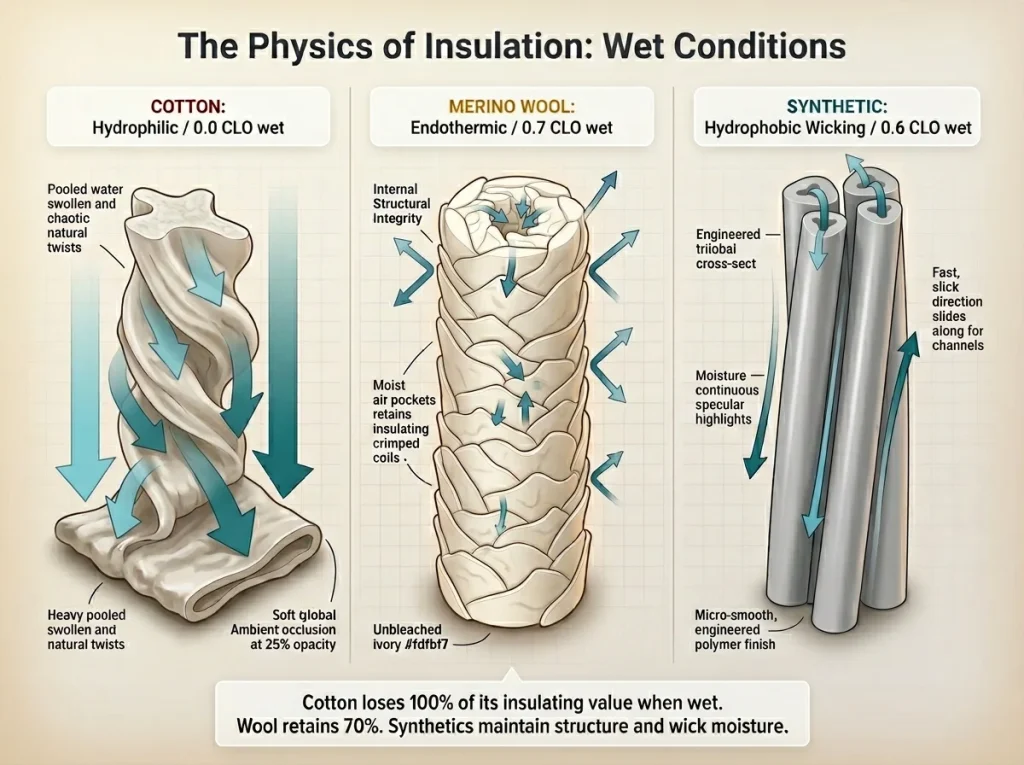
Heat loss through wet clothing is 25 times faster than through dry conditions. This is the actual science behind “cotton kills” — and it’s not a slogan. It’s thermal conductivity. If you want to understand exactly why wet cotton conducts heat away from your body so fast, the short version is this: cotton is hydrophilic, meaning it absorbs sweat and holds it. Once saturated, it loses all insulating value. Not most of it — all of it.
Merino wool maintains roughly 70% of its insulating value when wet, thanks to the structure of its keratin fibers. Synthetic polyester wicking base layers move moisture away from skin more aggressively than merino, though they pill faster. Your base layer’s only job is to move sweat away from skin, not to keep you warm. That’s the mid-layer’s job.
CLO value is the measurement of insulation capacity: 1 CLO is the insulation required to keep a resting person comfortable at 70°F. A functional winter 3-layer system runs 5–7 CLO total. That math only works if none of those layers is cotton.
Pro-Tip: Start cold at the trailhead. If you’re comfortable when you start moving, you’ll be soaked in sweat by the first mile. The chilling that follows when you stop is the setup for hypothermia — not some dramatic emergency, just a quiet physics problem that compounds over hours.
Down vs. synthetic mid-layer — the wet-transition problem
Down insulation with 800+ fill power is genuinely excellent — it creates air pockets that resist heat transfer better than any synthetic at the same weight. But down has a catastrophic failure mode. Down clusters are hydrophilic. When saturated, down loses up to 90% of its insulating value.
Synthetic filaments maintain their 3D structure when wet. They retain meaningful thermal resistance even soaked. For high-output hikers who sweat on steep ascents — which is most beginners — a synthetic puffy is a better choice than down for your active layer. Save down for when you’re stationary: lunch stops, summit breaks, or emergencies.
In the “wet-cold” transition zone (35–45°F with rain or sleet), the down vs. synthetic insulation performance matrix makes this decision simple: synthetic is a safety margin, down is a liability. The temperature difference between them matters far less than what happens when moisture shows up.
Vapor barrier liners — the advanced option beginners should know exists
A VBL (Vapor Barrier Liner) is a non-breathable material — silicone-impregnated nylon — worn against skin or over a thin liner sock. The mechanism is counterintuitive: by blocking “insensible perspiration” from reaching your outer insulation, the VBL creates a microclimate at 100% humidity at skin level. Your body reads that as “already wet” and stops sweating. Result: your outer insulation stays dry and lofted all day.
This is advanced gear. Most beginners should focus on getting moisture-wicking synthetics right before experimenting with VBLs. The failure mode is real — in above-freezing temps, sweat accumulates and chills you on rest stops. But for alpine approach hikes in extreme cold, it’s worth knowing the option exists. For the full system from base to shell, mastering winter layers from base to shell covers the complete picture.
The Gear Physics Checklist — Items That Pass the Science Test
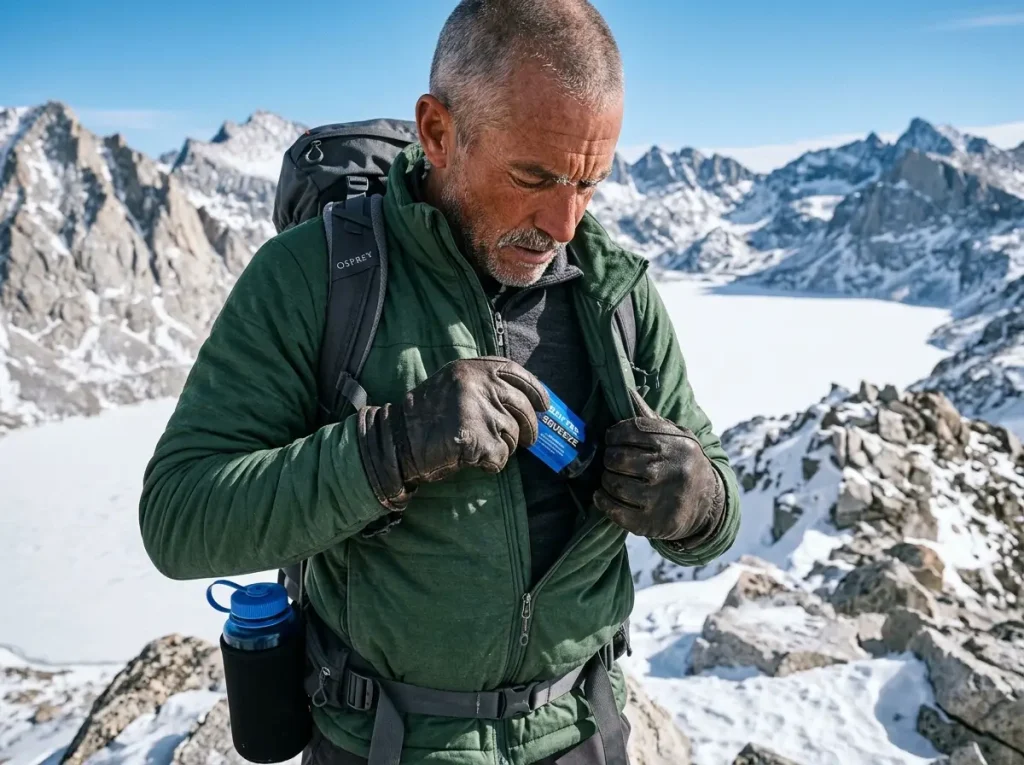
Beyond clothing, three pieces of gear have physics-based failure modes that most beginner guides never explain. Each one can end your trip or seriously harm you.
Battery chemistry — why lithium is non-negotiable
Alkaline batteries use a water-based electrolyte. Below 32°F, ion mobility drops sharply. The result is “voltage sag” — your headlamp or GPS unit doesn’t fade out gradually; it falls off a cliff. One moment it works, the next it doesn’t.
Lithium batteries (Lithium-Iron Disulfide) maintain a flat discharge curve from -40°F to +140°F. In high-drain cold testing, they outlast alkaline by up to 5 times at -20°C. In your headlamp and GPS: always lithium primaries. No exceptions in the backcountry.
One critical warning that almost no guide mentions: never charge Li-ion (rechargeable) batteries below 32°F. Cold electrolyte thickens and slows lithium ion movement. If you force a charge into a cold battery, ions can’t penetrate the anode quickly enough and instead “plate” onto the surface as metallic lithium. This permanently damages capacity and creates thermal runaway risk. Carry your power bank inside your insulation layer — body heat keeps it warm enough for safe charging at camp. For choosing a headlamp with battery performance for winter, this chemistry difference is the most important consideration.
Water filter failure in freezing temps (the hollow fiber problem)
Modern hollow fiber filters like the Sawyer Squeeze or Katadyn BeFree use 0.1–0.2 filter micron pore size tubes that block bacteria and protozoa. They work excellently — until they freeze.
Water expands approximately 9% in volume when it freezes. Once you’ve used a hollow fiber filter and water remains in its fibers, sub-zero temperatures cause microscopic ruptures in the fiber walls. These ruptures are invisible. The filter appears functional but allows Giardia and bacteria to pass through. Sawyer’s official guidance on freezing and filter integrity is unambiguous: if a used filter has been exposed to sub-freezing temperatures, replace it.
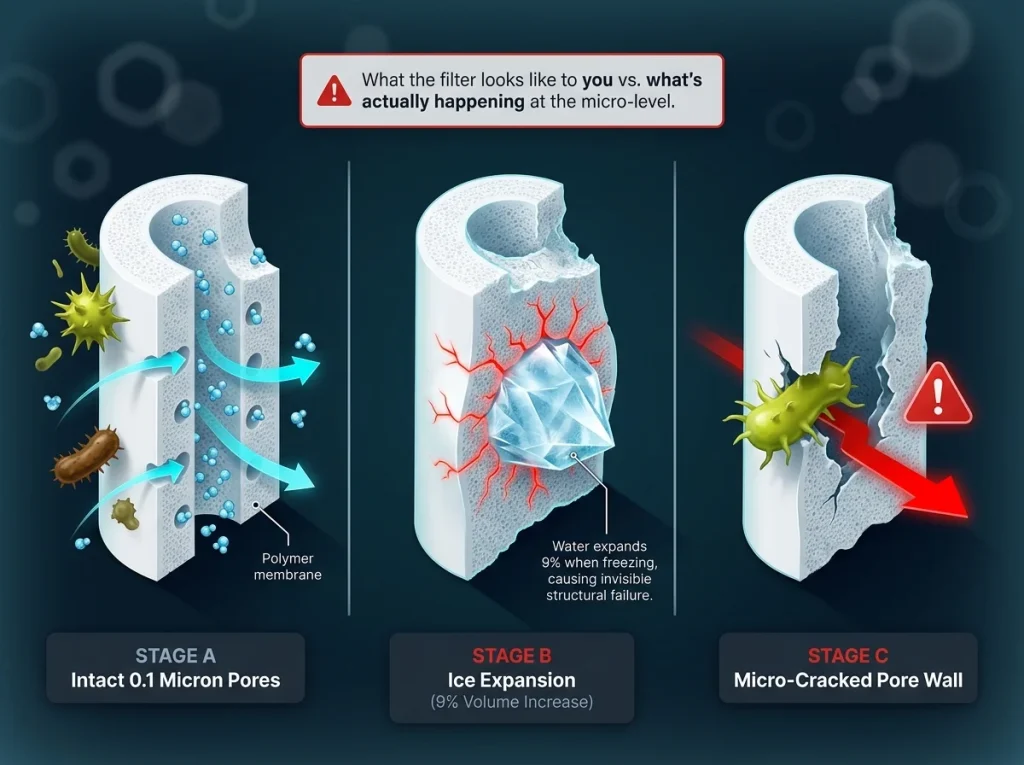
Field protocol: carry the filter inside an insulation layer against your body all day. Sleep it in a sealed bag at the bottom of your sleeping bag. Alternatives when this isn’t practical: chemical tablets (slow in cold — 4+ hours for Cryptosporidium), UV (SteriPEN — battery-dependent), or pre-filled insulated bottles. For a full system on how to keep water from freezing on winter day hikes, the upside-down Nalgene technique is another core piece.
Traction devices — hierarchy by terrain
Falls cause 50% of all hiking injuries. Winter amplifies this dramatically. The solution isn’t caution — it’s mechanical traction matched to your terrain.
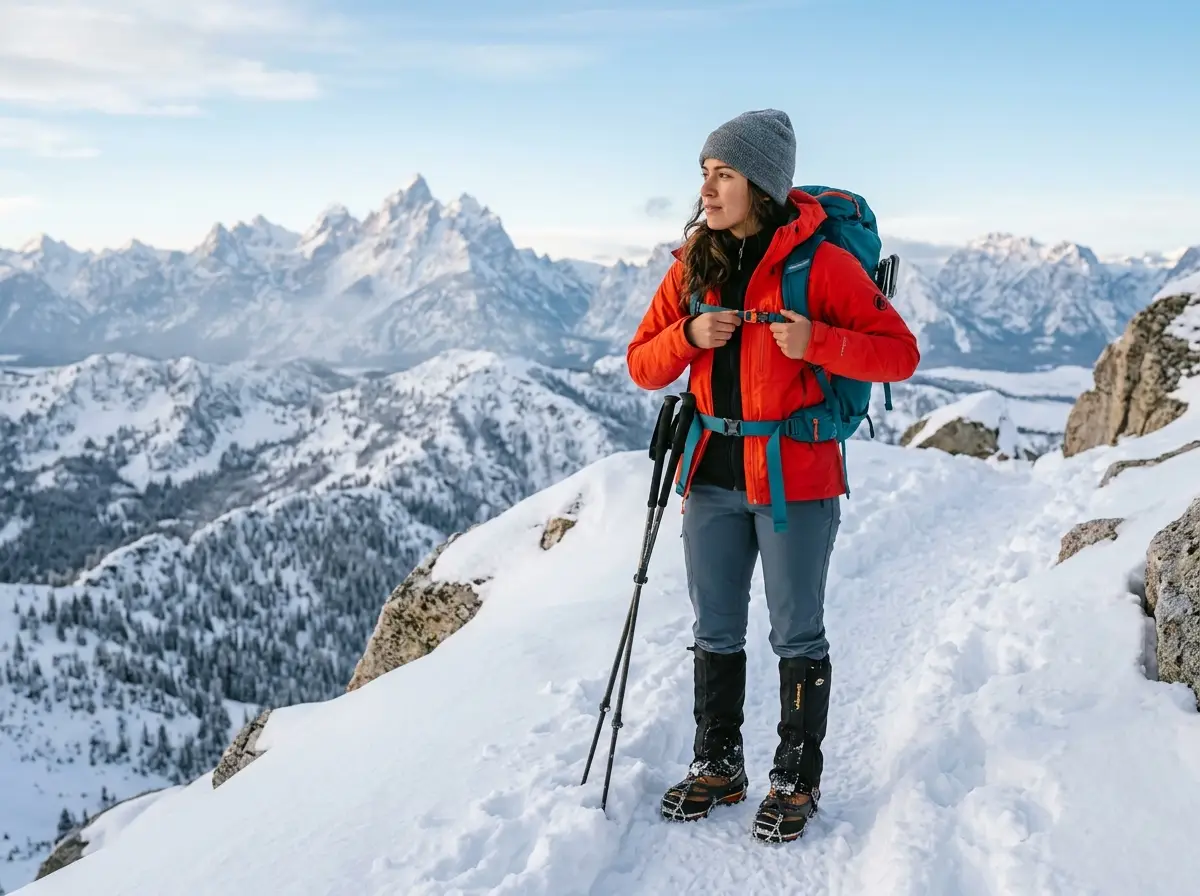
Kahtoola MICROspikes are the standard for most beginner-technical winter trails: stainless steel spikes and chains that grip packed snow and low-angle ice. They’re the baseline. Snowshoes become necessary when snow depth exceeds 8 or so inches of unconsolidated snow — post-holing destroys your energy reserves, damages trail integrity, and creates real ankle fracture risk. According to NYSDEC winter hiking traction requirements for Adirondacks, snowshoes are actually required by regulation in some High Peaks areas when conditions hit certain thresholds.
Crampons are technical terrain only. Beginners should stay off terrain that requires them until they’ve received training — “catching a point” on your own clothing during a fall is how catastrophic tumbles happen. For a direct comparison of beginner traction options, Yaktrax vs Kahtoola — which fails on real ice is the honest field test answer.
One final note on boots: size them for your merino wool hiking socks, not your summer socks. Compression from thick socks inside a tight boot restricts blood flow, accelerating frostbite risk in your toes.
Biological Fueling — Eating and Drinking for Thermostasis
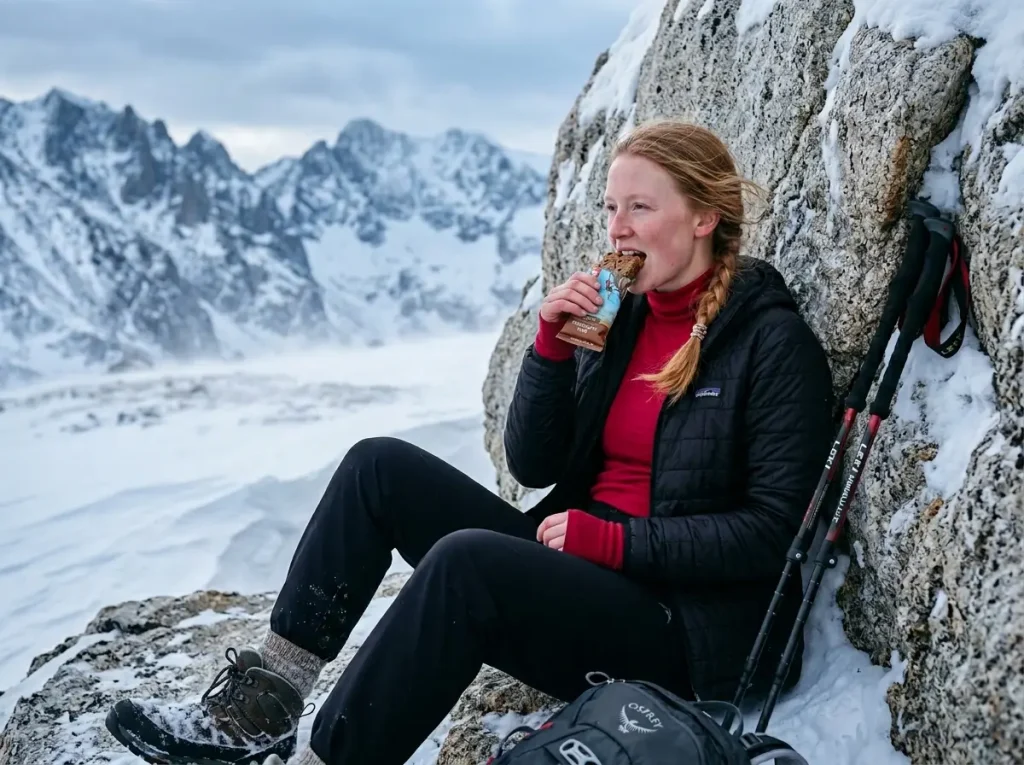
Winter hiking is not just athletically harder than summer hiking. It’s biologically different. Your body is running a survival program that eats through fuel at a rate most beginners don’t account for.
Why you need to eat twice as much (and what to eat)
The human body burns roughly 40% more calories as heat in winter just to maintain core temperature before you add any hiking output. Shivering recruits major muscle groups at up to 40% of maximal oxygen consumption — that’s not shaking, that’s involuntary aerobic exercise happening in your trunk and legs.
The body’s fuel preference shifts in cold conditions. It oxidizes carbohydrates (glucose) faster than fat to support high-frequency shivering muscle contractions. Research from PMC/NIH confirms shivering thermogenesis and metabolic rate increases in cold exposure can reach 5–6 times your basal metabolic rate. “Bonking” — glycogen depletion — in winter doesn’t just slow you down. It causes shivering to cease, and core temperature drops faster. That’s the energy cliff you cannot afford to hit.
Protocol: eat 300–500 calorie density for shivering per hour regardless of hunger. Cold blunts appetite by up to 40%. A snack schedule every 60–90 minutes is the professional standard. Run the fast carbs — gels, chocolate, gummies — for immediate shivering fuel, and add nut butter, cheese, and salami for sustained output on the return leg. Use the calculate exactly how many calories you need for a winter day hike tool to plan actual quantities before you leave.
Pro-Tip: Pack more food than you think you need and eat before you’re hungry. The first sign of bonking in winter isn’t hunger — it’s a subtle slowdown in your thinking. By the time you feel it, you’re already behind.
Cold-induced diuresis and the water you don’t feel you need
Cold air is fundamentally dry. Every exhaled breath is saturated with vapor — real water loss on every breath. At the same time, cold exposure triggers cold-induced diuresis: blood vessels constrict at the extremities and reroute blood to the core, increasing blood pressure, and the kidneys respond by ramping up urination. You lose water faster. You feel thirsty less.
Dehydration thickens blood, slowing heat transfer to your fingers and toes and dramatically increasing frostbite risk where you can least afford it. The protocol is 16 oz (~500ml) of water per hour of hiking regardless of thirst — treat it like a snack schedule. Use the hydration calculator for how much water to pack per mile to plan quantities.
Carry your bottles upside down in an insulated sleeve. Ice forms top-down, so when inverted, the drinking port stays liquid the longest.
Navigation When Landmarks Disappear
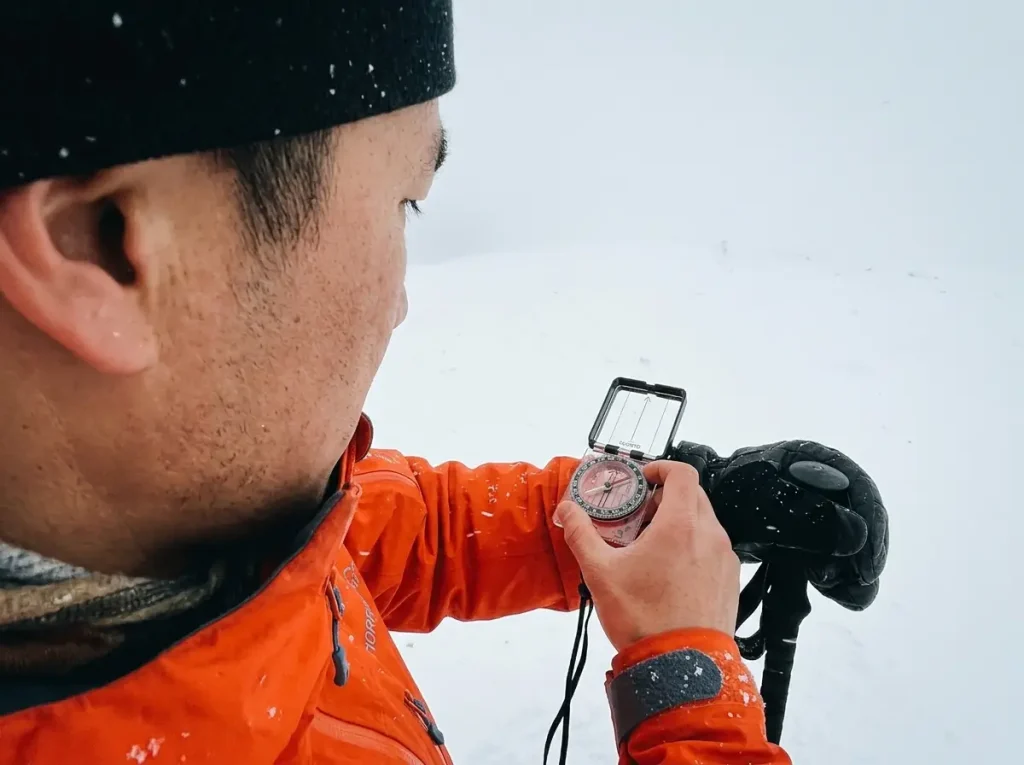
In summer, navigation is mostly trail-following. In winter, the trail is often gone. Cairns are under snow. Blazes are buried. Vegetation can look identical in every direction. Navigation becomes an actual skill requirement, not a luxury.
Magnetic declination — the calculation nobody teaches beginners
Magnetic declination is the angle between True North and Magnetic North — where your compass needle actually points. This value varies by location and changes over years. Pre-set your compass’s declination adjustment for your specific location using NOAA’s magnetic declination calculator before the trip.
Why does this matter specifically in winter? A 10° declination error over one mile equals 900 feet of lateral drift. In clear summer conditions, you’ll see the trail and self-correct. In whiteout conditions, how magnetic declination works and why it matters in winter is the difference between finding the trailhead and an unplanned bivouac.
Before leaving cell service, pre-load offline maps in Gaia GPS or CalTopo. Load the topographic layer, not just the trail overlay — the topo gives you contours to cross-reference with an altimeter when visibility drops. Also record your back bearing (180° opposite of your travel heading) at the trailhead. If the world turns white, that number is how you get home.
Whiteout protocol — what to do when depth perception disappears
In a whiteout, depth perception vanishes entirely. A flat snow surface and a 30-foot cornice drop look identical. This is not a situation where boldness pays.
The Leapfrog Technique in a group: the navigator takes a compass bearing and sends a partner to the edge of visibility. You verbally steer that partner left or right until they’re precisely on the bearing, then you advance to their position and repeat. Solo, toss a brightly colored cord or snowball ahead to provide visual contrast and detect slope changes before you commit your weight.
If you’re alone and the visibility genuinely goes to zero: stop. Anchor a shelter or emergency bivy and wait. Moving in zero-visibility on unknown terrain is covered in detail in how to navigate in zero-visibility fog and whiteout conditions — but the field-level rule is simple: walking in a whiteout is how people walk off cornices. Always note your last known GPS waypoint before conditions deteriorate.
Hypothermia and Cold Emergencies — What to Do When It Goes Wrong
All the planning in the world doesn’t make you immune to emergencies. When something goes wrong in winter, everyone within your group needs to know the response sequence.
The 1-10-1 principle — cold water immersion timeline
If someone falls through ice — including thin ice over a stream crossing, not just lake ice — survival follows a three-phase timeline validated by NOLS case study on ice immersion and the 1-10-1 response protocol:
1 minute (Cold Shock): The immediate gasping reflex. Most immersion fatalities in the first minute are from drowning, not hypothermia. Control your breathing. Don’t panic and inhale. This is the minute that determines whether you live.
10 minutes (Cold Incapacitation): Blood leaves the extremities. After 10 minutes, hands are too cold to grip, muscles too cold to contract. This is the window for self-rescue — haul out of the ice hole using your arms and forearms, not your hands. Kick your legs behind you. Get horizontal and roll onto solid ice.
1 hour (Hypothermia): Core temperature drops below 95°F, leading to unconsciousness. This is the timeline most people fear — but the real hazard is those first 10 minutes.
Accordingly, hiking near frozen water bodies in late fall or early spring demands extra caution and a throw rope in your group kit. For how to treat hypothermia in the field if someone does go down, the next section covers the essential field treatment.
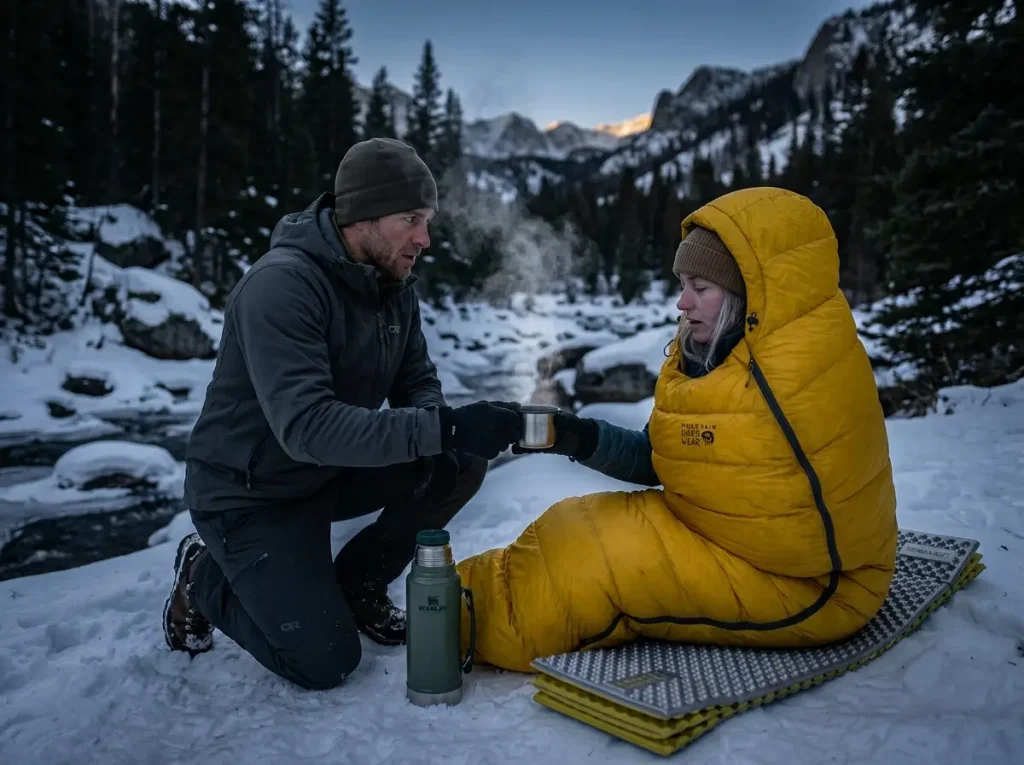
The Hypowrap — field treatment for severe hypothermia
Hypothermia signs to watch for: fumbling zippers (the “umbles” — stumbles, mumbles, fumbles, grumbles), cessation of shivering, slurred speech. These are late-stage warning signs. When you see them, stop moving toward the objective and execute the treatment.
The Hypowrap (Burrito Wrap) protocol, documented by the American Hiking Society cold weather hiking and hypothermia protocols:
- Insulate the patient from the ground with a closed-cell foam pad — ground conduction is enormous and often overlooked.
- Replace wet clothing with dry layers if possible. If not, layer a plastic tarp as a VBL between wet patient and dry insulation.
- Wrap in dry sleeping bags, then a waterproof outer shell.
- Provide warm, sweet drinks. Sugar fuels the metabolic fire of shivering. A cup of warm tea won’t raise core temperature — a 155 lb person is mostly water, and the caloric content of warm liquid alone is insufficient. It’s the calories that matter.
Then activate your PLB or satellite messenger. Severe hypothermia cannot be fully treated in the field. For when to use an emergency whistle vs. a PLB in a cold-weather emergency, the answer in a hypothermia situation is unambiguous: PLB.
Conclusion
Three things determine whether your winter hike ends with a story you tell, or one that gets told about you.
Plan backward from sunset, not forward from the trailhead. The 1/3 Rule with a hard alarm-based turnaround time is the most important planning tool beginners skip. Set the alarm. Honor it.
The failure modes are physics, not bad luck. Your cotton base layer conducts heat 25 times faster when wet. Your hollow fiber filter ruptures invisibly when frozen. Your alkaline battery dies flat without warning at -20°F. Understand the physics, and the right gear decision becomes obvious.
Shivering is a biological alarm, not discomfort. When your body activates shivering at 5–6 times your basal metabolic rate, you are burning your energy reserves and your clock is running. Eat on a schedule. Hydrate on a schedule. Turn around before your reserves run out.
Print this checklist. Run through it the night before your first winter hike. Set a cold alarm for the actual turnaround time — not the hoped-for summit time. Then pick a short, conservative route first. Winter terrain earns respect incrementally. The mountain will still be there next season.
FAQ
What should I wear for a winter day hike if I’m a beginner?
Wear a moisture-wicking synthetic or merino wool base layer, an insulating mid-layer (fleece or synthetic puffy), and a wind or waterproof shell. Never wear cotton against your skin. Wet cotton loses all insulating value and conducts heat away from your body 25 times faster than dry fabric — a physics problem that can become a hypothermia emergency within hours without dramatic warning.
How do I keep my water from freezing on a winter hike?
Use a wide-mouth Nalgene bottle and carry it upside down inside an insulated sleeve — ice forms top-down, so the drinking port stays liquid when inverted. Keep your water filter inside your insulation layer at all times, because hollow fiber membranes rupture invisibly when frozen and the filter will appear functional while passing pathogens.
Is it safe to hike alone in winter?
Solo winter hiking carries higher risk than group hiking — a fall on ice or a cold emergency without someone to assist can escalate fast. If you go solo, file a detailed trip plan with a non-hiking contact, carry a satellite messenger with a check-in schedule, and stick to well-traveled trails with known bailout points. The risk is manageable with the right protocols in place before you leave.
What is the 11th Essential for winter hiking?
Most people cite a satellite communicator or PLB, which isn’t wrong. But the functional 11th Essential for winter is a hard turnaround time — the discipline to reverse direction when your schedule demands it, regardless of how close the summit looks. Most winter incidents are time-management failures, not gear failures. Short days and slow winter pace are an unforgiving combination.
Do I need snowshoes or microspikes for a winter day hike?
Kahtoola MICROspikes are the standard for most packed-snow and low-angle ice conditions that beginners encounter. Snowshoes become necessary when snow is deep enough to post-hole (typically 8+ inches of unconsolidated snow), because post-holing destroys your energy reserves, damages the trail for every hiker behind you, and creates real ankle fracture risk. Check recent trip reports for your target trail to know what conditions you’ll actually face.
Risk Disclaimer: Hiking, trekking, backpacking, and all related outdoor activities involve inherent
risks which may result in serious injury, illness, or death. The information provided on The Hiking Tribe is for
educational and informational purposes only. While we strive for accuracy, information on trails, gear, techniques,
and safety is not a substitute for your own best judgment and thorough preparation. Trail conditions, weather, and
other environmental factors change rapidly and may differ from what is described on this site. Always check with
official sources like park services for the most current alerts and conditions. Never undertake a hike beyond your
abilities and always be prepared for the unexpected. By using this website, you agree that you are solely
responsible for your own safety. Any reliance you place on our content is strictly at your own risk, and you assume
all liability for your actions and decisions in the outdoors. The Hiking Tribe and its authors will not be held
liable for any injury, damage, or loss sustained in connection with the use of the information herein.
Affiliate Disclosure: We are a participant in the Amazon Services LLC Associates Program, an
affiliate advertising program designed to provide a means for us to earn advertising fees by advertising and linking
to Amazon.com. As an Amazon Associate, we earn from qualifying purchases. We are also an official affiliate partner
of Black Diamond Equipment via the AvantLink network. If you click on a Black Diamond affiliate link and make a
purchase, we may earn a commission at no additional cost to you. We also participate in other affiliate programs and
may receive a commission on products purchased through our links. Additional terms are found in the terms of
service.