















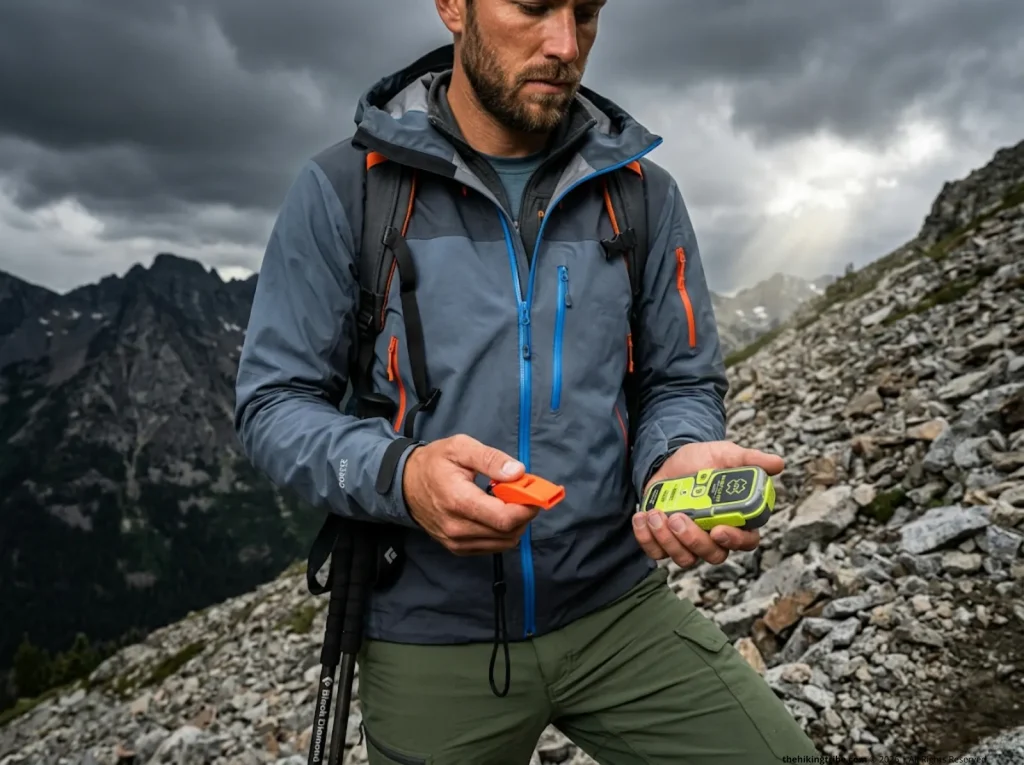
The barb was buried deep in my thumb, pain throbbing in my palm, and the nearest clinic was three hours by boat. In that moment of chaotic panic, the silence of the canyon wasn’t peaceful—it was a terrifying barrier between my injury and the outside world. After two decades of guiding these remote waterways and backcountry trails, I’ve learned that the core rule of backcountry survival is the ability to bridge the gap between a localized emergency and a global search and rescue infrastructure. This article strips away marketing hype to dissect the physics of sound and satellite mechanics, helping you determine whether an $8 whistle or a $350 Personal Locator Beacon (PLB) is the right redundancy for your specific trekking profile.
| Feature Comparison | ||
|---|---|---|
| Feature | Emergency Whistle | Personal Locator Beacon (PLB) |
| Range | 0.25 – 1.0 Mile (Variable) | Global |
| Energy Consumption | High (Lung Power) | Low (Battery Powered) |
| Weight | < 1 oz | ~5.5 oz |
| Battery Life | N/A (Mechanical) | 5 – 7 Years |
| Price | $5 – $20 | $300 – $400 |
⚡ Quick Answer: An emergency whistle provides a low-cost, close-range acoustic signal to alert nearby searchers, but its range drops quickly in dense timber. A Personal Locator Beacon (PLB) bypasses terrain entirely by transmitting a digital signal directly to global satellites. You need both tools: the PLB initiates the rescue from anywhere on Earth, while the whistle guides responders to your exact GPS coordinates during their final approach.
The Physics of Sound: Why Lung-Power Fails

Why Sound Fails Over Distance
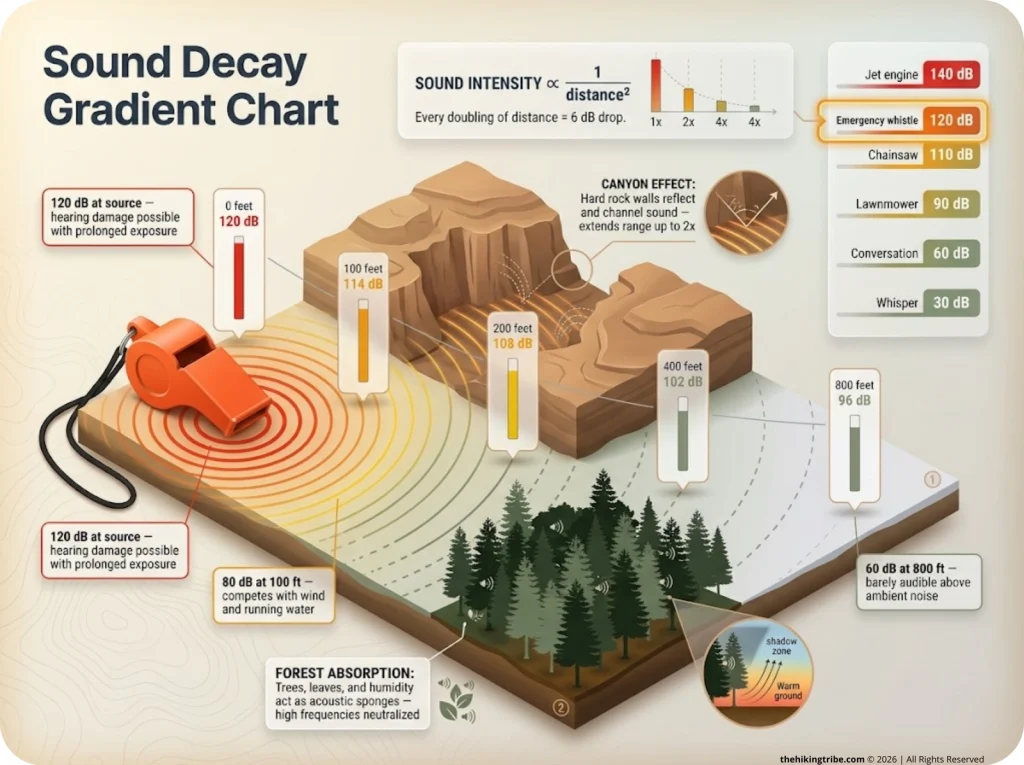
Sound drops off quickly in the open air. If you blow a 120 decibels blast at one foot away, it decays to 80 decibels at 100 feet. At that volume, your call for help barely competes with wind and running water. This means sound volume drops off fast across any open space, turning your frantic blowing into a faint whisper just a few hundred yards out.
How Weather Absorbs Sound
High-frequency sounds pierce through crowd noise, but they fail constantly in the timber. Trees, leaf litter, and high humidity act as massive acoustic sponges. The best survival whistles target the 3,150 Hz sweet spot because it cuts through the racket of a boat engine, but that same frequency gets completely neutralized by heavy moisture in the air. Lower tones travel further across long distances, but they require massive energy to produce—energy your lungs simply do not possess.
How Terrain Bends Your Signal
The physical geology surrounding you heavily distorts your emergency signaling. A narrow, hard-rock gorge can create a canyon effect, tunneling your acoustic energy and throwing it miles downriver. But on a sunny afternoon in the open valley, thermal lapse takes over. Warmer air near the ground bends the sound waves upward into the sky, creating a shadow zone that hides your specific location from ground-based trackers right around the corner.
Pro tip: The built-in sternum strap whistles on backpacks often fail to exceed ambient wind noise beyond 50 yards. Do not rely on them as your primary safety tool, or you’ll be screaming into the void. To understand why, you need to read the truth about sternum strap decibels.
How a Modern Survival Whistle Actually Works

The “Pealess” Advantage in Freezing Environments
Traditional pea whistles rely on a small cork ball rattling inside the chamber to create vibrato. If you are caught in a blizzard, the moisture from your exhausted breath freezes that little ball instantly, locking the device solid. You absolutely need a pealess whistle in your kit. Modern harmonic chambers purge water the exact second you blow into them, allowing units like the Fox 40 or the Storm whistle to blast loud and clear even if you just climbed out of an icy river.
Volume Benchmarks: How Loud Are They Really?
Gear companies love printing massive numbers on their packaging. Field testing reveals that top pealess options produce a verified 120 to 123 decibels. Then you look at aggressive outliers down the line, which push a theoretical 142 decibels. If you crack a blast at that decibel level, it is loud enough to cause immediate, lasting hearing damage. If you stack excessive volume in your chest rig, you must carry ear protection.
The “Rule of Threes”: International Protocol
Blowing wildly in the woods just makes you sound like a distressed bird. You must follow standardized emergency whistle protocols. The universal standard dictates 3 blasts of a whistle: three loud, three-second blows, followed by a one-minute pause to listen for a response. Keep hitting this pattern. When the response choppers get close, combining a signal mirror with your whistle blasts creates a massive visual and acoustic target that no pilot can possibly miss.
How Satellite Beacons Ignore the Terrain

The Global Digital Lifeline
Whistles fight the dense terrain; Personal Locator Beacons ignore it. A PLB bypasses distance restrictions by transmitting on the 406 MHz frequency—a digital band locked down globally for distress situations. This specific carrier wave punches straight through cloud cover up to the COSPAS-SARSAT satellite architecture. This multinational network of low, medium, and geostationary orbit satellites scans the globe constantly, waiting for you to flip the switch.
Pinpointing Your Exact Location
Before modern GPS integration, older beacons gave the authorities a vague three-mile radius to sweep. Today, units from legacy brands like McMurdo and ACR Electronics push your exact coordinates directly into the tracking packet. This reverse triangulation calculates your position down to about 100 meters. These rugged transponders operate far beyond dedicated hiking GPS unit limitations that routinely lose their sight lines under heavy timber.
Getting Confirmation That Help Is Coming
Hitting the panic button in the dark feels incredibly isolating. Modern beacons counter this by integrating Return Link Service (RLS) technology. After your distress call hits the mission control servers, the Galileo satellite network fires back a confirmation pulse. Your PLB lights up a blue LED, handing you the psychological anchor that they heard you, and giving you confidence that help is actively spooling up on the runway.
Pro tip: In a Severe emergency avalanche or venomous bite scenario, the one-button reliability of a dedicated PLB outperforms the exact positioning and Bluetooth pairing requirements of two-way satellite messengers. When you’re severely injured, you cannot afford to mess around with a smartphone screen.
The Legal Side: Why Registration Matters
The Federal Mandate for Beacons
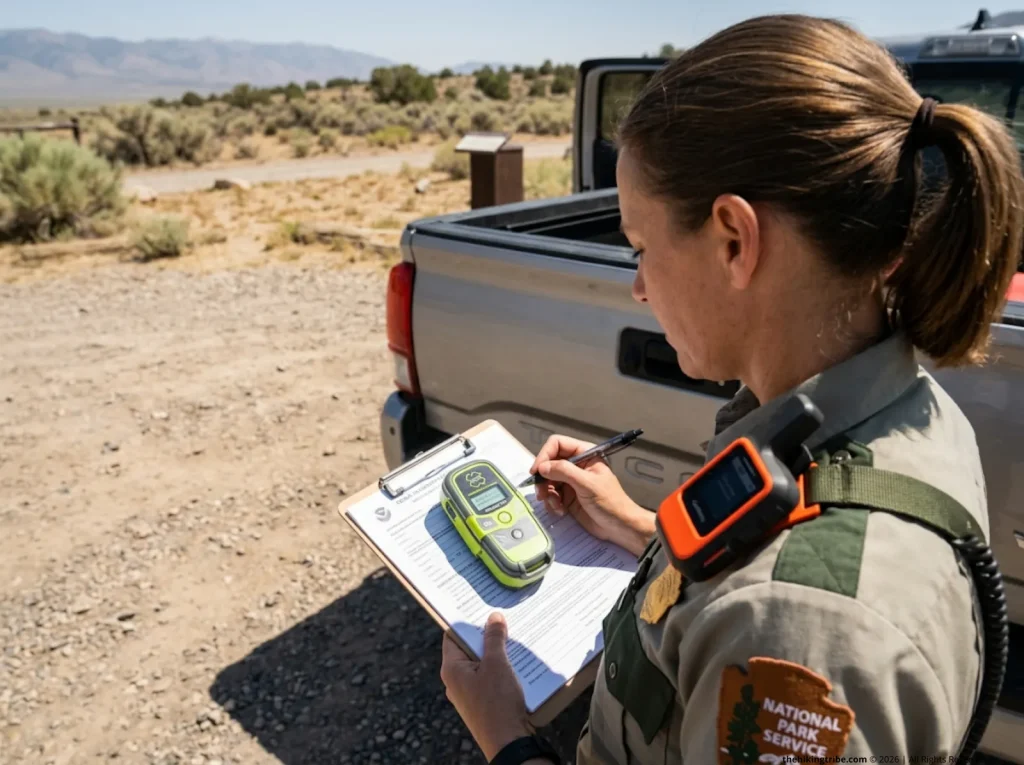
You don’t just buy a PLB and throw it in your backpack. Federal law under Title 47 CFR forces you to register that transponder immediately. This mandated NOAA beacon registration physically ties the 15-character Unique Identification Number (UIN) burned into your unit directly to your identity. If you trigger an unregistered beacon, you stall the response while the FCC and the Coast Guard waste tight windows figuring out who called for help.
Building Your NOAA Emergency Data Profile
This database functions as your digital safety net. You update your PLB registration every two years, feeding officials your primary contacts, medical conditions, and vessel or vehicle descriptions. This process ties neatly into locking in a strict solo trip plan. When the alarm sounds, dispatchers instantly phone your contacts to verify you are supposed to be out in that specific mountain range, eliminating all the guesswork.
Immediate Action Protocols for False Alerts
A false alert drains public resources and puts rescue pilots in active hazard. If you activate the beacon by mistake while packing your gear away, do not just turn it off, pack it up, and drive home. You must call the U.S. Air Force Rescue Coordination Center or the Coast Guard immediately. Give them your Hex ID and cancel the strike package before they spin up an actual aircraft.
The Physical Toll of Wilderness Signaling
Why Yelling Exhausts You Faster
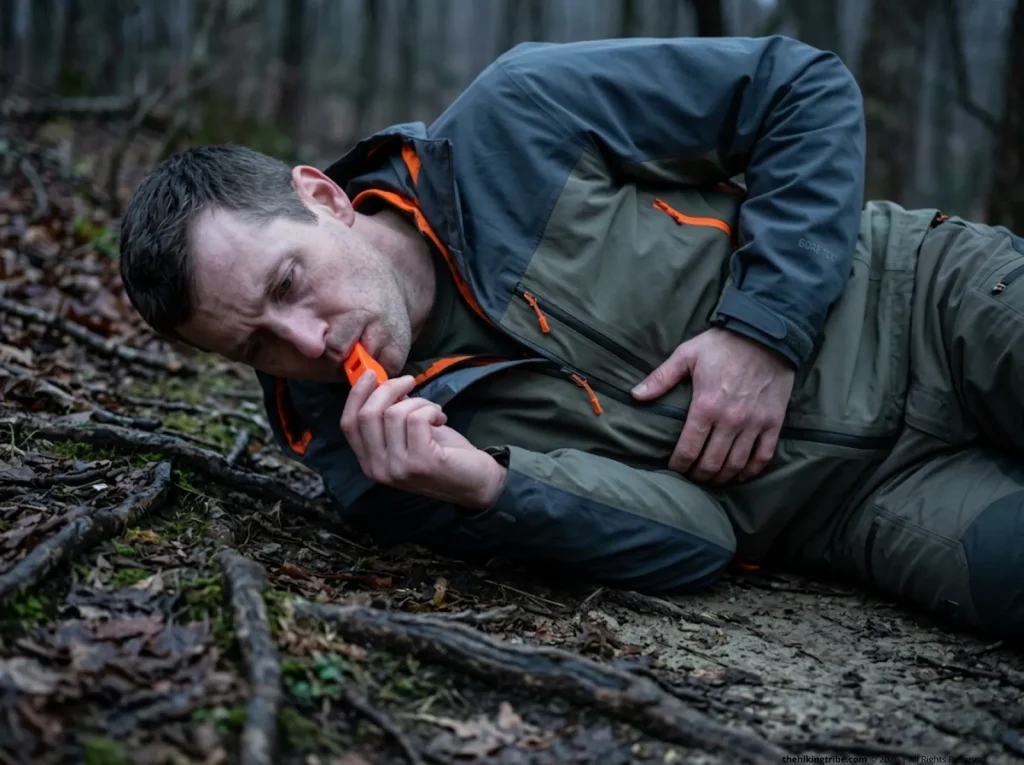
Screaming for your life burns fuel incredibly fast. Research on the anatomy of the voice confirms that sustained, high-volume shouting completely shreds your vocal cords within 20 to 30 minutes. If you sit freezing, injured, and dehydrated in the dirt, your throat gives out exactly when you need it most. Rescuers regularly push within 50 yards of victims who are physically incapable of shouting loud enough to beat the wind.
Conserving Energy When You Are Injured
Fighting through thick brush and deadfalls spikes your heart rate fast. Getting completely lost forces tremendous effort, driving the metabolic difficulty of off-trail navigation to three times your baseline hiking exertion. A sharp range whistle changes the math entirely. You push out 120 decibels from a gentle puff of air. Even with a cracked rib or a collapsed lung, you can blow that whistle all night without draining your remaining core reserves.
Saving Calories With One-Touch Devices
A PLB requires zero continuous effort. You snap the antenna out, push the fat red button, and bury your hands back deep inside your fleece jacket to conserve heat. The device burns its own long-lasting battery life for the next 24 to 30 hours, blasting the standard 121.5 MHz homing signal while you bunker down safely. While you wait, focus your remaining energy on pairing your audible signals with high-visibility safety colors so aircraft pilots easily spot your position against the dirt.
Building a Multi-Layered Signaling System
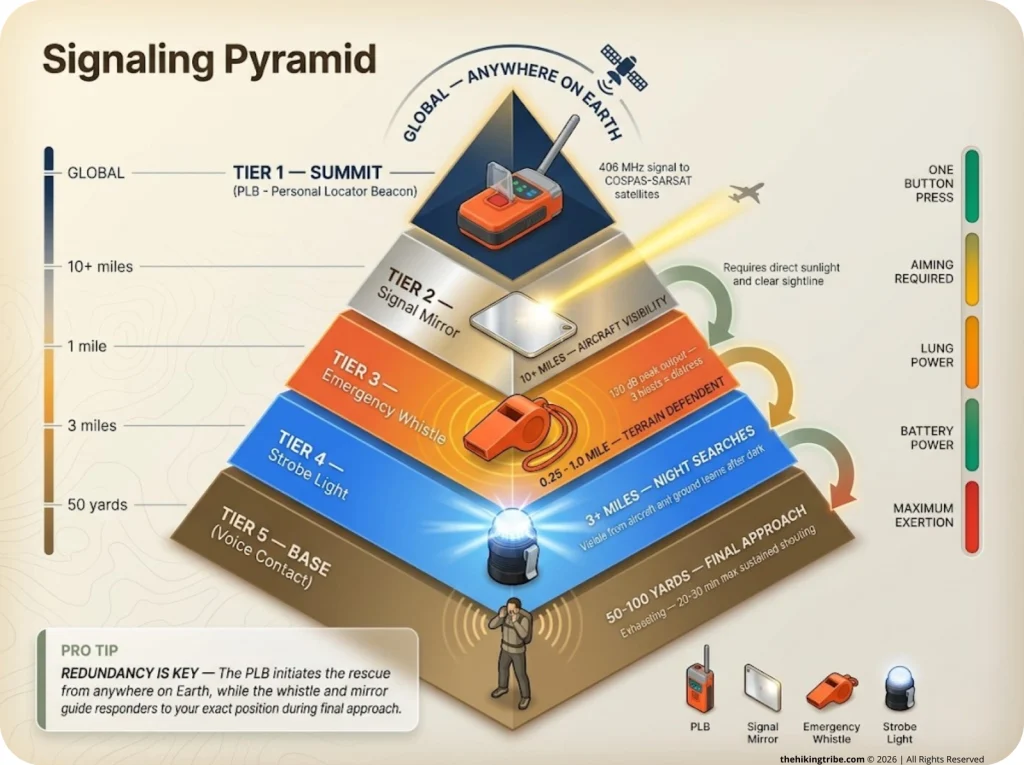
The 5-Step Safety Matrix
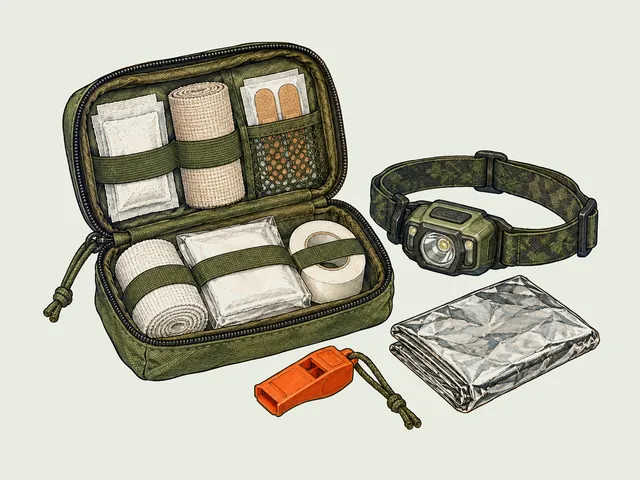
Your gear loadout must cover the entire physical space between deep satellite orbit and direct voice contact. Tier 1 is the PLB, broadcasting your location across global satellite coverage. Tier 2 is your mirrored flash, blinding aircraft pilots from ten miles away. Tier 3 is the aggressive volume of your survival whistle, shredding the immediate square mile. Tier 4 relies entirely on strobes for night searches, and Tier 5 is your raw voice for the final fifty-yard visual approach.
Solo vs. Group Loadout Strategies
If you walk alone out past the power lines, the PLB, signal mirror, and whistle are non-negotiable. Nobody else will initiate help. Conversely, large team trips shift the equipment dynamics. For heavy group hikes, force a high-output whistle on every group member and issue a single ResQLink to the trip leader. This tactic proves the smartest way of upgrading your baseline hiking starter kit without forcing every casual tag-along to spend hundreds of dollars.
Next-Gen Tech: AIS Modems for Coastal Treks
If you push boundaries along heavy coastlines or paddle massive open water, the newest beacons integrate Automatic Identification System (AIS) modems. When triggered, the device shoots a localized alert that paints your distress location all over the navigation screens of every single commercial ship within VHF radar limits. A passing freighter might haul you out of the surf hours before the Coast Guard even finishes their morning briefing.
Pro tip: Never drop your primary whistle inside the main compartment of your backpack. Wear it high on a lanyard around your neck or stuff it securely inside an active chest pocket. If you dump your heavy pack to scramble up a quick ridge and take a hard fall, a whistle strapped out of reach does you zero good.
The Bottom Line
The reality of wilderness survival does not care about your intentions. An emergency whistle hands you a cheap, subscription-free acoustic line to local searchers, but the brutal mechanics of the inverse square law crush that signal deep in the woods. Redundant signaling dictates you carry the whistle for the finish line but carry the PLB to start the race from anywhere on Earth. Verify your registration data, double-check your batteries, and lock your primary signaling tools to your gear so you dictate your rescue—rather than trusting your luck.
FAQ
Do I really need a PLB for hiking?
If you routinely walk miles past reliable cellular coverage, yes. A whistle only works if foot trackers are already pushing within a mile of your specific position, whereas a Search and Rescue beacon instantly kicks off the protocol globally.
How far can an emergency whistle be heard?
Under dead-silent and flat conditions, an aggressive whistle carries up to a mile away. However, heavy forest density, hard wind, and driving rain quickly strip that audible distance down to just a few hundred yards.
Is there a subscription fee for a PLB?
No, strict personal locator beacons ping directly off government-funded military and civilian networks. You foot the upfront hardware cost, and then you register the unit legally through the required federal channels for free.
Whistle vs. Two-way satellite messenger: What is the difference?
Your whistle leans on physical breath to hit hikers directly beside you, while messengers like the Garmin InReach or Zoleo run on paid commercial bands to bounce text messages out of the woods. A PLB operates as a high-powered, distress-only emergency hammer tied straight into the international defense network.

I've spent more than a decade researching hiking gear and trail technique. I read the specs, the forum threads and the long-term reviews, and every pick here comes with what it gets wrong.
End of the trail
You read every mile of this one. Here's where the trail goes next.