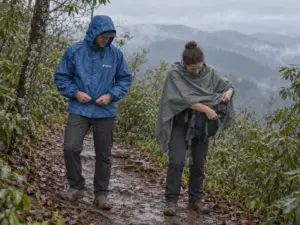
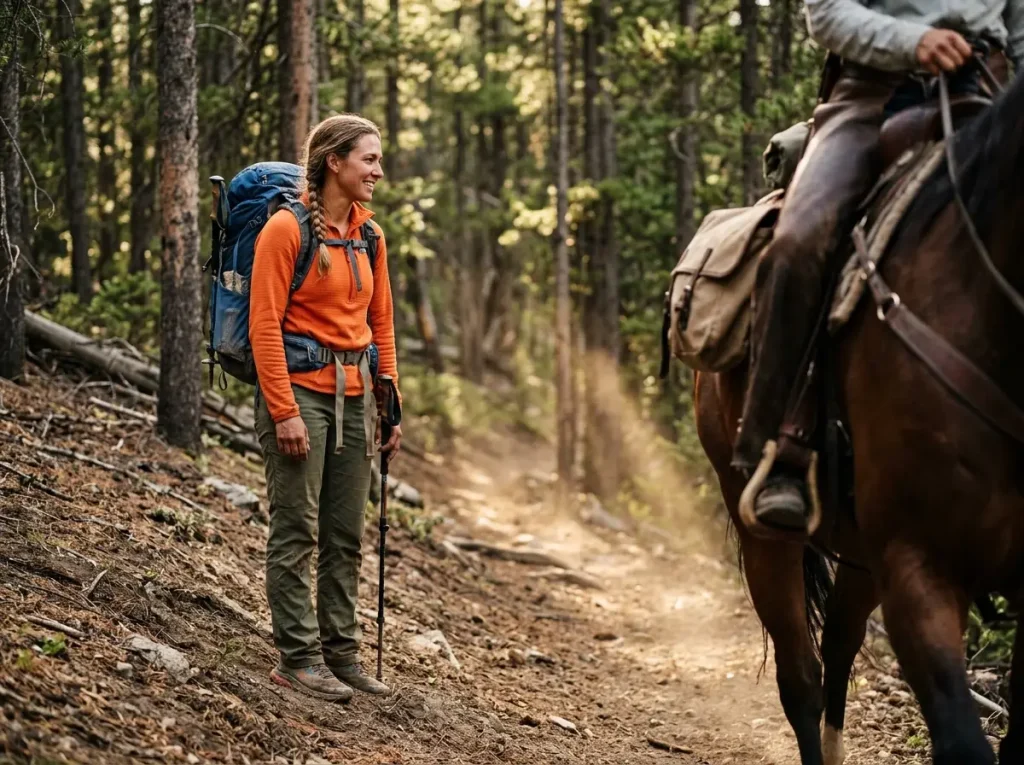
She stepped off the trail to let a horse pass — and stepped uphill. The animal spooked, lunged sideways, and nearly came out of its skin. Nobody got kicked. But it was close. The rider didn’t have time to explain the physics. You do.
Trail etiquette isn’t a courtesy system held together by politeness. It’s a risk management protocol built on metabolic science, equine biology, and the raw mechanics of mass in motion. Every rule on the trail exists because someone learned something the hard way — or because physics stopped pretending to be polite.
This guide breaks down the unwritten laws of the right-of-way hierarchy and the physical forces that wrote them. Know these before the horse rounds the corner.
| Trail Yielding Priority | ||
|---|---|---|
| Priority | User | Why |
| 1 (Yield to) | Horses & Pack Stock | 900–1,200 lb prey animals with a predator-flight reflex; bolt uphill at full speed when startled |
| 2 (Yield to) | Uphill Hikers | High metabolic cost to stop; limited forward vision; restart spikes heart rate hard |
| 3 (Yield to all) | Mountain Bikers | Mechanical advantage; can brake fast; lowest physiological cost to yield |
⚡ Quick Answer: The yield triangle on most trails puts horses first, hikers second, mountain bikers third. Between two hikers going opposite directions, the ascending party holds right of way because stopping on a steep grade is physiologically expensive — their heart rate is near maximum, their visual cone is aimed at their own feet, and restarting from a stop spikes the workload hard. Step downhill for a horse — not uphill, ever. The animal’s flight reflex sends it uphill at full bolt speed. Know the hierarchy, read the conditions, communicate early.
The Thermodynamics of Uphill Priority
The Aerobic Cost of Stopping Mid-Climb
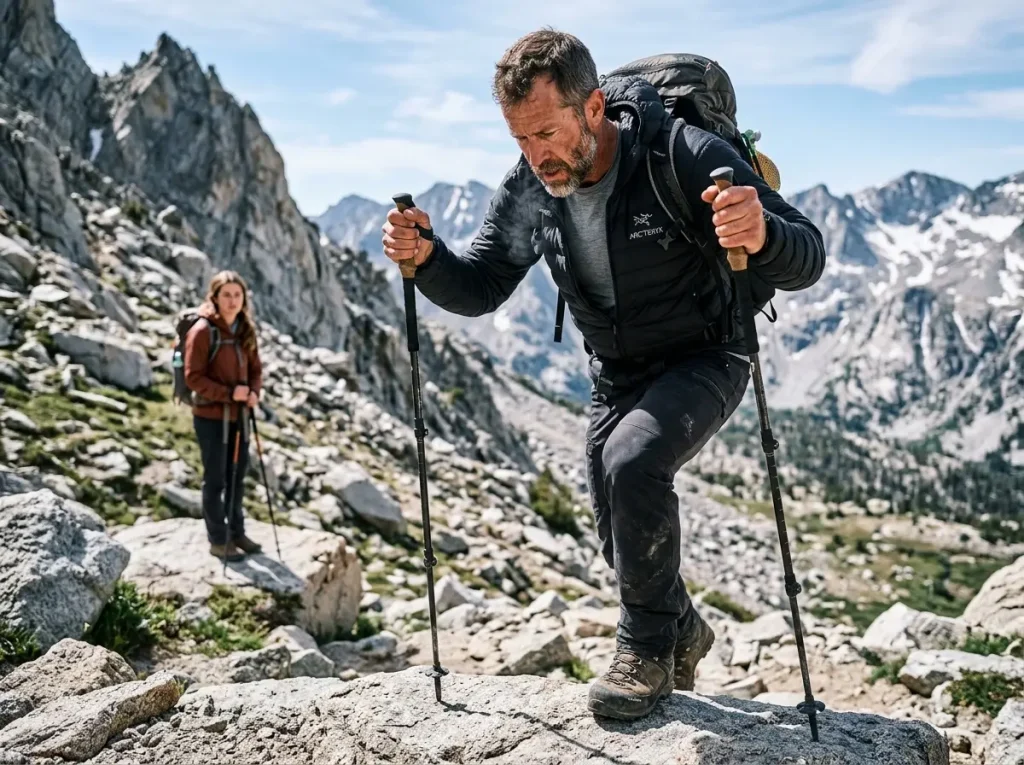
You’ve been grinding up a 15% grade for twenty minutes. Your legs are in rhythm, your breathing has synchronized, your heart rate has settled somewhere around 165 bpm — which, if you’re 40, puts you around 85% of your age-estimated maximum. This is metabolic steady-state: the place where effort feels hard but sustainable.
Then someone asks you to stop.
What happens next is not nothing. Stopping on an incline collapses that steady-state entirely. To restart, your body has to initiate a high-torque muscle contraction from a static position — instead of converting existing momentum forward — and your heart rate spikes to match. For a hiker already at 165–170 bpm, that spike can push into anaerobic territory fast. In hikers who are borderline fit, it can cause dizziness or syncope. I’ve watched a single unplanned stop on a 20% grade push a client’s heart rate from 155 to 178 in under 30 seconds. The physiological exertion data on inclined walking with and without poles backs this up: restarting on a gradient costs measurably more than maintaining a rhythm.
The downhill hiker? They’re trading gravitational potential energy for momentum. Stopping costs them almost nothing.
Pro Tip: Uphill hikers hold the right of way, but also hold the discretion to waive it. If you’re gassed and a downhill party wants to pass, let them through — you get a rest, they get their momentum. You’re playing energy chess, not traffic cop.
Understanding trekking pole cadence and breathing synchronization shows why disrupting a poled hiker in full rhythm is worse than disrupting someone who’s just walking — and why that break in cadence shows up in the data as a measurable cardiovascular hit.
The Visual Cone: What an Uphill Hiker Can’t See
Here’s the thing most people don’t think about: the uphill hiker is watching their feet. Their visual cone is restricted to roughly 3–6 feet in front of their boots — they have to be, or they’ll miss a root and go down. Meanwhile, the downhill hiker has a near-panoramic view of the trail ahead: they can spot a conflict 30–50 feet before it happens.
This optical asymmetry doubles the argument for the right-of-way rule. The person who can see the potential conflict and can stop without physical cost is the one who should yield. That’s the downhill hiker. Every time.
In low-light conditions — pre-dawn starts, overcast ridgelines — this gap gets worse. The ascending hiker’s headlamp throws a narrow beam ahead, compressing their field of view even further. If you’re coming down and spot an ascending party running headlamps, call out early. Don’t assume they’ve seen you.
The “Uphill Always Wins” Exception: Reading Context
The rule is a default, not a law. Wide switchbacks on maintained trails sometimes require the uphill group to step aside for size — a large ascending group pinching against a narrow corner should yield to a smaller downhill party before you create a bottleneck. Trail runners descending at speed hold right of way in most jurisdictions the same way mountain bikers do. On PCT and AT-class maintained paths, local norms have shifted enough that you should read the vibe and communicate rather than assume the rule is gospel.
Two ascending parties meeting on a narrow ledge? The lighter or more maneuverable group yields regardless of direction. The goal is flow, not a hierarchy debate on exposed terrain.
The Equine Safety Matrix: Mass, Momentum, and Spook Physics
Why Horses Bolt Uphill (And Why You Must Step Down)
Horses are prey animals. Their primary survival mechanism — refined over millions of years of being chased by things with teeth — is the flight response. And when a horse bolts, it bolts uphill, because gaining height advantage over a predator is hardwired into its threat-response system.
A startled horse weighing 900–1,200 lbs launching uphill is not something you survive standing in its path. Per NPS official guidelines on yielding to pack stock, the protocol is explicit: step to the downhill side, at least 6–10 feet off the trail, and stand still facing the animal so it can see you’re human.
The “Stealth Hiker” mistake is a common one: hikers duck behind a bush to let a horse pass without “spooking it.” This actually makes it worse. A horse that can’t see you is processing information about an unknown crouching object near the trail — which reads as ambush predator, not hiker. Speak in a calm, normal human voice before the horse rounds the corner. “Hey there, easy now” said at a conversational volume tells the horse: that’s not a mountain lion, that’s a person. It works.
A large hiking pack viewed from the side — especially one with rolls of tent and gear strapped to the outside — can silhouette like a puma on a rock. If the animal stays agitated even after you’ve stepped down and spoken clearly, remove the pack.
For a broader understanding of how animals read human presence on trail, the same principles apply to safe distance protocols for wildlife and large animals on trail — the hierarchy of threat-cues in prey animals is consistent across species.
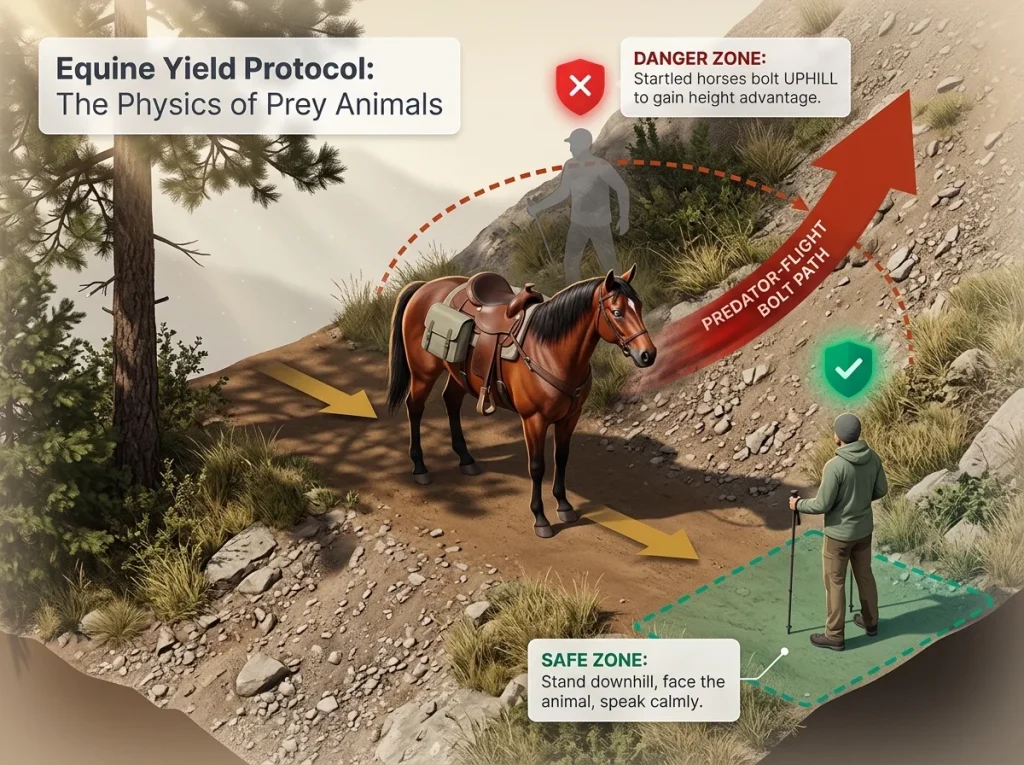
Pro Tip: On narrow switchbacks where you need to step downhill but there’s no flat ground to stand on, start moving 15–20 feet downslope before the horse rounds the corner. You want to be stationary and stable when the animal sees you — scrambling as it approaches makes things worse, not better.
The Protocol: Step-by-Step Yield for Horses
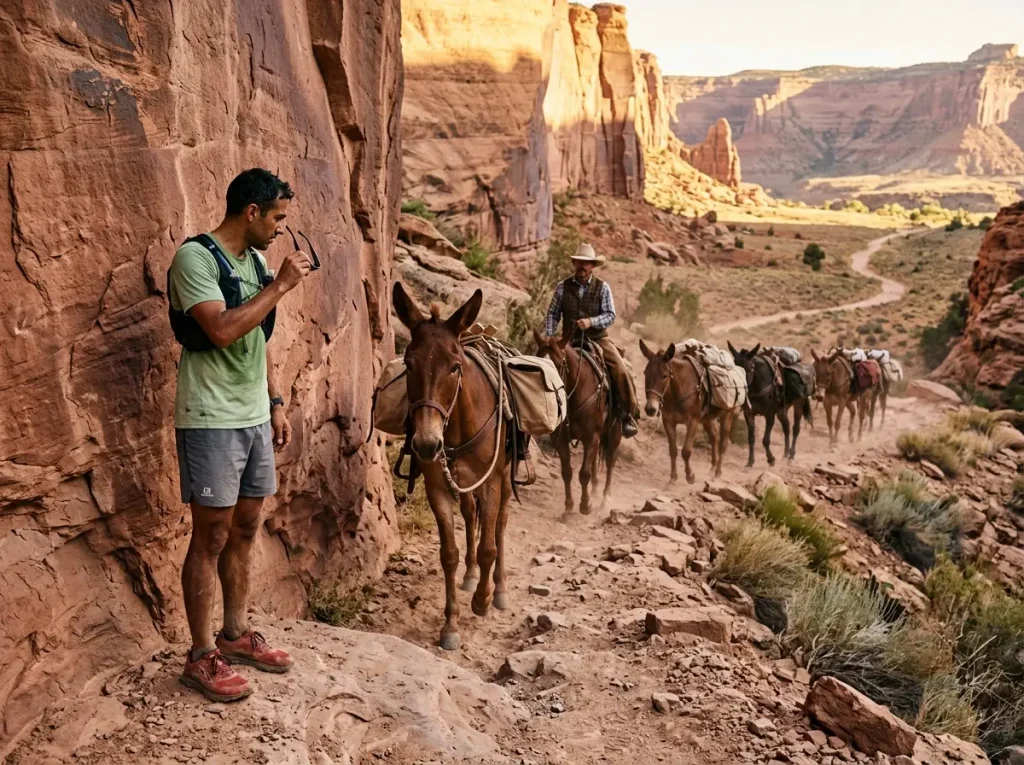
When you hear hooves, start moving immediately. Don’t wait to see the animal. Position yourself on the downhill side, at minimum 6–10 feet from the trail edge, before the horse rounds the bend. Stand still. Face it. Speak in a calm, level voice — not high-pitched, not a whisper. Wait for the entire string of animals to pass before you move back onto the trail. If there are mule or llama strings behind the lead horse, the same rules apply — they all move, you stay put.
Mules, Llamas, and Non-Horse Pack Stock
Mules are more sure-footed than horses but equally reactive to fast movement. Llamas — common on Pacific Crest and Cascade wilderness routes — have a wider comfort circle than most hikers expect, and they can spit at close range if they feel crowded. Downhill positioning applies to all pack stock. Any animal whose mass exceeds yours has right of way on singletrack.
Some wilderness areas and permit zones require you to wait 50 feet or more off-trail for stock passages. Check your permit conditions before you go.
Trekking Pole Etiquette: The Mechanics of a Hazardous Tool
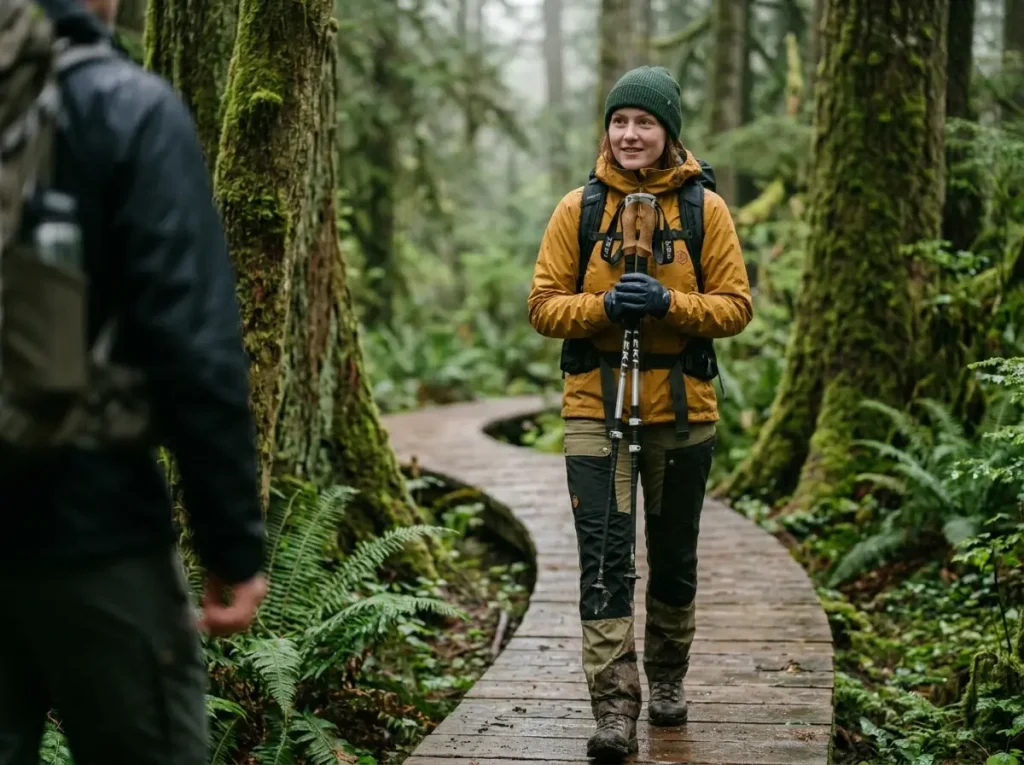
Pole Carry Position When Passing
Nobody in any major etiquette guide talks about this. Which is how you end up with three incidents I’ve personally seen on narrow singletrack: two tripped partners and one near-fall on technical terrain, all caused by the standard swinging gait of trekking poles while passing.
When you’re walking with trekking poles, your swing arc at knee height is 2–3 feet on each side. On a trail wide enough for two people passing, that arc gets into the other person’s ankles and lower legs. On Class 3 terrain, where a tripped partner can fall in a direction rated as “likely to cause lasting harm,” this stops being an inconvenience and starts being an emergency.
The rule: when passing anyone in either direction, hold your poles vertically, tips up, arms close to your body. The “flag carry” — folding them against your pack frame or holding both in one fist above the basket — is the right call at cliff edges and in tight passes.
Understanding proper wrist strap technique for safe pole transitions is directly tied to this: a hiker who uses their straps correctly can shift from swing to vertical carry in one smooth motion. Someone fighting with a poorly worn strap will fumble through it, which is exactly when the tip ends up in someone’s knee.
Rubber Tips, Rock Scarring, and the Trail Damage Nobody Talks About
Hardened carbide pole tips concentrate your body weight — roughly 150–200 lbs — onto a contact point measured in square millimeters. On granite and sandstone, that creates micro-channels in the rock surface that capture water and accelerate surface erosion. In high-traffic areas, this accumulates into measurable geological damage over years.
Rubber tips distribute that load across a much larger surface area. On rock, soil, and cryptobiotic crust environments — the living biological soil found in desert and alpine environments that can take decades to form — LNT etiquette calls for rubber tips. Bare carbide is acceptable on ice and hardened alpine rock above treeline. Anywhere else, cap them.
Rubber tips wear through every 200–400 miles on abrasive surfaces. Check yours before each trip. A worn rubber exposes the carbide underneath without any warning, usually at the most inconvenient moment on the most fragile terrain.
The Metronome Effect: Why Disrupting a Poled Hiker Is Worse
An experienced hiker with poles in full rhythm has synchronized their left pole plant with their right exhale in a breathing pattern that how poles redistribute body weight and protect your knees makes more efficient: poles transfer 20–25% of body weight to the upper body during ascent, reducing knee load substantially. That rhythm is the backbone of efficient high-mileage hiking.
Break that rhythm — force a sudden stop, cut too close when passing — and you don’t just inconvenience someone. You cause an abrupt load shift back onto the knees and a cardiovascular disruption similar to what happens when you stop an uphill hiker mid-stride.
Call out at least 10 feet before reaching a poled hiker in full rhythm. Give them time to consciously break the pattern before you pass. Don’t assume they heard you just because you spoke.
Group Dynamics and the Physics of Trail Flow
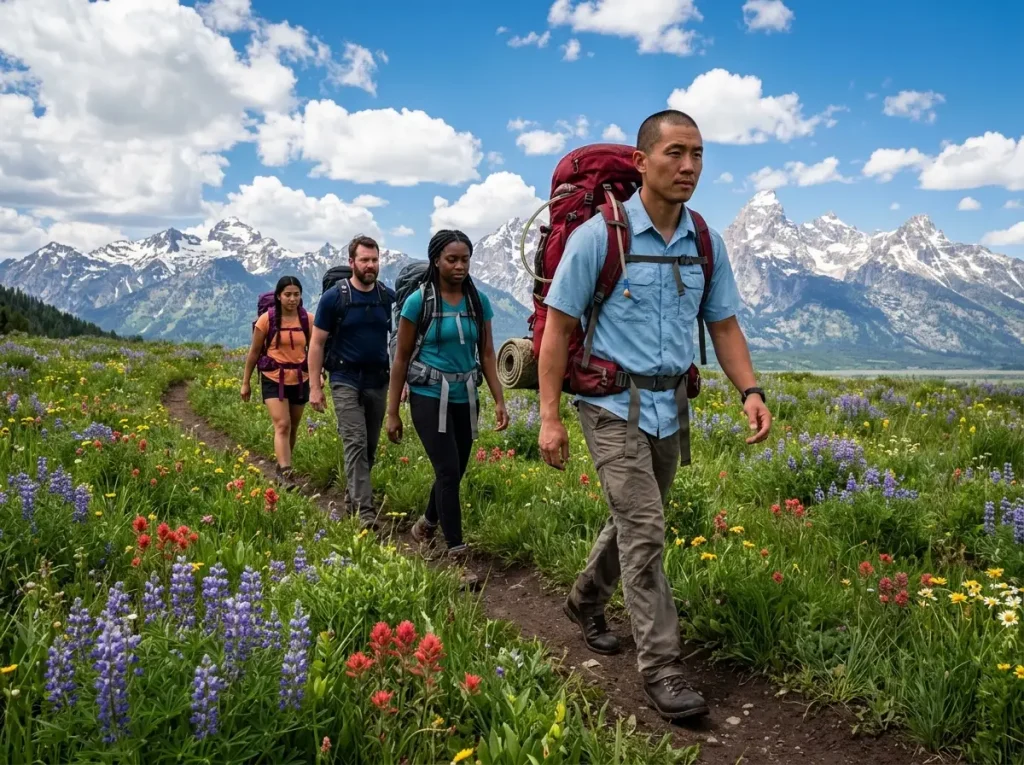
Single-File Protocol and Why Groups Walk Wrong
Three or four hikers walking abreast on singletrack isn’t just annoying. It’s doing direct physical damage to the trail corridor. When the designated path is narrower than the group, people step off the trail edge — and those footsteps accumulate into social trails: informal parallel paths that fragment adjacent habitat and widen the corridor permanently.
The industry standard is no more than six hikers abreast on any non-designated multi-use path. On singletrack, single file is the only format that doesn’t damage the trail. USGS data on trail erosion and the ecological cost of off-trail travel documents this clearly — pandemic-era recreation created a measurable increase in new social trails in high-use park zones, with corresponding habitat fragmentation and soil compaction in areas that took years to establish.
Pro Tip: In groups of 8 or more, use the Lead-Sweep system — a designated leader sets pace at the front, a sweep at the rear manages the accordion effect that naturally forms in larger groups and is the primary mechanism for trail widening.
The relationship between formation discipline and how hiker footsteps directly accelerate trail erosion is direct: trail width expands when hikers don’t hold their lane.
Noise, Bluetooth Speakers, and the Acoustic Footprint
Bluetooth speakers are banned in all designated wilderness areas under the 1964 Wilderness Act’s “outstanding opportunities for solitude” provision. That’s not a suggestion. On non-designated trails, the functional test is simple: if someone 30 feet away can hear your audio above conversation level, you’ve exceeded your acoustic footprint.
Washington State University research on human-wildlife interaction shows that recreational noise disrupts predator-prey behavioral patterns — birds flush earlier, deer alter feeding patterns, and apex predators shift movement corridors in response to consistent noise even at low volumes. A canyon amplifies sound 3–5 times compared to open meadow. What feels quiet at your camp speaker sounds like a construction site in a granite corridor.
The “Passing” Problem: Why “On Your Left” Often Causes Collisions
The Panic Jump is documented: hikers who hear “On your left” frequently jump to their left, directly into the path of the approaching runner or biker. It’s the verbal equivalent of a false start.
Better protocol: announce intent (“passing on your left”), drop to 75% normal speed before the pass, and only complete the pass when you have visual acknowledgment — eye contact, a wave, a verbal reply. Assume the person ahead cannot hear you. Headphones, wind, and moving water eliminate most ambient sound at 20 feet. Get close enough for visual contact before calling out.
Trail runners should slow to near-walking speed when passing elderly hikers, children, or hikers with leashed dogs. The speed differential is the hazard, not just the position.
Scrambling Etiquette: When Rockfall Changes Everything
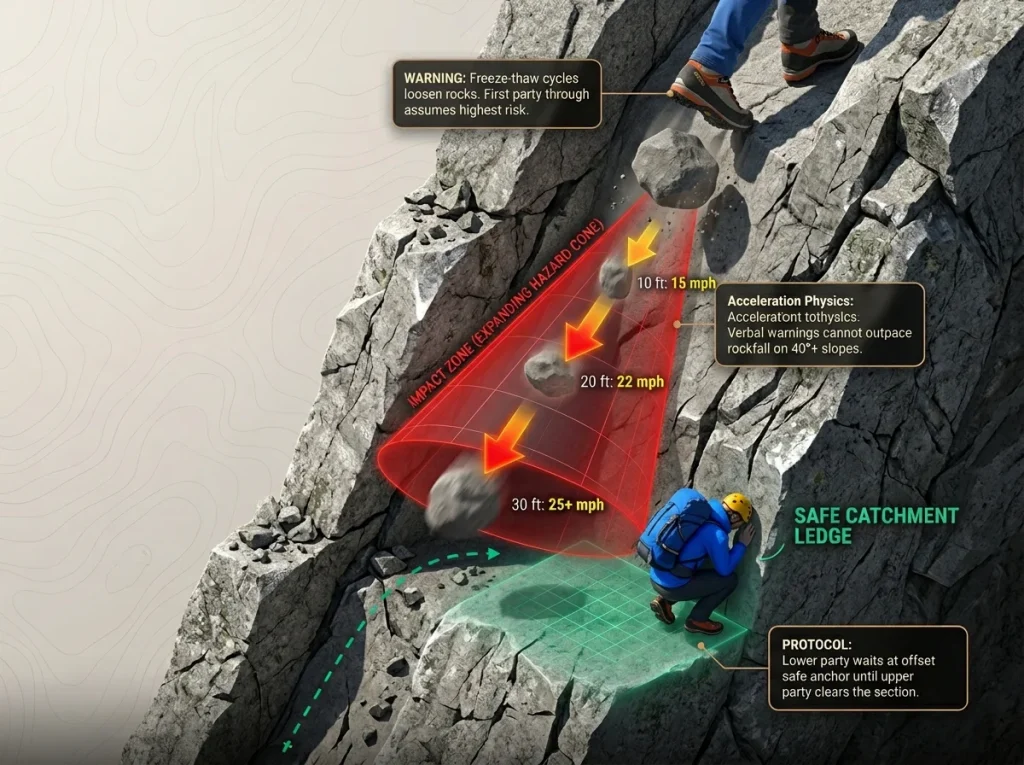
Rockfall Risk: Why the Lower Party Waits
Before getting into protocol, know what understanding Class 3 and 4 terrain risk ratings before you commit means in practice: on Class 3 terrain, hands are coming off the poles and onto rock. A fall can involve tumbling. On Class 4, a fall without protection is likely to cause lasting harm or worse. In this context, rockfall clearance protocols aren’t suggestions — they’re the difference between a good story and a body recovery.
On a 40–60-degree slope, a dislodged rock reaches a lower party before verbal warning is possible. On a 30-degree slope, a basketball-sized rock reaches roughly 25 mph within 10 feet of release. The lower party always waits at a stable “safe catchment” — a ledge, a wide section, an outcrop — until the upper party has reached solid ground or a stable anchor and cleared the loose section. Minimum clearance distances have to account for that acceleration curve.
“ROCK!” protocol when called: every hiker below leans immediately into the slope, nose to rock, and uses their backpack as a ballistic shield. Never look up. Never run perpendicular — that’s how you turn a close call into a direct hit.
Freeze-thaw cycles loosen summit rocks overnight. The first ascent party of the day should treat any alpine couloir as a minefield — loose until the sun has been working on it for 1–2 hours.
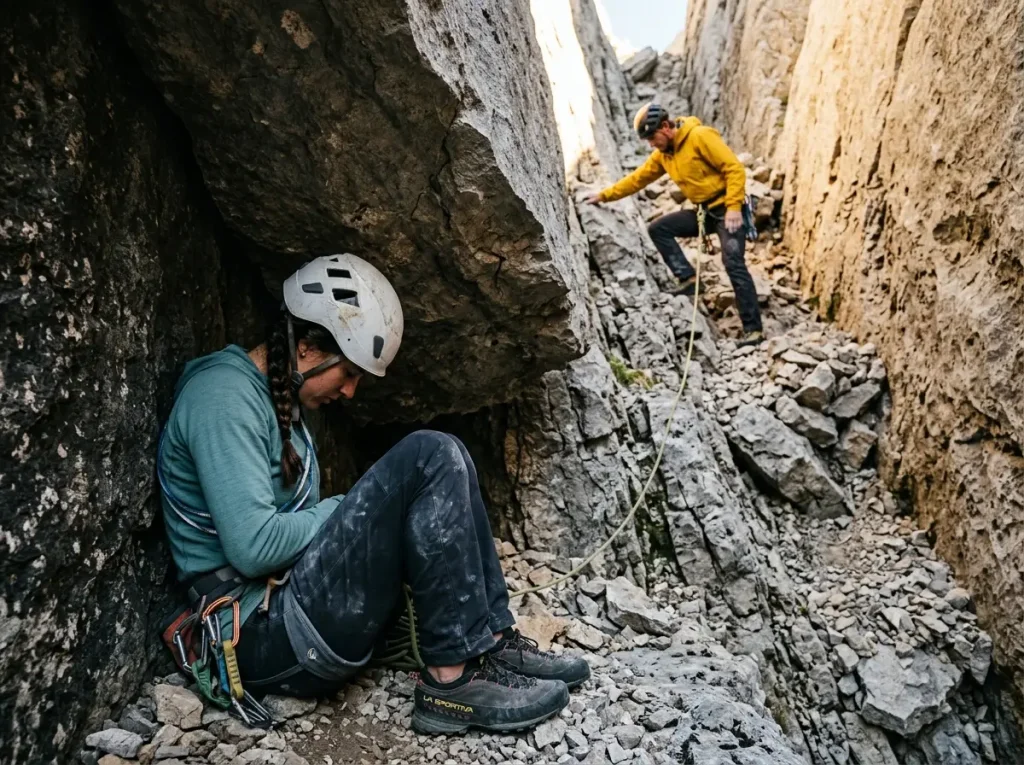
“Spraying Beta” and Technical Social Codes
“Spraying beta” — giving unsolicited advice to a climber or scrambler mid-route — is a violation of both autonomy and safety. The distraction on technical terrain is real. The exception: safety-critical information always overrides the no-spray rule. If someone is moving toward a ledge edge because they’ve misread the route, you speak up. Otherwise, let them work it.
Pass-through protocol on a shared scramble route: the party that has established position on a technical move — hands on rock, committed to a sequence — has priority. Approach with audible noise early enough that they know you’re there. Don’t appear silently at hip level while someone is mid-dynamic.
On multi-pitch scrambles where groups stack at technical cruxes, an early start prevents all of it.
“Sloppy Feet O’Clock” and the Fatigue Window
“Sloppy Feet O’Clock” is the final 2–3 miles of a high-mileage day when your quadriceps and ankle stabilizers have been working for 8+ hours and proprioceptive accuracy drops. You notice yourself scuffing roots. Misjudging step height. Tripping over things you’d have cleared easily at mile three.
This is not just uncomfortable. On descent — where eccentric muscle loading is highest and fatigue-induced stumbles compound downhill momentum — this is when most late-day accidents happen.
In the fatigue window, etiquette becomes safety. Slower passing protocols. More distance between party members on technical sections. Verbal communication stepped up deliberately. Tell your group when you’ve entered it — don’t pretend you’re still running at full efficiency.
Physically preparing to extend this window is the clearest preventive measure: exercises that build ankle stability for technical scrambling give you more margin before degradation sets in.
The Stewardship Physics: Social Trails and Ecological Impact
Why “Just This Once” Creates Permanent Damage
Social trails fragment what ecologists call Interior Habitat — areas 100 or more meters from any trail edge. Interior habitat is where species breed, shelter, and maintain territories without human-pressure disturbance. When hikers repeatedly cut corners, create parallel paths, or avoid mud by stepping into the vegetation margin, that interior shrinks. Permanently.
USGS documentation of soil loss and trail impact in national parks records soil loss in unmanaged social trails exceeding one foot in depth in high-use areas. Sediment carried away by water runoff doesn’t come back. The vegetation that stabilized it is gone. The crust that supported both is broken.
In desert and alpine environments, cryptobiotic soil crust — the biological matrix of algae, fungi, and bacteria that functions as topsoil in these ecosystems — can take decades to form and is destroyed by a single footstep. The correct LNT interpretation in fragile zones is center of trail walking, not dispersing your footsteps. The instinct to walk in the vegetation margin to “spread the load” seems considerate but causes net harm. Concentrated impact on designated surfaces is categorically better than dispersed impact on unfragmented terrain.
According to Leave No Trace’s yielding and stewardship guidelines, the “durable surfaces” principle isn’t just trail etiquette — it’s the foundational rule that keeps fragile ecosystems functional across thousands of hiking visits per season.
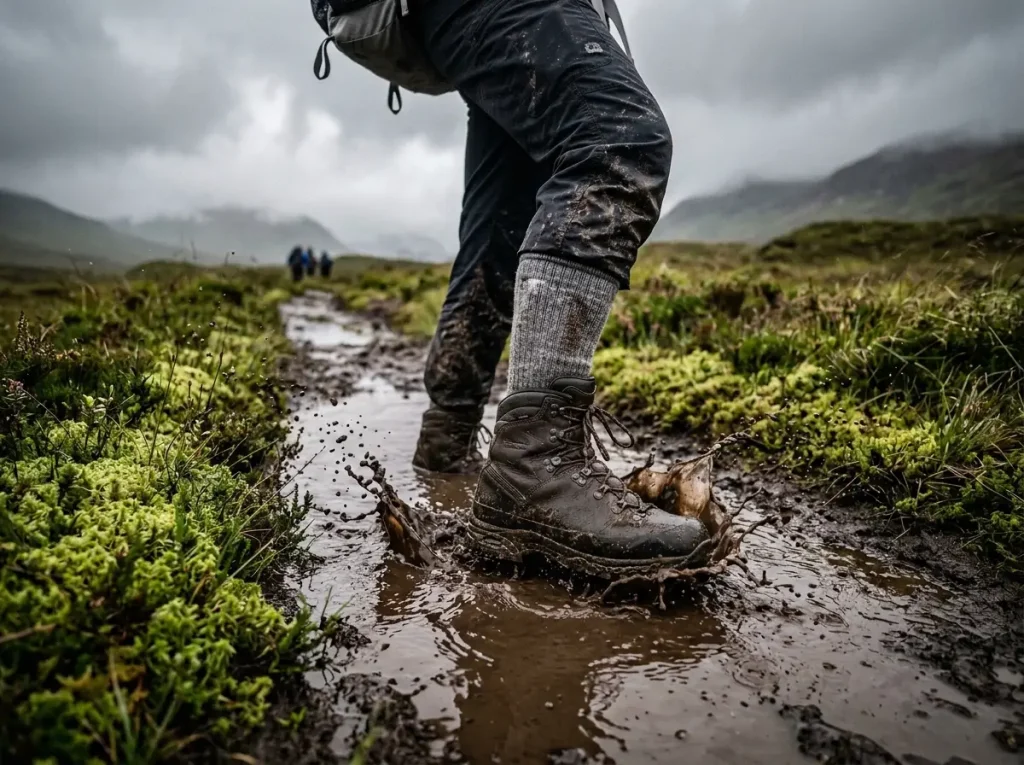
Pro Tip: In fragile ecosystems — alpine tundra, desert biocrust, subalpine meadow — stay on the designated trail even when it’s ugly out there. Hike through the mud, not around it. Your waterproof boots can handle it. The crust cannot.
The full scope of the invisible damage hikers cause in fragile ecosystems goes well past what most hikers have considered.
Dogs, Leashes, and the Ecology of a Pet on Trail
Off-leash dogs in NPS and most state park areas can result in fines starting at $100–$500 per incident. That’s the administrative reality. The ecological reality is different: dogs carry scent that triggers threat-response in wildlife for up to 40 minutes after passage — far beyond the animal’s actual presence on the trail. An off-leash dog in a summer wildflower zone can damage 30–50 square feet of root-fragile soil per sprint.
The “voice control” exception is narrower than most people assume. “Voice-controlled” dog regulations do not constitute off-leash authorization on most NPS land. If you’re not sure, you’re probably breaking the rule.
Leash laws also protect other hikers. An off-leash dog approaching equestrian stock is a direct spook risk. An unfamiliar dog running at a child on a narrow trail can cause a fall before the child or parent can react. What’s actually legal for off-leash dogs on national forest and NPS land is jurisdiction-specific and worth verifying before you go.
Conclusion
Three things to carry off this trail:
The yield hierarchy is physics, not politeness. Uphill hikers protecting metabolic steady-state, horses bolting uphill on predator-reflex, and social trail fragmentation are all governed by physical laws that don’t respond to intent or good manners.
On technical terrain, etiquette becomes safety. Rockfall clearance protocols and trekking pole carry positions in tight passes separate a normal day out from a helicopter evacuation. These are not suggestions.
The highest-value trail behaviors are acts of restraint. Staying center-trail, holding single-file formation in your group, keeping your dog leashed, letting the uphill hiker pass — none of these cost you anything meaningful. All of them add up to a trail system that stays functional for the people who come after you.
On your next trip, pick one rule you’ve been fuzzy on — the downhill side for horses, rubber tips on granite, or stepped-up communication in the final miles. Practice it deliberately. Technical competence on trail, like any other field skill, builds one rep at a time.
FAQ
Who has the right of way on a hiking trail?
Pack stock first, hikers second, mountain bikers third — that’s the hierarchy the NPS and Leave No Trace both use. Between two hikers going opposite directions, the ascending party holds right of way. These are defaults. Read conditions and communicate.
Why do uphill hikers have the right of way?
Because stopping on an incline is physiologically expensive in a way that stopping on a descent isn’t. The ascending hiker is near maximum heart rate, watching their feet, and restarting from a stop requires a high-torque muscle effort that can push them into anaerobic territory. The downhill hiker has a clear view of the trail 30–50 feet ahead and near-zero metabolic cost to pause. The math is straightforward.
Do I really need to step to the downhill side for a horse?
Yes, and the reason is mechanical. A horse’s predator-flight reflex sends it uphill. If you’re on the uphill side, you’re in the path of a 900–1,200 lb animal moving at full flight speed. Stepping downhill clears that path. Standing still and speaking in a normal voice helps the horse register you as human, not a threat.
What are the rules for trekking poles when passing other hikers?
When passing in either direction, hold poles vertically with tips up and arms close to your body. The standard swing arc at knee height is 2–3 feet — a direct tripping hazard on narrow trail. On Class 3+ terrain, hold them in one hand above the basket or clip them to your pack entirely before committing to technical moves.
Is it okay to hike off-trail to avoid a muddy section?
No — and especially not in sensitive ecosystems. Bypassing mud creates a new social trail that widens the corridor, fragments adjacent habitat, and compresses unfragmented soil that can take years to recover. Hike through the mud center-trail on your durable footwear. The ecological cost of going around it is higher than the aesthetic inconvenience.
I've spent more than a decade researching hiking gear and trail technique. I read the specs, the forum threads and the long-term reviews, and every pick here comes with what it gets wrong.
End of the trail
You read every mile of this one. Here's where the trail goes next.