

You’re standing in the gear closet the night before a big scree-scramble day, holding two pairs. One is plush and cushioned. One is stiffer, with a plate you can feel through the sole. You reach for the cushioned pair because “speed hiking shoe” sounded like it should just mean the fast one, and you spend the next eight hours placing every foot deliberately instead of flowing. The fastpacking and peak-bagging crowd throws around speed hiking shoes as if it’s a category you can shop by name, and the brands mostly don’t use the term at all, which is why searching it returns a confusing mess. Here’s what actually separates a speed hiking shoe from a pure trail runner, and how weight, pace mechanics, toe-bang, durability and cost should drive the pick instead of the label.
Here’s the short version, side by side.
| Attribute | Trail Runners | Speed Hiking Shoes |
|---|---|---|
| Underfoot stiffness | Flexible, rock plate optional or absent | Rock plate or reinforced midsole standard |
| Lug depth | Shallower, tuned for packed singletrack | Deeper and more aggressive, for scree and off-trail |
| Waterproofing | Breathable mesh by default, membrane an upcharge | Membrane frequently shipped as standard |
| Best terrain | Established trail, groomed tread, long smooth miles | Technical, rocky, off-trail, loose side-hill |
| Mileage lifespan | 300 to 500 miles before the midsole packs out | Similar range, outsole often lasts longer on rock |
What “Speed Hiking Shoes” Actually Means
Start with the uncomfortable part: you searched a term the footwear industry barely uses. Type it into Amazon and you get lightweight boots, road-to-trail runners, and approach shoes in the same scroll, because no filter exists for it. That’s not your search skills failing. That’s a community label meeting a catalog that was never built around it.
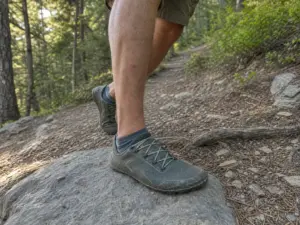
The label comes from fastpacking and peak-bagging circles, where people needed a word for the shoes that sit between a race-day trail runner and a lightweight hiking shoe. Brands sell those shoes. They just file them under trail running or hiking, depending on which marketing team won the argument. Merrell’s Moab Speed 2 GTX is the clearest industry example of the spec pattern, pairing a nylon rock plate, an aggressive Vibram outsole and a membrane on a running-shoe last, and even Merrell doesn’t call it a speed hiking shoe on the box.
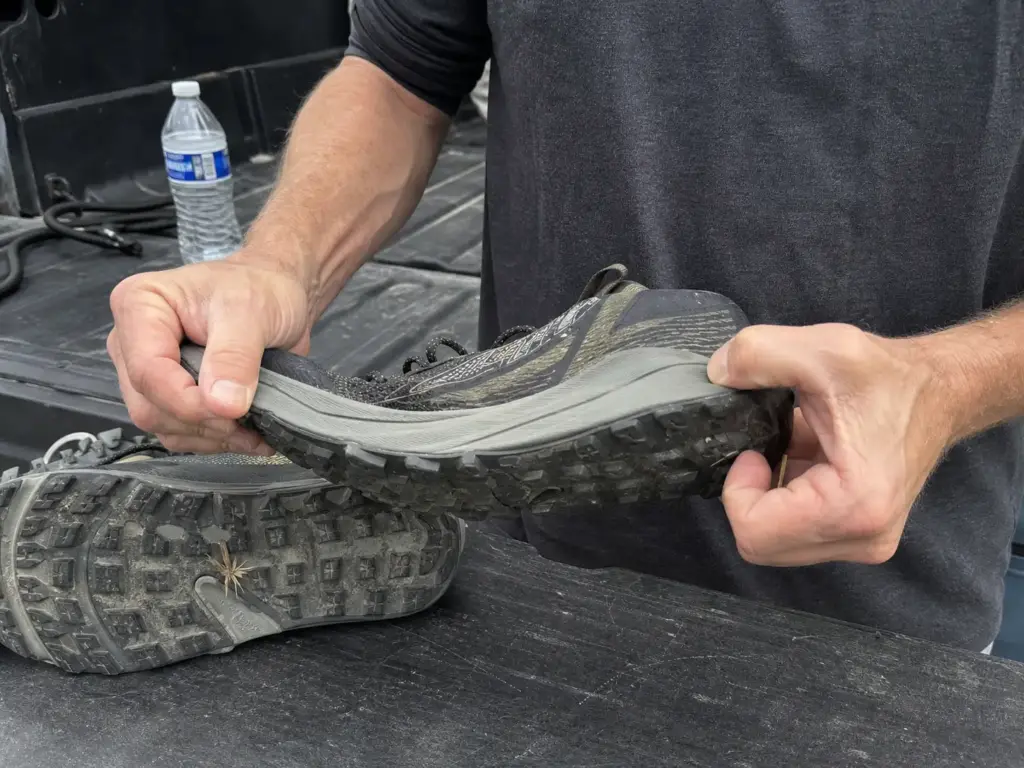
Underneath the label, though, there is a real and defensible pattern. Shoes the community calls speed hiking shoes share three traits that pure trail runners often skip: a rock plate or reinforced midsole for torsional rigidity, deeper and more aggressive lugs for off-trail and scree grip, and frequently a waterproof membrane as standard rather than an upcharge. Not one of those is a marketing invention. All three are things you can hold in your hands and verify.
The rock plate is worth understanding properly, because it’s the mechanical heart of the whole distinction. It’s a thin sheet, usually nylon or TPU, that sits between the midsole and the outsole. Its one job is to stop a sharp rock from pressing straight through the sole into your arch. You pay for that in flex and a little weight, and if you want the full breakdown on rock plates, the trade-offs go deeper than most spec sheets admit. It’s not fluff. It’s a plate.
At the other end of the spectrum sits the pure trail runner, and the HOKA Speedgoat 6 (men’s · women’s) is the honest benchmark for it. A 33mm stack, Vibram Megagrip, meta-rocker geometry built to roll a running gait forward. It is superb on long established-trail miles and it is exactly what a speed hiking shoe is defined against. If the anatomy of that side of the spectrum is new to you, it’s worth understanding what a trail runner is actually built to do before you shop the stiffer end.
So the practical read is this: a speed hiking shoe is a position on a spectrum, not a separate species. Pure trail runner on one end, lightweight hiking shoe on the other, and the speed hiking shoe splits the difference. Once you see it that way, the confusing search results stop being confusing. You’re not looking for a category. You’re looking for three traits.
Skip the marketing copy and do the twist test in the store. Grab the shoe at heel and toe and wring it like a towel. If the midsole twists easily, there is no plate in there, whatever the tag says. A plated shoe resists and springs back. That five-second check tells you more than any product page.
The Weight Difference and Why It Compounds
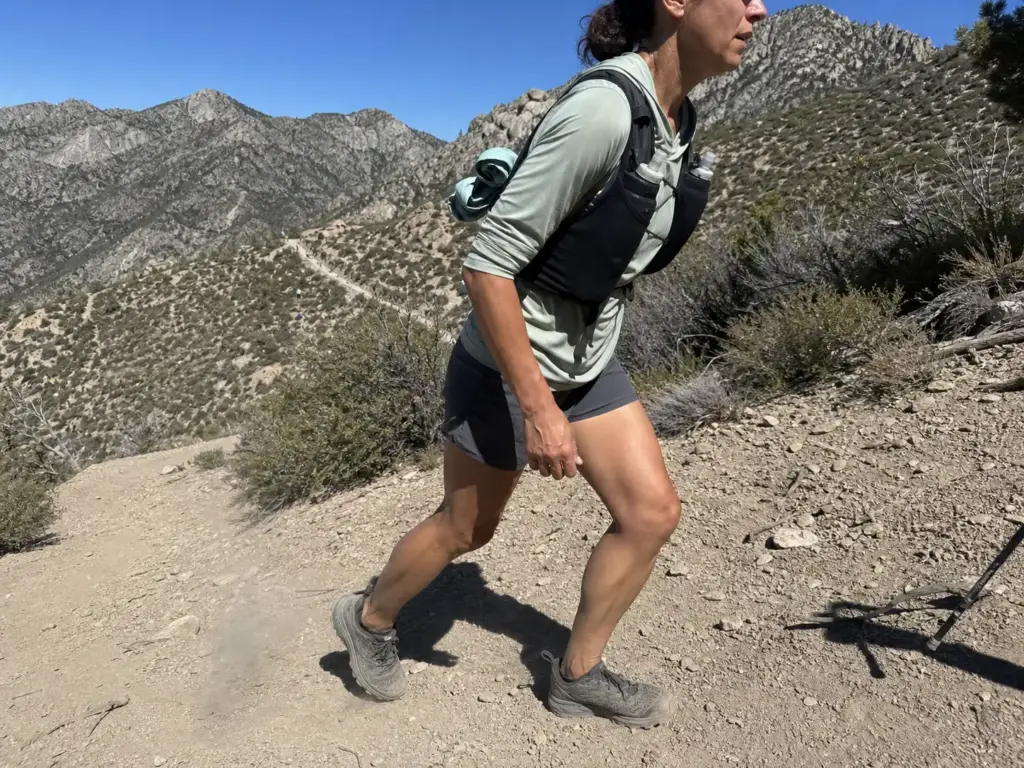
Everyone at the trailhead repeats the same line: a pound on your feet costs you five on your back. It shows up near-verbatim across REI, the Appalachian Mountain Club and The Hiking Life, and it’s the single thing the whole internet agrees on about this topic. Fine. It’s also where most articles stop, which is a shame, because the slogan is the setup, not the answer.
What the multiplier actually describes is lift count. Your feet swing through a full arc thousands upon thousands of times a day, and every one of those swings pays the weight tax again. That’s the difference between weight on your back, which you carry, and weight on your feet, which you lift over and over. A few ounces you can’t feel in mile one is a real amount of accumulated work by mile twelve, and it doesn’t announce itself as heaviness. It announces itself as sloppy foot placement late in the day.
Weight is where trail runners win outright, and there’s no point pretending otherwise. A speed hiking shoe pays a real penalty for its plate, its deeper lugs and its membrane. Three features, three small weight costs, all compounding on the same lift count.
Here’s the countercase, though, and it’s the part the slogan hides. The lighter shoe only wins if it’s still protecting your foot at hour six. A shoe so light that you start babying every rock placement isn’t fast, it’s just light. Pace on technical ground is a function of how confidently you can put a foot down without looking, and protection buys confidence.
Load changes the whole calculation too. Fastpacking generally targets a base pack weight under 15 pounds, with the ultralight crowd pushing under 10. The same stiff, plated shoe that feels perfect under a 12-pound kit feels overbuilt and punishing under 35 pounds, because a heavy pack changes what your foot needs from the ground up. If you’re carrying real weight, how pack weight changes which trail runner works matters more than the ounce count on the shoe itself. Shoe and load are one decision, not two.
Pace Mechanics Nobody Talks About
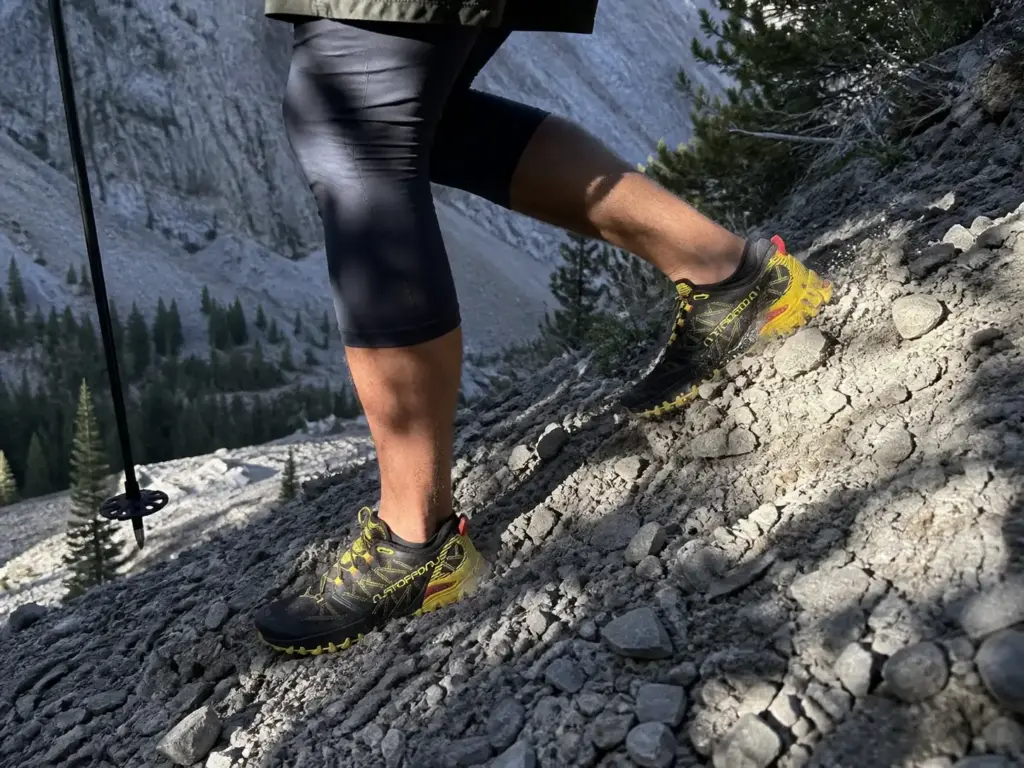
You’ve felt this even if you’ve never had words for it: a tall, plush shoe going slightly vague underfoot on a loose side-hill traverse. Nothing dramatic. The ground just stops reporting back clearly, and you notice you’ve switched from flowing to placing each foot on purpose. That moment is stack height doing exactly what physics says it should.
Above roughly 33mm of stack height, the shoe raises your center of gravity enough to cut precision on off-camber terrain and quick direction changes. The taller the platform, the more leverage a rolled edge has on your ankle, and the less directly your foot reads the ground. That’s the cost. Nobody selling cushion advertises it. Terrain should drive that number, and picking a stack height for your terrain is genuinely the decision underneath most of this article.
Now the counterintuitive part. On long routes with sustained descents, moderate-high stack shoes in the 35 to 40mm range often produce faster overall times, even with lower peak agility, because feet stay fresher for longer. Speed over a full day isn’t which shoe feels fastest in mile one. It’s which one still lets you push at mile fifteen. That’s why the plush shoe isn’t automatically the wrong call, and why “more precise” isn’t automatically “faster.”
Drop belongs in the same conversation. A zero drop shoe puts your heel and forefoot on the same plane, which loads the calf and Achilles harder on sustained climbs than the 4 to 8mm most trail shoes ship with. It suits people who have adapted to it over months and punishes people who switch mid-season. And under all of it sits the foam itself: a standard EVA midsole compresses gradually with mileage, which is why a shoe can look fine and still be finished.
Rocker geometry is the piece that reads differently between the two disciplines. A rockered midsole is shaped to roll your foot forward through the gait cycle, which is efficient at a running cadence where you’re already moving through that arc quickly. At a sustained hiking pace, especially on climbs, you spend longer in mid-stance and the roll works less in your favor. It doesn’t hurt you. It just does less than the marketing implies when you’re power-hiking rather than running.
The rock plate earns its pace differently than people expect. It doesn’t propel you. What it buys is the ability to stop babying foot placement on scree and rubble, and to plant your foot where the line wants it rather than where it looks safest for your arch. Over a talus field, that’s minutes.
Match stack height to terrain, not to marketing. Tall and plush for long days on established trail where fatigue is the enemy. Lower, firmer and plated for technical off-trail where precision and torsional stability decide your pace. Owning both and choosing at the door beats hunting for one shoe that does everything.
For the firm end of that spectrum, the La Sportiva Bushido III (men’s · women’s) is about as far as it goes: aggressive lugs, a torsional rigidity plate, and a low-volume performance fit built for scree and off-trail scrambling at pace. Be honest with yourself about it, though. That fit is tight, it demands real descent technique, and it is a premium buy. If you’re newer to moving fast on technical ground, this is not the shoe to learn in.
Ankle Support Is the Wrong Question
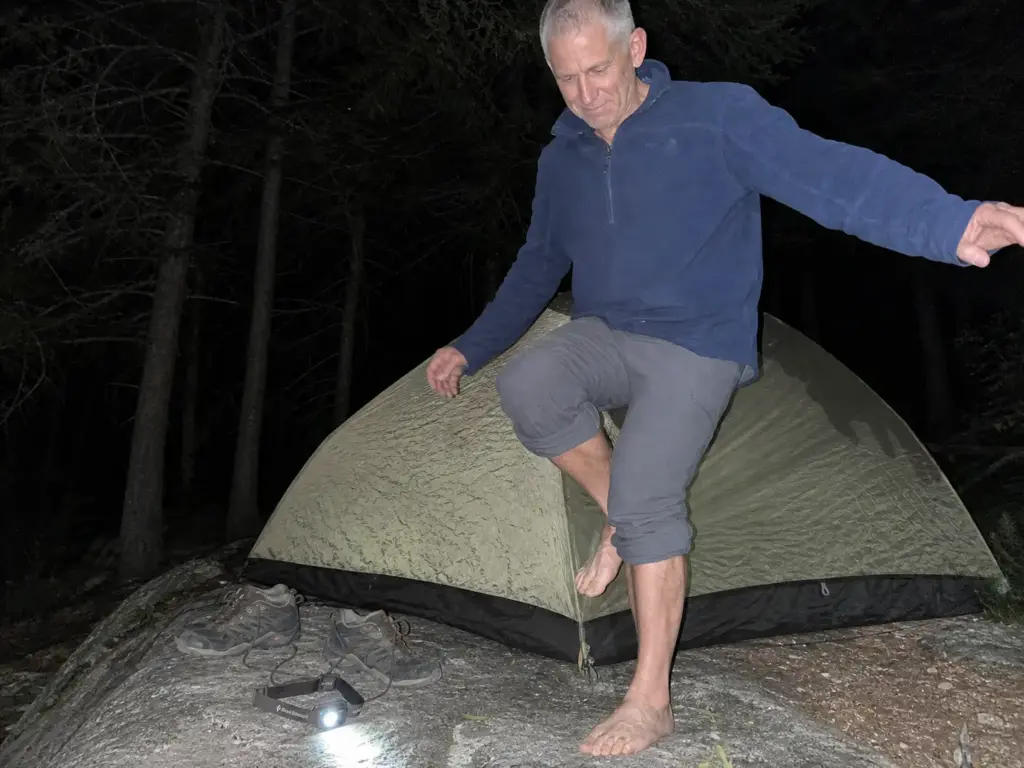
Here’s where people go wrong: assuming a stiffer speed hiking shoe means more ankle support. It’s an understandable jump. It’s also two different things wearing the same word. Torsional rigidity underfoot resists the sole twisting. Lateral ankle support resists your ankle rolling. A plate does the first and does essentially nothing for the second.
The concern behind the question is legitimate. Ankle injuries account for roughly 40% of all injuries sustained in trail running, per a Journal of Sports Medicine analysis. That’s not a fringe worry, that’s nearly half of everything that goes wrong out there. The problem is the proposed fix.
What actually moves the number is training, not geometry. Ankle proprioception training has been shown to cut sprain risk by 40 to 60%, far more than any boot collar — single-leg balance work, peroneal strengthening, the unglamorous ten minutes nobody films. And if you’ve already rolled an ankle once, you’re roughly 75% more likely to develop chronic instability without doing that corrective work. The shoe is not the variable in that equation. Your lower leg is.
The genuinely speed-specific risk is one nobody flags, and it isn’t collar height. It’s losing proprioceptive feedback while moving fast and tired at the same time. Fatigue degrades the signal your ankle uses to correct itself, and speed shortens the window it has to act. That combination is the failure mode on fast descents, not an inch of fabric above the malleolus. Nothing in a shoe fixes it. Pacing, fueling and strength work do.
None of which means shoe choice is irrelevant, only that it’s a smaller lever than the marketing suggests. If you want the evidence laid out properly, here’s the full case against the ankle support myth, including what the research does and doesn’t show about high-cut footwear.
Toe-Bang and the Sizing Mistake That Costs Toenails
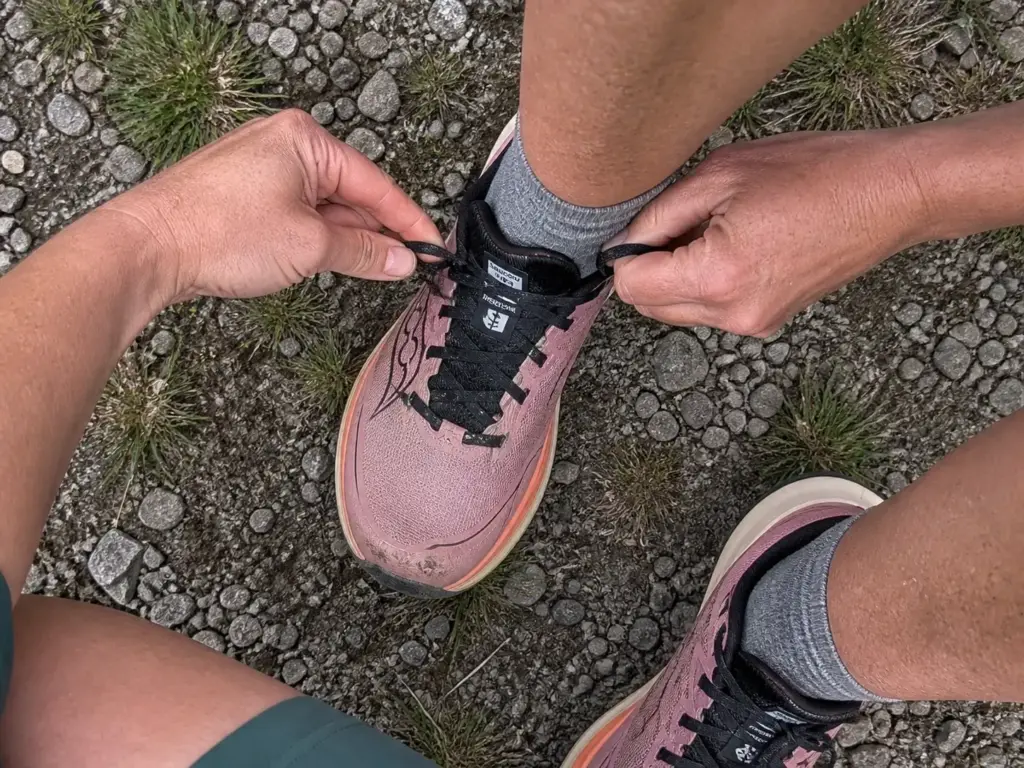
The story recurs across hiking forums in almost identical form: six hours in, one long descent done, sock peeled off at camp, and there’s a blackened, throbbing big toe that wasn’t there this morning. Almost nobody sees it coming, because at the trailhead the shoe fit perfectly. That’s the whole trap.
Toe-bang has three root causes and none of them is a shoe that’s insufficiently tough. Undersized length, a toe box without enough height, and inadequate heel lock letting your foot slide forward on every descent step. Add a fast pace and a loaded pack and you’re driving your toes into the front of the shoe thousands of times in an afternoon.
Fix one is sizing. Size up half a size to a full size for swelling, because your trailhead fit is not your mile-eight fit. Feet swell measurably over hours of loaded movement, and the snug fit that felt precise in the parking lot becomes a vice on the descent. This is the single most common footwear mistake in fast hiking, and it costs people toenails every season. If you’re unsure how far to go, when sizing up is the right call walks through the thresholds properly.
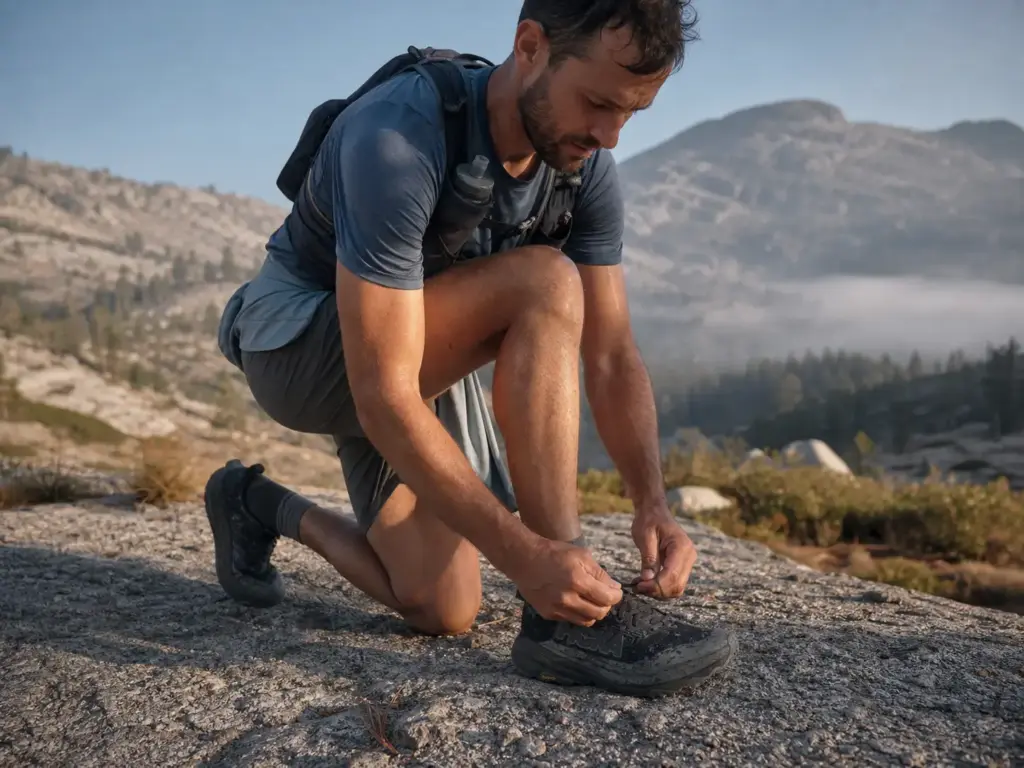
Fix two is free and takes twenty seconds. Heel-lock lacing, also called the runner’s loop, uses the top two eyelets to make a loop on each side, threads the lace across, and cinches with a surgeon’s knot at the ankle. It pins your heel into the back of the shoe so your foot physically can’t slide forward. Most people who fix toe-bang fix it here, not with a new pair. And re-lace at the top of the descent instead of leaving climb tension on. Different job, different tension.
Fix three is diagnostic. Pull the stock insole out and check your toe clearance without it. If the problem disappears, you had a volume problem, not a length problem, and a thinner insole solves it without a resize. Worth doing before you spend money.
Fix four is the sock. Thicker cushioned merino-style socks are doing real mechanical work absorbing forward slide, not just adding comfort, and the fastpacking crowd on Backpacking Light flags them consistently alongside sizing up. The same fix doubles as blister prevention, since the friction that lifts a blister and the slide that bangs a toenail come from the same loose foot. Cheapest insurance in the sport.
One genuine advantage of this whole category over boots: there is essentially no break-in period. A trail runner is ready the day you buy it, which is exactly why sizing it correctly at purchase carries so much weight. There’s no gradual moulding coming to save a bad fit.
One more, and it’s the one people skip: the American Hiking Society recommends trying shoes on later in the day, when your feet are at their largest. Buying at 9am and fitting your morning foot is how the whole problem starts.
The Saucony Peregrine 16 (men’s · women’s) is the clearest live example of the hybrid this article has been defining, and the sensible mid-tier pick: a PWRTRAC outsole, a genuine rock plate, and a 4mm drop, without the price premium a GTX version tacks on. Stiffer underfoot than a pure trail runner, still light enough to move in. Size it with the swelling rule above and it’s a lot of shoe for the money.
Durability, Mileage, and Cost Per Mile
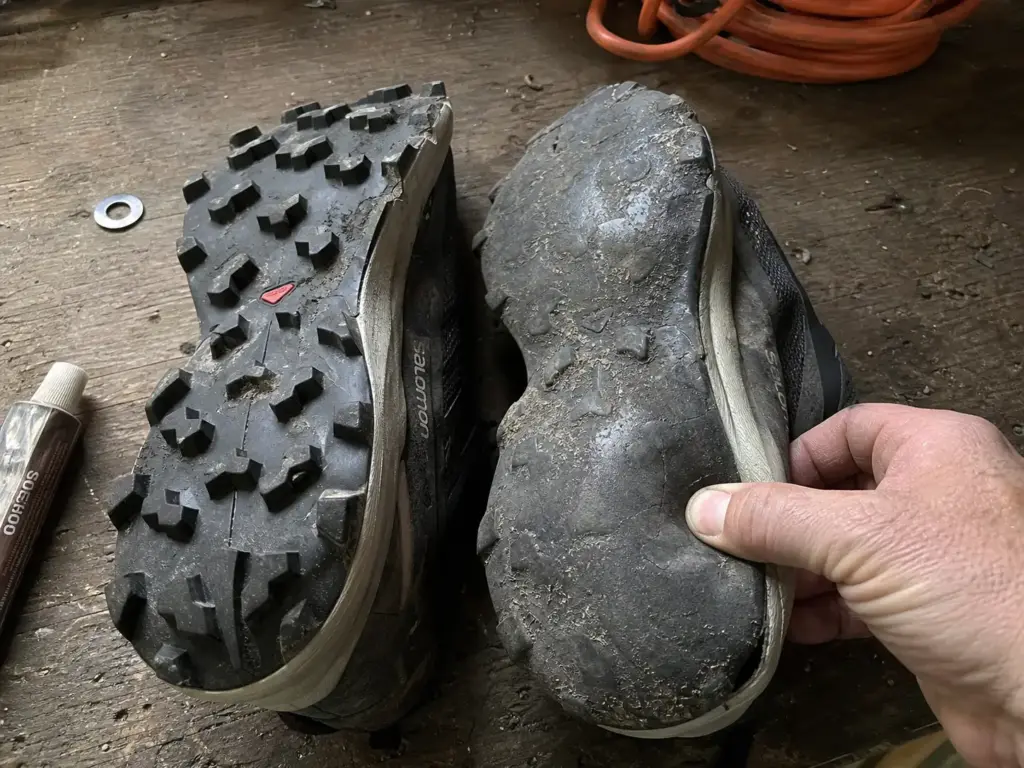
Nobody selling trail runners leads with this, so here it is plainly: they wear out fast. Typical lifespan runs 300 to 500 miles before midsole compression and outsole wear stop supporting your foot properly. Where you land in that range depends heavily on the surface you run and how much load you put through the shoe. Granite and scree chew an outsole far faster than packed dirt. Rock plates and blown lugs are two different failure clocks running at once, and the press test for a dead midsole will tell you which one ran out first.
Put that in season terms and it lands differently. A six-month season of 40-mile weekends is a new pair every two to three months. Not once a year. Not “when they look tired.” Every couple of months, and the shoe will still look fine from the outside while the midsole underneath has quietly stopped doing its job.
Boots and traditional hiking shoes go substantially further before they’re done, often by a wide margin. That gap is real, and it is the strongest argument anyone makes against trail runners. Anybody who waves it away is selling something.
Which is why practitioners stop talking about sticker price and start talking about cost per mile: total price divided by expected mileage. A premium shoe that lasts 500 miles can genuinely beat a budget one that dies at 250, and a boot that goes 900 miles beats both on paper while costing you pace on every one of them. Run the division before you decide anything, especially on a long trip where cost per mile on a thru-hike is the number that actually governs your resupply plan.
The thing you lose going cheap is more specific than “quality.” It’s the outsole compound. Softer, cheaper rubber wears fastest on granite, scree and abrasive rock, which is exactly the terrain speed hiking happens on. A budget shoe on packed dirt might go the full 500. That same shoe on a season of talus can be showing bald lugs by 250. The savings evaporate precisely where you were going to use it.
And the trade-off nobody markets: blown-out lugs by mile 400 of a thru-hike, or a boot that outlasts the whole trip and turns every fast mile into a slog. The long-distance crowd has a name for living that choice. Type II fun. You don’t get to skip it, you only get to pick which version you’re signing up for.
Write the purchase date inside the tongue in permanent marker and log your rough mileage in your phone notes. Midsoles die silently and your legs adapt to the decline gradually, so you will not notice until something hurts. A number on the tongue is more honest than your memory.
Waterproofing, Weather, and the Membrane Trade-Off
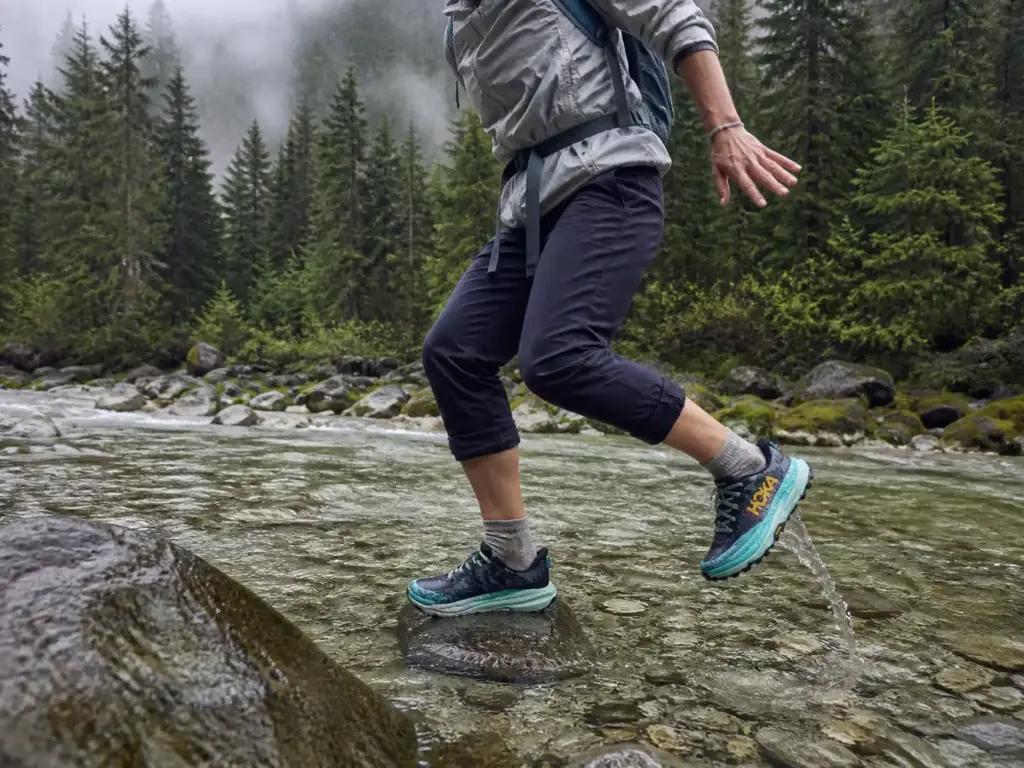
The membrane question gets answered generically everywhere: Gore-Tex for wet, breathable mesh for dry, done. That answer is fine for someone strolling a groomed trail. It’s incomplete for someone moving fast and sweating hard, because pace shifts the whole calculation.
The baseline trade-off holds. A membrane wins in cold and sustained wet conditions, where keeping water out keeps your feet functional. Non-waterproof mesh dries faster and breathes better in warm three-season conditions. Nothing controversial there.
What changes at pace is the moisture source. Move fast and your feet generate serious moisture from the inside, and a membrane that stops water getting in also slows sweat getting out. The faster you go, the worse the sweat side of that equation gets, until you’re wearing a waterproof shoe full of your own water. Worth understanding what a Gore-Tex membrane costs you in breathability before you pay extra for it.
This matters more here than in most footwear discussions because speed hiking shoes frequently ship with a membrane as standard rather than as an option. It’s one of the three defining traits from earlier, and it means the default was chosen for you. Question that default against your actual conditions instead of accepting it as an upgrade.
The wet-foot reality settles the argument anyway. In sustained rain, on a churned muddy trail, or across repeated stream crossings, every shoe wets out. Every one. Once that’s happened, the only question left is drying time, and the mesh shoe wins that decisively while the membrane holds the water in against your skin.
So call it flatly. Membrane for cold and shoulder season. Mesh for warm and three-season. If you’re heading into genuine winter, stop trying to make a trail runner work and get cold-weather footwear built for it, because a membrane on a summer shoe is not an insulation strategy.
The Gear Around the Shoe That Changes Your Pace
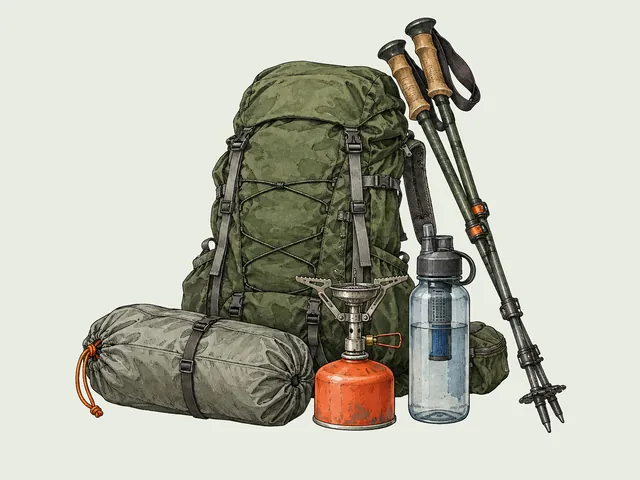
You’ve been optimizing the shoe. The cheap stuff around it often matters more, and that’s the correction most fast hikers get late. A fastpacking kit works as a system, and how a fastpacking kit comes together is the frame the shoe choice sits inside.
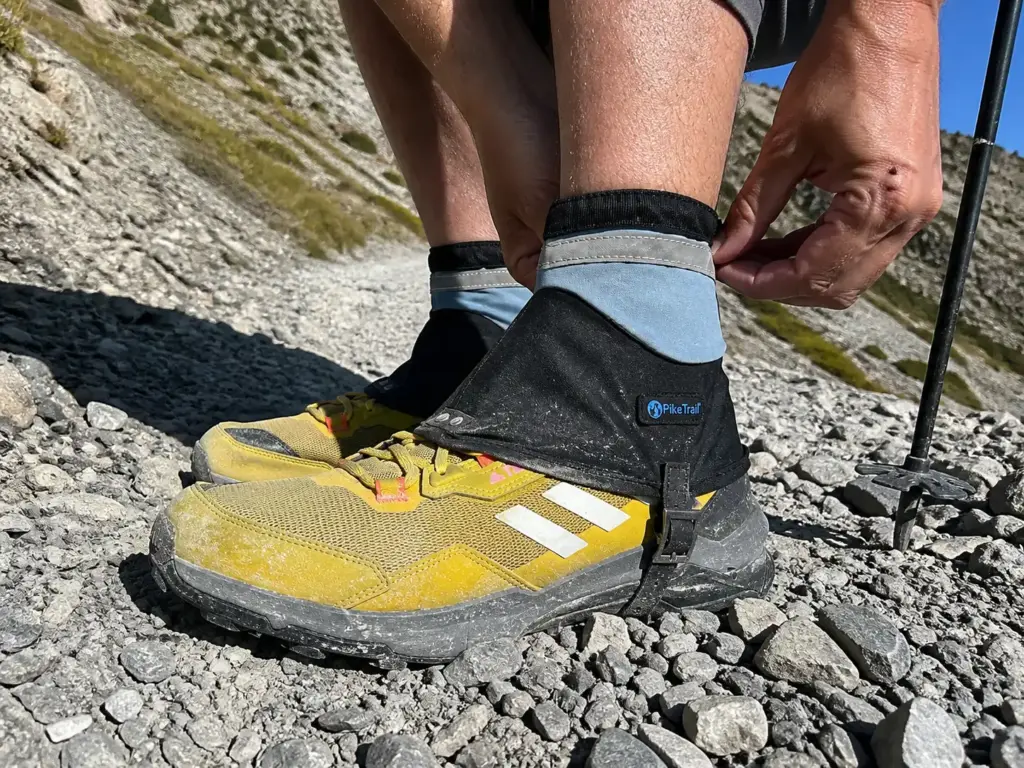
Start with gaiters, because they’re the highest-return item in this whole article. Low-cut shoes on scree, loose gravel and off-trail terrain let debris in constantly. A cheap pair of low gaiters solves roughly 90% of the stop-and-empty-my-shoe interruptions, and those interruptions are what quietly ruin a fast day.
Run the pace math on it. Each stop is a minute or two once you’ve found a rock to sit on, unlaced, shaken the shoe out and re-laced. On a scree-heavy peak-bagging day you’ll do that a dozen times. That’s fifteen to twenty-five minutes of standing still, plus the rhythm you lose restarting every time. Your shoe wasn’t slowing you down.
Here’s the part people underestimate: you won’t stop at the first piece of grit. You’ll feel a single sharp fragment work its way under your arch on a fast descent, decide it’s tolerable, and walk on it for another half mile of hammering steps because stopping breaks your flow. By the time you finally sit down there’s a hot spot forming. Everybody does this. Gaiters remove the decision.
The Pike Trail Ankle Gaiters are the budget-friendly answer here: low-cut, velcro and spandex closure, unisex, and they weigh essentially nothing in a vest pocket. Check them on Amazon if you’re heading anywhere loose. For what they cost relative to a pair of shoes, skipping them to save money is the wrong economy.
Trekking poles are the second lever, and they change what the shoe has to do. Poles offload a meaningful share of descent impact into your arms and add two more contact points on loose ground, which means a softer, less rigid shoe becomes viable on terrain that would otherwise demand a plate. Two poles, used properly on descents rather than carried, can substitute for a good chunk of what you were about to buy stiffness for.
Then the sock system. Thicker cushioned merino-style socks absorb forward slide on descents and take real load off your toes, which loops straight back to the toe-bang problem. Bring a dry spare and change at the halfway point of a long day. And think about what you carry it all in, because a pack that bounces changes your gait, and a changed gait changes which shoe feels right.
The Bottom Line on Speed Hiking Shoes vs Trail Runners
Three things to carry out of here. First, speed hiking shoes aren’t a category you can shop by name. They’re a spectrum position defined by a rock plate, deeper lugs, and often a membrane, and once you know the three traits you can identify one in any brand’s catalog regardless of what section it’s filed under.
Second, match stack and stiffness to your terrain instead of the label on the box. Plush and tall for long established-trail days where fatigue is the enemy. Firm, lower and plated for technical off-trail where precision decides your pace.
Third, the free fixes beat the purchase almost every time. Size up for swelling, lace a heel-lock, add gaiters, use poles on descents. That’s four changes that cost close to nothing and fix more real problems than upgrading shoes will.
Before your next fast day, go do the twist test on whatever’s already in the closet, and lace a heel-lock at the top of the first long descent. Most people learn more about what they own in one hike than in another hour of shopping.
Frequently Asked Questions
01Are trail runners better than hiking shoes?
Neither is better outright. It depends on your load, terrain and season. Trail runners win on weight and drying speed, which matters most on warm three-season trail with a light pack. Hiking shoes win on durability and underfoot protection, which matters most on rock, off-trail ground and under heavier loads.
02Can I use the same shoes for running and hiking?
Yes, for most established trail one pair covers both. The one difference worth knowing is rocker geometry, which is designed to roll the foot forward at a running cadence and does less for you at a sustained hiking pace, especially on climbs.
03What is the difference between speed hiking and trail running?
The difference is pace and intent, not footwear category. Speed hiking means sustained fast movement over distance, usually with a light pack and a walking gait. Trail running uses a running gait. The footwear overlaps heavily, which is exactly why the two labels blur together in product listings.
04Do trail running shoes wear out faster on the road?
Yes. Trail outsoles use softer, grippier rubber compounds tuned for dirt and rock, and pavement grinds them down quickly. Road miles on trail shoes eat into the same 300 to 500 mile budget you were saving for the trail, which is why cost per mile gets worse fast.
05Can I use trail running shoes for trekking?
Yes, with a load caveat. Under roughly 15 pounds base weight they work well and most fastpackers prefer them. Above that, the lack of underfoot rigidity starts to tell on long days, and a rock plate or a stiffer hiking shoe becomes the smarter call.

I've spent more than a decade researching hiking gear and trail technique. I read the specs, the forum threads and the long-term reviews, and every pick here comes with what it gets wrong.
End of the trail
You read every mile of this one. Here's where the trail goes next.