



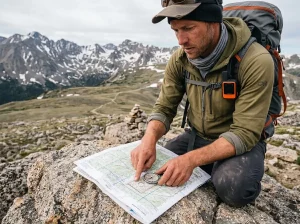


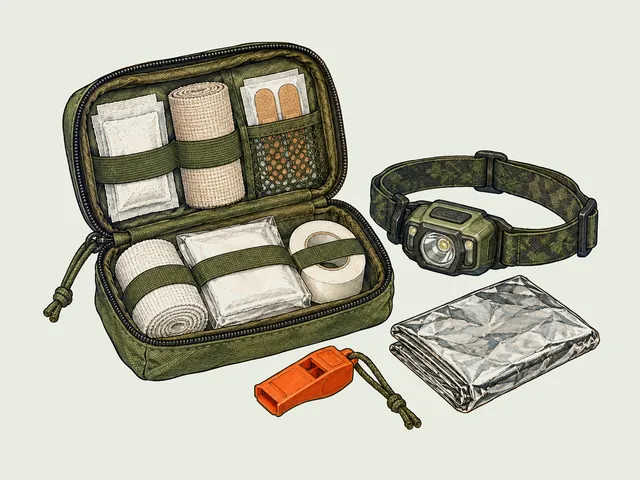



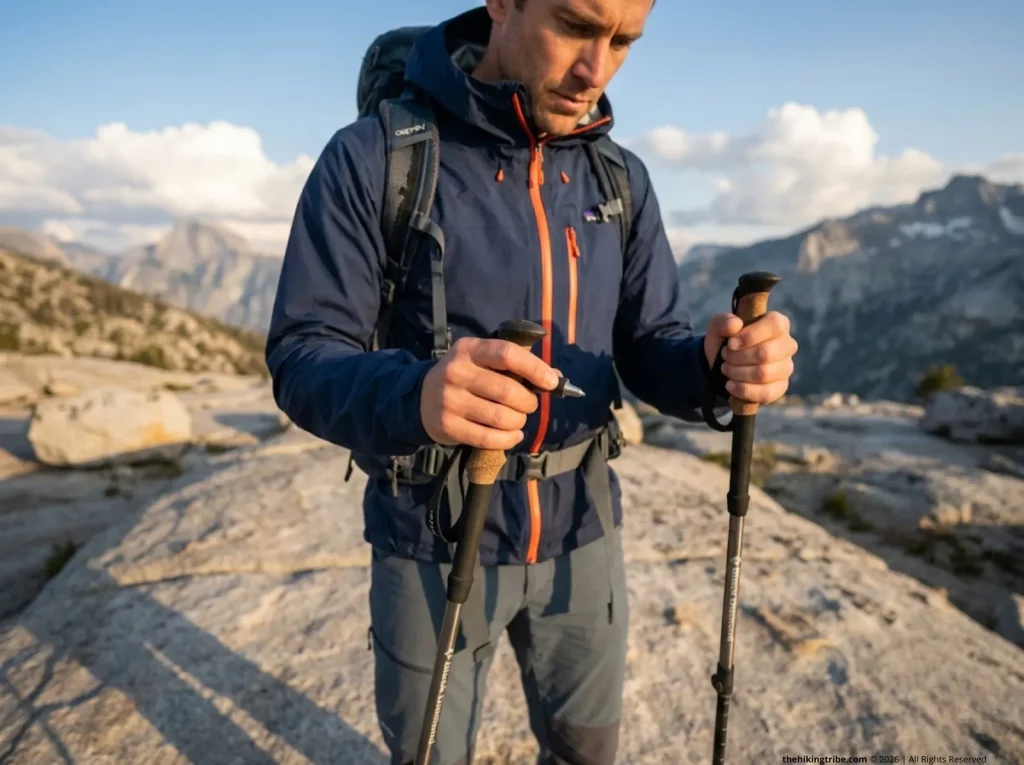
Mile 487 on the John Muir Trail, and my left pole was ice-skating across granite. The carbide tip had ground down to a smooth aluminum nub over 500 miles of Sierra rock, and I’d been ignoring the warning signs for two days. I dug into my repair kit, found a fresh pair of Black Diamond Flex Tips, and stared at the old ones — fused to the shaft like they were welded on. Then I remembered the boiling water trick a thru-hiker had shown me at a shelter in Virginia: thirty seconds in a hot pot, a firm twist, and the whole thing pops off clean.
I’ve been replacing trekking pole tips on my own gear since 2014, and this guide covers everything I’ve learned the hard way — from the right water temperature and plier grip to why your rubber tips might matter more for the trail than your carbide tips do.
⚡ Quick Answer: Submerge the worn pole tip in boiling water for 10–15 seconds to soften the plastic and any adhesive. Grip low on the tip with slip-joint pliers and twist off. Tap the new replacement tip onto the clean shaft end against a flat rock or concrete surface — no glue needed. Black Diamond Flex Tips run about $12 a pair and fit most poles. Expect a length increase of roughly 1.5 inches after swapping to BD tips.
When Trekking Pole Tips Actually Need Replacing
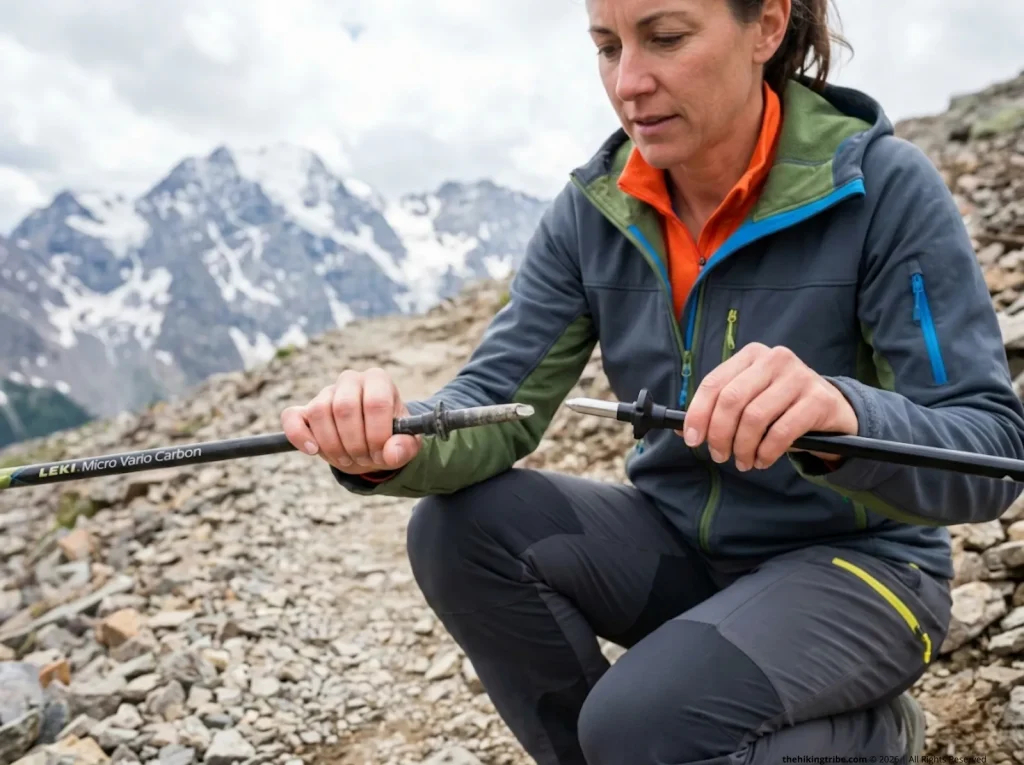
Most hikers wait too long. By the time they notice their worn tips skating on wet rock, the damage is done — they’ve been hiking without real traction for weeks. The fix is fast and cheap, but only if you catch it in time.
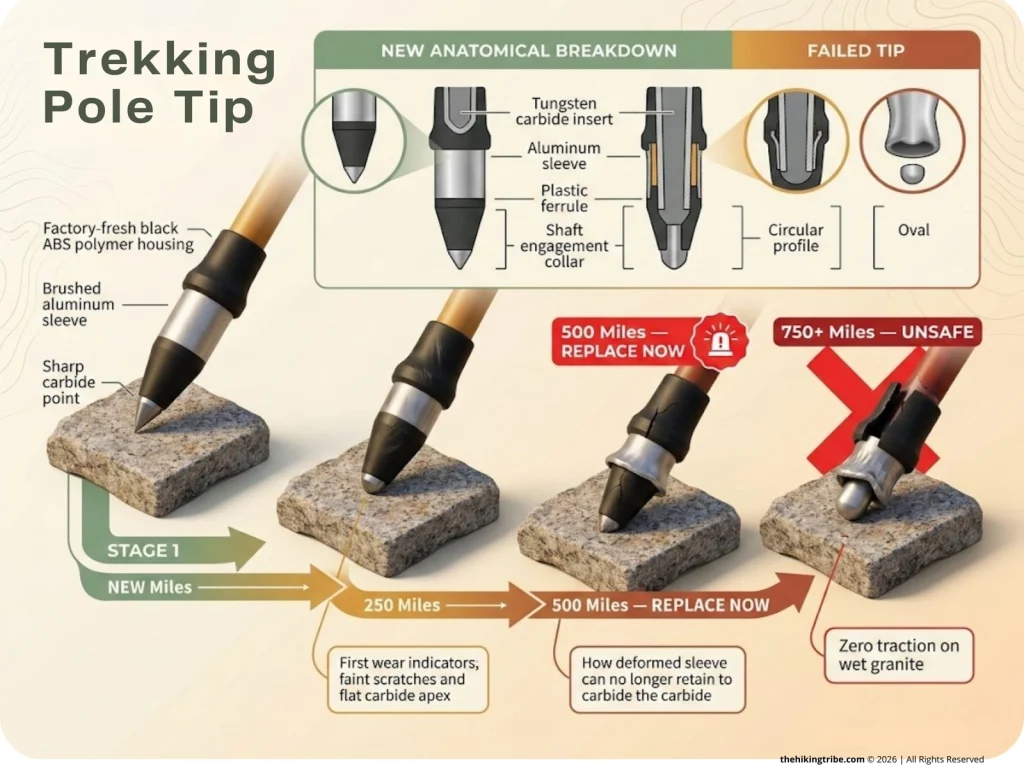
Here’s what actually fails first: the carbide point itself almost never wears out. It’s extraordinarily hard — close to diamond on the hardness scale. Andrew Skurka, who has more than 10,000 miles of backcountry experience, puts it clearly: “The failure point is not the actual tip, which is made of carbide and nearly as tough as diamond, but rather the aluminum and plastic parts of the tip.” What you’re looking at when a trekking pole tip goes bad is a mushroomed aluminum sleeve and a cracked plastic ferrule that can no longer hold the carbide secure.
Mileage Benchmarks and When to Check
On mixed rock like the Sierra Nevada or White Mountains, expect to replace pole tips every 500–600 miles. On packed dirt trail, you might squeeze 650–750 miles out of a pair. Pavement and gravel road walks accelerate wear dramatically — don’t be surprised to see failure at 300–400 miles on a thru-hike with significant road sections.
The visual check is simple. Push the carbide point sideways. If it wobbles or the aluminum housing looks flattened and mushroom-shaped, replace them now. Part of a regular trekking pole maintenance routine is building in a quick tip inspection at every resupply town. Thirty seconds of checking saves you a sketchy descent on bald poles.
Pro-Tip: Replace your trekking pole tips preemptively — before they erode into nubs or fall out of the housing mid-hike. Carry one spare pair in your repair kit on any trip over three days.
The Boiling Water Removal Method (Step by Step)
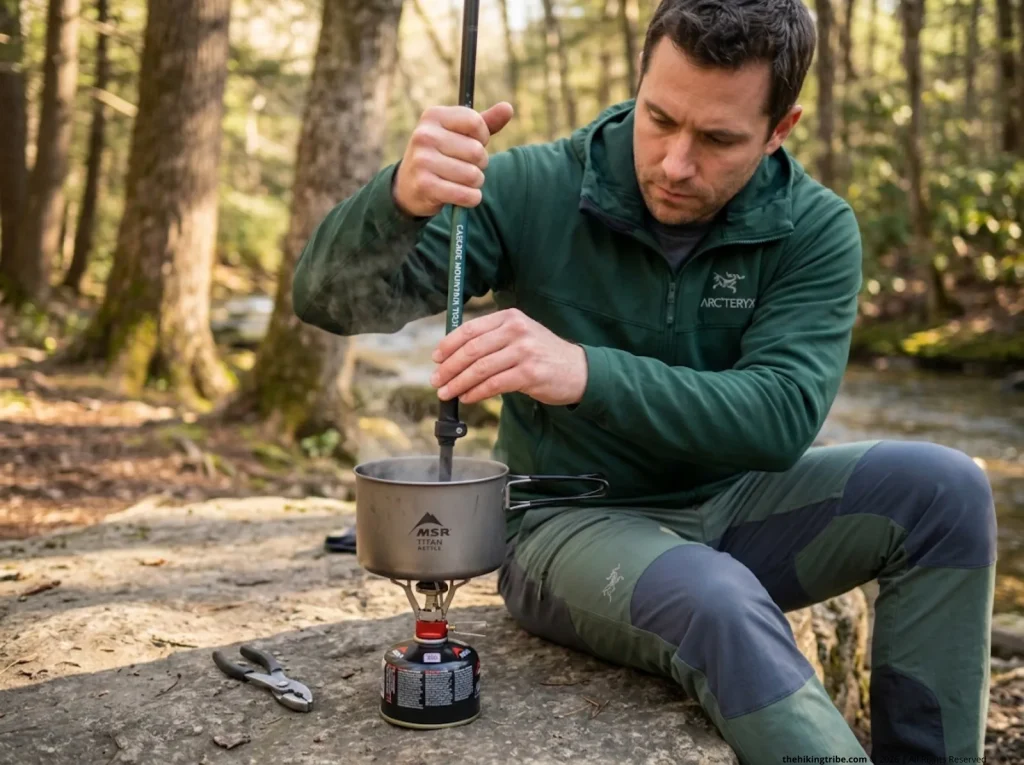
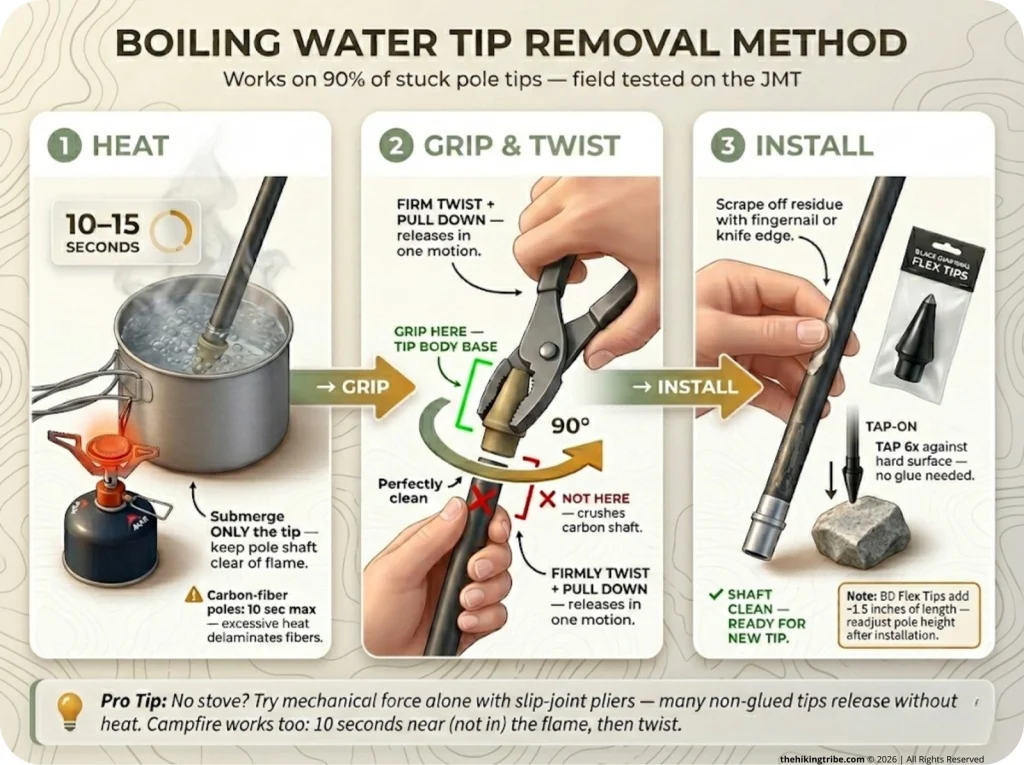
This is the technique that solves 90% of stuck tip problems. It works because heat softens the plastic ferrule and breaks down any residual adhesive between the tip and the pole shaft. The whole process takes under two minutes at a camp kitchen, or five minutes at home.
Gather Your Tools
You need three things: a pot of boiling water, a pair of slip-joint pliers, and a rag or glove. The pliers choice matters more than most guides let on. Slip-joint pliers open wide enough to grip the tip body without also grabbing the pole shaft. Needle-nose pliers are too narrow and will crush the shaft on carbon poles. Remove any baskets before you start — they block plier access and can get damaged by the heat.
Pro-Tip: At home, use a standard kitchen pot. On trail, your camp cook pot and stove work perfectly. An MSR Pocket Rocket and a titanium kettle are all you need for a clean field replacement.
Heat, Grip, and Twist
Lower the tip end of the pole into boiling water and leave it for 10–15 seconds — count it out. Pull the pole clear, then immediately grip low on the tip with your pliers. This is the move most people get wrong. Gripping too high means you’re also clenching the pole shaft, which can crush a carbon tube. Grip the tip body near its base, twist firmly, and pull straight down. It should release in one smooth motion.
For carbon-fiber poles, stay disciplined about the timing. Excessive heat is the one thing that can delaminate carbon fibers, so 10–15 seconds is enough. Resist the urge to keep the shaft submerged while you’re fiddling with the pliers.
When the Standard Method Fails
Some manufacturers use industrial adhesive that laughs at a quick boil. Cascade Mountain Tech poles and certain Zpacks models are the main offenders. For a glued carbon tip, extend your soak to 30–60 seconds. Wrap the shaft in a rag if the metal gets uncomfortably hot. A heat gun on a low setting is a solid alternative to boiling water when you’re at home — more controlled heat, less mess.
If none of that works, you’re into what I call the saw method: slit the plastic ferrule lengthwise with a dovetail saw or keyhole saw, then lever it off with a small flathead screwdriver or chisel. This sounds drastic, but it takes about two minutes and causes zero damage to the underlying shaft. You’ll find this technique buried in Backpacking Light forum threads and Zpacks discussions, but it’s completely absent from every mainstream guide on the first page of Google.
Carrying a quality multi-tool with pliers handles field repairs beautifully — keep one in your pack on any serious trip.
Installing New Tips (The Tap-On Method)
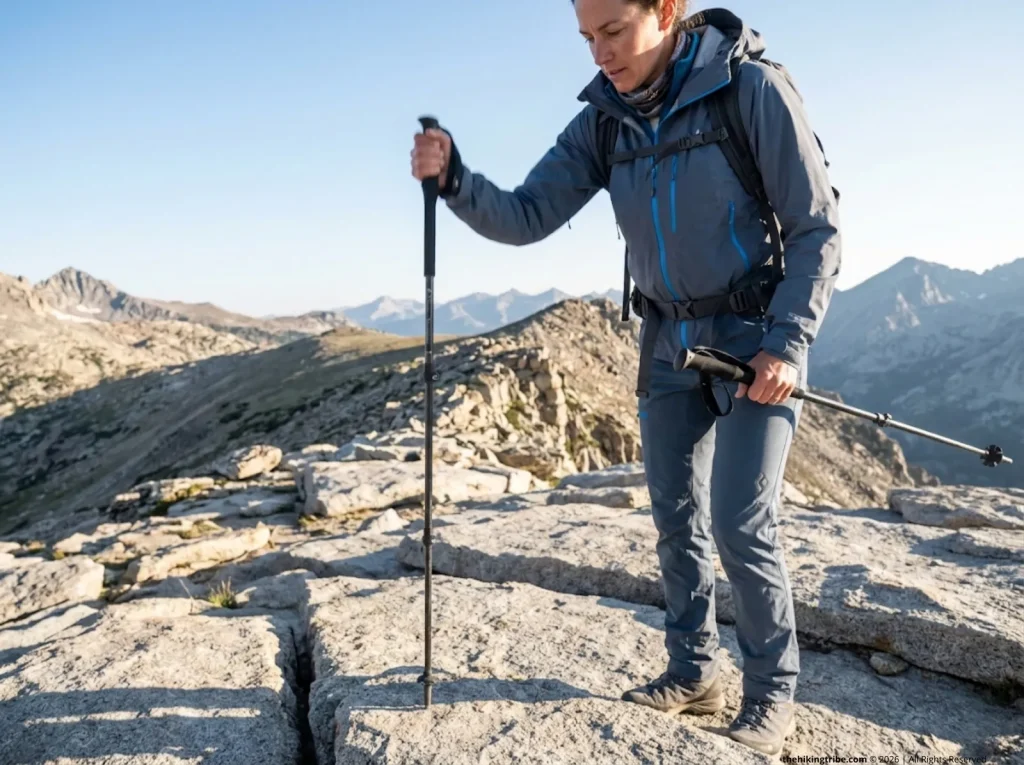
Once the old tip is off and the shaft end is clean, installation is almost too simple. No glue, no special tools beyond a hard flat surface. Scrape any residual adhesive or plastic fragments off the shaft end with your fingernail or a knife edge, then check the shaft for damage — dents, cracks, or oval deformation mean the shaft itself is compromised and no replacement tip will fix that.
Tap, Don’t Jam
Slide the new replacement tip onto the shaft end. It should fit snugly but not go all the way on by hand — that’s by design. Hold the pole vertically with the tip pointing down, then tap the butt end firmly against flat granite or concrete, six times minimum. Each tap drives the tip deeper into a press-fit. No adhesive required. In fact, using glue is the mistake that leads to the saw method on your next replacement cycle — tap-on installation only, every time.
Check the Length Change
Here’s the detail every guide misses. Black Diamond Flex Tips have a longer, narrower profile than most stock original tips. When you swap them onto non-BD poles, you gain approximately 1.5 inches — 3.75 centimeters — of effective pole length. That might not sound like much, but it throws off your muscle memory on descent, and it compounds over a long day of hiking.
Pro-Tip: Swap one tip first. Plant the pole and compare its height to the unchanged pole. If there’s a noticeable difference, readjust your length settings on both before the next hike. That 1.5-inch shift matters most on technical downhill terrain.
After swapping, setting your pole length for uphill and downhill terrain takes about thirty seconds. Make it part of any tip replacement routine.
Carbide vs. Rubber Tips (And the LNT Angle Everyone Ignores)

Every replacement tip guide covers the basic carbide vs rubber question. Very few cover what happens to the trail when you choose wrong.
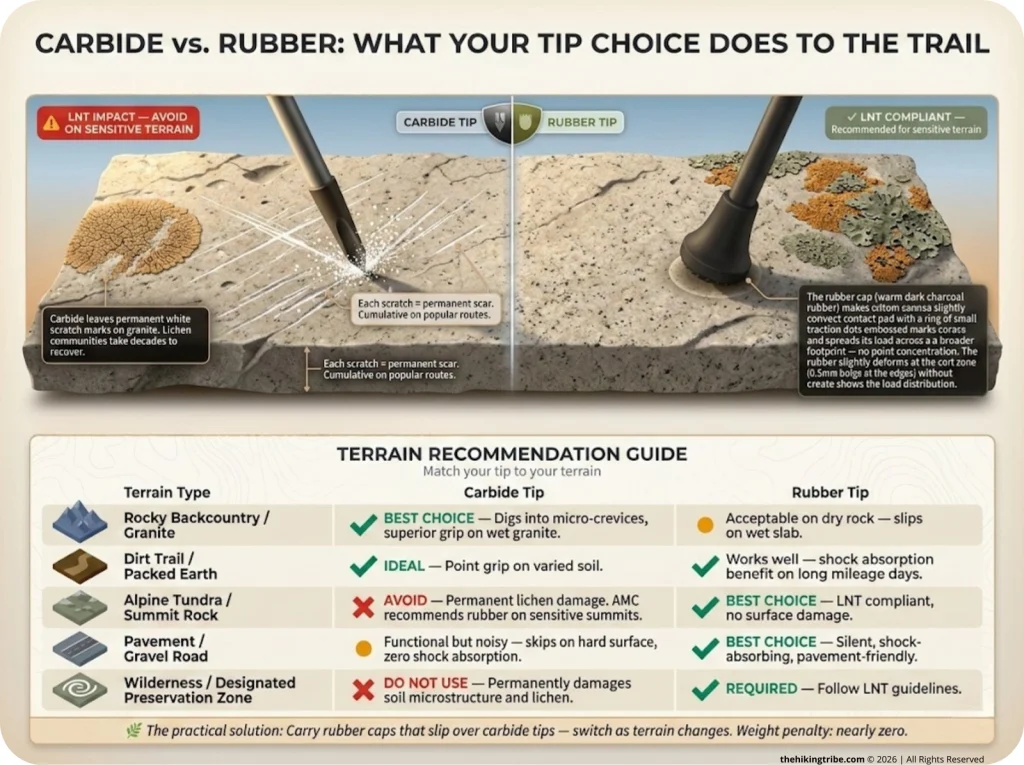
Carbide tips are the default for good reason. They provide reliable grip on dirt, loose rock, and mixed backcountry terrain. On wet granite, the carbide point digs into micro-crevices where a rubber road tip would slide sideways. On technical downhill and steep mixed rugged terrain, carbide is the clear choice for stability.
Rubber tips are better for hard surfaces — pavement, concrete, indoor floors — where carbide just skips and clicks. They absorb shock more effectively and run significantly quieter, which translates to real noise reduction on popular shared trails. The Leki rubber walking tip fits over existing carbide, so you don’t need to choose one permanently. Carry both and swap as the terrain shifts.
The LNT Conversation Most Guides Skip
Carbide tips leave visible white scratch marks on rock slabs. On popular summit rocks, alpine tundra, and desert slickrock, the cumulative scarring from thousands of poles is permanent. The carbide also punches small holes in the soil microstructure and damages lichen communities that take decades to recover. The Appalachian Mountain Club recommends rubber tips as part of LNT best practices for trekking poles on sensitive terrain, and for solid reason.
This is the Leave No Trace equivalent of staying on trail. On sensitive terrain — designated wilderness, heavily used summit routes, paved park paths — switch to rubber. The choice is small, the cumulative impact is not. The same principle behind responsible gear maintenance on the trail applies directly to the two carbide points at the bottom of your poles. And if you’re curious how your boot steps compound the problem, how hiker impact causes trail erosion rounds out the full picture.
Brand Compatibility and Shaft Diameter Guide
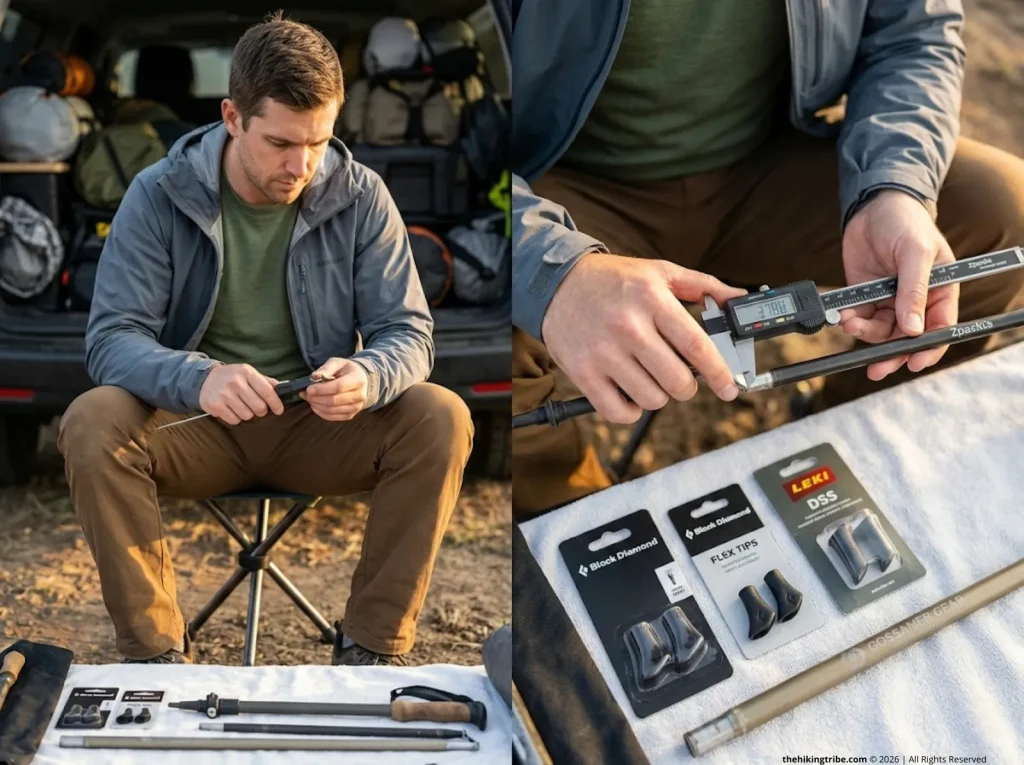
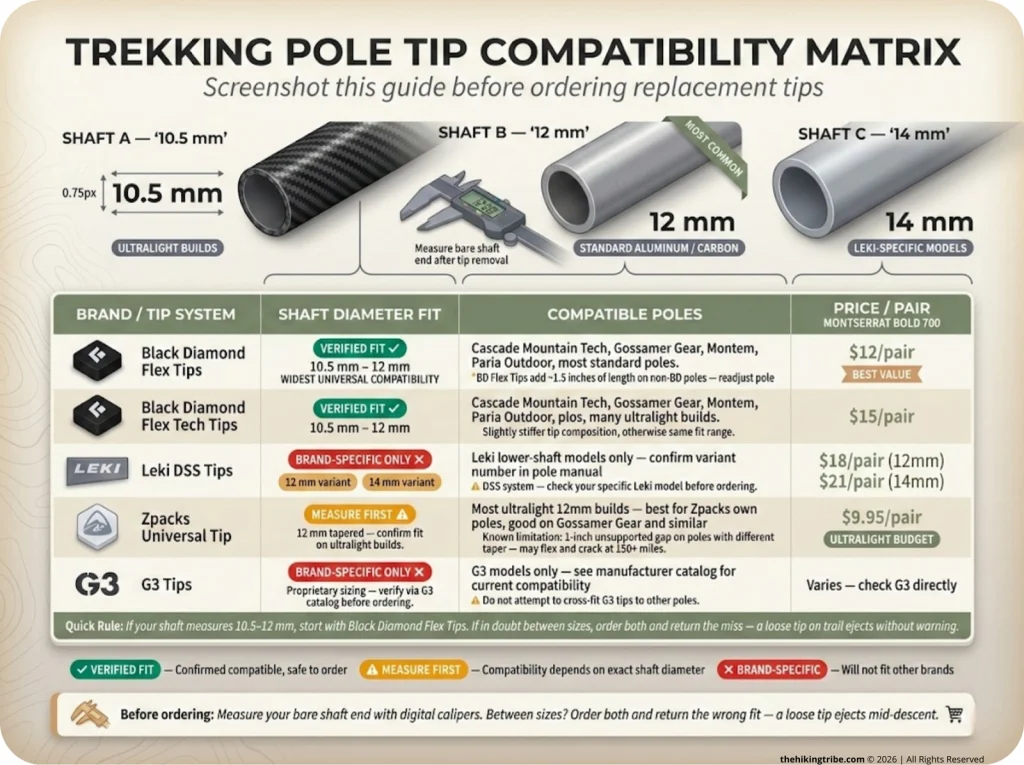
Before you order replacement tips, you need to know your shaft diameter. This is the single most frustrating part of tip replacement, and it causes a surprising number of wrong orders.
How to Measure and What You’ll Find
Use digital calipers on the bare shaft end after the old tip is off. The most common diameters are 10.5 mm for ultralight carbon poles (many Gossamer Gear, Zpacks, and similar ultralight builds), 12 mm for most standard aluminum and carbon poles, and 14 mm for some Leki models. If you’re between sizes, order both and return the one that doesn’t fit — a loose tip will eject on trail, and that’s a problem you don’t want to solve six miles from the trailhead.
Black Diamond Flex Tips and Flex Tech Tips fit a wide range of poles in the 10.5–12 mm range, including Cascade Mountain Tech, Gossamer Gear, Montem, and Paria Outdoor. Leki DSS tips are brand-specific — 12 mm and 14 mm variants match specific lower-shaft diameters. Zpacks sells a universal 12 mm tapered tip for $9.95 that works well on most ultralight builds. G3 uses proprietary sizing; check their catalog directly.
One nuance worth knowing: when you fit Black Diamond Flex Tips onto poles with a slightly different taper, there can be about an inch of unsupported plastic between the tip and where the shaft widens. On high-mileage use — roughly 150 miles or more — that unsupported section can flex and eventually crack. Skurka documented this failure mode on CMT poles in his field notes. It’s not common, but it’s worth knowing before a five-day trip.
Understanding how folding and telescoping poles actually fail gives useful context here — tip compatibility is just one piece of the trekking pole maintenance picture.
The Thru-Hiker’s Tip Repair Kit
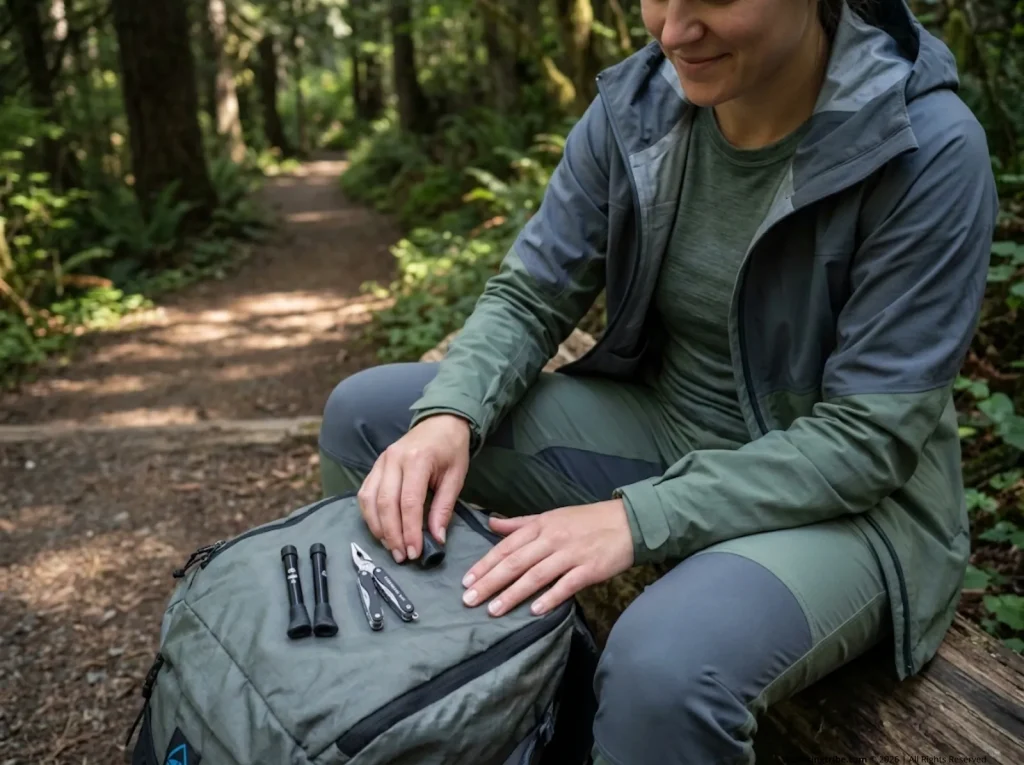
On any trip over 500 miles, carrying a minimal tip repair kit is basic trail sense. The weight penalty is under 2.5 ounces. The upside is never having to hobble out of the backcountry on smooth aluminum nubs.
What Fits in a 2-Ounce Kit
One spare pair of Black Diamond Flex Tips weighs about half an ounce. A compact set of slip-joint pliers adds around 1.5 ounces. Toss in one rubber tip cap for LNT sections or town walks, and you’re done. Pack it in an accessible hip belt pocket or the top lid of your pack — the last thing you want is to unpack everything to find a lost tip at mile 3 of a 20-mile section.
For trail-side replacement when you have no stove available, grip the old tip firmly with pliers and try mechanical force alone. Many non-glued tips release without heat. If you’re stuck and have access to a campfire, hold the tip end close to — not in — the fire for ten seconds, then twist. Tap the new tip on a flat trailside rock. Granite works best. Done.
Building a modular hiking gear repair kit doesn’t require much weight or money. Spare tips, a small tool, and knowledge of the boiling water removal technique covers most long-distance hikers’ field repair situations without carrying anything extra beyond a couple ounces.
Conclusion
Three things matter here. First, the boiling water removal method — 10–15 seconds in a hot pot, pliers gripped low, one clean twist — handles nearly every stuck tip situation. For stubborn glued models, extend to 30–60 seconds or use the saw-slit technique. Second, Black Diamond Flex Tips are the most versatile universal replacement at around $12 a pair, but measure your shaft diameter first and account for the length change before your next hike. Third, carry rubber tips and use them on sensitive terrain. The LNT impact of your tip choice is real, it adds up over thousands of boots and poles on the same routes, and it’s an easy swap to make.
Check your tips at home before the next trip. If the aluminum looks anywhere close to worn, replace them at the kitchen table. A $12 fix now beats a treacherous descent on dead poles later — and keeps the trail looking like it should for the hikers who come behind you.
FAQ
How do you remove stuck trekking pole tips that won’t budge?
Submerge the tip in boiling water for 10–15 seconds to soften the adhesive and plastic, then grip low on the tip with slip-joint pliers and twist firmly. For super-glued carbon poles like some CMT and Zpacks builds, extend to 30–60 seconds. If that still fails, slit the plastic ferrule lengthwise with a dovetail saw and pry it apart with a flathead — this handles the impossible stuck tip without damaging the shaft.
What size replacement tips do I need for my trekking poles?
Measure the bare shaft diameter with calipers at the tip end after removal. Most poles are 10.5–12 mm, which is what Black Diamond Flex Tips are designed for. Leki uses 12 mm or 14 mm depending on the pole model. When in doubt, check your manufacturer’s spec sheet before ordering — a poor fit means a tip that ejects on the trail.
How often should you replace trekking pole tips?
Every 500–750 trail miles on rocky or mixed terrain, and every 300–400 miles on pavement or gravel. Inspect tips at every resupply stop on a thru-hike. If the aluminum housing looks mushroomed or the carbide point wobbles when you push it sideways, replace immediately.
Are trekking pole tips universal across brands?
Not fully. Black Diamond Flex Tips and Flex Tech Tips fit a wide range of poles with 10.5–12 mm shafts, including Cascade Mountain Tech, Gossamer Gear, and Montem. Leki DSS tips are brand-specific. Zpacks sells a reasonably universal 12 mm tapered tip. Always confirm shaft diameter before ordering.
Carbide vs. rubber trekking pole tips — which should I use?
Use carbide for backcountry dirt and rock where grip matters. Use rubber for pavement, indoor surfaces, and ecologically sensitive terrain — alpine tundra, slickrock, heavily trafficked summits — where carbide leaves permanent scratch marks and soil damage. Carrying one set of rubber caps to slip over your carbide tips on town walks and sensitive stretches weighs almost nothing and is the most practical approach for multi-day trips that cross varied terrains.

I've spent more than a decade researching hiking gear and trail technique. I read the specs, the forum threads and the long-term reviews, and every pick here comes with what it gets wrong.
End of the trail
You read every mile of this one. Here's where the trail goes next.