In this article
Pole sizing advice on most gear blogs caps at 125 or 130 centimeters — which quietly sidelines every hiker over six feet. The elbow-at-90-degree rule (the reference every legitimate sizing guide cites) pushes a 6’2″ hiker to 135 cm and a 6’4″ hiker past 140 cm. Buying a pole that doesn’t reach your height isn’t a minor inconvenience; it forces the shoulder to roll forward on every plant, which quietly degrades your gait over a multi-day trip and can aggravate rotator-cuff issues on steep descents.
After cross-referencing the five criteria tall hikers actually care about — maximum extended length, lock-mechanism durability under load, grip ergonomics for longer arm reach, carbide-tip engagement on hard surfaces, and weight-to-rigidity ratio — and confirming verified long-term Amazon review patterns against OutdoorGearLab’s 2026 testing notes, five poles clear the bar. Each pick is paired with the height range it genuinely fits, so a 6’0″ hiker can avoid overbuying and a 6’5″ hiker can skip the two models that won’t extend far enough.
Below: a comparison table for fast scanning, then full reviews that name each pole’s specific flaw. Use these alongside the Naismith’s Rule hiking-time calculator when planning routes — pole sizing directly affects sustained pace on vertical gain.
The 5 Best Trekking Poles for Tall Hikers in 2026
Organized by body type and trail profile — not by brand cachet. The Best Overall is the trail-day pick for most 6’0″-6’2″ hikers; the Best Value proves a 137 cm reach doesn’t require spending $200; the Alpine/140 cm pick is where mountaineering demands enter the equation; the Heavier-Hiker pick handles body weight over 200 lb where cheaper carbon shafts start flexing; and the Honorable Mention earns its slot on pure Z-fold packability for travel. Each review includes the specific flaw the pole carries — generic “pros-only” reviews are why most hikers end up with poles that don’t fit them.
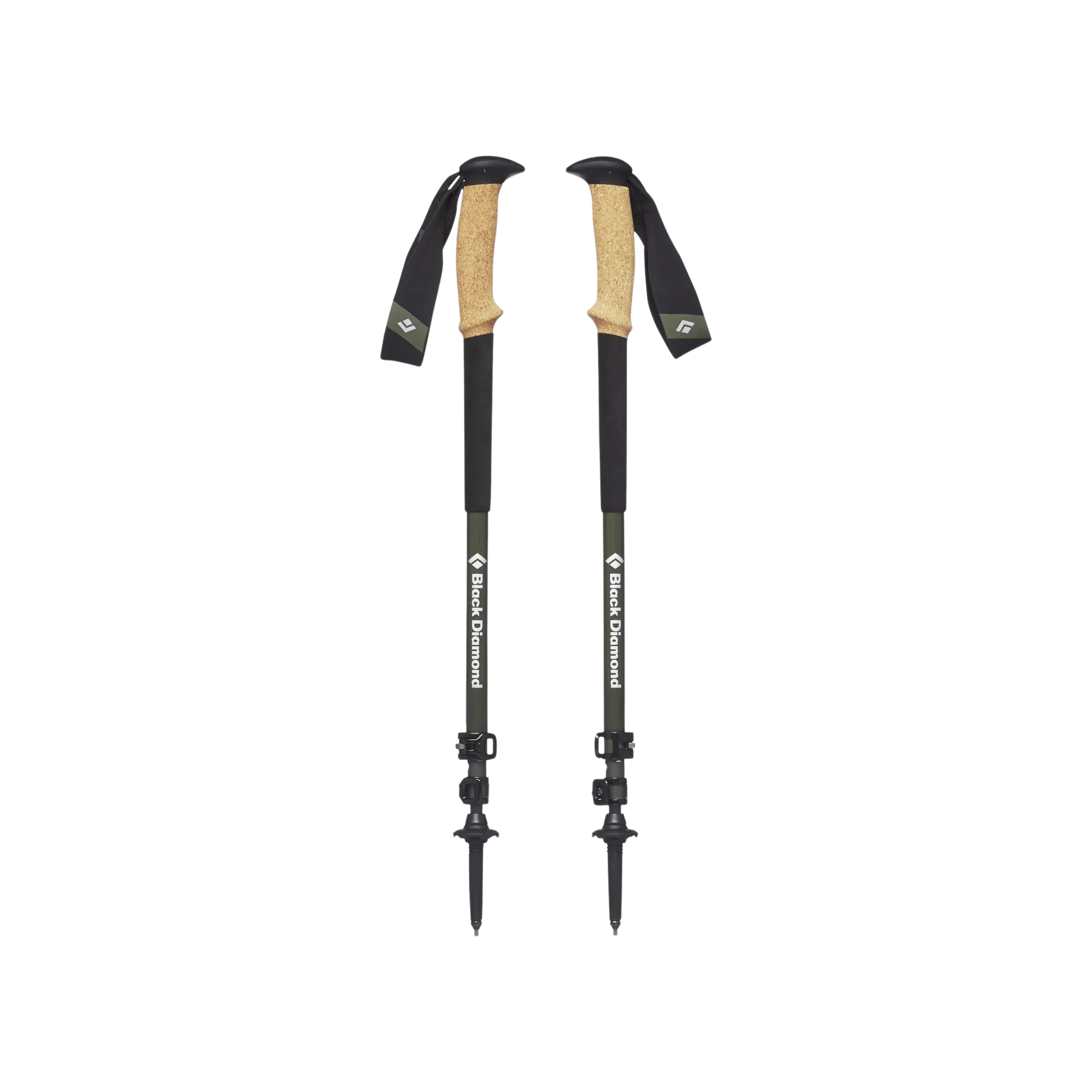
1. Black Diamond Alpine Carbon Cork — Best Overall (6’0″-6’2″)
OutdoorGearLab’s 2026 round-up ranked the Alpine Carbon Cork as one of the top poles tested for durability and overall trail versatility — and for hikers in the 6’0″-6’2″ range, the 130 cm max extension is enough. The cork handle molds to the hand over the first 30-40 trail miles, which matters more than it sounds — as you climb, sweat softens the cork’s surface and the grip progressively shapes to your palm’s natural creases. Synthetic grips never do this. The wrist straps are wide, padded, and handed (left vs. right), which most competitors skip.
The FlickLock Pro mechanism is the real separator. It’s entirely metal, and verified long-term owners report no slip on loaded descents after hundreds of trail miles — the failure mode that plagues plastic twist-lock poles. At 17 oz per pair, the Alpine Carbon Cork sits mid-pack on weight; lighter poles exist but give up lock durability.
The honest flaw: the FlickLock Pro tension is adjusted with a very small Allen key, which makes on-trail adjustments impossible if you didn’t pack the tool. If you haven’t set the lock tension correctly before the hike and the lock starts slipping mid-descent, your only option is stopping and waiting for help. Carry the Allen key — Black Diamond does not ship a spare.
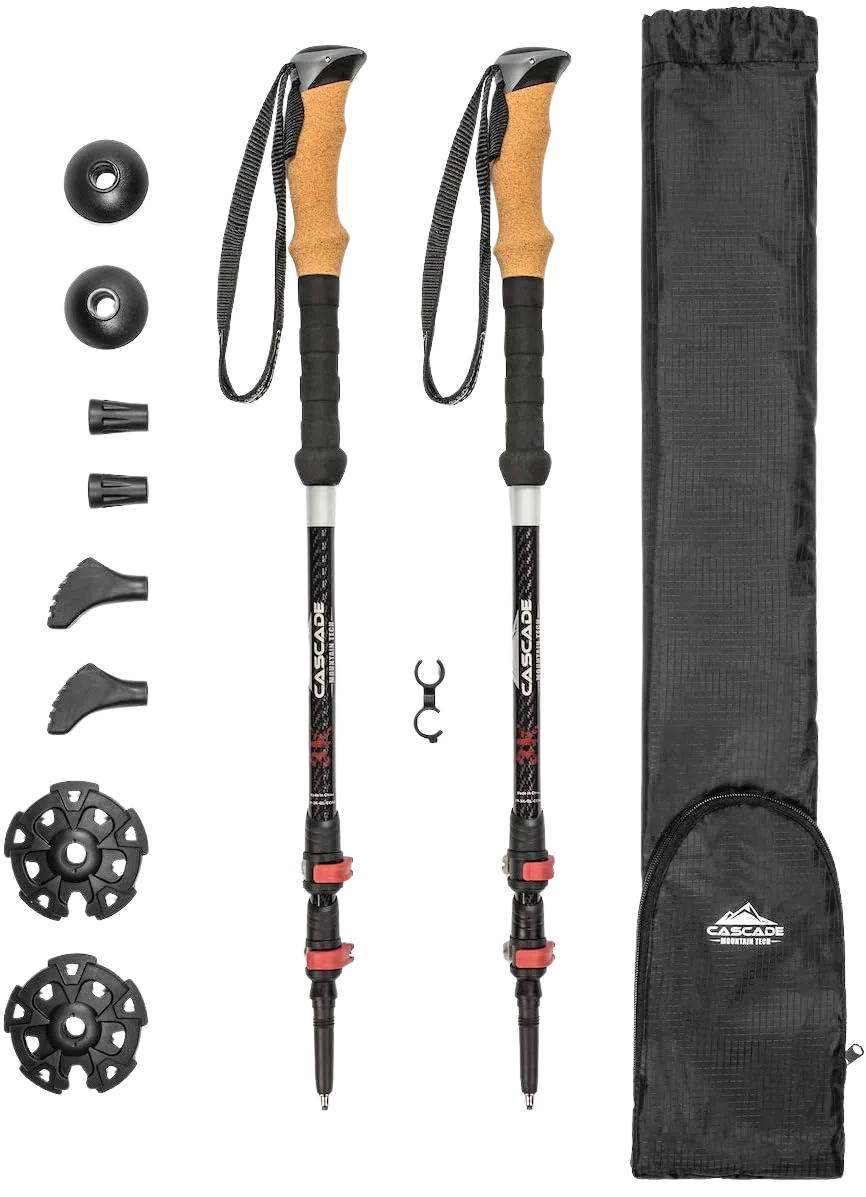
2. Cascade Mountain Tech 3K Carbon Fiber — Best Value (6’0″-6’3″)
The Cascade Mountain Tech 3K Carbon earns this slot by delivering a 26-54 inch (~66-137 cm) adjustment range at a street price under $80 — which is roughly one-third of the Black Diamond. For a hiker in the 6’0″-6’3″ range whose pole budget is shaped by loss risk (left at a trailhead, sat on in a tent, snapped between rocks), the Cascade is the smart pick. 2×2 twill carbon fiber is stronger than standard unidirectional carbon and handles lateral impact better, which is the failure mode that kills cheap carbon poles.
Verified Amazon reviewers consistently call out the quick-lock mechanism as “easy to use and reliable” and the cork grips as “comfortable with lower vibration.” Cascade also ships a bonus tip kit with snow baskets, sand/mud baskets, rubber boot tips, and a carry bag — accessories that cost $30-$50 separately from premium brands. At 8 oz per pole, these are closer to ultralight carbon weights than the Alpine Carbon Cork.
The flaw: the quick-lock external cam isn’t as robust as Black Diamond’s FlickLock Pro. After a year or two of heavy use, verified reviews report the lock starting to slip under full body weight on descents. The fix is tightening the cam screw — but unlike the Alpine Carbon Cork’s Allen-key system, this mechanism wears faster because it’s made of plastic-over-metal rather than all-metal construction. Treat as a 2-3 season pole, not a decade pole.
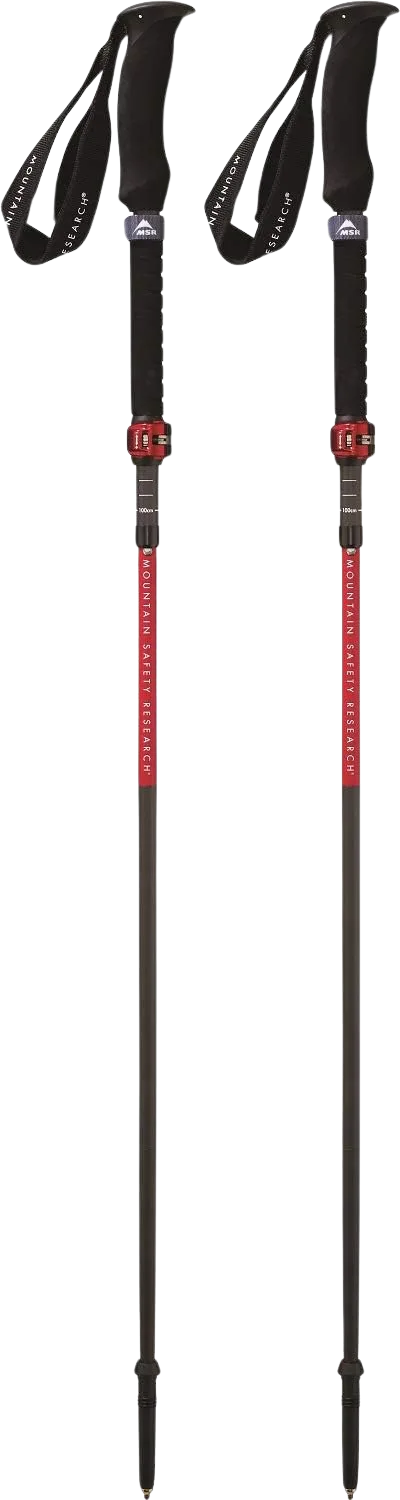
3. MSR DynaLock Ascent Carbon (Large, 120-140 cm) — Best for Alpine + 140 cm Max Length
The MSR DynaLock Ascent Carbon Large is one of the few poles on the market where 140 cm is genuinely achievable in the Large size variant — most “tall” poles quietly cap at 135 cm or 137 cm. For hikers 6’3″+ who need the full 90° elbow reach, this is the practical answer. OutdoorGearLab noted the DynaLock Ascent Carbon as a top recommendation for its dual-purpose design: long enough for tall hikers, collapsible enough (17.5 inches folded) to fit inside alpine packs and travel bags.
The shaft is Kevlar-reinforced carbon fiber — genuinely different from standard carbon in impact resistance, which matters when you’re planting hard on frozen ground or rock. The DynaLock mechanism offers tool-free tension adjustment (no Allen key needed) and 20 cm of pole length adjustment, which is more than the typical 15-20 cm window of competitors. EVA foam grips include an extended lower grip for multi-hand placement — useful on steep traverses where you need to choke up on the shaft without readjusting the wrist strap. Review good practice for glacier travel and alpine-access techniques that these poles were built for in the glacier-rope-up protocol.
Pro tip: On alpine approaches, swap the trekking baskets for the included snow baskets before you leave the trailhead. Ascent carbon poles plant hard — if the tip penetrates soft snow past the basket, you lose the support and can twist an ankle in the recovery step. The basket swap takes 15 seconds and has saved real injuries.
The flaw: at $200+ retail, the DynaLock Ascent Carbon is the most expensive pick on this list. For a hiker who doesn’t do genuine alpine or winter mountaineering, the premium buys you capabilities you won’t use. Day hikers 6’3″+ without winter exposure get most of the value at half the cost from the Cascade or BD Trail Ergo Cork.
4. Black Diamond Trail Ergo Cork — Best for Heavier Hikers and Big Loads
The Trail Ergo Cork is the pole verified Amazon reviewers recommend for body weights over 200 lb — one reviewer specifically notes they work “fabulously” for someone at 220-230 lb on loaded descents, which is the condition where budget carbon poles genuinely bend or snap. The ergonomically-angled cork grips are a specific design choice for heavier hikers: the angle reduces wrist cocking on the power-plant, which over a multi-day trip reduces forearm fatigue that compounds with every pole plant. It’s the pole to buy if you’re 6’0″+ and also carrying a 40-lb pack on multi-day routes.
The Trail Ergo Cork is aluminum, not carbon — which is specifically what you want for sustained heavy-load hiking. Aluminum flexes and returns; carbon under extreme repeated stress can develop hairline fractures that propagate catastrophically. At 18 oz per pair, these are heavier than the Alpine Carbon Cork by about 1 oz, which you’ll notice over a 20-mile day but not over a 5-mile day. The FlickLock Pro mechanism is the same metal-on-metal reliability as the BD Alpine.
The flaw: the Trail Ergo Cork collapses to a minimum size of 27 inches, which doesn’t pack down small enough to fit inside most external pack storage. If you’re a backpacker who stows poles inside the pack during Class 3 scrambles, these won’t fit — they strap to the outside. Verified reviewers consistently flag this. Also, at 18 oz, these are not the pole for ultralight-focused thru-hikers counting every ounce.
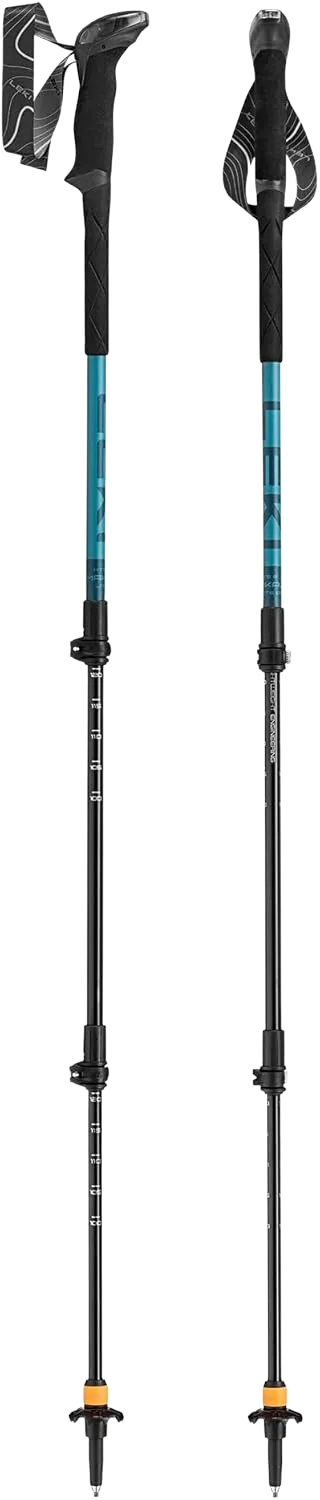
5. Leki Makalu Lite AS — Honorable Mention (Z-Fold Packability)
The Makalu Lite AS earns its slot for one specific use case: travel. The telescoping adjustment (100-135 cm) covers the mid-tall range, the Aergon Air grip reduces hand fatigue on long days, and the Anti-Shock system (the “AS” in the name) absorbs repeated hard plant impact on rocky trails. Speed Lock 2 Plus allows tool-free adjustment. Max length of 135 cm puts this in range for hikers up to 6’2″ and marginal for 6’3″.
How to Choose Trekking Poles for Tall Hikers
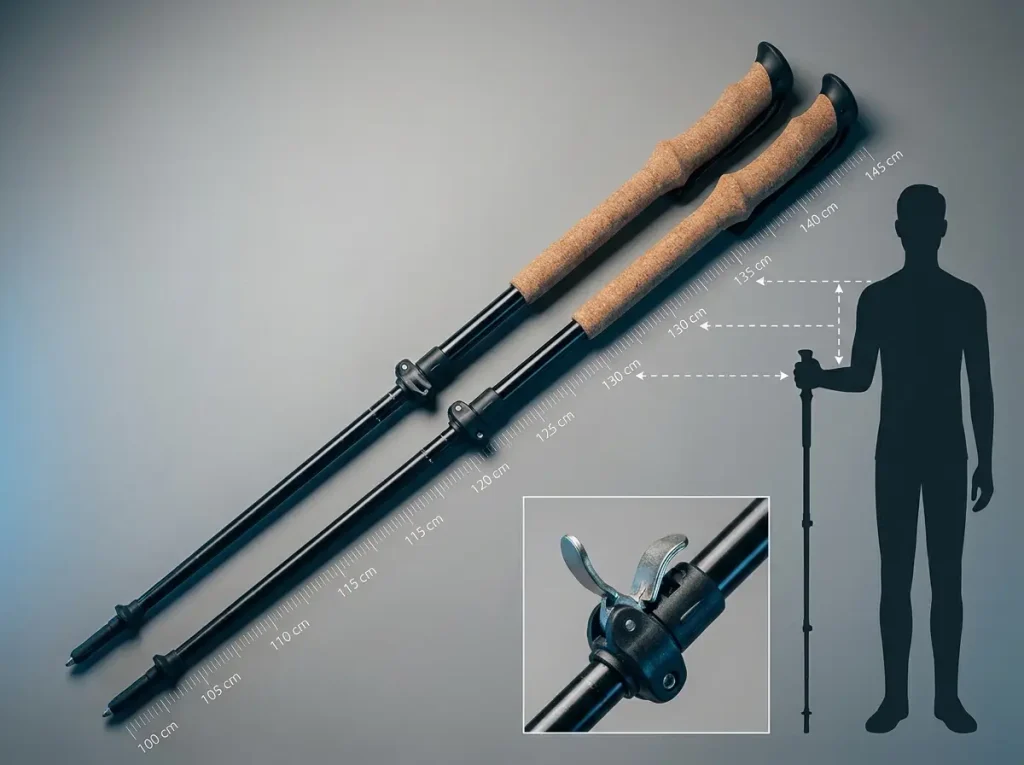
Most pole-sizing guides collapse to “pick one that extends to your elbow at 90 degrees.” That’s right but incomplete — for tall hikers, four other specs actually determine whether a pole works for you.
Pole Length Math — The 90-Degree Elbow Rule Applied to Tall Hikers
Stand upright in your hiking shoes. Bend your elbow to 90 degrees so your forearm is parallel to the ground. The distance from the ground to your hand is your baseline pole length. For average hikers, this translates to 5’6″-5’9″ = 110 cm, 5’10”-6’0″ = 120-125 cm, 6’0″-6’2″ = 130 cm, 6’2″-6’4″ = 135 cm, 6’4″+ = 140 cm. Subtract 5-10 cm for sustained climbs; add 5-10 cm for sustained descents. If your pole tops out below this baseline, your shoulders will compensate and your upper body will fatigue. Not speculation — biomechanics.
Lock Mechanism — Why It Matters More for Tall Hikers
Tall hikers plant with longer moment arms, which means more leverage on the locking mechanism during load-bearing moments like descending a staircase or stabilizing on loose rock. A plastic twist-lock that handles a 5’8″ hiker’s plant force will slip under a 6’3″ hiker’s equivalent load. The three mechanisms that actually hold up: FlickLock Pro (Black Diamond, all-metal), DynaLock (MSR, metal-reinforced), and Speed Lock 2 Plus (Leki, proprietary). Avoid twist-locks and plain plastic cam levers for sustained use at tall-hiker leverage.
Grip Ergonomics — Cork, Foam, and Angled Designs
Cork grips break in to your hand over the first 30-40 trail miles — they start stiff and progressively soften and shape. Foam (EVA) grips are consistent from day one but never mold to you. Angled grips (like the Trail Ergo Cork) reduce wrist cocking on the power-plant and matter especially for tall hikers who plant with more leverage. For day hikers: foam is fine. For anyone doing 10+ mile days: cork. For heavy-load backpackers: angled cork.
Shaft Material — Carbon vs. Aluminum Under Load
Carbon is lighter and absorbs impact vibration better on rocky trails. Aluminum flexes under load and returns predictably — the failure mode of aluminum is a visible bend, while the failure mode of carbon is a hidden hairline crack that eventually snaps under load. For tall hikers over 200 lb, aluminum is the conservative choice. For tall hikers under 180 lb with moderate loads, carbon’s weight savings are worth the tradeoff.
Pro tip: When you hike above treeline on exposed ridges, inspect your carbon shafts for hairline cracks at the joint above each lock. The joints are the stress concentration points. Any visible fracture means retire the pole — carbon fails suddenly without warning once a crack starts propagating.
When Trekking Poles Become a Liability
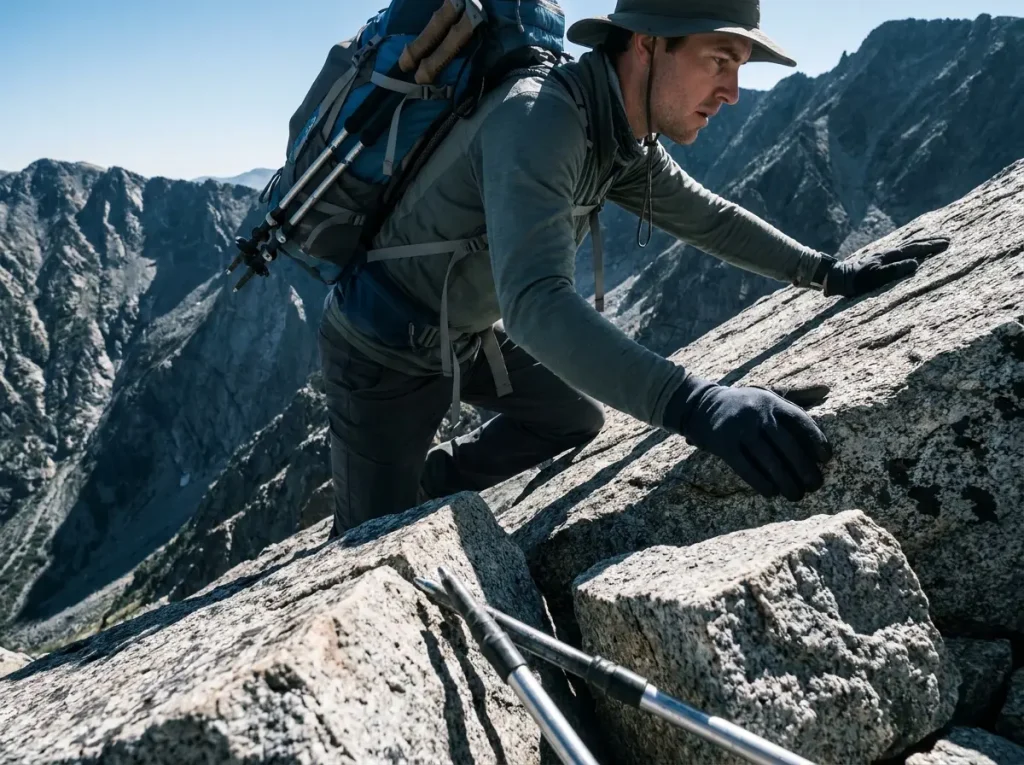
Poles solve problems. They also create problems when used past their usable domain.
Class 3 scrambling terrain. When you need both hands on rock — friction palming, crimping edges, working horizontal traverses — poles become dangerous. They can catch between rocks and torque your wrist on a fall, or prevent you from making a clean hand-to-rock transition. Stow them on your pack before entering scrambling terrain. The turnaround-time decision framework should include “poles stowable and accessible” as a checkpoint for the route.
Stream crossings on wet rock. Polished wet granite is one of the most unpredictable surfaces for pole tips — carbide engages well on dry rock but can skate on wet polished surfaces. This is terrain where hands-on-rock beats pole-on-rock by a large margin. Stow and go four-point.
Narrow brushy trail corridors. On overgrown trails, poles snag. What saves you on open trail becomes a continuous irritation where every third step catches on a branch. If you hike narrow brushy routes regularly, fold-collapse poles (Leki Makalu Lite, BD Distance) win over telescoping ones.
Fast ultralight trail running. Below ~130 bpm heart rate and rolling terrain, poles can speed you up. Above that, the arm-swing mechanics actually slow you down. Ultralight runners typically skip poles entirely or carry only one in steeper sections.
Warranty and Lifetime Value for Tall-Hiker Poles
Long-term pole math matters because tall-hiker geometry stresses the locking mechanism more than average. Warranty coverage represents how confident the manufacturer is that their lock holds up.
- Black Diamond Alpine Carbon Cork + Trail Ergo Cork: 1-year warranty on defects. BD has a reputation for replacing anything that fails under reasonable use beyond that — not a written policy but a documented customer-service pattern.
- Cascade Mountain Tech: 1-year limited. Honest match for the price point.
- MSR DynaLock Ascent Carbon: 3-year limited. Kevlar-reinforced carbon is warrantied against fracture.
- Leki Makalu Lite AS: 1-year manufacturer warranty with optional extended-coverage program.
Net practical read: for tall hikers, the two Black Diamond picks (Alpine Carbon Cork and Trail Ergo Cork) carry the strongest real-world long-term coverage through customer service, even though the written warranty is shorter than MSR’s. MSR’s 3-year on the Kevlar shaft is the most explicit protection for carbon-fiber tall-hiker durability.
Conclusion
Three takeaways that should drive your pick:
Match pole length to your actual height — not to the brand marketing. For 6’0″-6’2″ hikers, any of our five picks work; for 6’3″+ hikers, only the MSR DynaLock Ascent Large and BD Trail Ergo Cork truly extend to the 90° elbow position.
Match shaft material to your body weight and load profile. Aluminum (Trail Ergo Cork) for 200+ lb hikers and heavy packs. Carbon (Alpine Carbon Cork, Cascade, MSR) for lighter loads where weight savings matter.
Match lock mechanism to your planting force. Tall-hiker leverage breaks plastic twist-locks. FlickLock Pro, DynaLock, and Speed Lock 2 Plus are the three mechanisms that genuinely hold up. The Cascade Mountain Tech earns its value slot but expect to treat it as a 2-3 season pole, not a decade-long pair.
Q1 What pole length do I need if I’m 6’3″ tall?
A 6’3″ hiker needs a pole that extends to approximately 135-140 cm for the 90-degree elbow position on flat ground. Subtract 5-10 cm for sustained climbs and add 5-10 cm for sustained descents. Poles that max out at 130 cm will force your shoulders forward on every plant and cause fatigue on multi-day hikes.
Q2 Are carbon or aluminum trekking poles better for tall hikers?
Carbon is lighter and absorbs vibration better; aluminum is more predictable under load and better suited to hikers over 200 lb with heavy packs. For day hikes and moderate loads at tall-hiker height, carbon wins on ounce savings. For backpacking with 40+ lb packs, aluminum is the conservative choice — aluminum bends visibly while carbon can fail suddenly.
Q3 Do I really need trekking poles if I’m a tall hiker?
Trekking poles reduce knee joint force by 15-25% on descents, which matters more for tall hikers because the longer leg moment arm translates to higher per-step impact. The research on joint-impact reduction is consistent. Poles are not required, but the joint-preservation math favors using them on any hike over 5 miles with elevation change.
Q4 How much should I spend on trekking poles as a tall hiker?
Budget $60-$90 for a 2-3 season pair (Cascade Mountain Tech), $150-$200 for a long-term daily-driver (Black Diamond Alpine Carbon Cork or Trail Ergo Cork), $200-$250 for alpine-capable poles (MSR DynaLock Ascent Carbon). Tall-hiker leverage breaks cheap locks faster — sub-$40 poles rarely last a full season under 200+ lb hikers.
Q5 Can women over 6 feet tall use these same trekking poles?
Yes — tall women can use the same poles featured here. Most brands make gender-specific versions, but for tall women (6’0″+), the standard or Men’s versions typically offer the length extension needed. Women’s-specific versions often cap at 125 cm, which is too short for the 90-degree elbow position at 6’0″+ heights.
Risk Disclaimer: Hiking, trekking, backpacking, and all related outdoor activities involve inherent
risks which may result in serious injury, illness, or death. The information provided on The Hiking Tribe is for
educational and informational purposes only. While we strive for accuracy, information on trails, gear, techniques,
and safety is not a substitute for your own best judgment and thorough preparation. Trail conditions, weather, and
other environmental factors change rapidly and may differ from what is described on this site. Always check with
official sources like park services for the most current alerts and conditions. Never undertake a hike beyond your
abilities and always be prepared for the unexpected. By using this website, you agree that you are solely
responsible for your own safety. Any reliance you place on our content is strictly at your own risk, and you assume
all liability for your actions and decisions in the outdoors. The Hiking Tribe and its authors will not be held
liable for any injury, damage, or loss sustained in connection with the use of the information herein.
Affiliate Disclosure: We are a participant in the Amazon Services LLC Associates Program, an
affiliate advertising program designed to provide a means for us to earn advertising fees by advertising and linking
to Amazon.com. As an Amazon Associate, we earn from qualifying purchases. We are also an official affiliate partner
of Black Diamond Equipment via the AvantLink network. If you click on a Black Diamond affiliate link and make a
purchase, we may earn a commission at no additional cost to you. We also participate in other affiliate programs and
may receive a commission on products purchased through our links. Additional terms are found in the terms of
service.