








You step over a pile on the trail, and you notice steam still rising into the cool morning air. That isn’t just a mess on the ground. It is the best news report the forest can give you—the trail’s newspaper. It screams that a large animal is only minutes ahead of you.
Most hikers walk right past this clue. They don’t see the difference between a harmless white-tailed deer crossing and a mountain lion marking its territory.
I have spent decades teaching students how to read the ground. I can tell you that the trail is like a wildlife awareness dashboard. It tells you exactly what is moving around you and how you should react. This guide will help you turn that overlooked detail into a real skill. We will move past simple curiosity and learn the scat identification techniques that separate a wild dog from a gray wolf, and how to use freshness to keep yourself safe.
How Do You Distinguish Between Predator and Prey Scat?
Before you worry about exactly which animal left the pile, you need to figure out one big thing. Is this creature looking for grass, or is it looking for meat? The answer is usually right there in the shape, a method known as morphological identification.
What Do Shape and Ends Reveal About Diet?
Start by looking at the general form. Animals with simple stomachs—like black bears, raccoons, and humans—usually make tubular scat. On the other hand, ruminants like mule deer and elk need to save water. This creates hard, round objects known as pellet-shaped scat.
You should also look at how solid it is. If it looks like a twisted rope-like cord or a rope with distinct sections, it often means the animal is good at absorbing water, like a cat. If it looks like a loose plop or patty, the animal might be eating a lot of fruit or digesting its food very quickly.
The best way to tell them apart is to look at the scat diameter. Length changes based on how much they ate, but the width is limited by the animal’s body size. To get specific, you can look at detailed measurements for scat diameter and morphology. These guides from university programs give you the exact numbers to help you rule out certain animals.
Wildlife Scat Identification Guide
A field comparison of trackable signs, dietary markers, and encounter risk levels.
Shape & Ends
Tubular, segmented, or rope-like cords. Ends are Tapered/Pointed, a result of hair pulling through the sphincter.
Primary Content
Consists of Hair, Bone fragments, Feathers, and Scales depending on the prey type.
Shape & Ends
Pelletized (spheres or ovals). Can appear as amorphous clumps in summer. Ends are rounded, dimpled, or flat.
Primary Content
Fibrous Plant Matter, lignin, or material resembling sawdust.
Shape & Ends
Large tubular or loose “Plops” (cow-pie style). The ends are typically Blunt or Flat.
Primary Content
Highly varied: Seeds, Berry skins, Nut shells (Mast), and Insect parts.
Shape & Ends
Small tubular shapes, often found as broken chunks with blunt ends. Frequently found in “latrines.”
Primary Content
Mixed debris including Berries, Corn, Human Trash, and assorted organic waste.
Once you check the shape, look at the ends of the scat. This is the “Pointy End” rule. If it has tapered ends, that is usually animal hair being pulled through. That signals a predator.
If the ends are blunt ends or flat, the animal is likely eating plants. Vegetation doesn’t have the hair or bone fragments needed to twist the ends. This points toward herbivores or omnivores.
Pro-Tip: If the scat is dense and features deep fissures creating a “beaded” look, you are likely looking at the “Segmentation Signature” of a wild felid. This binary assessment—Predator vs. Prey—is the foundation of the hiker’s natural navigation guide, allowing you to assess risk before you even identify the animal.
How Can You Identify Big Game and Predator Scat?

Once you know if you are looking at predator scat or prey scat, you can start narrowing down exactly who left the sign. Here is a species-specific breakdown of the most common tracking families you will see on the trail.
How Do You Tell Black Bear and Grizzly Scat Apart?
Look at the size of the pile first. Black bear scat is usually about 1 to 1.5 inches wide. Grizzly bear scat is often huge, usually over 2 inches wide.
You also have to watch out for the seasons. Bear scat changes throughout the year. In the spring, it looks like fibrous plugs. In the summer, when they eat berries, it looks like loose cow pies.
Take a close look at the scat contents. If you see seeds, fruit skins, or chewed-up grasses, you know they are eating plants. You can also check the color. Black scat might indicate meat, while brown scat or tan scat often points to fiber. Bear scat often turns a light straw color after sitting in the sun, even if the inside is still dark.
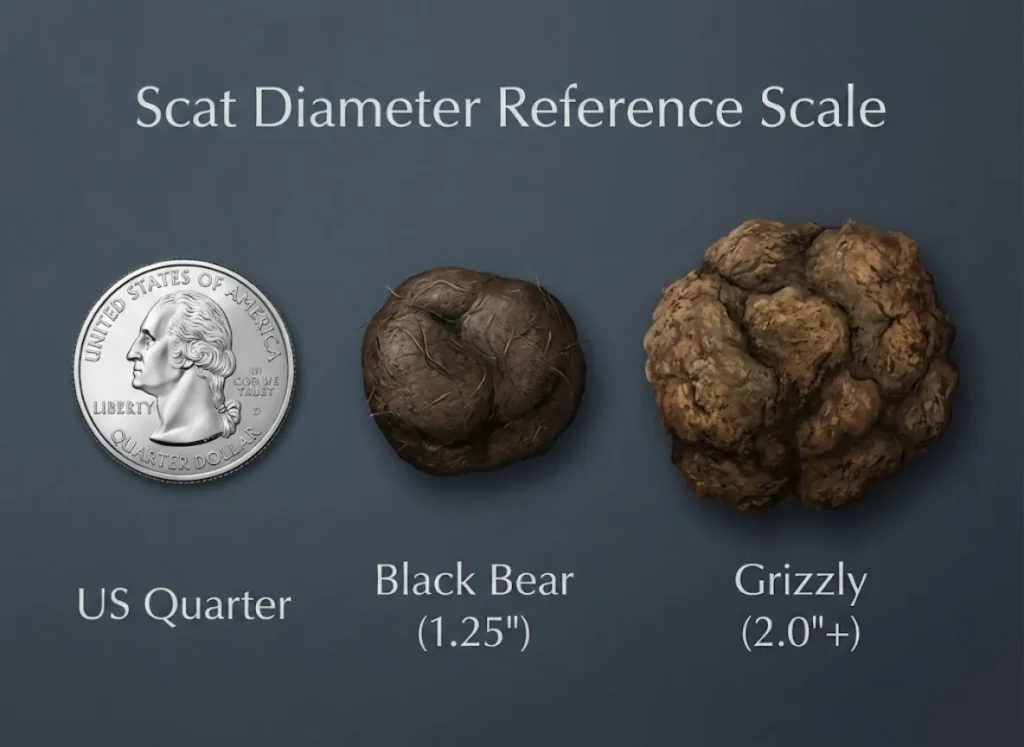
For a closer look, search for signs of meat eating. If the scat has big bone fragments, fish scales, or lots of dug-up roots, it is more likely to be a Grizzly. This matches the rules for identifying grizzly versus black bear sign set by bear experts. Grizzlies are stronger diggers and hunt large animals more often than Black Bears.
Also, look for the “Poop Castle.” This happens when a bear stays in one spot and leaves multiple piles of different ages. It signals a feeding hub or a day bed. If you are on one of the best day hikes in Glacier National Park, spotting these hubs helps you avoid surprising a nuisance bear.
Is That Mountain Lion or Bobcat Sign?
Cat sign is hard to find, but it looks very distinct. Look for that “beaded” look we mentioned earlier. Wild felids leave scat that is very dense, dry, and segmented.
You can tell them apart by size. Mountain lion (or cougar) scat is about the size of a human wrist (over 1 inch wide). Bobcat scat is much smaller, closer to the size of a cigar or a Tootsie Roll.
Check the contents for signs of a pure meat diet. You will see packed hair and bone chips, but no grass or berries. Unlike the twisted ends of dog scat, cat scat often has blunt or flat ends between the segments.
Context is also a big clue. Look around for “Scrapes.” This is where the cat has raked pine needles or dirt into a pile for territory marking. The Mountain Lion Foundation notes that these scrapes are clear evidence of a lion’s presence. A fresh scrape with scat on it is a warning sign. It means the cat is active right there. If you see this, you need to switch gears and use the safety tips found in a hiker’s emergency guide.
How Do You Differentiate Wolf, Coyote, and Fox Scat?
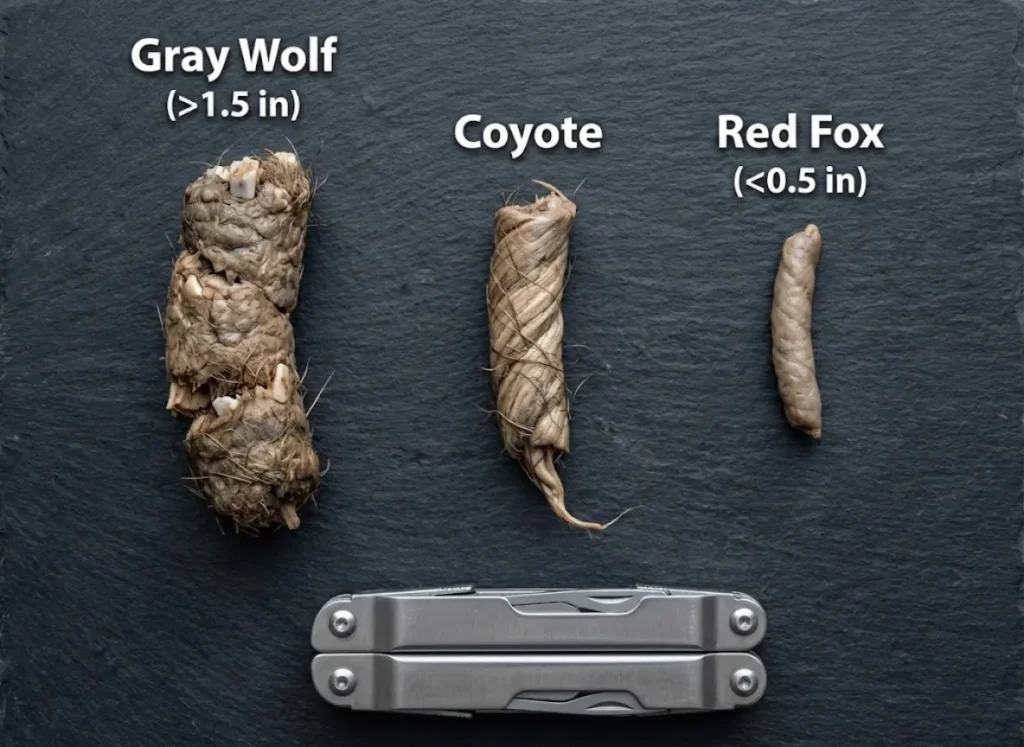
Wolves and dogs use the same trails we do. To identify them, look for the “Canid Taper.” These are tubes that end in a twisted, drawn-out point. This shape is created by hair.
You can tell them apart by size. Gray wolf scat is massive (over 1.5 inches wide) and is often mistaken for bear scat. Coyote scat is medium-sized. Red fox or gray fox scat is the smallest, usually just half an inch wide.
Check for bones. Wolf scat often has large, sharp bone shards because they have powerful jaws. Coyotes cannot crush bone like that. For help spotting the difference, the Iowa DNR has a guide on canid identification: wolves vs. coyotes.
You can also (carefully) smell it. Fox scat has a very distinct, skunky, musky odor—similar to their cousins the fisher, mink, and weasel. It smells sharper than the flat smell of dogs or coyotes. Just be careful near trailheads. “Urban Coyotes” might eat trash or pet food, which makes their scat look crumbly and grain-filled, just like a pet’s.
Pro-Tip: If you are hiking with your dog: a system for gear, safety & rules, keep them away from wild canid scat. It acts as a vector for diseases like Parvo and parasites that can easily transfer to your pet.
What Does Seasonal Ungulate Scat Look Like?
Most hikers know what deer poop looks like in the winter. It comes in hard, distinct pellets. White-tailed deer pellets are oval or bullet-shaped. Moose pellets are much larger and look a bit like chocolate-covered almonds.
But you have to watch out for summer changes. When these animals eat lush, wet grass, it acts like a laxative. The distinct pellets turn into soft clumps or “patties” that look more like cattle manure.
If you look closely at winter pellets, you might see a nipple-dimple shape—a small point on one end and a dent on the other. This happens when the pellets press against each other inside the animal. In the Southwest, you might also find javelina, desert bighorn sheep, or burro scat, which share similar pellet characteristics but often in different pile configurations. The New Hampshire Fish and Game Department has a great ungulate scat identification card to help you visualize this.
Knowing these signs helps you track game on USA bucket list hikes: ranked by skill & prep needed, where spotting a Moose or Elk is often the highlight of the trip.
How Does Scat Freshness Determine Trail Safety?

Knowing the animal is only half the battle. To be safe, you need to know when the animal was there, a process called temporal identification. This is where tracking turns into timing.
What Do Steam and Shine Tell You About Proximity?
Check the heat first. If the fresh scat is steaming, the animal is likely within 15 minutes of you. That is a clear “Stop” signal on the freshness-to-action scale.
Next, look for shine or moisture. Fresh scat has a wet, glossy coating. In dry air, this coating gets dull within an hour or two. This gives you a rough 2-hour safety window.
Look at the bugs. Presence of flies might occur in minutes, but if you see eggs or hatched maggots, the pile has been there for 12 to 24 hours. That is a “Cold” trail.
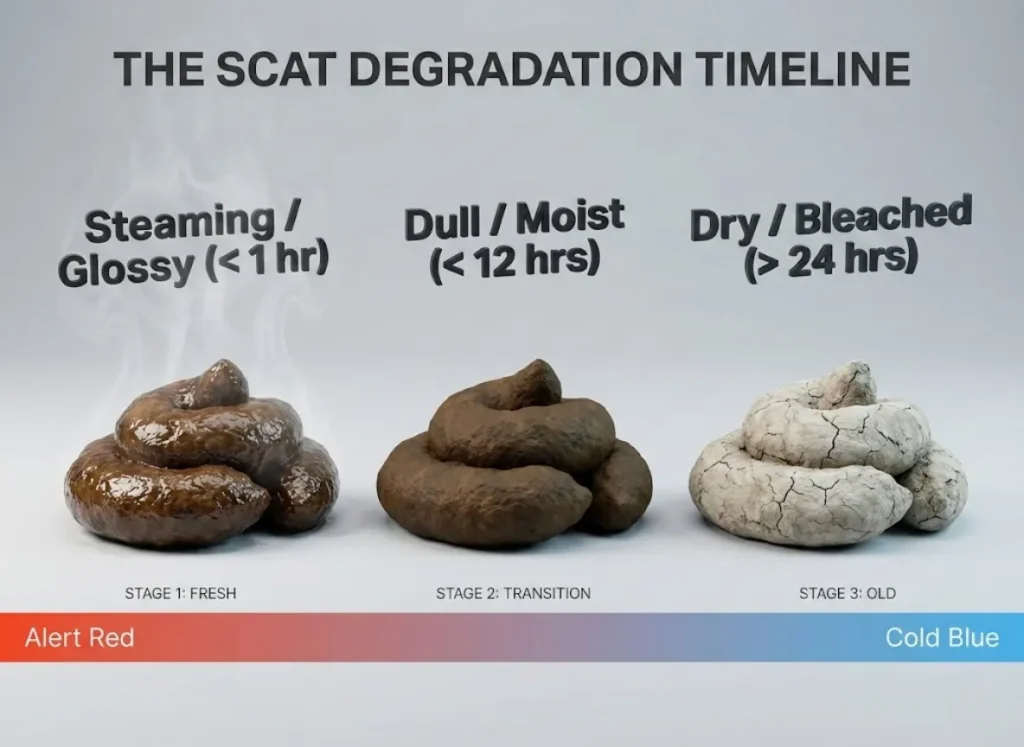
You also have to think about the weather. Sun and wind turn it into dry scat rapidly. A moist pile sitting in the open sun is much fresher than a moist pile hiding in the shade.
If you find fresh predator sign, you need to react. According to bear safety protocols for hikers, you should group up, make noise, and get your bear spray ready. This safety response protocol should be as automatic as carrying the gear listed in the 10 essentials explained: a day hiking checklist.
When Does Scat Become a Biohazard?
Freshness tells you about physical safety, but even old scat has invisible dangers.
Watch out for latrines, especially from Raccoons. Their roundworm eggs can live in the soil for years. The CDC warns that raccoon roundworm infection risks are serious and can cause brain damage if you accidentally ingest the eggs.
Be careful with dust in enclosed spaces like shelters or cabins. Droppings from mice, rats, or voles can carry Hantavirus. If you sweep them up dry, the virus gets into the air. Never breathe that dust.
Follow the “Look, Don’t Touch” rule. Parasites in dog or wolf scat can cause pathogen transfer to your hands and gear easily.
This connects to your water plan, too. Scat is the main reason streams get dirty with zoonotic diseases like Giardia. This reinforces why you need to read a water filter vs. purifier: expert trail gear guide. And if you step in predator scat, clean your boots so you don’t track those germs into your car or home.
The Bottom Line
A pile of poop is just a pile until you read it. By looking at the shape, you know the risk. By measuring the width, you know the species. By checking for steam and shine, you know the time.
- Shape Matters: Use the “Tube vs. Pellet” rule to separate Predator from Prey.
- Size Matters: Measure the width to tell a harmless opossum or skunk from a Black Bear.
- The Timer: Steam is a stop signal; shine is a warning.
- Safety First: Treat all scat like a biohazard. Do not touch it.
Next time you are on the trail, don’t just step over the evidence—stop and read it. Share your most interesting tracking finds or questions in the comments below to help us all learn more.
FAQ – Frequently Asked Questions about Wildlife Scat Identification
How can you tell the difference between bear scat and raccoon scat?
Focus on the width and the amount. Bear scat is usually over an inch wide and found in large piles. Raccoon scat is usually smaller, under 0.75 inches. Also, raccoons often leave their scat at the base of trees or on logs (latrines), whereas bears drop it anywhere on the trail.
Is it dangerous to smell animal scat to identify it?
Generally, you should not get your nose too close. You don’t want to breathe in spores or dust. However, a gentle waft from a distance can help you smell the scat scent—like the musky odor of a fox. Never put your nose near dry rodent scat in a cabin because of Hantavirus.
Why does some coyote scat look like it is full of hair?
Coyotes eat small animals whole, including rabbits, squirrels, and ground squirrels. The hair doesn’t digest, so it passes through and holds the scat together. This hairy look, often twisted into a point, is the best way to tell wild coyote scat from domestic dog scat, which usually looks like grain or mush.
What does it mean if I find purple or blue poop on the trail?
This means the animal has been eating a lot of berries. In summer and fall, bears, coyotes, and raccoons eat huge amounts of huckleberries or blackberries. The purple or blue scat takes on the color of the fruit and often looks loose because the fruit acts as a natural laxative.

I've spent more than a decade researching hiking gear and trail technique. I read the specs, the forum threads and the long-term reviews, and every pick here comes with what it gets wrong.
End of the trail
You read every mile of this one. Here's where the trail goes next.