In this article
I pulled my favorite boots off the shelf last March — the same pair that carried me through every weekend trail for two solid seasons. They still looked perfect on the outside. Clean leather, barely scuffed toes. Then my thumb sank into the midsole like pushing into wet clay, and it never bounced back. Three steps into the driveway, the sole peeled away from the upper in one long, sickening strip. Eighteen months in a dark closet had done what 400 miles of granite never could.
That moment cost me a $170 pair of boots and a full day on the trail. It also sent me down a rabbit hole that changed the way I buy, wear, and care for every piece of footwear I own. After two years of testing shoe rotation systems, tracking shoe mileage logs, and talking to foot specialists and cobblers, I can tell you this: most hikers are killing their shoes from the inside out, and the fix is simpler than you think.
Here’s the complete breakdown — the science behind midsole compression, the clinical proof that rotating hiking shoes cuts injury risk reduction nearly in half, and the maintenance protocol that can extend lifespan by 25–40% per pair.
⚡ Quick Answer: Your hiking shoes die early because the midsole foam breaks down invisibly — either through mechanical compression (EVA) or chemical hydrolysis (PU) — long before the outsole shows wear. Rotating 2–3 pairs of different models gives each pair 24–48 hours to recover between uses, which extends each pair’s life by 25–40% and reduces your injury risk by 39%. Proper drying, cleaning, and storage habits matter just as much as how you hike in them.
The Invisible Engine That Keeps You Moving: Midsole Mechanics
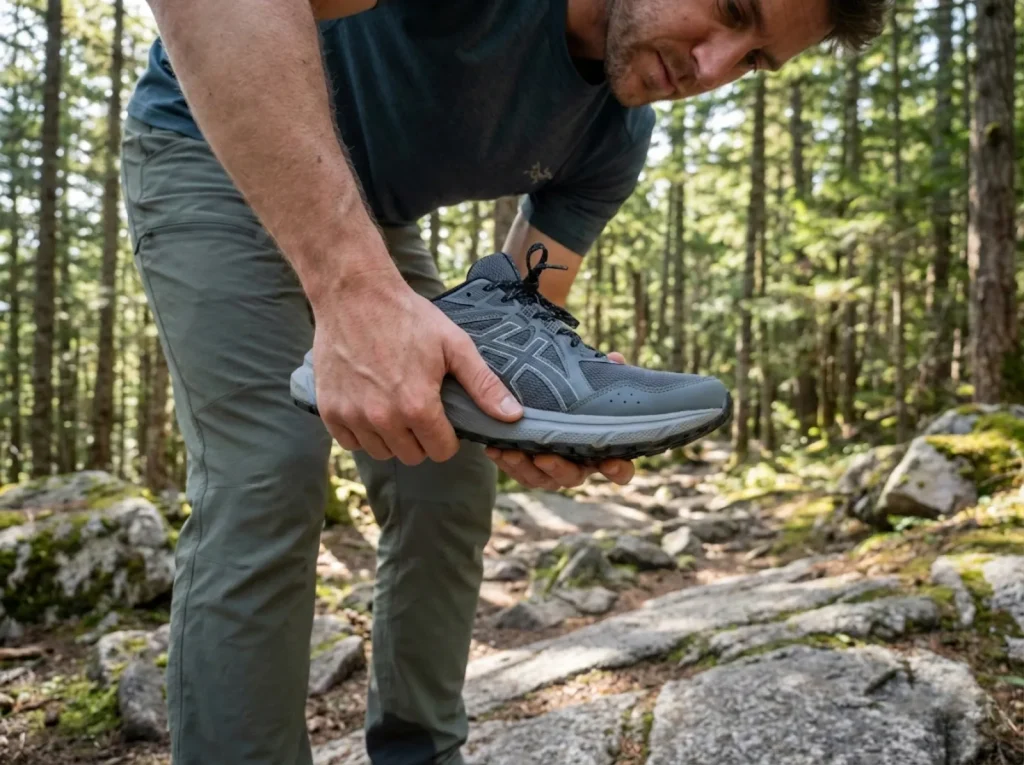
Most hikers obsess over tread patterns and waterproofing. Meanwhile, the part that actually saves your knees, ankles, and plantar fascia is hidden between the outsole and your foot — and it’s quietly dying with every step you take. Understanding how each layer of your boot works together is the first step toward making any pair last longer.
EVA Foam: Why Your Trail Runners Feel Flat After 300 Miles
EVA (ethylene-vinyl acetate) dominates lightweight hiking shoes and trail runners because it’s light, cheap, and feels cushy right out of the box. That comfort comes from thousands of microscopic gas bubbles trapped inside the foam. Every step you take forces gas out through the cell walls. After roughly 300–500 miles, those bubbles collapse permanently — a process gear nerds call “packing out.”
The squishy rebound disappears, and the shoe starts punishing your joints instead of protecting them. You don’t see it happening. The outsole still grips. The upper still holds. But the engine is dead.
Here’s what most people miss: EVA is wildly sensitive to temperature. In freezing conditions, the foam stiffens dramatically, losing most of its shock absorption when you need it more. A trail runner that feels plush on a warm September morning can feel like a brick on a January snowshoe trip. That loss of compliance forces your body to absorb the extra impact, and your Achilles tendons and shins pay the price.
Pro tip: If you’re winter hiking in EVA-soled shoes, warm them inside your sleeping bag before lacing up. Cold EVA provides almost zero cushioning on frozen ground.
PU and the “Storage Disease” That Eats Boots Alive
Polyurethane (PU) midsoles show up in heavier trekking boots built for rough terrain and heavy loads. PU lasts longer than EVA — roughly 600–1,000 miles — and it doesn’t pack out the same way. Instead, it dies by chemistry.
Hydrolysis is the word. Water vapor attacks the polymer chains inside the foam, breaking them apart molecule by molecule. Softeners evaporate. The midsole turns from a flexible cushion into a brittle, crumbling mess — and then your sole falls off mid-trail. For a deeper look at the chemical process behind sole detachment, the mechanism is well-documented by footwear engineers.
The cruel irony: boots that sit in storage fail faster than boots you actually wear. Manufacturers describe this as “You Rest, You Rust.” When you walk in PU-soled boots, the flexing action pumps air through the foam’s open-cell structure — a process called the Bellows Effect. That airflow prevents water vapor from settling and reaching the concentration needed to trigger hydrolysis. A boot worn once a week can last a decade. A boot worn once every three years might crumble after five.

The Wear Timeline: When Each Component Gives Out
Not every part of your shoe dies at the same rate. Here’s the real schedule, pulled from clinical testing and manufacturer data:
- PEBA “super foams” (the expensive performance foams in premium trail runners): lose 2.2% of their maximum energy return after just 280 miles — the shortest shoe lifespan of any cushioning material
- Traditional EVA: begins packing out between 300–500 miles
- Vibram outsoles: lugs worn below 50% height around 800+ miles
- Gore-Tex membranes: mechanical flexing creates micro-leaks after roughly 500 miles
- Leather uppers: crack if not conditioned every 3–6 months
Here’s the kicker: more expensive doesn’t mean longer lasting. A study of 391 shoe models found that shoes averaging $180 were actually rated 8.1% worse by users than shoes averaging $65. Mid-range footwear with traditional EVA often outlasts premium models running fragile super foams.
The 39% Rule: How Rotation Protects Your Body (Not Just Your Gear)

Shoe rotation isn’t just a gear-preservation strategy. It’s a body-preservation strategy, and the clinical data backs that up hard.
The Scandinavian Study That Changed the Math
A 22-week prospective study published in the Scandinavian Journal of Medicine & Science in Sports tracked 264 recreational athletes to measure the effect of footwear variation on the clinical evidence behind shoe rotation and injury prevention. The result: athletes who rotated between multiple shoe models experienced a 39% lower risk of injury compared to those using a single pair.
The mechanism is straightforward. Every shoe creates a unique ground-contact and cushioning signature. Alternating shoes introduces what researchers call “healthy variability” — shifting the physical load across different shoes, different muscle groups, and different tendons with every swap. Wearing the same pair daily locks your body into identical biomechanical stress patterns, which is exactly how overuse injuries like Achilles tendinopathy and plantar fascia inflammation develop.
Why Your Midsoles Need 48 Hours of Sleep
Midsole recovery isn’t a luxury — it’s material science. Cushioning foams need 24–48 hours to fully rebound and regain their original shape after a high-impact session. Wearing shoes back-to-back prevents full midsole decompression, and the foam remains partially compressed. That means higher impact forces on your joints, faster cushioning breakdown, and a shorter shoe lifespan overall.
Think of it like squeezing a sponge and never letting go. Eventually, it stops expanding. A dedicated rotation schedule of 2–3 pairs guarantees each shoe gets proper rest between uses, allowing the cushioning material rebound that keeps both your gear and your body performing.
The Connection Between Worn Midsoles and Morning Heel Pain
If you’ve noticed creaky knees on day two of a backpacking trip, or morning heel pain that wasn’t there last season, your shoes are sending passive-aggressive signals. Degraded midsoles shift load directly onto your plantar fascia — the thick band of tissue running along the sole of the foot.
Dr. Matthew Wagoner from Cone Health recommends inspecting tread patterns specifically for uneven outsole wear, which indicates the footwear is no longer supporting a neutral stride. And if you’re adding foot orthotics to “fix” worn shoes, know this: aftermarket insoles improve range of motion support and comfort, but they cannot restore a collapsed midsole’s shock absorption. Once the foam is packed out or hydrolyzed, the structural protection is gone. Insoles are a complement to healthy shoes, not a substitute — learn more about when aftermarket insoles actually help — and when they can’t.
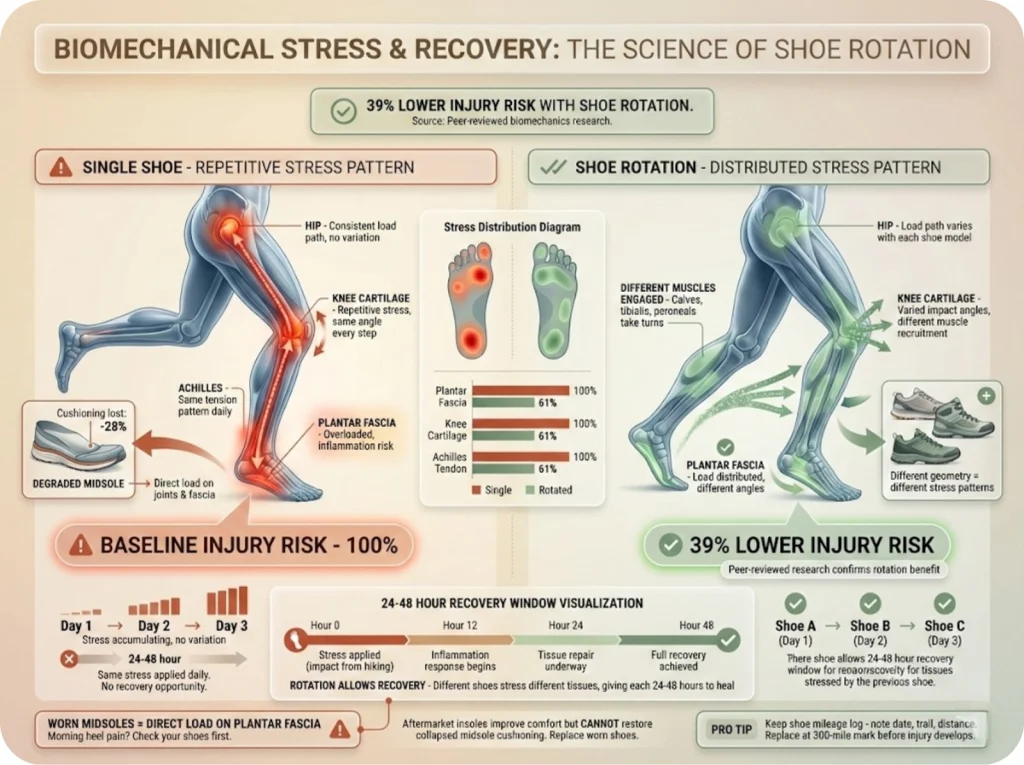
Pro tip: Keep a shoe mileage log for each pair. A simple note in your phone — date, trail, estimated distance — tells you exactly when you’re approaching the 300-mile danger zone.
Building a Rotation System That Fits Your Pack (And Your Budget)
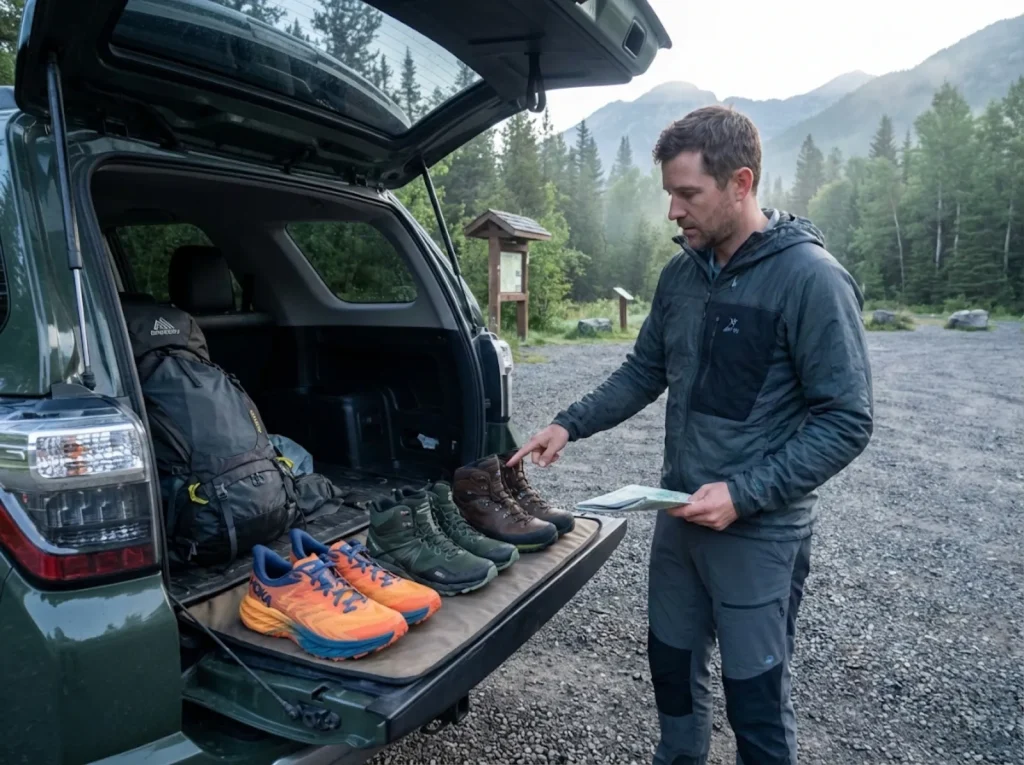
Knowing you should rotate is one thing. Actually building a system that works with your hiking style and wallet is another.
Two Pairs, Three Pairs, or Overkill? Choosing Your System
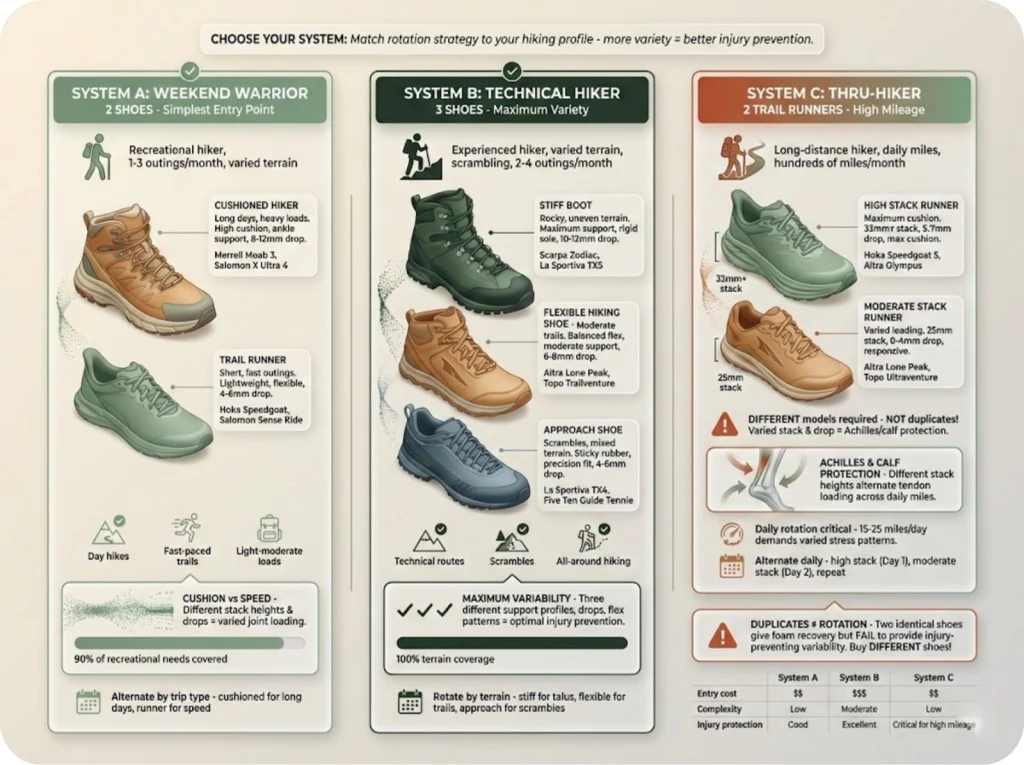
System A — The Weekend Warrior: Two pairs. One cushioned hiker for long days and one lightweight trail runner for shorter, faster outings. This covers 90% of recreational hiking needs and is the easiest entry point into rotation.
System B — The Technical Hiker: Three pairs. One stiff boot for rocky, uneven terrain. One flexible hiking shoe for moderate trails. One approach shoe for scrambles and mixed terrain. Maximum variety in heel-toe drop and support profiles means maximum protection.
System C — The Thru-Hiker: Alternate between two pairs of trail runners with different stack height or heel-toe drop to vary the load on your Achilles tendons and calves across hundreds of daily miles.
One critical detail: buying two pairs of the exact same model gives your foam recovery time, but it fails to deliver the healthy variability that prevents injury. You need different shoes — not duplicates.
The 30-Day Break-In Transition
Don’t slam a brand-new pair into your rotation on a 12-mile ridge day. Transitioning requires patience — follow the full break-in protocol that prevents blisters to do it right.
Week 1–2: Wear the new pair for only 10–15% of your weekly mileage. Short neighborhood walking sessions, not trail days. Week 3–4: Bump usage by 5% per week while monitoring for heel slippage, toe-box pressure, or arch discomfort. Watch for those passive-aggressive pain signals — if creaky knees or morning heel pain appear only after wearing a specific pair, slow down the transition. This gradual approach functions like cross-training for feet, building adaptation without risking injury.
The Budget-Smart Approach to Multiple Pairs
Three pairs sounds expensive. It doesn’t have to be. Previous-year models save roughly 19% off retail. Online purchasing saves an additional 38% compared to brick-and-mortar. And traditional EVA in a $65–$100 mid-range shoe often maintains performance longer than $160+ models chasing fragile super foams — making it the smarter call for any budget-conscious hiker.
Strategy: buy your primary pair new at full price, then hunt for a clearance pair of a complementary model for rotation. You’ll spend less over time because each pair lasts longer. The data on the true cost-per-mile breakdown of leather versus synthetic confirms that smart buying beats expensive buying every time.
The Seven Maintenance Mistakes That Kill Shoes Faster Than Trails
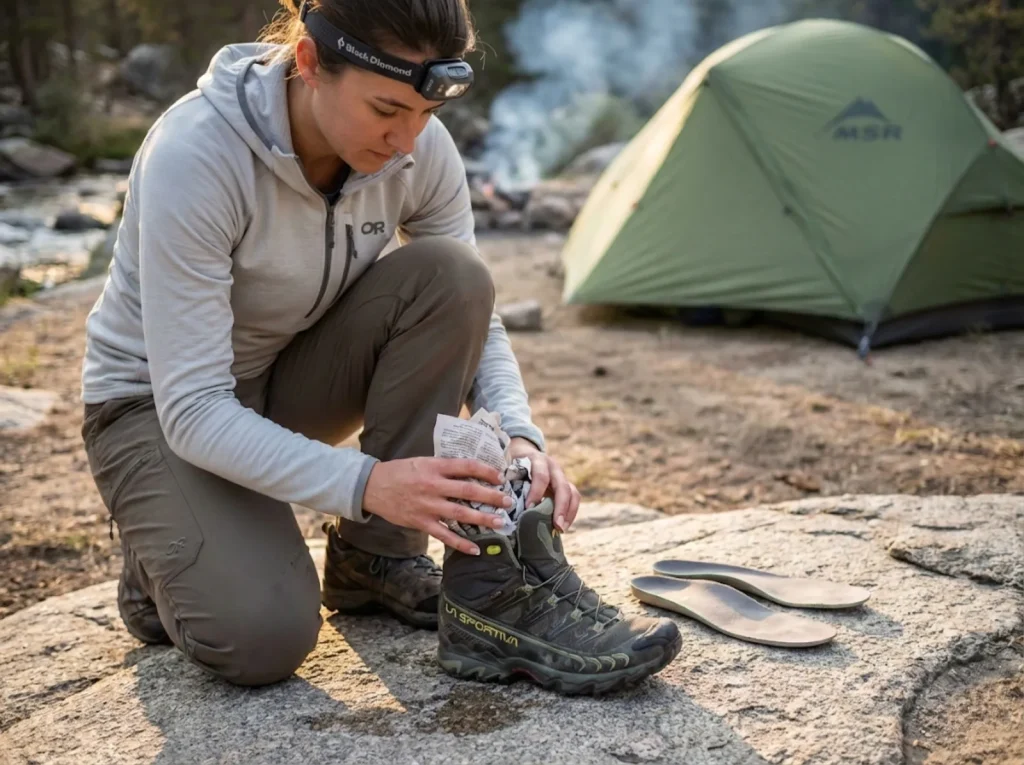
Rotation only works if you aren’t sabotaging your footwear between hikes. Here are the mistakes I see constantly — and the fixes.
The Campfire Trap: How Heat Melts Your Investment
The most common killer reported on hiking forums: drying boots by the campfire. High temperatures melt the adhesives connecting the sole to the upper. Leather loses its natural oils under intense heat, becoming brittle and cracking — permanently destroying its waterproofing.
The fix: Remove insoles, loosen laces, stuff shoes with newspaper. The paper pulls moisture through capillary action without damaging anything. It’s slow, it’s boring, and it works. For the complete procedure, read the safe overnight drying method that protects adhesive bonds.
Gore-Tex and other waterproof membranes die from high heat too. Radiators, car dashboards, and sunny windowsills are all campfire-level threats.
Trail Dust Is Tiny Sandpaper (And Machine Wash Is Worse)
Mud and fine grit act like abrasive particles on shoe fibers, accelerating upper degradation with every step if left uncleaned. After every hike: soft brush, warm water, remove insoles to air dry. Three minutes of gear maintenance adds months of life.
Machine washing? Never. The mechanical agitation and heat destroy internal foam structure and melt adhesives. Even “delicate” cycles generate enough force to ruin a good pair of trail runners. Leather boots need periodic conditioning with boot-specific oils or waxes to stay supple and waterproof — a practice footwear engineers call regular “feeding.”
Storage: The Silent Killer You Control
Store shoes in cool, dry, well-ventilated rooms. Direct sunlight accelerates rubber degradation and PU hydrolysis. Never seal boots in plastic bins, stuff them in damp basements, or leave them in car trunks. Remove insoles for seasonal storage to allow airflow to the bottom of the boot. For more detail on storage conditions that prevent PU damage, see manufacturer guidance on preventing midsole hydrolysis.
For PU-soled boots you only use seasonally, walking around the house in them every month or two — even 30 minutes — activates the Bellows Effect and prevents stagnant moisture evaporation from triggering hydrolysis. For the complete system covering mold prevention, temperature control, and PU foam across all your equipment, check out the full gear storage guide that prevents delamination.
Pro tip: Write the date of purchase and starting mileage on a piece of tape inside the tongue of every new pair. When you spot uneven outsole wear or feel that “dead” cushioning, check the tape — it gives you a hard data point for shoe replacement signs.
The Math That Proves Rotation Pays for Itself
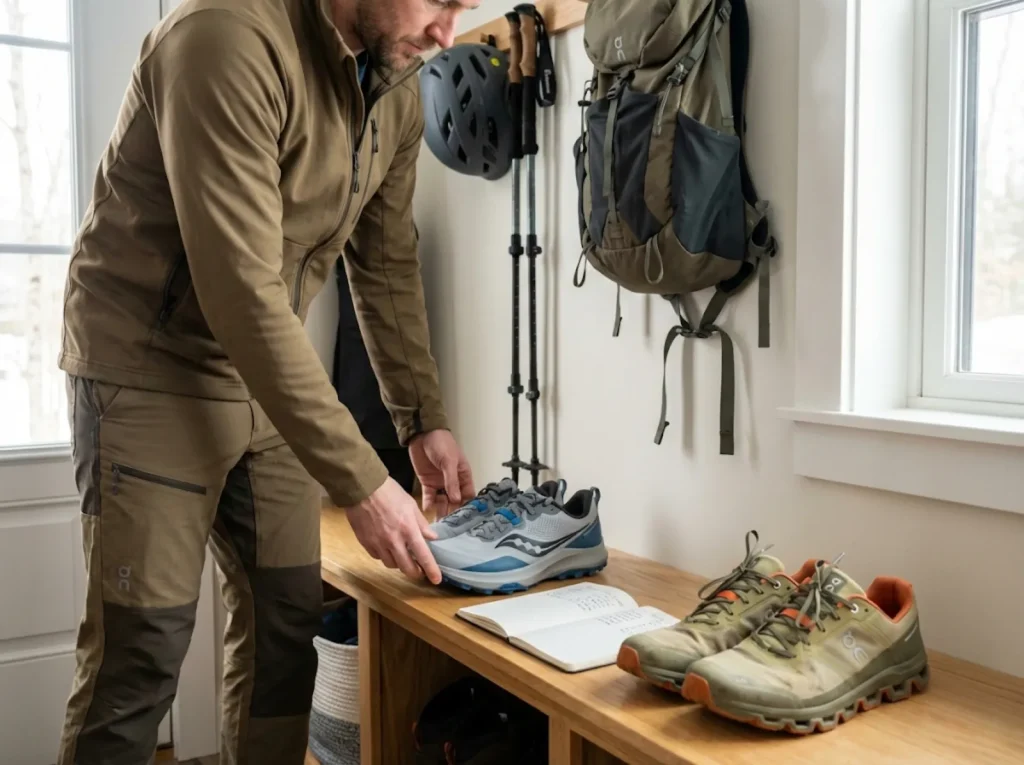
Let’s kill the “rotation is too expensive” myth with real numbers.
Cost-Per-Mile: Single Pair vs. Rotation System
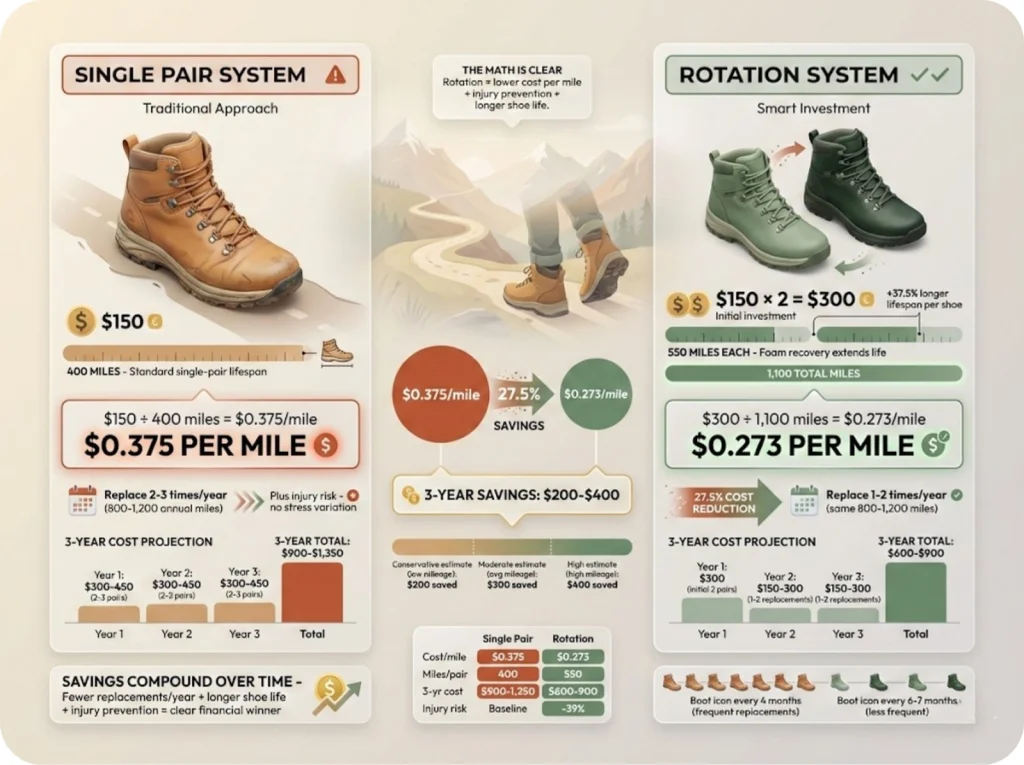
A $150 shoe lasting 400 miles = $0.375 per mile. Two $150 shoes in rotation — each lasting 550 miles thanks to recovery and better footwear care — gives you 1,100 total miles for $300. That’s $0.273 per mile, a 27.5% reduction in cost, with each pair simultaneously delivering that 39% lower injury risk.
Factor in fewer shoe replacements per year and the cost savings compound. Over three years of regular hiking, rotation saves an estimated $200–$400 depending on your mileage volume. The budget math isn’t even close.
Why $60 Shoes Often Outlast $180 Ones
That study of 391 shoe models isn’t a fluke. The most expensive shoes chase performance metrics like maximum energy return and featherweight construction, but they trade away durability to get there. PEBA super foams lose effective cushioning after just 280 miles. Traditional EVA in a budget-conscious mid-range shoe holds up far longer, making the cost-performance ratio dramatically better.
Pro tip: Buy rotation pairs based on the type of hiking you do with each, not the price tag. A $90 trail runner alternated with a $120 hiker outperforms a single $200 “do everything” boot in both longevity and injury prevention.
Hiking for the Planet: Why Extending Shoe Life Is a Leave No Trace Decision
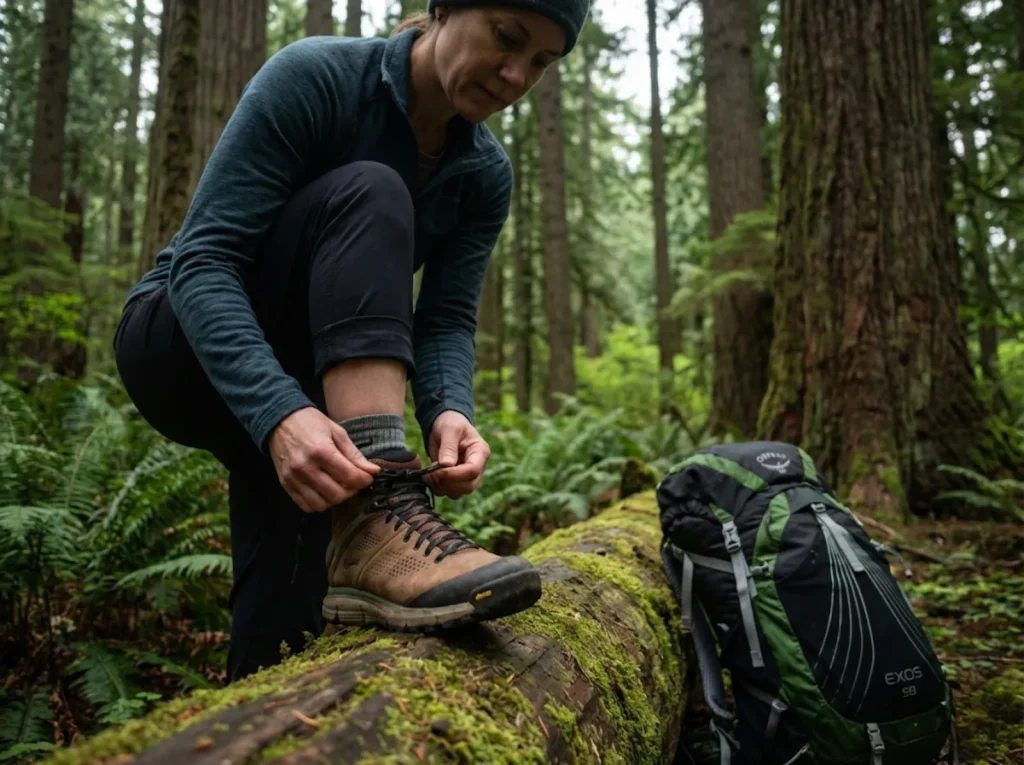
If you care about Leave No Trace on the trail, your gear closet deserves the same attention. The Leave No Trace Center for Outdoor Ethics emphasizes that responsible outdoor recreation extends beyond trail behavior — it includes how we consume and maintain gear.
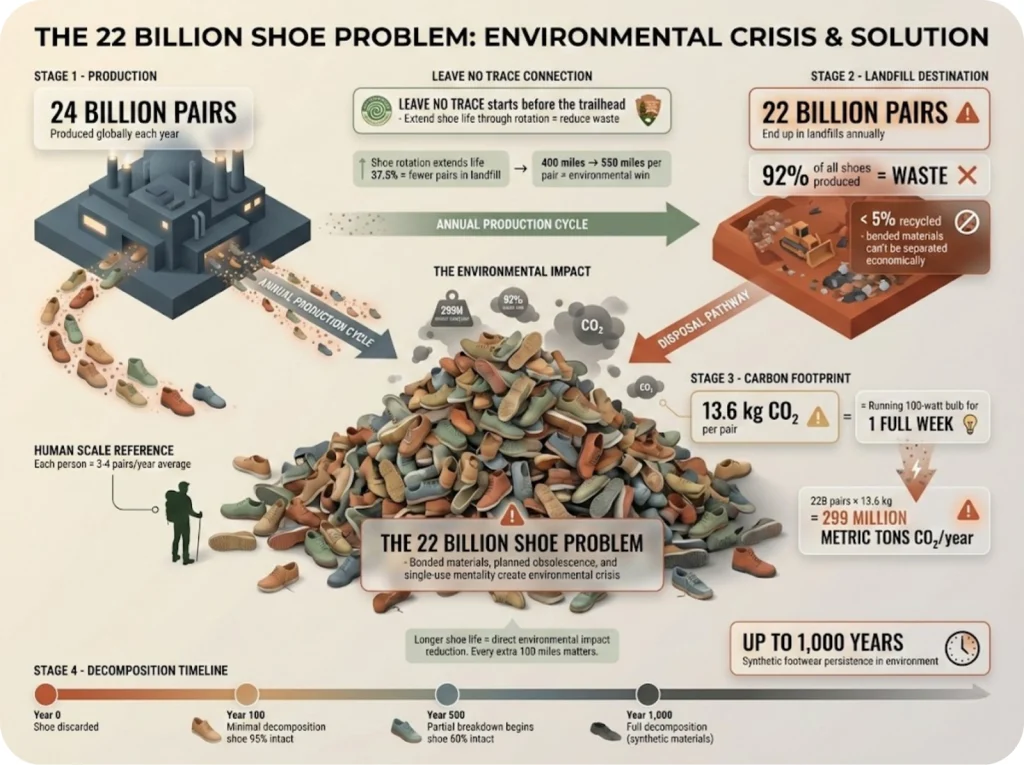
The 22 Billion Shoe Problem
The numbers are staggering: 24 billion pairs of shoes produced globally each year. 22 billion end up in landfills. Each pair generates approximately 13.6 kg of CO₂ — equivalent to running a 100-watt bulb for a full week. Less than 5% of shoes are recycled, because bonded materials — foam, rubber, synthetic uppers — can’t be economically separated. Synthetic footwear takes up to 1,000 years to decompose.
The National Park Service’s own Leave No Trace guidelines reinforce that responsible disposal and reduction of waste start long before you reach the trailhead — including how long you keep your gear working.
Repair Over Replace: The Most Sustainable Gear Choice
Resoling leather boots can stretch their useful life to several thousand miles — 10x the lifespan of a disposable trail runner. Brands like Merrell and Adidas Terrex are incorporating upcycled rubber and ocean plastics into their hiking lines, and companies like Allbirds and VivoBarefoot are building with biodegradable components.
But the single most impactful thing you can do isn’t buying “sustainable” new gear — it’s making what you already own last longer. Extending shoe lifespan through rotation and gear maintenance is one of the highest-impact personal actions available to any hiker who takes sustainability seriously. For the full framework, read the complete lifecycle guide for hiking gear.
Conclusion
Three things will save your shoes — and your body.
First, your shoes are dying from the inside out. Midsole foam degrades through compression fatigue (EVA) or chemical hydrolysis (PU), often long before the outsole shows any visible wear. Run the pressure test tonight.
Second, rotating 2–3 pairs of different models with varying cushioning profiles cuts injury risk by 39%, stretches each pair’s mileage by 25–40%, and costs less per mile than a single-pair approach.
Third, storage and heat are silent killers. How you dry and store your shoes matters as much as how you hike in them. Newspaper, airflow, and monthly use for PU boots — that’s the formula.
Next time you pull a pair off the shelf, press your thumb into that midsole before you lace up. If the impression stays, those shoes are on borrowed time. And now you know exactly what to do about it.
FAQ
Does rotating shoes really make them last longer?
Yes. Giving midsole foam 24–48 hours of rest between uses allows midsoles to decompress, preventing permanent densification. Research-backed rotation protocols can extend each pair’s life by 25–40% compared to daily use of a single pair.
How many pairs of hiking shoes should I rotate?
Two pairs is the minimum for effective shoe rotation. Three is optimal because it guarantees 48+ hours of rest per pair and maximizes the healthy variability that prevents overuse injuries. Buy different shoes — not duplicates — to get the injury risk reduction benefit.
How do I know when my hiking shoes are actually worn out?
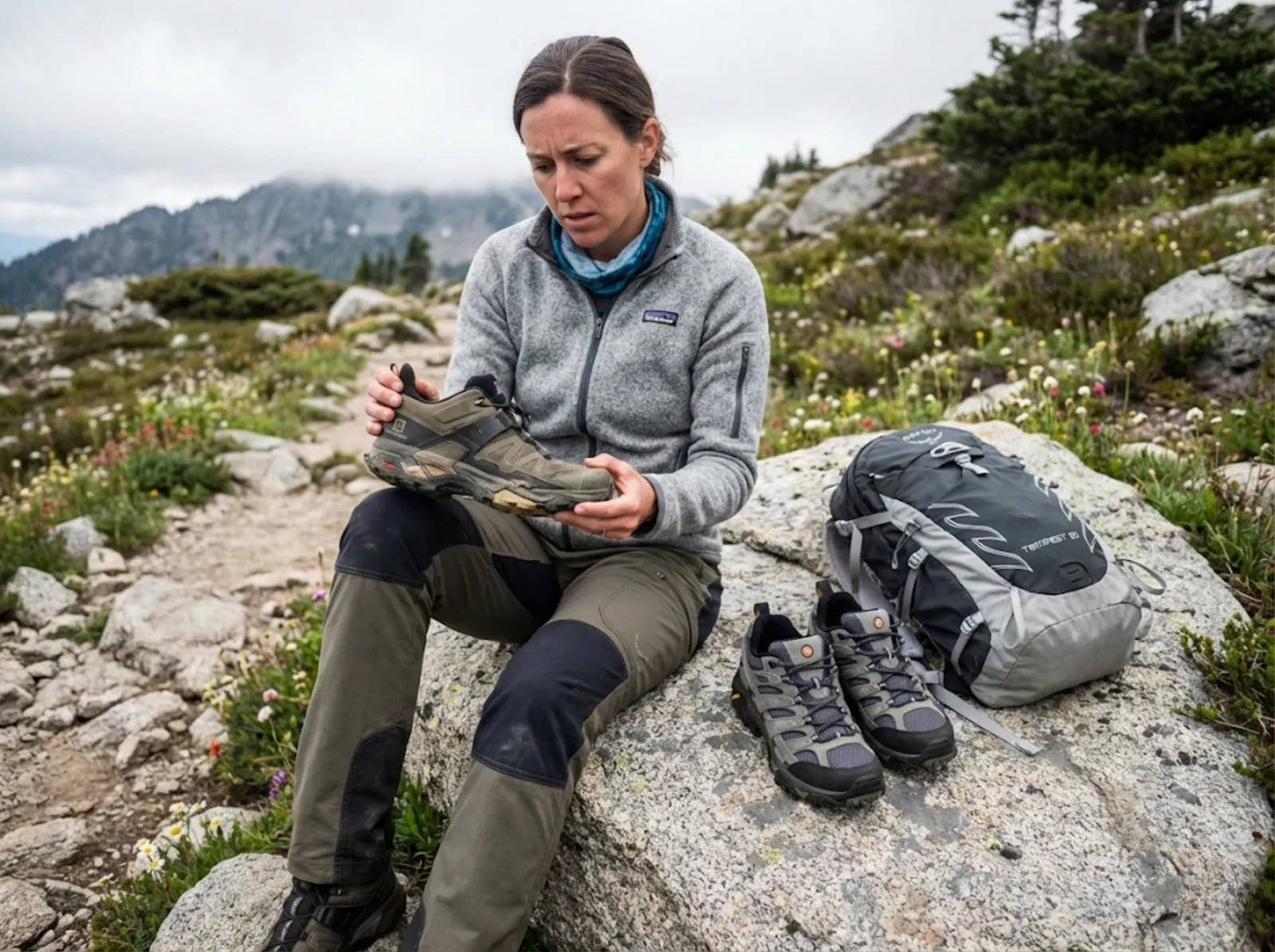
Press a key or pen tip into the midsole. If the impression doesn’t spring back within a second, the foam has permanently compressed. Also check for uneven outsole wear, heel counter collapse, and any morning heel pain that appeared after the shoes hit roughly 300–500 miles. These are your shoe replacement signs.
Can insoles fix a shoe with a worn-out midsole?
Aftermarket foot orthotics improve arch support and comfort, but they cannot restore a collapsed midsole’s shock absorption. Once the foam is packed out or hydrolyzed, the structural protection is gone. Insoles complement healthy footwear — they don’t replace it.
Do hiking shoes wear out even if I don’t use them?
Yes — especially boots with polyurethane (PU) midsoles. Hydrolysis, triggered by humidity effects, breaks down PU bonds during seasonal storage. Boots sitting unused in a damp closet can crumble within 3–5 years. Regular use actually prevents this by circulating air through the foam via the Bellows Effect.
Risk Disclaimer: Hiking, trekking, backpacking, and all related outdoor activities involve inherent
risks which may result in serious injury, illness, or death. The information provided on The Hiking Tribe is for
educational and informational purposes only. While we strive for accuracy, information on trails, gear, techniques,
and safety is not a substitute for your own best judgment and thorough preparation. Trail conditions, weather, and
other environmental factors change rapidly and may differ from what is described on this site. Always check with
official sources like park services for the most current alerts and conditions. Never undertake a hike beyond your
abilities and always be prepared for the unexpected. By using this website, you agree that you are solely
responsible for your own safety. Any reliance you place on our content is strictly at your own risk, and you assume
all liability for your actions and decisions in the outdoors. The Hiking Tribe and its authors will not be held
liable for any injury, damage, or loss sustained in connection with the use of the information herein.
Affiliate Disclosure: We are a participant in the Amazon Services LLC Associates Program, an
affiliate advertising program designed to provide a means for us to earn advertising fees by advertising and linking
to Amazon.com. As an Amazon Associate, we earn from qualifying purchases. We are also an official affiliate partner
of Black Diamond Equipment via the AvantLink network. If you click on a Black Diamond affiliate link and make a
purchase, we may earn a commission at no additional cost to you. We also participate in other affiliate programs and
may receive a commission on products purchased through our links. Additional terms are found in the terms of
service.