In this article
I rounded a switchback above the treeline and heard it before I saw it: a two-stroke dirt bike ripping through a designated wilderness area, spitting mud and leaving twin gouges in the alpine tundra. My first instinct was to yell. My second—and the one that actually mattered—was to quietly pull out my phone and drop a waypoint.
If you spend enough days outside, you eventually walk into a mess somebody else left behind. Maybe it’s a blown-out footbridge, a smoldering campfire in a dry season, or someone loading centuries-old pottery shards into a backpack. Land managers are stretched incredibly thin. They depend on hikers like us to be their eyes on the ground, but most well-intentioned tip-offs end up lost in the system because of missing details. By the time you finish reading, you’ll know exactly who to call, what to document, and how to get that information to the right desk without putting yourself in a sketchy situation.
⚡ Quick Answer: To report trail damage or unauthorized activity, identify the land agency in charge, capture GPS coordinates with a geotagged photo, and call the local Ranger District. Knowing exactly which agency to call is the hurdle most hikers trip over, but it’s remarkably simple once you learn the trick.
| Agency Reporting and Response Guide | |||
|---|---|---|---|
| Issue Type | Agency | Best Contact Method | Response Speed |
| Downed tree / Washout | USFS / BLM local district | Online form / Phone | Days to weeks |
| Unauthorized ATV / OHV | BLM / USFS Law Enforcement | Non-emergency tip line | Highest priority |
| Resource theft | NPS / BLM | Tip line + Local district | Weeks to months |
| Prohibited camping / fire | All agencies | Local district phone | Moderate |
| Hazardous washout | All agencies | Online form + Phone | Depends on safety risk |
Who Actually Owns the Trail You’re On
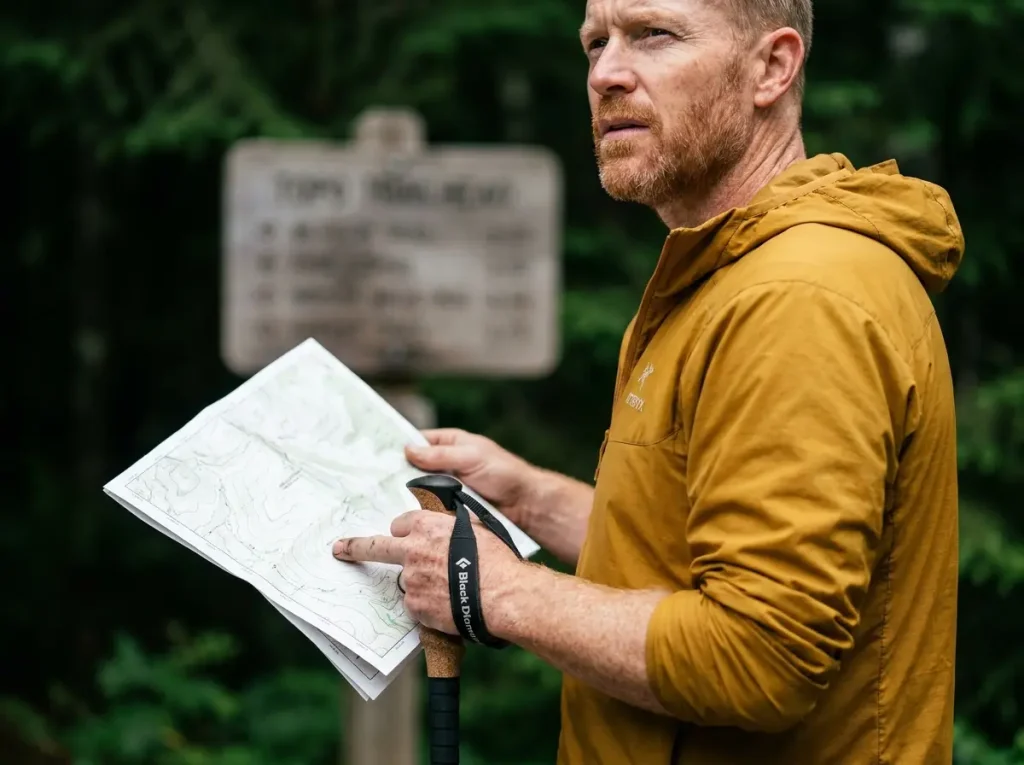
The single most frustrating thing about trying to help fix a trail is dialing the wrong number. If you call the National Park Service about a logging road washout, they literally cannot help you. Their jurisdiction ends at the park boundary.
Think of this as the trailhead sign test. Land ownership dictates what rules apply. A muddy four-wheeler tearing up a dirt road might be perfectly acceptable on designated routes, but that exact same vehicle crossing into a wilderness area commits a severe federal offense.
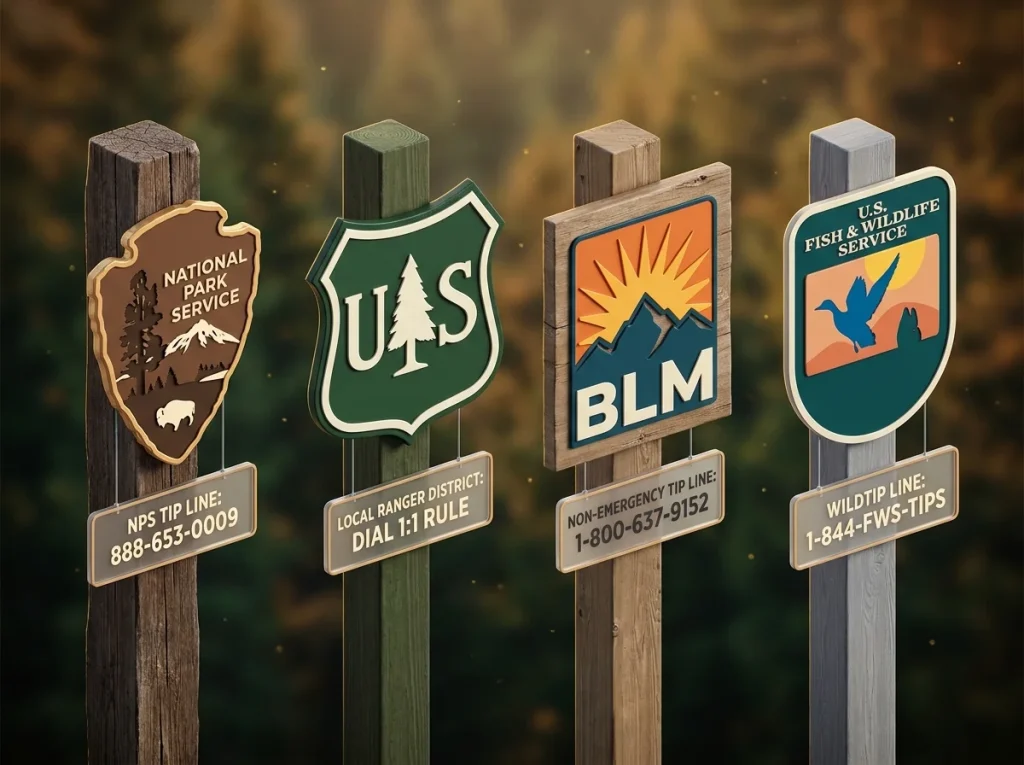
Four federal agencies run the show. The National Park Service (NPS) strictly preserves everything. The U.S. Forest Service (USFS) allows timber harvests and motorized action in designated zones. The Bureau of Land Management (BLM) handles vast desert and scrubland with flexible use. It helps to figure out which agency manages the land you’re hiking on before you lose cell service.
Pro-Tip: The app OnX Backcountry shows you land ownership overlays even when your phone has zero bars. You’ll know the jurisdiction before you ever hit the dirt.
Reading the Trailhead Sign Like a Pro
Look straight at the logo and the colors on the wooden kiosk. The USFS prints everything on green backgrounds featuring their signature shield. The NPS sticks to their famous brown background with the gold arrowhead. BLM signs vary slightly but almost always flash the agency name or sunburst logo at the top. If there is no formal sign, check the bulletin board staples; you’ll usually spot a contact number for the managing office. And if you want to skip the guesswork entirely, digital mapping tools clear up the boundary lines instantly.
The “1:1 Rule” — Why You Need the Local District, Not National HQ
A massive mistake hikers make is looking up the 1-800 number for a national headquarters in Washington, D.C. They set the policy, but they don’t fix the trails. You need the 1:1 rule. You must match your specific problem to the specific local office overseeing that patch of dirt.
The local District Ranger manages the trail crews. They hold the maintenance schedules and the maps. Save that local number in your phone as “Trail Report – [Forest Name]” while you are still sitting on your couch at home. For any BLM-managed area, check the BLM law enforcement and public land jurisdiction page before your trip to understand who handles local enforcement.
If you don’t save the number beforehand, you’ll be out of luck when the signal drops. That’s why building a pre-trip routine pays off. You should have the specific contact info locked into your phone alongside your offline maps. Speaking of local contacts, the federal agencies aren’t the only ones running the show.
State Parks and Local Land Trusts — The Forgotten Managers
Not every path belongs to the federal government. Sometimes you’ll find yourself navigating a state park or a county preserve. Find a state park’s direct office number through your state’s wildlife department website before you leave. Local trail clubs like the NYNJTC in the Northeast often maintain the physical tread under your boots, making them the absolute fastest first call for a blown-down oak tree blocking your route. If you genuinely cannot figure out who owns the section you are standing on, ring the local non-emergency dispatch line; they’ll route your information to the proper desk.
Getting the correct agency on the phone is half the battle. But you also need to know if the issue you’re looking at actually warrants a phone call in the first place.
What Counts as Reportable — and What Doesn’t
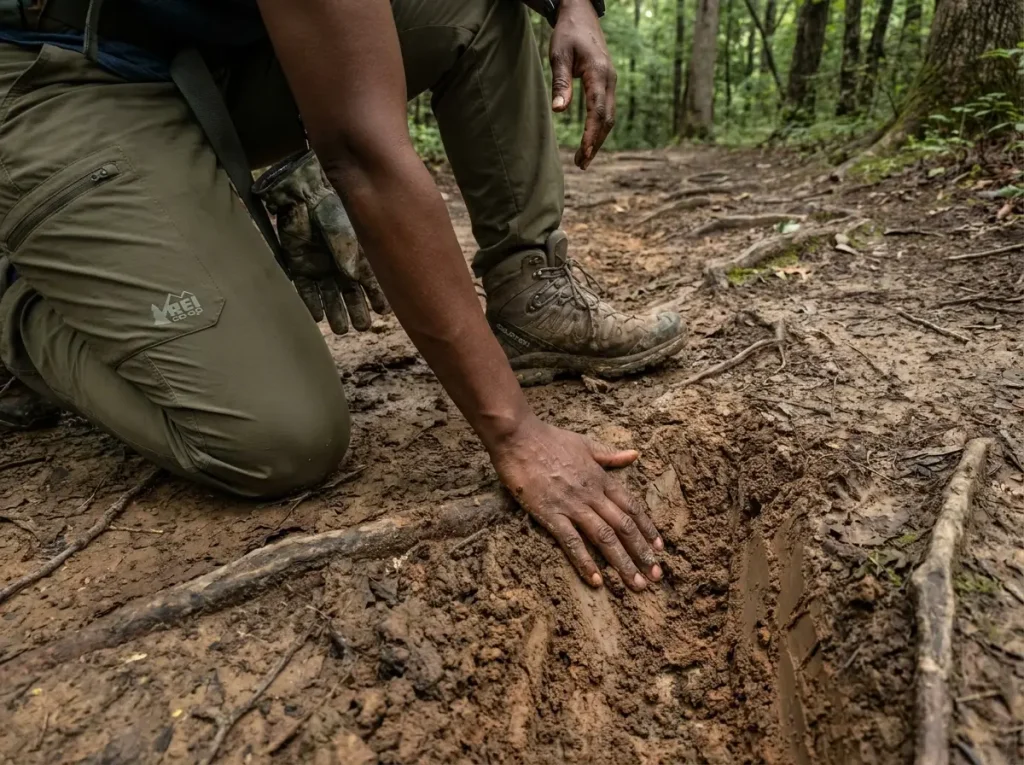
Not every irritating thing you see on a hike deserves a phone call. There’s a massive difference between a muddy trail detour, a dog off-leash in a restricted zone, and somebody backing a truck up to an ancient ruin. Knowing how to classify an issue keeps you from feeling like a nuisance and helps you escalate the situation appropriately.
Physical wear to the path falls strictly under maintenance. If you want to understand how social trails damage the underlying trail structure, the short version is that hikers taking shortcuts crush the root systems holding the hillside together. It accelerates erosion, but it’s a maintenance problem, not a federal offense.
Major violations involve theft, severe environmental destruction, and motorized incursions. Stuffing ancient pottery shards into a pocket violates the Archaeological Resources Protection Act. If someone’s behavior severely trashes the place or gives them unauthorized access to a protected resource, you should absolutely speak up.
Pro-Tip: When in doubt about whether to call, report it anyway. The officers working these beats heavily prefer getting a tip they cannot act on over completely missing a serious incident.
The Three Tiers of Trail Problems
Tier 1 covers natural maintenance issues like downed logs, washed-out switchbacks, and eroding tread. Submit these through online agency forms on a Monday morning. Expect a slow response unless it poses an immediate safety hazard.
Tier 2 involves human-caused violations like prohibited camping, unattended fires in a moderate ban, or off-leash dogs in strict wildlife areas. Use the non-emergency tip lines and direct local agency contacts for these.
Tier 3 represents severe misconduct. Unauthorized motorized use, archaeological looting, or dumping hazardous materials requires an immediate call to the local sheriff’s non-emergency line and the agency’s law enforcement reporting number. Make sure you stay far away from the area.
How to Recognize Unauthorized Motorized Use
Motorized travel must stay entirely on the routes outlined on the official Motor Vehicle Use Map (MVUM). The BLM regularly issues guidelines on reporting unauthorized motorized travel and dumping because of the immense damage it causes.
The easiest tell is trail width. If a vehicle is physically wider than the cut of the path it is driving on, it does not belong there. Evidence of misuse includes deep tire ruts, crushed trailside vegetation, and lingering fuel smells. If you witness an off-road violation, the license plate is the holy grail. Write down the state and the exact numbers.
You might spot tire tracks easily, but figuring out if someone is messing with historical artifacts takes a sharper eye. Recognizing when history is being stolen requires knowing what subtle disturbances look like.
Spotting Resource Theft and Vandalism
Looters are unfortunately common in areas with indigenous history. Look for freshly turned dirt sitting at the base of cliff walls or small, deliberate holes dug near rock overhangs. Items that look like bone, pottery, or shaped stone tools getting loaded into a backpack represent a major concern.
Vandalism is equally glaring. Finding fresh spray paint or initials gouged deeply into living bark is defacement. Grab a clear photo showing the damage. Under no circumstances should you touch or move any artifacts you find. The exact spot where an object rests tells archaeologists as much as the object itself.
Now that you know what actually warrants getting the authorities involved, you need to know exactly what pieces of information to hand them so they don’t have to guess.
Your 5-Point Reporting Checklist
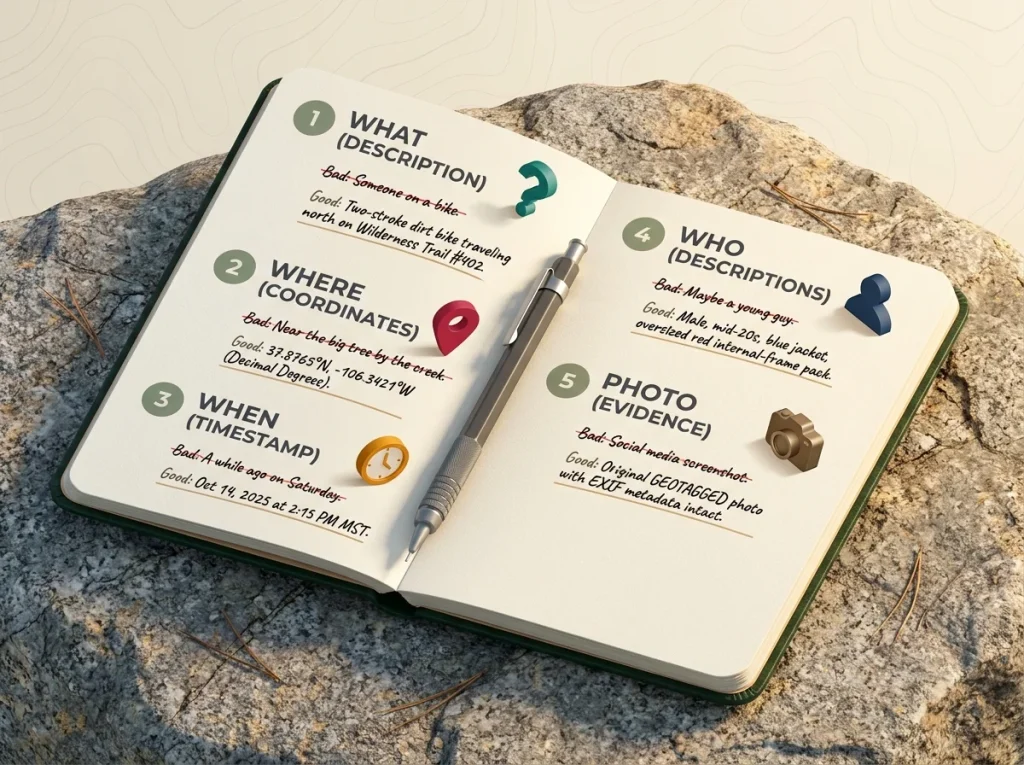
Rangers patrol millions of acres. You need a 5-point reporting checklist to make your info bulletproof. The better your details, the faster they can actually dispatch a crew. Think of this as texting a friend who needs to find the exact spot you’re standing in, having never been there before.
First, note exactly what happened. Keep it concrete. “Two guys on dirt bikes traveling northeast on the non-motorized Lost Creek trail” works infinitely better than “some bikes I saw.” Next, nail down the location. Decimal degrees are the gold standard for your damage location.
Third, record the exact date and time. If it’s still happening right now, state that clearly. Fourth, give physical descriptions. Say “blue jacket, red pack,” not generic guesses about their age.
Finally, capture visual proof. A digital photo includes hidden data. If you are wondering whether your phone gives you accurate enough coordinates for a formal report, the answer is a massive yes. I’ve submitted reports using UTM formats where I was off by half a mile, and that half mile matters immensely in steep canyon country.
Nailing the Location — GPS Coordinates, Landmarks, and Waypoints
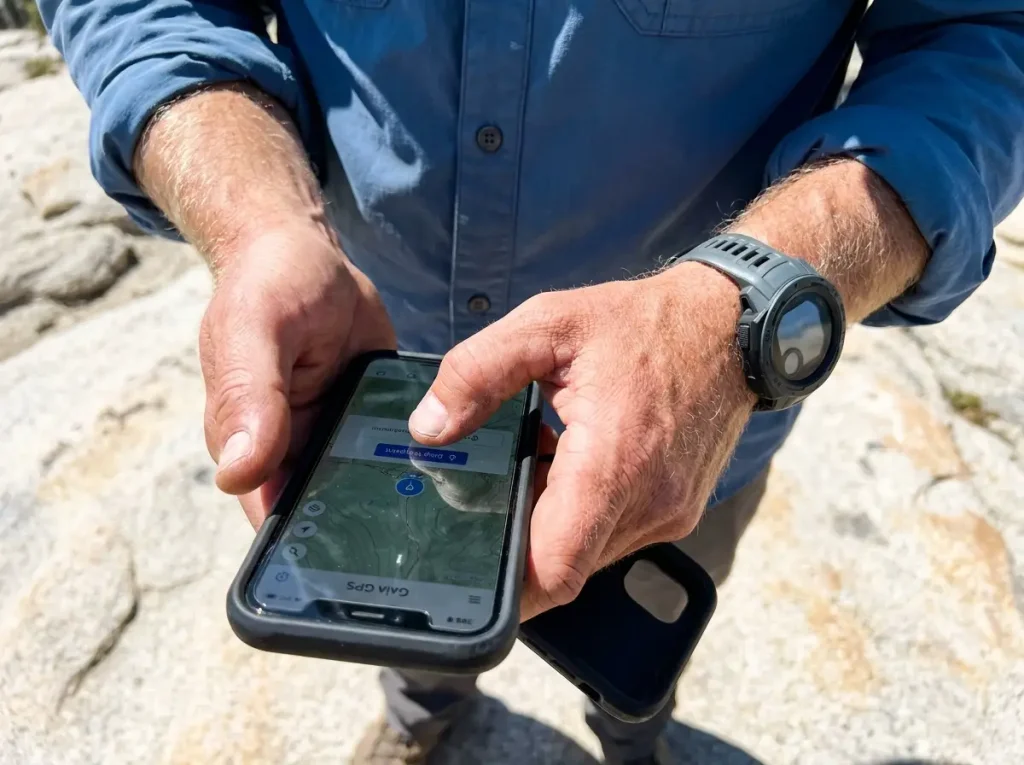
Pull out your phone, open your mapping app, and hit the plus button to drop a fresh waypoint exactly where you are standing. You want the numbers that look like this: 37.8765°N, -106.3421°W. That is the decimal degree format that most dispatchers type into their systems.
Avoid using UTM coordinates on web forms; it historically causes massive confusion unless you explicitly state the format. If your GPS fails, write down the named trail, the last junction you passed, and the estimated mileage from that point. In a slot canyon where signals bounce, a photo of a visible trail marker or distinct rock formation proves far more useful than a shaky GPS read.
The Geotagging Hack — Make Your Camera a Digital Witness
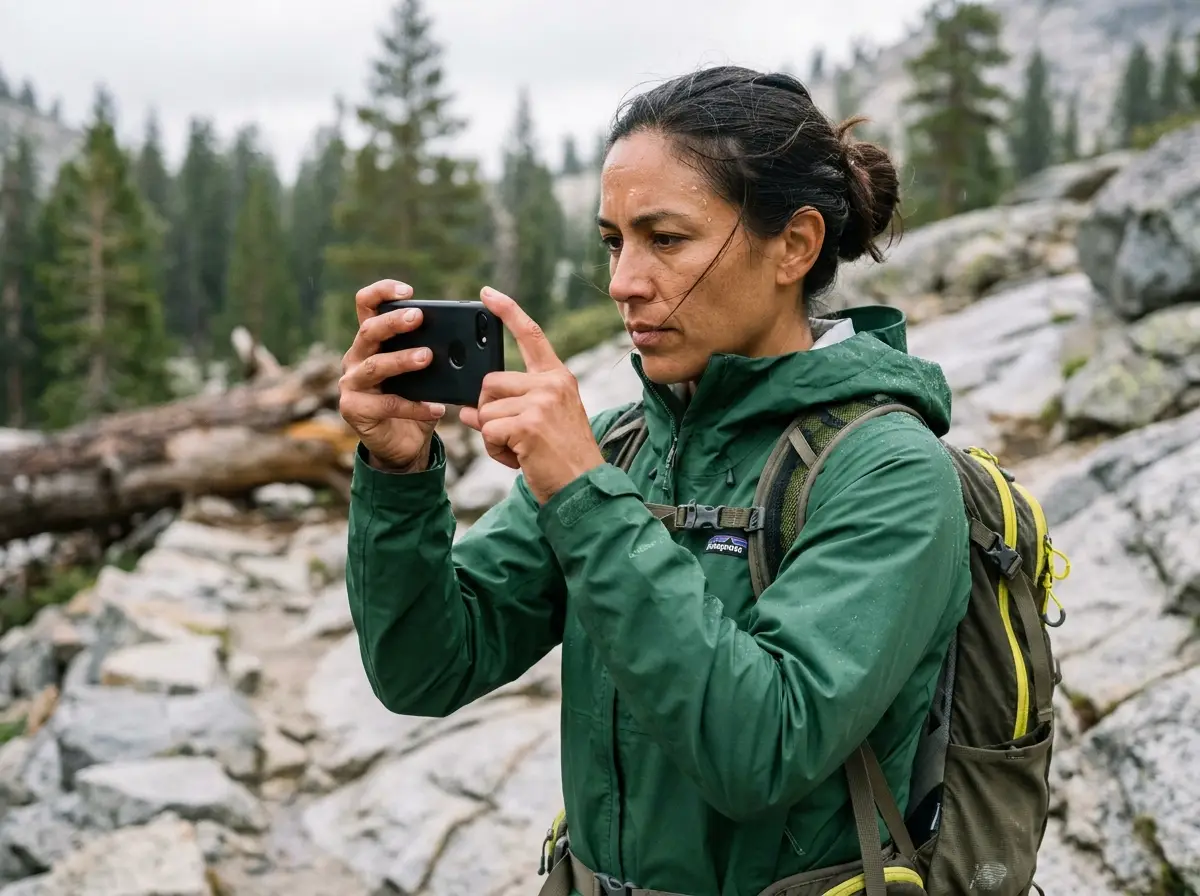
This is the biggest photo metadata secret that changes the reporting game. Every single time your phone snaps a picture, it secretly stamps an EXIF file into the image containing the GPS coordinates, date, and time. I call it the geotagging hack because it completely bypasses your memory.
You must trigger this feature before you leave pavement. On your smartphone settings, toggle the location services for the camera app to “While Using.” When you prepare to send geotagged evidence to the ranger, attach the actual original file from your gallery. Do not send a screenshot or a social media download. Platforms like Instagram strip EXIF data entirely, making the image useless for an investigation.
Getting the technical data dialed in guarantees they find the spot. But when you write out what you saw, using the wrong words can accidentally mislead an investigator.
Describing the Incident Without Getting It Wrong
The golden rule of giving a description of issue is to write down your raw, biological observations. Say, “I watched a truck drive off the road into the meadow.” Do not say, “A guy was out here poaching.” You observed a truck; you did not observe the completion of a wildlife offense.
Use hard compass directions instead of relative terms. “Traveling east away from the river” stands up as evidence, whereas “heading to the left” means absolutely nothing to someone looking at a map. Keep a quick voice memo on your phone if you can’t type while walking. Recording thirty seconds of audio beats trying to reconstruct the details from memory three hours later at the truck.
You have the checklist down. Now you just need to know which buttons to push on your devices to generate these precise reports.
The Phone Arsenal — Apps That Make Reporting Faster
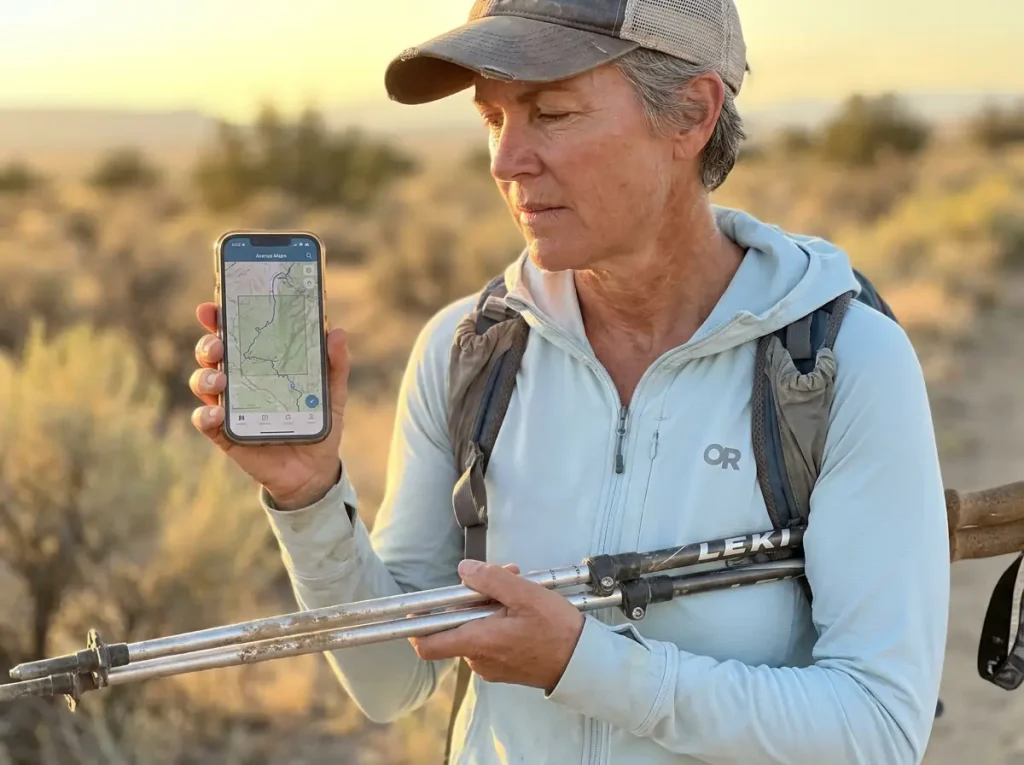
Your phone already holds the best field equipment available. Hikers heavily rely on their screens for tracking miles, but that same device can generate a time-stamped, coordinate-accurate report that a ranger can act on instantly. You just need to know how to use it.
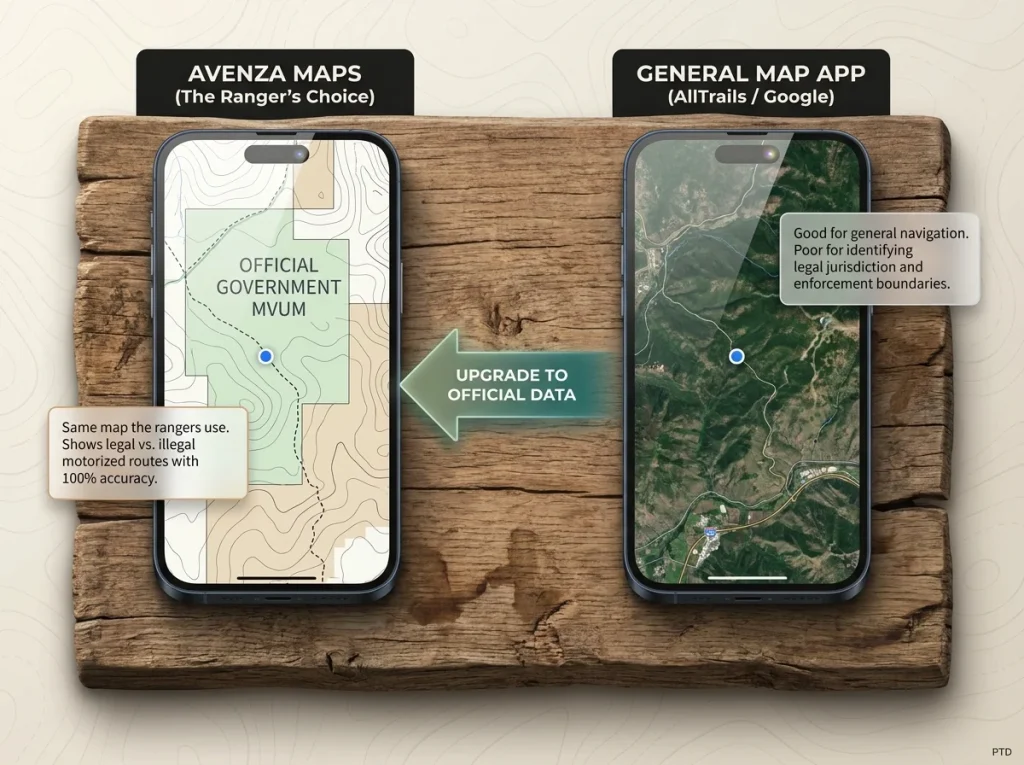
Gaia GPS gives you the absolute best coordinate control. It lets you switch formats seamlessly and drop named waypoints. Avenza Maps holds massive respect among field professionals because it ingests official, georeferenced PDF maps. The NPS maintains clear guidelines on how to submit a tip using precise data because they rely on us feeding them exact locations.
Trailforks heavily relies on its community and excels at crowdsourced reporting, sending your issue straight to the local clubs with shovels. AllTrails works well for general navigation but falls short on exporting hard coordinate data for authorities.
Technology routinely fails in the cold. You still need to carry the local office number. If you genuinely want to know which hiking app gives you the most accurate coordinates for reporting, it comes down to understanding the specific strengths and offline limitations of these tools.
Pro-Tip: Test your offline maps on a neighborhood walk before your trip. Turn on airplane mode, open the app, and see if the map actually loads. The trailhead is a terrible place to figure out your download failed.
Gaia GPS — Generating Coordinates That Rangers Can Use
When you find an issue, tap the plus sign inside Gaia and drop a waypoint immediately. Rename it “Incident” with the current date so you don’t lose it amongst your camping spots.
The app lets you hit the export button and package that point as a GPX file. When you finally hit a cell tower, you just email that file cleanly to the local office. Gaia also logs your actual walking route, showing the investigators exactly which access points you used, providing them immense contextual clues.
Avenza Maps — The Ranger’s Map, On Your Phone
Think of Avenza as looking over a ranger’s shoulder. Before your trip, download the Motor Vehicle Use Map (MVUM) PDF for that particular forest from the agency site and drop it straight into the app.
Your little blue GPS dot shows up directly on top of the actual government document. You will see immediately if a four-wheeler is crushing a closed path. Avenza lets you drop a placemark directly on the official map and share the coordinates with an attached note, effectively putting your eyes on their paperwork.
While digital mapping makes reporting incredibly smooth, relying exclusively on an app puts you at risk when the battery inevitably dies. You need a backup plan for when the screen goes dark.
When the Apps Fail — The Analog Backup
Winter destroys lithium batteries. Cold temperatures drain a phone completely before you even hit the halfway mark. This is why you must carry a paper topographic map folded in your jacket, along with a stubby pencil. When the screen dies, physically mark an ‘X’ over your location.
Check your elevation contour lines, note the massive ridgeline to your right, and write down the nearest named feature. That is exactly what a ranger’s topo map will show. If you have absolutely nothing, note your compass bearing and estimate your mileage from the last named trail junction.
Knowing how to document the details matters, but keeping yourself protected while you do it is the single most important rule of the outdoors.
Safety First — How to Document Without Confrontation
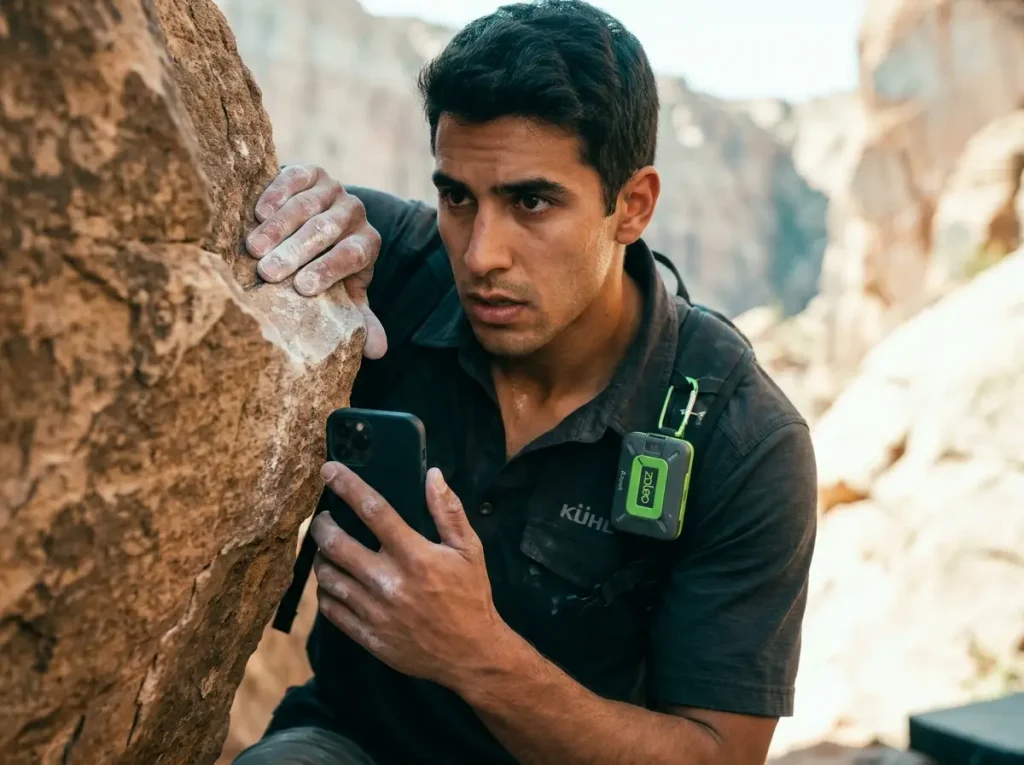
The only non-negotiable rule out here is this: do not play hero. Land management agencies train their officers heavily in defensive tactics and situational de-escalation. You are not trained for that. The single best outcome for a weekend hiker is getting the data and walking away unharmed.
Your entire objective centers on evidence gathering without confrontation. You secure the information, maintain total distance, and withdraw safely. Do not attempt to block a trail, stop a vehicle, or lecture someone committing an offense.
Because maintaining safe distance applies to people as much as wildlife, you treat unpredictable situations exactly like a bear encounter. You back away slowly, stay quiet, and go home. The data isn’t worth an altercation two miles from the nearest road.
When you get to safety, dial the non-emergency vs emergency lines appropriately.
Pro-Tip: Tell someone your route and your panic time before you cross the trailhead boundary. That is your dead man’s switch. Use it on every single hike, even the familiar ones.
The Three-Step Observation Protocol
First, freeze and use the timber. Break up your human outline behind a boulder or a large tree trunk. Your goal is totally passive observation without drawing any attention.
Second, document strictly from a distance. Snapping a grainy photo of a license plate from eighty yards helps a Law Enforcement Officer (LEO) significantly more than getting zero report because you were afraid to get close. A blurry picture still acts as a massive operational lead.
Third, pull back using your exact entry route. Retreat the way you came because you know definitively that path is clear of hazards or accomplices.
What to Do When You Find Something Truly Dangerous
If you hike deep and long enough, you might stumble into an illicit grow operation or a suspicious campsite. The moment you see black drip tubing running off-trail or stacked fertilizer bags, turn around instantly. Do not stop to shoot photos. Get out, hit the pavement, and call the sheriff.
Suspected chemical processing sites carry intense smells entirely out of place in the woods. Immediate withdrawal is your only option, as airborne fumes alone pose severe health hazards. Retreat upwind and call emergency dispatch when you clear the area entirely.
If you find poached wildlife or livestock, secure a wide photo, drop the coordinates, and call the local state game warden. Never post these photos publicly before calling it in, as social media tips off the perpetrators.
You can’t depend on spotting these things by pure chance. You need to build a habit of scanning your environment long before things get sketchy.
Situational Awareness as a Habit, Not a Reaction
You do not simply flip a switch for safety only when things look bad. True situational awareness means you quietly register your surroundings on a Tuesday morning stroll. The best protocol is the one you rarely have to activate because you paid attention early.
Get into a tight habit at the parking lot. Count the cars at the trailhead. More cars returning means more witnesses on the trail if something goes wrong.
When I hike solo in rugged terrain, I carry a satellite messenger device. It lets me ping a check-in point even without cellular service. A simple waterproof notebook stuffed in your hip pocket lets you scribble down a license plate number instantly. Rely on your pen, because adrenaline erases memory fast.
Sending your report off to the authorities feels good, but expecting a SWAT team to drop in from a helicopter the next day will leave you massively disappointed.
What Happens After You Report — Managing Expectations
Filing a report frequently feels like shouting your problem into an empty, echoing canyon. I’ve submitted trail damage reports and heard absolutely nothing back for six months. I’ve also dropped a report on a Tuesday and watched a crew clearing the mess by Friday.
The difference entirely rested on priority and detail. For the slow one, I provided a terrible description of the erosion location. But for the quick one, I attached exact decimal coordinates and clear distance markings.
A ranger runs an office constantly bleeding resources. A pine limb resting on an abandoned spur trail ranks dead last compared to an active wildfire. Law enforcement processes drag slowly on purpose. A single tip regarding stolen artifacts might be one tiny piece of a multi-agency, multi-year puzzle.
Under the Privacy Act, agencies cannot inform you about the specific outcome of a citation. This isn’t personal; the system protects individual privacy. You can file anonymously, but slapping your real name and phone number on the report heavily increases its value. The officers need to call you back to verify exactly what color the jeep was.
Pro-Tip: You can make a polite follow-up call thirty days later. Dial the local office, state your report date, and simply verify if it landed in the maintenance queue. Do not demand an update. If you passionately want to know how volunteer trail crews actually handle the maintenance backlog, ask about joining a work party instead of complaining about the wait times.
Realistic Timelines for Different Issue Types
Safety threats get the absolute spotlight. A blown-out footbridge or a massive rockslide blocking a major thoroughfare hits the heavy machinery queue rapidly. Expect a response window of a few business days for an assessment.
Severe violation reports plunge into a black hole of silence. If you report an unregistered vehicle tearing up a meadow, an officer flags it immediately. But they unequivocally will not call you to give a trial update. The investigation requires absolute confidentiality.
Basic trail maintenance operates strictly by trail headcount. Heavy traffic zones see chainsaws within a few weeks of a reported log jam. If you found a trail obstruction deep in the backcountry, the local trail maintainer groups will drag it into next year’s seasonal plan.
Following Up Without Being “That Person”
Patience solves most issues. Wait at least a full month before you even think about calling for an update on a non-emergency report physical trail issues submission. Organizations operate at a bureaucratic pace, not social media speed.
When you get a clerk on the phone, drop your ego. “I submitted a downed tree report on the 14th for the Cascade ridge, just checking if it made the work list,” operates brilliantly. Ask if it landed in the queue; do not ask why it remains unfixed.
Never call to demand progress on a severe tip. Rangers respect hikers who supply solid coordinates, drop clean reports, and walk away. Be the hiker who helps, not the one who hinders.
Conclusion
Taking ownership of the dirt we hike on doesn’t require a green uniform, but it does require paying attention. You now have the exact playbook for when things go off the rails in the backcountry.
- Know your jurisdiction first. Read the sign at the gravel lot. When you rely on your jurisdiction cheat sheet or OnX maps, you lock in the right agency immediately. The right agency matters more than any other detail.
- Let your hardware do the heavy lifting. Open your settings, trigger your camera GPS abilities, and secure factual data. Send the original full-size photo, never just a screen grab.
- Never play hero. Observe from distance, document what you can clearly see, and withdraw out the way you came in. Snapping a grainy photo safely from the tree line does immense good. Confronting a stranger deep in the woods does none.
Before you load your pack this weekend, spend five minutes on your couch. Find the local desk number for the dirt you plan to walk on, punch it into your contacts, and switch your camera tags on. When you finally see a problem staring you in the face, you’ll be the person who actually knows how to solve it.
FAQ
How do I report a downed tree on a trail?
Identify the exact managing agency, capture a downed tree on a trail photo with geotags enabled, and email the local district office. Include exact coordinates or the approximate mileage from the nearest junction, as response speeds heavily depend on accurate location data.
Who do I call for prohibited camping or a campfire in a fire ban?
Ring the managing agency’s local district directly during regular hours. For an active, raging fire during a severe ban, immediately dispatch the local sheriff’s non-emergency line. Retreat safely and do not try to stomp out an aggressive fire yourself.
Can I report trail damage on Trailforks?
Yes, Trailforks pushes your trail maintenance report right to the local trail organizations, getting dirt shovels moving rapidly for physical repairs. But for major offenses like destructive motorized use, always contact the federal land management agency separately.
How do I find out who owns the land I am hiking on?
Scan the primary agency sign standing at the main kiosk. If the kiosk is missing, use offline map applications like Gaia GPS or OnX Backcountry to verify your exact land ownership boundary overlays before you lose cellular connection driving up the mountain.
Do I have to give my name when I report something?
No, dispatch gladly accepts anonymous tips across almost every platform. But handing them your real phone number allows investigators to call you back for critical missing context. Just know you will not receive specific updates due to privacy regulations.
Risk Disclaimer: Hiking, trekking, backpacking, and all related outdoor activities involve inherent
risks which may result in serious injury, illness, or death. The information provided on The Hiking Tribe is for
educational and informational purposes only. While we strive for accuracy, information on trails, gear, techniques,
and safety is not a substitute for your own best judgment and thorough preparation. Trail conditions, weather, and
other environmental factors change rapidly and may differ from what is described on this site. Always check with
official sources like park services for the most current alerts and conditions. Never undertake a hike beyond your
abilities and always be prepared for the unexpected. By using this website, you agree that you are solely
responsible for your own safety. Any reliance you place on our content is strictly at your own risk, and you assume
all liability for your actions and decisions in the outdoors. The Hiking Tribe and its authors will not be held
liable for any injury, damage, or loss sustained in connection with the use of the information herein.
Affiliate Disclosure: We are a participant in the Amazon Services LLC Associates Program, an
affiliate advertising program designed to provide a means for us to earn advertising fees by advertising and linking
to Amazon.com. As an Amazon Associate, we earn from qualifying purchases. We are also an official affiliate partner
of Black Diamond Equipment via the AvantLink network. If you click on a Black Diamond affiliate link and make a
purchase, we may earn a commission at no additional cost to you. We also participate in other affiliate programs and
may receive a commission on products purchased through our links. Additional terms are found in the terms of
service.