

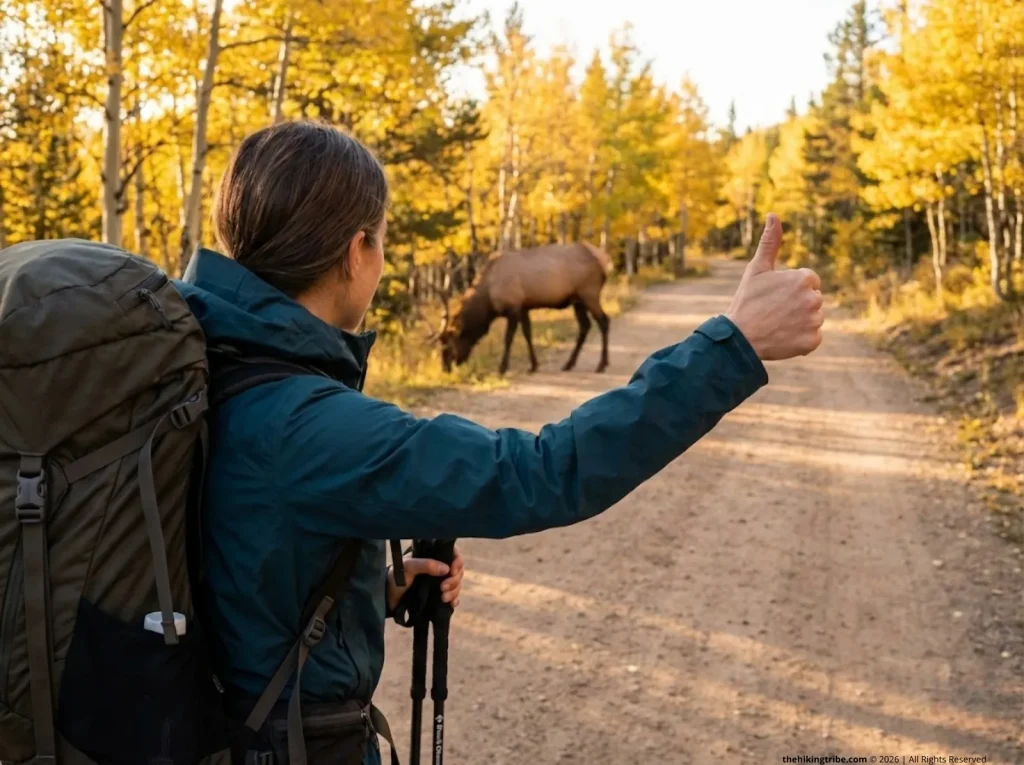
Dawn on the Yellowstone River Trail. A cow elk stepped onto the single-track ten yards ahead—ears pinned, nostrils flared. My hiking partner reached for his phone. I grabbed his arm. That animal was already deciding whether to charge or bolt, and ten yards was close enough to guarantee neither option ended well for us.
After years of leading groups through bear country and elk corridors, I’ve watched more hikers blow safe wildlife distance rules than I can count. Most don’t even know they’re breaking the law. The fine is up to $5,000 and six months in jail—but the real cost is the animal that gets euthanized after one too many close encounters taught it that humans mean food.
This guide breaks down the exact wildlife watching distance rules that hikers violate most often on trail. You’ll learn how to measure distance without any tools, read an animal’s stress signals before the situation goes sideways, and build wildlife respect into every mile of your hike.
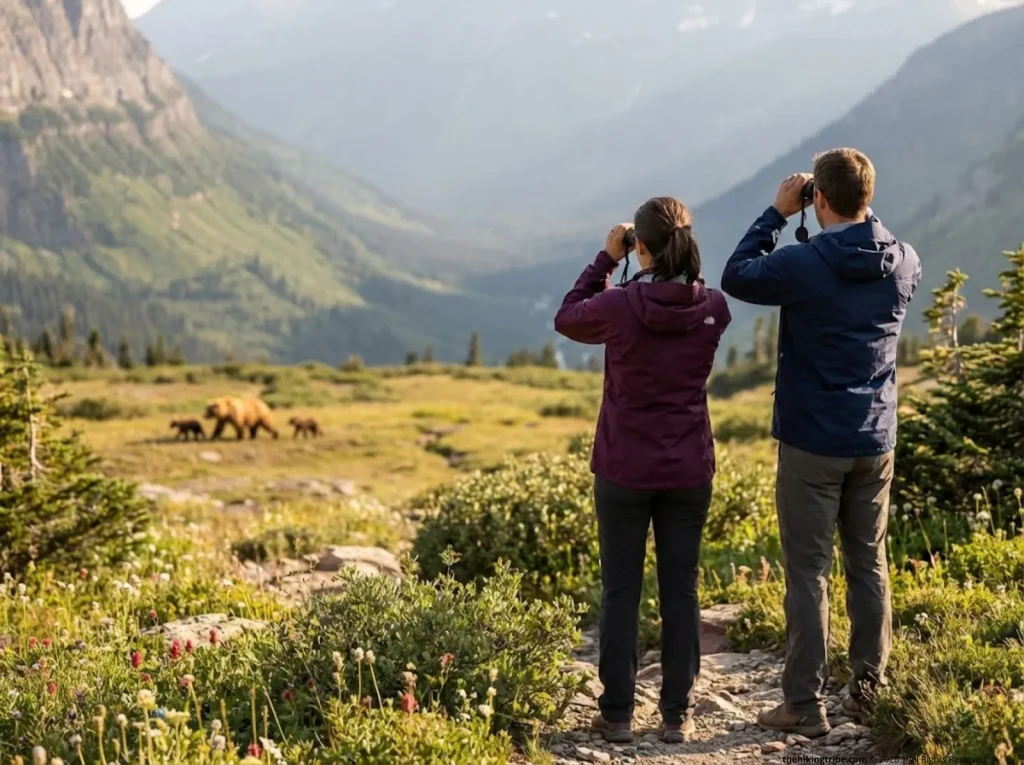
⚡ Quick Answer: The NPS requires 25 yards (~2 bus lengths) from most wildlife and 100 yards (~8 bus lengths) from bears and wolves. To check instantly on trail: extend your arm, raise your thumb, close one eye. If the animal isn’t completely hidden behind your thumb, you’re too close—back away slowly. Individual parks often set stricter rules, so check the Superintendent’s Compendium before every trip.
The 25-Yard and 100-Yard Rules Nobody Follows
Where the Numbers Come From
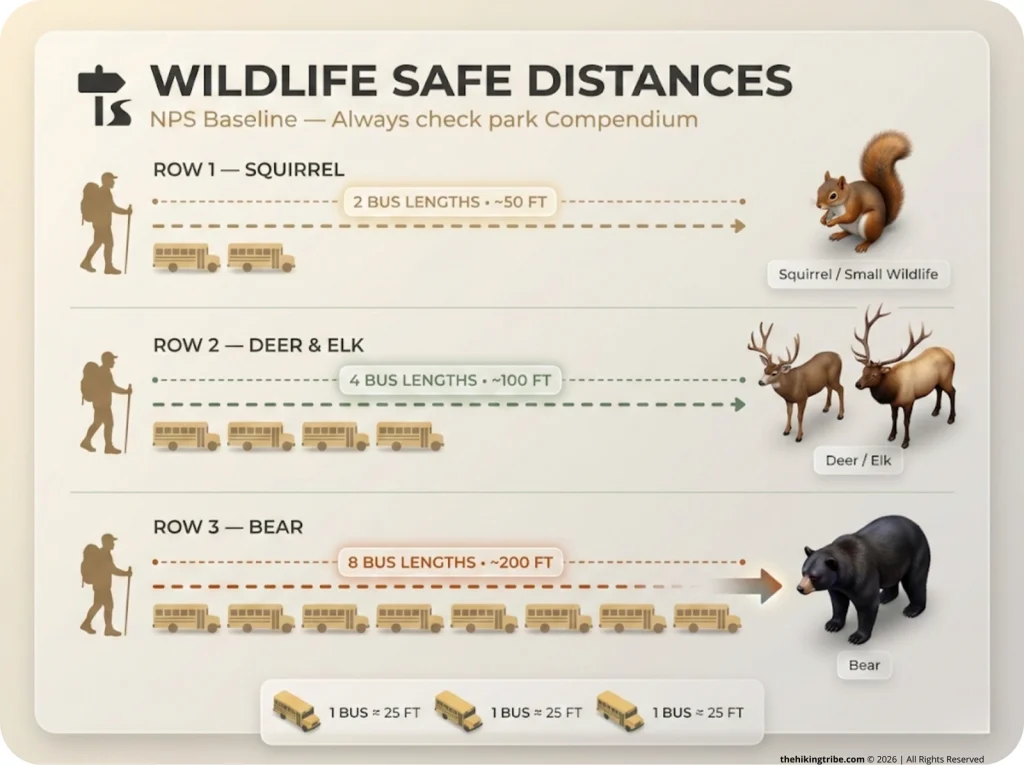
The National Park Service sets two baseline distances that apply across every unit in the system: 25 yards from most wildlife and 100 yards from bears and wolves. Twenty-five yards translates to about 75 feet—roughly two school bus lengths. A hundred yards is 300 feet, or about eight buses lined up end to end.
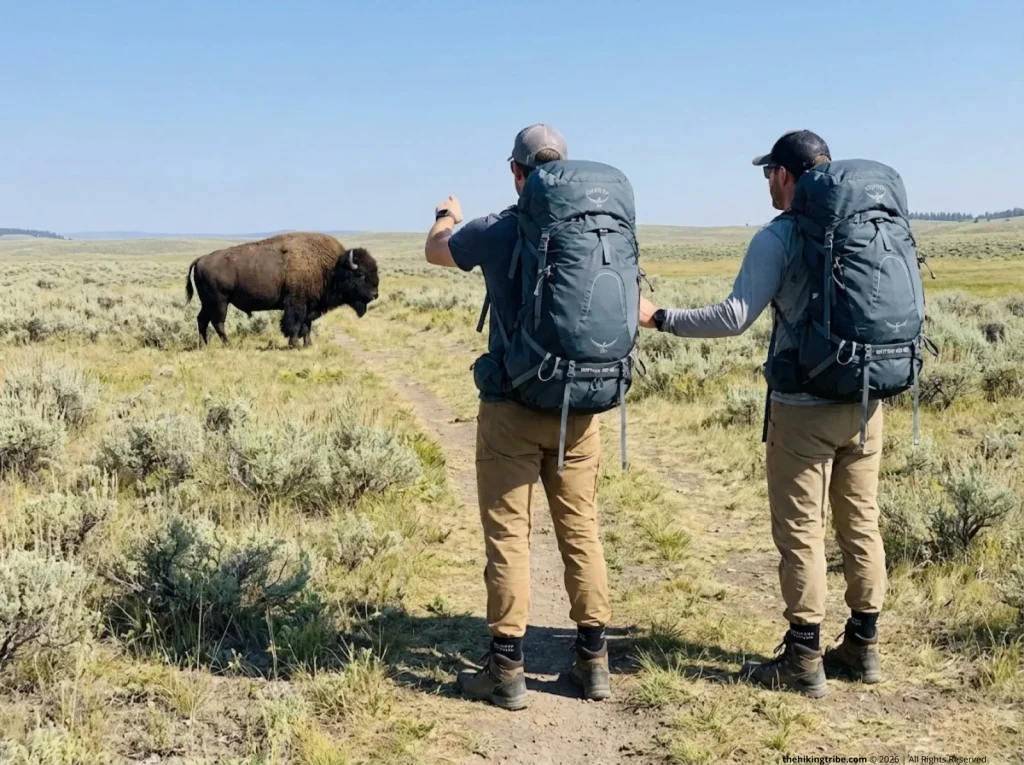
Those numbers sound generous until you consider speed. A bison covers 25 yards in under three seconds at full charge. An elk closes that gap even faster downhill. These aren’t “suggested minimums.” They’re federal law under 36 CFR § 2.2, which defines any disturbance to wildlife—including approaching too close for a photo—as a “take” violation punishable by fines up to $5,000.
The problem is that most hikers memorize “25 and 100” and think they’re covered. They’re not. Those are the floor, not the ceiling.
Why Bison Hurt More People Than Bears
Bison cause the majority of wildlife injuries in Yellowstone—more than grizzlies, more than elk. Nearly every incident happens the same way: a visitor walks within 25 yards for a photo, the bison charges, and someone ends up airlifted. NPS spokeswoman Charissa Reid put it plainly: “We don’t want people to change the animals’ behavior.”
That quote is the whole rule in one sentence. If the animal changes what it’s doing—stops feeding, stares at you, shifts its weight in your direction—you’ve already crossed the line. You didn’t need to touch it or feed it. Your presence alone caused the disturbance, and that’s enough for a citation.
Pro tip: If an animal looks calm, that doesn’t mean you’re at a safe distance. “Calm” might mean it hasn’t noticed you yet. Watch for subtle shifts—head turning, ears rotating, weight redistribution—before assuming you’re fine.
The Park-Specific Trap
Here’s where experienced hikers still get caught. Every park publishes a Superintendent’s Compendium with park-specific regulations that override the 25/100 baseline. Olympic National Park requires 50 yards from all wildlife—no exceptions. Shenandoah bumps the bear distance to 150 feet. Ridgefield National Wildlife Refuge sets 100 feet from elk and deer and says never approach mountain lions at all.
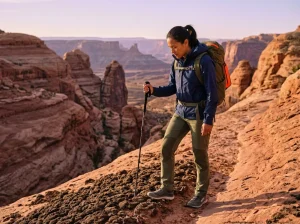
Hikers who memorize the NPS baseline and stop there get blindsided by stricter local rules. Before every trip, pull up the Compendium for your destination. Takes 30 seconds on your phone and saves a $150 fine—or worse. If you can identify animal scat on the trail, you’ll know which species are active in your area before you round a blind corner, and you can adjust your alertness accordingly.
The Thumb Rule That Replaces Guessing
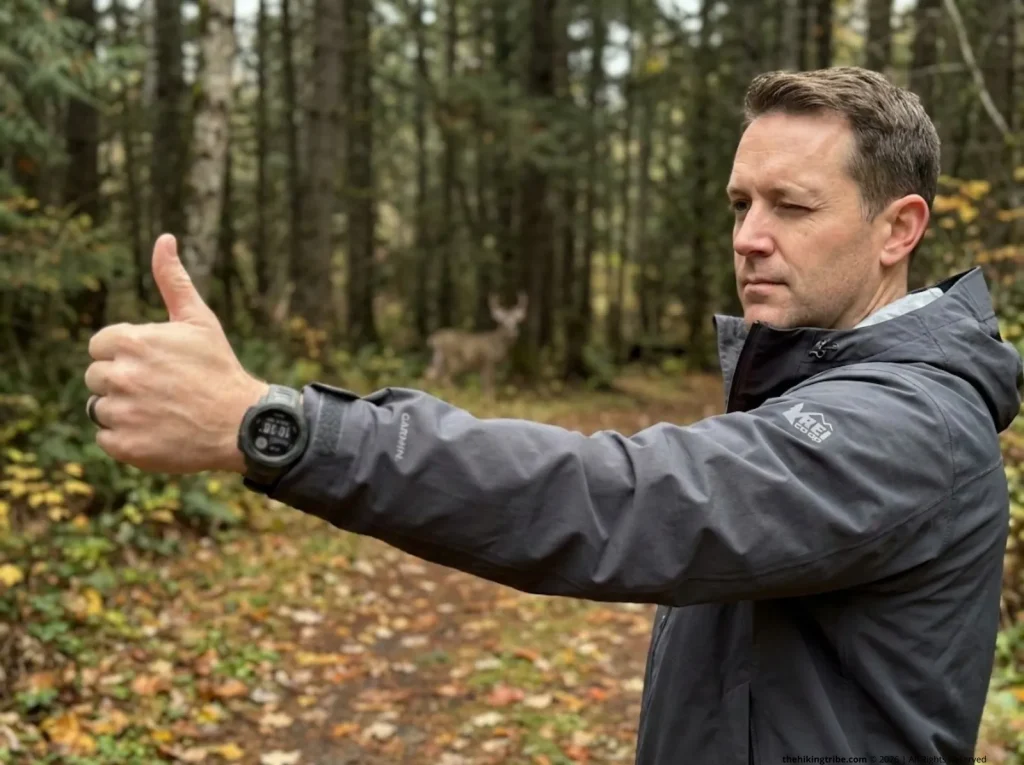
How the Thumb Test Works (Step by Step)
Most hikers have no reliable way to judge 25 yards on a trail. Pacing it off means walking toward the animal—exactly the wrong move. The thumb rule fixes this without any tools.
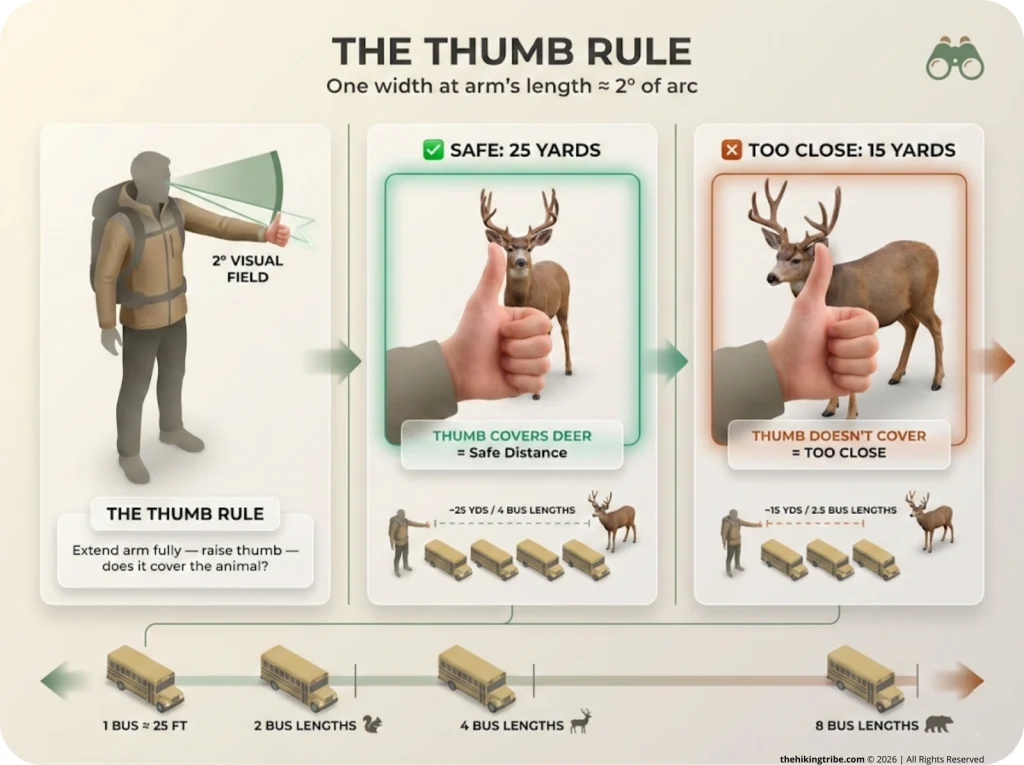
Extend your arm fully. Raise your thumb. Close one eye. If the animal is completely hidden behind your thumb, you’re at a safe distance. If any part of the animal is visible beyond your thumb’s edge, you’re too close. Back away immediately.
Here’s the simple version of why it works: your thumb at arm’s length blocks a small slice of your vision. At the right distance, that slice is bigger than the animal. At the wrong distance, the animal sticks out past your thumb on both sides. Colorado State University researchers tested this method across four national parks and found that teaching it—combined with messaging like “protect yourself” instead of scare tactics—increased visitor compliance by at least 16% in three of the four parks.
You don’t need a rangefinder. You don’t need an app. You need your arm and your thumb. That’s it.
When the Thumb Rule Fails
Dawn and dusk compress depth perception. Low light makes it harder to judge whether your thumb actually covers the animal or just seems to. In these conditions, scan with binoculars first, then thumb-test from where you stand. Don’t walk closer to “get a better look.”
Fog and heavy rain are worse. If you can’t see the animal clearly enough to run the thumb test, you’re operating blind. Assume you’re too close and act accordingly. The safest move is to stay put, make noise, and let the animal move off on its own.
Pro tip: Always scan with binoculars first before committing to a viewing spot. If you spot wildlife at range, thumb-test from where you stand—don’t walk closer to check. The animal you can barely see is the one at a safe distance. The one you can see clearly without optics probably isn’t.
Reading Stress Signals Before the Animal Reacts
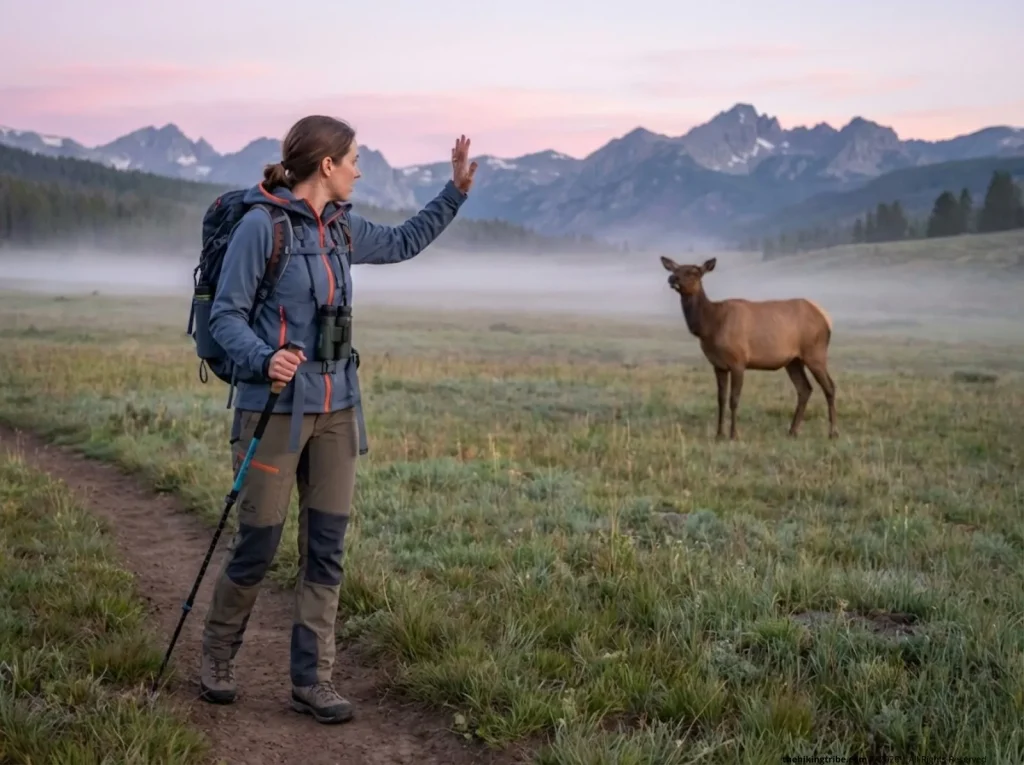
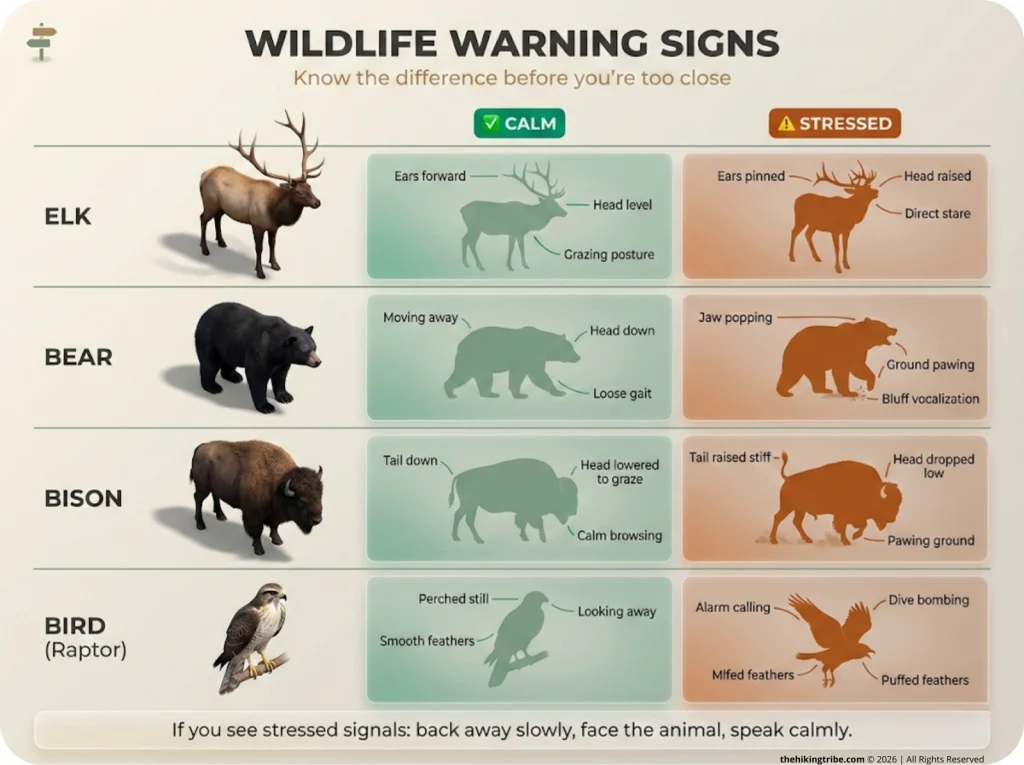
Universal Warning Signs Across Species
The distance rules exist for a reason, but animals don’t read signs. A deer might tolerate you at 20 yards one day and bolt at 40 the next. What matters isn’t the tape measure—it’s the behavioral change. The NPS says it directly: “If animals react to your presence, you are too close. If you’re close enough for a selfie, you’re definitely too close.”
Here’s what to watch for across every species you’ll encounter on US trails. Direct staring means the animal has identified you as a potential threat and is assessing. An elk that pins its ears or a bear that starts jaw-popping is past the assessment stage and moving toward a defensive response. Huffing, ground-pawing, and weight shifting toward you are final warnings. Head-bobbing in birds and tail-slapping from beavers serve the same function—they’re telling you to leave.
The damage most hikers never see is the silent kind. A bird that abandons its nest because you walked too close. A doe that flees from a fawn hidden in grass. Those outcomes don’t make the news, but they stack up across thousands of visitors per season.
The 30-Minute Observation Limit
Even at safe distance, your presence takes a toll. NOAA guidelines recommend limiting observation of any individual animal or group to 30 minutes maximum. That sounds generous, but most hikers blow right past it without realizing—especially with a camera.
Research compiled by Earthwise Aware found that human presence alone disturbs large mammals like elk and moose at distances up to 3,300 feet—that’s more than half a mile. Birds show behavioral changes at up to 1,300 feet. The 25-yard rule protects you from getting charged. The 30-minute observation limit protects the animal from the kind of slow, invisible damage—disrupted feeding, abandoned territory, constant low-grade alarm—that you’ll never see from the trail.
Most hikers who say they’re “not bothering” the wildlife are causing stress they have no way to observe.
What “Back Away Slowly” Actually Means
When you realize you’re too close, here’s the protocol. Face the animal. Do not turn your back. Take slow, deliberate steps backward. Speak in a low, calm voice so the animal tracks your retreat and doesn’t get startled by a sudden movement.
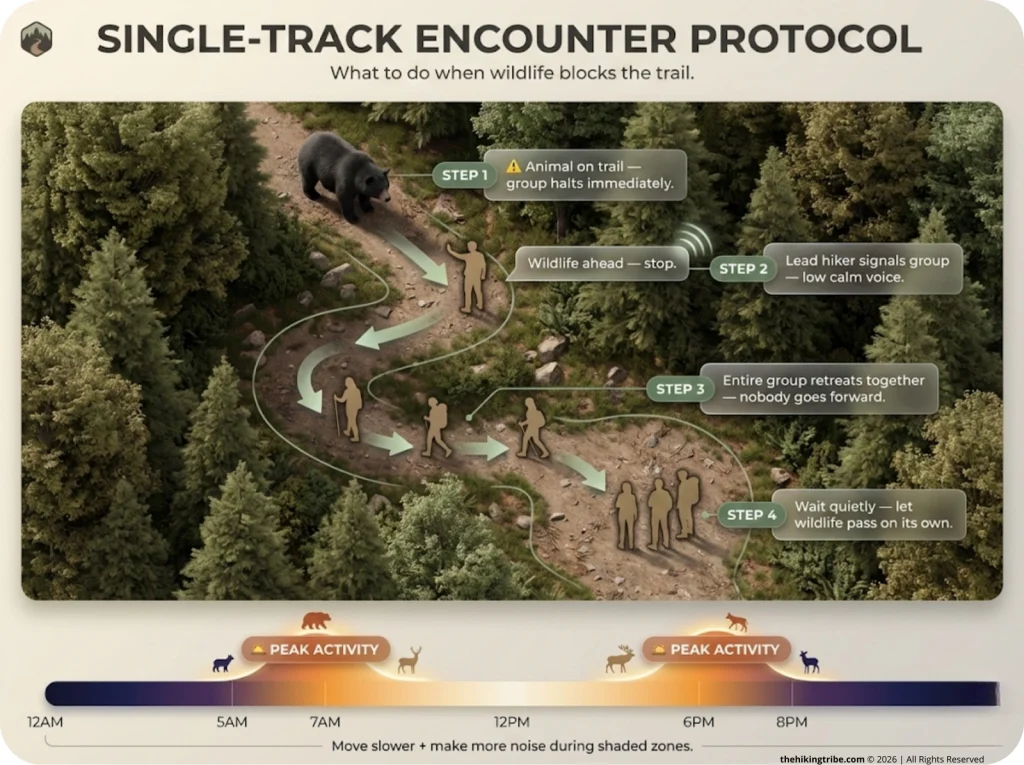
On narrow single-track, the entire group backs up together. The person in front calls “wildlife ahead” and everyone reverses. Never send one person forward to “check” while others wait—that isolates the most vulnerable hiker between the group and the animal.
If backing away doesn’t de-escalate, having your bear spray deployment speed dialed means the difference between a close call and a hospital visit. A chest holster puts spray in your hands within two seconds. A bear spray canister buried in your pack is worthless.
Pro tip: Never yield uphill to wildlife on a switchback. Back down the way you came. You need the animal above you, not charging downhill at you where gravity adds speed and you lose footing.
Species Distance Table Every Hiker Should Carry
No competitor publishes a consolidated species-specific distance table for trail animals. They all list “25 and 100” and call it done. Here’s the reference card that actually belongs in your pack.
Large Mammals (Highest Risk)
Bears (grizzly and black) demand 100 yards minimum across every NPS unit—no exceptions, no “but it looked calm.” Wolves get the same 100-yard buffer. Bison technically fall under the 25-yard rule, but treating 50 yards as your working minimum is smarter given their charge speed and unpredictability.
Elk and moose show the most variation between parks. The NPS baseline is 25 yards, but Olympic requires 50, and Ridgefield NWR sets 100 feet specifically for elk and deer. If a bull elk has its ears back and is walking toward you, the distance on paper doesn’t matter—you move.
Mountain lions get their own category: never approach. If you see one, make yourself large, maintain eye contact, speak loudly, and back away slowly. Don’t run. Running triggers pursuit instinct.
Having proper bear-proof food storage options sorted before you hit the trail is the other half of bear safety. Distance rules protect you during encounters. Wildlife-resistant food storage prevents encounters from happening in the first place.
Medium and Small Wildlife
Mule deer, whitetails, and coyotes all fall under the standard 25-yard rule. Yes, squirrels, marmots, and pikas too—even the “cute” ones. LNT guidance uses the bus-length comparison: two buses for smaller wildlife, four buses for deer and elk.
Snakes demand a different calculation. Rattlesnakes and copperheads can strike at roughly two-thirds of their body length—which means a six-foot minimum on trail. Give them wide berth and don’t poke them with trekking poles. That’s not safe distance management. That’s provocation.
Birds and Nesting Areas
The general rule is 25 yards from all wild birds, but raptors at nest sites can trigger defensive behavior at 100 yards or more. Some wildlife refuges require 300 feet during nesting season. Ground-nesting species like plovers and terns are nearly invisible—their eggs look like rocks. The best protection for them is staying on established trails, which keeps you away from nests you’d never spot anyway.
If a bird starts head-bobbing, alarm-calling, or dive-bombing, you’re in its territory. That’s not aggression—it’s a parent defending eggs or chicks. The correct response is to leave immediately, not stand there filming.
Food, Trash, and the Habituation Cycle That Kills Animals
Why “Just Crumbs” Gets Animals Killed
Feeding wildlife—including unintentional crumbs and unsecured trash—is illegal under 36 CFR § 2.2. It’s also the single fastest path to getting an animal killed. Here’s the chain: human food creates association. Association creates approach behavior. Approach behavior creates aggression. Aggression creates a dead animal—euthanized by rangers who have no other option once habituation sets in.
A single granola bar wrapper can start that sequence. A cooler left open during a bathroom break can finish it. Leave No Trace Principle 6 (Respect Wildlife) extends to every scrap that leaves your pack, every crumb that falls off your spork, every wrapper that escapes your pocket. The official Leave No Trace Respect Wildlife principles spell out exactly why food management and wildlife conservation are the same conversation. If you want the full picture of how LNT connects to every trail decision you make, see the full Leave No Trace ethics framework.
Trail Camp Food Storage Protocols
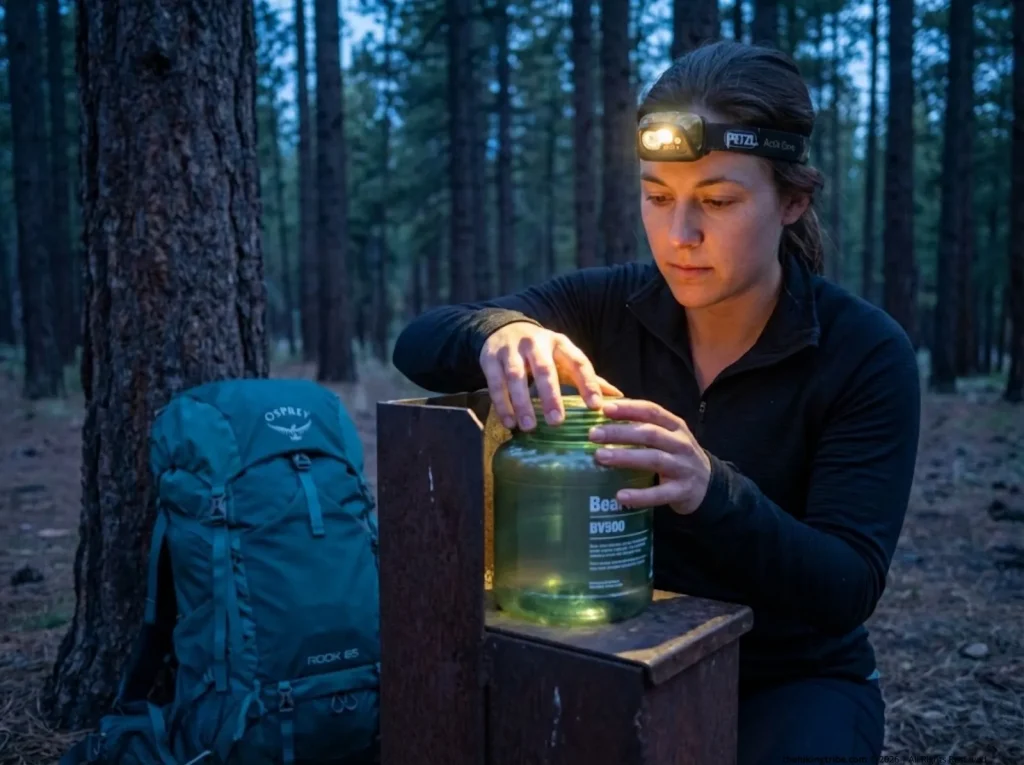
Bear canisters are required in many wilderness areas—check regulations before you go. Where they’re not required, hang food using the PCT method: 200 feet from camp, 10 feet high, 4 feet from the trunk. Cook and eat 200 feet downwind from your sleeping area. These aren’t suggestions. They’re the buffer between you sleeping through the night and a black bear pawing through your vestibule at 3 AM.
Pro tip: Clean your cook pot like your life depends on it—because the bear that smells last night’s ramen at 3 AM doesn’t care that you’re sleeping. A single greasy pot can lure a habituated animal from a quarter-mile away. Scrub everything, strain dishwater through a bandana, and pack out the food particles.
Gear That Keeps You Close Without Getting Closer
Lightweight Binoculars for Backpackers
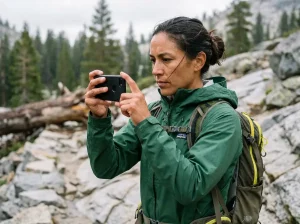
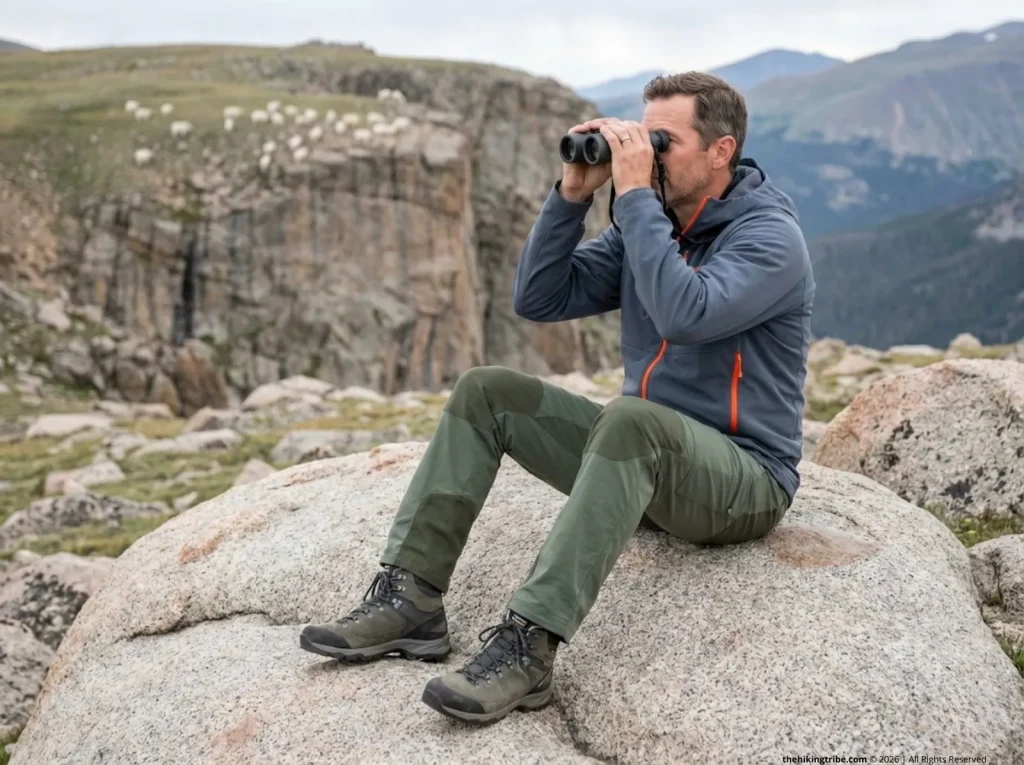
The NPS says “use your zoom lens.” They mean it literally—if the animal fills your phone screen without zoom, you’re dangerously close. The real solution is a pair of 8×42 compact binoculars that give you the magnification to enjoy wildlife from well beyond safe viewing distance without adding serious pack weight.
The sweet spot for backpackers is under 24 ounces. The Vortex Viper HD 8×42 at 23 ounces and the Nikon Monarch M5 are both field-proven choices that handle dawn and dusk light—exactly when wildlife is most active and encounters are most likely. Skip the ultra-compact 10x25s. They’re too narrow for scanning terrain and too dim once the light drops.
If you’re hiking solo, having binoculars matters even more. A solo hiker without optics relies entirely on their eyes to spot wildlife at range, which means the first alert is often a close encounter. Solid solo hiking safety protocols start with spotting animals before they spot you.
Phone Photography from Safe Distance
Your smartphone’s optical zoom maxes out at 3 to 5x—functionally useless beyond 25 yards. Clip-on telephoto attachments extend that range to 10x or 20x, but they add bulk and produce mediocre results. The best strategy is digiscoping: hold your phone to one eyepiece of your binoculars and shoot through the optic. It takes practice, but the results beat any phone zoom at wildlife distances.
The bottom line: if the animal fills your phone screen without zoom or binoculars, you’ve broken the distance rule. Period.
Narrow Trails, Dawn Patrols, and Surprise Encounters
Single-Track Wildlife Protocol
Every government website assumes you’re standing in an open meadow with room to sidestep. On a narrow single-track trail through dense spruce with your pack scraping branches on both sides, you can’t maintain 25 yards. The trail geometry dictates your options.
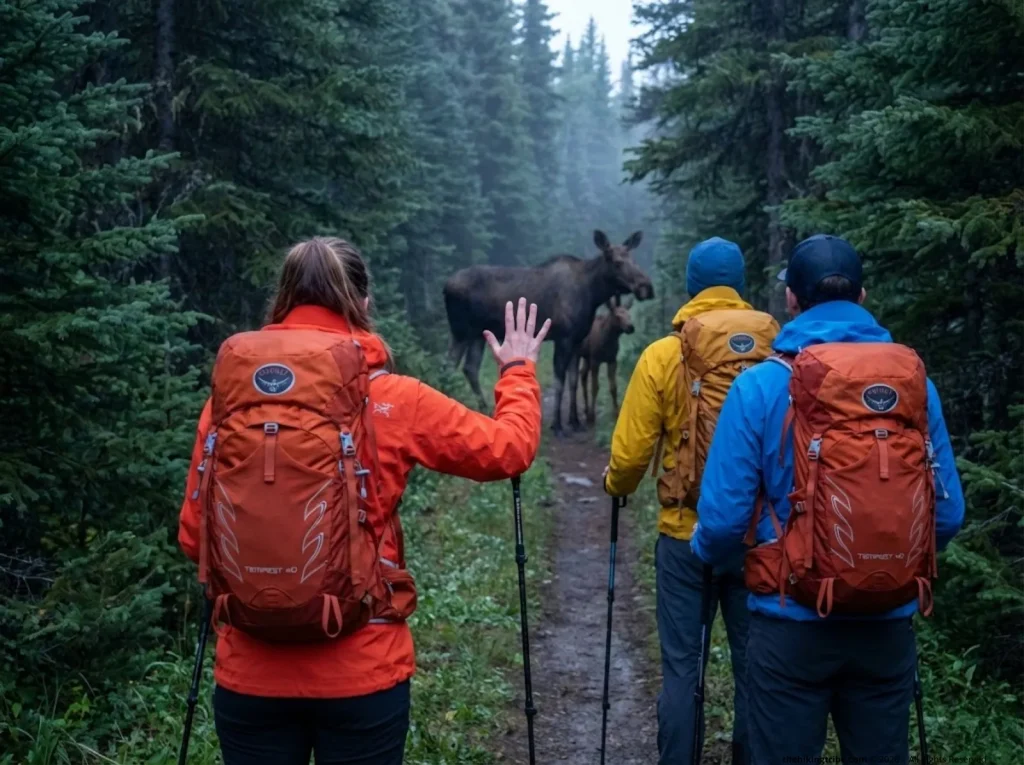
If wildlife is ahead on the trail: stop. Assess the animal behavior—is it moving away, stationary, or coming toward you? Back up to the nearest wider section of trail—a switchback, a clearing, a junction—and wait. Let the animal move off on its own timeline. Patience is the cheapest safety tool you’ll ever carry.
If wildlife appears suddenly at close range—around a blind corner, over a ridge—freeze. Don’t spin around. Don’t shout. Assess the animal’s behavior for two seconds, then speak calmly and start backing away. Group protocol: the person in front calls “wildlife ahead” and the entire group backs up together. Never split the group. That isolates people and removes the size advantage that keeps large animals cautious.
Dawn, Dusk, and Fog Encounters
Animals are most active at dawn and dusk—precisely when hikers start and finish their days. Low light compresses depth perception. That dark shape at 20 yards could be a boulder or a black bear, and by the time you resolve the difference, you’re already inside the distance threshold.
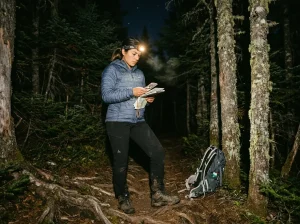
Make noise during low-visibility hours. Talk, clap, or use bear bells. In fog, cut your pace in half and scan trail edges where animals bed down. Your headlamp beam at dawn can startle wildlife—switch to red light mode when possible, which preserves your night vision and produces less animal disturbance. The NPS wildlife viewing safety guidelines reinforce this approach: give animals room, stay on trails, and let the animal dictate the encounter—not your camera.
The hikers who get surprised on trail are almost always the ones moving fast and quiet through low-light conditions. Slow down. Make noise. Let the ecosystem know you’re coming. That’s not weakness—it’s how experienced backcountry travelers have stayed safe for decades.
Conclusion
Three rules cover 90% of what goes wrong between hikers and wildlife on trail.
The 25-yard and 100-yard rules are federal minimums, not suggestions—and your park may be stricter. Check the Superintendent’s Compendium before every trip. It takes 30 seconds and removes every excuse.
The thumb rule takes two seconds and zero gear. If the animal isn’t hidden behind your thumb at arm’s length, you’re too close. Back away. No photo is worth a citation, a charge, or an animal that has to be put down because one too many hikers made the same mistake.
Wildlife safety isn’t just about you. Every crumb left behind, every selfie attempt, every “just one more step closer” contributes to habituation that gets animals killed. The distance you keep today protects the encounter someone else will have tomorrow.
Next time you spot wildlife on trail, resist the phone reflex. Raise your thumb instead. That two-second test is the boundary between a clean encounter you’ll remember for years and one that ends with a ranger citation—or a bear that never gets another chance.
FAQ
What is the thumb rule for wildlife distance?
Extend your arm fully, raise your thumb, and close one eye. If the animal is completely hidden behind your thumb, you’re at a safe distance. If any part of the animal is visible beyond your thumb, back away slowly until it’s fully covered. Your thumb blocks a small slice of your vision that’s proportional to the animal’s size at safe distance.
What happens if you get too close to wildlife in a national park?
You can be cited under 36 CFR § 2.2 with fines up to $5,000 and six months in jail. Beyond legal consequences, approaching too close causes animal stress and habituation. Animals that lose their natural fear of humans may become aggressive and get euthanized by park rangers.
How far should you be from a bear on the trail?
The NPS requires a minimum of 100 yards (300 feet, approximately eight school bus lengths) from bears and wolves in all national parks. Some parks require greater distances. Never approach a bear for any reason—if one approaches you, remain facing the animal and back away slowly while speaking in a low, calm voice.
Can you watch wildlife with binoculars instead of getting closer?
Binoculars are the NPS-recommended solution. An 8×42 pair weighing under 24 ounces lets you observe wildlife in detail from well beyond safe distance, even at dawn and dusk. Digiscoping through binoculars with your phone produces better wildlife photos than walking closer with a phone camera.
Why is feeding wildlife dangerous?
Feeding wildlife—including leaving crumbs or unsecured trash—is illegal under federal law and starts a chain of habituation that often ends with the animal being put down. Animals that associate humans with food lose their fear, approach aggressively, and rangers have no choice but to remove them. A single food wrapper can start this cycle.
I've spent more than a decade researching hiking gear and trail technique. I read the specs, the forum threads and the long-term reviews, and every pick here comes with what it gets wrong.
End of the trail
You read every mile of this one. Here's where the trail goes next.