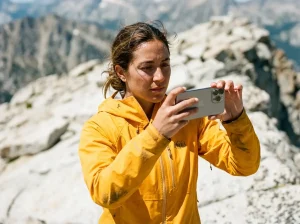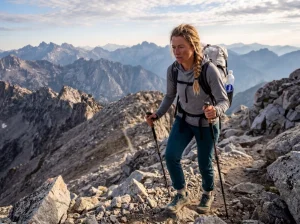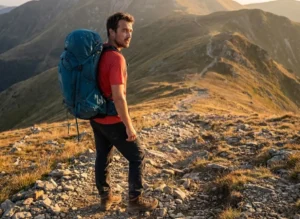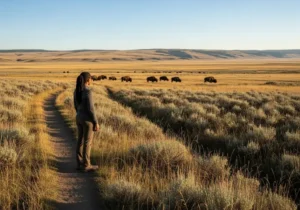
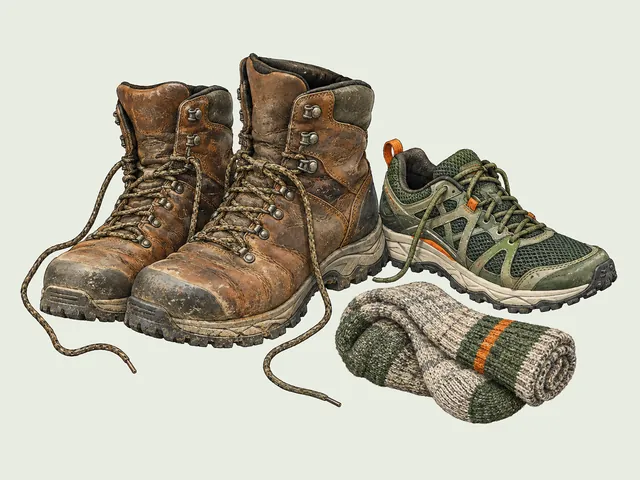
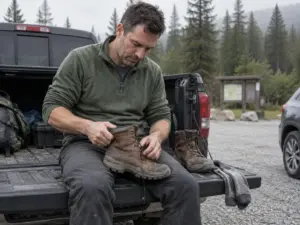
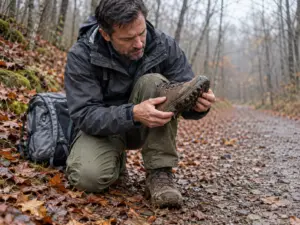
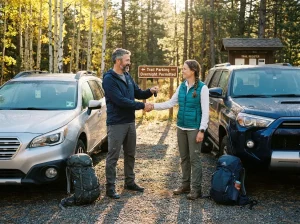
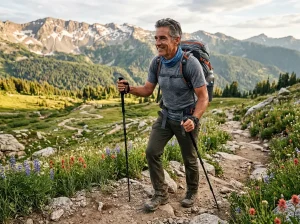
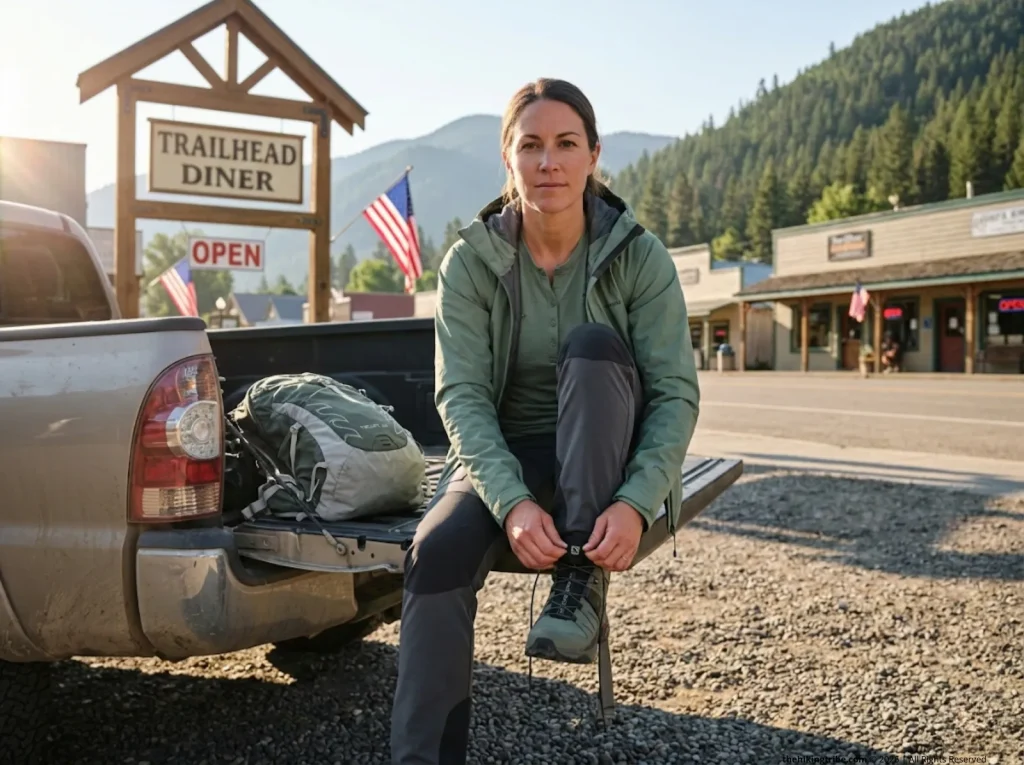
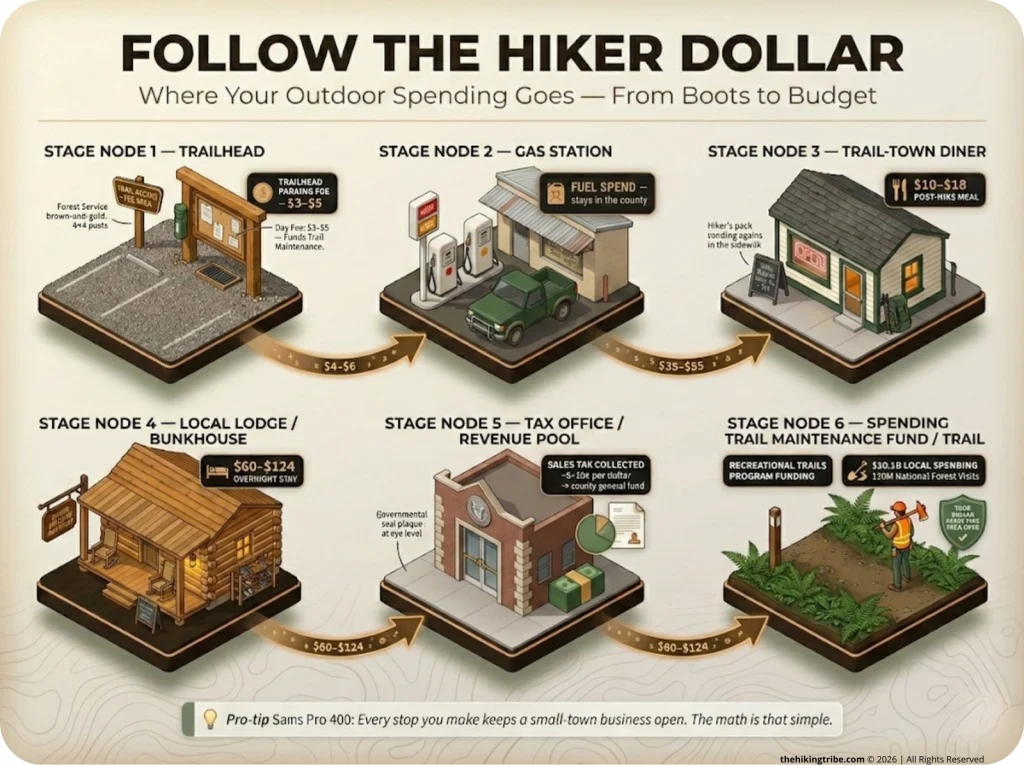
You pull into a gravel parking lot outside a one-stoplight town, lace up your boots, and hit a 6-mile loop through ridge forest. Four hours later you sit at the only diner in town, boots unlaced under the table, dropping $14 on a burger and a local IPA. You do not think about it. But that $14, plus your gas, your trailhead coffee, and your campground fee, just became the single biggest reason that diner still exists.
After years of hiking through gateway communities from the gorges of Kentucky to the timber towns of Washington, I have watched this pattern repeat. Your boots on a trail feed the same small-town economy that keeps the trail maintained. The numbers behind it are staggering, and they tell a story most hikers never hear.
This piece breaks down exactly where your outdoor recreation spending goes when you hike, shows you the hard data from the Bureau of Economic Analysis and on-the-ground case studies, and explains why responsible hiking is the best economic investment small towns never had to ask for.
⚡ Quick Answer: Outdoor recreation generated $639.5 billion in value added (2.3% of U.S. GDP) in 2023 and supported 5 million jobs. Your single day hike pumps real dollars into gateway communities through gas, food, lodging, and gear purchases. The average overnight hiker spends $124 per visit on lodging alone. Responsible hiking practices like Leave No Trace protect the trail quality that keeps this economic engine running for decades.
The Numbers Behind Your Bootprints
$639.5 Billion and Counting
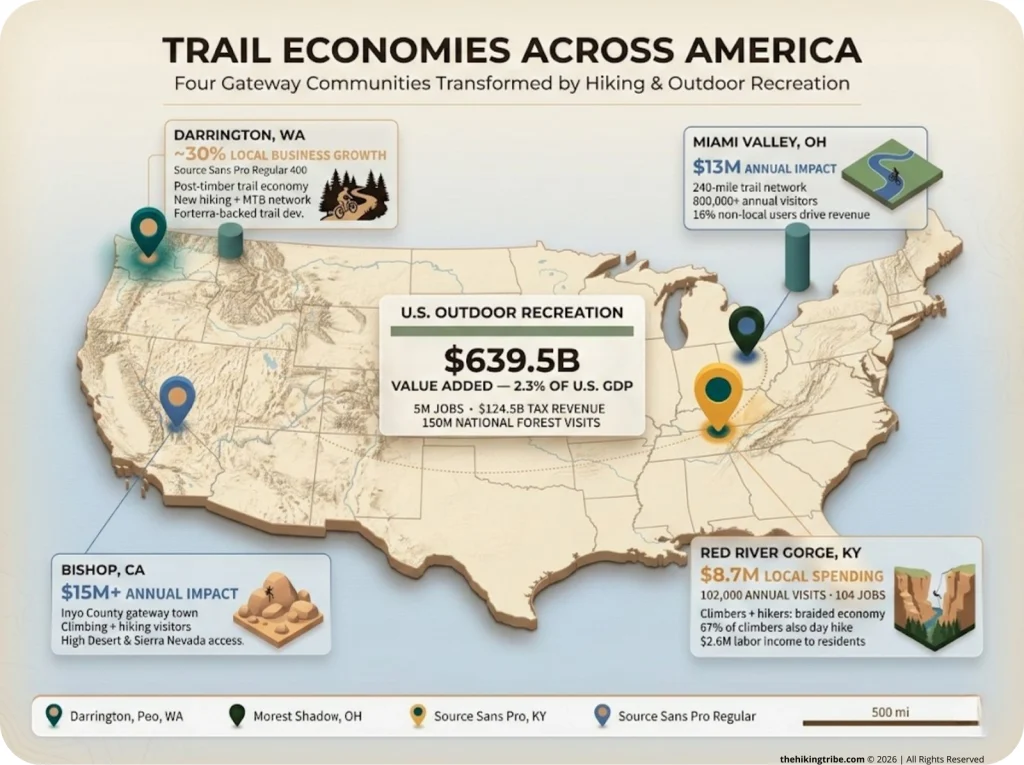
The outdoor recreation economy is not a side hustle for the United States. It is a pillar. According to the latest Bureau of Economic Analysis data, outdoor recreation generated $1.2 trillion in gross output and $639.5 billion in value added in 2023. That is 2.3% of the entire U.S. GDP, and the outdoor recreation sector grew 3.6% that year, outpacing the overall economy at 2.9%.
Those are not abstract numbers. They translate into 5 million American jobs, 3.1% of the workforce, and $124.5 billion in tax revenue. The state and local tax revenue share of that haul sits at roughly $59 billion. Every time you fill up gas near a trailhead, you contribute to that pool.
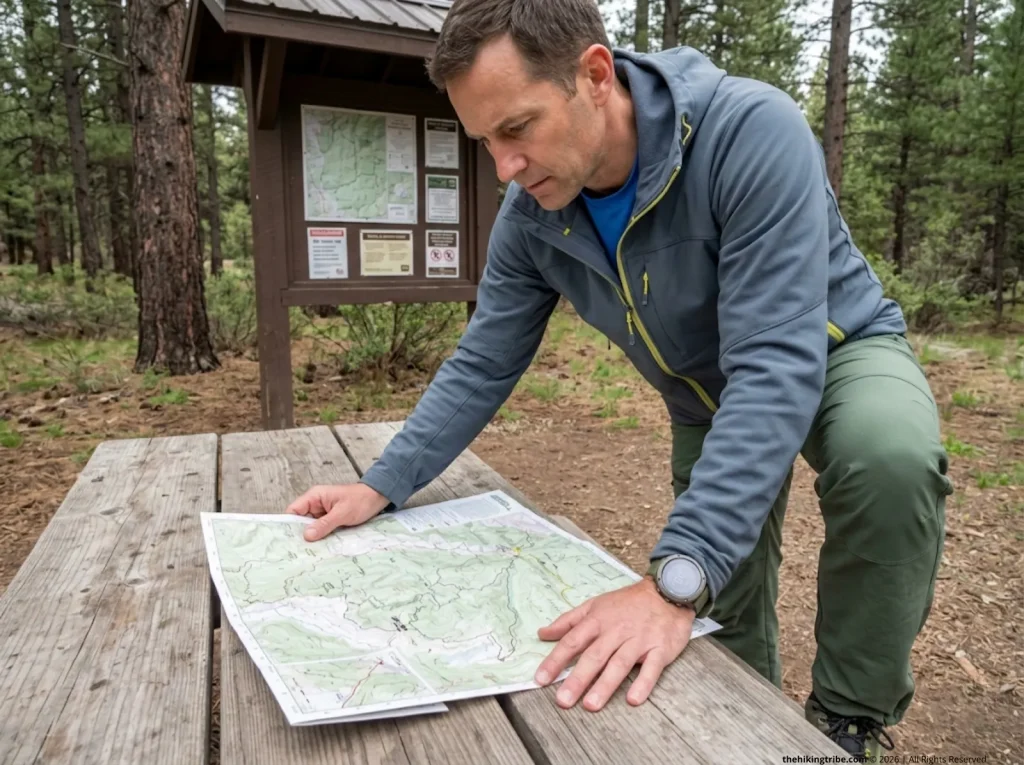
Pro tip: You do not need to summit a 14er to matter economically. Even a 3-mile loop through a county park feeds the local tax base through parking fees, gas purchases, and that post-hike snack run.
Where Hiking Fits in the $1.2 Trillion Picture
Not all outdoor activities carry the same weight. The BEA breaks recreation into subcategories, and “climbing, hiking, and tent camping” contributed $7.465 billion in value added on its own. Trail sports showed 6% growth year-over-year, making it one of the fastest-growing segments in the entire outdoor industry.
More than 175.8 million Americans participated in recreational activities in 2023. On national forest land alone, 150 million visits generated $10.1 billion in local spending and supported 153,800 jobs. These are real paychecks in real communities, and they trace directly back to people who lace up boots and walk into the woods.
The story of the evolution from survival walking to a $639 billion recreational economy only makes the numbers more striking. Hiking went from a necessity to an industry, and the communities built around trails know it.
Why These Numbers Undercount Hikers
The BEA figures are conservative. They exclude resident spending and zero-expenditure visits. The economic multiplier effect, where restaurant wages get re-spent at grocery stores and hardware shops, adds layers that the top-line numbers miss. Day hikers often get lumped into broad “trail sports” buckets with no individual attribution. The actual economic impact of dedicated hikers is almost certainly higher than any single report suggests.
Follow the Dollar From Trailhead to Town
The $124 Gateway Spend
Here is where it gets personal. An Eastern Kentucky University study on Red River Gorge trail users tracked exactly where visitor spending goes. Climbers and hikers staying in hotels spend an average of $124 per visit on lodging alone. Across 102,000 annual visits, Red River Gorge generates $8.7 million in local spending, supports 104 jobs, and puts $2.6 million in labor income into the pockets of people who live there.
Here is the detail most people miss. Sixty-seven percent of climbers at the Gorge also do day hiking on the same trip. The climbing and hiking economies are braided together. Those bunkhouses, restaurants, and gear rental shops that have multiplied along the gorge roads over the past decade exist because people like us show up with boots and appetite.
Day Visitor vs. Overnight Multiplier
Not every hiker stays overnight. Non-local trail-town visits generate roughly $18 to $55 per party in travel spending on food, gas, and retail. Add an overnight stay and the number jumps to $124 or more. The Miami Valley trail system in Ohio, a 240-mile network including the Little Miami and Great Miami River Trails, illustrates this split. Sixteen percent of its 800,000+ annual users come from outside the region, and they drive the network’s $13 million annual direct economic impact.
The “zero night” hiker, the one who hits the trail and drives home, still feeds local gas stations, diners, and gear shops. Every stop counts. Consider budget-conscious gear choices that still support local outfitters as part of your trailhead spending plan.
Pro tip: Fill up gas and buy snacks at the last independent store before the trailhead. Chain stations send profits out of town. That $4 coffee at the local place stays in the community.
The Multiplier Effect
When you spend $14 at a trail-town diner, the server spends part of her wages at the grocery store down the road. The grocer pays local suppliers. Those suppliers pay rent. IMPLAN models used in economic impact reports show that every $1 in direct consumer spending can generate $1.50 to $2.00 in total local economic activity. Gateway communities capture these ripple effects when hikers choose local businesses over chain stops at the highway interchange.
Trail Towns That Prove the Math
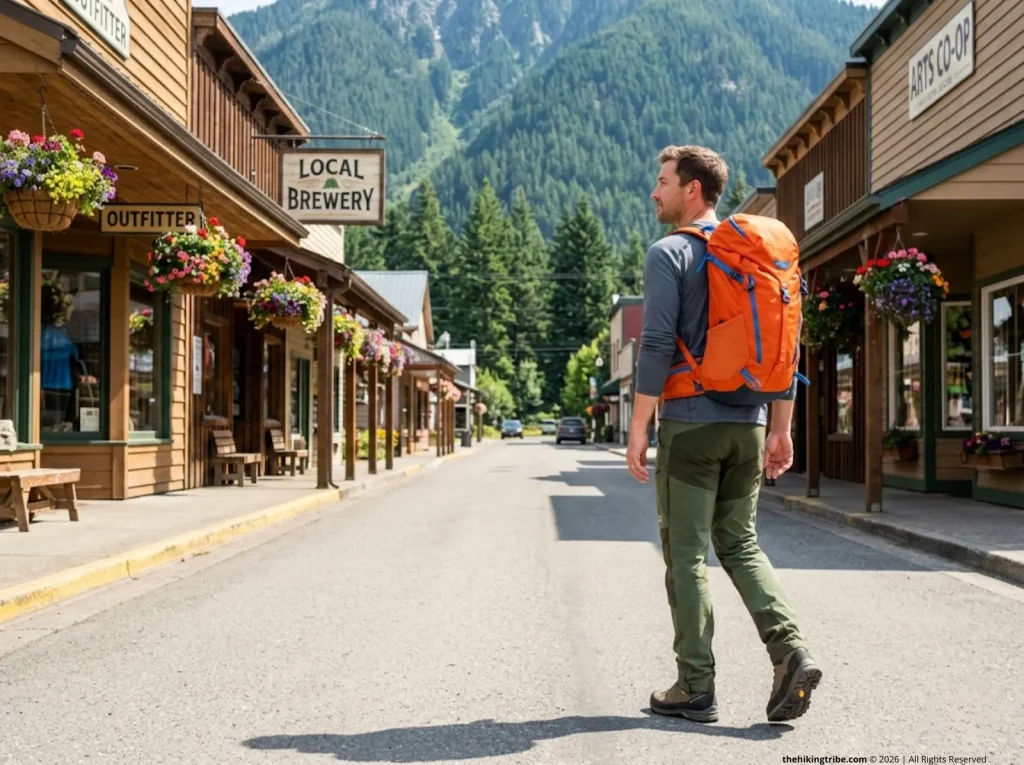
Darrington, WA — From Landslide to Trailhead Economy
In 2014, the Oso landslide devastated Darrington, a small timber town in Washington. The traditional logging economy was already shrinking. Then the trails came. New mountain bike and hiking trails developed with support from Forterra drove roughly a 30% increase in local business activity. A town that lost its primary industry found a new one, one that arrives on foot, spends money, and comes back next season. That is rural resilience written in boot tread.
Miami Valley, OH — 240 Miles of Economic Infrastructure
The Miami Valley Trails function less like a recreation amenity and more like outdoor recreation infrastructure. The network’s $13 million annual impact comes from 800,000+ visits, with trail-adjacent businesses reporting measurable local revenue tied directly to user traffic. Multi-use trail networks connecting rural communities create economic corridors, not just places to walk.
Red River Gorge, KY and Bishop, CA
The Red River Gorge numbers bear repeating because they are among the most detailed in the country. At 102,000 visits with $8.7 million in spending and 104 outdoor recreation jobs, this gateway economy is built entirely around trail and cliff access. Bishop, California, shows a similar pattern. Climbers and hikers in Inyo County contribute more than $15 million annually to the local economy.
Behind all of these examples stand public lands. Bureau of Land Management recreation areas contributed $11.8 billion in economic output and 76,000 jobs in FY2023. U.S. Forest Service lands generated $10.1 billion in local spending from 150 million recreation visits. These are the free infrastructure that powers gateway communities. If you are thinking about spreading your visits into shoulder season to sustain year-round visitor flow for these destinations, that instinct is exactly right.
Leave No Trace Is an Economic Strategy
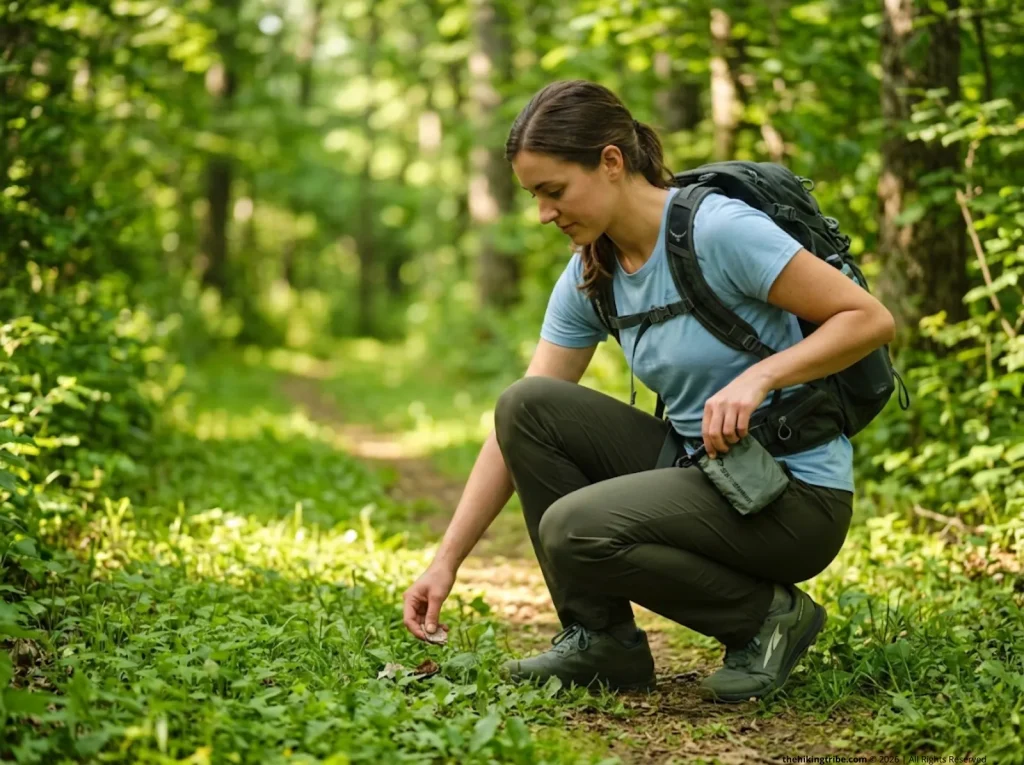
When Trails Degrade, Revenue Disappears
Most hikers think of Leave No Trace as an ethical obligation. It is that. But it is also an economic one. When trails degrade from overuse, erosion, and litter, repeat visitation drops. Trail closures for restoration mean zero visitor spending during the closure period. A single trail-braiding event from hikers cutting switchbacks can cost thousands in repair and months of lost access. The outdoor businesses that depend on steady hiker traffic absorb every dollar of that loss.
Understanding the soil mechanics behind how your footsteps shape trail longevity makes this connection concrete. Your boot pressure on healthy trail tread is not just a footprint. It is a vote for the diner at the bottom of the hill to stay open another year.
LNT as Long-Term Investment Protection
Hikers who practice responsible recreation preserve the resource that generates $639.5 billion in annual value added. Think of packing out your trash as paying forward the next hiker’s $14 burger. If the trail falls apart, the diner closes. Leave No Trace education also reduces the maintenance burden on underfunded land management agencies like the National Park Service and Bureau of Land Management, stretching thin budgets further.
According to BLM data on how the Great American Outdoors Act has transformed public lands and their economic output, federal investment in trail infrastructure directly supports the outdoor recreation economy. Every hiker choosing to stay on trail, pack out waste, and respect wildlife protects gateway revenue. Trail stewardship multiplies because one responsible hiker influences trail culture for dozens of others.
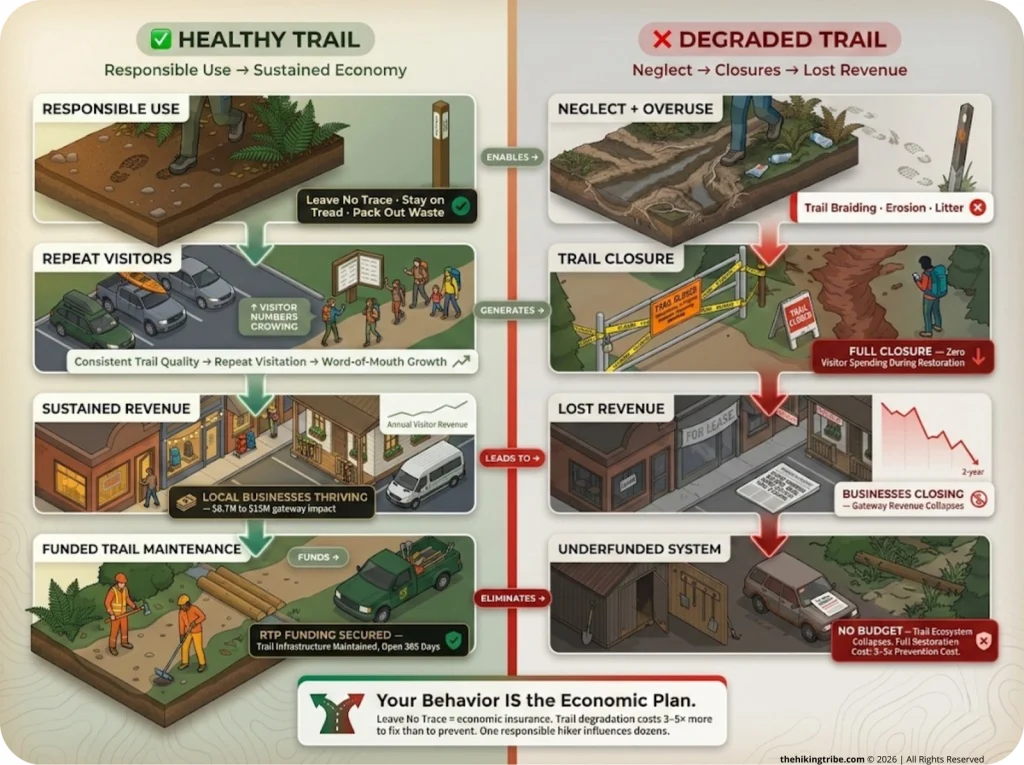
Pro tip: Think of LNT as economic insurance. The same trail that supports a $13 million economy today can only do it next year if you leave it the way you found it. Your trash bag is your premium payment.
Your Hiker’s Toolkit for Supporting Local Economies
At the Trailhead
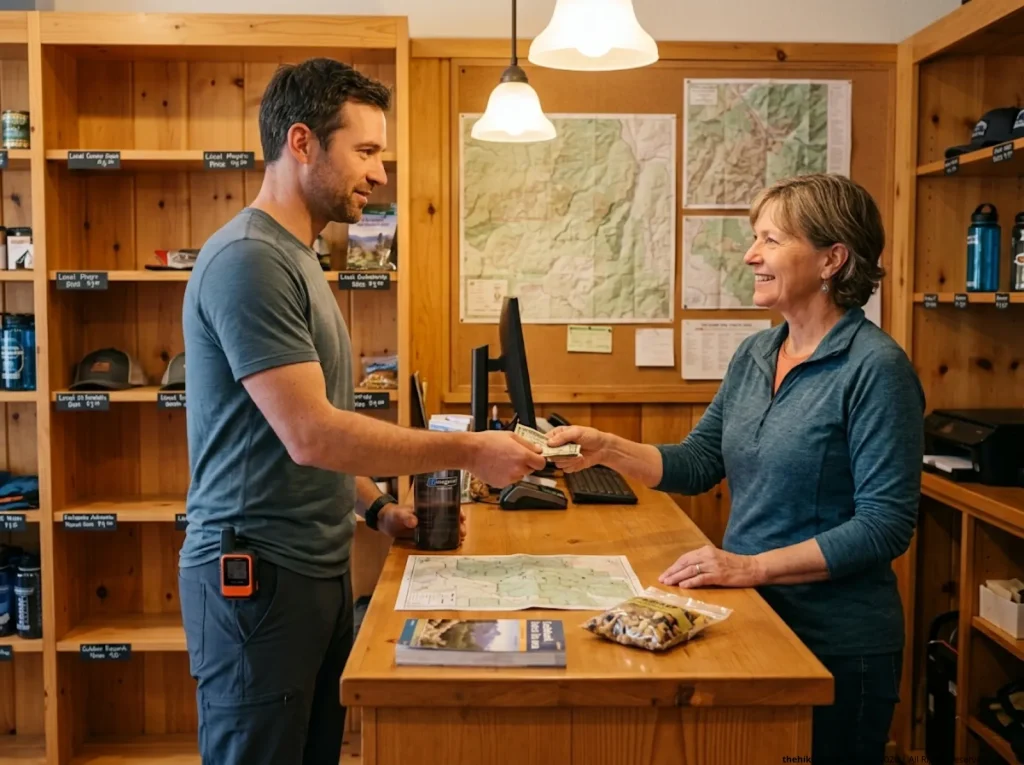
You do not need a policy degree to make a difference. Start at the trailhead. Fill up at the independent gas station, not the highway chain. Buy snacks and water at local convenience stores or farm stands. Pay your campground and parking fees because they directly fund trail maintenance and Recreational Trails Program budgets. “Town food” spending at local shops is the simplest and most direct way to pump money into a gateway community.
After the Hike
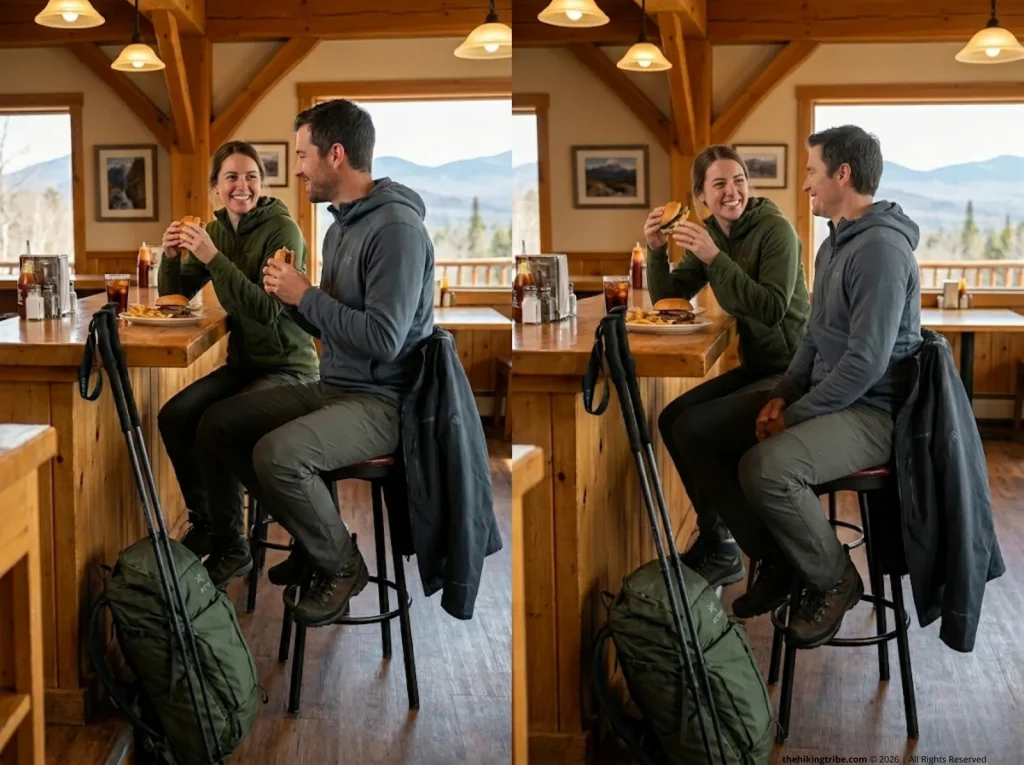
Post-trail, eat at the local restaurant instead of driving home hungry. Your $14 burger matters more than you think. Support local gear shops for minor resupply items like socks, sunscreen, and maps. Stay at locally owned lodges, campgrounds, or bunkhouses. Attend trail-town events like the GoPro Mountain Games or smaller community programs that concentrate visitor spending in one weekend.
Beyond the Dollar
Leave positive reviews that mention outdoor access, because that drives future visitors. Share trail-town experiences on social media, but be responsible about environmental conservation. Being thoughtful about managing microtrash on the trail keeps the resource attractive for the next hiker and the next tourist dollar. Volunteer for trail maintenance days. Your physical labor translates into saved tax dollars and healthier trail tread. Advocate for public lands funding at local meetings because your voice protects the economic engine that keeps these communities viable.
The Bigger Picture for Rural America
Trails as Rural Diversification
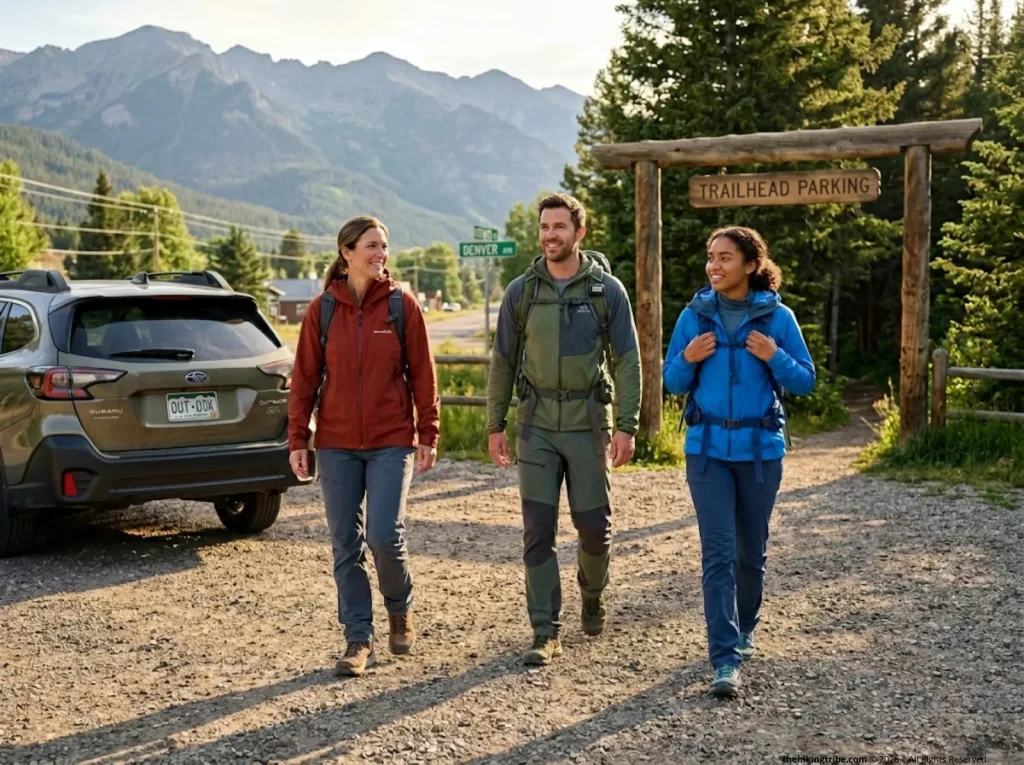
The pattern is clear across the country. Central Appalachian communities are pivoting to nature-based tourism as coal revenue dries up. Darrington’s model shows that trail redevelopment works as a post-coal recovery tool. Rail-trail conversions, where abandoned rail corridors become multi-use paths, create economic corridors that connect rural towns and pull visitor spending into places that need it most.
The outdoor recreation economy works as a rural diversification strategy because it does not require massive factory investment. It requires trails, clean water, and scenic landscapes. Many rural economies already have those assets. They just need the outdoor recreation infrastructure to connect hikers to local businesses.
The Equity Dimension
Outdoor access and outdoor recreation opportunities correlate with community economic health. The outdoor economy works best when it works for everyone. Federal programs like the Outdoor Equity Fund and the Recreational Trails Program channel investment to underserved communities, and the U.S. Forest Service data on national forest recreation and local economic impacts backs up the return on that investment.
Building a more inclusive outdoor community is not just the right thing to do. It is the economically smart thing to do. Every new hiker on a trail is a new customer at the gateway diner.
Pro tip: When you hike a trail in former coal country, you are literally walking on the economy’s new foundation. Spend accordingly.
Conclusion
Your day hike is not just exercise. It is a direct economic injection into gateway communities that generates job creation, tax revenue, and small-business survival. The data is unambiguous. Outdoor recreation adds $639.5 billion in value added to the U.S. economy, and trails are the free infrastructure that makes it work. Responsible hiking, local spending, and volunteer trail stewardship are not just the ethical choice. They are the economically rational one.
Next time you lace up, remember that every trailhead parking spot, every post-hike meal, and every locally bought pair of socks is a vote for the community that maintains the trail you love. Hike deliberately. Spend locally. The math works for everyone.
FAQ
How much does outdoor recreation contribute to the U.S. GDP?
Outdoor recreation generated $639.5 billion in value added in 2023, representing 2.3% of U.S. GDP. The sector supports 5 million jobs and generates $124.5 billion in tax revenue, according to the Bureau of Economic Analysis.
How much do hikers spend in local gateway communities?
Overnight hikers and climbers spend an average of $124 per visit on lodging alone. Day visitors spend $18 to $55 per party on food, gas, and retail. Across the Miami Valley trail network, visitors generate $13 million in annual direct economic impact.
What are examples of trails driving local economic growth?
Darrington, WA saw a roughly 30% local business increase after new hiking and MTB trails replaced lost timber jobs. Red River Gorge generates $8.7 million annually from 102,000 hiker and climber visits. Bishop, CA captures more than $15 million per year from gateway trail users.
How does Leave No Trace affect a trail town’s economy?
Leave No Trace practices preserve trail quality, which sustains repeat visitation and the visitor spending that gateway communities depend on. Trail degradation leads to closures and lost revenue. Responsible hiking protects the economic engine by keeping trails usable for decades.
Which states benefit most from outdoor recreation spending?
States with significant public lands and trail infrastructure, like Colorado, Montana, Wyoming, California, and Washington, capture disproportionate outdoor recreation value. Every state with trail systems benefits from visitor spending, with BEA reporting state-level data annually through the Outdoor Recreation Satellite Account.
I've spent more than a decade researching hiking gear and trail technique. I read the specs, the forum threads and the long-term reviews, and every pick here comes with what it gets wrong.
End of the trail
You read every mile of this one. Here's where the trail goes next.