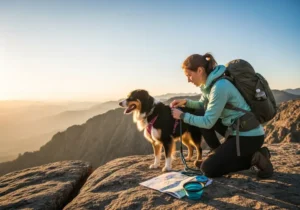

















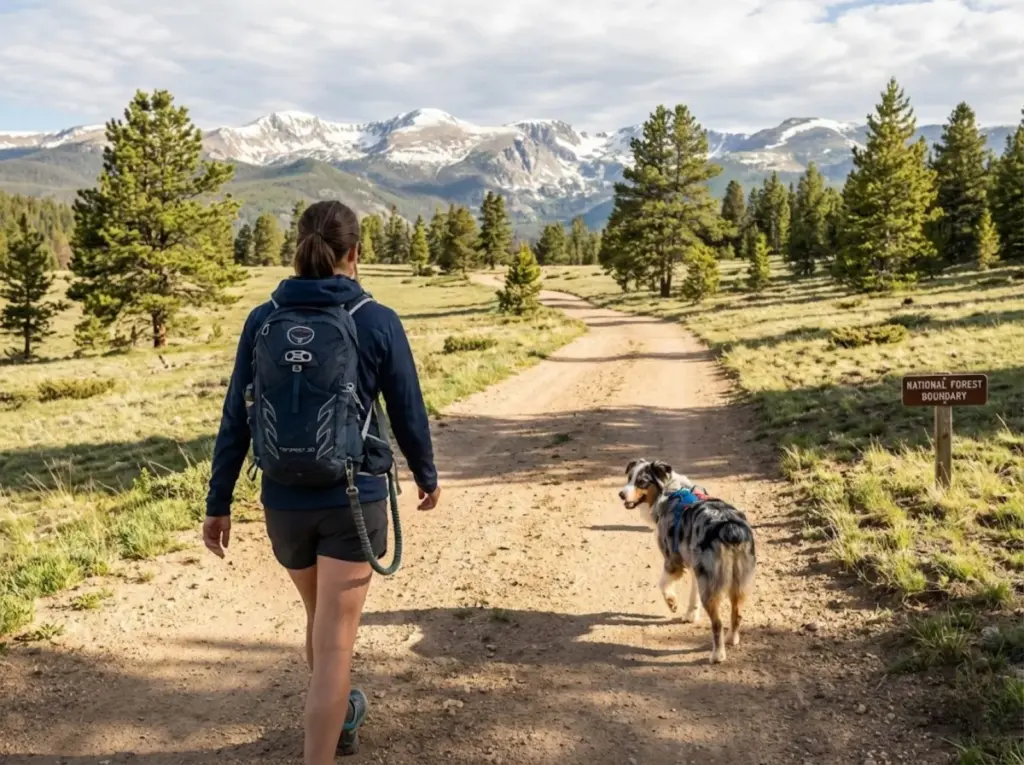
The ranger at the trailhead didn’t ask nicely. She pointed at the 6-foot leash balled up in my hand, then at my dog trotting 30 yards ahead on the fire road, and said: “That’ll be $150. This is Wilderness.” I’d crossed an invisible line from National Forest into a Wilderness Area, and the rules changed without a single sign. That ticket taught me something most dog hikers learn the hard way: “dog friendly trails” and “off-leash” are two completely different things.
After years of hiking with dogs across Colorado, Washington, and the Bay Area, I can tell you the rules are a mess—but they’re knowable. This guide breaks down the actual legal framework governing off-leash hiking across federal, state, and local jurisdictions so you know exactly where your dog can run free, where it can’t, and what happens when you get it wrong.
⚡ Quick Answer: Off-leash dog hiking legality depends entirely on the land management agency—not the trail name or state. National Parks prohibit dogs on nearly all trails. National Forests generally allow voice control off-leash but individual Forest Orders and Wilderness boundaries override this. BLM lands are the most permissive. Always check the specific agency’s pet policy and verify you’re not crossing into a different jurisdiction mid-hike by using the land ownership layer on Gaia GPS or Caltopo.
The Legal Hierarchy: Who Actually Makes the Rules
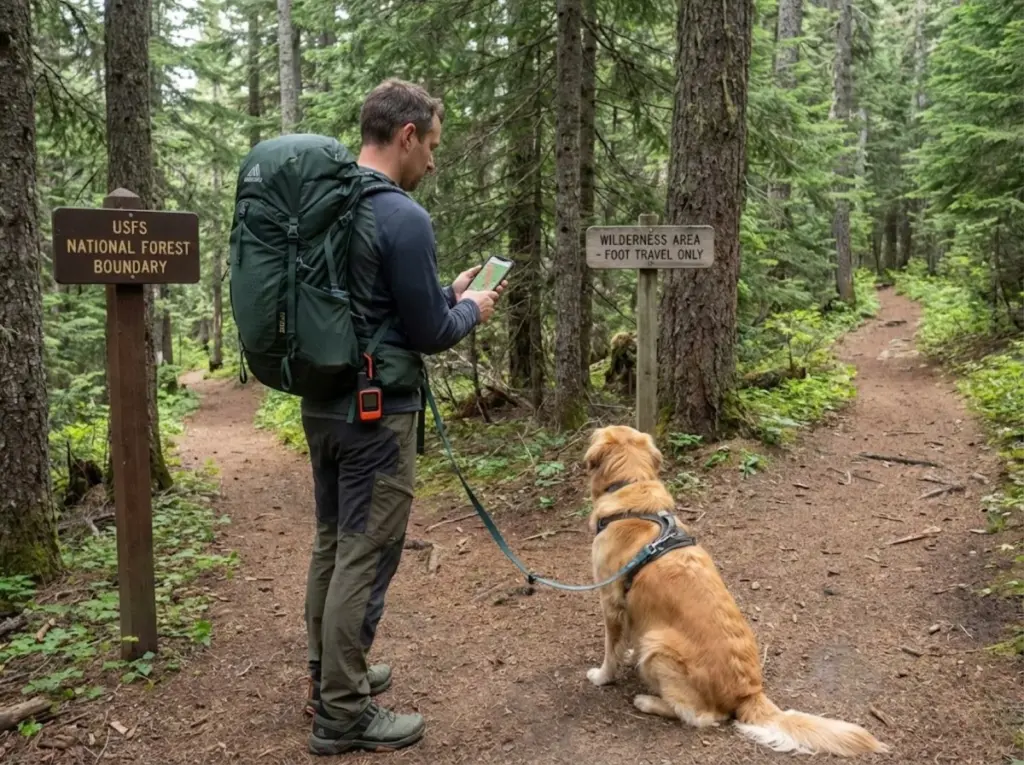
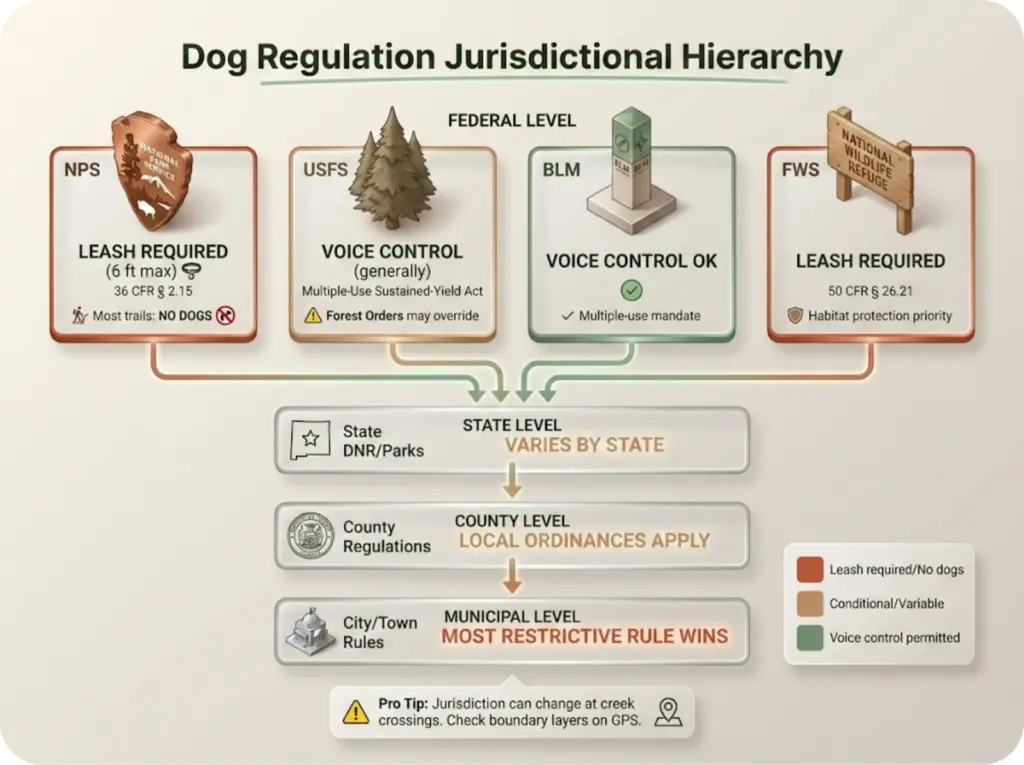
Here’s what most people get wrong about leash laws on trails: they assume the state makes the rules. It doesn’t. The agency that manages the land you’re standing on determines whether your dog can be off leash or not. And on a single 10-mile hike, you might cross three different jurisdictions without seeing a single posted notice.
How Federal Land Agencies Regulate Dogs Differently
The National Park Service (NPS) operates under 36 CFR § 2.15 pet regulations that prohibit dogs on nearly all trails. Where dogs are permitted at all, they must be on a leash no longer than six feet. No exceptions. This applies to places like Rainier, Olympic, and North Cascades—dogs are banned from every single hiking trail.
The U.S. Forest Service (USFS) takes a different approach. Under the Multiple-Use Sustained-Yield Act, dogs are generally allowed under voice control on non-Wilderness trails. But individual ranger districts issue Forest Orders that can override this general permission at any time. Just because you’re in a National Forest doesn’t mean every trail has the same rules.
BLM (Bureau of Land Management) lands are the most relaxed. The multiple-use mandate means dogs are generally permitted under voice control across most public lands. And then there’s U.S. Fish & Wildlife Service refuges, which are the opposite extreme—50 CFR § 26.21 mandates leashes with zero off-leash eligibility, because habitat protection trumps recreation.
Pro tip: Download the agency boundary layer on Gaia GPS before your trip. The line between “voice control OK” and “$150 fine” can be a single creek crossing. I’ve had it happen in Colorado where the Wilderness boundary was marked by nothing more than a small brown sign I nearly missed at hiking speed.
State and Municipal Layers: The Rules Inside the Rules
State Parks almost universally require leashes, mirroring the NPS six-foot standard. Washington State DNR lands like Mount Si and Tiger Mountain mandate leashes at all times with no voice control exception.
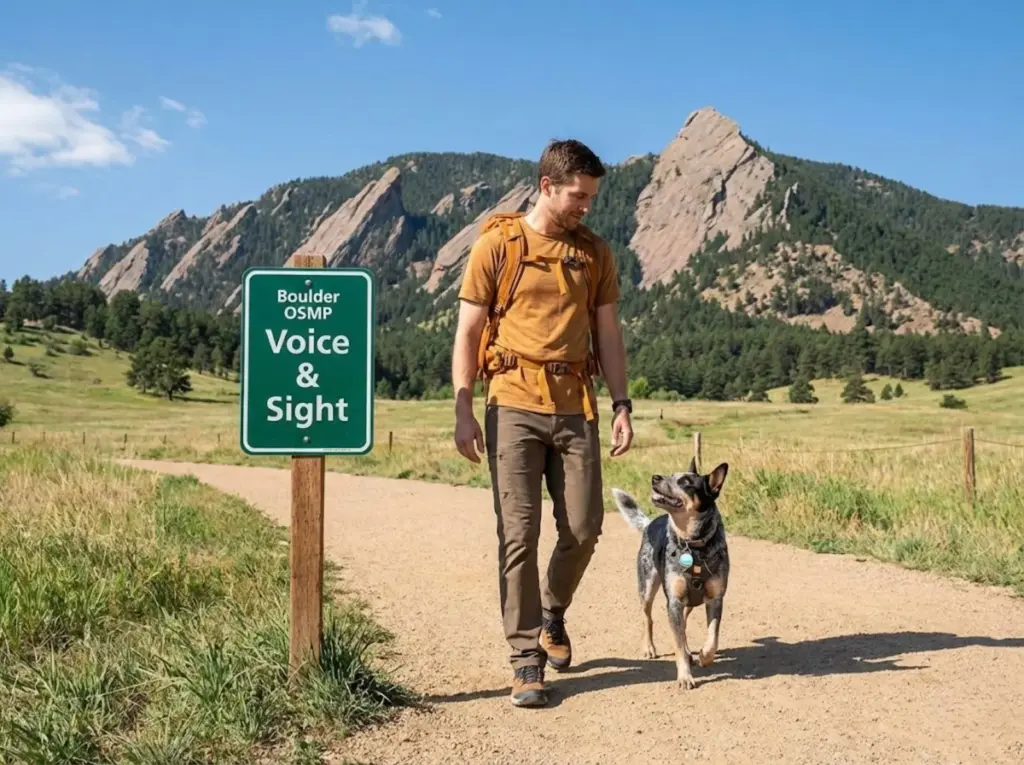
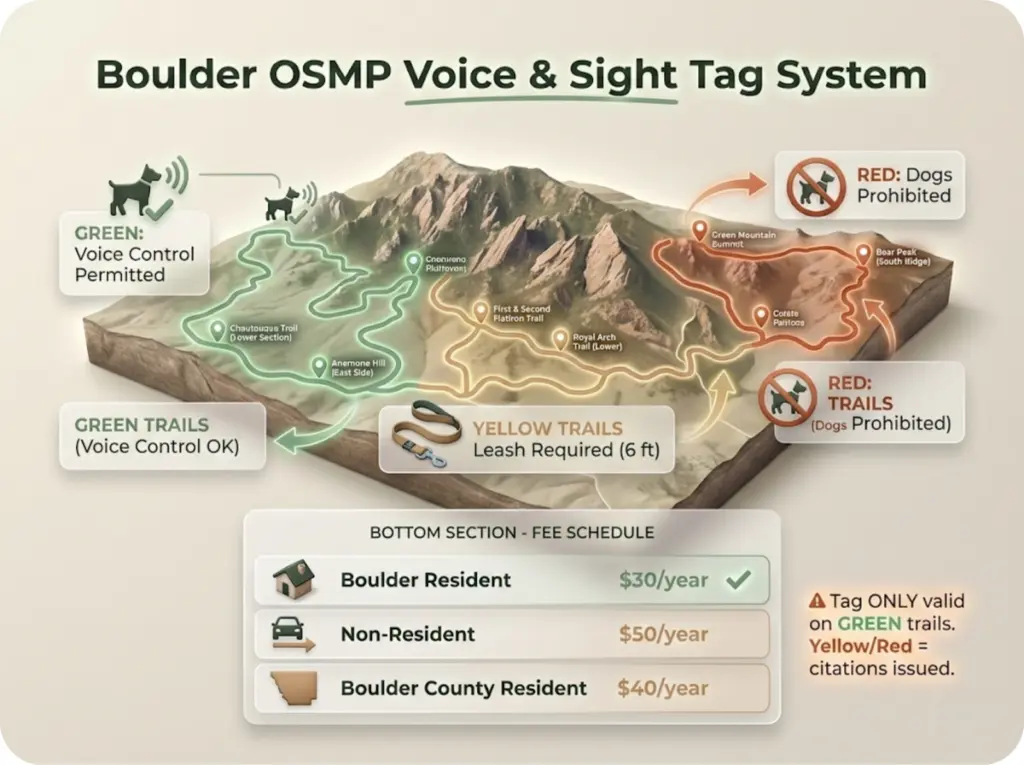
Then there are municipal systems that create their own categories entirely. Boulder Open Space & Mountain Parks runs the Voice & Sight Tag program—a color-coded trail system where Green means voice control is allowed for tag holders, Yellow means leash required for everyone, and Red means dogs prohibited entirely. The tag costs residents $13 initially with $5 annual renewal. It’s the closest thing to a working permit system that varies wildly between agencies that actually succeeds.
How to Determine Jurisdiction Before You Go
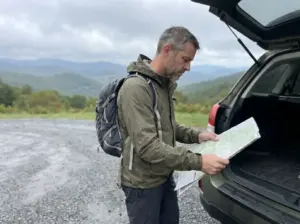
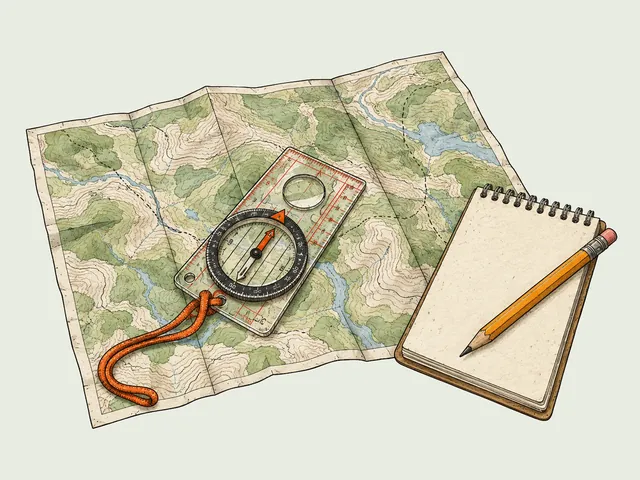
Check the land manager first, not the trail name. Use the “Land Ownership” layer on Caltopo or Gaia GPS. Then search the specific agency’s website for “pet policy” or “special orders.” Generic trail apps like AllTrails often list trails as “dog-friendly” without distinguishing leash requirements.
If your route crosses multiple jurisdictions, call the ranger district office directly. They’ll tell you exactly where the lines fall. Five minutes of homework beats a $150 ticket every time.
Voice Control: What It Actually Means Legally
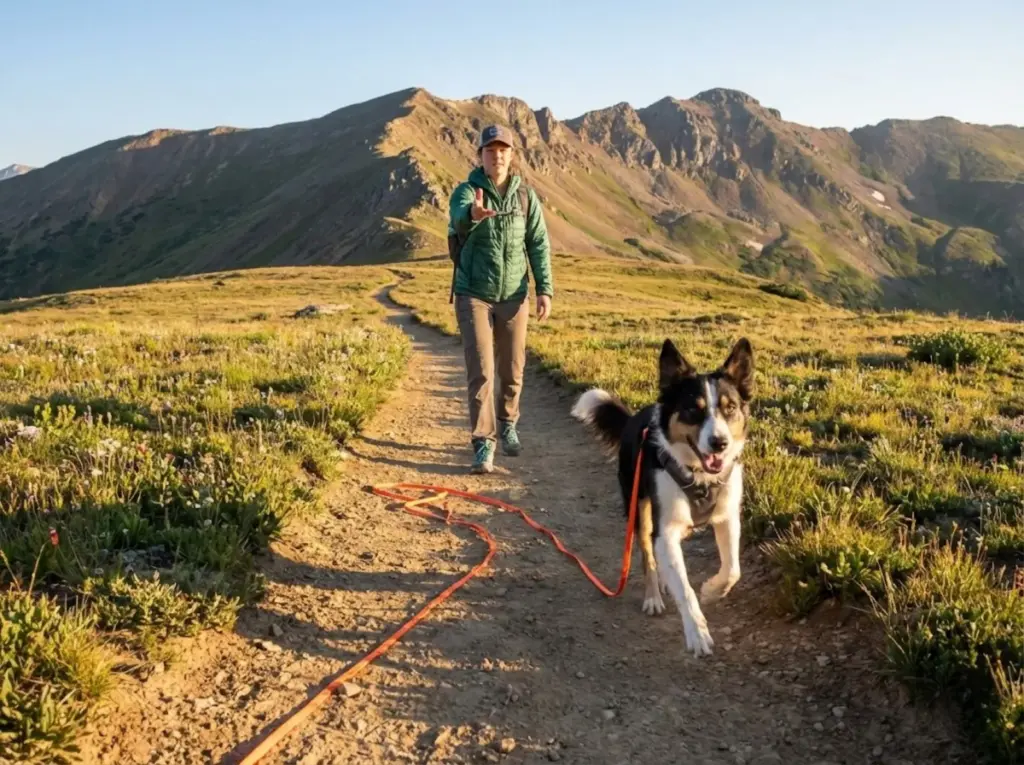
Most dog owners dramatically overestimate what “voice control” means in a legal context. It’s not “my dog usually comes when I call.” It’s a legal surrogate for physical restraint.
The Legal Definition Most Hikers Get Wrong
Under Boulder’s Voice and Sight control standards, your dog must remain within clear view, stay within 25 yards, and respond immediately to voice commands or hand gestures. Not on the second call. Not after they finish sniffing. Immediately.
If your dog chases wildlife, charges another hiker, or wanders behind a ridge where you can’t see them—they’re legally “at large” regardless of how well-behaved they are at home. And here’s the part nobody talks about: an unleashed dog running toward a stranger is legally problematic regardless of intent. Some trail users have cynophobia. Some are walking reactive dogs they’re actively training. Your “friendly” off-leash dog charging a leash reactive dog creates a conflict that falls squarely on you.
Pro tip: The real test of off-leash readiness isn’t recall in your backyard—it’s recall when a deer bolts 40 yards ahead on a ridgeline. If you hesitate to answer “yes” to that scenario, the leash stays on.
Assessing Your Dog’s Off-Leash Readiness Honestly
Reliable immediate recall means returning on the first command, every single time, regardless of what’s happening around them. Not 90%. Not “usually.” Training progressions should follow a clear path: six-foot leash → 15-50 foot check cord → controlled off-leash in low-distraction environments → actual trail conditions.
Be honest about breed-specific considerations too. Scent hounds like Beagles and high-prey-drive breeds like terriers may find it biologically impossible to override the scent of a deer once they’ve locked on. That’s not a character flaw—it’s genetics and a legitimate leash decision. For the complete preparation system including gear checklists and paw protection protocols, check out the full gear and safety system for hiking with your dog.
What Happens When You Get Caught: Fines, Liability, and Worse
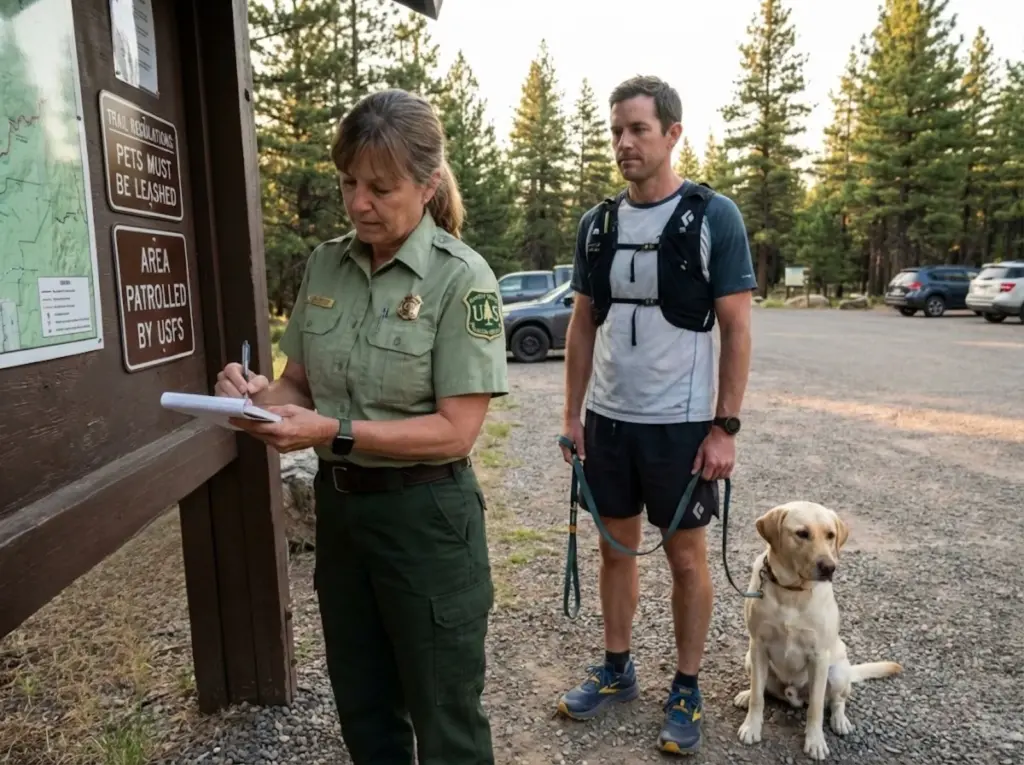
Here’s what other guides won’t tell you: the consequences of off-leash violations go far beyond a lecture from a ranger.
The Fine Schedule Nobody Tells You About
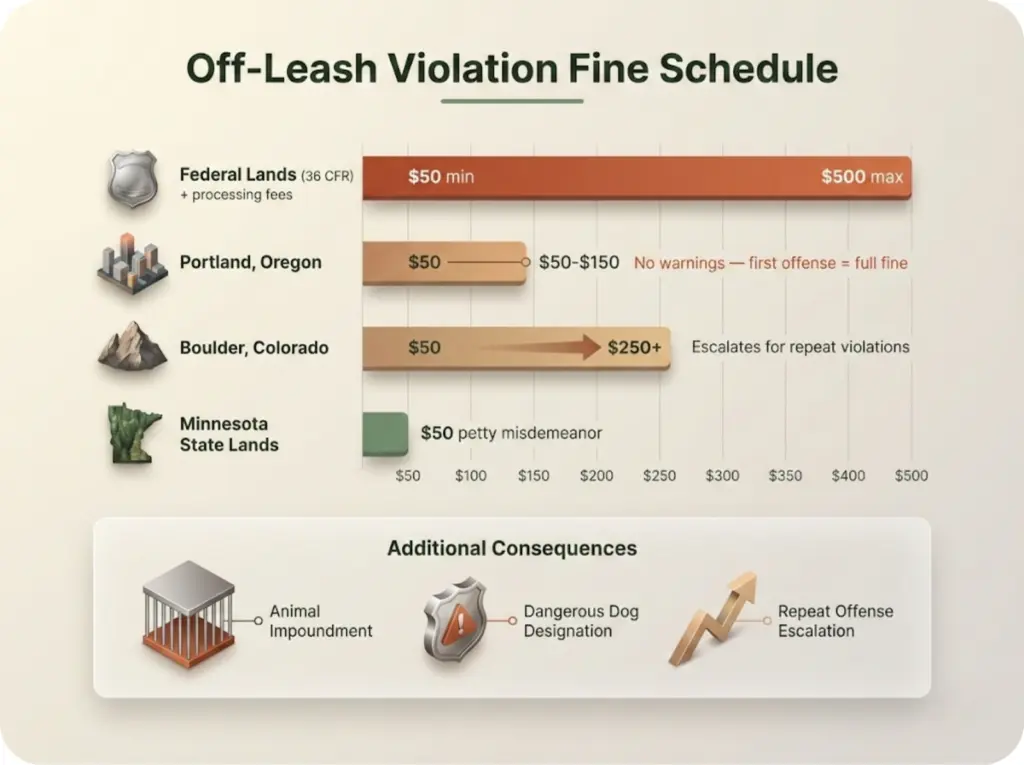
Federal violations under 36 CFR carry $50–$150 minimum collateral fines plus processing fees, with a maximum of $500. Portland, Oregon charges $50–$150 with no warning—first offense gets the full fine. Boulder, CO escalates from $50 to $250+ for repeat violations. Minnesota state lands treat it as a $50 petty misdemeanor.
Beyond the money, enforcement officers can impound animals “running at large” that threaten wildlife or public safety. I once watched three citations handed out at a Colorado trailhead in a single morning—all to people whose dogs were “just 20 feet ahead.”
Strict Liability: When Your Dog Hurts Someone
In strict liability states like Arizona, Florida, and Pennsylvania, you’re liable for all injuries regardless of your dog’s history. In “one-bite” states like Texas, violating a local leash law bypasses the one-bite protection entirely—you’re automatically negligent the moment the leash comes off illegally. Severe dog bite injury awards routinely exceed $100,000.
Here’s the insurance trap most people don’t know about: many homeowner and renter policies contain “off-leash exclusions.” If your dog causes harm while illegally off-leash, your carrier can deny the claim entirely. You’re personally liable for everything.
The Nuclear Option: When They Can Destroy Your Dog
Federal and state law authorizes rangers—and in some states, private citizens—to destroy a dog caught killing or injuring wildlife or livestock. A dog that causes unprovoked harm off-leash may receive a “Dangerous Dog” designation requiring specialized liability insurance, high-security fencing, and warning signs on your property. This isn’t theoretical. It happens every year in high-traffic wilderness areas.
Trail Etiquette That Keeps Off-Leash Access Open
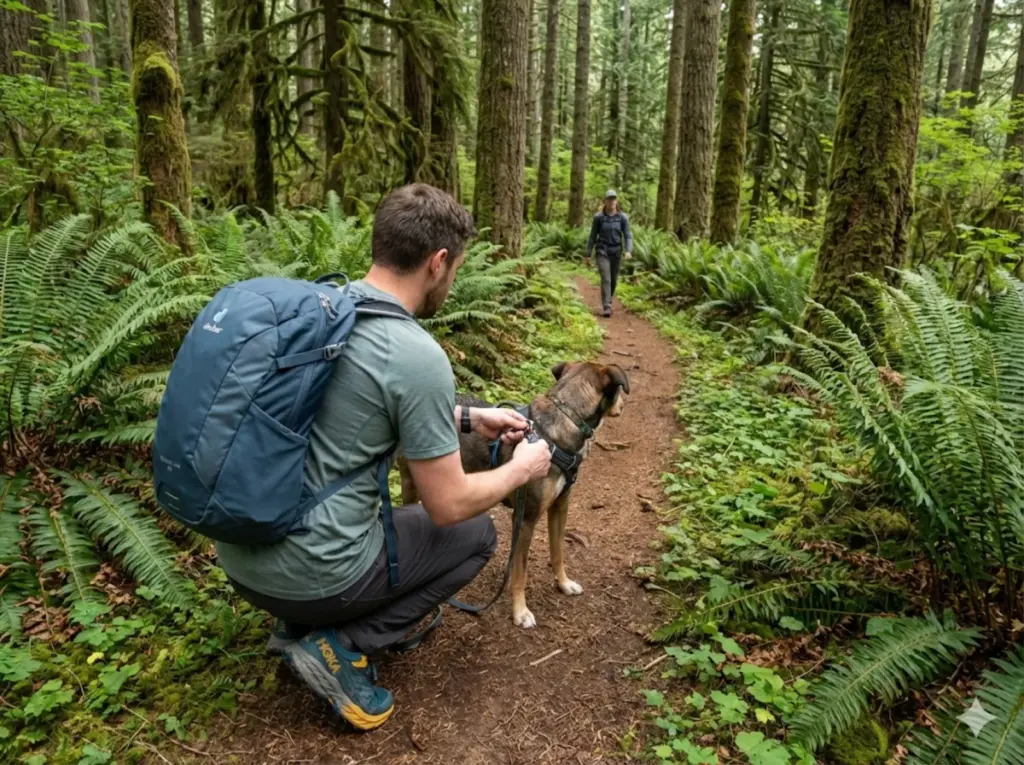
Today’s non-compliance is the direct cause of tomorrow’s trail closures and outright dog bans. If you want off-leash zones to survive, the behavior has to be bulletproof.
The Sight-and-Recall Protocol
The moment another trail user comes into view—hiker, cyclist, equestrian—recall your dog to heel or leash up. Before the encounter, not during. This demonstrates “under control” status and respects the space of hikers who may be fearful, allergic, or dog walking a reactive dog on a training session.
Expert handlers cap off-leash hiking at two dogs per person. Three or more dogs shift into pack behavior with reduced individual recall reliability. That’s not a rule of thumb—it’s how pack dynamics actually work on narrow trails.
Equestrian and Multi-User Encounters
Horses are prey animals. Sudden dog movement triggers a flight response that can unseat riders and cause serious injury. When yielding to horses, move to the downhill side of the trail—a dog positioned uphill appears larger and more predator-like.
Always announce your dog’s presence from a distance so the rider can prepare. On busy multi-use trails, leash before blind corners and switchbacks. Good common trail etiquette with horses is the single fastest way to keep off-leash access on shared corridors.
Waste Management: The Part That Closes Trails
Dog waste introduces nitrogen and phosphorus into mountain waterways, triggering algal blooms. Dogs entering streams can introduce toxic compounds from flea and tick treatments that harm aquatic life. “Pack out dog waste” means all the way to the parking lot—leaving a bag trailside “to grab on the way back” is a citable littering offense.
In alpine environments, bury waste in a cathole 200+ feet from water at minimum six inches deep—the same protocol required for human waste under the full Leave No Trace field protocol.
Pro tip: Double-bag with a Ziploc and drop in a dryer sheet to neutralize odor for the carry-out. It works better than any “dog waste bag” product I’ve tested across hundreds of miles.
The Ecological Cost Your Dog Leaves Behind
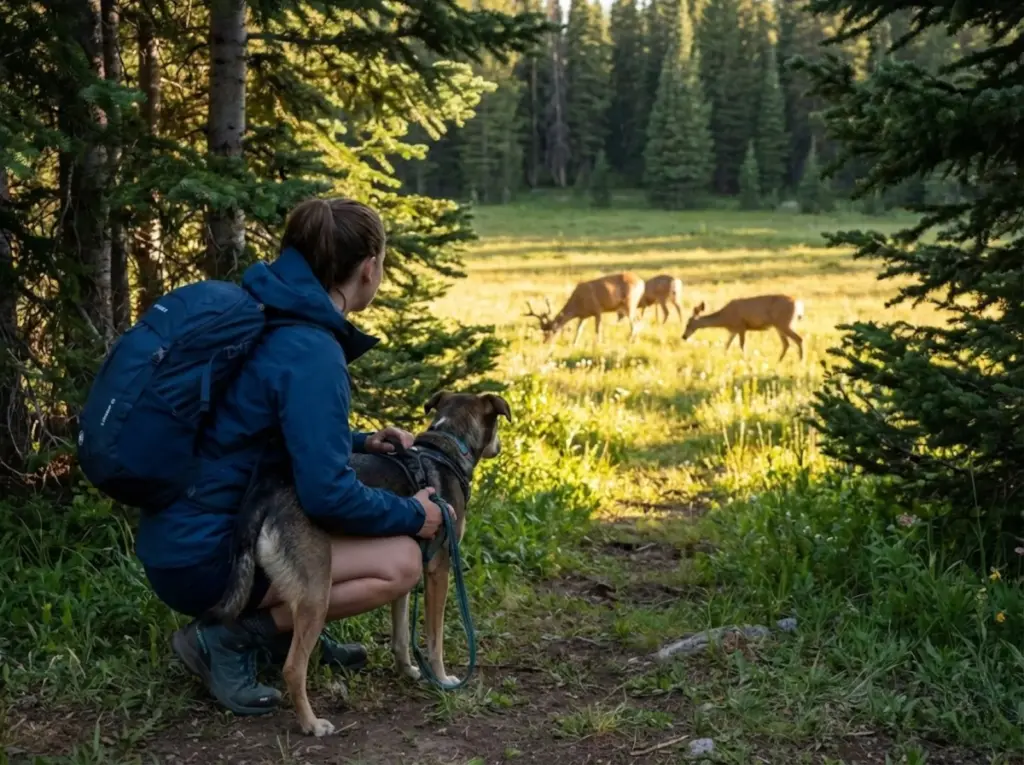
Off-leash regulations exist for a reason that goes deeper than trailhead politics. The science is clear, and understanding it turns compliance from a burden into something that actually makes sense.
Predator Scent and Habitat Displacement
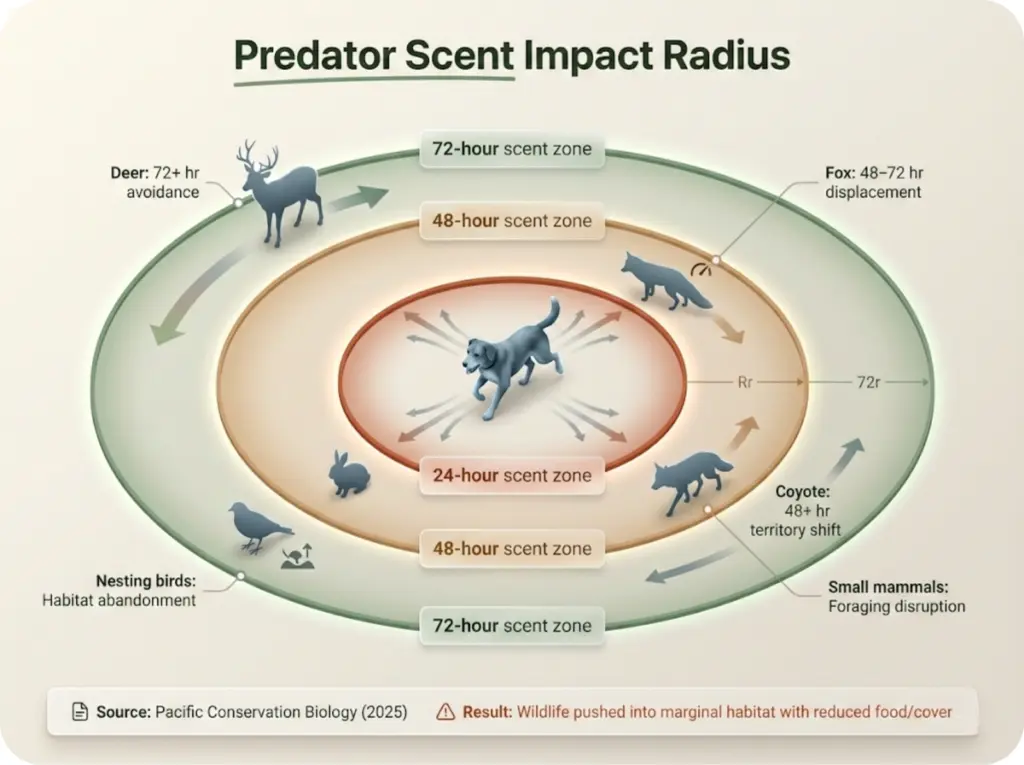
2025 research on the environmental impact of domestic dogs published in Pacific Conservation Biology documented “extensive and multifarious” environmental impacts of domestic dogs on public lands. Dogs descend from wolves. Their presence alone triggers avoidance behavior in deer, foxes, and coyotes for days after departure through scent traces in urine and feces.
Off-leash dogs amplify this by wandering off-trail, spreading predator scent into nesting and foraging grounds that would otherwise stay undisturbed. The result is habitat displacement—local wildlife pushed into marginal territory with less food and cover. Over time, that pressure puts real strain on populations, especially during harsh winters and breeding seasons.
Why Ground-Nesting Birds Pay the Highest Price
Dogs flush nesting birds off the ground far more than hikers alone. If a bird gets flushed ten times a day, it burns roughly 5–8% more energy just on alarm flights. During breeding season, that extra metabolic cost leads to nest abandonment or chick mortality. Seasonal wildlife closures for nesting birds protection and bighorn sheep lambing areas aren’t arbitrary—they’re backed by decades of population data.
Here’s the uncomfortable number: compliance with leash laws in sensitive bird habitats falls below 25%. That gap between what dog owners say they support and what they actually do on the trail is exactly why these regulations keep getting stricter.
Pro tip: If your trail passes through posted seasonal wildlife closures, leash up before you enter the zone—not when you see an animal. The closure protects species you won’t see, like ground-nesting chicks hidden in the grass.
Regional Deep Dive: Where Off-Leash Actually Works
Theory is fine, but what you actually need is specific trail intelligence. Here are the three highest-demand off-leash corridors in the U.S. and exactly how they work.
Colorado Front Range and High Peaks
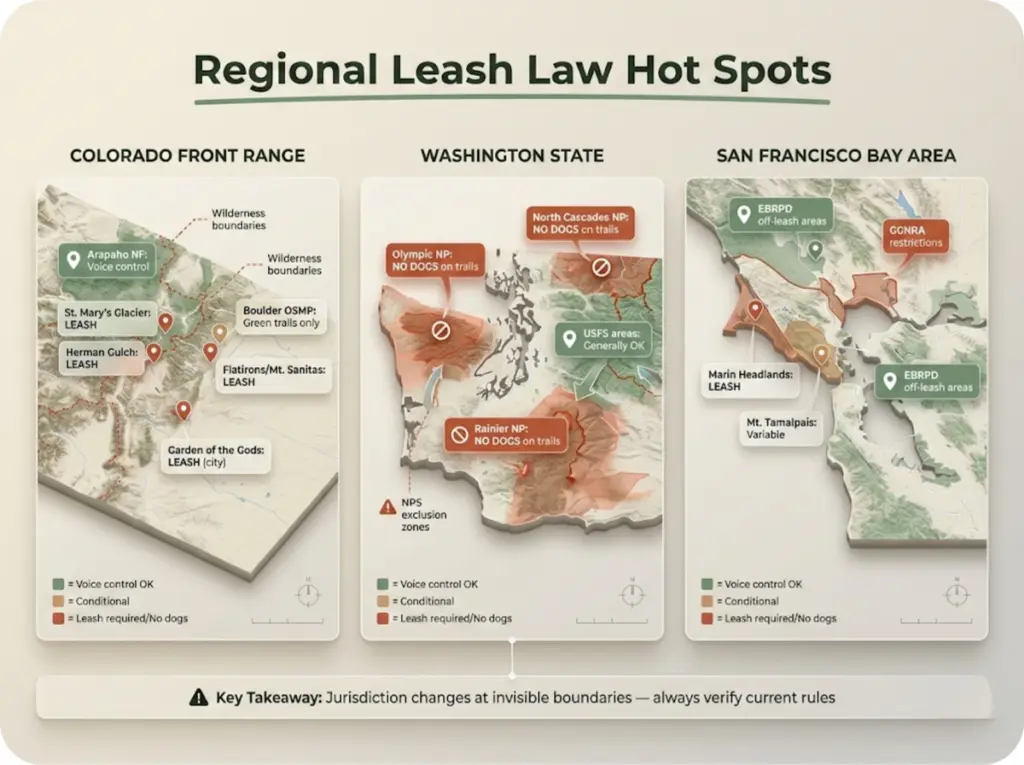
Arapaho National Forest generally allows voice control off-leash—but this permission evaporates at every Wilderness boundary. St. Mary’s Glacier near Idaho Springs requires a leash despite being “National Forest” because the trail is the primary access for James Peak Wilderness. Herman Gulch near Loveland Pass has the same issue. Garden of the Gods in Colorado Springs is city-managed with extreme visitor density—leashes mandatory, citations issued immediately.
The Boulder OSMP color system with the Voice & Sight Tag remains the gold standard. But the tag only works on Green-designated trails. Flatirons trails and Mt. Sanitas see heavy enforcement. Golden Gate Canyon State Park and Eldorado Canyon both require six-foot leashes.
Pacific Northwest: Washington State
National Parks in Washington State—Rainier, Olympic, North Cascades—prohibit dogs on all trails with zero tolerance. The Enchantments and Ingalls Lake prohibit dogs entirely due to fragile high-alpine ecosystems and mountain goats. Alpine Lakes Wilderness generally requires leashes, with the west side being stricter than the east.
State DNR lands like Mount Si mandate leashes at all times. WTA (Washington Trails Association) maintains trail-by-trail dog policy information that’s more reliable than crowdsourced apps.
San Francisco Bay Area
East Bay Regional Park District and Golden Gate National Recreation Area have different “off-leash under voice control” policies that shift trail by trail. Redwood Regional Park in Oakland allows off-leash dogs on most hiking trails but mandates leashes on Stream Trail during specific seasons to protect native trout.
Fort Funston in San Francisco endured a decade-long legal battle between dog owners and NPS that illustrates the tension between “established use” and federal conservation mandates. Consider hiking during shoulder season to avoid crowds when popular trailheads are calmer and off-leash hiking feels safer for everyone.
Your Next Trail Day Starts with Five Minutes of Homework
Three things to carry with you on every dog hike: know the jurisdiction first, because the land management agency determines the rules—not the trail name or the state line. Be honest about your dog’s voice control reliability, because “usually comes when called” doesn’t meet the legal standard. And understand that the consequences of getting it wrong extend beyond a fine—liability considerations, insurance denial, and the collective loss of trail access for every dog owner who comes after you.
Before your next trip, spend five minutes on Caltopo or Gaia GPS checking the land ownership layer for your route. That one step separates the responsible pet owners who keep off-leash access open from the ones who get it closed for good.
FAQ
Are dogs allowed off-leash in National Forests?
Generally yes, under voice control, but this is not universal. Individual ranger districts issue Forest Orders that override the general permission, and Wilderness Areas within National Forests almost always require leashes. Always check the specific forest’s pet policy before assuming voice control is allowed.
What does voice control legally mean for dogs on trails?
Voice control is a legal surrogate for physical restraint. Your dog must remain within clear sight (typically within 25 yards), respond immediately to the first recall command, and not chase, charge, or harass any person, animal, or wildlife. If you need to repeat the command, your dog is not legally under control.
Can I get fined for having my dog off-leash on a trail?
Yes, and fines start immediately with no warning in many jurisdictions. Federal violations under 36 CFR § 2.15 carry $50–$150 minimum fines up to $500 maximum. Municipal fines range from $50 in Minnesota to $250+ in Boulder, CO. Rangers can also impound dogs running at large that threaten wildlife.
How do I know if a trail allows dogs off-leash?
Check the land management agency first—not the trail app. Use Caltopo or Gaia GPS to view the land ownership layer and identify whether you’re on NPS, USFS, BLM, state, or municipal land. Then verify that agency’s pet policy. Dog-friendly on AllTrails does not mean off-leash legal.
What happens if my off-leash dog injures someone on the trail?
In strict liability states like Arizona, Florida, and Pennsylvania, you’re liable regardless of your dog’s history. In one-bite states, violating a leash ordinance bypasses the one-bite protection—you’re automatically negligent. Homeowner’s insurance may deny claims if you were violating leash laws. Severe injury awards routinely exceed $100,000.

I've spent more than a decade researching hiking gear and trail technique. I read the specs, the forum threads and the long-term reviews, and every pick here comes with what it gets wrong.
End of the trail
You read every mile of this one. Here's where the trail goes next.