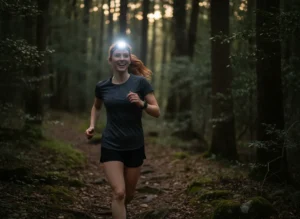

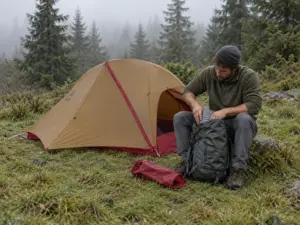



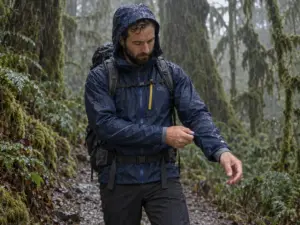
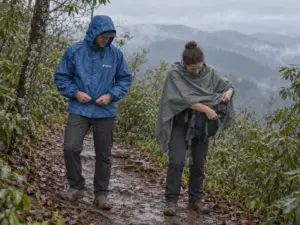
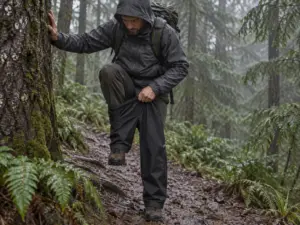









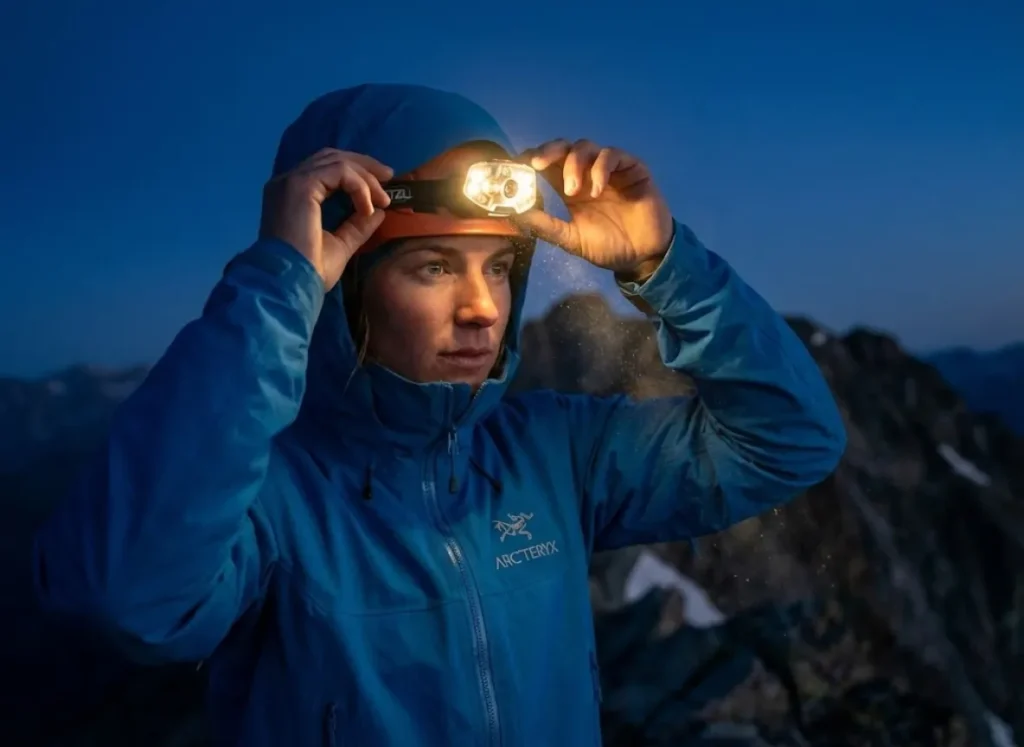
You are fifty meters from the next cairn. The fog has just rolled in, thick as cotton wool, and the sun is gone. You reach up, click your headlight to “Turbo,” and blast 1,000 lumens into the void.
Instead of seeing the trail, you are instantly blinded. The light hits the moisture and bounces straight back into your eyes, creating a wall of white static. You squint, stumbling over a root you couldn’t see because your pupils just constricted in response to the glare.
In my years leading groups through the Cascades, I have seen this scenario play out dozens of times. A student brings the “brightest” light they could find, often an ultra 1,000-lumen model, only to discover that raw power is useless without control.
This isn’t a failure of your vision; it is a failure to apply hiker’s terrain physics to the environment.
To navigate safely in the wilderness, you need to stop thinking of your headlamp as a simple flashlight and start treating it as a precision navigation instrument. We are going to strip away the marketing hype and conduct a technical deep-dive into the optics that actually let you see in the dark.
The Photometric Trinity: What Do the Numbers Actually Mean?
Most hikers shop for headlamps the way they shop for horsepower: bigger numbers must be better. But outdoor illumination is complex, and the three primary units of measurement—Lumens, Candela, and Lux—tell very different stories.
Why Is the Lumen the Most Misleading Metric on the Box?
Luminous Flux (Lumens) is the total amount of visible light emitted in all directions.
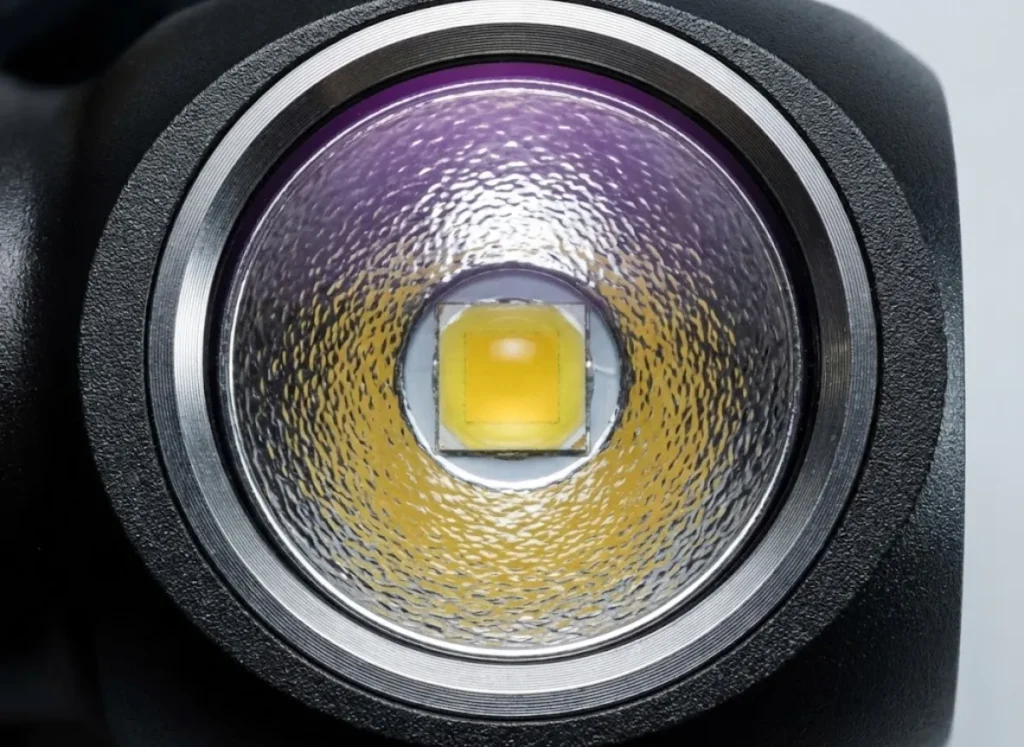
Think of lumens as the raw fuel in the tank. It measures the total light output coming from the LED chips. Manufacturers determine this using an integrating sphere, a device that captures every photon to generate a big number. However, it tells you nothing about where that light is going.
If you hold a bare LED bulb (a “mule” light) in an open field, it might pump out 2,000 lumens. However, because that energy is spilling out in a 360-degree sphere, the intensity dissipates almost instantly.
This creates the “Lumen Trap.” Light manufacturers push massive lumen counts because they sell units. But high lumens with poor optics create a “wall of light” right at your feet.
This destroys your night vision and fails to reach down the trail. You need to understand this distinction before selecting a guide to trail safety and performance. A light with fewer lumens but better focus will often appear “brighter” where it counts.
Pro-Tip: If a headlamp boasts 1,000+ lumens but has a tiny battery and no heat fins, it will likely drop to 300 lumens within 45 seconds to prevent overheating. Always look for the “sustained output” specs, not just the startup burst.
For the science behind this, you can look at the fundamental physics of the inverse square law, which explains why raw energy isn’t enough.
How Does Candela Determine Your Ability to See Distance?
Luminous Intensity (Candela) is the amount of light emitted in a specific direction.
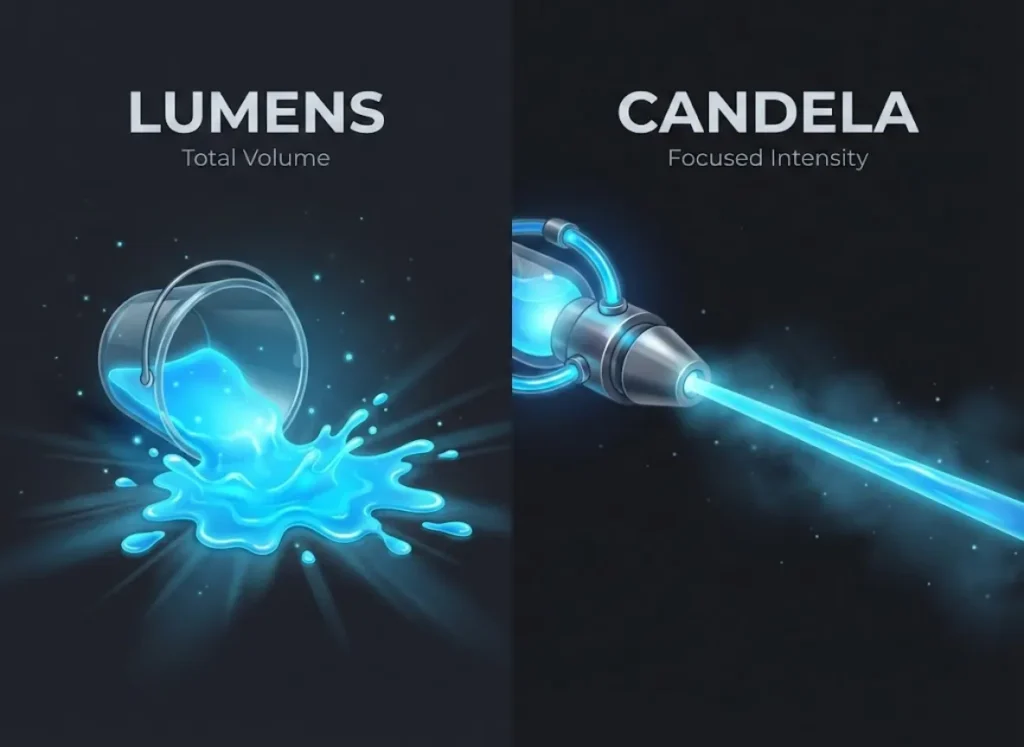
We often use the garden hose analogy: if lumens are the water volume in the hose, candela is the pressure at the nozzle. It measures the throw or peak beam intensity. To see a trail marker across a ravine, you need high candela, regardless of how many total lumens the light produces.
This is achieved through the optical system—reflectors or lenses that gather the isotropic light from the LED emitter and force it into a tight cone known as the solid angle (measured in steradians). By narrowing the beam angle, you increase the candela exponentially without using more battery power.
This candela rating is vital for route-finding. When you are scanning for a blaze on a distant tree, you are relying on intensity, not total volume. This ability to see distance is a critical component of a hiker’s natural navigation guide, allowing you to orient yourself without constantly checking a GPS.
See the luminous intensity and solid angle relationships to understand the math behind beam focus.
What Is the Inverse Square Law and Why Does It Kill Your Beam?
Illuminance (Lux) is the measure of light intensity as it falls on a surface.
This is the only metric you actually experience: the light hitting the dirt in front of you. If you were to use a luxmeter on the trail, you would see that physics is cruel here. The Inverse Square Law states that illuminance drops by the square of the distance ($E = I/d^2$).
A light that is blindingly bright at one meter provides only a fraction of that usable light at ten meters. To double your beam distance, you need four times the intensity.
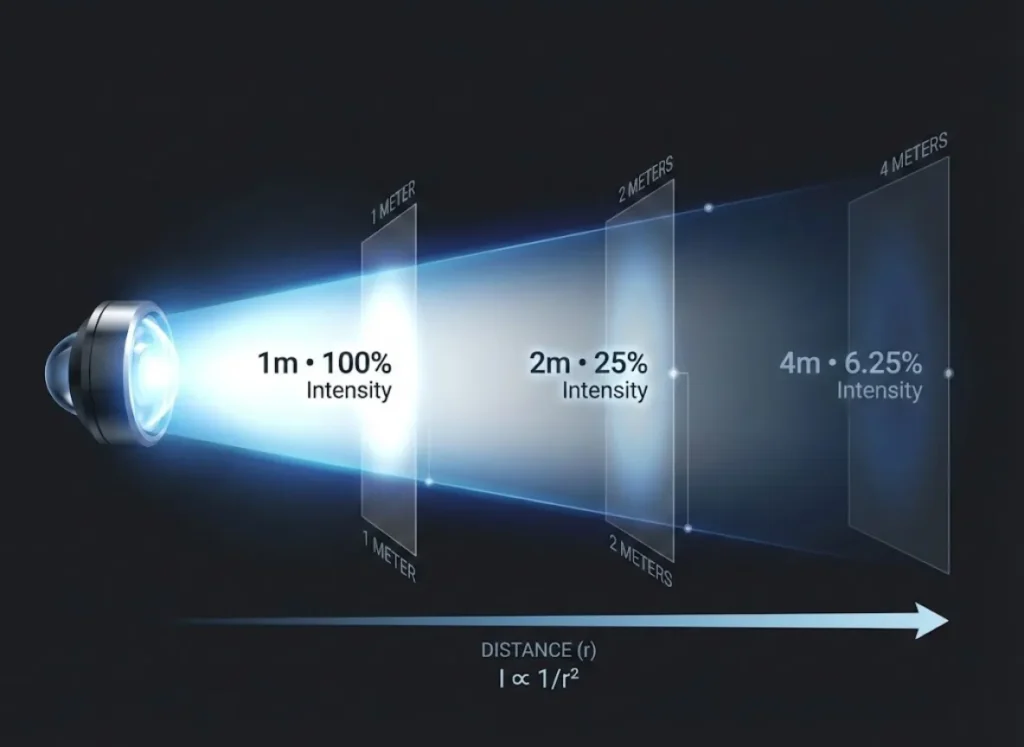
Be wary of the “Beam Distance” rating on the box. The ANSI standard allows manufacturers to rate distance down to 0.25 lux—roughly the light of a full moon. In a complex forest environment, that is not enough light to safely identify a tripping hazard.
You generally need 1.0 to 3.0 actual lux for safe movement. When packing your essential gear guide, assume the “usable” range of a light is half of what the box claims.
For a practical breakdown, check out this guide on the science of light intensity measurement.
Atmospheric Physics: How Light Interacts with the Environment?
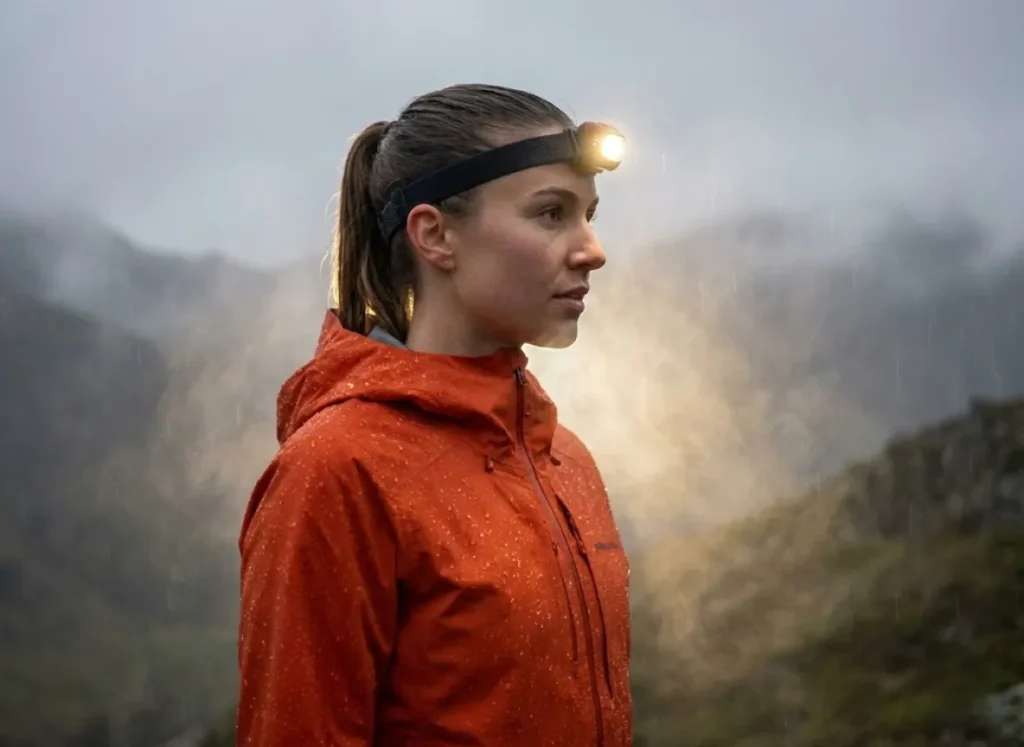
Physics dictates how light moves through a vacuum, but hikers move through air. That air is often filled with moisture, dust, and precipitation that fundamentally alters the visual data you receive.
Why Does High-Lumen Cool White Light Fail in Fog and Rain?
When light hits water droplets that are roughly the size of the light’s wavelength, a phenomenon called Mie Scattering occurs.
This results in “backscatter,” where high-intensity light reflects off the moisture directly back into your pupils. This is why high beams in a car are useless in dense fog.
The problem is exacerbated by “Cool White” LEDs (6000K-6500K Kelvin), which are standard in most outdoor lights because they are efficient and bright. However, cool white light contains a “blue spike” on the spectrum. This creates a “veiling luminance”—a bright whiteout condition that obscures everything behind it.
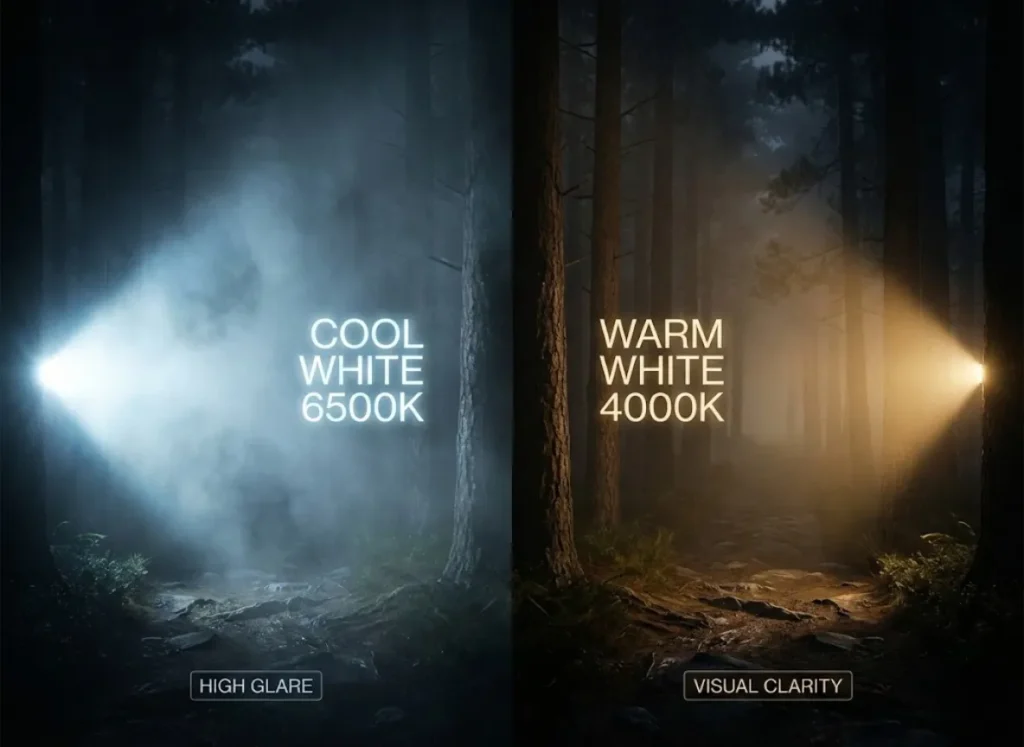
The solution is a Neutral or Warm White emitter (4000K-5000K color temperature). While yellow light doesn’t magically “penetrate” fog, it causes less glare and creates higher contrast.
This reduces the constriction of your pupils, allowing you to see through the noise. These conditions are standard fare in our winter hiking guide to gear, where snow and mist make tint selection a safety priority.
Read more about the atmospheric scattering of light to understand how particles affect visibility.
How Do Optical Systems Shape the Beam for Different Terrains?
The shape of your beam determines how your brain processes the terrain. Standard reflector geometry creates a sharp “hotspot” for distance and dim “spill” for width.
This can cause “tunnel vision.” Your eyes constantly adapt between the bright spot and the dark periphery, leading to eye fatigue—the “bouncing ball” effect.
For general hiking, Total Internal Reflection (TIR) lenses, especially those with beaded or honeycomb faces, are superior. They create a smooth gradient of light that mimics your natural field of view, providing better lighting uniformity.
This supports proprioception—your body’s sense of position in space. A wide, even flood allows you to maintain peripheral awareness, seeing your feet and the trail ahead simultaneously without jerking your head.
This peripheral illumination is vital, especially on technical ground where our guide to Class 2, 3, and 4 terrain emphasizes the importance of precise foot placement during technical scrambles.
You can study the optical principles of TIR lenses to see how engineers manipulate light paths.
The Biological Interface: How Your Eyes Process Artificial Light?
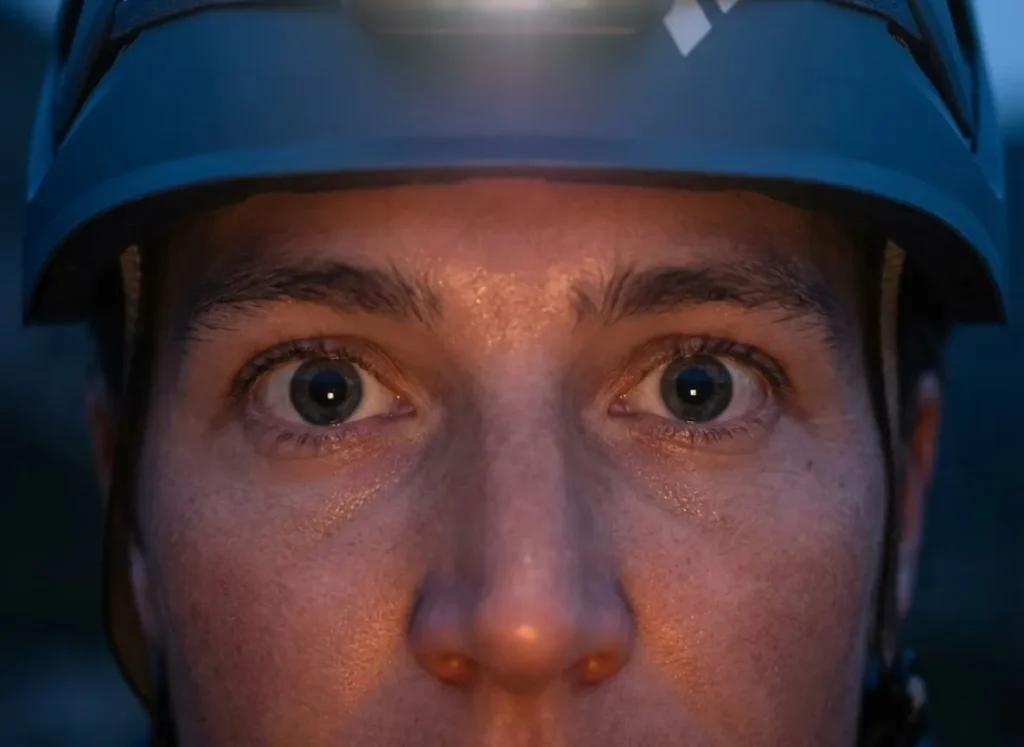
The hardware delivers the light, but the final processing happens in the complex biological machinery of the human vision system.
What Is Mesopic Vision and Why Do You Need It on the Trail?
Hiking at night places you in Mesopic Vision—an intermediate state between Photopic vision (daylight) and Scotopic vision (darkness). In this state, both rods (low light/motion) and cones (color/detail) are active.
A cool white light creates a paradox. The blue spectrum stimulates the rods, making the light feel “bright,” but it fails to stimulate the cones effectively. This results in “ghostly” vision where you can see shapes but not textures or depth.
When contrast is flattened, a hole in the ground looks just like a shadow. A slick rock looks the same as a dry one. This lack of visual information can lead to the scenarios described in our hiker’s emergency guide.
Using a neutral white light (around 4500K) keeps your cones engaged, preserving stereopsis (depth perception).
This visual performance in mesopic conditions study explains the spectral shifts that occur in low light.
How Does Color Rendering Index (CRI) Affect Safety and Reaction Time?
CRI (Color Rendering Index) measures a light source’s ability to reveal true colors on a scale of 0-100.
Standard LEDs often have a CRI of 70. They are missing the red spectrum (R9), turning browns, reds, and oranges into a muddy gray. High CRI (90+) lights, which align closer to the CIE 1931 function, render these colors accurately.
This is not about aesthetics; it is about data fidelity. You need to distinguish between wet clay (slick) and dry dirt (safe). In a medical or SAR scenario, you need to identify dried blood versus mud.
High CRI reduces the cognitive load on your brain. You don’t have to squint or pause to interpret the ground; you just see it. That fidelity matters when deciding what to do if bitten by a snake, as accurate pattern recognition is your first line of defense.
See this research on the effects of light spectrum on perception for more on how light quality impacts what we see.
Engineering and Regulation: What Separates Toys from Tools?
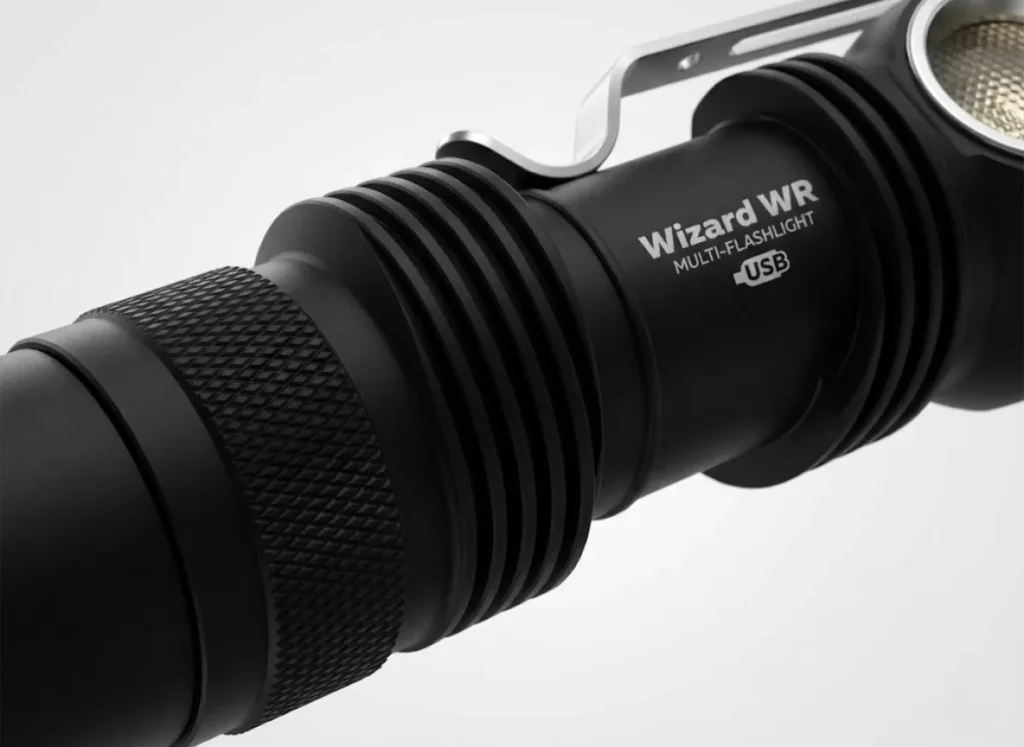
The final variable in the equation is the energy source itself. A light is only as good as the driver that regulates it.
Why Do Most Store-Bought Headlamps Dim So Quickly?
Many mass-market headlamps use Unregulated (Direct Drive) circuits. The output is tied directly to the battery voltage. As the battery drains, the light dims immediately and continuously.
Manufacturers exploit the ANSI/PLATO FL 1 Standard, which measures the time it takes for output to drop to 10%. A light might claim a 10-hour runtime, but it spends 9 of those hours at a brightness too low to hike with.
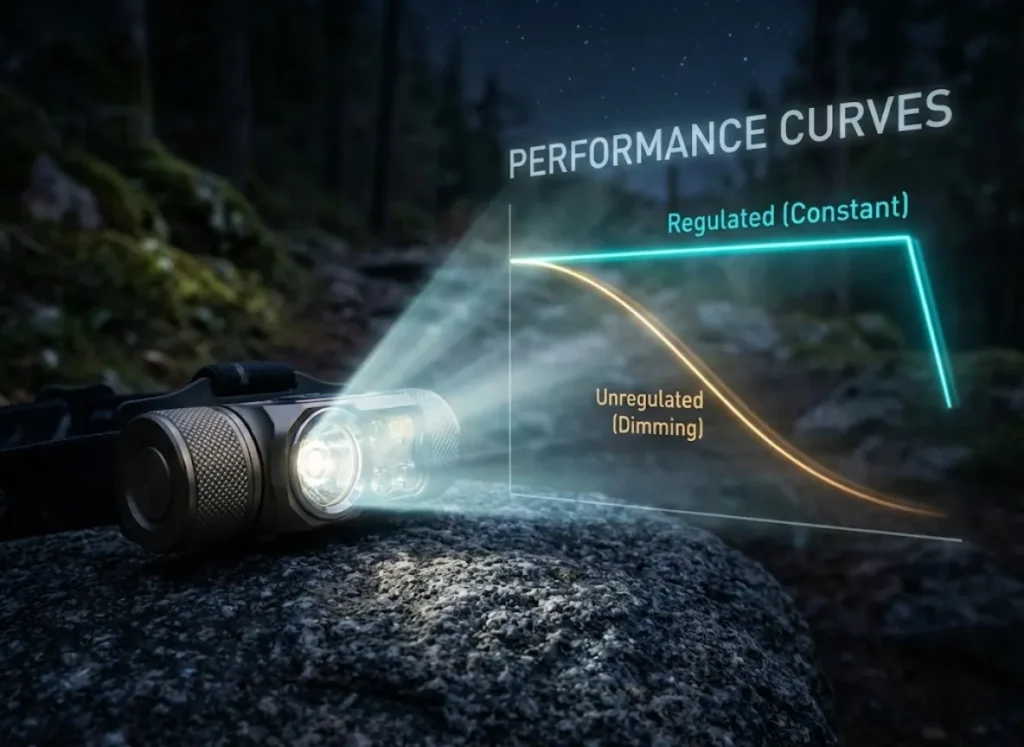
Professional lights use Regulated (Buck/Boost) drivers. These maintain constant brightness until the battery is nearly dead. You get consistent performance, which is essential for safety.
Reliability is the cornerstone of a hiker’s core gear system. Always check runtime graphs, not just the side of the box, to ensure regulatory compliance aligns with real-world needs.
For the definitive source on these measurements, refer to the ANSI/PLATO FL 1 2019 Standard.
Final Thoughts on Light Physics
When the sun sets, your safety depends on the photons you carry with you.
- Candela is King: For identifying markers and route-finding, intensity matters more than total volume.
- Fidelity is Safety: High CRI and Neutral Tint allow your brain to decode terrain instantly, preventing slips and reducing fatigue.
- Regulation is Trust: Ignore “Max Runtime” claims; look for flat discharge curves that guarantee consistent light.
Check the specs of your current headlamp against these physics principles. If your light relies on marketing lumens rather than optical engineering, it might be time to upgrade.
FAQ – Frequently Asked Questions about Headlamp Physics
Is it possible to convert lumens to candela?
Not directly. Lumens measure total light output, while candela measures intensity in a single direction. To convert lumens to candela, you would need to know the exact beam angle (solid angle) in steradians. A 1,000-lumen floodlight could have significantly lower candela than a focused 200-lumen spotlight.
What does 10,000 candela look like in a hiking scenario?
It equals about 100 meters of real-world visibility. While the ANSI rating for 10,000cd is 200 meters, effective use is usually half that. This candela measures ability is excellent for spotting trail markers across a valley, signaling for help, or navigating off-trail terrain where you need to scan well ahead of your feet.
Why does my high-lumen headlamp feel dim on the trail?
It likely has a wide flood beam. According to the Inverse Square Law, light spreads out and loses intensity rapidly over distance. Alternatively, your light may be suffering from thermal throttling or voltage sag (unregulated driver), meaning it dimmed significantly within the first few minutes of use without you noticing.
Which light is better for fog: yellow or white?
Warmer (yellow or neutral) light is superior. While it doesn’t cut through fog like a laser, warm light (4000K) creates less backscatter and glare than cool white (6500K) light. This prevents the white wall effect, keeping your pupils dilated so you can pick up contrast and shapes through the mist.

I've spent more than a decade researching hiking gear and trail technique. I read the specs, the forum threads and the long-term reviews, and every pick here comes with what it gets wrong.
End of the trail
You read every mile of this one. Here's where the trail goes next.