
In this article
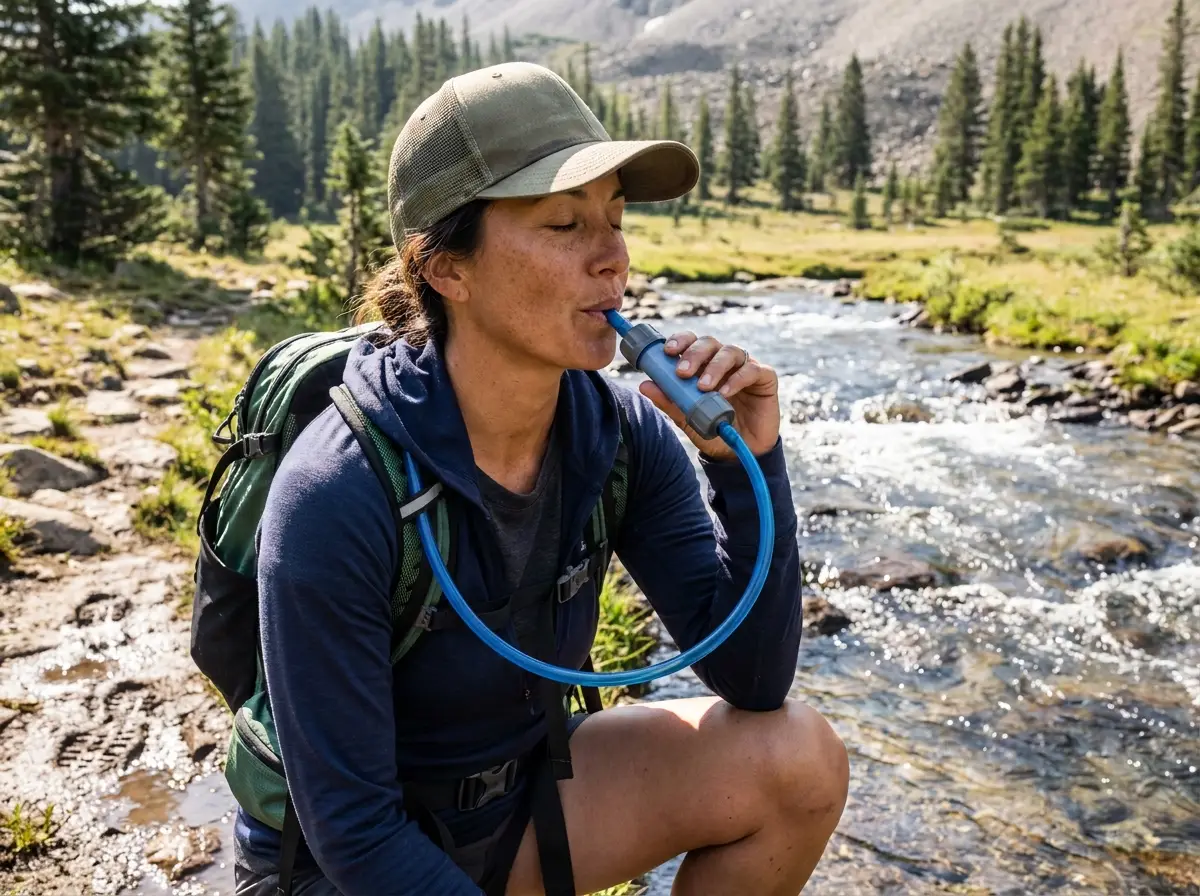
An inline filter is a narrow product class that most backpacking water-filter roundups skim over in a single paragraph. The filter sits in the drink tube between your reservoir and your bite valve, and you drink filtered water through normal suction. That workflow introduces its own failure modes: flow rates that choke under drinking pressure, adapters that only fit specific bladder brands, hollow fiber membranes that die silently when they freeze, and a backflushing routine that most owners never perform because removing the filter from the hose is a pain.
The lineup below is built around exactly that workflow. I cross-referenced verified Amazon reviews, rankings from Switchback Travel, OutdoorGearLab, GearJunkie, and MSR’s own first-party specs, and added three picks the top guides miss entirely — the HydraPak 28mm Filter Kit, the Sagan Life Inline Purifier, and the Aquamira Frontier Max. If you want honest context on filter lifespan before you commit, the Sawyer 100,000-gallon claim versus real thru-hiker data is worth reading — it informs the per-gallon economics section of this guide.
The 7 Best Inline Water Filters for Hydration Bladders in 2026
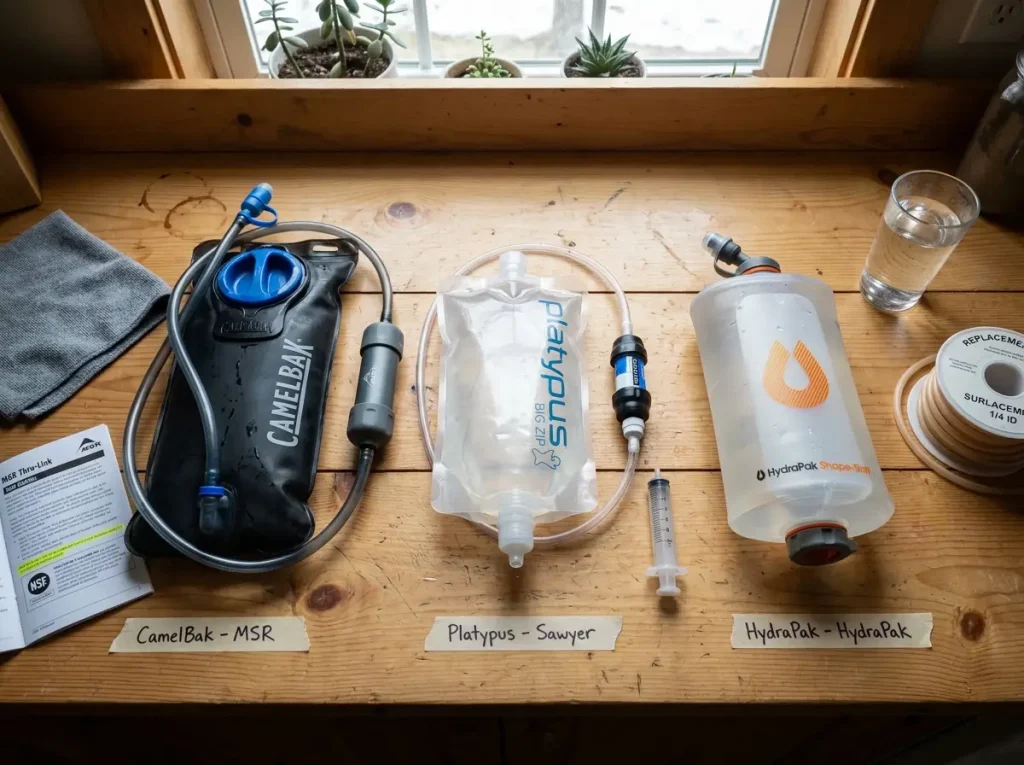
Pick based on three things the marketing copy tends to bury: whether your bladder brand plays nicely with the adapter, whether you need virus protection (most of these only stop bacteria and protozoa), and whether the filter’s flow rate survives under actual drinking suction as opposed to a gravity-test marketing number. The reviews below are ordered by how most two-person or solo hikers should weigh the decision.
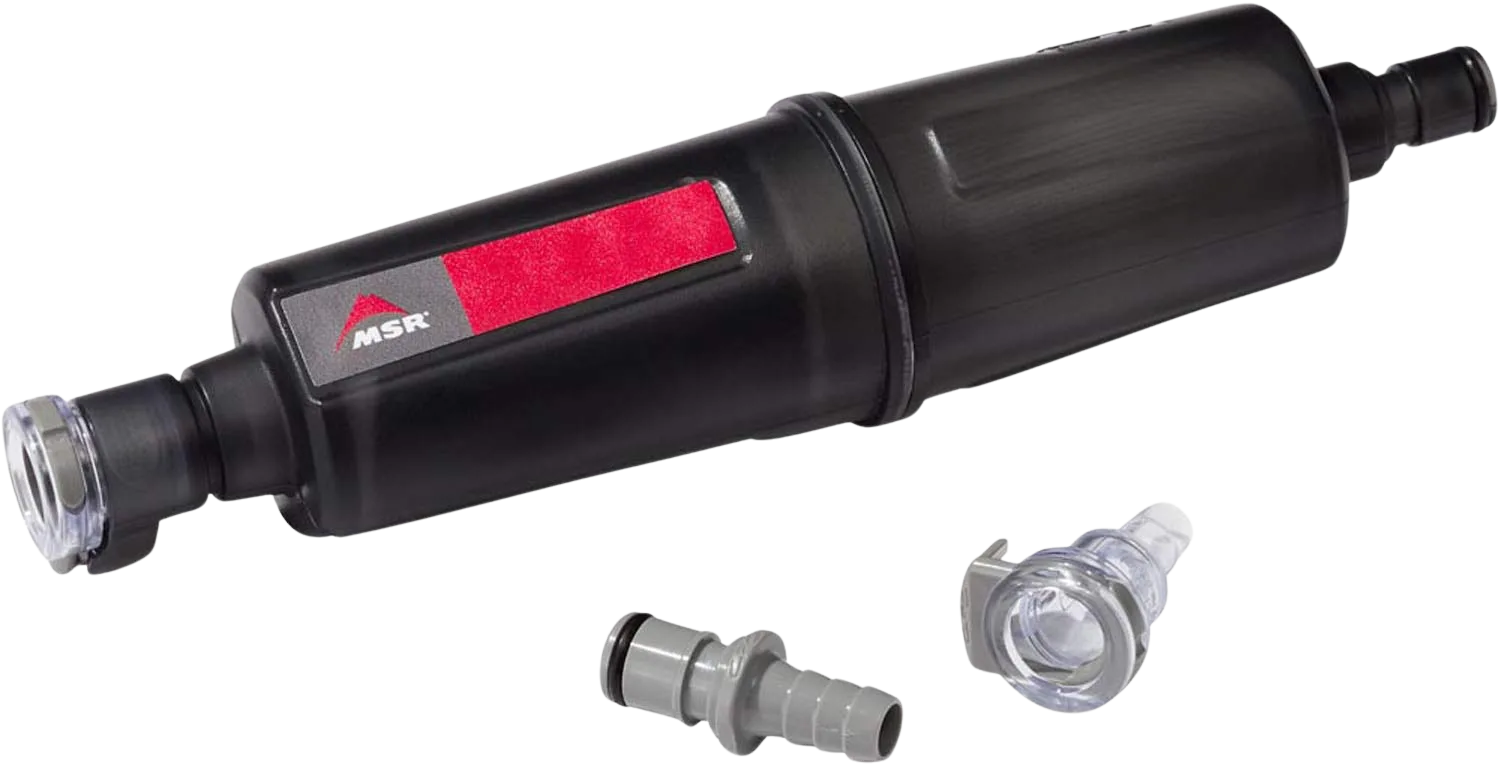
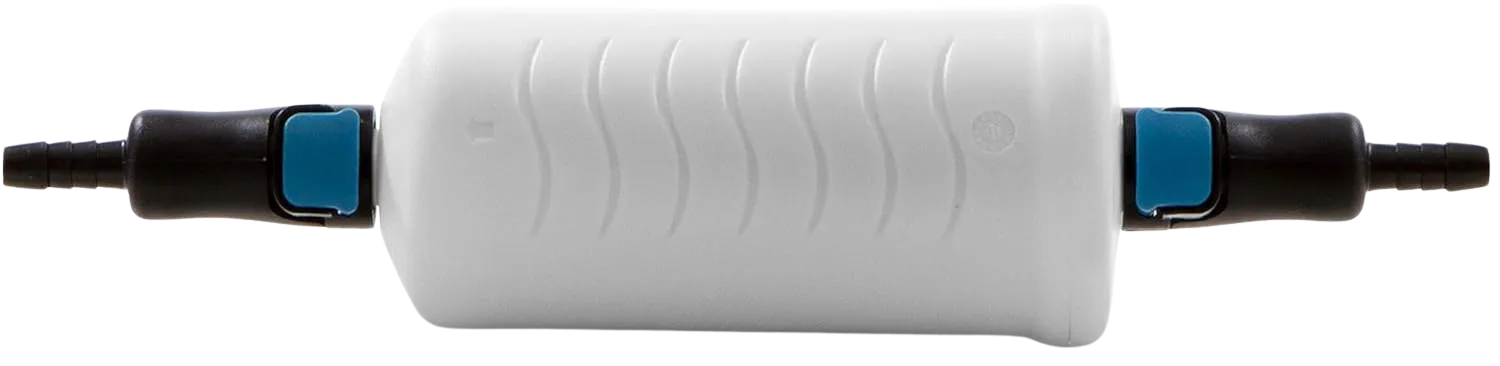
🏆 Best Overall: MSR Thru-Link Inline Water Filter
The Thru-Link is the only purpose-built-for-bladder inline filter on the market, and it is the reason this review exists as a category. Two-stage filtration, a 0.2-micron hollow-fiber membrane plus an activated-carbon layer, lets it do what the single-stage Sawyers cannot — remove chemicals, tastes, and the slight plastic funk that hose-stored reservoir water picks up after a hot afternoon. MSR’s own spec sheet documents NSF P231 certification for bacteria and protozoa removal, and the ultrasonic-welded ABS housing comes from a military-grade product line that predates the consumer Thru-Link by roughly a decade.
Verified Amazon reviews converge on three patterns worth knowing. First, the quick-connect fittings genuinely work with CamelBak, Platypus, HydraPak, Osprey, and Source bladders — “any hydration reservoir on the market” is MSR marketing language, but owners confirm it across brands. Second, flow under drinking suction runs closer to 1 L/min than the marketed 1.5 L/min, which is still fast enough that you won’t feel like you’re dragging water through a coffee straw. Third, the carbon layer is limited-life and service-life drops roughly 30% if you use it on silty water without a pre-filter sock.
The honest flaw: the Thru-Link is not virus-rated. It handles bacteria at 99.9999% and protozoa at 99.9%, but viruses pass through the 0.2-micron hollow-fiber membrane. For North American backcountry that matters less, because virus contamination of wilderness water is rare compared to bacteria and parasites. For international travel or any water that could carry human fecal contamination (urban runoff, agricultural zones, high-use campgrounds), you need a purifier, not this filter. Buy the Thru-Link if you want one-piece turnkey inline filtration for domestic backcountry use and value the carbon layer for taste. Skip it if you travel internationally regularly (go Sagan Life or Aquamira Frontier Max) or if you’re price-sensitive (go Sawyer Squeeze + adapter kit for less than half the cost).
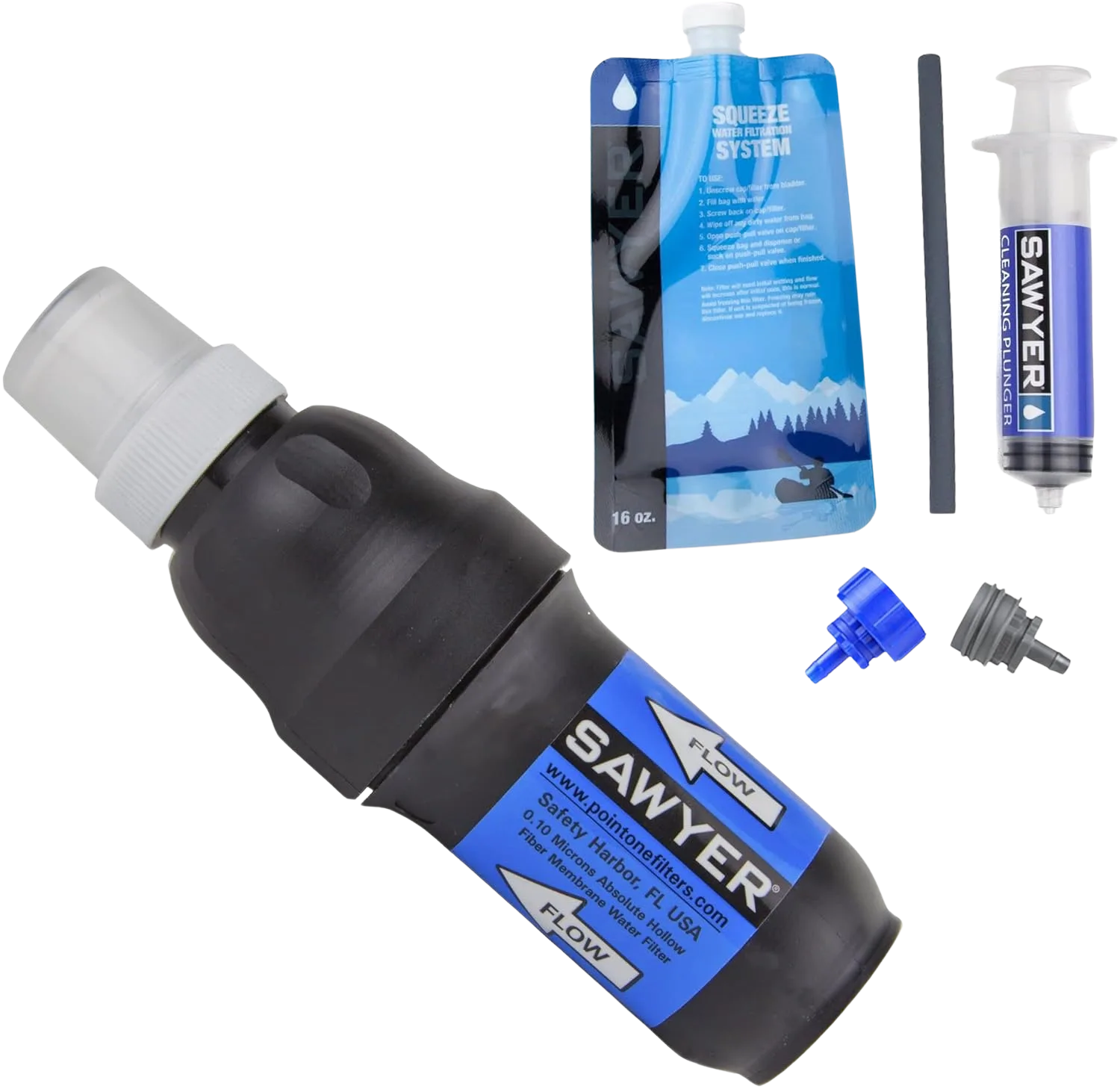
💰 Best Value: Sawyer Squeeze + Inline Adapter Kit
The Sawyer Squeeze is the default answer on thru-hiker forums for one reason: it delivers the same 0.1-micron hollow-fiber filtration as filters costing three times as much, at a price point where replacing it every two seasons is painless. Sawyer markets a 100,000-gallon lifespan, which is optimistic — real thru-hiker service data lands closer to 300-1,000 gallons depending on how diligent you are about backflushing. For hydration-bladder inline use, you pair the Squeeze with Sawyer’s SP110 hydration pack adapter or buy the SP137 bundle that ships with the adapter kit included.
Verified Amazon reviews across 40,000+ ratings on the Squeeze line back one specific pattern for inline-bladder use: the setup works reliably when the hose is routed without any pinch points, and it fails when the hose bends sharply at the shoulder strap or crosses under a sternum strap. GearJunkie’s 2026 reviewer specifically noted the inline configuration as “a bit finicky” — not broken, but sensitive to routing. For a two-season Squeeze used primarily inline, flow rate holds up well if you backflush with the included syringe every 15-20 liters of dirty water, less often if your water is clean.
The real flaw: freeze vulnerability. Any hollow-fiber filter fails silently after a single freeze cycle — the membrane ruptures at a microscopic level and the filter passes water at the same rate as before but no longer filters anything. Owners who camp shoulder-season and leave an installed Squeeze on the hose overnight in sub-freezing temperatures report return-home illness that maps directly to a frozen filter. Buy the Squeeze + inline kit if you want the cheapest per-gallon hollow-fiber filter with the best community support. Skip it if you hike cold-weather trips where the hose sits below freezing overnight (consider pulling the filter inside your sleeping bag, or step to the MSR Thru-Link’s more protected housing).
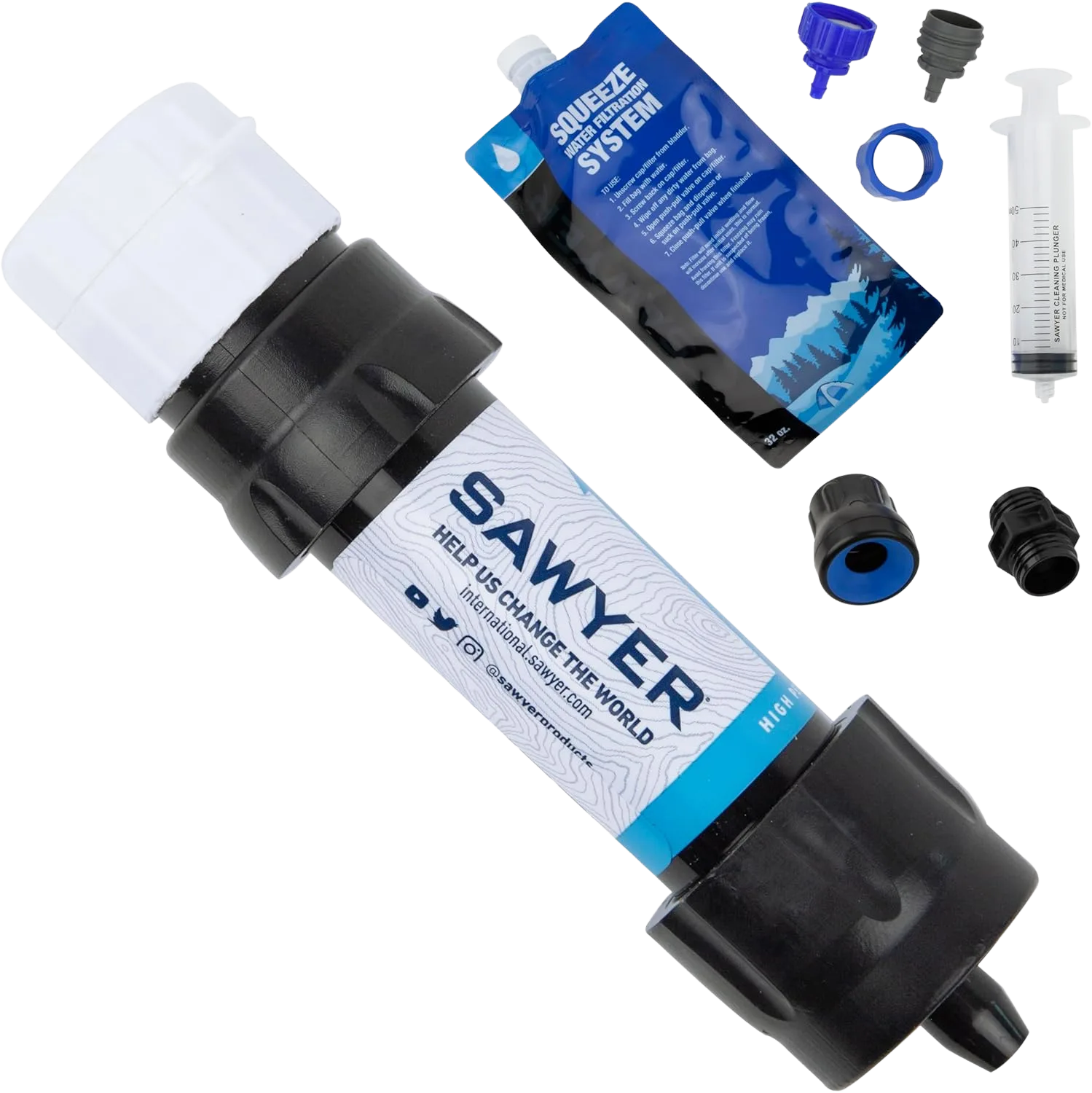
🎯 Best Ultralight: Sawyer Mini Dual Threaded (SP2306)
The Mini is the Squeeze’s smaller sibling — 2 oz instead of 3, same 0.1-micron hollow fiber, same 100,000-gallon marketing claim. For inline use, the SP2306 Dual Threaded bundle ships with the inline adapter kit already in the box, so the assembly is no harder than the Squeeze. For ultralight thru-hiking pairs or solo fastpackers counting every gram, the Mini is the obvious pick.
Verified Amazon reviews on the SP2306 pattern-match on one point that matters: flow under drinking suction is noticeably slower than the Squeeze. Sawyer’s own spec puts the Mini’s flow at roughly 30% lower than the Squeeze when used in-line, and owners describe the suction as “working for it” rather than the easier draw of the Squeeze or Thru-Link. The smaller filter volume also clogs faster on sediment-heavy water, and backflushing is trickier because the syringe-to-filter geometry is tighter.
The honest flaw: the Mini is genuinely slow. If you drink through your bladder often (say, in heat where you pull from the hose every 5-10 minutes), the reduced flow will frustrate you. That’s the trade for the weight savings. Buy the Mini if your priority is grams-on-the-back and you accept slightly slower hydration, and if your water sources are generally clean (less sediment stress). Skip it if you drink heavily and frequently through the bladder (go Squeeze or HydraPak 28mm), or if your typical water source carries visible sediment.
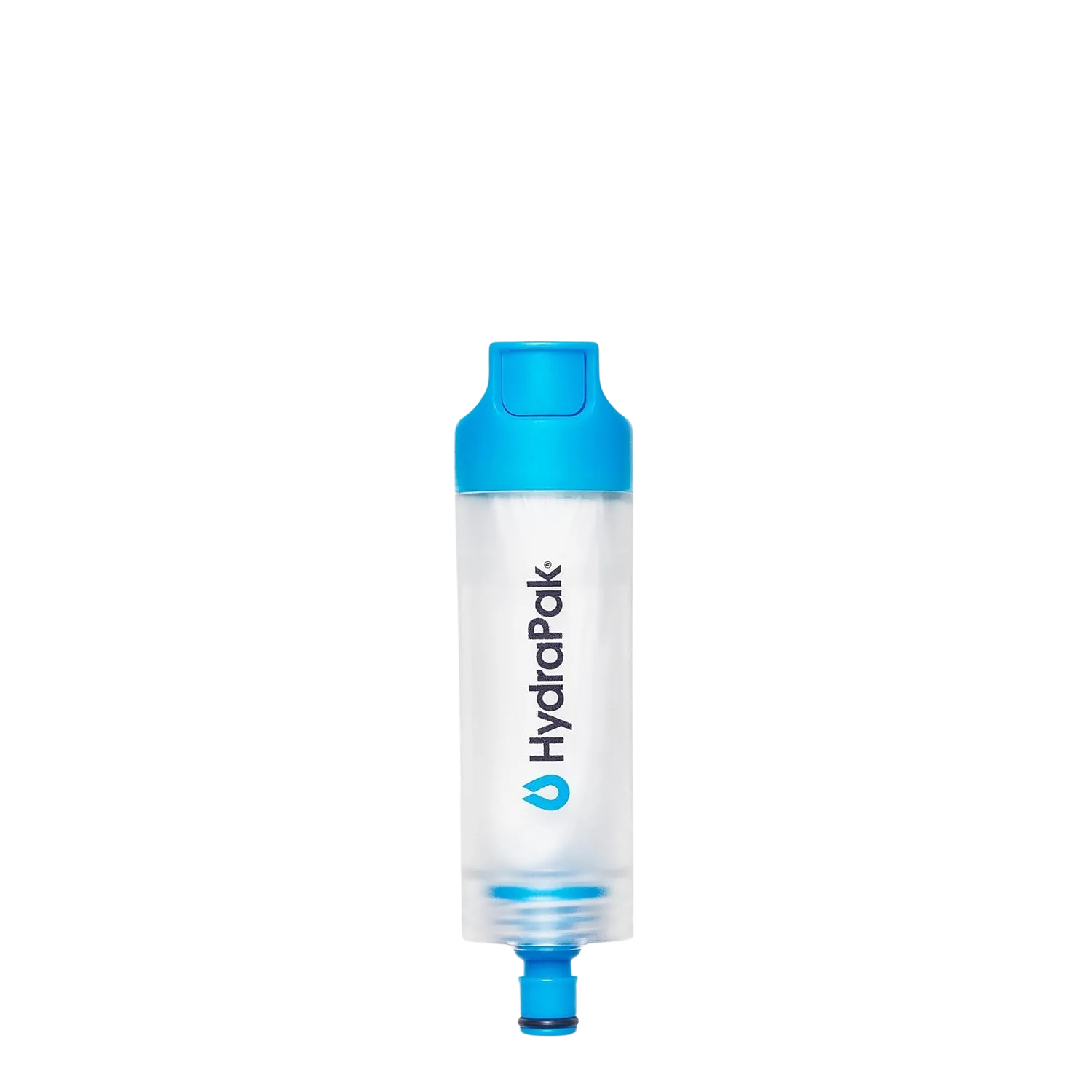
🎯 Best Fast Flow: HydraPak 28mm Filter Kit
The HydraPak 28mm Filter Kit is the filter Switchback Travel calls out specifically for inline-reservoir use, and it is the lightest hollow-fiber option in this lineup at 47 grams (1.7 oz). Its headline claim is NSF 42 microplastic reduction at ≥3.0 microns — a feature none of the Sawyer or MSR options match — combined with NSF P231 bacteria and protozoa removal. The 28mm thread makes it native to HydraPak’s 28mm bottle ecosystem and their Plug-N-Play reservoir connectors, and the kit ships with both a cap adapter and a backflush adapter so you can run it three different ways without buying accessories.
Verified Amazon reviews concentrate on two patterns. First, flow rate is genuinely fast — multiple reviewers compare it favorably against the Sawyer Squeeze in squeeze-mode, and in inline use on a HydraPak bladder the flow holds up under drinking suction better than any Sawyer variant. Second, the backflush adapter is the detail that separates HydraPak’s kit from competitors — thread a clean bottle onto the backflush adapter, squeeze, and you’re flushed in 15 seconds without removing the filter from the hose.
Pro tip: If your bladder is a HydraPak Shape-Shift, Seeker+, or any model with a 28mm-threaded Plug-N-Play port, the 28mm Filter Kit is effectively plug-and-play — no adapter shopping required. For CamelBak Crux or Osprey Hydraulics reservoirs with proprietary fittings, you’ll need a third-party 28mm-to-1/4-inch-ID hose adapter (roughly $8-12), which eats the filter’s ecosystem advantage. For mixed-fleet families with bladders from multiple brands, the MSR Thru-Link’s universal quick-connect is the more honest answer.
The honest flaw: the HydraPak ecosystem-optimization is also its limitation. Outside of HydraPak reservoirs, the 28mm thread becomes a mismatch you have to adapter your way around. Also worth flagging: no carbon layer, so chemical taste removal isn’t part of the package. Buy the 28mm Filter Kit if you already run HydraPak bladders, want microplastic filtration, and prioritize flow rate under suction. Skip it if your bladder is CamelBak-native or if you need carbon filtration for urban or agricultural water.
🎯 Best Purifier (Virus + Heavy Metals): Sagan Life Inline Purifier
The Sagan Life Inline Purifier is the only product in this lineup that qualifies as a genuine purifier for bladder inline use. That distinction matters: a filter (Thru-Link, Sawyer, HydraPak) removes bacteria and protozoa. A purifier adds virus removal plus lead and heavy-metal reduction, which bumps it into a different class for international travel, urban emergency water, and any source that could carry human-waste contamination or industrial runoff. The 250-gallon service life is the smallest in this review — a deliberate trade for the purifier-grade filtration.
Sagan’s claim set includes bacteria, giardia, cryptosporidium, viruses, lead, and heavy metals — all of which map to use cases the Thru-Link and Sawyer families flatly cannot handle. It works with any bladder pack that uses a standard 1/4-inch-ID drink tube (every major brand), and its gravity-fed design means you can also remove it from the hose at camp and run it as a gravity filter into a pot or cooking vessel.
The honest flaws are two. First, the 250-gallon life is short — at daily backcountry use, you’re replacing or retiring the filter within a single season of heavy hiking, whereas the MSR Thru-Link runs past that point. Second, Sagan Life is a small-brand operation compared to MSR and Sawyer, so retail support, replacement parts, and third-party review depth are thinner. Buy the Sagan Life Inline Purifier if you travel internationally, camp in areas with legitimate virus risk, or draw water from sources where heavy-metal contamination is plausible. Skip it if you hike exclusively North American backcountry where the virus threat is minimal and filter (not purifier) protection is enough.
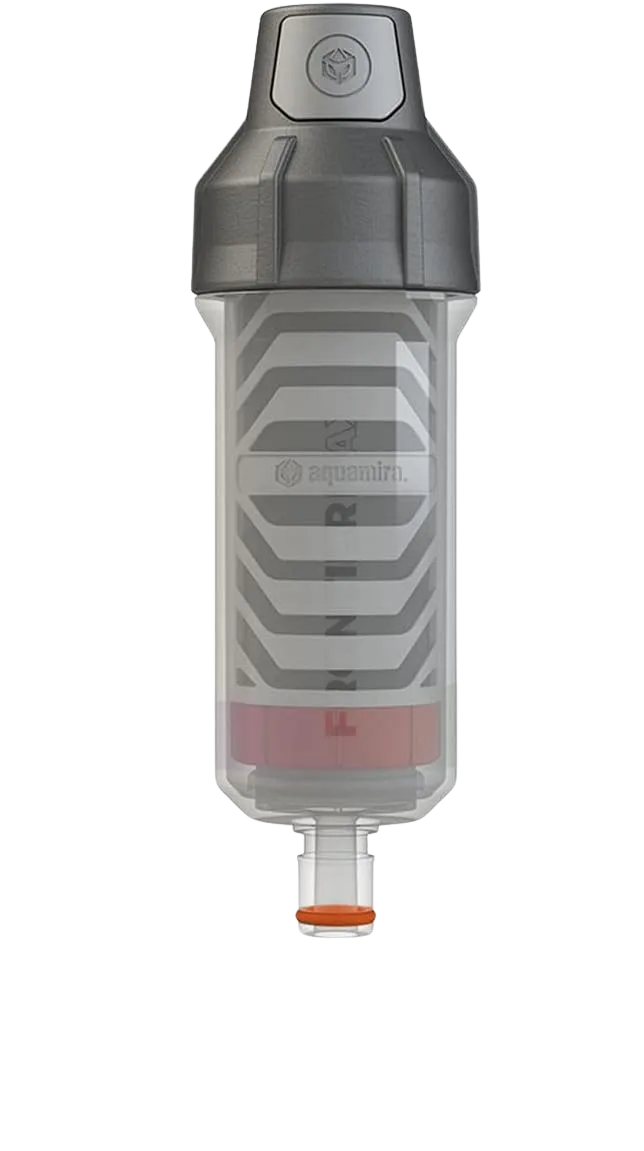
🎯 Best for Emergency Kits: Aquamira Frontier Max
The Aquamira Frontier Max sits in a different category from the others — it is the filter you keep in an emergency kit, a bug-out bag, or a disaster-preparedness stash. At 1 oz for the bare Red Line Worldwide filter, it is the lightest virus-capable option in this lineup, and Aquamira’s Series IV system lets you swap cartridges between the Frontier Max, Shift bottles, and their pressurized reservoirs so the same housing handles multiple scenarios. NSF/ANSI 372 lead-free certification and a 500 ml/min flow rate on the Red Line round out a spec sheet that competes directly with Sagan Life at a lower entry price.
Verified Amazon reviews pattern-match on Aquamira’s dual identity. First, the brand’s Frontier line has genuine pedigree — it was one of the first emergency-focused filters on the US market and has the military/preparedness brand credibility that newer entrants lack. Second, for pure inline-on-hydration-bladder use, owners find the threading works but the filter’s emergency-first design means it isn’t as seamless as the Thru-Link’s purpose-built fittings.
The honest flaws are two. First, the Red Line’s 120-gallon filter life is the shortest in this review — aggressive for a product priced in the mid-range. Second, the Series IV cartridge system means replacements add up over time if you use it as a primary filter rather than a backup. The Backcountry Plus cartridge at 1000 gallons is a better value if you commit, but you’re then locked into Aquamira’s ecosystem. Buy the Frontier Max if you keep an emergency kit, want virus-capable filtration in the smallest possible package, or value redundancy across bottle/straw/inline configurations. Skip it if you’re a high-mileage hiker who needs a primary filter with real-world service life — Sawyer’s economics win that comparison.
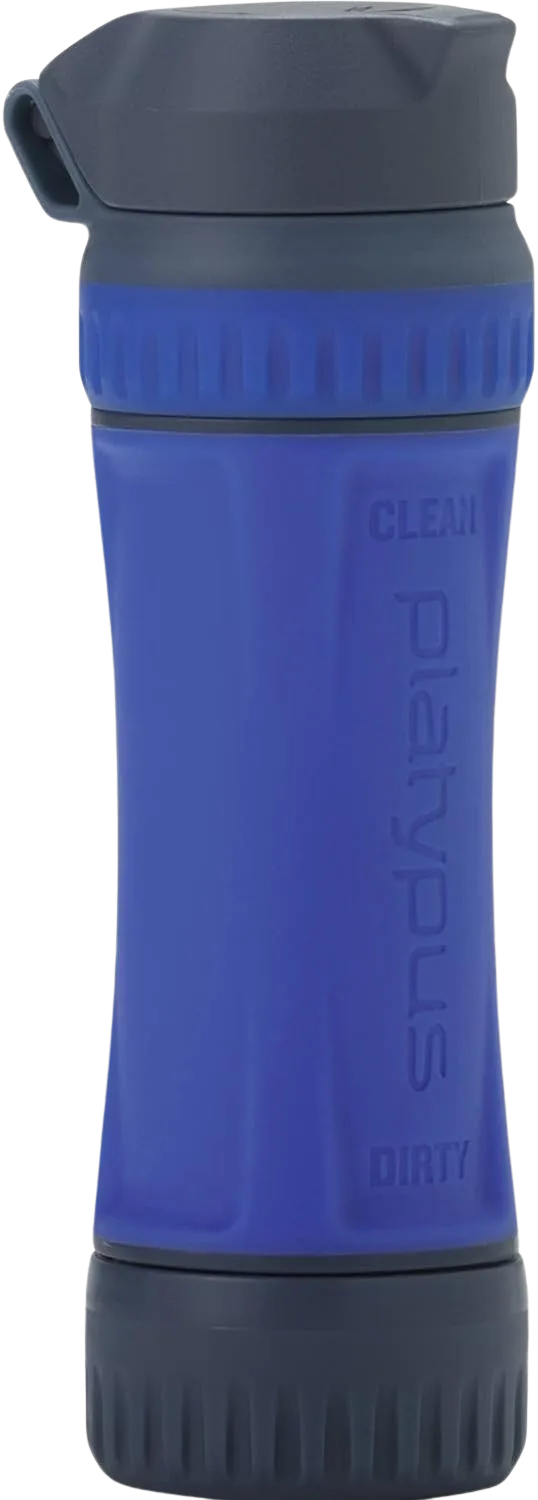
🎖️ Honorable Mention: Platypus QuickDraw Microfilter
The Platypus QuickDraw earns its honorable mention because it solves the reservoir-water problem from a different angle. It isn’t a true inline-on-the-drink-tube filter — it’s a high-flow hollow-fiber filter with a ConnectCap that lets you plug it into a reservoir’s CPC port and rapidly fill the bladder with already-filtered water. For hikers who prefer to fill clean rather than drink through a filter in the hose, the QuickDraw’s 3 L/min flow rate and tool-free backflushing make it a strong alternative workflow.
How to Choose an Inline Water Filter for Your Hydration Bladder
Four decisions drive the right pick: bladder-brand compatibility, flow rate under drinking suction, backflushing convenience, and freeze vulnerability. Generic water-filter roundups skip all four because they’re specific to the inline-on-a-hose workflow. If you’re unsure whether the water you’re about to drink is even safe, our guide to why hikers get sick from clear-looking water covers the risk-assessment framework that decides when you need a purifier versus a plain filter.
Why Bladder-Brand Compatibility Matters
Hydration bladders use different hose diameters and fittings. CamelBak’s Crux uses proprietary Quick-Link fittings. Platypus Big Zip uses standard 1/4-inch ID. HydraPak uses 28mm Plug-N-Play on reservoirs and bottles. Osprey Hydraulics uses proprietary magnetic couplings. Source uses a UTA valve system that isn’t cross-compatible.
What this means in practice: a filter engineered around one brand’s fittings will require an adapter for another brand’s fittings, which adds a potential failure point every time you rebuild the setup. The MSR Thru-Link’s universal quick-connect is the rare filter that genuinely works across brands without needing to track down third-party adapters. The HydraPak 28mm Filter Kit is brilliant inside HydraPak’s ecosystem and requires a mismatch adapter elsewhere. The Sawyer inline adapter kit (SP110) is built for 1/4-inch ID hoses, which covers Platypus, Osprey’s older lines, Source, and most HydraPak drink tubes — but not CamelBak Crux without a workaround.
Why Flow Rate Under Drinking Suction Is Different from Marketing Flow Rate
Manufacturer flow-rate claims (Thru-Link 1.5 L/min, HydraPak 28mm’s fast-flow marketing, QuickDraw 3 L/min) are measured under gravity or squeeze pressure — not the suction you create when drinking from a hose. Under drinking suction, effective flow is 30-60% of the marketing number, because your lungs can’t generate the same delta pressure as a Sawyer Squeeze bag compressed by hand.
This matters for two reasons. First, it explains why the Sawyer Mini feels noticeably slower than the Sawyer Squeeze even though both are 0.1-micron — the Mini’s smaller filter area means more resistance per unit of pressure. Second, it means flow rate numbers are only useful for relative comparisons within the inline class. The Thru-Link’s 1.5 L/min is faster than the Sawyer Squeeze’s ~1.0 L/min, which is faster than the Sawyer Mini’s ~0.7 L/min — those ratios hold up under suction even though the absolute numbers don’t. If you drink heavily on trail, prioritize filters that score well on the relative ranking.
Why Backflushing on the Hose Is Not Optional
Hollow-fiber filters clog. Sediment, pollen, tannins from shallow stream water, and algae cells all accumulate on the clean side of the membrane and gradually choke flow until drinking through the filter becomes a chore. Backflushing — forcing clean water backwards through the filter to dislodge the buildup — is the maintenance that separates a filter that lasts 300 gallons from one that quits at 50.
Pro tip: Backflush every 15-20 liters of dirty water you run through the filter, more often if your source is visibly cloudy. The HydraPak 28mm Filter Kit includes a dedicated backflush adapter that threads onto a clean bottle, so you can backflush without removing the filter from the hose — the cleanest workflow of any filter in this review. For the Sawyer family, keep the syringe accessible in a pack pocket, not buried at the bottom. For the MSR Thru-Link, the quick-connects pop off in under five seconds for bench backflushing and the filter runs a full boil-and-swap cycle between trips.
The filters in this review vary dramatically on backflush convenience. HydraPak and MSR Thru-Link are the easiest. Sawyer Squeeze and Mini are manageable if you keep the syringe accessible. The Sagan Life Inline Purifier and Aquamira Frontier Max have their own maintenance routines specified in their manuals — follow those, because general hollow-fiber backflush procedures don’t apply to purifier cartridge stages.
Why Freezing Will Destroy Your Filter Silently
Hollow-fiber membranes are made of thin polymer tubes with microscopic pores. When water inside the filter freezes, the expansion tears the tubes at a scale too small to see. The filter will still pass water at roughly the same flow rate afterward — it just stops filtering. You won’t notice until you get giardia or crypto a week after the trip.
This is the failure mode thru-hikers learn the hard way. If your hose sits exposed in 25°F overnight air while you sleep with your bladder filled (or even empty), assume the filter is compromised. The three defenses that work: pull the filter off the hose and sleep with it inside your quilt (primary thru-hiker solution), drain the filter and hose completely before sleeping below freezing (imperfect but better than leaving water inside), or choose a filter whose housing provides more thermal mass against short cold spells (the MSR Thru-Link’s ABS housing buys you a small margin versus the Sawyer’s thin plastic shell). No hollow-fiber filter survives a hard freeze indefinitely — the goal is to avoid exposing it in the first place.
Conclusion
Match the filter to the water you actually drink from, not the star rating. The three frameworks that cover most hikers:
For North American backcountry day hikes, weekends, and multi-day trips where bacteria and protozoa are the real risk: the MSR Thru-Link is the turnkey pick, with the Sawyer Squeeze + Inline Kit as the budget answer that delivers the same filtration class for half the price.
For ultralight-focused hikers who need to shave weight without sacrificing the filter class: the Sawyer Mini SP2306 at 2 oz is the lightest Sawyer option, and the HydraPak 28mm Filter Kit at 1.7 oz is lighter still with better flow if you run HydraPak bladders.
For international travel, virus-risk water, or emergency preparedness: the Sagan Life Inline Purifier handles the heaviest contamination profile and the Aquamira Frontier Max brings virus protection in the smallest package of the lineup. For either of these, pair the filter with a disciplined bladder-care routine — our water bladder mold prevention guide covers the cleaning steps that keep the reservoir from seeding bacteria upstream of whichever filter you chose.
Q1 Can you put a water filter inline with a CamelBak hydration bladder?
Yes, but CamelBak’s proprietary Quick-Link fittings make it less plug-and-play than other brands. The MSR Thru-Link’s universal quick-connect works with CamelBak directly. Sawyer and HydraPak filters need a third-party 1/4-inch-ID-to-CamelBak adapter, available for $8–12 on Amazon.
Q2 How do you clean or backflush an inline water filter without taking it off the hose?
The HydraPak 28mm Filter Kit ships with a backflush adapter that threads onto a clean bottle — squeeze backwards through the hose to flush. Most other filters require removing the filter from the hose, running Sawyer’s syringe or MSR’s backflush procedure, and reinstalling. Plan 2–3 minutes per cleaning cycle.
Q3 Does the MSR Thru-Link remove viruses?
No. The Thru-Link is a filter, not a purifier — its 0.2-micron hollow-fiber membrane removes bacteria (99.9999%) and protozoa (99.9%) but passes viruses. For virus protection on a hydration bladder, the Sagan Life Inline Purifier or Aquamira Frontier Max Red Line are the right choices.
Q4 Can a Sawyer Squeeze be used inline on a hydration bladder, and what adapters do you need?
Yes, with the SP110 Inline Hydration Pack Adapter kit (sold separately) or the SP137 bundle that includes the Squeeze + inline adapters in one box. Route the adapter fittings onto each side of the Squeeze and insert into the 1/4-inch-ID drink tube. Works on Platypus, HydraPak, Source, and most standard bladders. If you want the comparison to chemical treatment, iodine and chlorine dioxide are the inline-filter alternatives.
Q5 Can an inline water filter freeze and still work after?
No. Hollow-fiber filters — including the MSR Thru-Link, Sawyer Squeeze, Sawyer Mini, HydraPak 28mm, and Platypus QuickDraw — fail silently after a single freeze cycle. The filter still passes water but stops filtering. If the hose sat below 32°F, replace the filter before your next water source.
Risk Disclaimer: Hiking, trekking, backpacking, and all related outdoor activities involve inherent
risks which may result in serious injury, illness, or death. The information provided on The Hiking Tribe is for
educational and informational purposes only. While we strive for accuracy, information on trails, gear, techniques,
and safety is not a substitute for your own best judgment and thorough preparation. Trail conditions, weather, and
other environmental factors change rapidly and may differ from what is described on this site. Always check with
official sources like park services for the most current alerts and conditions. Never undertake a hike beyond your
abilities and always be prepared for the unexpected. By using this website, you agree that you are solely
responsible for your own safety. Any reliance you place on our content is strictly at your own risk, and you assume
all liability for your actions and decisions in the outdoors. The Hiking Tribe and its authors will not be held
liable for any injury, damage, or loss sustained in connection with the use of the information herein.
Affiliate Disclosure: We are a participant in the Amazon Services LLC Associates Program, an
affiliate advertising program designed to provide a means for us to earn advertising fees by advertising and linking
to Amazon.com. As an Amazon Associate, we earn from qualifying purchases. We are also an official affiliate partner
of Black Diamond Equipment via the AvantLink network. If you click on a Black Diamond affiliate link and make a
purchase, we may earn a commission at no additional cost to you. We also participate in other affiliate programs and
may receive a commission on products purchased through our links. Additional terms are found in the terms of
service.