In this article
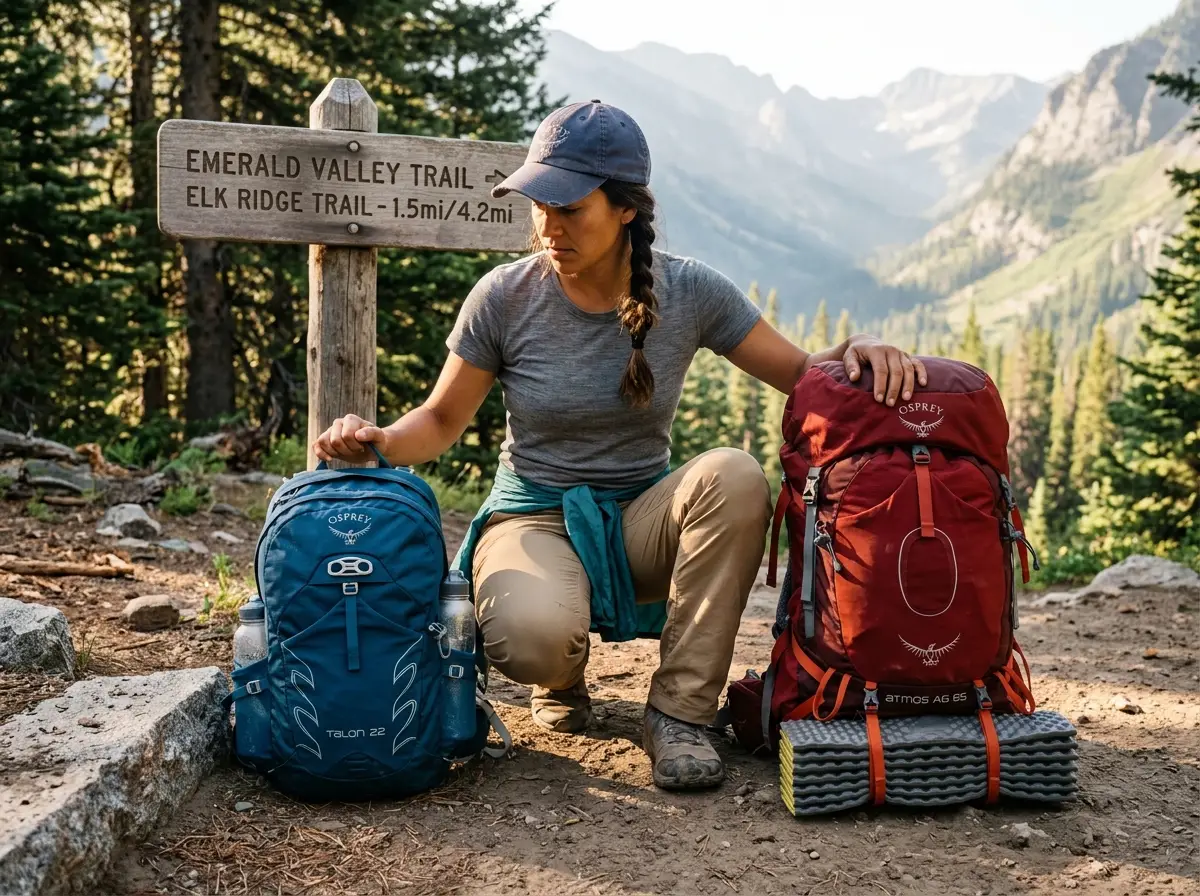
You are staring at two backpacks. One swallows a sleeping bag whole; the other looks barely big enough for lunch and a rain shell. The tag on both just says “hiking backpack,” which helps nobody. Ask around in any hiking forum and the same story shows up on repeat: someone brings a day pack to their first overnight, or hauls a 65-liter monster on a four-mile stroll, and learns the difference the hard way.
This guide skips that lesson. Below is the real split between a daypack and a backpacking pack, the capacity numbers that actually matter, and a simple way to know which one your next trip needs. For the wider view on sizing and features, our complete guide to choosing a hiking backpack covers the full decision while this article zooms in on the question that trips up the most people.
Here is the whole comparison at a glance before we get into the why.
| Attribute | Daypack | Backpacking Pack |
|---|---|---|
| Capacity | 10–35L | 40–80L and up |
| Frame | Frameless or light framesheet | Internal frame, adjustable suspension |
| Hip belt’s job | Stabilizes the load | Transfers 70–80% of weight to your hips |
| Carries best | Up to ~10% of your weight | Up to ~20% of your weight, all day |
| Trip length | One day, home by dark | Overnight to multi-day |
| Typical load | Water, layers, snacks, essentials | Sleep system, shelter, stove, food |
The Real Difference in Plain English
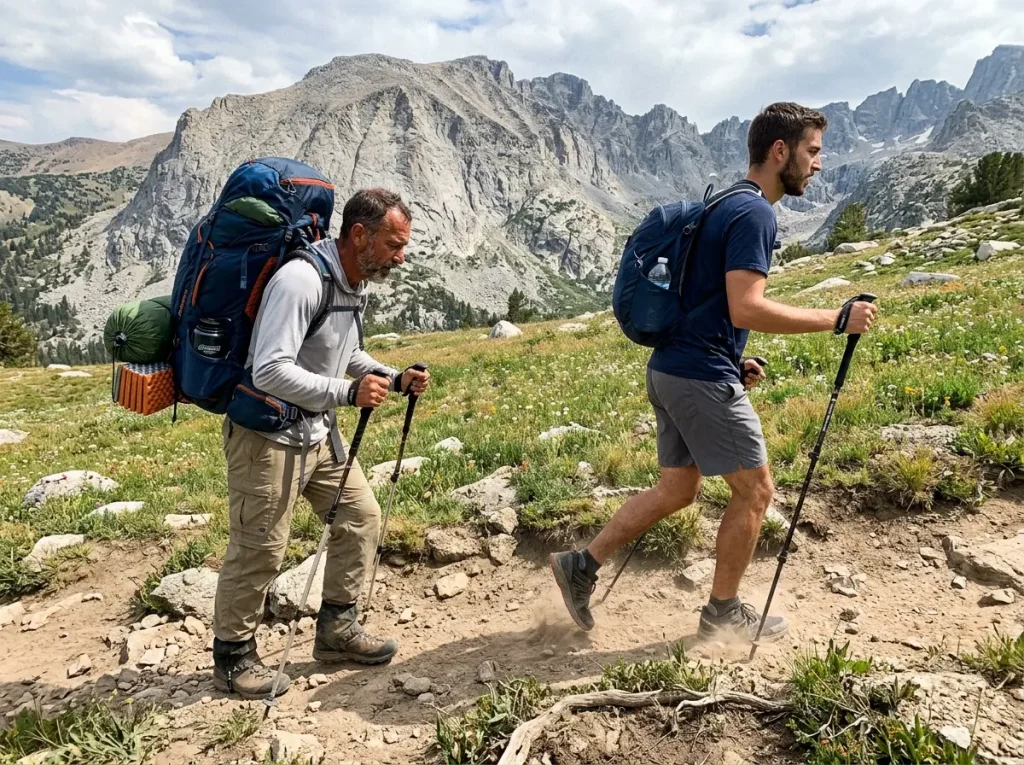
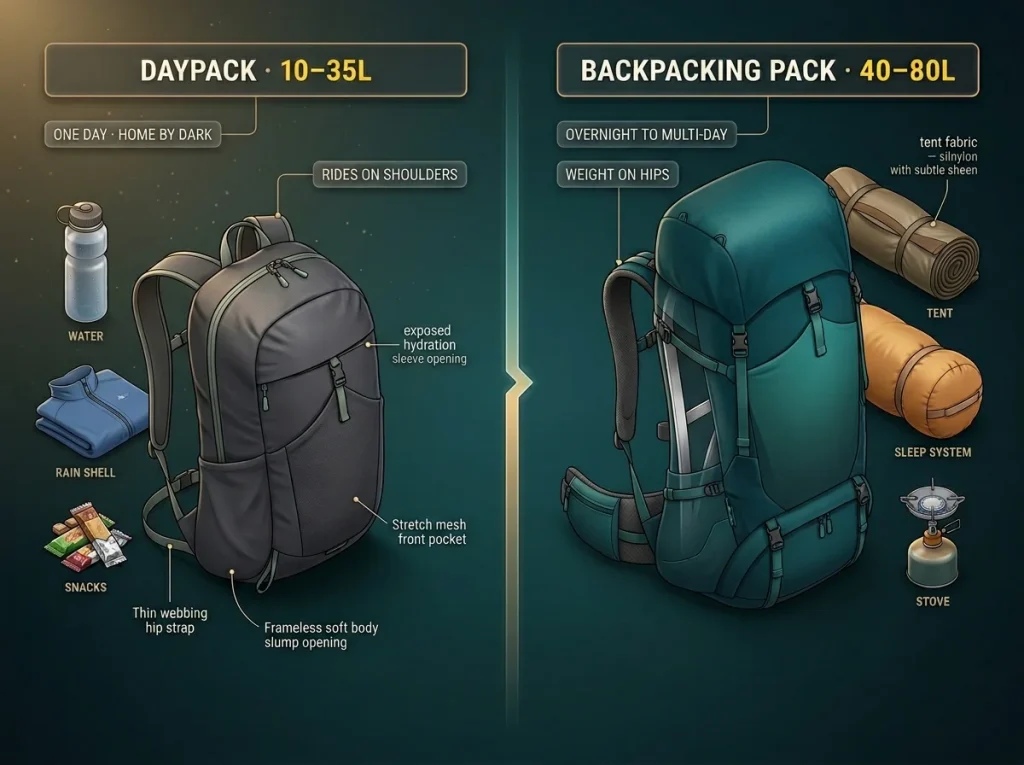
Forget the marketing names for a second. A daypack is built to carry one day’s worth of gear on your shoulders. A backpacking pack is built to carry a multi-day load on your hips.
They are not “small backpack” and “big backpack.” They are two different machines that happen to share a shape.
What a daypack is actually built for
A daypack expects you home by dark. It holds water, snacks, an extra layer, a rain shell, and the rest of your day-hike essentials, and that is about it. Most run frameless or with a thin sheet of plastic for structure, because a load under roughly 15 pounds rides fine on your shoulders for a single day.
The features reflect that: a hydration sleeve, quick-access pockets, and light fabric. Nobody designed it to sleep out.
What a backpacking pack is actually built for
A backpacking pack expects you to sleep somewhere. Once you add a sleeping bag, a tent, a stove, and a few days of food, the load climbs past what shoulders can handle comfortably, so the pack gets an internal frame and a real suspension system that moves that weight onto your pelvis. Sleeping-bag compartments, compression straps, and a structural hip belt all exist for one reason: to carry heavy loads, far, without wrecking your back.
The one-number tell on the tag
When in doubt, read the volume. Anything under 35 liters was engineered for a day. Anything 40 liters and up was built to carry overnight gear.
The story that keeps coming up among first-timers makes the point: someone shows up to their first overnight with a 22-liter day pack, then discovers at the trailhead that the sleeping bag will not fit inside, straps it to the outside, and watches it soak through in the first rain. The tag tried to tell them.
Capacity: How Many Liters Do You Actually Need?
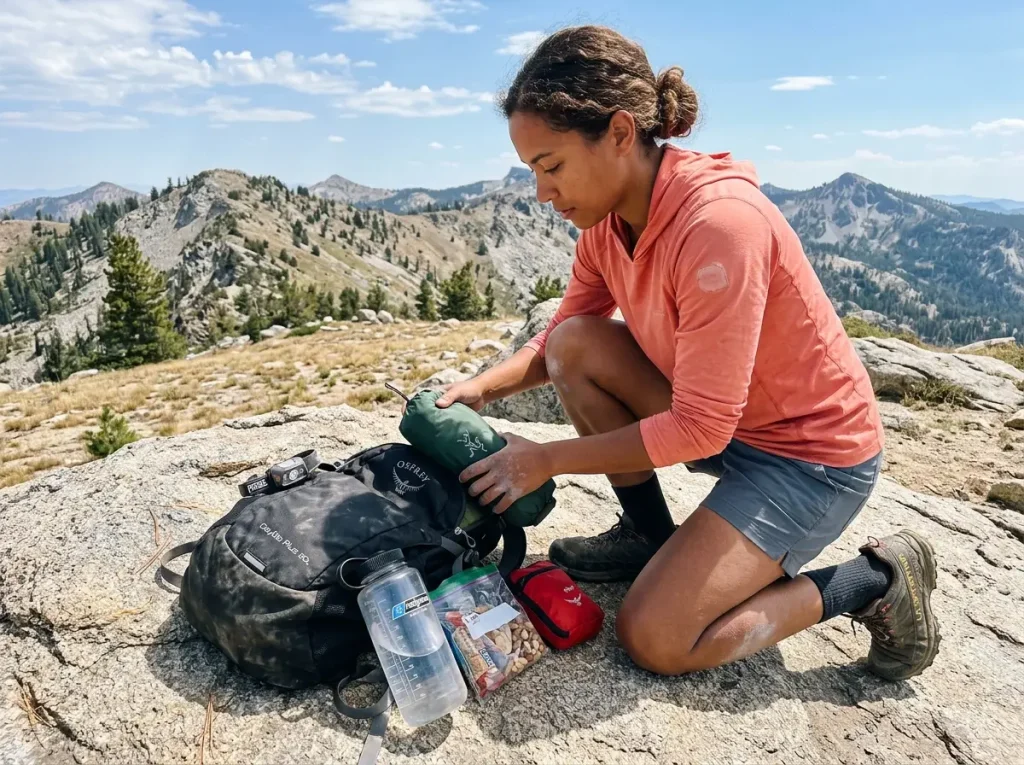
Liters are an abstraction until you map them to a trip. Veteran hikers carry a rough cheat sheet in their heads, and it looks like this.
For day hiking, 18 to 30 liters covers fair weather through a full summer day. Step up to 35 to 45 liters for variable weather or snowshoeing. For overnights, 45 to 50 liters handles one or two nights, 50 to 70 liters covers three to seven nights, and 70 liters and up is for extended trips and mountaineering. The Washington Trails Association’s capacity guidelines back up those ranges if you want the source.
Day hiking: 18–30L (and why summer and winter differ)
For most summer day hikes, a 20-liter pack is plenty for water, layers, and the Ten Essentials. If you only need the basics, the Osprey Daylite Plus 20L is about as simple and budget-friendly as it gets: frameless, light, with a sleeve for a hydration bladder and not much to fuss over.
The thing nobody warns beginners about is winter. That same 20-liter pack that crushed a July summit will leave you short on a January day hike, once you add an insulating layer, microspikes, an emergency bivy, and extra food. Cold-weather day kits often run 28 to 35 liters even though the trip is still just a day.
Overnight and multi-day: 45–70L+
The moment you carry a place to sleep, the math changes. A standard overnight kit (sleeping bag, pad, shelter, stove, food, water) needs 45 liters minimum, and a long weekend pushes you toward 50 to 65. If you are weighing an overnight against a full weekend, our breakdown of how the liter math shifts between an overnight and a longer trip walks through the jump in detail.
The weight ceiling nobody tells beginners (10% vs 20%)
Here is the rule that quietly governs everything: a loaded day pack should stay under about 10% of your weight, and a loaded backpacking pack under about 20%. For a 150-pound hiker, that is roughly 15 pounds for a day hike and 30 pounds backpacking. These are not soft suggestions. Cross them and the load starts riding on joints and tendons that were not built for sustained carry.
An empty pack fits everyone. Before you judge any pack in the store, load it to at least 15 pounds with their sandbags or your own water bottles. A loaded pack tells you the truth about whether the weight sits where it should; an empty one tells you nothing.
Frame and Suspension: Why It Matters After Mile 5
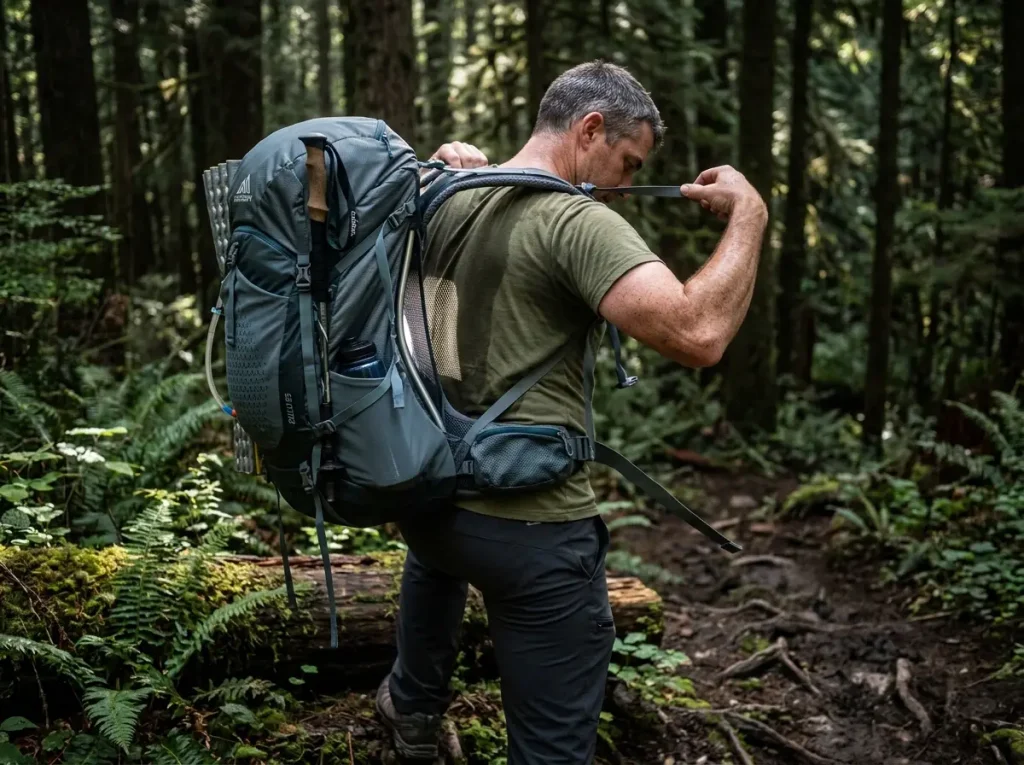
The frame is invisible until mile 5. Then it is the only thing you can think about. This is the part competitors mention in passing and never actually explain, so let’s fix that.
Frameless vs internal frame — what each one does
A frameless daypack lets the load sit close against your back, which is fine when that load is light. A backpacking pack runs an internal frame (aluminum stays, an HDPE framesheet, or both) plus a tensioned back panel that holds the weight in a rigid column and channels it down to the hip belt. The fancy suspension names you see, AntiGravity and AirSpeed and the rest, are just different ways of holding that frame slightly off your back with a tensioned mesh back panel so air can move. If you want the full teardown, our guide to framed versus frameless packs covers every tradeoff.
The 15-pound line where frames stop being optional
There is a real threshold around 15 pounds (about 7 kilograms). Under it, your shoulders can manage a frameless pack for a day. Over it, a frameless pack starts to sag, pull backward, and force your shoulders to fight the load on every step.
The frame is not a luxury feature at that point. It is the only thing keeping the weight from dragging you around.
The opposite mistake: too much frame, not enough load
It cuts both ways. Buy a 65-liter pack for “just in case” day hikes and you get the reverse problem. The story experienced hikers love to retell is the person who carried a big empty backpacking pack on a four-mile trail with eight pounds inside. The frame swayed with every step, the hollow pack bounced, and they had a headache by mile two while a ranger asked if they were alright.
A pack needs to be reasonably full to ride well. Oversizing is its own kind of wrong answer.
Hip Belt: Stabilizer vs Load Transfer
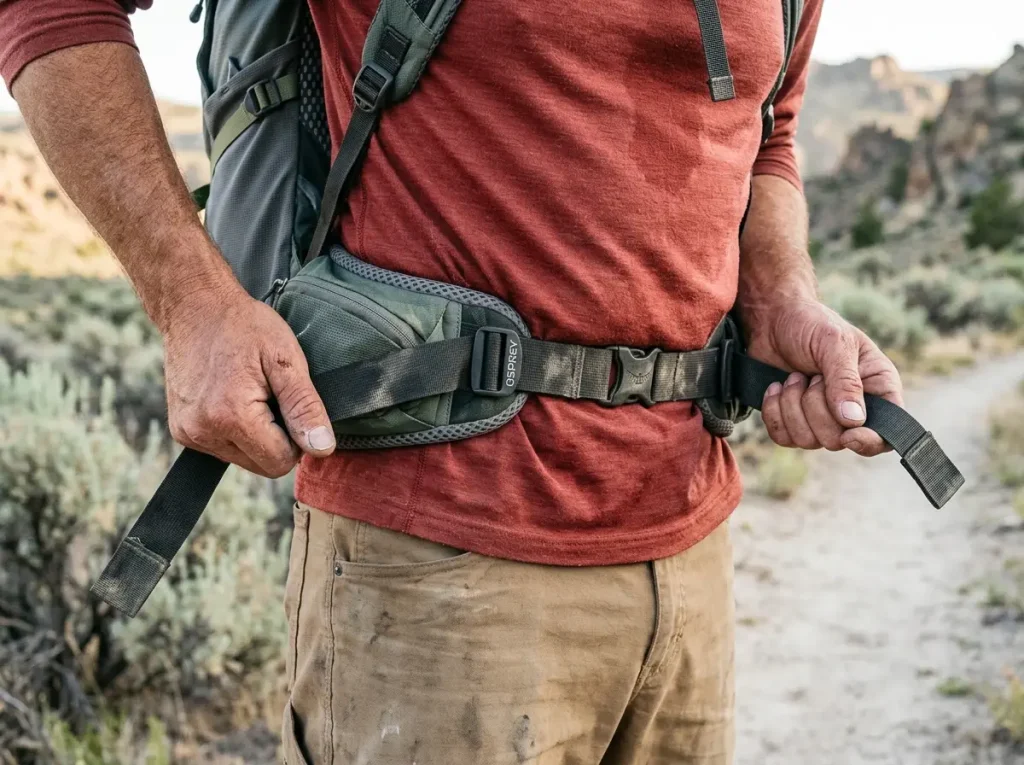
This is the single most misunderstood difference between the two packs, so it gets the most ink. Same name, completely different job. On a daypack, the hip belt keeps the pack from swinging. On a backpacking pack, the hip belt is the suspension.
A webbing strap vs a structural belt
A daypack hip belt is usually a thin webbing strap. Its only job is to stop the pack from bouncing when you scramble.
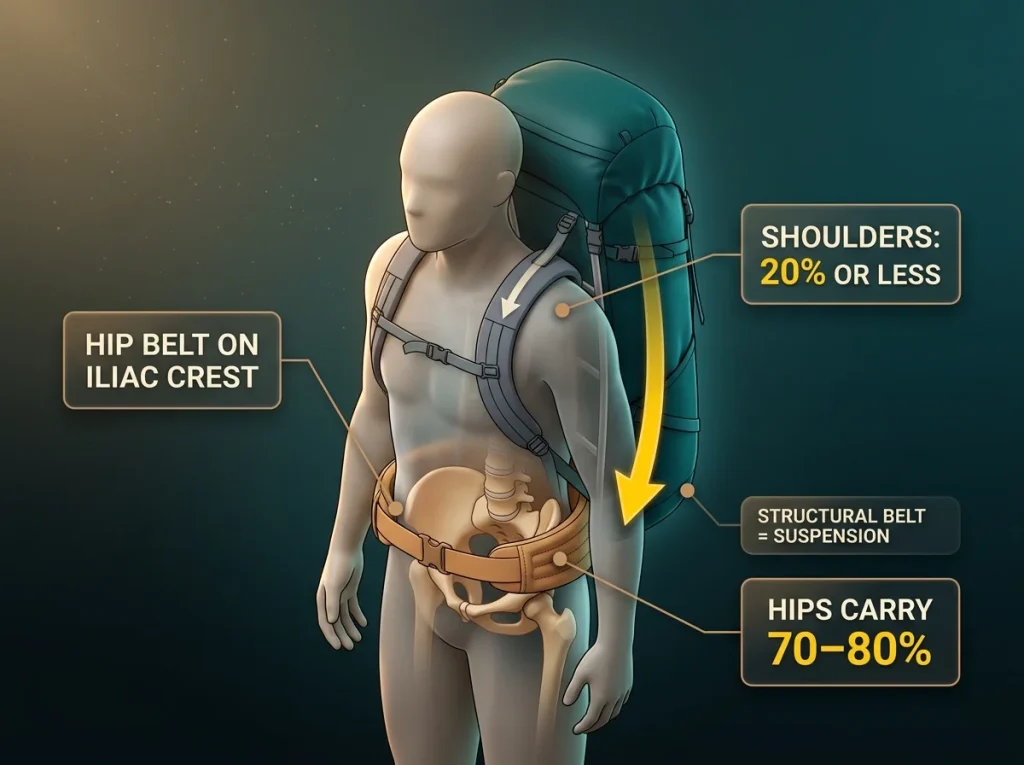
A backpacking pack hip belt is a padded, structural piece that wraps your iliac crest, the shelf of your hip bones, and locks the load onto your pelvis. That difference is why clipping the flimsy belt on a frameless daypack does nothing for your shoulders. There is no frame behind it to move the weight.
Where the weight actually goes (70–80% to your hips)
With a properly fitted backpacking pack, 70 to 80% of the total load rides on your hips, and the shoulder straps carry no more than about 20%. The American Hiking Society’s reminder that shoulder straps were never meant to carry the load is the whole game in one sentence. In trail terms: after eight miles shoulder-loading 25 pounds in a daypack, your trapezius and neck are doing roughly 80% of the work, and they will tell you about it. A 30-pound load carried shoulder-heavy can feel and perform like 45 pounds, because poor weight position multiplies fatigue.
Why your shoulders hurt — and the fix that feels backward
Here is the counterintuitive part. When a backpacking pack makes your shoulders ache, the instinct is to tighten the shoulder straps. That makes it worse. The fix is to loosen the shoulders and cinch the hip belt harder, so the weight drops back onto your pelvis where it belongs.
Sharp pain on the tops of your shoulders usually means the hip belt is too loose or the torso length is too short. Once the belt carries the load, clip and slide the sternum strap so the shoulder straps stop splaying, then fine-tune the load-lifter straps to settle the weight distribution against your back.
Wearing a backpacking pack with the hip belt unclipped for ventilation is the fastest way to turn a comfortable load into a sore back. Shoulder-loading 40 pounds for 12 miles is the exact injury pattern the frame and belt were designed to prevent. Clip in, then vent by loosening, not unclipping.
The Grey Zone: 30–40L Packs and When the Rules Break
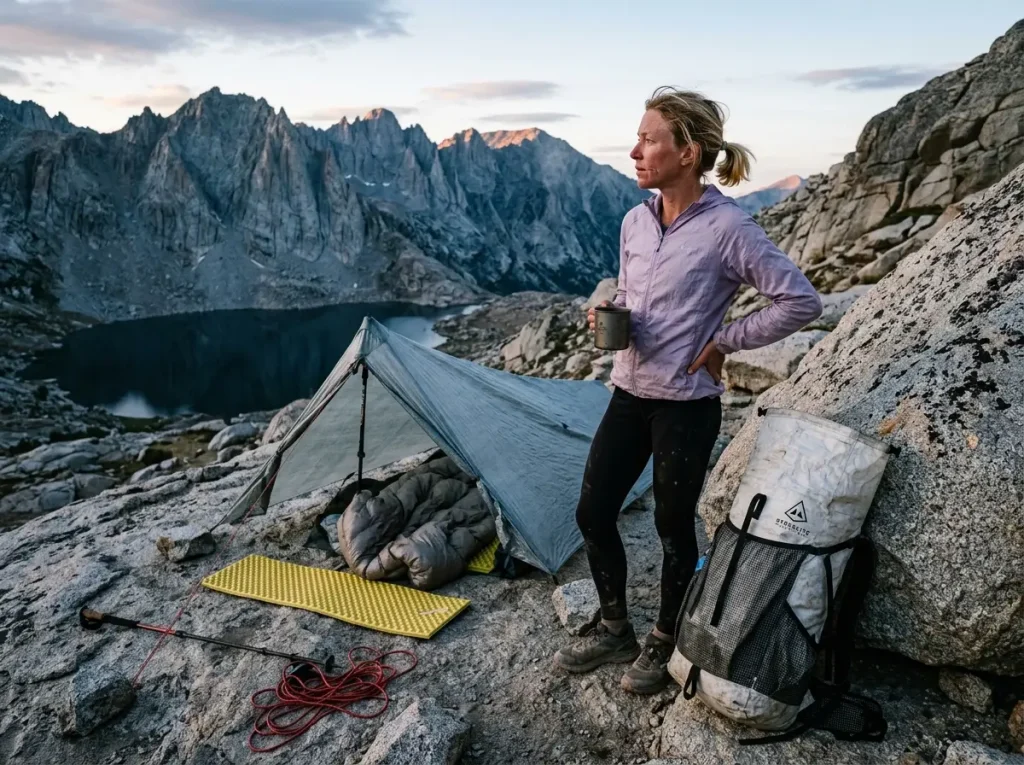
This is the pack that confuses everyone. A 30 to 40-liter pack lives between the two categories, and it is the most common buying mistake in the whole conversation. The community even has a name for it: the grey zone.
What a 30–35L pack can and can’t do
A 30 to 35-liter pack is a specialist tool, not a smaller backpacking pack. It shines on long day hikes and ultralight overnights, and it falls apart on a standard two-night trip with a normal sleep system. Buy one expecting “a beginner backpacking pack” and you will run out of room the morning of day two, once food and clothes are in. It can stretch to an overnight, but only if you are willing to lash the sleeping pad to the outside and pack with real discipline.
The ultralight exception (and the Big Three rule)
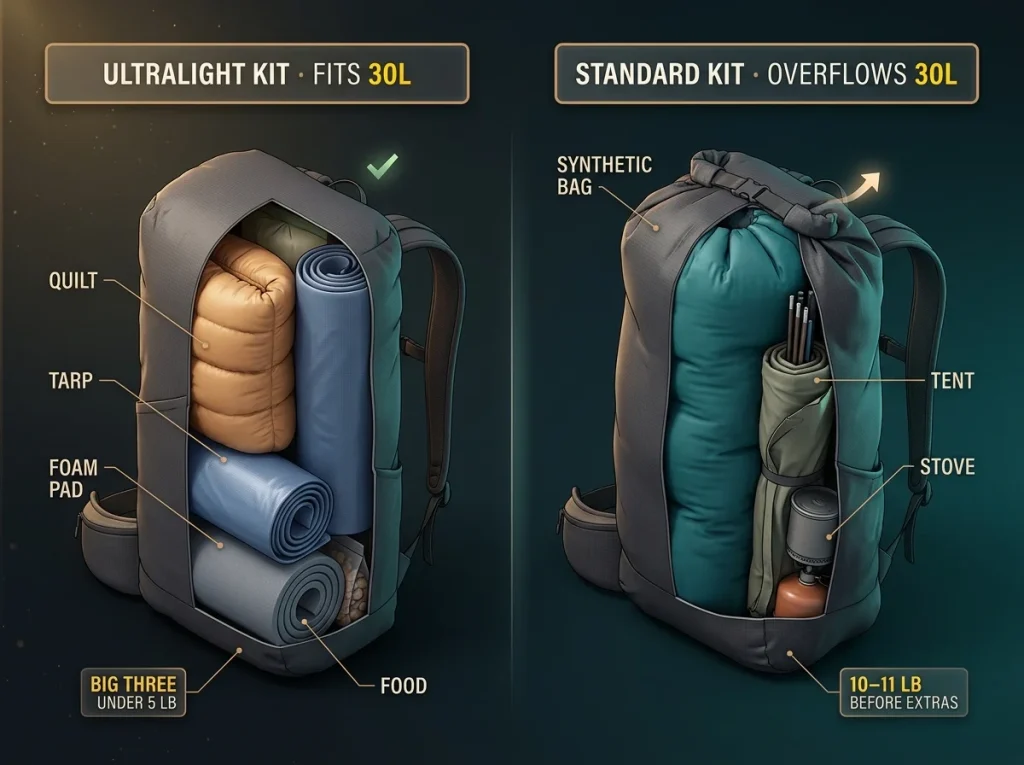
There is a real audience that uses a 30-liter frameless pack for overnights on purpose, and they are not breaking the rules so much as earning an exception. It works only if your Big Three (shelter, sleep system, and pack) come in under five pounds total. That usually means a sub-one-pound quilt, a tarp, a 10-ounce foam pad, and no bulky extras like a bear canister, which alone can swallow a third of a 30-liter pack. A standard kit (a synthetic bag at three pounds, a tent at three pounds, a pack at four) eats 10 or 11 pounds before anything else goes in, and none of it fits in 30 liters.
If you are headed that direction, our roundup of the actual sub-2-pound packs built for it is the place to start. The crossover pick most hikers reach for is the Osprey Stratos 36 and Sirrus 36 (men’s · women’s), marketed for exactly this span, from long day hikes to lightweight overnights.
The winter day-hike trap
The grey zone shows up in winter too. A 20-liter pack that handled a 12-pound summer kit physically cannot hold the 17 to 19 pounds a winter day demands, once you add a mid-layer, microspikes, an emergency bivy, and more food and water. Winter day hikes live in daypack territory but need near-backpacking capacity, which is why a 28 to 35-liter pack is often the right call for a cold-weather day out.
If your Big Three is already light, the daypack you own might be all you need for an overnight. Do not buy a new pack just to feel prepared. The ultralight slogan is pack the scale, not the comfort, and the grey-zone pack is a reward for cutting weight, not a shortcut to skip it.
Which Pack for Which Trip
Forget the theory for a moment. Tell me where you are going, and the answer gets simple. The best pack is the one that fits your torso and your real trips, not the one with the most expensive suspension.
For day hikes (and winter day hikes)
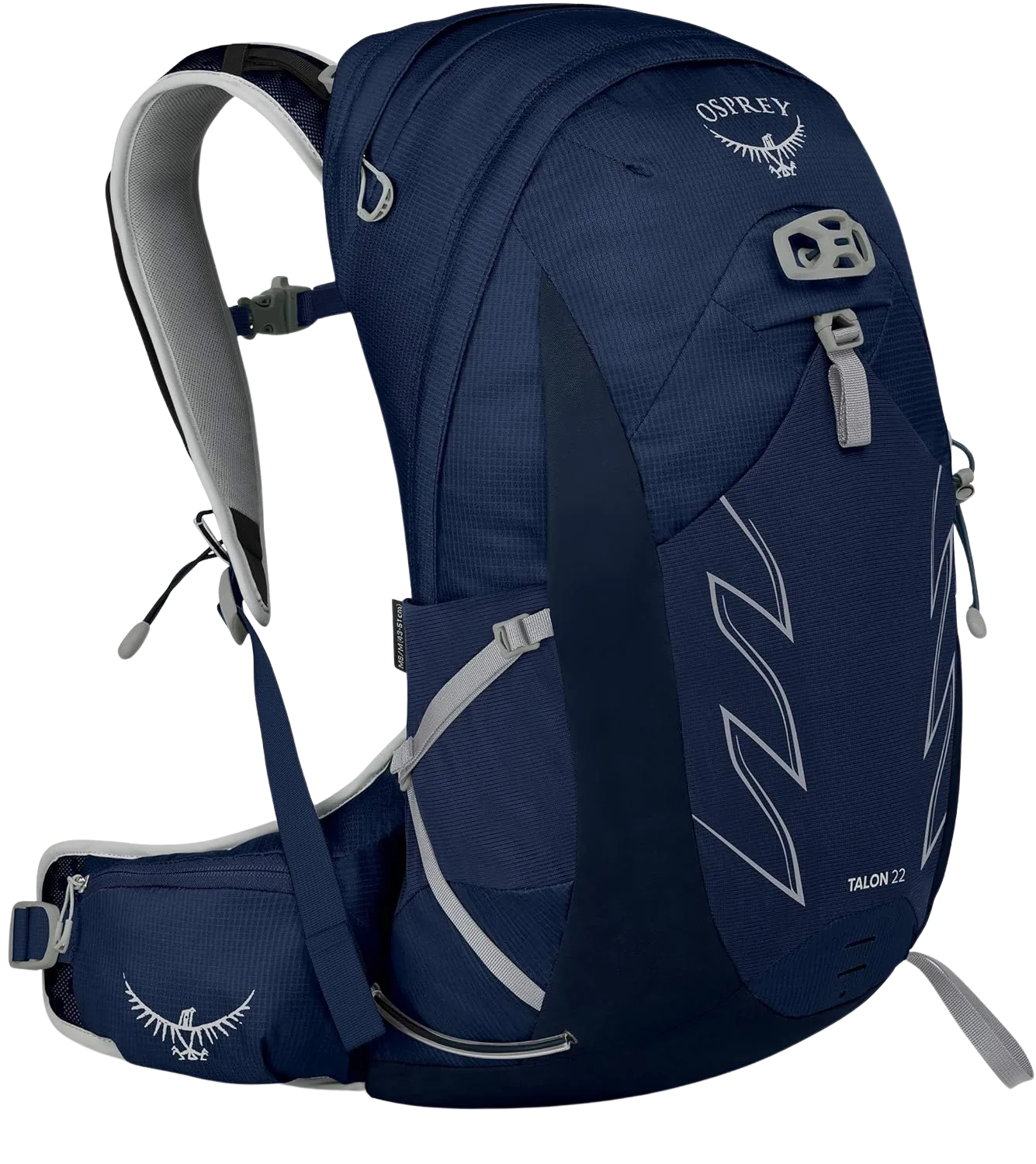
For summer day hikes, a quality 18 to 22-liter daypack is all you need. The honest pick across the board is the Osprey Talon and Tempest, light enough to forget you are wearing it, with enough ventilation to matter in July.
For winter day hikes, size up to the 28 to 35-liter range from the grey-zone logic above. Same trip length, much more gear.
For your first overnight or weekend
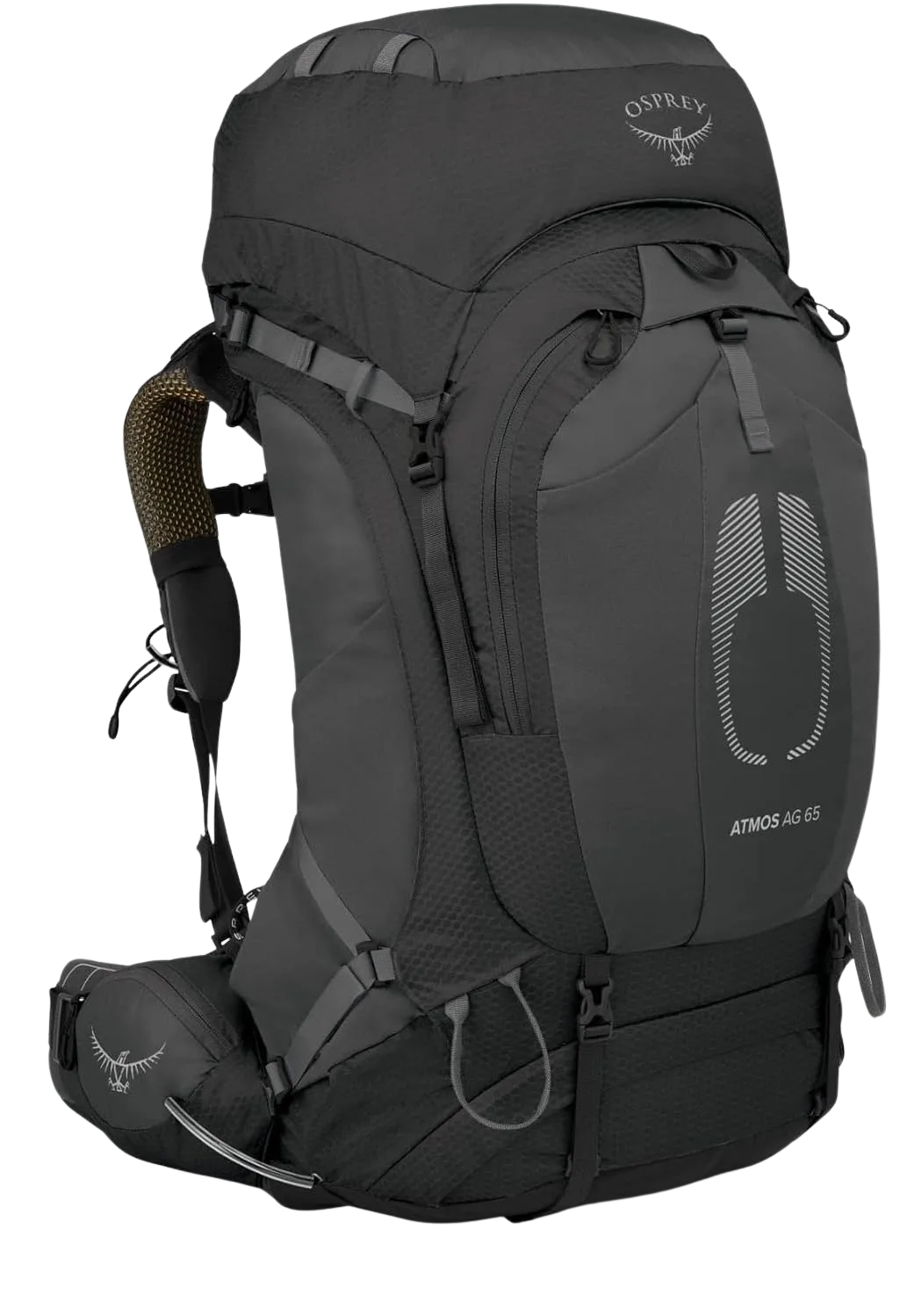
The moment you carry a place to sleep, you need a real 45 to 65-liter backpacking pack with a working hip belt. The benchmark suspension belongs to the Osprey Atmos and Aura, with the AntiGravity system that most other packs get measured against. For a deeper look at the category, our guide to multi-day backpacking packs lays out the field.
Not ready to spend at that tier? You do not have to. The Osprey Rook 65 and Renn 65 (men’s · women’s) give you a genuine internal frame and real hip-to-pelvis load transfer at a mid-range price, and for most first-time overnighters they carry a weekend load just fine.
For going ultralight or long
If you are cutting your base weight and thru-hiking long trails, you already know the grey-zone pack and the crossover logic from the section above apply to you. Match the pack to your kit, not to the trip’s reputation.
Fit and Sizing: The Step Most Buyers Skip
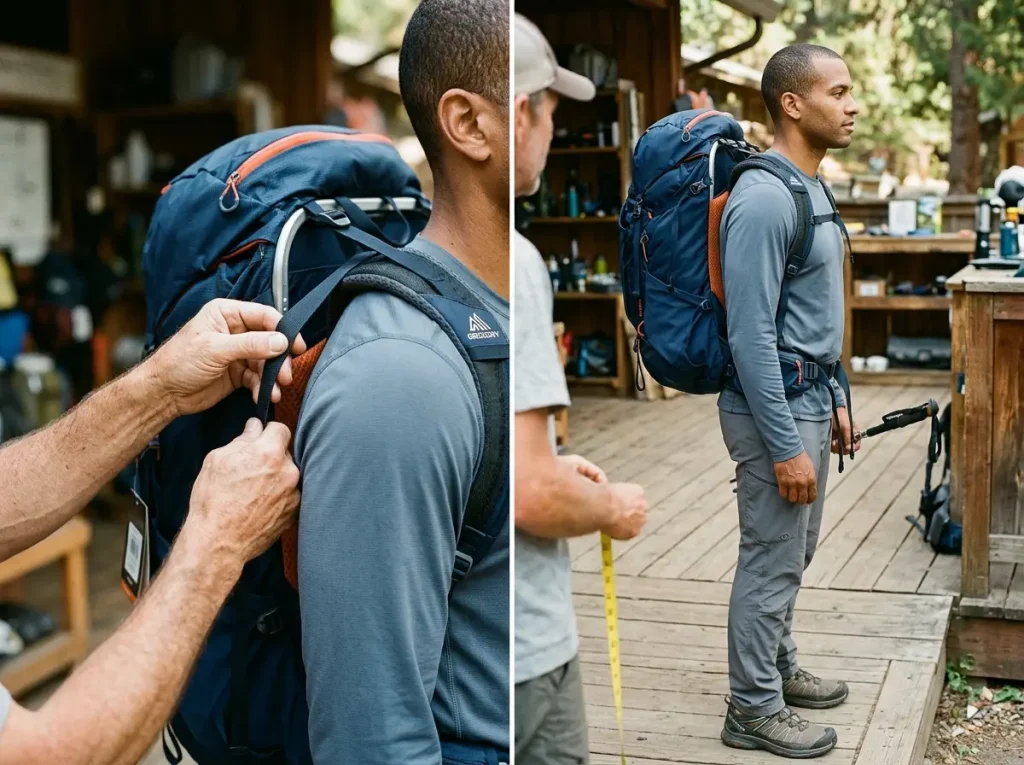
Buying a backpacking pack by your height is like buying running shoes by your weight. The number that matters is torso length, and most first-time buyers never measure it.
Torso length, not height
Torso length runs from your C7 vertebra (the bump at the base of your neck) down to the shelf of your iliac crest, measured with a flexible tape while you bend forward slightly. That measurement picks your pack size, not your height and not your shirt size. Two hikers the same height can wear different pack sizes, and getting it wrong by a couple of inches means back pain by mile 10. Our walkthrough on how to measure your torso length shows the exact method.
The 45-degree load-lifter check
Once the pack is on and loaded, look at the load-lifter straps that run from the top of your shoulders back to the frame. They should angle at roughly 45 degrees. If they point straight up or lie flat, the torso length is wrong for you.
The Appalachian Mountain Club’s fit guide on load-lifter angle is a clean reference for getting this right. Daypacks rarely need any of this; backpacking packs always do.
Women’s-specific fit (and when it matters)
Women’s-specific packs like the Tempest, Aura, and Sirrus are not marketing. They run a shorter torso range, narrower shoulder-strap spacing, and a hip belt shaped for a different pelvic angle. If a standard pack never quite sits right no matter how you adjust it, the fit geometry may simply be wrong for your frame, and a women’s-fit version can solve what no amount of cinching will.
Always fit a backpacking pack with weight in it. Load it to 15 pounds or more before you decide, then check whether the hip belt actually sits on your iliac crest or rides up above it. An empty pack hides a bad fit; a loaded one exposes it in 30 seconds.
The Bottom Line
The volume on the tag tells you most of what you need: under 35 liters is built for a day, 40 and up is built to sleep out. The real dividing line is not size but the hip belt, because a structural belt and frame move the weight onto your pelvis, where you can carry it for miles. And the smartest move is to match your liters and your torso to your actual trips, not to the most expensive pack on the wall.
Before your next trip, load whatever pack you are leaning toward to its real trip weight and walk a hill for 20 minutes. That short test reveals more than any spec sheet. And when the pack you choose finally starts to wear out, here is how to tell when a pack is done.
Frequently Asked Questions
01Can you use a daypack for overnight backpacking?
Only if your gear is genuinely ultralight. A 30L frameless daypack works for an overnight when your shelter, sleep system, and pack together weigh under five pounds. With a standard tent and sleeping bag, you will run out of room on night one.
02What size pack do I need for a day hike?
For most summer day hikes, 18 to 30 liters is plenty for water, layers, and snacks. Winter day hikes need more, usually 28 to 35 liters, to fit extra insulation, traction devices, and emergency gear.
03How many liters do I need for a 3-day backpacking trip?
Plan on 50 to 65 liters for a three-day trip with standard gear. That range fits a sleeping bag, pad, shelter, stove, and three days of food without strapping things to the outside. Ultralight hikers can go smaller.
04Do you really need a hip belt on a daypack?
Not for carrying weight. A daypack hip belt only stabilizes the pack so it stops swinging on uneven ground. Without a frame behind it, the belt cannot transfer load to your hips, so it is a convenience, not a necessity.
05Is a 35L pack a daypack or a backpacking pack?
Neither, cleanly. A 35L pack sits in the grey zone, built for long day hikes and ultralight overnights. It works as a big daypack or a minimalist overnight pack, but it is too small for a standard multi-day trip with conventional gear.
Risk Disclaimer: Hiking, trekking, backpacking, and all related outdoor activities involve inherent
risks which may result in serious injury, illness, or death. The information provided on The Hiking Tribe is for
educational and informational purposes only. While we strive for accuracy, information on trails, gear, techniques,
and safety is not a substitute for your own best judgment and thorough preparation. Trail conditions, weather, and
other environmental factors change rapidly and may differ from what is described on this site. Always check with
official sources like park services for the most current alerts and conditions. Never undertake a hike beyond your
abilities and always be prepared for the unexpected. By using this website, you agree that you are solely
responsible for your own safety. Any reliance you place on our content is strictly at your own risk, and you assume
all liability for your actions and decisions in the outdoors. The Hiking Tribe and its authors will not be held
liable for any injury, damage, or loss sustained in connection with the use of the information herein.
Affiliate Disclosure: We are a participant in the Amazon Services LLC Associates Program, an
affiliate advertising program designed to provide a means for us to earn advertising fees by advertising and linking
to Amazon.com. As an Amazon Associate, we earn from qualifying purchases. We are also an official affiliate partner
of Black Diamond Equipment via the AvantLink network. If you click on a Black Diamond affiliate link and make a
purchase, we may earn a commission at no additional cost to you. We also participate in other affiliate programs and
may receive a commission on products purchased through our links. Additional terms are found in the terms of
service.