In this article
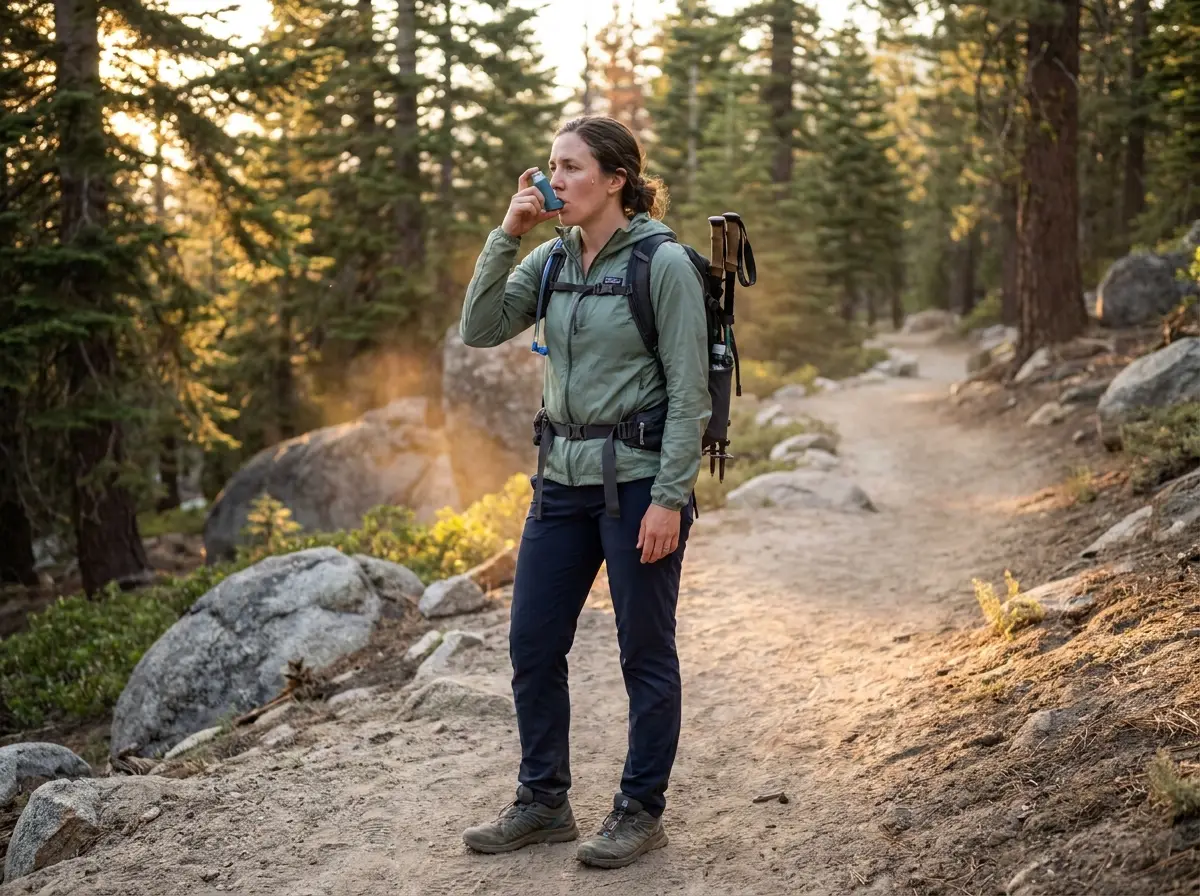
You’re twenty minutes into a trail you’ve hiked before, and your chest starts to tighten. Not because the hill is steep — because the pollen count spiked overnight and you didn’t check. I’ve hiked hundreds of miles managing exercise-induced bronchoconstriction, and every asthmatic hiker I know has a version of this story. This guide covers the five mistakes that send asthmatic hikers home early — and the inhaler management, trail selection, and emergency protocols that keep you on the trail safely.
Quick Answer: Most asthmatic hikers fail on the trail not because of their lungs, but because they skip the prep that keeps their lungs open. Check air quality before you drive, pre-treat with your rescue inhaler 15 minutes before hiking, keep your puffer in a 3-second-access pocket, and have a Red Zone plan for when meds stop working. Get those four things right and asthma becomes a manageable trail companion, not a trip-ender.
Not Checking Air Quality Before You Drive to the Trailhead
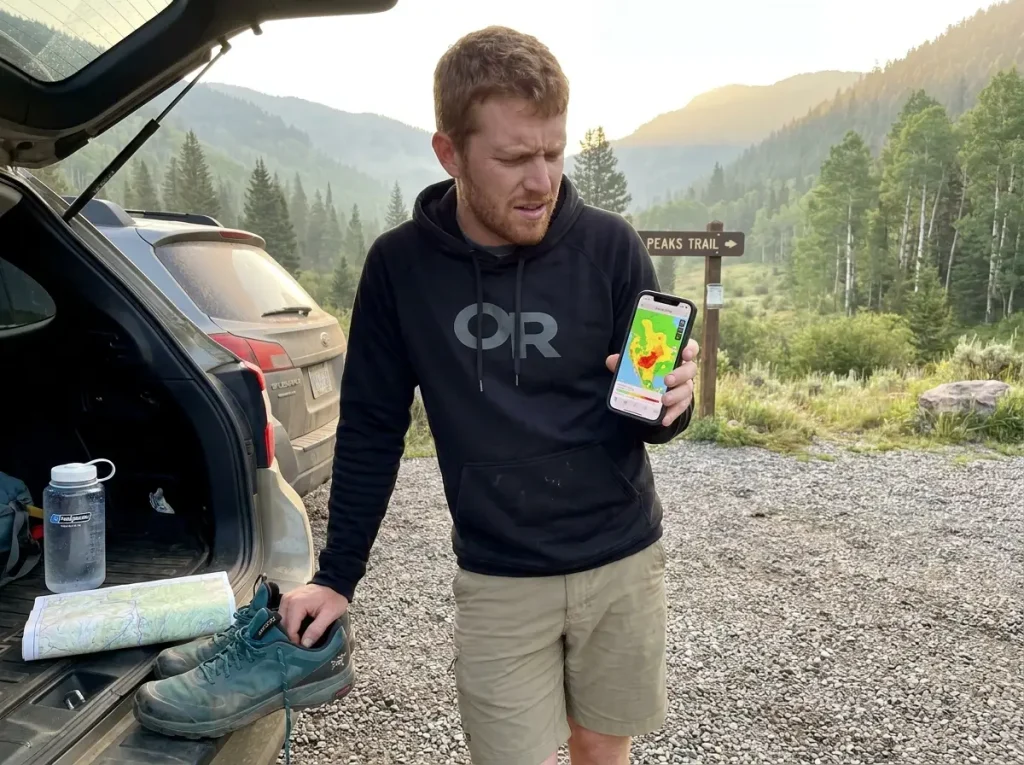
Most asthmatics know their triggers. Cold air, dust, pollen — the usual suspects. But here’s the mistake I see over and over: hikers check the weather forecast and skip the air quality index. That’s like checking the road conditions but not whether your car has gas.
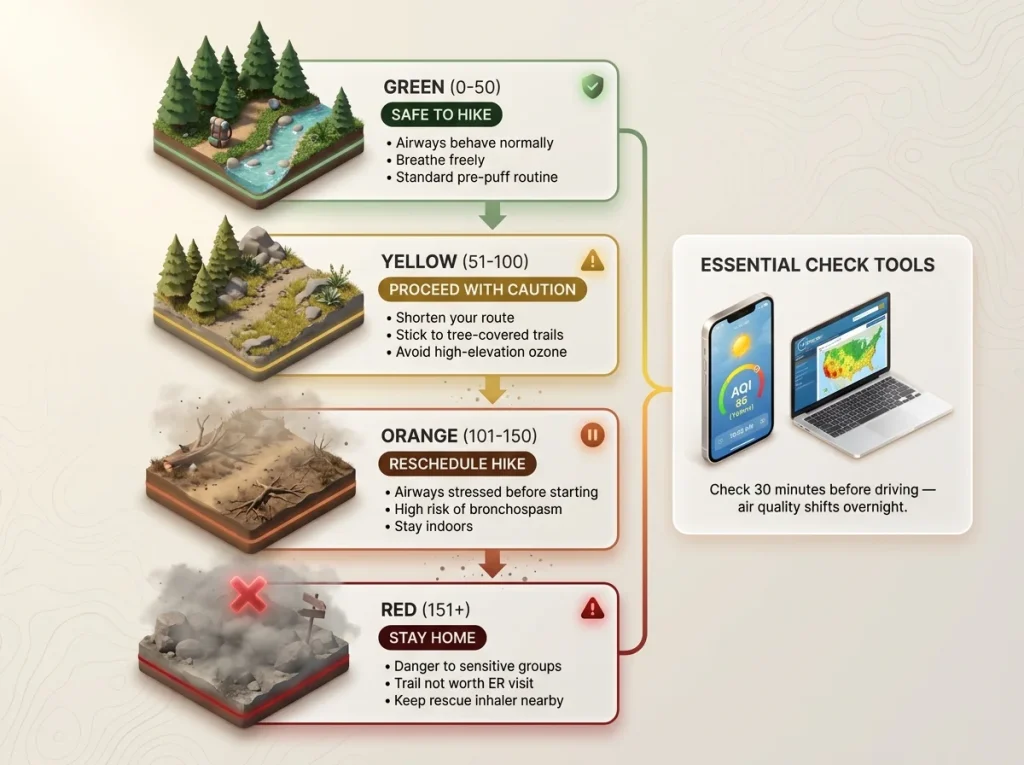
The AQI Color Code for Asthmatic Hikers
The AQI runs on a simple color system, and the numbers matter more than most hikers realize. Green (0-50) means your airways should behave normally — hike freely. Yellow (51-100) is where it gets interesting. Most people think yellow is fine, but even moderate ozone levels can trigger tightening above treeline where the air is thinner and drier. If you see yellow, consider a shorter route or stick to lower-elevation, tree-covered trails.
Orange (101-150) is your reschedule signal. At this level, your airways are already working harder before you take a single step. Red (151 and above) means stay home — no trail is worth a trip to the ER. The American Lung Association’s AQI breakdown spells this out clearly for sensitive groups including asthmatics.
Pro tip: Check AirNow.gov the morning of your hike, not the night before. Air quality shifts overnight, especially in valleys where pollution settles. A 10-second check saves you a 2-hour drive to a trailhead where you can’t breathe.
Pollen Counts and Seasonal Timing
Pollen peaks in early morning during spring and early summer — exactly when most hikers like to start. If pollen is one of your asthma triggers, an afternoon hike or a post-rain window drops your exposure significantly. Rain washes pollen out of the air. The first sunny hour after a storm is often the cleanest air you’ll breathe all week.
Shoulder season is a trap. The temperature feels perfect, but pollen and air quality can be at their worst. A beautiful 55-degree April morning with a pollen count of 10+ is harder on your lungs than a hot July afternoon with clean air. Pay attention to reading weather signs on the trail and you’ll learn to read the atmosphere as a whole, not just the temperature.
Tools That Make the Check Take 30 Seconds
AirNow.gov is free and gives you zip-code-level AQI readings updated hourly. Most weather apps now include AQI data — Apple Weather, Weather Underground, and The Weather Channel all show it on the main screen. Set your home trailheads as saved locations and you’ll see the numbers without even searching.
Carrying Your Inhaler Wrong (or Not At All)
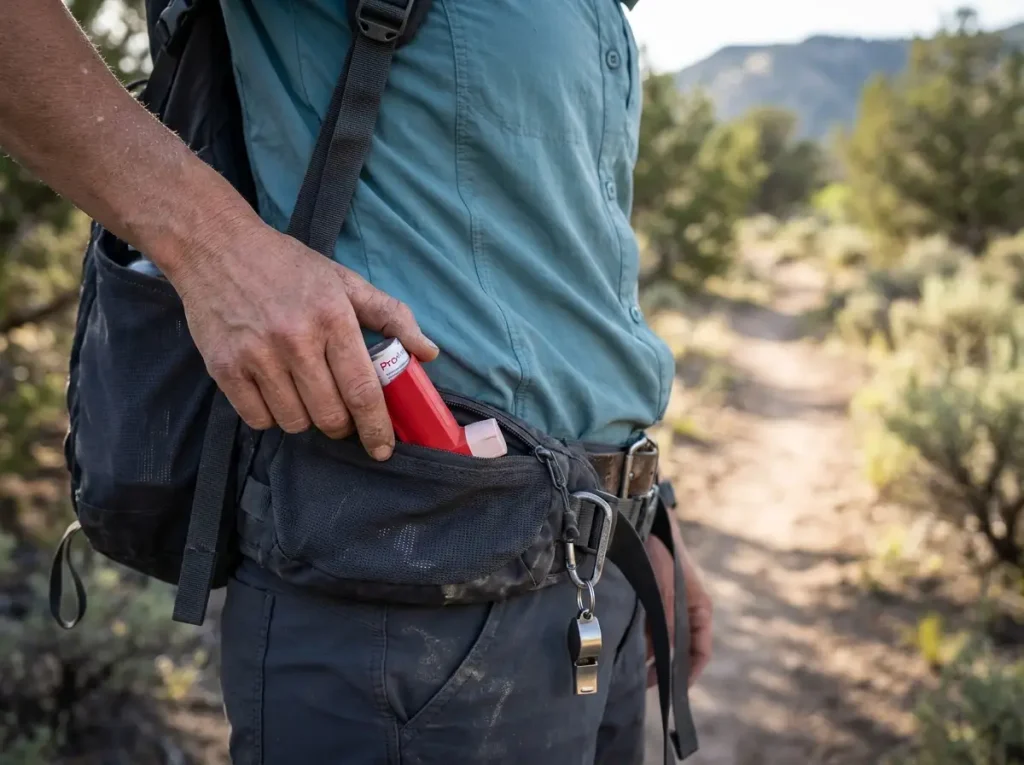
Your rescue inhaler sitting in the bottom of your pack under your rain jacket is the same as not having one. When your chest locks up at mile 3, you need that puffer in your hand in three seconds, not three minutes.
The 3-Second Rule for Inhaler Placement
Keep your albuterol inhaler in your chest pocket, hip belt pocket, or running vest pocket — somewhere your hand goes without thinking. Treat it like experienced hikers treat bear spray: accessible, not buried. If you have to take off your pack to reach your inhaler, you’ve already lost critical time when your airways are narrowing.
The dose counter on your inhaler matters too. A half-empty canister on a backcountry trip is a risk you don’t need. Check it before every hike the same way you’d check your headlamp batteries. Most metered-dose inhalers have a built-in counter — when it hits 20 doses remaining, replace it before your next trip.
The Buddy Inhaler System
Give a backup inhaler to your hiking partner. Show them where it is in their pack and how to shake it, prime it, and hand it to you. One AT thru-hiker I read about kept a backup in their partner’s pack and needed it mid-winter when their primary inhaler froze in an outside pocket. That backup was the only thing between them and an emergency evacuation.
This works both ways — your partner should know you have asthma, know what your early warning signs look like, and know where both inhalers are. Having emergency communication devices for backcountry trips matters even more when one member of your group has a respiratory condition.
Checking Expiration and Dose Counter
Expired albuterol loses potency fast. The medication doesn’t become harmful, but it becomes less effective — and less effective is the last thing you need when your bronchioles are clamping shut on a ridge. Check the expiration date before every trip. Keep a fresh inhaler in your hiking kit and rotate it into daily use when it gets within three months of expiring.
Skipping the Pre-Hike Inhaler Routine
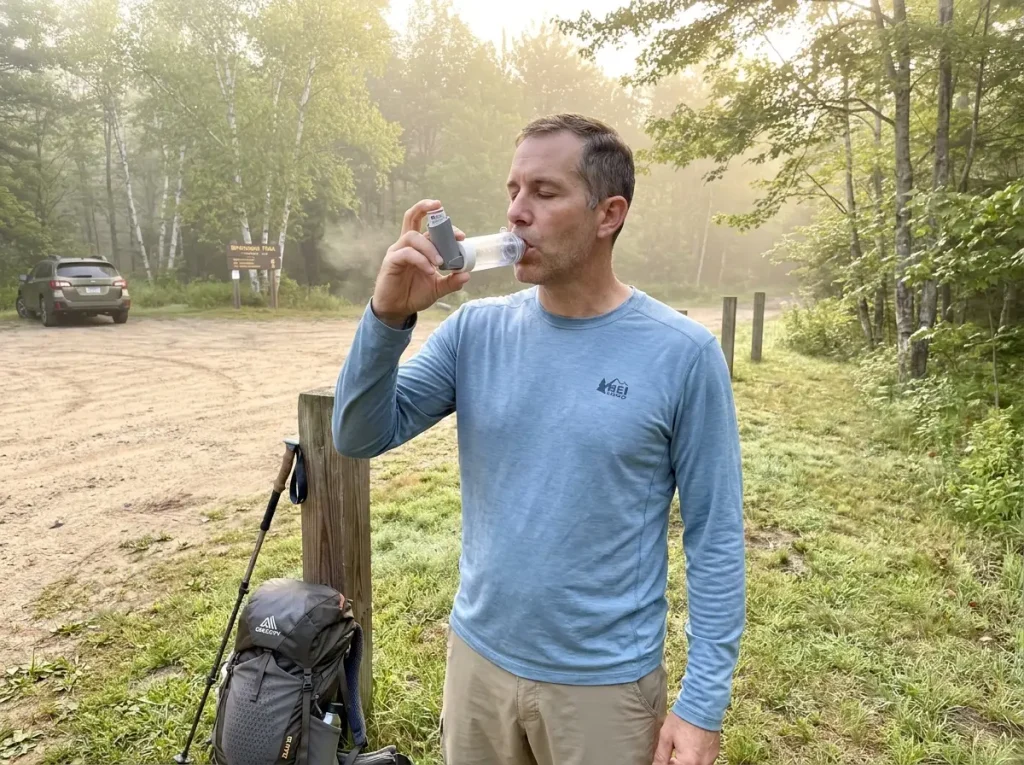
The 15 minutes before you start hiking matter more than any mile on the trail. Most asthmatic hikers know they should carry an inhaler. Far fewer know they should use it before they feel symptoms.
The 15-Minute Pre-Treatment Window
Two puffs of a short-acting beta-agonist like albuterol, 15 to 30 minutes before you start hiking, opens your airways proactively and buys you 2 to 4 hours of protection. The MedlinePlus guidelines on exercise-induced asthma confirm this timing window. The community calls it “pre-puffing,” and it’s the single highest-impact habit an asthmatic hiker can build.
Time it with your drive. If the trailhead is 20 minutes from your house, take your puffs as you get in the car. If it’s an hour away, wait until you park. The protection window starts when the medication hits your lungs, not when you start walking.
The Warm-Up That Actually Prevents Flare-Ups
A slow 6-to-10-minute walk at the trailhead before you push the pace reduces exercise-induced bronchoconstriction episodes significantly. Your airways need time to adjust to the temperature change, the exertion level, and the air quality outside your car. Jumping straight from the parking lot to a steep climb is how “the first mile panic” happens.
That first-mile panic is real. Asthmatic hikers often feel worst in the first 10 to 15 minutes before their airways warm up and the pre-treatment medication fully kicks in. If you pre-puffed and warmed up, push through that initial tightness gently. It usually passes. If it doesn’t pass after 15 minutes, that’s a different signal — stop and assess. Picking the right time to start your hike plays into this too — cooler morning starts give your airways more to adapt to.
Pro tip: The warm-up isn’t a separate activity. Walk the first half-mile at conversation pace — slow enough to talk in full sentences without pausing for breath. Your lungs will tell you when they’re ready for more.
Controller Medications vs Rescue — What Goes When
Controller medications (daily inhalers like Flovent or combination inhalers like Advair) prevent inflammation over time. Rescue inhalers (albuterol) open airways in minutes during an acute episode. Both travel with you on every hike, but they do different jobs.
Don’t skip your controller med the morning of a hike because you’re “going to use the rescue one anyway.” Controllers keep your baseline inflammation low, which means your rescue inhaler works better and your triggers have less to work with. Think of the controller as your foundation and the rescue as your emergency brake.
Ignoring Cold and Dry Air — The Real Altitude Trigger
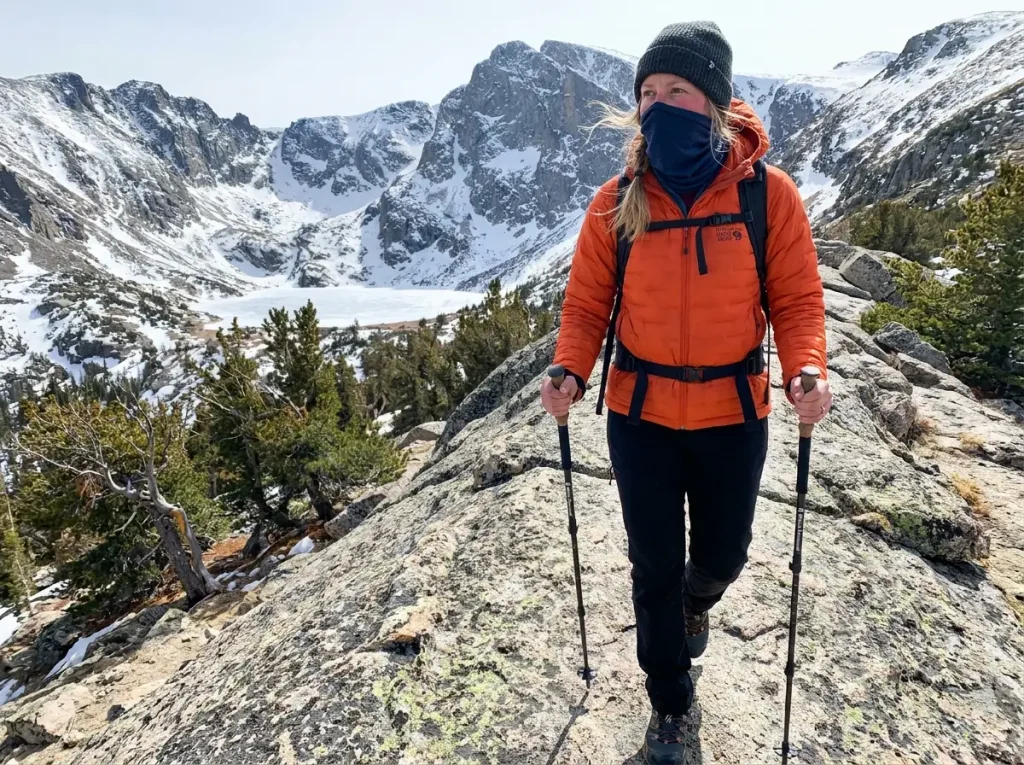
Everyone warns you about altitude and asthma. Almost nobody explains what’s actually happening. It’s not the elevation number that squeezes your airways shut — it’s the cold, dry air that comes with it.
Why Cold Dry Air Triggers Bronchospasm
When you inhale cold, dry air, your airway lining loses moisture rapidly. That moisture loss irritates the tissue, triggers inflammation, and your bronchioles constrict in response — that’s bronchospasm. Higher elevations mean colder, drier air, which means faster moisture loss from your airways. A hike at 5,000 feet in July might feel fine. The same elevation in January can lock your chest up in 20 minutes.
The fix isn’t avoiding altitude. It’s managing what happens between the outside air and your lungs. If you’re planning high-altitude hiking and need to acclimatize, add airway management to your acclimatization checklist alongside hydration and sleep altitude.
MDI vs DPI — Why Your Inhaler Fails in the Cold
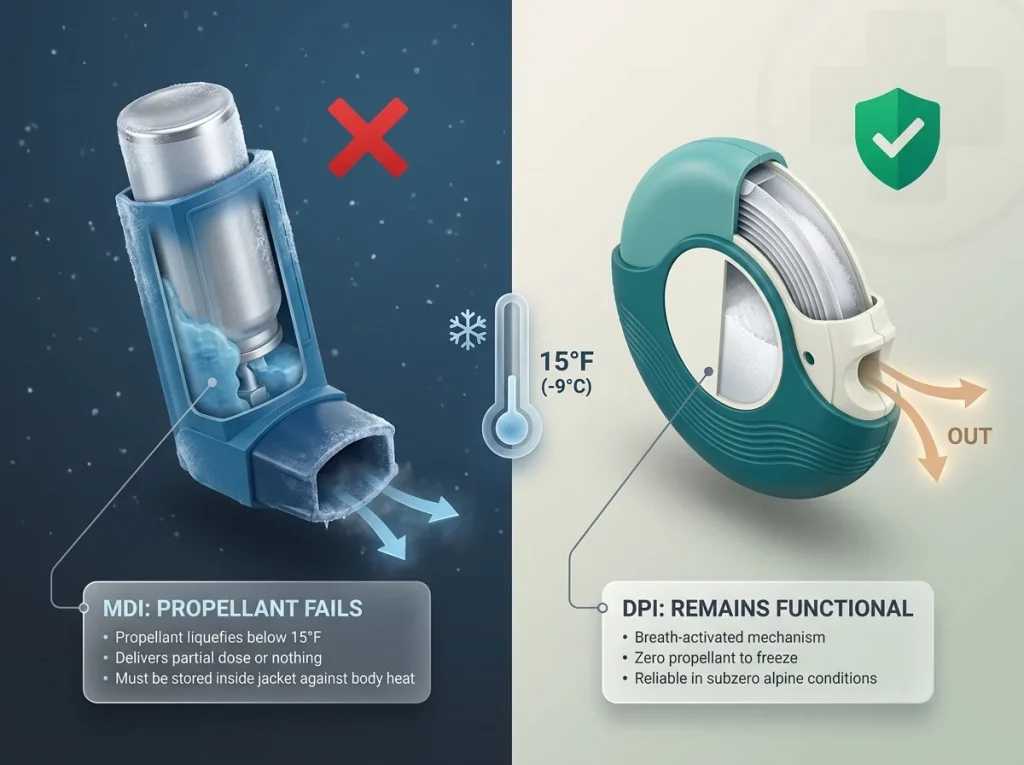
Here’s something most hiking guides don’t tell you: standard metered-dose inhalers use an HFA propellant that doesn’t work well below about 15°F. The propellant partially liquefies in cold temperatures, which means you get a partial dose or nothing at all when you press the canister. You’re standing on a frozen ridge, chest tight, pressing your inhaler, and wondering why nothing is happening.
Dry powder inhalers — like the Diskus or Turbuhaler — are breath-activated. No propellant, no cold-weather failure. You inhale sharply and the mechanism delivers the dose mechanically. If you hike in winter or at altitude regularly, talk to your doctor about a DPI as your backup or primary trail inhaler. It’s a conversation most asthmatic hikers never have because most guides never mention it.
If switching to a DPI isn’t an option, keep your MDI against your torso inside a chest layer — good base layers for cold weather create enough warmth to keep the propellant functional. Skin contact or close-to-skin storage is the minimum. Outside pockets, pack lids, and side mesh pockets are where inhalers go to freeze.
The Buff Trick and Other Airway Warmers
A Buff neck gaiter pulled up over your nose and mouth warms and humidifies air before it reaches your bronchioles. It’s the cheapest, lightest airway management tool that actually works. The fabric traps your exhaled moisture and heat, so the next breath in is warmer and wetter than the ambient air.
Nose breathing does the same thing naturally — your nasal passages warm and filter air far better than your mouth. Train yourself to nose-breathe on moderate grades at lower elevations so it becomes automatic when you need it above treeline. When the grade gets steep enough that nose breathing isn’t enough, that’s when the Buff earns its weight.
Pro tip: In cold conditions, breathe in through your nose and out through the Buff. This double-warms the air and keeps your face from freezing at the same time. It takes about three hikes to stop feeling like you’re suffocating, and then you never go back.
Breathing Wrong on the Climb
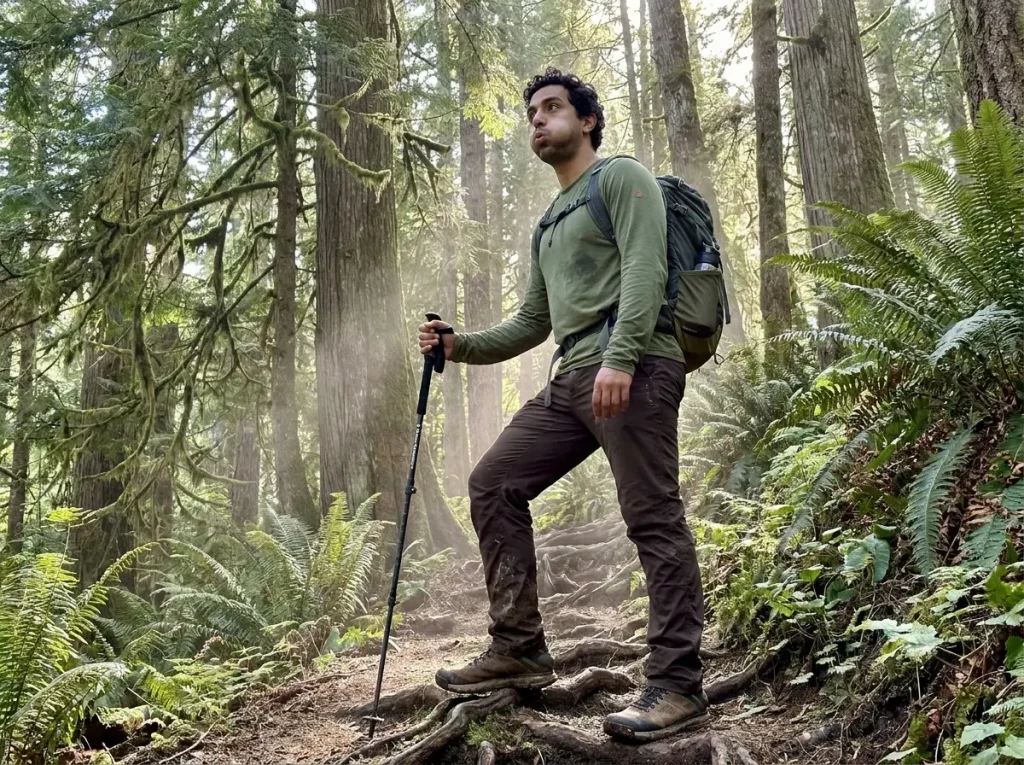
Your natural response to getting winded on a steep section is to gasp through your mouth. That’s exactly what your asthmatic lungs don’t need — cold, unfiltered air rushing past dried-out airways.
The 2-Step / 4-Step Breathing Rhythm
Synchronize your breathing to your steps: inhale for 2 steps, exhale for 4. This does two things at once. It forces a longer exhale, which gives your lungs more time to empty trapped air. And it automatically governs your pace — if you can’t maintain the rhythm, you’re moving too fast for your current lung capacity.
The rhythm takes a few miles to become automatic. Start practicing on flat terrain where your breathing isn’t challenged, then carry it onto moderate inclines. By the time you hit steep grades, the pattern should feel natural. If it doesn’t, your pace is too aggressive.
Pursed-Lip Breathing on Steep Sections
Pursed-lip breathing creates back-pressure in your airways that keeps narrowed bronchioles from collapsing completely. Breathe in normally through your nose, then exhale slowly through pursed lips — like you’re blowing out a candle three feet away. The back-pressure forces trapped air out of constricted passages and makes the next inhale deeper and more productive.
Use this technique on steep switchbacks, sustained climbs, or whenever you feel “the squeeze” — that familiar chest tightness that precedes wheezing. It’s not a substitute for your inhaler, but it buys you time and keeps your breathing from spiraling into a full episode.
When to Stop vs When to Slow Down
There’s a line between “I need to slow down” and “I need to stop,” and experienced asthmatic hikers learn to feel it. Chest tightness without audible wheezing means slow your pace, focus on the 2/4 rhythm, and see if it resolves in a few minutes. Audible wheezing — that whistling sound on exhale — means stop, sit upright, and use your rescue inhaler.
One detail veterans mention: jaw clenching. Before the chest tightens, before the wheeze starts, many asthmatic hikers notice their jaw muscles clench. It’s your system bracing for restricted breathing. If you catch the jaw clench, slow down immediately — you’re ahead of the attack instead of behind it.
Hydration matters here too. Thick airway mucus narrows your passages faster. Sip water every 15 to 20 minutes, not just when you’re thirsty. Your route planning with contour lines should factor in water sources if you’re on a longer hike — running low on water is running low on airway management.
Picking the Wrong Trail for Your Lungs
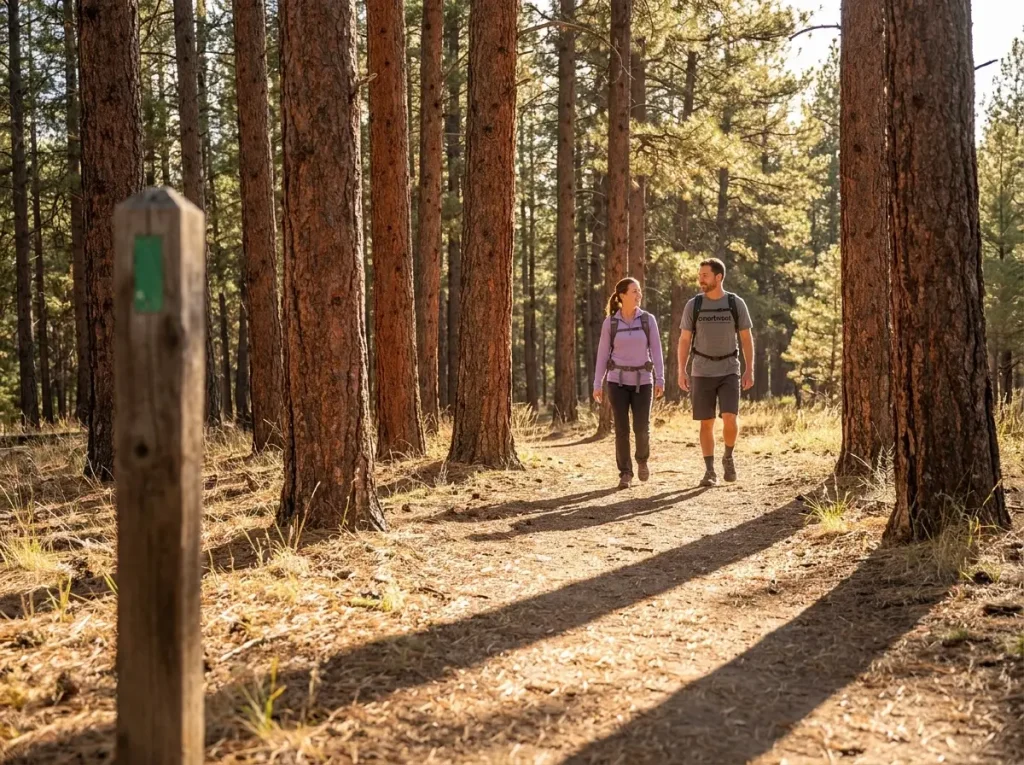
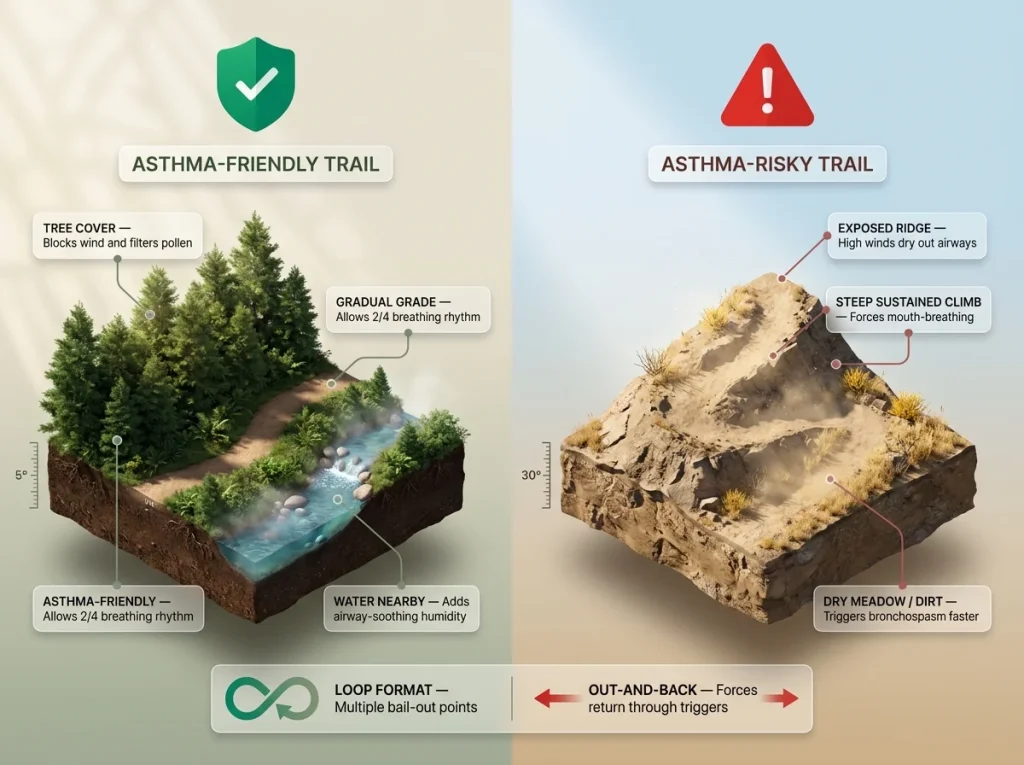
Not every trail is an asthma trigger. But some trail features — exposed ridgelines, steep sustained climbs, high-pollen meadows — stack the deck against you before your boots hit dirt.
Elevation Profile — Gradual vs Steep Matters More Than Total Gain
A trail that gains 2,000 feet over 6 miles is a completely different experience for asthmatic lungs than one that gains the same 2,000 feet in 2 miles. Gradual sustained climbs let you maintain the 2/4 breathing rhythm without breaking form. Steep pitches force mouth breathing, spike your heart rate, and dry out your airways all at once.
Look at the elevation profile before you go. A trail with steady moderate grade is more asthma-friendly than one with flat sections interrupted by brutal steep sections. The steep bursts are where episodes happen because your breathing goes from controlled to desperate in 50 yards.
Tree Cover, Wind Exposure, and Water Features
Tree cover does three things for asthmatic hikers: it blocks wind that carries pollen and dries airways, it keeps air warmer than exposed ridgelines, and it filters some particulate matter before it reaches you. Dense forest trails are generally kinder to sensitive lungs than alpine meadows or exposed ridge walks.
Water features — rivers, waterfalls, streams running beside the trail — add humidity to the air. Humid air is easier on asthmatic airways than dry air. This isn’t a reason to hike only along rivers, but when choosing between two similar trails, the one near water gives your lungs a slight advantage.
Wind exposure is the variable most hikers ignore. A ridgeline with 20 mph wind drives cold dry air into your lungs faster than you can warm it. That same ridge on a calm day might feel fine. Check the wind forecast alongside the AQI.
Loop Trails vs Out-and-Back — The Bail-Out Factor
Loop trails give you options. If your lungs start struggling at the halfway point, you can often shortcut back to the trailhead via a connector trail or a shorter return leg. Out-and-back trails mean you have to hike through the same trigger section twice — once going out, once coming back.
For asthmatic hikers building confidence, start with shorter loop trails that have multiple bail-out points. As you learn your limits and your pre-treatment routine dials in, extend the distance and complexity. Picking trails that feel like shoulder season weather surprises aren’t waiting around every corner reduces the mental load that comes with managing a chronic condition on trail.
Pro tip: Trail apps like AllTrails show elevation profiles and trail type (loop vs out-and-back). Filter for moderate difficulty, loop format, and forested terrain — that’s your asthma-friendly starting template.
Having No Plan When Your Inhaler Stops Working
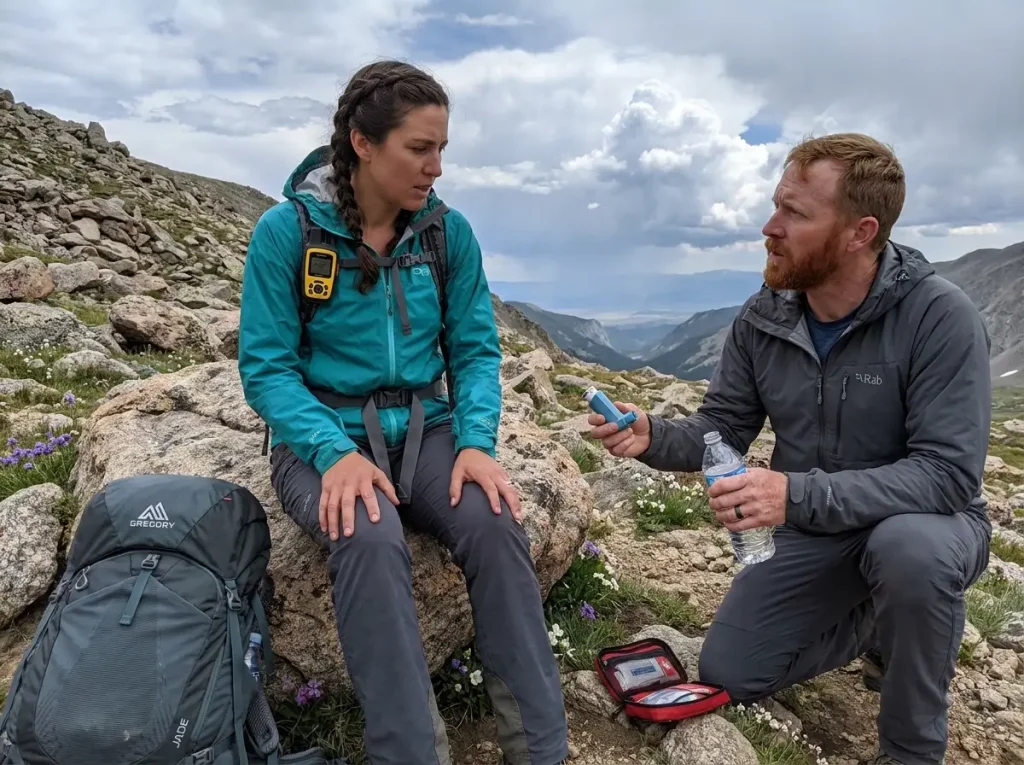
Your rescue inhaler handles 95% of what trail life throws at your lungs. The other 5% is what sends people to the ER. Most asthmatic hikers have zero plan for when their medication stops working — and in the backcountry, that gap between “my inhaler isn’t working” and “I need help” fills up fast.
The Two-Dose Rule and When to Escalate
Take your first rescue inhaler dose when symptoms don’t respond to slowing down and breathing techniques. Wait 15 to 20 minutes. If symptoms haven’t improved, take a second dose. If there’s still no improvement after two doses — you are in the Red Zone of your asthma action plan. This is no longer a “let’s wait and see” situation. This is an evacuation trigger.
NOLS — the organization that trains wilderness guides — uses the same threshold: evacuate any patient whose asthma symptoms aren’t improving after medication. Severe asthma attacks can require epinephrine or systemic steroids, neither of which you’re carrying in a standard hiking first aid kit. The window between “not improving” and “medical emergency” can close in minutes at altitude.
What Your Hiking Partners Need to Know
Before you leave the trailhead, your hiking partners should know three things: where your inhaler is, what your action plan zones look like (Green = normal, Yellow = symptoms present, Red = emergency), and what to do if you can’t talk. A person in severe respiratory distress can’t give instructions. Your partners need to know the plan before it’s needed.
Practice this like you’d practice any trail safety protocol. Wilderness first aid basics should include respiratory emergencies, not just fractures and bleeds. If your group includes someone with asthma, make sure at least one other person knows how to help.
Emergency Communication — PLB, Phone, and the Evacuation Decision
Cell service dies long before trails do. If you’re hiking backcountry with asthma, a personal locator beacon or satellite communicator like the Garmin inReach isn’t optional gear — it’s backcountry emergency communication that could save your life. A PLB sends your GPS coordinates to search and rescue with one button press when your lungs won’t let you speak.
Don’t wait to “see if it gets better.” Asthma attacks escalate faster than most people expect, especially at altitude where the air is already working against you. The time to activate your emergency plan is when the second inhaler dose doesn’t work — not 30 minutes later when you can barely stand.
Pro tip: Pre-program your emergency contacts and your asthma action plan summary into your phone’s medical ID. First responders check the medical ID on locked phones. If you’re unconscious, that screen might be the only medical history they get.
Conclusion
Three things keep asthmatic hikers on the trail instead of in the car headed to urgent care. First, check the air before you check the weather — AQI and pollen count are your first trail decision, not an afterthought. Second, pre-treat with your rescue inhaler 15 minutes before you start, warm up for 10 minutes, and keep your puffer where your hand finds it without looking. Third, have a Red Zone plan and make sure your hiking partners know it cold before you leave the trailhead.
Start with your next day hike. Pull up AirNow.gov the morning of, pre-puff at the car, walk the first half-mile at conversation pace, and tell your partner where the backup inhaler is. That’s 90% of the work. The other 10% — trail selection, breathing rhythm, the DPI conversation with your doctor — builds over time as you learn what your lungs can handle.
Q1 Can you hike if you have asthma?
Yes — with the right preparation and inhaler management, most asthmatics hike safely at all experience levels. Pre-treat with your rescue inhaler before you start, carry it where you can reach it in seconds, and know your triggers so you can plan around them.
Q2 What should I do if I have an asthma attack while hiking?
Stop immediately, sit upright, and use your rescue inhaler. Wait 15 to 20 minutes. If symptoms don’t improve, take a second dose. If there’s still no improvement after two doses, activate your emergency plan and begin evacuation — this is a Red Zone event.
Q3 How do I keep my inhaler working in cold weather?
Keep your metered-dose inhaler against your torso inside a chest layer — your warmth prevents the HFA propellant from failing. For subzero conditions, ask your doctor about a dry powder inhaler like Diskus or Turbuhaler, which uses no propellant and works in any temperature.
Q4 Is high altitude bad for asthma?
The elevation itself isn’t the trigger — cold, dry air at altitude is. Your airways lose moisture faster in thin dry air, which causes bronchospasm. Acclimatize gradually, use a Buff to warm inhaled air, and pre-treat before gaining significant elevation.
Q5 What AQI level is safe for hiking with asthma?
AQI below 50 (green) is safe for most asthmatics. Between 51 and 100 (yellow), shorten your hike and monitor symptoms closely. Above 100 (orange or worse), reschedule — your airways are already stressed before you take a single step on the trail.
Risk Disclaimer: Hiking, trekking, backpacking, and all related outdoor activities involve inherent
risks which may result in serious injury, illness, or death. The information provided on The Hiking Tribe is for
educational and informational purposes only. While we strive for accuracy, information on trails, gear, techniques,
and safety is not a substitute for your own best judgment and thorough preparation. Trail conditions, weather, and
other environmental factors change rapidly and may differ from what is described on this site. Always check with
official sources like park services for the most current alerts and conditions. Never undertake a hike beyond your
abilities and always be prepared for the unexpected. By using this website, you agree that you are solely
responsible for your own safety. Any reliance you place on our content is strictly at your own risk, and you assume
all liability for your actions and decisions in the outdoors. The Hiking Tribe and its authors will not be held
liable for any injury, damage, or loss sustained in connection with the use of the information herein.
Affiliate Disclosure: We are a participant in the Amazon Services LLC Associates Program, an
affiliate advertising program designed to provide a means for us to earn advertising fees by advertising and linking
to Amazon.com. As an Amazon Associate, we earn from qualifying purchases. We are also an official affiliate partner
of Black Diamond Equipment via the AvantLink network. If you click on a Black Diamond affiliate link and make a
purchase, we may earn a commission at no additional cost to you. We also participate in other affiliate programs and
may receive a commission on products purchased through our links. Additional terms are found in the terms of
service.