
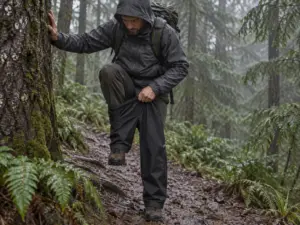





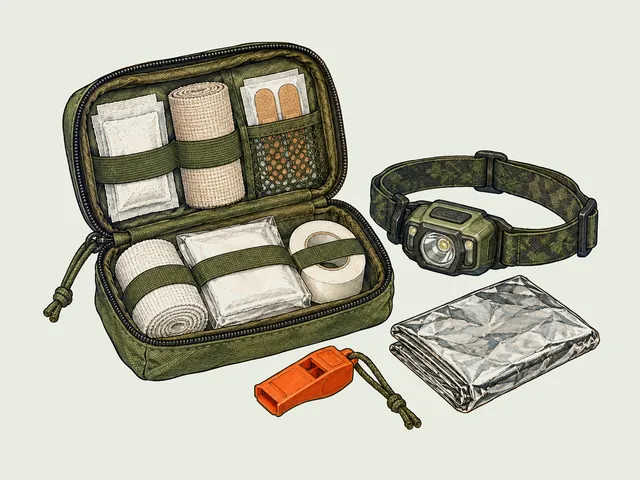




Your lungs are burning, but that’s not the real crisis. The actual threat materializes on the 3,000-foot descent, when your quads start visibly shaking on a Class 3 talus field and your center of mass wavers with every agonizing step. After thousands of miles logged in the backcountry and years of extracting hikers who overestimated their abilities, I’ve seen the “jelly-leg” phenomenon precede severe falls too many times. This technical guide replaces feel-good gym routines with a brutal, data-backed 3-step diagnostic to determine your absolute “go/no-go” readiness for technical terrain.
| Diagnostic Tier Overview | ||
|---|---|---|
| Diagnostic Tier | Primary Metric | Trail Significance |
| Cardiovascular Diagnostic | Heart Rate Recovery | Upper limit of sustainable pacing |
| Structural Durability | Eccentric Brake Strength | Stability and knee protection on descents |
| Functional Load Battery | Distance Under Weight | Arduous duty and multi-day hauling readiness |
⚡ Quick Answer: Hiking isn’t gym fitness. To safely tackle technical trails, pass the YMCA 3-Minute Step Test for cardiovascular recovery, clear 38.5 degrees of ankle dorsiflexion while mastering weighted tempo lunges to protect your knees downhill, and crush the USDA Forest Service Pack Test (3 miles, 45 lbs, 45 minutes). These three metrics determine your literal safety margin on the mountain.
The Physics of Load Carriage and Metabolism

Hiking is, at its core, a brutal math problem involving gravity and friction. Traditional gym cardio fails to prepare you because it doesn’t account for external load. Moving your own body weight is one thing, but strapped to a multi-day pack, the energy demand compounds based on your body composition and cardiovascular efficiency.
The Metabolic Cost of Vertical Displacement
The central hurdle of any serious summit bid is the vertical kilometer. Crushing a flat trail won’t tell you how your body burns oxygen when fighting grade. Research indicates that climbing a standard 1,000 feet per hour demands roughly 35 milliliters of oxygen per kilogram of body weight every minute. Because you can’t sustain effort at your absolute maximum vo2 max all day, you need a massive safety buffer.
Most dialed-in hikers operate at roughly 62% of their maximum capacity during long ascents. If your baseline is too low, you burn out fast. Every pound of gear you strap to your back increases the energy cost exponentially.
The Pandolf Equation and the 15% Rule
You can actually model this misery. The Pandolf Equation is the math proving that trail conditions manipulate your energy bleed. It’s widely used for modeling the metabolic costs of heavy military backpacking. A map mile is just physical distance, but a “Metabolic Energy Mile” factors in the friction of mud, snow, and talus, which can double the caloric cost of every step.
That leads directly to the 15% Bodyweight formula. To keep your center of mass stable on Class 2-4 scrambles, your loaded pack shouldn’t exceed 15% of your total body weight. When you’re calculating your true pack weight, every ounce of water and safety gear must be factored rigidly to keep you within that tight margin.
Altitude Adaptation: The Physiological Redline
Sea-level fitness is a liar. At 10,000 feet, your aerobic engine takes a 20% hit. The thin air forces your lungs to work overtime just to facilitate standard oxygen exchange against the compressive stress of your pack straps.
If you don’t possess peak metabolic efficiency under load, the altitude forces you into an anaerobic burn immediately. You tap your short-term energy reserves, lose your cognitive sharpness, and cross the physiological redline faster than your body can clear the lactic acid.
Pro tip: At 10,000 feet, forcing hydration won’t stop altitude sickness. If you haven’t built a massive cardiovascular engine at sea level, standard acclimatization protocols give you a false sense of security.
Step 1: The Cardiovascular Diagnostic (YMCA Step Test)

The first tier evaluates the engine. But we aren’t testing how fast you can run a 5K on a treadmill. We are measuring how efficiently your heart recovers from a submaximal load. The ymca 3-minute step test is the dirtbag standard here. It requires zero lab equipment and definitively maps your aerobic threshold.
Executing the 3-Minute Protocol
Adhere to the standard. Find a solid 12-inch box, block, or step. This height accurately mimics the standard vertical displacement of a rock water bar found on most trails. Set a metronome to exactly 96 beats per minute.
Step up-up-down-down to the cadence for exactly three minutes. You must track an aggressive step-up cadence of 24 full cycles per minute. Don’t pace yourself visually. Follow the clicks. The second the three minutes end, sit down and immediately find your pulse.
Calculating Your Heart Rate Recovery (HRR)
The true metric of a trail-hardened heart is the 60-second recovery pulse taken right after you stop. Count your beats for exactly one minute while seated. This is your heart rate recovery score.
A lower pulse count indicates your nervous system is kicking in fast to dump heat and restore chemical balance in your muscles. If you are monitoring resting heart rate for recovery on a long thru-hike, a rapid drop in pulse during a quick 30-second map check is the exact capability that keeps you moving strong all day.
Diagnosing Aerobic Deficiency Syndrome
If your pulse stays pegged near max capacity long after you sit down, you suffer from Aerobic Deficiency Syndrome. This means your body defaults to burning limited glycogen reserves rather than fat.
Your zone 2 aerobic threshold is underdeveloped. When hikers inexplicably bonk three hours into an approach, this is why. If your heart cannot clear the fatigue byproducts while resting, you have zero business committing to a long slog far from the trailhead.
Step 2: Structural Durability and the Descent Problem
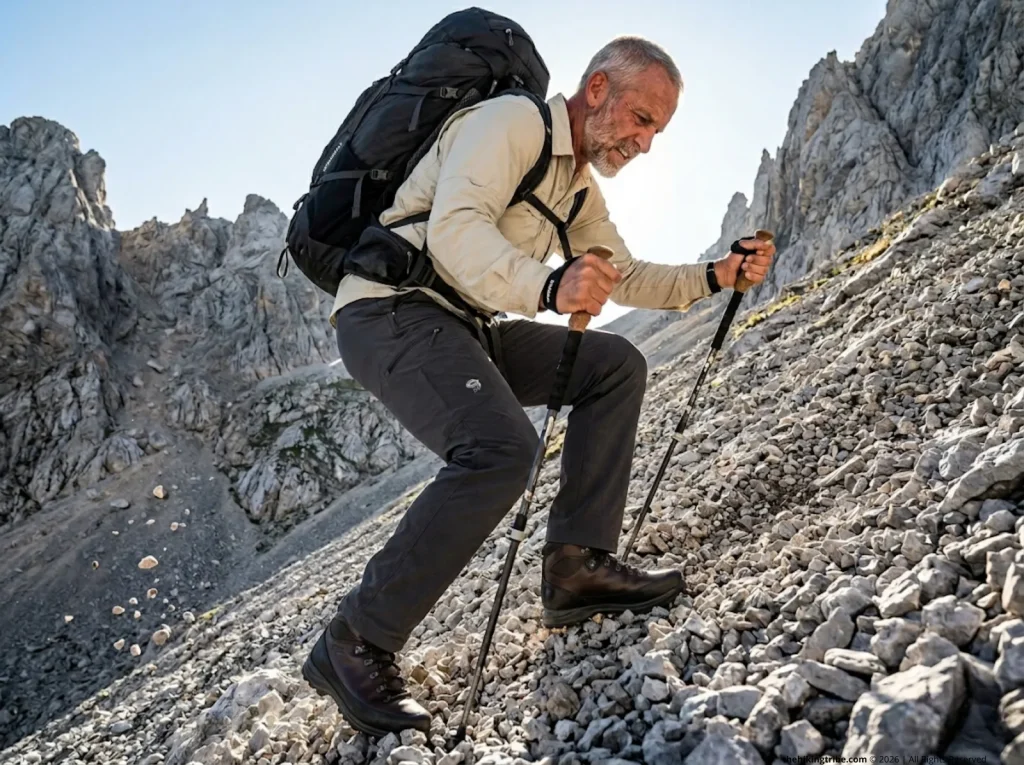
Your lungs get you up the peak. Your joints keep you from flying off it. Step 2 isolates the brutal mechanics of going downhill. You must evaluate eccentric leg strength.
The Tempo Lunge Test for Eccentric Braking
Going downhill forces your quadriceps to act as an aggressive braking system. Every downward step forces the quad muscle to lengthen under the full tension of your body mass plus your pack. When your eccentric brake strength fails, things get hazardous fast.
Set up for the Tempo Lunge Test. Perform 3 sets of 20 forward lunges per leg. The catch? You must lower yourself over a strict 4-second count, and push back up in 1 second. If your legs buckle, stall, or shake violently by the second set, your braking system is fundamentally compromised.
Ankle Dorsiflexion as a Stability Metric
Your ankle needs to bend upward toward your shin. Without proper ankle dorsiflexion, your overall balance on steep rock is nonexistent. If there is a restriction, your body compensates by lifting the heel early or pitching your knees inward, systematically destroying your ligaments over a ten-mile day.
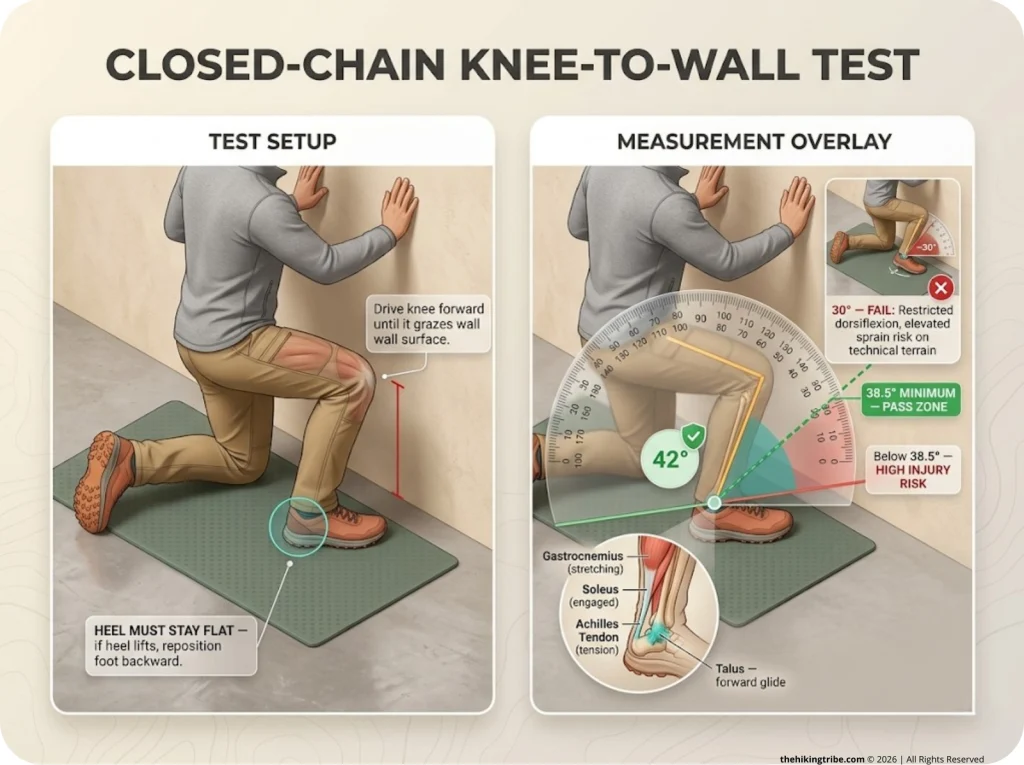
Execute the Closed-Chain Knee-to-Wall test. Kneel and push your knee forward to graze a wall while keeping your heel flat on the floor. You need a minimum of 38.5 degrees of flexibility. Anything less equates to a massive surge in the risk of suffering a lateral ankle sprain when negotiating bad footing.
The “Jelly-Leg” Phenomenon on Technical Terrain
When the quad brakes burn out, the force doesn’t just disappear. The load violently transfers directly to your knee cartilage. This instantly triggers hiker’s knee. A nagging pain soon degrades into total joint refusal.
When you lose structural leg control, you experience the hazardous “jelly-leg.” Your entire lower body stability shuts down, making you totally unpredictable on narrow trails. Before you ever complain about weak knees, strengthen your ability to absorb the physical shock of the descent, and actively start redistributing eccentric load away from the knees with proper trekking pole technique.
Pro tip: Weighted tempo squats are mandatory. The best descent protection isn’t a knee brace; it’s a quad muscle built to absorb shock without dumping the weight onto your connective tissue.
Step 3: The Functional Load Battery (USDA Pack Test)
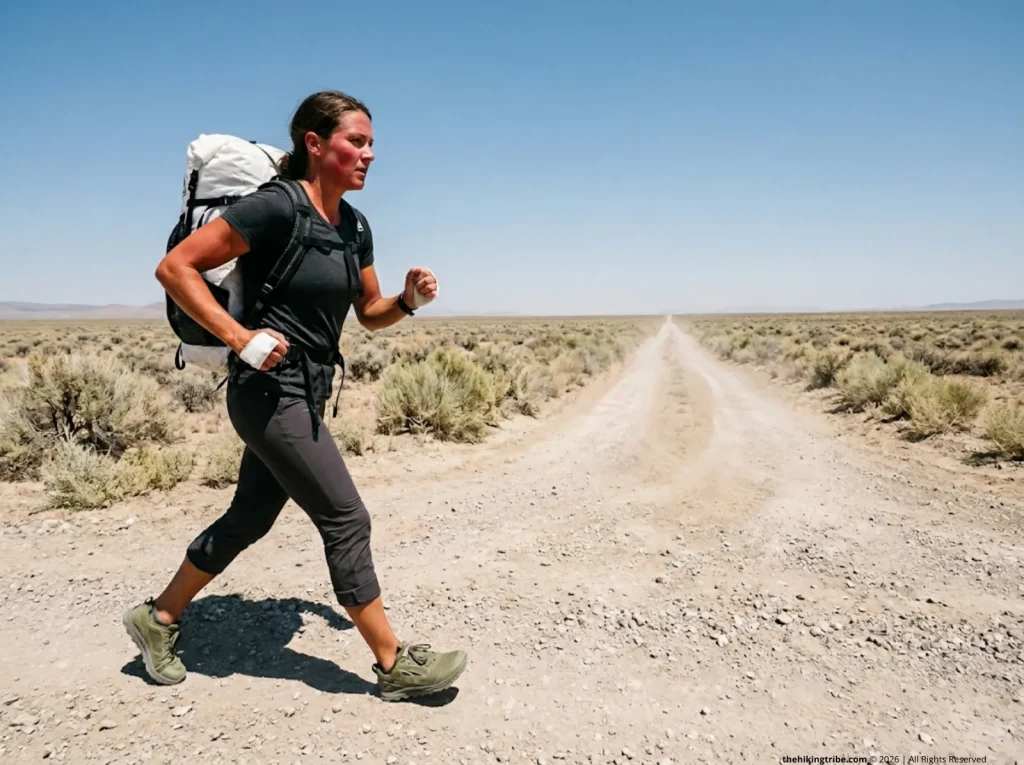
Step 1 covers the heart, Step 2 covers the joints. Step 3 puts the full functional trail durability to the test. The gold standard for measuring your capacity to drag heavy weight over distance is the usda forest service pack test. It is designed to expose weakness.
The “Arduous” Standard Protocol
The test provides absolute clarity. You load a pack with 45 pounds of dead weight (sandbags or water bladders work perfectly). You map out a flat, 3-mile course. You must cover that distance in 45 minutes or less.
If you hit the mark, you meet the official Work Capacity Test requirements. This validates that your lower body engine—specifically the shins, calves, and core stabilizers—can handle grueling, long-form exertion.
Why Power Walking Beats Running for Trail Prep
Running is an automatic disqualification. You are strictly required to keep one foot in contact with the ground at all times. Running relies on airborne momentum. Power-walking isolates the exact muscular tension required for a trail slog.
When the shin splints tear into your lower leg during mile two of this power-walk, you completely understand why standard treadmill running fails to translate. You are conditioning the body to bear the load efficiently, focusing entirely on training for the uphill athlete.
Scaling the Test for Your Pack Weight
Not every hiker needs to carry a 45-pound monster. If your objectives are lighter, scale the load.
A “Moderate” standard utilizes 25 pounds over a 2-mile distance in 30 minutes, representing the demands of a heavy day pack on a Class 2 trail. The test scales directly to your intended environment. But remember, practicing structural loading strategies with a heavy pack on flat ground provides massive dividends when you eventually transition to rough vertical terrain.
Calculating Your THT Safety Margin Score
Passing these tests doesn’t just make you “fit.” It builds your direct physical buffer against wilderness emergencies. In the backcountry, an exhaustion-related mistake usually results in a severe injury on a technical scramble. Managing your energy is risk management pure and simple.
Matching Fitness Profiles to YDS Technical Grades
You must match your physical reality to the Yosemite Decimal System (YDS) classification.
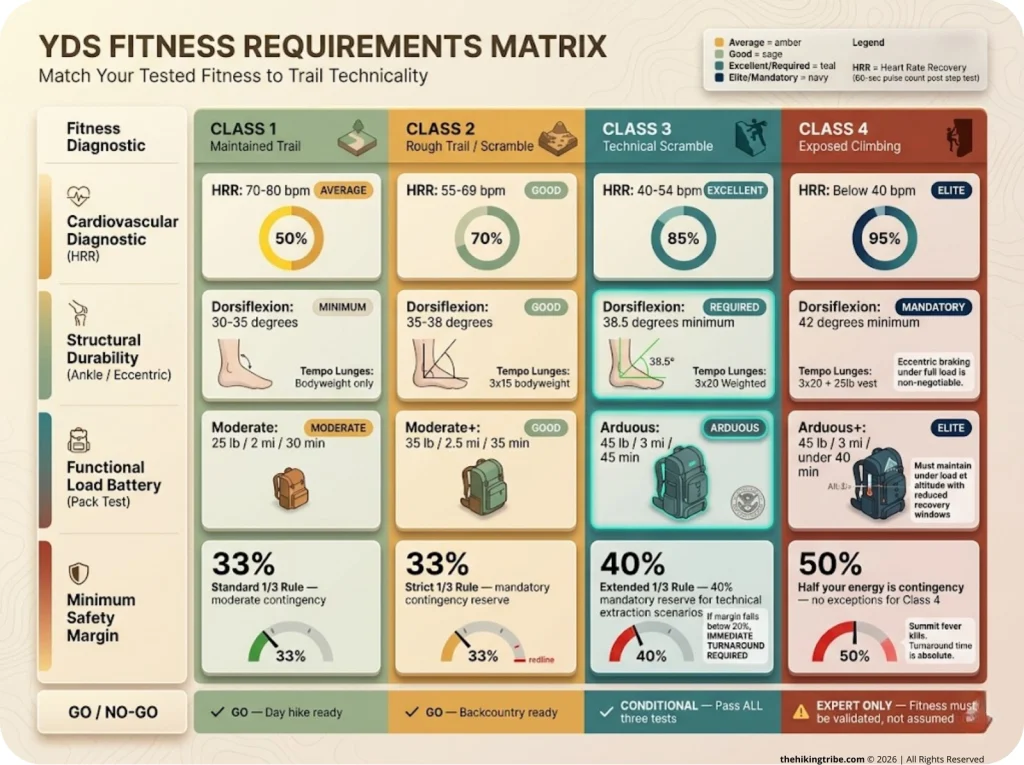
A Class 3 scramble necessitates a passing grade on the Arduous Pack Test, excellent heart rate variability, and a mandatory 38.5 degrees of ankle mobility. If your test data lands in the “Moderate” or “Average” category, you belong on a casual Class 1 or 2 trail. Stepping over your tested trail class limit guarantees trouble.
The 1/3 Rule of Energy Management
Once your pack is on, your energy bank is constantly depleting. Implement the strict 1/3 Rule. You allocate 33% of your total energy for the ascent. The next 33% is reserved specifically for the descent. The final 33% is locked away as a mandatory contingency reserve.
You never tap that final third voluntarily. That energy exists solely to handle the broken trail, the unexpected storm, or the twisted ankle that requires a brutal, slow extraction.
When to Pull the Plug: Turnaround Times and Fatigue
I’ve watched gassed hikers stumble past their hard turnaround time purely blinded by summit fever. When you drain the tank dry on an ascent, you physically cannot execute the safe “three points of contact” required to get off the wall.
When you start calculating your mandatory turnaround time, it must be rooted in your tested physical reality. If your legs are shaking on the approach, your safety margin score is effectively zero. Turn back. The mountain stays put.
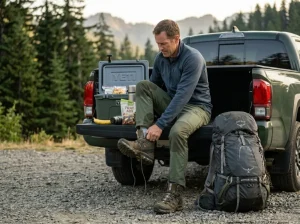
Pro tip: Always set a hard turnaround time based on daylight and fatigue before you leave the truck. If you miss the mark by 10 minutes, you still turn around. Don’t negotiate with a tired brain.
Final Thoughts
- Trust Your Testing: Your heart rate recovery sets your pace, your eccentric braking shields your knees, and the USDA pack test validates your baseline endurance.
- Respect Gravity: Gravity plus pack weight dictates all terms in technical environments; sea-level gym routines do not cross over.
- Identify Your Baseline: Gear up, locate a 12-inch step, block out an hour, and execute the full test battery today to finally understand your actual trail threshold.
FAQ
Are you fit enough to hike a specific trail?
Compare your 3-step test results directly to the required YDS trail class. If you pass the Moderate pack test and score Good heart rate recovery, you’ve established your baseline for standard Class 2 terrain. A technical scrambler needs top-tier HRR and passing Arduous metrics.
What is a good hiking pace for a beginner with a pack?
Most beginners should sustain 2 to 2.5 miles per hour on flat terrain, settling around 1,000 feet of vertical gain per hour when ascending. If your cadence violently dips and your pulse pegs constantly, your borg rating of perceived exertion is screaming that your functional endurance is lacking.
How to train for elevation gain training if you live at sea level?
You crush the Tempo Lunge Test to build essential eccentric braking capacity and run staircase repeats wearing your weighted pack. The priority is forging the raw mechanical muscle needed to slow descent momentum safely, which translates infinitely better than running empty on flat asphalt.
Why do knees hurt immediately on steep downhill descents?
Your quadriceps fail to absorb the intense eccentric force acting upon your frame, transferring the shock impact straight to your joints. Building massive eccentric leg strength via strict tempo movements forces the muscles to take the hit, sparing your cartilage and preventing painful inflammation.

I've spent more than a decade researching hiking gear and trail technique. I read the specs, the forum threads and the long-term reviews, and every pick here comes with what it gets wrong.
End of the trail
You read every mile of this one. Here's where the trail goes next.