In this article
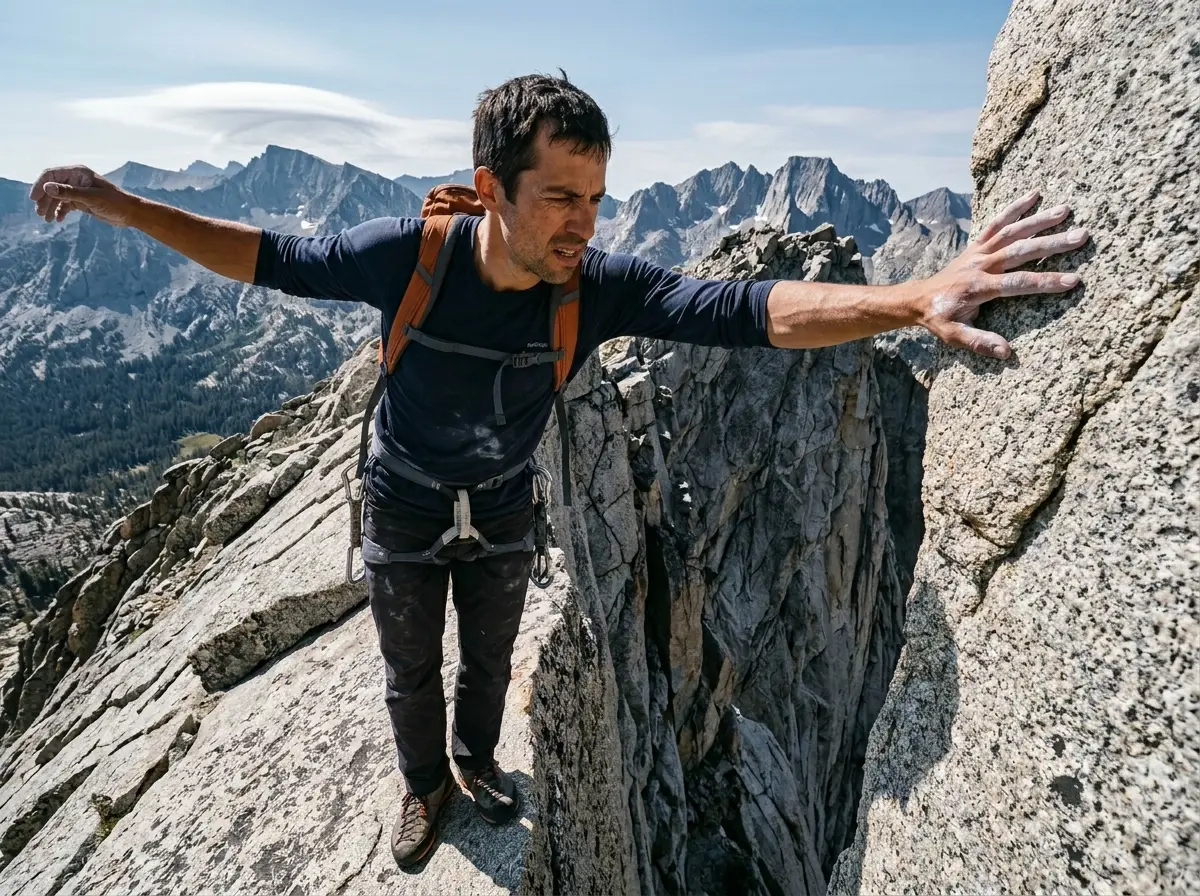
Fifteen feet below the crux, my fingers were crimping a cold granite edge and I could already hear the wind gusting across the shadeless ridge above. The handholds I needed were up there somewhere — I couldn’t see them from where I was standing. Below me was 600 feet of nothing. The hardest decision on that ridge wasn’t the next move. It was whether to make any move at all.
That moment wasn’t about courage. It was about calculation. For most hikers in the technical Class 2–4 zone, that calculation is exactly where things go wrong — not because the rock was hard, but because the decision framework was missing entirely.
What follows is the HT-3 Framework — three pillars built around Hazard, Team, and Time — that gives you a binary Go/No-Go protocol for exposed terrain. One you can run in your head at the crux, or better yet, at the trailhead before you ever clip your pack.
⚡ Quick Answer: Turn back on a scramble when any single indicator in the HT-3 matrix trips — wet rock, wind over 30 mph, lenticular clouds, group silence, leg pump on ascent, or a blown turnaround time. You need all three pillars green to keep moving. One red flag is enough. The down-climb penalty means getting down takes twice as long as getting up. Set a clock-based turnaround before you leave the trailhead, say it out loud, and treat it as non-negotiable.
Understanding What Class Really Means for Your Risk Exposure
Most hikers read a trail rating like it’s a fixed truth about the mountain. It isn’t. The Yosemite Decimal System was developed by the Sierra Club in the 1930s and later refined at Tahquitz Rock to provide a consequence ladder. As RJ Secor put it: “Class 2: you fall, you break your arm. Class 3: you fall, you break your leg. Class 4: you fall, you are almost dead.”
The crux rule is something most competitor guides skip entirely: a 1,000-foot ridge of Class 2 with a single 20-foot Class 4 section is a Class 4 route. Your personal rating cannot be lower than the hardest move on the route. That’s the decision that separates people who summit from people who don’t come back. See our full breakdown of the Yosemite Decimal System and the historical grade-inflation record at Wikipedia.
Exposed 3rd Class isn’t a grade — it’s a psychological overlay. A 400-foot drop beside a technically simple move adds a difficulty layer that doesn’t show up in the number but will absolutely show up in your body. Grade inflation compounds this: a “Class 3” scramble in a 1950s Sierra Club guide might match a modern guidebook’s “Easy Class 4.” Assume conditions and perception both drift.
I’ve watched hikers in expensive boots freeze solid at a Class 3 step-over that my teenagers cruised. The rock rating doesn’t know your name. And if you needed counter-force moves — stemming, laybacking — to get up something, assume you cannot reverse them under fatigue. That’s when the grade truly matters.
I’ve been on ridges where the guidebook said Class 3 and the rock was clearly a different conversation. Grade inflation in older Sierra Club guides is real — I add half a grade to anything published before 1980.
The Environmental Pillar — Weather, Rock, and Wind as Binary Signals
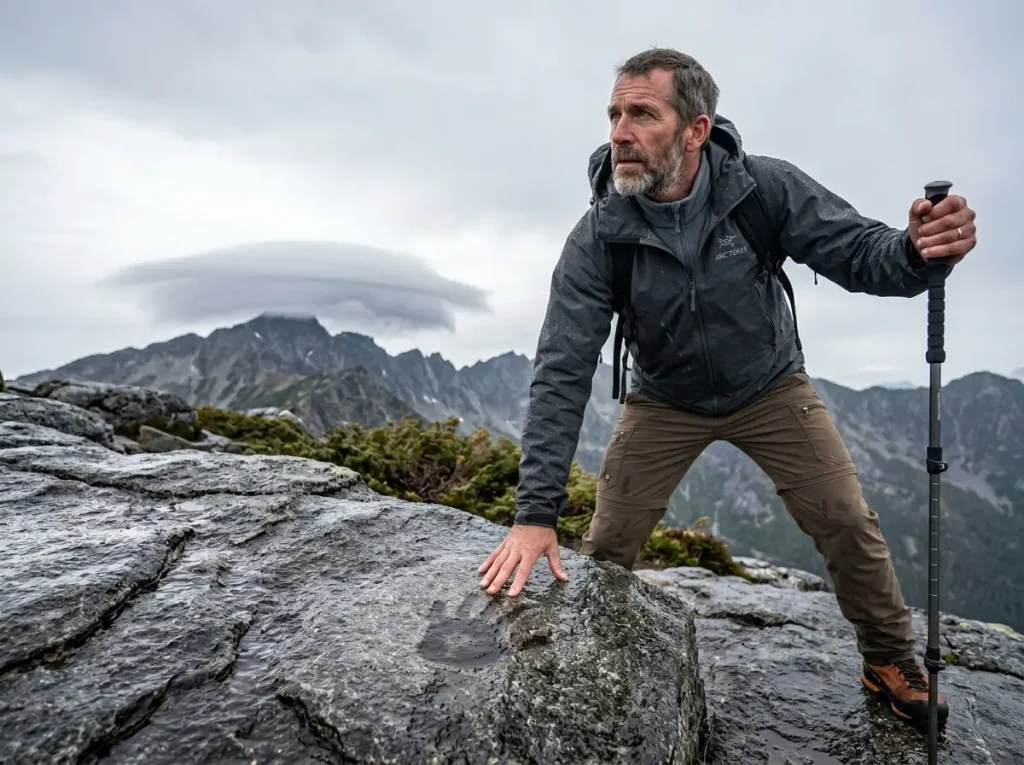
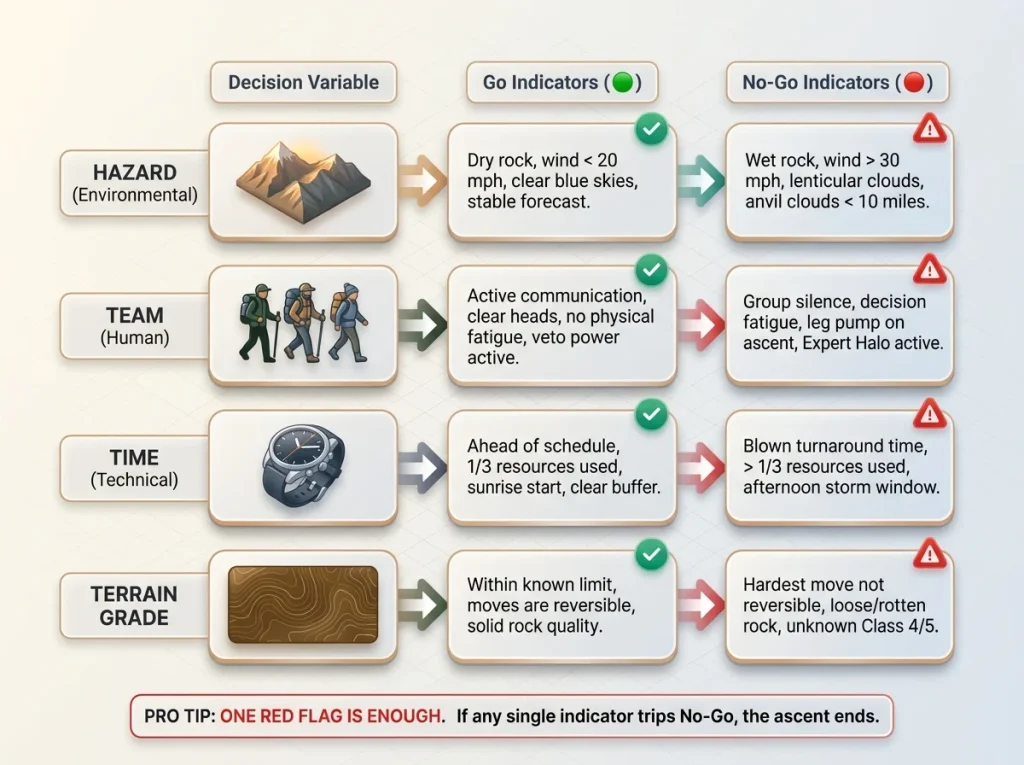
The first column of the HT-3 matrix has zero negotiation built in. Environmental conditions don’t care about your summit plan.
Rock moisture is the most misunderstood hazard on Class 4 terrain. Non-porous crystalline granite can’t absorb water — it forms a hydroplaning film. Wet sandstone looks grippy but loses 50–75% structural integrity when wet — not slip failure, but hold failure. Both are automatic No-Go on Class 4 in wet conditions.
Wind has hard thresholds. Per the Mountaineering Scotland wind speed effect matrix: 0–20 mph is negligible; 30–40 affects balance for strong adults; 40–50 is Turn Back territory. A forecast mean of 30 mph can carry gusts to 60–70 mph on exposed ridgelines. Mountain weather at 3,000 feet can be double sea-level wind speed. “2pm storms possible” should be read as a probability, not a promise.
Lenticular clouds over a peak are a weather fact, not a warning. Stationary, lens-shaped formations indicate sustained 60–80 mph winds at that elevation. Ridge travel ends when you see them. Cumulonimbus anvil clouds within 10 miles by 11 AM mean lightning probability above 70%. For field-forecasting mountain weather without an app, the full cloud signal sequence is on the site.
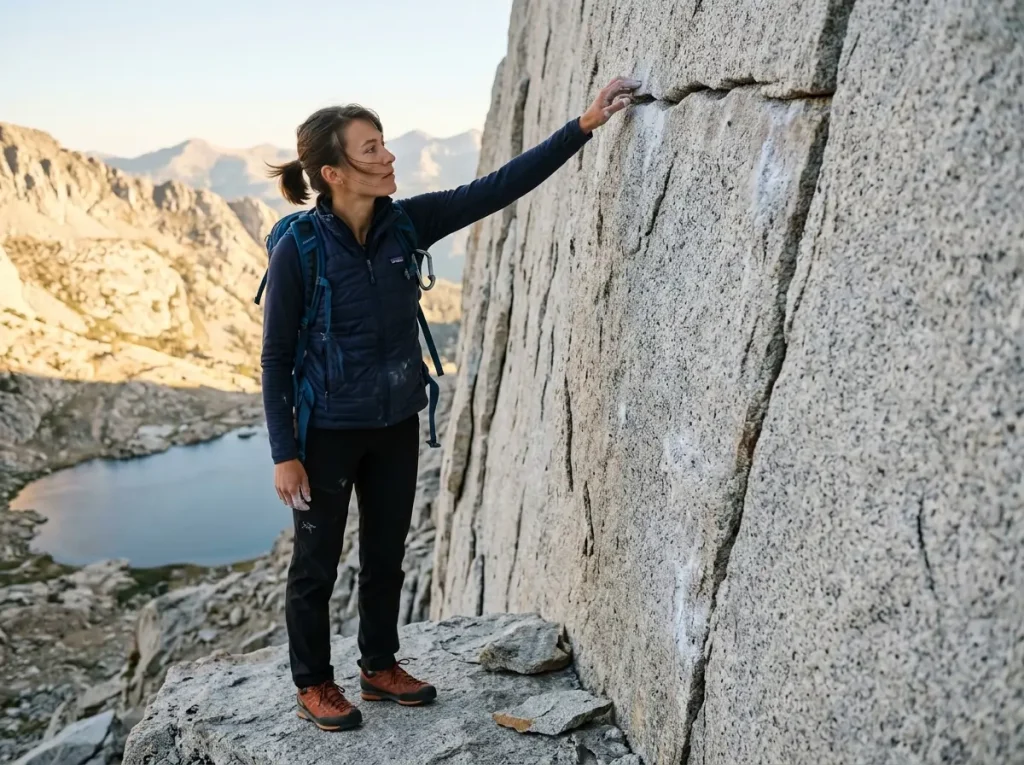
Pro tip: Use the S.T.A.P. framework before committing weight to any hold: Sound (ring vs. hollow thud), Test (incremental bodyweight over 3–4 seconds), Angle (loading direction), Pull (steady and controlled). A failing hold will telegraph a micro-shift before it breaks. For the full protocol on how to read rock quality before committing weight, that field guide is worth reading before any Class 4 trip.
The Rock Friction Paradox You Haven’t Been Told
Here’s what most guides leave out: magnesium carbonate particles on non-porous rock like granite act as micro-ball-bearings, not drying agents. Excess chalk can reduce friction on polished granite. Use low-volume, high-purity block chalk — not liquid, not heavy powder layers. Effective grip comes from molecular adhesion (van der Waals forces) and mechanical keying (rubber deforming into rock rugosities). Moisture degrades both simultaneously. Wet sandstone is worse than wet granite because you get grip right up until catastrophic hold failure. There’s no warning.
What Silence in Your Group Actually Means
Communication volume is a group health indicator. “Decision fatigue clustering” happens when three or more members go quiet simultaneously — the group has mentally outsourced decision-making to an implicit leader. Counter it with a forced check-in every 30–45 minutes: “Energy, comfort, time, weather — everyone.” For managing cognitive pressure on technical terrain, the strategies for stress management on exposed routes are worth reviewing before a big objective.
The Human Pillar — Reading Your Body and Your Group
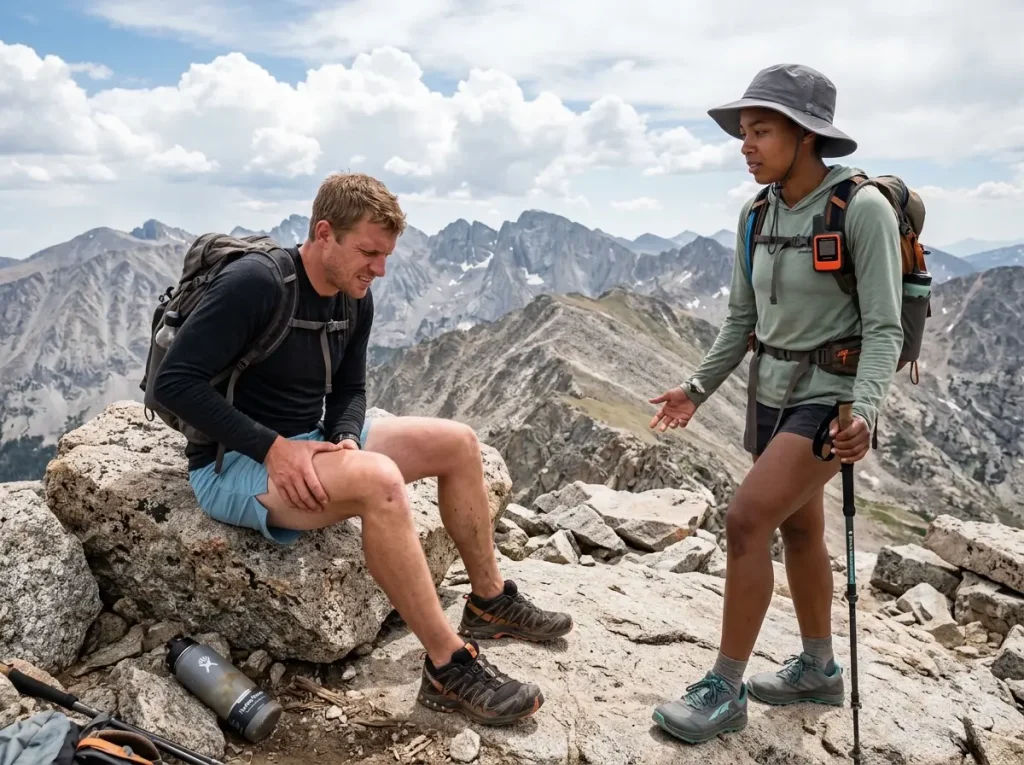
Physical and psychological signals are harder to read than weather because the brain hides them.
Leg pump on the ascent is a specific biological signal most guides miss. Descending requires eccentric muscle contractions (the muscle lengthening under load), which are far more fatiguing than the concentric contractions used climbing up. If your quads are burning on the way up, your body has already consumed the muscular reserve needed for a safe, controlled down-climb. That’s a measurable No-Go signal, not standard fatigue. See eccentric training that prepares your legs for safe descent for the preparation work.
Decision fatigue is the quiet one. The brain’s capacity for complex risk calculations degrades through the day. What feels like a “gut read” in the afternoon is a tired prefrontal cortex defaulting to the easier choice — which is almost always “keep going.”
When team communication drops sharply, one member rushing ahead or taking bigger risks is a red flag for Expert Halo or Social Proof traps activating. The F.A.C.E.T.S. heuristic framework from Avalanche.org identifies six cognitive shortcuts that lead teams into bad decisions: Familiarity, Acceptance, Commitment, Expert Halo, Tracks/Scarcity, Social Proof. Name them at the trailhead before boots hit the trail.
Veto Power is the protocol that counters all of them. Every team member holds a unilateral turn-back veto — established before departure, not at the crux.
The FACETS Traps Most Hikers Trigger on Every Summit
Summit Fever — the Commitment heuristic — is the primary cause of mountaineering fatalities per accident investigators. The closer the summit looks, the more irrational the risk tolerance becomes. Expert Halo is particularly sharp in mixed-skill groups: novices are significantly more likely to follow a perceived leader into hazardous terrain than when decisions are made by consensus. Social Proof has a modern layer: Instagram photos and Strava routes of others on a given line create false confidence. “There is no safety in numbers when the numbers are all guessing.”
The FACETS traps don’t hit all at once — they stack. Familiarity lowers your guard first, Commitment anchors the goal, and by the time Expert Halo kicks in, nobody in the group is doing independent math. That’s when it gets genuine sketch.
Pro tip: At the trailhead, state your turnaround time out loud and have everyone repeat it back. Verbal commitment to a constraint before departure activates a different part of the brain than silent awareness.
The Time Pillar — Turnaround Math That Doesn’t Lie
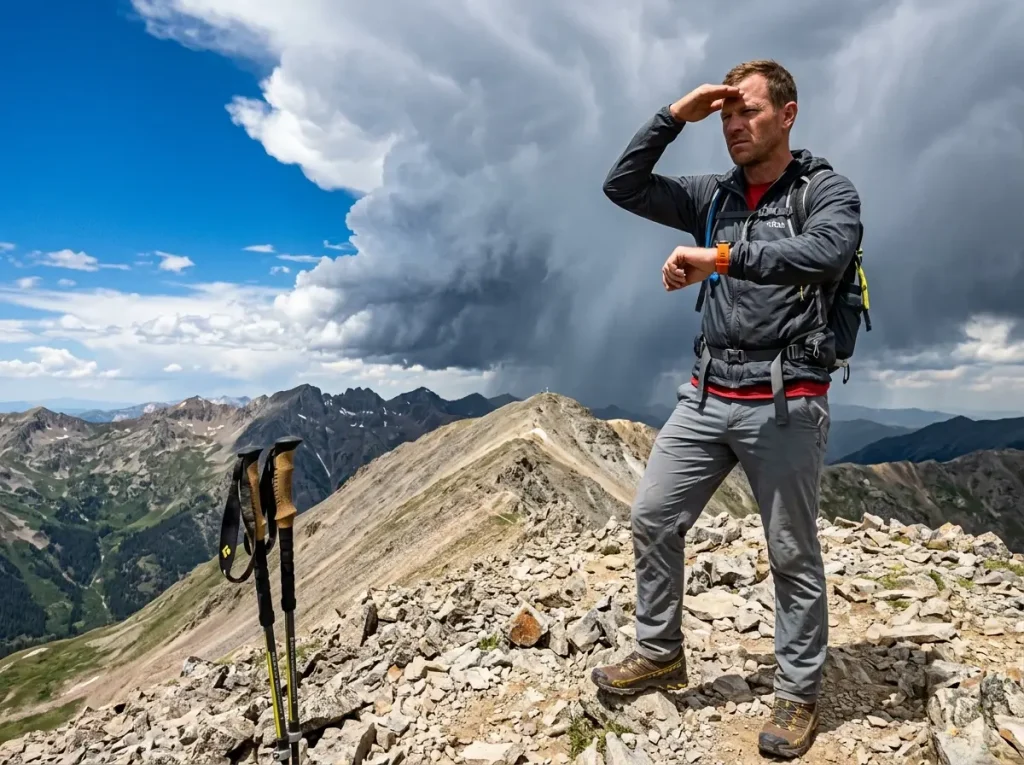
The down-climb penalty is why turnaround math matters more than most hikers realize. Descending technical Class 4 terrain is twice as slow and twice as risky as ascending. Plan your turnaround based on descent speed, not ascent speed.
Naismith’s Rule — 1 hour per 3 miles plus 1 hour per 2,000 feet of gain — needs adjustment for descents. Multiply your Class 3 descent time by 1.5, your Class 4 descent time by 2.0. A 2-hour ascent means a 3-to-4-hour descent plan.
The 2 O’Clock Rule applies in most North American mountain ranges: afternoon thunderstorms become probable by 2 PM in summer. Set a turnaround time that guarantees sub-treeline position by 2 PM regardless of summit status.
A clock-based turnaround is the only honest plan. “We’ll turn back if the weather looks bad” is not a plan — weather changes in 20 minutes. NOLS Search and Rescue victim demographics research confirms the statistical relationship between timing errors and SAR incidents. Apply the 1/3 Rule: use no more than one-third of your resources on the outbound leg, one-third for the return, one-third in reserve. For the full calculation method, see the math behind a safe turnaround time.
In the Cascades, our turnaround was 10 AM. We hit that time 200 feet below the summit. We turned around. The summit was still there next season. One person in the party wasn’t listening to the math — and spent that afternoon somewhere very uncomfortable.
Calculating Your Real Turnaround Time — Step by Step
Step 1: Estimate ascent time using Naismith’s Rule. Step 2: Multiply by 1.5 for Class 3 or 2.0 for Class 4. Step 3: Add both plus a 30-minute buffer and subtract from sunset or 2 PM storm window, whichever is earlier. Step 4: Set the alarm — when it goes off, the decision is already made.
Worked example: ascent takes 2.5 hours. Class 4, so multiply by 2.0 for a 5-hour descent estimate. Total: 8 hours with buffer. Sunrise 6 AM and storms by 2 PM gives you exactly 8 hours. Your start time is 5:50 AM or the climb is off. Add 25% for wet rock, 30% for a route you’ve never done before.
Why the Clock Must Overrule the Conditions
“The sky looks fine” is not data. It’s a snapshot. The Commitment heuristic makes us weight current conditions and dismiss forecast probability. A clear sky at 1 PM does not erase the 70% storm probability modeled from the morning soundings. Professional guides operate on hard clocks. When the alarm goes off, debate ends. Tell your group before departure: “When the alarm goes off, we say ‘Let’s go.’ That’s it.”
The Down-Climb Penalty — Why Getting Down Is Harder Than Getting Up
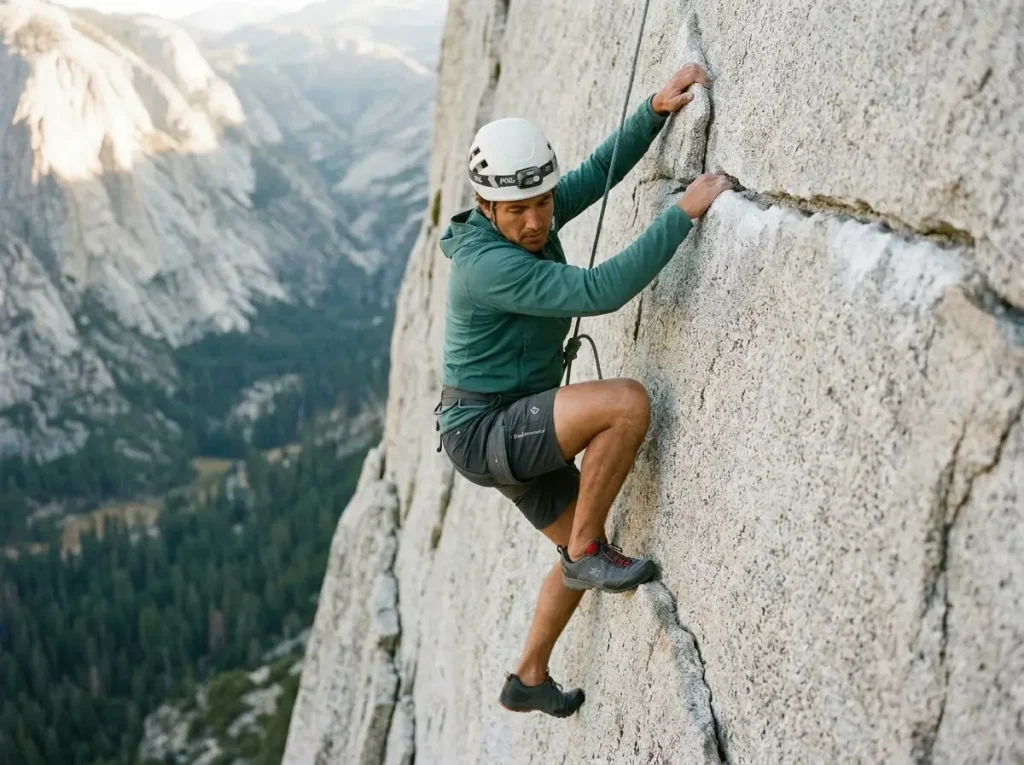
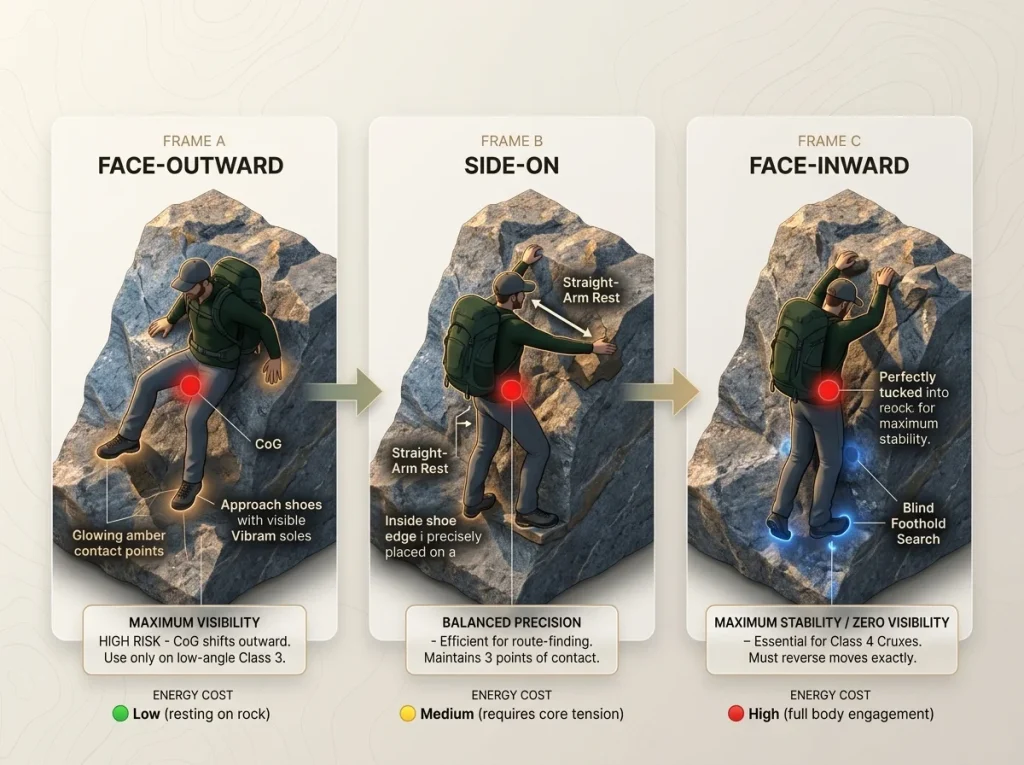
The visibility gap is the primary mechanical problem. Ascending, holds are at or above eye level. Descending, footholds are below your waist — to see them, you have to lean away from the rock, which shifts your center of gravity outward and reduces friction. The same move is physically different depending on direction.
On Class 4, you must turn face-inward — “climbing down a ladder” — with severely limited view of the terrain below. I’ve seen capable scramblers freeze on Class 3 descents — not because the rock was hard, but because their brain couldn’t reconcile looking down 300 feet while their hands searched for holds they couldn’t see.
Eccentric contraction is what makes your quads burn harder going down than up. If you hit that leg pump sensation on the way up, your capacity for a safe controlled descent is already reduced. How trekking poles reduce descent biomechanical load is worth reading — poles actively cut the eccentric tax on every step down. Research on human factors in high-altitude movement from Purdue University confirms these psychophysiological fatigue effects on motor control in mountain terrain.
The Three Movement Positions That Determine Safe Descent
Side-on is the most energy-efficient: one hip toward rock, inside edge of shoe on the hold, straight-arm rest possible — available on Class 3 and some Class 4. Face-outward provides full situational awareness but puts your center of gravity furthest from the rock — works on Class 3 and easy Class 4. Face-inward is the Class 4 default: mechanically the most stable, but you cannot see terrain below you. If you’ve never practiced face-inward descents on lower-angle terrain, don’t attempt it for the first time on a live route with 400 feet of exposure.
Key decision: if you cannot see holds below you in face-inward position AND you are fatigued, stop and assess. If you cannot down-climb safely, bivouac is the correct call.
Pro tip: If your hands or feet are cold enough that you can’t feel individual holds, treat it the same as if your brakes were failing. That feedback loop is gone. For approach shoe sole performance on wet and dry Class 4 rock, the field test results on grip in cold conditions are directly relevant here.
The HT-3 Framework in Practice — Your Field Decision Card
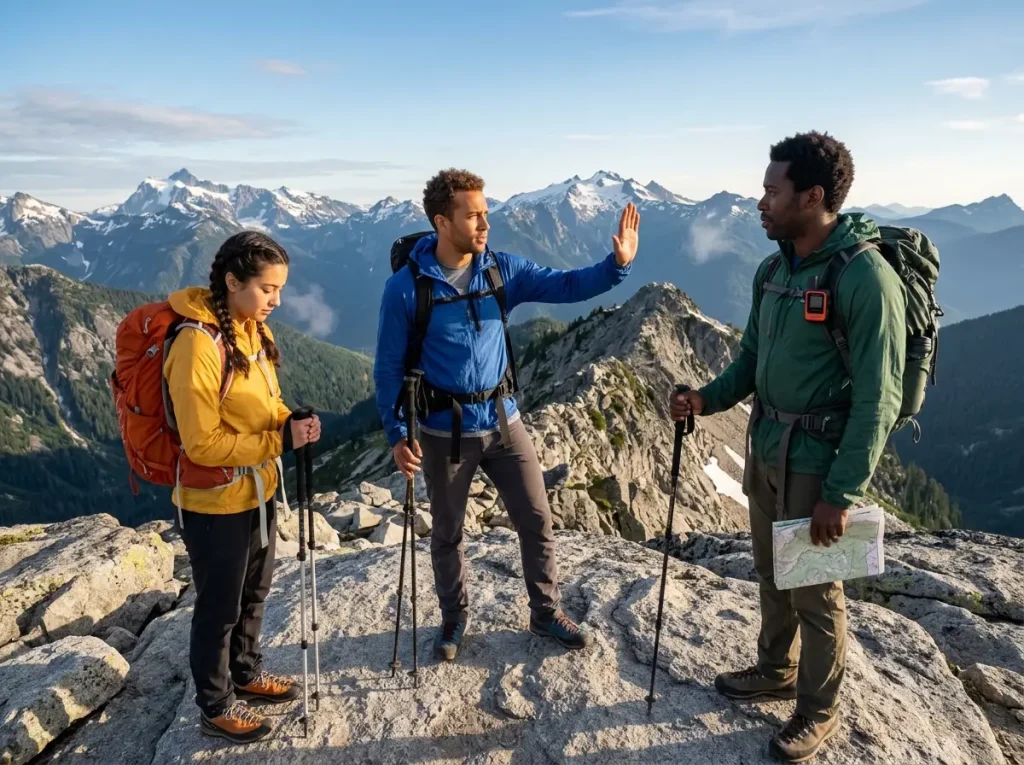
Any single No-Go indicator ends the ascent. There’s no partial No-Go. The mountain doesn’t grade on a curve.
The Rule of 3 for accident precursors: most mountaineering incidents are preceded by three minor red flags — a late start, a missing layer, an unexpected cloud bank. Count your flags. At two consecutive flags, set a soft turnaround. At three, stop and reassess immediately. The Swiss Cheese Effect means that when individual safety layers (skills, gear, weather window, fitness) all have holes and those holes align, the incident happens. The HT-3 matrix examines each layer independently. That independence is the point.
The STOP Protocol when stuck: Stop — Think — Observe — Plan. Stop moving immediately. Evaluate your map, time, daylight. Never move “just a little further” to find the trail. For the STOP protocol and what to do when you’re stuck on trail, the full emergency decision sequence is there. If you have less than 2 hours of daylight and a Class 4 descent of 1+ hour, bivouac is safer than descending in low light. The American Alpine Institute on heuristic traps and risk management confirms that FACETS cognitive traps consistently appear in post-incident investigations.
Applying the HT-3 Matrix on Route — A Worked Example
Three scramblers on a Class 4 Colorado ridge. 11:15 AM. 800 feet below the summit.
Hazard check: rock is dry, wind is 22 mph gusting to 35, no lenticular clouds. Two greens and a soft yellow. Mostly clear.
Team check: one member mentions burning quads on the ascent — leg pump signal, biological No-Go marker. Communication dropped in the last 30 minutes, single-word answers. Leader is pushing pace while others go quiet. Three soft warnings.
Time check: turnaround time was 11:00 AM. It’s 11:15. Hard No-Go.
Result: one confirmed No-Go (time), two soft warnings (team). Protocol: turn back. The leader who honors this says: “Alarm’s up. Let’s go.” The leader who ignores it says: “We’re so close, just another 30 minutes.” That second phrase is a FACETS Commitment trigger. If you hear yourself saying it, that’s the signal.
Pre-Trip Briefing Checklist (The Trailhead Protocol)
State out loud: the turnaround time, the turnaround signal, the veto-power rule. Three sentences, done before you leave the parking lot. Assign one “Devil’s Advocate” per trip whose explicit job is to ask “should we turn back?” at every rest stop. Brief FACETS by name: “If anyone hears ‘we’re so close’ or ‘those other guys went up,’ call it out.” For preparing mentally and physically for the jump to peak bagging, that transition guide covers the mindset work in full.
Wrapping It Up
Three things to carry off this ridge:
The grade doesn’t protect you — the crux does. Your route is rated by its hardest move, and that move has to be reversible under fatigue or the rating is academic. Any single No-Go indicator in the HT-3 matrix ends the ascent — environmental condition, human signal, or time. One flag is enough. Physics doesn’t negotiate. Plan the descent, not the summit. Your turnaround time is calculated from descent speed, daylight, and bivouac risk — not from how much summit you can see from where you’re standing.
Before your next technical route, take 10 minutes at the trailhead and run through the HT-3 checklist out loud with your group. Set the clock alarm. Name the FACETS traps by name. The mountains you love will be there next season. Make sure you will be too.
FAQ
What is the 1 or 3 rule in hiking?
The 1 or 3 Rule means no more than one-third of your resources — time, water, energy — on the outbound leg, one-third for the return, and one-third held in reserve for emergencies. On a scramble with a 9-hour daylight window, your turnaround point is at the 3-hour mark regardless of how far you’ve traveled. If you’ve burned more than a third going out, the math on the return is already compromised.
At what point does a scramble become a climb?
By the YDS definition, the transition is Class 4 or 5 — but in practical terms, it’s when a fall shifts from injurious to likely fatal. Class 4 requires real climbing moves (stemming, laybacking) and a fall is described as almost dead. If you’re searching for specific holds and relying on counter-force techniques, you’re at or above Class 4 and the turn-back decision framework changes significantly.
How do you overcome summit fever?
You don’t overcome it in the moment — you architect around it before departure. Set a hard, clock-based turnaround time at the trailhead, say it out loud, and have everyone repeat it back. By the time summit fever hits — usually the last 400 feet — your rational brain is running on depleted reserves. The rule you set in the parking lot is the only thing that works at altitude.
What are the 6 heuristic traps (FACETS)?
The FACETS framework: Familiarity (underestimating a known peak), Acceptance (pushing because of group dynamics), Commitment (Summit Fever), Expert Halo (following a de facto leader without personal judgment), Tracks or Scarcity (rushing because it’s the last good weather day), and Social Proof (assuming safety because others went up). All six are active on any technical scramble. Name them before you leave.
How do you know when to call for mountain rescue?
If any team member cannot safely descend under their own power, if you have less than 2 hours of daylight with a Class 4 descent remaining, or if anyone shows signs of hypothermia or serious injury — call immediately. Activate your Garmin InReach or personal locator beacon and stay put. Your goal is to be found, not to self-rescue into a worse position.
Risk Disclaimer: Hiking, trekking, backpacking, and all related outdoor activities involve inherent
risks which may result in serious injury, illness, or death. The information provided on The Hiking Tribe is for
educational and informational purposes only. While we strive for accuracy, information on trails, gear, techniques,
and safety is not a substitute for your own best judgment and thorough preparation. Trail conditions, weather, and
other environmental factors change rapidly and may differ from what is described on this site. Always check with
official sources like park services for the most current alerts and conditions. Never undertake a hike beyond your
abilities and always be prepared for the unexpected. By using this website, you agree that you are solely
responsible for your own safety. Any reliance you place on our content is strictly at your own risk, and you assume
all liability for your actions and decisions in the outdoors. The Hiking Tribe and its authors will not be held
liable for any injury, damage, or loss sustained in connection with the use of the information herein.
Affiliate Disclosure: We are a participant in the Amazon Services LLC Associates Program, an
affiliate advertising program designed to provide a means for us to earn advertising fees by advertising and linking
to Amazon.com. As an Amazon Associate, we earn from qualifying purchases. We are also an official affiliate partner
of Black Diamond Equipment via the AvantLink network. If you click on a Black Diamond affiliate link and make a
purchase, we may earn a commission at no additional cost to you. We also participate in other affiliate programs and
may receive a commission on products purchased through our links. Additional terms are found in the terms of
service.