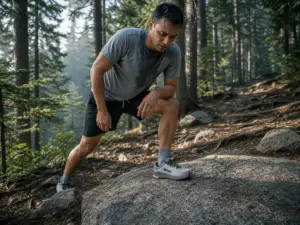
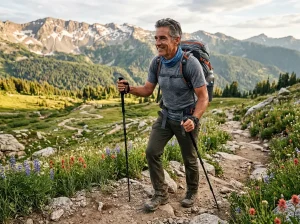
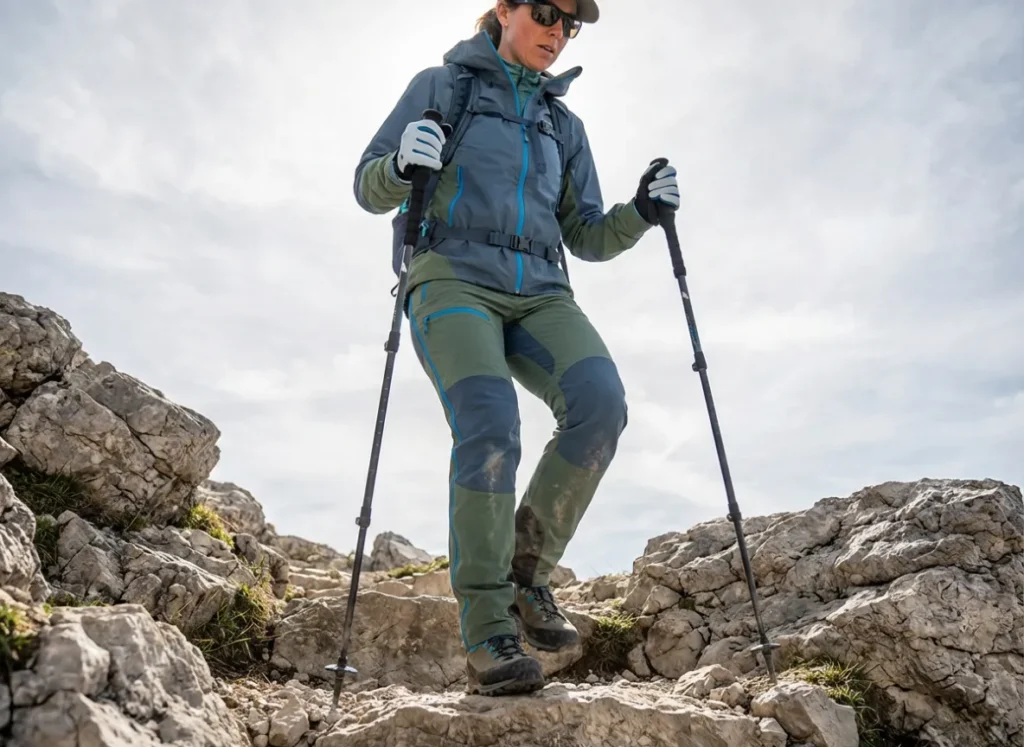
The summit isn’t the finish line; it’s the halfway point. In fact, most mountaineering accidents and the majority of acute injuries happen on the way down. Gravity, which fought you every inch of the ascent, suddenly becomes a forceful accelerant. With every step down the scree, the ground pushes back with three times your body weight, sending shockwaves through the cartilage of your knees and the fibers of your quadriceps.
This is the “Downhill Paradox”: your lungs finally recover, but your joints begin to degrade.
As a lead instructor who has guided groups from the steep slides of the Adirondacks to the famed Chilkoot Trail in the Yukon, I have watched countless strong hikers crumble on the descent. Too many view trekking poles as passive walking sticks rather than active suspension systems. The difference between a crippling descent and a controlled return to the trailhead lies in mechanical advantage. By the end of this how-to guide, you will understand the biomechanics of load transfer, how to configure your gear for the drop, and the specific advanced trekking techniques required to save your knees for the next season.
Why does downhill hiking hurt so much, and do poles actually help?
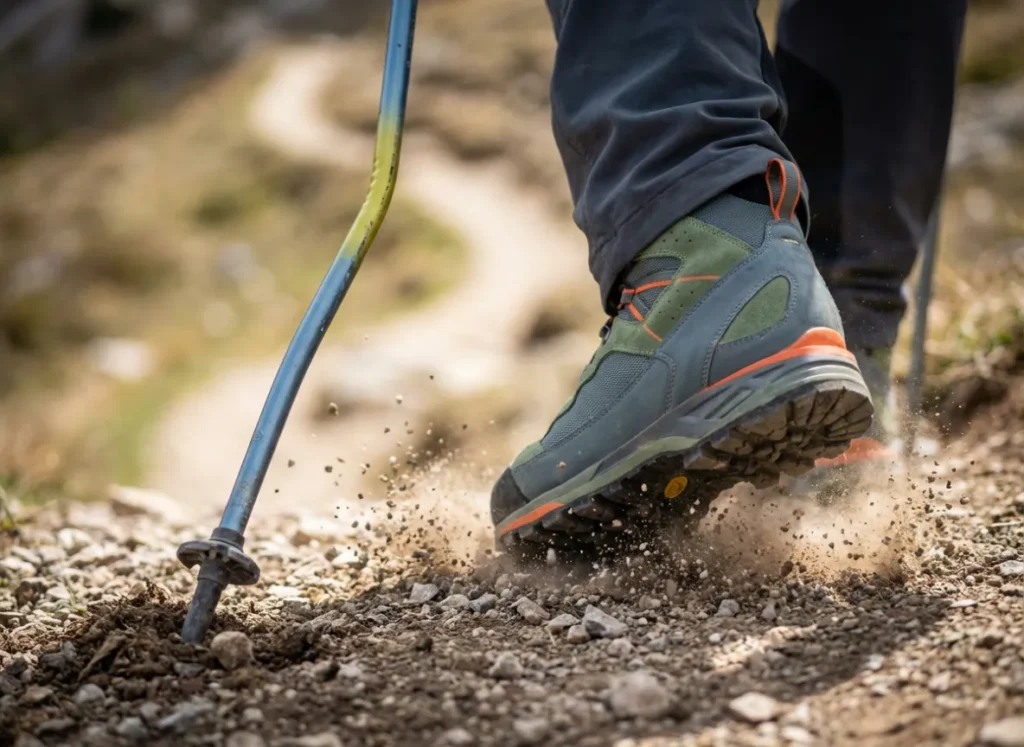
Downhill hiking causes pain due to eccentric muscle contraction and high impact forces; trekking poles help by acting as additional limbs to redistribute this weight.
What is the “eccentric braking” phenomenon?
Walking downhill requires your leg muscles, specifically the quadriceps, to lengthen while simultaneously contracting to resist gravity. This action, known as eccentric muscle contraction, functions as a biological braking system to control your descent speed. It is fundamentally different from the concentric (shortening) contractions used to climb.
Unlike the metabolic fatigue of climbing, eccentric loading creates high tension in muscle fibers. This tension causes microscopic tears in the sarcomeres. This micro-trauma is the primary driver of Delayed Onset Muscle Soreness (DOMS), that familiar “quad burn” or muscle fatigue you feel two days after a trip.
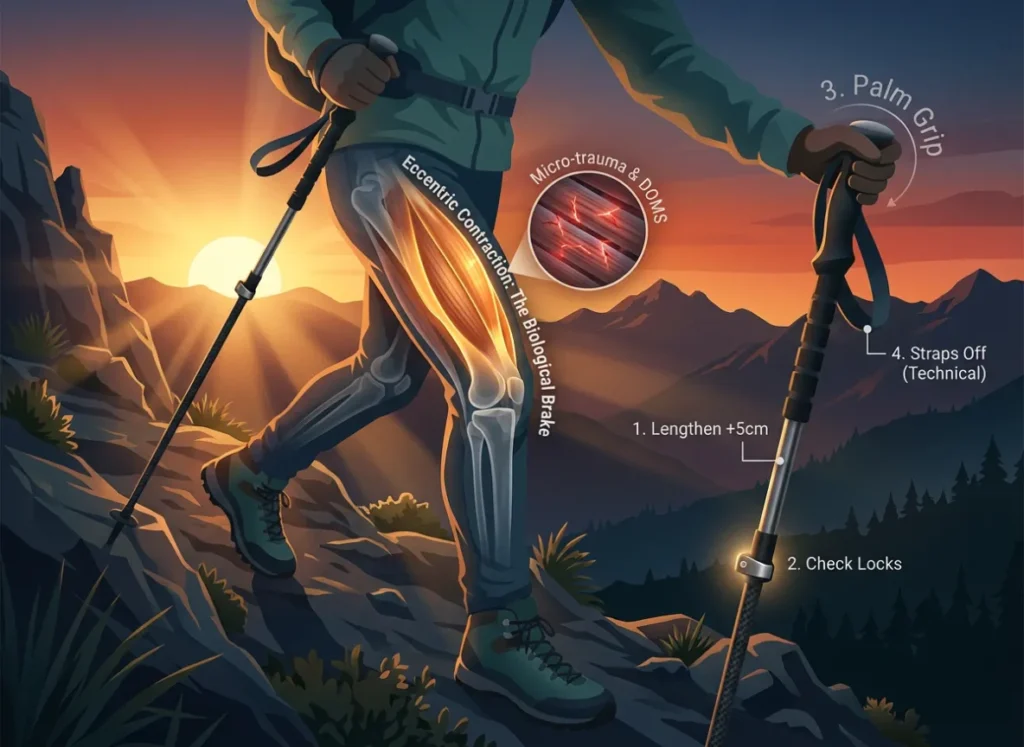
Mechanically, this braking action pulls the patella (kneecap) aggressively into the femoral groove, spiking patellar compression. Without poles to share the load, the legs must absorb 100% of this energy. Poles recruit the upper body—specifically the triceps and pectorals—to distribute this braking force. Proper training for hiking must account for this eccentric load, but even the strongest legs benefit from mechanical aid.
According to kinesiologists and data housed by the National Institutes of Health (NIH), utilizing trekking poles significantly mitigates this specific type of muscle tearing and improves joint health.
How much weight do trekking poles really offload?
Research indicates that during a steep descent, Ground Reaction Forces (GRF) can spike to 2-3 times your body weight due to acceleration. However, correctly used trekking poles can reduce these compressive forces on the knee joint by approximately 25%.
For a 180lb hiker carrying a heavy backpack load, this translates to offloading roughly 112 lbs of knee impact force per step.
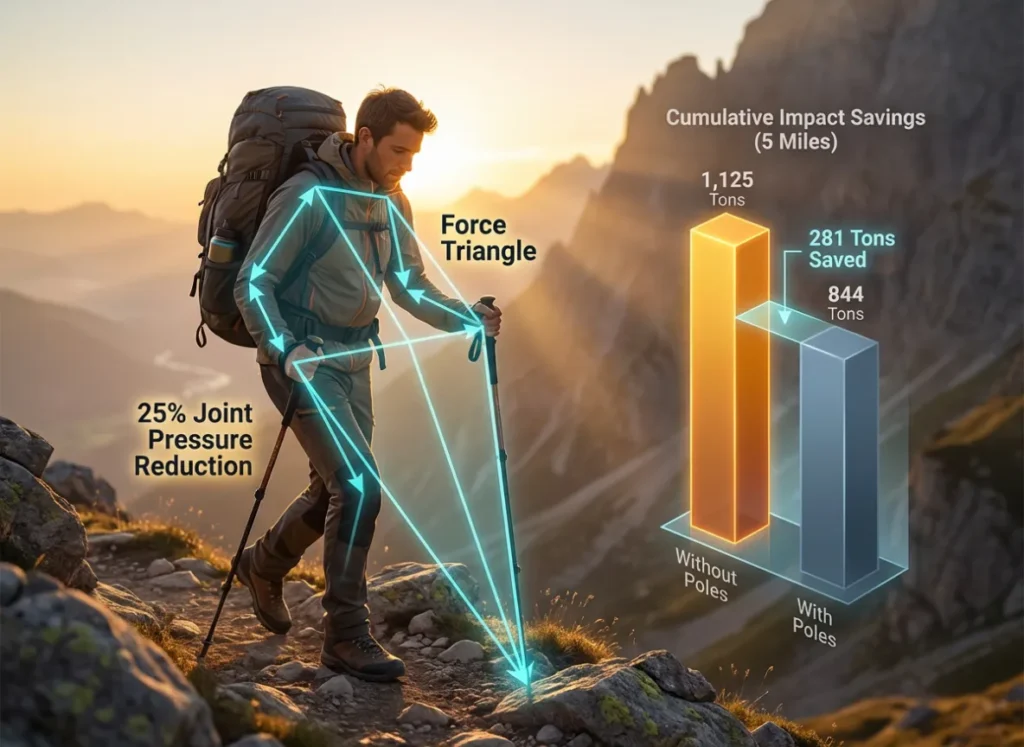
While 112 lbs seems moderate, the cumulative effect is massive. You can think of it as a mental cumulative load calculator: over a single mile (roughly 2,000 steps), you spare your knees over 112 tons of force. This massive weight reduction per mile explains why understanding the benefits of trekking poles is vital for trekkers with osteoarthritis or meniscus issues. The “force triangle” created by the poles allows the load to bypass the spine and legs, transferring directly into the ground through the arms.
Pro-Tip: To visualize the force reduction, imagine you are hiking with a weighted vest. Using poles correctly is the biomechanical equivalent of taking that vest off for the descent.
Reliable data on knee joint forces during downhill walking provides the scientific validation that this reduction applies specifically to the compressive and shear forces that degrade joint health.
How should I configure my poles before the descent begins?
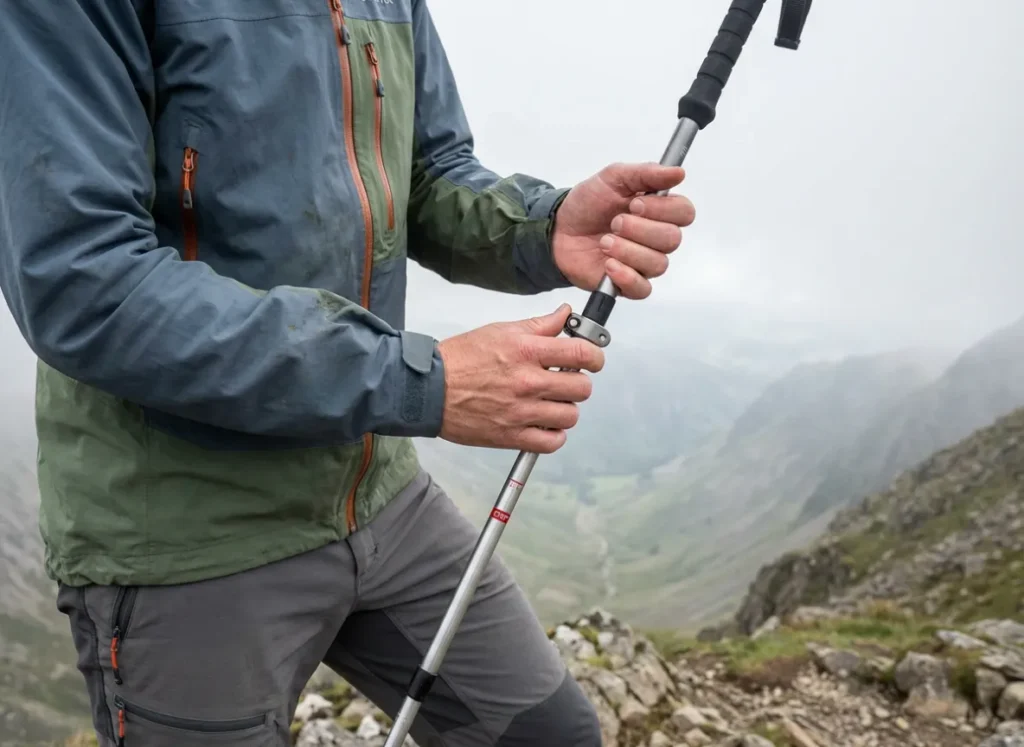
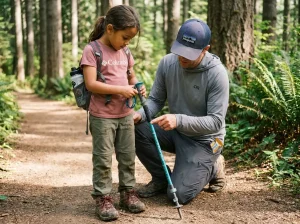
You should lengthen poles for descent by 5 to 10 cm and verify the locking mechanism is secure before dropping in.
Why and how much should you lengthen the poles?
Before descending, lengthen your adjustable poles by 5 to 10 cm (2 to 4 inches) relative to your flat-ground setting. Unlock the mechanism, extend the lower shaft sections first to maintain swing balance, and re-lock firmly.
The goal is to ensure that when you plant ahead on the step below you, your elbow remains at a comfortable 90-135 degrees angle. If poles are left short, you are forced to hunch forward or lower your center of gravity excessively to make ground contact.
Proper pole length adjustment allows you to maintain an upright, neutral spine. This keeps your Center of Mass (COM) aligned over your knees rather than pitching forward. This “suspension geometry” allows the skeleton to bear the load rather than the lower back muscles. Getting the correct hiking pole length is a dynamic process, not a “set it and forget it” rule.
Research on the effects of hiking pole length on gait mechanics confirms that length adjustment is critical for maintaining stability on downhill sections.
How do you verify the locking mechanism is safe?
Perform a “Full Weight Test” by leaning your entire body weight onto the poles before taking the first step. Sudden pole collapse during a steep descent is a common cause of injury, effectively turning a safety tool into a hazard.
For lever locks (like the Black Diamond Flick-Lock system), ensure the thumbscrew is tightened enough that closing the lever requires firm pressure. For twist-lock mechanisms (common on some Leki models), clean any dust from the expansion cones, as grit can cause slippage under heavy vertical loads. Regular trekking pole maintenance helps prevent these failures.
This verification is especially critical for hikers carrying heavy expedition packs, where the axial load on the shaft is highest. Lever locks are generally preferred for heavy downhill stints because they provide a visual confirmation of being locked. This applies whether you are using carbon fiber for shock absorption or aluminum for durability.
Current studies on the biomechanical effects of pole usage highlight the significant joint loading these tools must withstand to be effective.
What are the correct grip and movement techniques for descending?
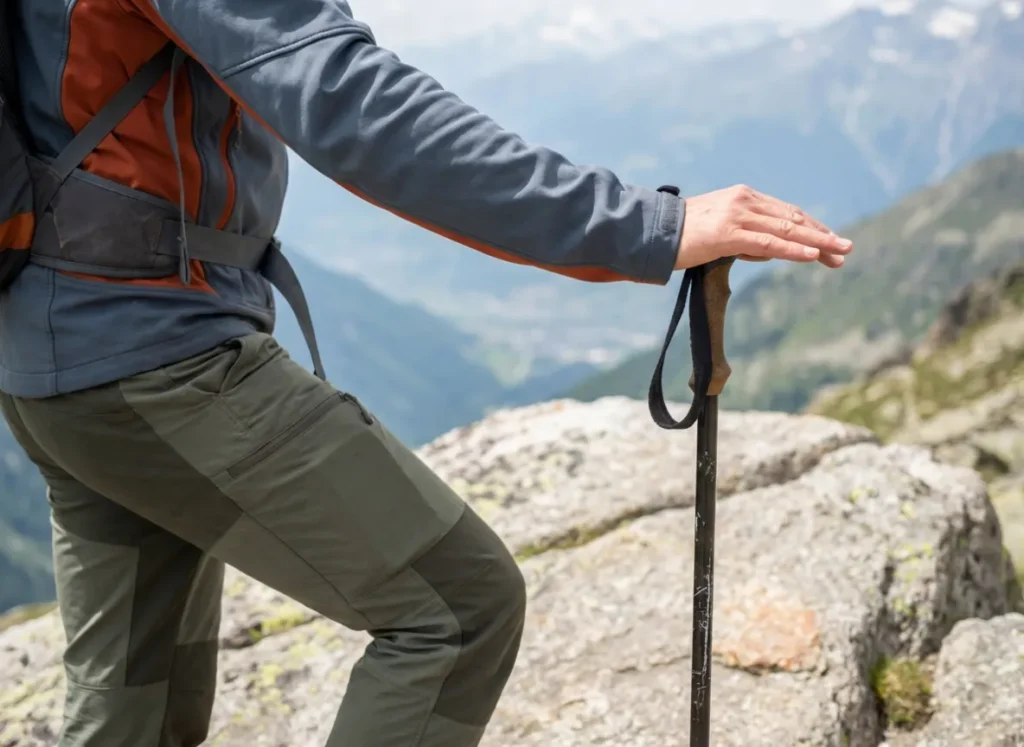
The most effective techniques are the “Palm-on-Top” grip for ergonomics and the “Double Plant” rhythm for stability.
Why is the “Palm-on-Top” grip superior to the standard handle grip?
Disengage your fingers from the main shaft grip and place the center of your palm directly on the rounded top (pommel) of the pole handle. Your fingers should drape loosely over the front, treating the pole like a cane rather than a ski pole.
This “palm-down technique” aligns the force vector directly up the shaft into the skeletal structure of your arm and shoulder. Gripping the vertical handle on steep downhills forces the wrist into extreme ulnar deviation, leading to wrist strain over long distances.
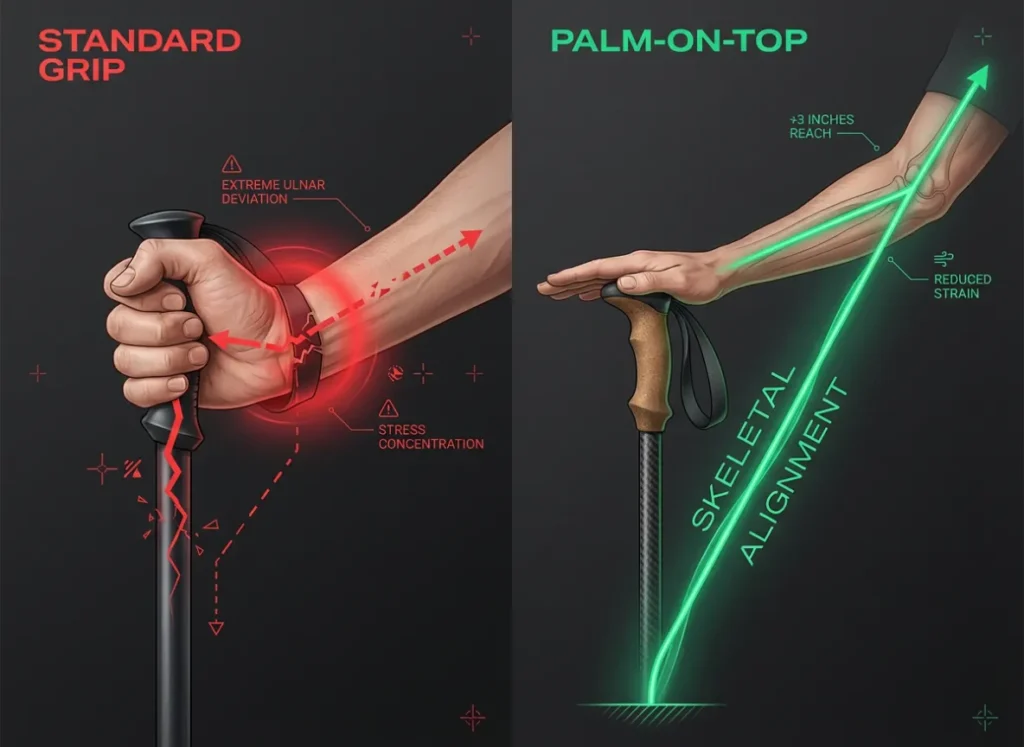
Palm-top grip effectively adds another 2-3 inches of pole reach, which is useful for sudden drop-offs without needing to adjust the shaft length again. Many hikers choosing between carbon vs. aluminum trekking poles look for ergonomic cork or rubberized tops specifically to facilitate this friction-based hold.
Detailed analysis of gait parameters and ground reaction forces supports the ergonomic argument for posture-aligning grip positions.
When should you use the “Double Plant” versus the alternating rhythm?
On moderate slopes, use the Alternating Rhythm: swing the opposite hand and leg (Right Pole + Left Foot) to walk naturally and maintain a natural arm swing. This is standard walking mechanics.
On steep terrain, switch to the Double-Plant Technique. Swing both poles forward and plant them simultaneously on the step below. Lean your weight onto this “dual-leg” tripod before lowering your first foot.
The Double Plant acts as an “emergency brake,” providing significant braking power and allowing you to momentarily offload up to 50% of your body weight while stepping down. This technique creates a stable three-point stance at all times, critical for navigating large boulders or knee-deep drops. While slower, this planting rhythm is the most effective method for protecting an injured knee. If you are new to this, reviewing trekking poles 101 can help solidify the basics before attempting advanced planting.
Research into sensorimotor control loops in downhill walking explains the proprioceptive benefits of these additional contact points.
How do you adapt your technique for different terrain types?
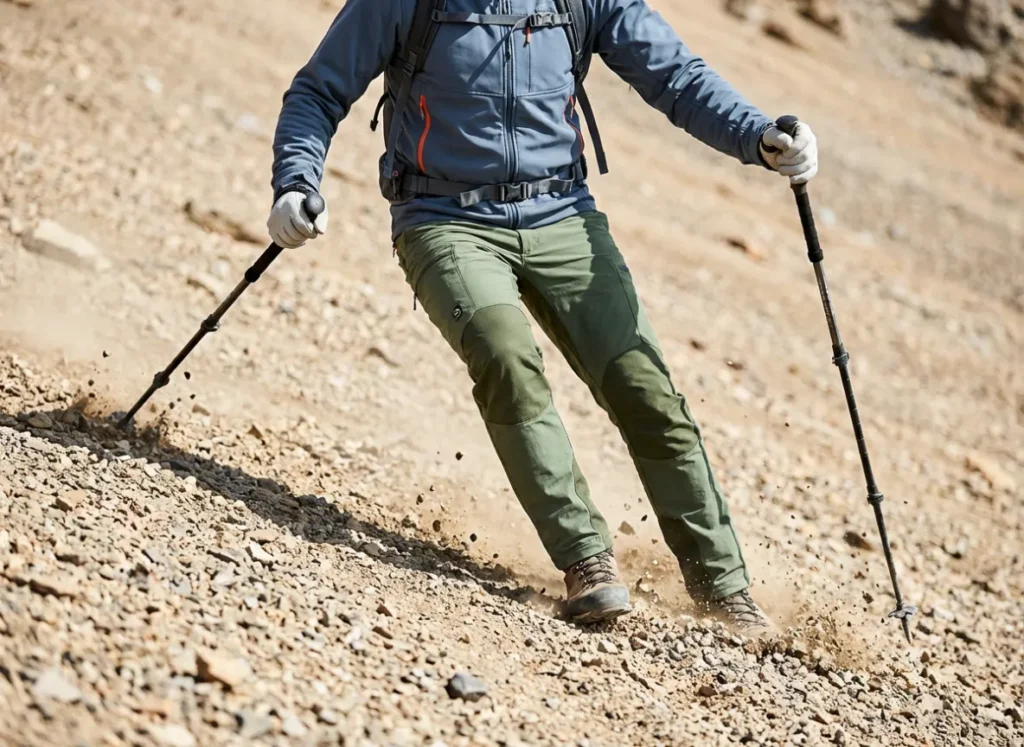
You must switch between the “Vault” technique for rock steps and the “Plunge Step” for loose scree, mud, or ice.
What is the “Vault” technique for solid rock steps?
Used when descending hard terrain like granite staircases in the White Mountains, the goal here is impact mitigation. Plant both poles on the lower rock step, lean forward until your arms are bearing weight, and lower your body slowly using triceps strength.
This controlled lowering eliminates the jarring “plop” landing that sends shockwaves up the spine. It effectively replaces the eccentric work of the quadriceps with the concentric work of the arms.
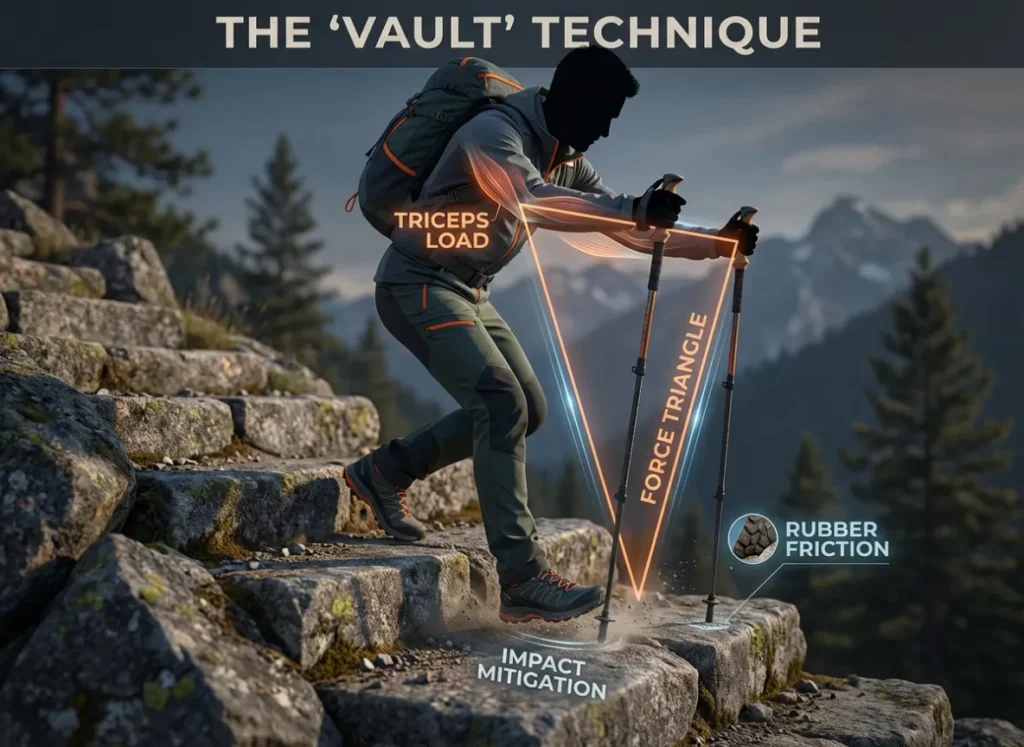
To preserve the rock face and reduce noise, use rubber tips instead of the standard carbide tip. This also provides better friction on dry slab. This technique turns a staircase descent into a smooth, flowing motion. It is a fundamental skill when scrambling explained covers Class 2 terrain.
For environmental considerations, refer to Leave No Trace (LNT) guidelines regarding trekking poles to minimize scarring on the landscape. Leave No Trace LNT for trekking poles.
How does the “Plunge Step” work on loose scree and gravel?
When descending soft terrain like volcanic scree or mud, impact is less of a concern than shear force (slipping). Widen your pole stance to create “outriggers” for lateral balance.
Adopt the “Plunge Step”: drive your heel aggressively into the loose material, keeping your toe pointed up, to create a platform. In this scenario, the poles act as stabilizers rather than weight bearers; they are your third and fourth legs to catch a fall if the scree shifts.
Keep your weight vertically over your heels. Leaning back—a natural fear response—pushes your feet out from under you. Remove snow baskets or mud baskets if they are catching on rocks, but keep them on for deep, soft substrate (a trick often borrowed from snowshoers). Because this terrain is messy, hiking with gaiters is essential to keep debris out of your boots while plunging.
Expert advice on hiking efficiently on scree confirms that vertical alignment over the heels is key to traction.
Is it safe to use wrist straps while hiking downhill?
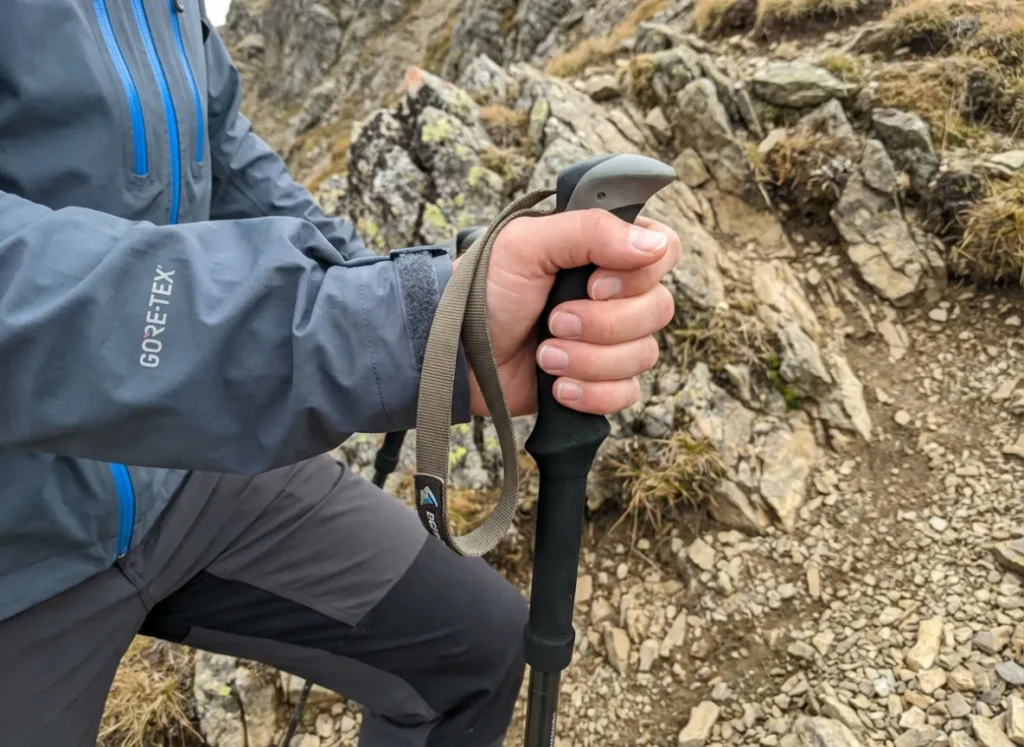
It is generally unsafe to use pole straps on technical, steep, or rocky downhill terrain due to the risk of injury.
What is “Skier’s Thumb” and how do straps cause it?
“Skier’s Thumb” is an injury to the Ulnar Collateral Ligament (UCL) caused by falling while the hand is tethered to a pole. If you fall and the pole handle lands awkwardly, the strap prevents your hand from releasing. The handle then acts as a fulcrum to hyperextend the thumb.
This can result in a complete rupture of the ligament, requiring surgery and ending your hiking season. This risk is highest on technical, uneven terrain where tripping is likely and the ground is hard.
While straps are excellent for transferring load to the wrist on uphill sections to save grip strength, they become a liability in high-risk downhill scenarios. Awareness of this injury mechanism is a critical component of wilderness first aid knowledge.
The mechanism of Skier’s Thumb injury is well-documented by hand surgery specialists.
When should you definitely remove your hands from the straps?
Follow the Rule of Thumb: If the terrain is technical enough that a fall is possible (scree, stream crossings, scrambling), remove your hands from the straps.
Follow the Rule of Consequence: If falling would result in a slide or tumble (steep exposure), straps must be off. This allows you to discard the poles instantly and self-arrest with your hands.
When crossing fast-moving water, always remove straps; a trapped pole snagged on a rock can drag you underwater or dislocate a shoulder. In deep snow or mud, keeping straps off prevents your arm from being wrenched if the pole plunges deep and gets stuck. Treat the strap as a tool for propulsion on the flat terrain, and an optional hazard on the technical downhill. This mindset is part of a broader hiker’s emergency guide to preventing entrapment.
| Trekking Pole Strap Usage Guide | ||
|---|---|---|
| Terrain Type | Strap Recommendation | Reason |
| Smooth Trail (Flat/Uphill) | ON | Reduces grip fatigue; aids propulsion. |
| Steep Steps / Rock | OFF | Risk of entrapment during a fall. |
| Scree / Loose Gravel | OFF | High fall probability; need hands free. |
| River Crossings | OFF | Drowning/Entrapment hazard. |
Guidelines from organizations like the British Mountaineering Council (BMC) consistently prioritize the ability to discard gear during a fall.
Conclusion
The descent doesn’t have to be the price you pay for the climb. By understanding that downhill forces can exceed three times your body weight, you can appreciate why trekking poles are medical necessities, not just accessories. Remember the checklist: lengthen your poles by 5-10cm, verify your locks, and switch to a “Palm-on-Top” grip.
On the trail, let the terrain dictate your rhythm—vaulting down solid rock and plunging through loose scree. Most importantly, respect the strap debate; click out when the going gets technical to protect your thumbs. With these adjustments, you move from simply surviving the hike out to mastering the mountain environment.
Have you tried the “Double Plant” technique on a steep descent? Let us know in the comments how it changed your hike.
FAQ – Frequently Asked Questions
How much longer should trekking poles be for downhill hiking?
Lengthen your poles by 5 to 10 cm (2 to 4 inches) compared to your flat-ground length. This ensures you can plant the pole on the step below while keeping your body upright and your elbow at a comfortable 90-degree angle.
Do trekking poles actually save your knees?
Yes, studies show trekking poles reduce compressive force on the knees by up to 25%. They redistribute ground reaction forces through the arms and upper body, significantly reducing the cumulative load over a long hike.
Should I put my hands through the straps when going downhill?
On smooth, easy trails, straps provide support; however, on technical, steep, or rocky terrain, you should remove your hands from the straps. This prevents Skier’s Thumb and wrist strain by allowing you to instantly discard the poles if you fall.
What is the best grip for hiking downhill with poles?
The Palm-on-Top (or cane grip) is the most effective technique for descent. Placing your palm on the rounded top of the handle allows for direct force transfer and prevents excessive wrist bending (ulnar deviation).

I've spent more than a decade researching hiking gear and trail technique. I read the specs, the forum threads and the long-term reviews, and every pick here comes with what it gets wrong.
End of the trail
You read every mile of this one. Here's where the trail goes next.