In this article
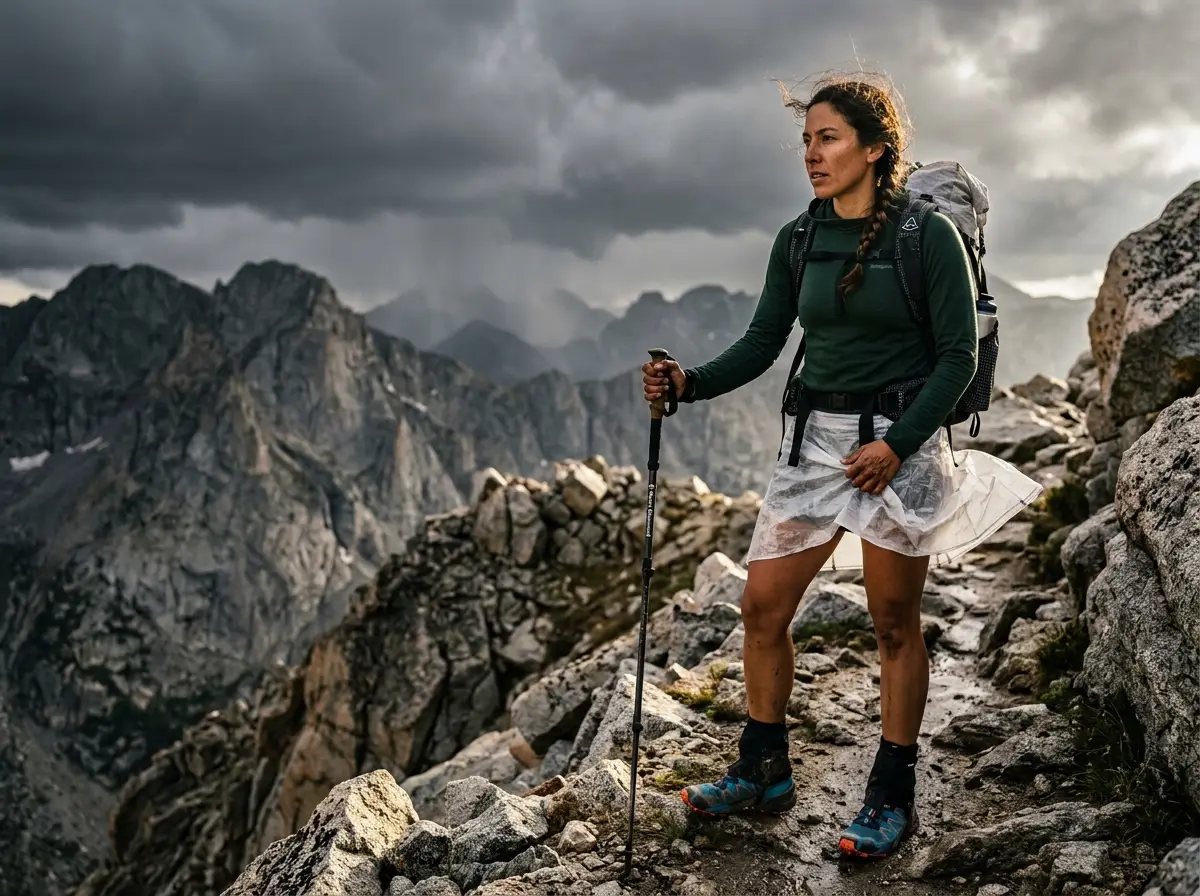
The “Marilyn Moment” hit at 5,000 feet on an exposed New Hampshire ridgeline. Thirty-five-mile-per-hour winds caught my ultralight rain skirt, violently blowing it upward and blasting freezing rain onto my thighs. What started as mild discomfort turned into early-stage hypothermia in minutes. I trusted a sunny trailhead forecast over the brutal reality of alpine weather.
After 20 years testing gear on trails from the Whites to the Cascades, I know exactly when lower-leg protection fails. Your leg layers aren’t just for keeping mud off your hiking pants. They are critical thermoregulation tools. When temperatures plunge and the wind howls, packing the wrong option means serious trouble.
This guide breaks down exactly when an ultralight kilt fails and enclosed pants become a backcountry survival necessity. Here is how to build a waist-to-ankle protection system that keeps you safe when the weather turns violent.
⚡ Quick Answer: Wear a rain skirt in mild, humid conditions where heavy exertion causes rapid sweat accumulation. Skirts use mechanical ventilation to exhaust heat fast via the chimney effect. Switch aggressively to enclosed rain pants when temperatures drop below 45°F or when you cross above treeline. High winds strip your core heat, making a full leg enclosure mandatory for survival.
How Wet Legs Strip Your Core Heat
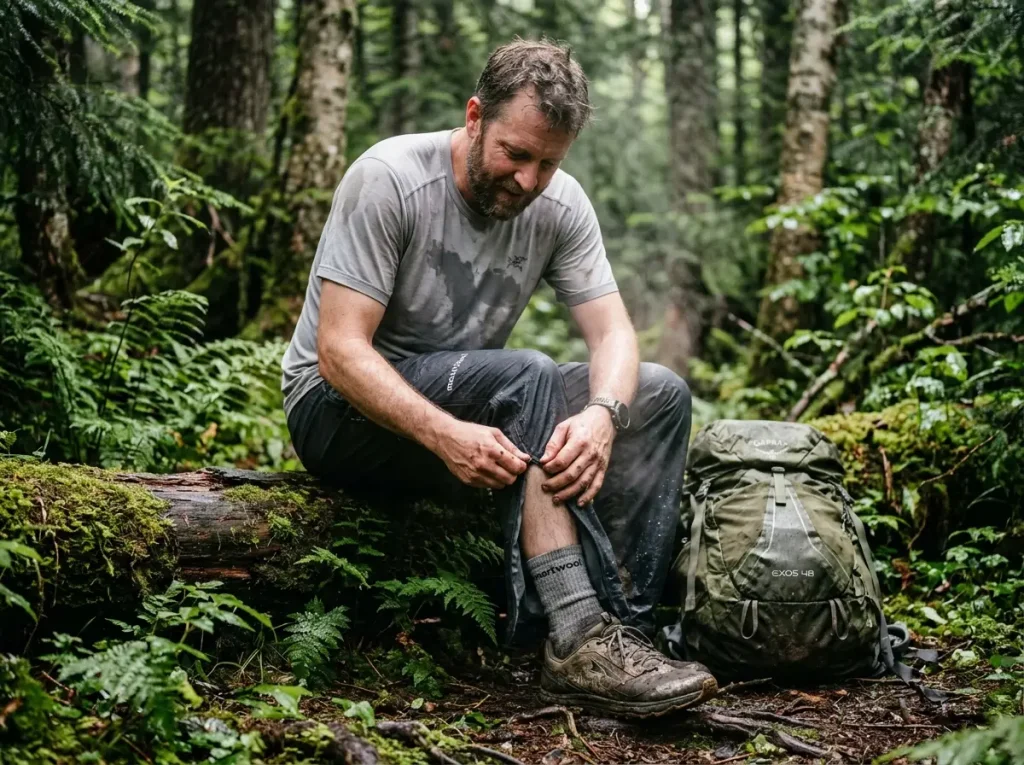
Your legs act as massive thermal radiators. The large muscle groups of your quadriceps and hamstrings generate serious heat during long, steep climbs. But they also offer a huge surface area for heat exchange.
If you get these muscles wet, the physics out here are unforgiving. Water transfers heat away from you twenty-five times faster than static air. A saturated leg loses warmth at a terrifying rate that you simply cannot out-produce.
Veteran hikers learn the hard way: staying one-hundred percent dry is an impossible fantasy. Your actual goal out here is staying warm while wet.
The 25x Conductive Hazard Zone
Heat loss accelerates brutally when both your layers and your bare skin are completely saturated. You are essentially touching cold water constantly, draining your internal battery with every step.
The real hazard zone sits right in that 35°F to 50°F “wet misery” window. This is where most hiker hypothermia cases happen. People look at the thermometer and think it is too warm to freeze, so they push too far.
When your legs are wet, your core battery drains aggressively. You never notice it while hammering up a steep climb. But the second you stop moving, the crash hits. This is known as “rest-break hypothermia”. You sit down on a rock, the exertion stops, and your saturated clothing immediately pulls the remaining heat out of you through rapid evaporation.
Sweating Out: The Membrane Paradox
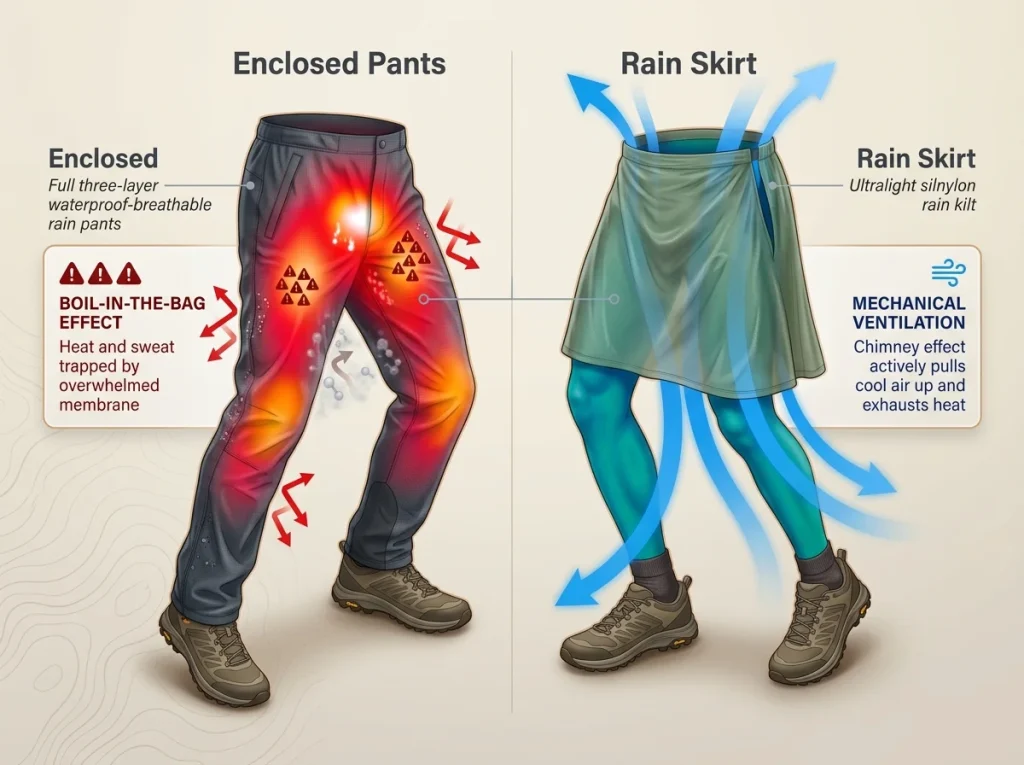
You pull on your heavy rain pants to stay dry during a sudden squall. Twenty minutes into a steep climb, you realize you are soaked underneath from thigh to ankle. This is the boil-in-the-bag effect.
Non-breathable layers or overwhelmed shells trap your metabolic moisture mercilessly. You create your own suffocating personal sauna inside the pants. This inner wetting from your own sweat is just as hazardous as the rain outside.
A damp base layer worn under a non-permeable shell absolutely requires steady motion to maintain thermal equilibrium. You have to keep the engine running hard to stay warm. The second you sit down to filter water, the violent shivering starts. If you want to understand choosing between water-resistant and fully waterproof barriers, you have to look at how much you sweat.
Pro-Tip: You know you are slipping into the hazard zone when your hands stop working gracefully. The first twenty times you try to open a snack wrapper with numb fingers, you tell yourself you are just tired. If you physically cannot pinch a tent zipper pull, your core is already hoarding warmth from your extremities to protect your organs. Fix your layers instantly.
The Thermoregulatory Set-Point
Your hypothalamus rules your internal temperature with an iron fist. It rigorously defends that 98.6°F baseline against external threats. When your skin gets chilled by wet clothing, your system reacts instantly with severe vasoconstriction. It yanks the circulation away from your skin surface to protect the heat in your chest and brain.
If you keep losing heat, violent shivering kicks in. This is you desperately burning emergency fuel to create friction heat in the muscles. Rapid, unrelenting cooling from wet leg clothing can overwhelm these natural defenses fast. By the time you consciously realize you are in trouble, your physical coordination is already impaired.
Rain Pants: Membrane Diffusion and Structural Physics

Three-layer rain pants from companies like Outdoor Research and Montbell promise a technical miracle: they stop heavy water from getting in while supposedly letting your sweat get out. The reality on a muddy, steep trail is far more complicated.
These advanced garments rely entirely on a partial pressure gradient. This means they need a steep difference in temperature and humidity between the swampy inside of the pant and the outside mountain air to function at all.
The Partial Pressure Gradient Collapse
High-end WPB membranes like classic Gore-Tex naturally push vapor from a warm, humid interior out into a cool, dry exterior environment. This complex system works brilliantly on a brisk, crisp autumn afternoon in the alpine.
It fails miserably during a warm, heavy summer downpour on the Appalachian Trail. When the external ambient relative humidity climbs above eighty percent, the membrane efficiency plummets. The driving pressure gradient you rely on flatlines entirely. This locks your sweat inside the pants with nowhere to go.
Even expensive materials boasting elite moisture vapor transmission rate numbers of 75,000 are rendered effectively useless in a ninety-five percent humidity rainstorm. Lab tests for breathability happen in controlled, dry rooms. They rarely reflect the brutal realities of a humid forest ascent.
The Pumping Action Mechanism
Because the breathable fabric inevitably struggles in high humidity, enclosed pants rely heavily on mechanical pumping action. Every single time you bend your knee or take a long step, the rhythmic compression of the pant legs acts exactly like a fireplace bellows. It actively forces stale, hot air out through your open hems and waistline gaps.
If your rain pants fit tightly like yoga pants, you neutralize this critical exhaust system entirely. An athletic fit shuts down the mechanical bellows effect dead. You ensure rapid internal sweat accumulation right around your thighs and crotch exactly where you generate the most heat.
Pro-Tip: Always unzip your ankle closures halfway up the calf when you hit aggressive uphills. You radically increase the exhaust rate of the pumping action. You want those pant legs flapping slightly with every step to actively push the stale air out.
Wind Protection: Surviving Convective Bursts
Rain pants act as physical armor against convective heat loss stripping your thermal boundary. They stop the brutal wind from aggressively stripping the warm boundary layer straight off your skin.
Pants cross the line from optional comfort to mandatory survival gear above the treeline. Once you step out of the protective forest canopy and hit sustained winds blowing over twenty-five miles per hour on an exposed ridge, you need a full enclosure around your legs. You can check the wind chill index and heat loss calculation to see how fast heat strips away.
A high hydrostatic head rating of 20,000mm or more offers extreme weather protection during gales. It actively blocks driving, horizontal rain that easily punches right through lighter fabrics to soak your base layers.
Rain Skirts: Mechanical Ventilation and The Stack Effect

A rain kilt completely bypasses the inherent limitations of breathable waterproof fabrics. It ignores the pressure gradients completely and gives you direct, aggressive airflow right from the knees down to flush out the heat.
In the right environmental conditions, this simple piece of open gear radically outperforms expensive membrane pants. It manages your internal moisture safely because it intentionally refuses to trap the air around your legs.
These garments dominate the ultralight trekking scene for a very good reason. They keep you moving fast up endless switchbacks without overheating and drowning in your own sweat.
The Stack Effect in Field Conditions
The skirt works beautifully on a basic physical principle of buoyancy called the chimney effect. It utilizes the principles of natural ventilation perfectly. The warm, incredibly moist air produced by your churning legs is less dense than the ambient air outside. This causes the hot air to naturally rise up and escape right out of the loose waistband.
At the exact same time, the skirt provides a massive, totally unrestricted intake valve at the open bottom hem. Cooler, drier air pulls forcefully in from below your knees. This continuous, natural cycle effortlessly flushes heat without relying on high-tech fabric pores to do the heavy lifting.
This kind of raw mechanical ventilation can reliably maintain core temperatures drastically cooler than enclosed pants during agonizing exertion. You avoid the inner sauna effect entirely. In warm thunderstorms, a cheap, zero-breathability skirt keeps you far more comfortable than premium three-layer mountaineering pants.
Pro-Tip: Put your rain skirt to work even when it stops raining. Use it as a totally waterproof, perfectly dry sit pad during trail breaks on saturated, muddy ground. Just fold it flat and drop it on a wet log to save your hiking shorts from soaking through.
Mitigating the Double-Drip Phenomenon
The fatal flaw of the skirt design is exactly how it interacts with your top shell layers. Short waist-length rain jackets funnel intense upper-layer runoff aggressively directly onto your mid-thighs. We call this disastrous cascade the double-drip phenomenon.
Water hits your jacket shoulders, rolls rapidly down to the hem in a standard rain shell run-off, and dumps straight onto your lower garments. If it hits the mid-thigh line of the skirt, it sheets right down to your bare calves in a concentrated stream.
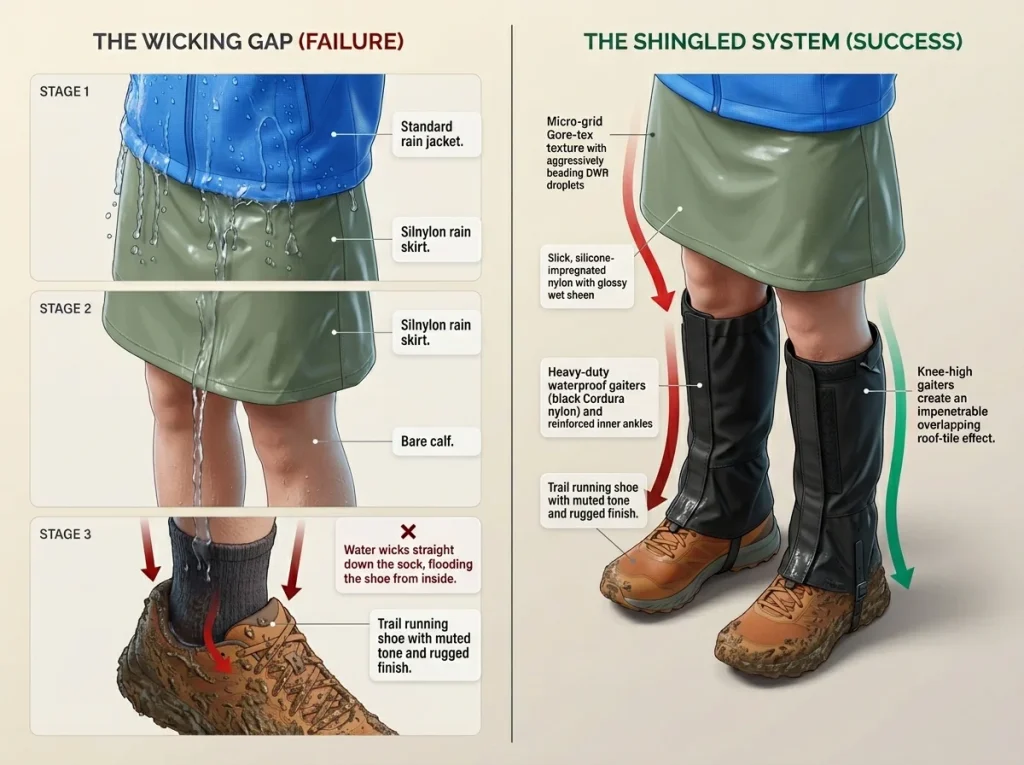
This immediately triggers the dreaded “Wicking Gap.” The heavy rain drops to your bare calves, wicks terrifyingly fast into your merino wool socks, and eventually floods your waterproof shoes completely from the top down.
To fix this cascading system failure, you must construct an overlapping, shingled system by systematizing your gaiters. Pair your skirt with heavy, knee-high waterproof gaiters or specific rain chaps. You instantly create a 360-degree water-shedding fortress that overlaps seamlessly like roof tiles.
The “Marilyn Moment”: Hazards in High-Wind Exposure
The rugged skirt fails spectacularly when the wind truly howls. The wide, open bottom hem becomes an unforgiving liability in a storm.
High winds catch the loose fabric and violently blow the icy rain straight up into your crotch. The trail community bitterly calls this the Marilyn Moment. It instantly replaces your hard-earned warm boundary layer with a ruthless convective burst of freezing cold air and water.
This strips away your heat in seconds. High winds aggressively turn the brilliant structural advantage of an airy skirt into a severe, life-threatening hypothermia hazard.
TheHikingTribe Safety Matrix: Decision by Environment
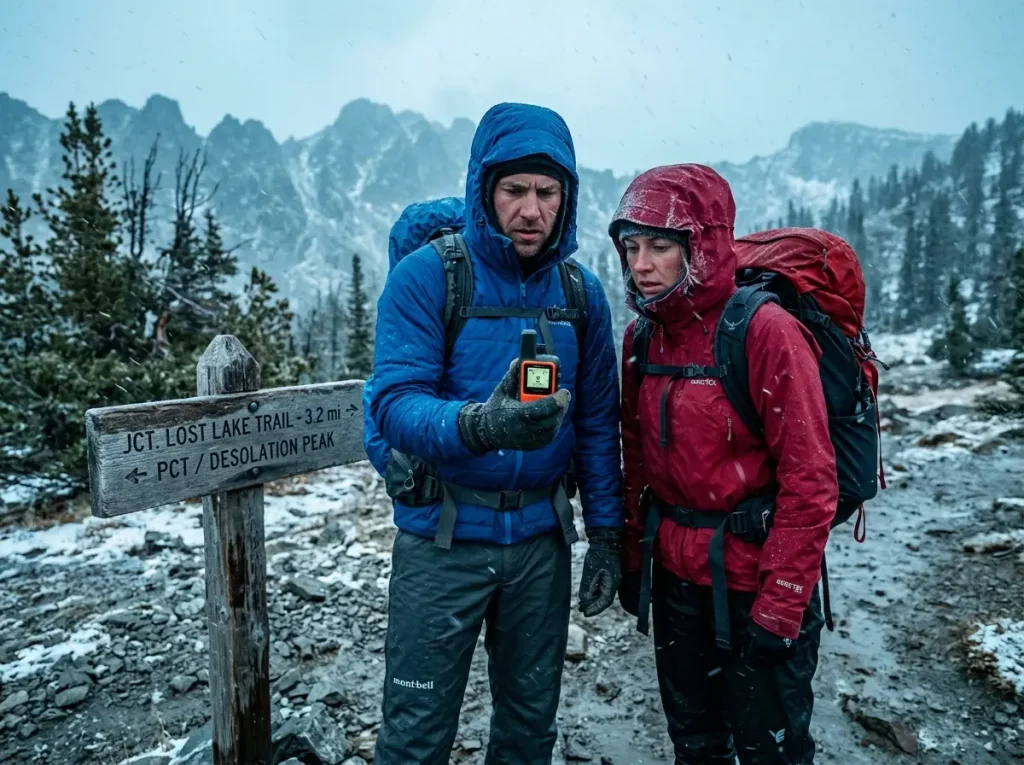
You cannot pack your essential survival gear based simply on the high temperature number listed on a weather app. You must rigorously build your system around wind chill, absolute terrain exposure, and the lethal risk of convective heat loss.
Below is our definitive, hyper-actionable framework for picking your leg protection. This safety matrix breaks down the precise, unforgiving atmospheric thresholds you face in the wild.
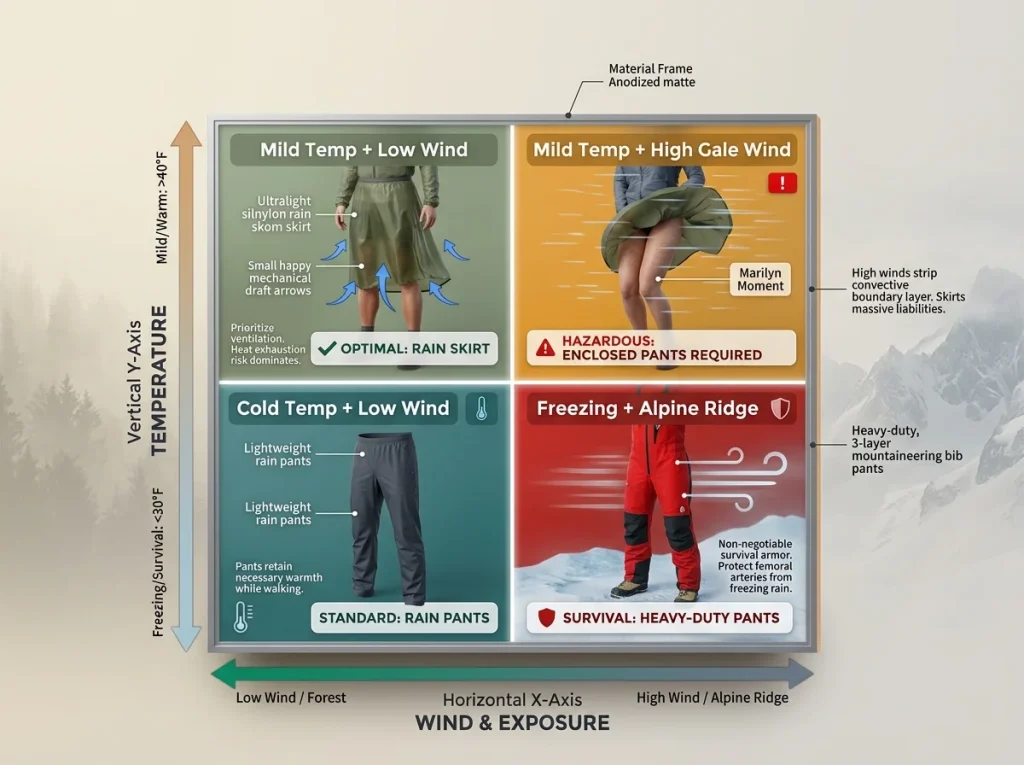
The Mild and Humid Threshold (>40°F, Low Wind)
In warm, sticky weather pulling across a heavy forest with minimal breeze, your primary enemy is your own cascading sweat. The serious risk of heat exhaustion completely dwarfs the risk of hypothermia at these temperatures.
You desperately need rapid heat exhaust. Mechanical drafting is the only logically valid answer here. Heavy, grinding exertion combined with high southern humidity fiercely guarantees the sauna effect in any enclosed pants.
A skirt excels dominantly in these specific conditions. It manages heat dissipation in humid environments better and faster than anything else in your kit cache.
The Alpine Boundary (Exposed Ridges, High Wind)
When you finally break out of the trees and cross above treeline, raw terrain exposure violently overtakes the localized ambient temperature. The wind rips across granite ridges with nothing but scrub to slow it down.
In this ruthless zone, absolute windproofing is far more crucial than staying dry from the falling rain drops. Proper site selection dictates that you drop your pack and change your gear before you leave the trees.
The skirt becomes a profound hazard in this zone. The up-drafting rain will chill you straight to the bone marrow. You must aggressively transition to full rain pants before you step out onto the exposed ridge. Never trust the pleasant summit forecast temps exclusively; the wind strips that warmth away instantly.
The Survival Zone (<30°F, Freezing Rain)
When the temperature sits near the freezing mark and cold rain mixes violently with sleet, your margin for error hits absolute zero. Severe frostbite on your extremities and rapid core temperature drops become imminent, fast-acting threats.
Insulated or heavy-duty three-layer pants switch immediately from optional comfort gear to non-negotiable survival equipment. You desperately need a fierce, impenetrable barrier around your legs to shield you from the assault.
The large femoral arteries run right through the surface of your thighs. If the biting wind and driving ice repeatedly hit those arteries, your internal temperature spirals down remarkably fast. Full enclosure rigidly prevents the fatal wet-out of your critical base layers.
Footwear Integration and Technical Scrambling
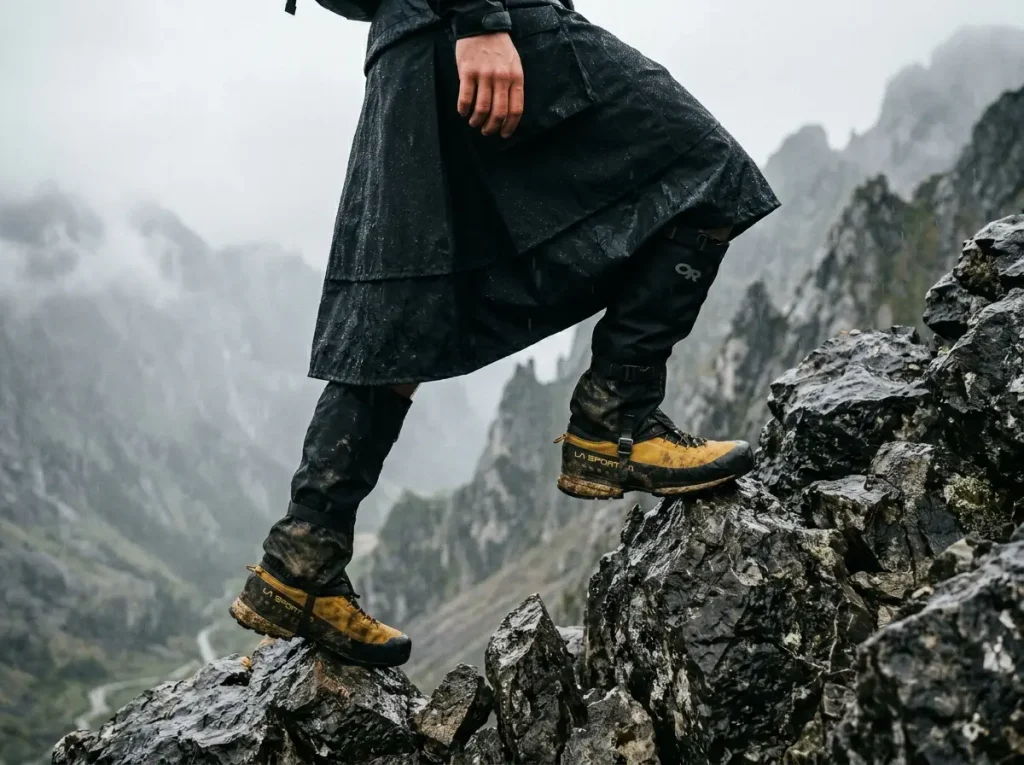
Your rain gear system does not exist in a vacuum. It interacts heavily and constantly with your boots, your gaiters, and the rough trail itself. The physical shape of your leg protection dictates exactly how fluidly you can move over jagged rocks and muddy ravines without destroying yourself.
The Wicking Gap Vulnerability
The conical geometry of a skirt naturally dumps all collected water straight down the fabric. Without a proper bridge layer shielding your shins, you face a compounding system failure that ruins your day.
The torrential rain pours cleanly off the skirt, drops directly to your bare calves, wicks fiercely into your wool socks, and floods your expensive Gore-Tex shoes quietly from the top down.
Waterproof knee-high gaiters or specific trail chaps are unequivocally mandatory when relying on a skirt. Without perfectly overlapping coverage creating a unified shield, the waterproof integrity of your whole lower system fails catastrophically in the mud.
Class 2-4 Scrambling Flexibility
When the brutal trail kicks straight up and demands you use your freezing hands to ascend steep ledges, the skirt suddenly fights your progress. The tight silnylon wrap limits your stride length aggressively on big step-ups.
Skirts stubbornly hoop around your knees or fatally catch on sharp branches. They actively create a perilous tripping hazard near sheer rock drops where you need perfect balance.
Enclosed pants win dominantly on this highly technical rock terrain. They feature articulated knees that let you high-step freely onto ledges. Their high-denier face fabric gives you raw physical armor against abrasive granite cuts.
Pro-Tip: If you are unexpectedly forced to scramble up a rock face in a skirt, unfasten the lower half instantly. This rapidly widens your stance to safely clear the rock hurdle, even though you temporarily sacrifice a little rain coverage. Falling on rock hurts much worse than getting wet.
Deployment Speed on the Fly
You feel the first fat drops of a passing squall smash into your arms. The dark wind picks up instantly. You have to pull your gear from your pack and deploy it incredibly fast before you soak through.
Skirts heavily dominate the quick-change maneuver. You can fully deploy one in mere seconds. You just loosely wrap it around your waist and snap it shut. You never once have to take off your mud-caked boots or awkwardly drop your heavy framed pack in a puddle. Rapid on/off speed is a massive advantage when the skies open up abruptly.
Rain pants viciously force a precarious one-legged balancing act. You either fight the tight zipper violently over your muddy heel pieces while hopping around, or you have to take your boots off entirely while standing barefoot in the freezing mud.
Evaluating Materials and Weight Efficiency
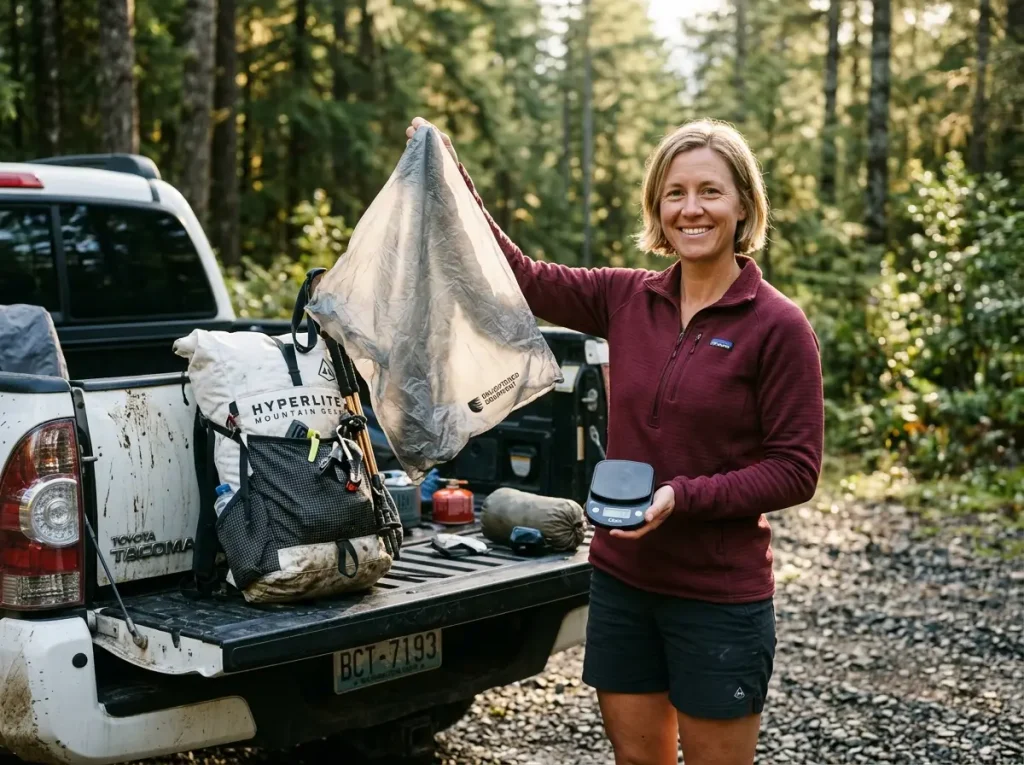
The boutique outdoor market offers confusing options made of cheap siliconized nylon, expensive DCF (Dyneema Composite Fabric), and highly advanced laminates. We look strictly past the logos at analyzing the lifetime value of silnylon versus DCF to find real durability.
The Silnylon vs. DCF Kilt Debate
A basic silnylon skirt from dedicated ultralight companies like Lightheart Gear is astonishingly cheap, reasonably tough, and one-hundred percent waterproof. The painful trade-off is absolutely zero baseline breathability and a frustrating tendency for the stretch fabric to cling closely to your wet skin when it saturates.
Premium Dyneema options from brands like Zpacks cost significantly more up front but offer undeniable, field-tested advantages for the serious thru-hiker. The futuristic fabric physically cannot absorb molecular moisture. It never truly wets out and becomes heavy. Because it absorbs nothing internally, a quick physical shake makes a Dyneema skirt instantly dry enough to stuff safely back into your pack.
Membrane Pants: Demystifying HH and MVTR
When evaluating full enclosure armor, you see two dominant figures thrown around the spec sheets.
The first is the hydrostatic head or HH rating. This precisely measures how much sheer water pressure the material can withstand before catastrophic leaking occurs. A 20,000mm rating is absolutely required to physically block driving, gale-force rain from punching through on exposed ridges.
The second metric attempts to measure the moisture vapor transmission rate (MVTR). Higher numbers technically mean better breathing on paper. But constantly remember that those clean lab tests happen in perfectly dry rooms. They rarely reflect the real-world humidity failure point you face miles away from the trailhead.
The Ultralight Weight-to-Safety Ratio
An ultralight Dyneema skirt weighs around a mere 1.8 ounces. High-end, protective membrane breathability pants weigh closer to 4.5 ounces on the scale.
Is fiercely saving less than three ounces of fabric in your pack truly worth risking extreme exposure to the elements?
You must frame that tiny weight savings directly against the physical consequences of a sudden weather shift knocking you over. If your planned route drags you over a high-wind alpine col where the weather turns vicious in minutes, tightly pack the pants.
Conclusion
The physics governing heat out in the backcountry are consistently unforgiving. Walking intensely in the rain means you deal with moisture inevitably, whether it falls violently from the sky or seeps quietly from your own pores. Staying perfectly, comfortably dry is impossible, but aggressively staying warm while managing the wet is a survivable, mandatory skill.
Your lightweight skirt easily dominates the sheer ventilation game, offering rapid deployment speed and unmatched comfort on sticky, humid forest ascents. Yet it violently transforms into a massive, chilling hazard the precise second you hit gale-force winds above the sheltering trees.
Your lower gear loadout must critically account for anticipated wind chill and absolute terrain exposure, not just the pleasant base temperature forecast pinned to the wooden trailhead board. Analyze your route carefully, study the high ridge lines, and strictly build your kit right around the absolute worst-case wind scenario.
FAQ
Are rain skirts better than rain pants?
Rain skirts are superior to rain pants only in mild, humid conditions where heavy, grinding exertion causes rapid sweat accumulation. They provide massive mechanical ventilation by utilizing the chimney effect to pull cool air up. They utterly fail in high winds or alpine ridges where rain violently blows upward and chilling convective heat loss spikes to hazardous levels.
Do rain skirts keep you actually dry?
Rain skirts effectively block direct, vertical precipitation from soaking your sensitive thighs, but they will not keep your lower legs remotely dry. Without waterproof, knee-high gaiters bridging the gap, water will inevitably runoff the skirt edge in a sheet, wick deep into your socks, and eventually flood your footwear completely.
How do you safely wear a rain kilt with other gear?
A rain kilt should be buckled securely around your natural waistline, sitting directly under the bottom hem of your primary rain jacket to effectively prevent the double-drip phenomenon. It must be paired heavily with tall waterproof gaiters to seal the critical wicking gap sitting between the bottom skirt hem and your hiking boots.
What exactly is the Double-Drip phenomenon?
The double-drip phenomenon occurs when a standard-length rain jacket aggressively funnels all collected upper-layer runoff directly onto your mid-thighs. If you aren’t wearing perfectly overlapping layers, this concentrated deluge easily overwhelms the taped seams of your pants or funnels rapidly into the open waist of a rain skirt.
Can you safely use a rain skirt in winter hiking conditions?
No, deploying a thin rain skirt in deep winter conditions casually introduces severe hypothermia and rapid frostbite risks. Sub-freezing temperatures demand the absolute, enclosed barrier of insulated rain pants to completely block convective wind bursts and fiercely protect your vulnerable femoral arteries.
Risk Disclaimer: Hiking, trekking, backpacking, and all related outdoor activities involve inherent
risks which may result in serious injury, illness, or death. The information provided on The Hiking Tribe is for
educational and informational purposes only. While we strive for accuracy, information on trails, gear, techniques,
and safety is not a substitute for your own best judgment and thorough preparation. Trail conditions, weather, and
other environmental factors change rapidly and may differ from what is described on this site. Always check with
official sources like park services for the most current alerts and conditions. Never undertake a hike beyond your
abilities and always be prepared for the unexpected. By using this website, you agree that you are solely
responsible for your own safety. Any reliance you place on our content is strictly at your own risk, and you assume
all liability for your actions and decisions in the outdoors. The Hiking Tribe and its authors will not be held
liable for any injury, damage, or loss sustained in connection with the use of the information herein.
Affiliate Disclosure: We are a participant in the Amazon Services LLC Associates Program, an
affiliate advertising program designed to provide a means for us to earn advertising fees by advertising and linking
to Amazon.com. As an Amazon Associate, we earn from qualifying purchases. We are also an official affiliate partner
of Black Diamond Equipment via the AvantLink network. If you click on a Black Diamond affiliate link and make a
purchase, we may earn a commission at no additional cost to you. We also participate in other affiliate programs and
may receive a commission on products purchased through our links. Additional terms are found in the terms of
service.