In this article
The surging pain radiating through the last two fingers of my right hand felt like a muscle cramp midway through the steep descent of Washington Pass. But weeks later, a CT scan revealed a jagged hairline split in the hamate bone—a hidden injury caused not by a fall, but by thousands of repetitive downward strikes on my pole grips. Trekking poles have evolved from optional aids to a mandatory backcountry uniform for many, but their widespread adoption has entirely outpaced our understanding of their limitations.
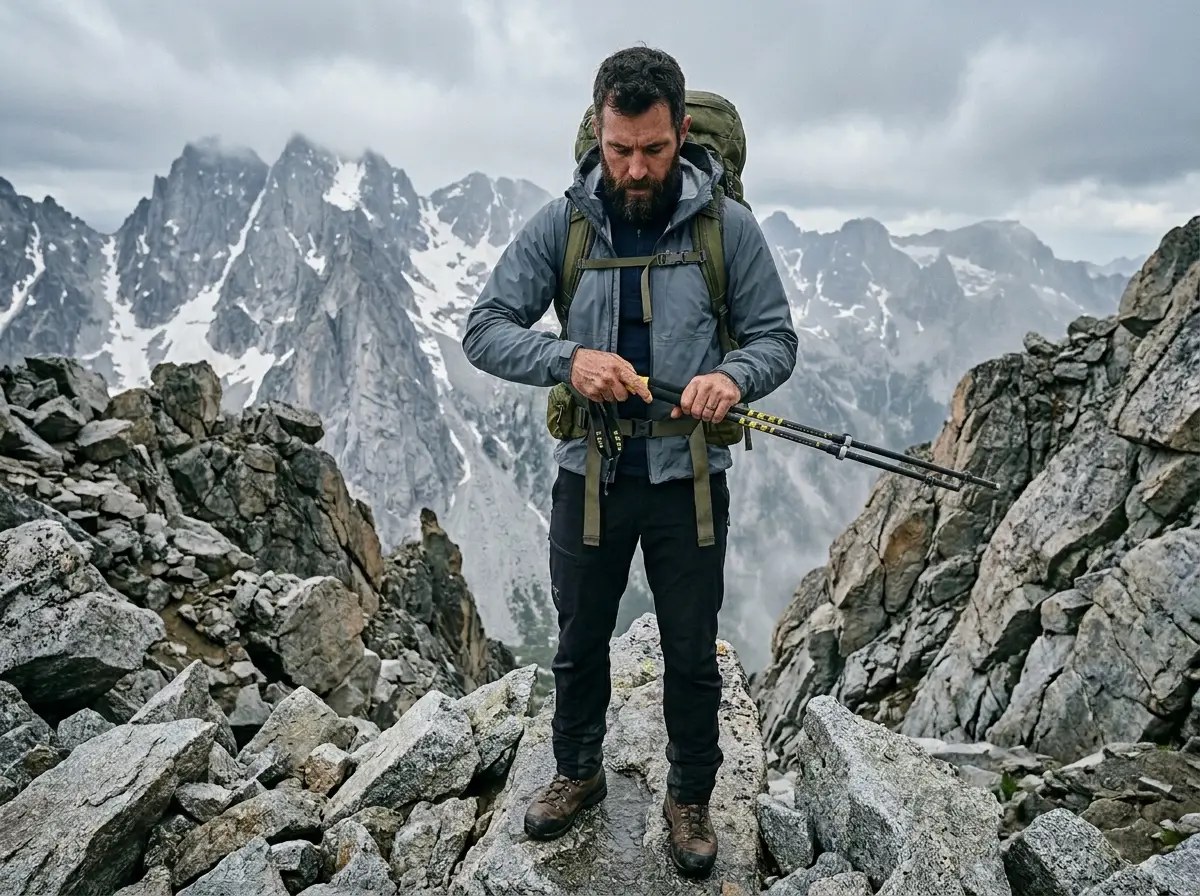
You see it on every trailhead now: someone clicking their telescoping shafts into place before their boots even hit the dirt, preparing for a long day of walking on four limbs. There is a deep comfort in that four-point rhythm. It saves your joint cartilage and sets a relentless uphill cadence. But when you rely entirely on an aluminum stick to catch your falls, you stop trusting your own two feet.
When the environment reaches a threshold of complexity—or when your reliance degrades your innate survival systems—poles transition from tactical tools into massive liabilities. The physics of failure are unforgiving out here. This guide examines the exact moments, specific terrain traps, and medical realities where stowing your trekking poles is the only safe decision you can make for true risk mitigation.
⚡ Quick Answer: You should collapse and stow trekking poles entirely when entering YDS Class 3 scrambling terrain, crossing fragile desert soil crusts, or navigating steep snow that requires an ice axe. While poles brilliantly reduce joint load on groomed trails, prolonged use degrades your natural balance reflexes, and poor wrist strap discipline on steep rocky descents frequently causes severe shoulder dislocations and hidden hand fractures.
| Biomechanical Variable Comparison | ||
|---|---|---|
| Biomechanical Variable | Bipedal Gait (No Poles) | Quadrupedal Gait (With Poles) |
| Core Activation | Maximum (Required for dynamic stability) | Reduced (Stability burden shared with arms) |
| Mechanoreceptor Feedback | High (Continuous from feet/ankles) | Partially Offloaded (Signal distributed to poles) |
| Joint Loading | 100% of physical and pack weight | Reduced by 15-25% |
The Biology of Balance: Knowing When Not to Use Trekking Poles on Trail

The stealthiest failure of your equipment doesn’t happen when a shaft snaps or a locking mechanism slips. It happens quietly inside your central nervous system over hundreds of miles.
Your physical frame relies heavily on proprioception—the subconscious perception of your position in space, based on sensory feedback from nerves in your muscles, tendons, and joints. This system acts as your primary fail-safe. It allows you to make split-second micro-adjustments to your core and legs without ever looking at your feet. But when you start relying on an external aid for your balance every single time you hit the trail, you actively initiate proprioception atrophy.
The Problem of Neuro-Mechanical Dependency
Chronic use of these tools effectively shifts your human gait into a four-legged model. Yes, walking on four limbs reduces the brutal compressive force of gravity on your knees. But it fundamentally alters how your brain maps your limbs in physical space.
As you offload your balancing workload to the hands and arms, the nerves in your leg ligaments go underutilized. Clinicians call this “proprioceptive drift.” The signals from your legs get weaker because your brain expects the poles to handle the fine-tuning of uneven ground. You lose your vital joint position sense. Medical studies tracking the encoding of movement primitives through distributed proprioception show exactly how relying on an external crutch dulls your system’s reflexive responsiveness.
If you slip on a wet root and your pole tip skitters out from under you, your core stability is totally unprepared to catch the shifting weight of your pack. A neuromuscular system that has been sleeping for the last five miles simply cannot fire fast enough to stop the fall. If you want to wake those systems back up, check out our guide on rewiring trail balance and proprioception for specific training routines.
Bipedal vs Quadrupedal Gait Mechanics
We know that chronic four-point contact pulls the balancing workload out of the lower chain. Your core activation drops artificially because your arms are fighting the stabilization battle.
This creates an enforced mechanical rhythm that restricts your natural footwork. You fall into a trance-like walking pace. This rigid rhythm is exactly what you want when crushing twenty flat miles on the Pacific Crest Trail for maximum uphill efficiency, but it becomes a massive hazard the second the trail abruptly transitions into a chaotic boulder field. Prolonged use acts as a sensory buffer against complex terrain. It literally numbs your feet to the reality of the rock beneath them. The first time you hit loose scree without poles, your ankles will feel terrifyingly weak—that’s the reliance talking.
Why Peak Baggers Need Pole-Free Training
Technical off-trail environments demand pristine, innate equilibrium. Your legs and ankles must provide the primary source of postural control when you transition onto steep, loose rock.
Younger hikers should view their poles as a long-term investment in knee health. Reducing joint impact early in your career pays off decades later when you want to keep climbing. But you must actively train without them to retain your reflexes. Keeping your legs sharp ensures your balance is rock-solid when your hands are busy gripping holds. It’s a critical piece of your skill progression. If you can’t walk across a simple creek crossing on wet stones without putting your poles down, your baseline balance is gone.
Pro-Tip: Schedule deliberate “pole-free Sundays” on your local conditioning hikes. Forcing your legs and core to handle all the stabilization work on familiar ground physically boots your proprioceptive systems right back online before you tackle high-consequence technical trips.
The Covert Injury: Repetitive Palmar Pressure and Hamate Fractures
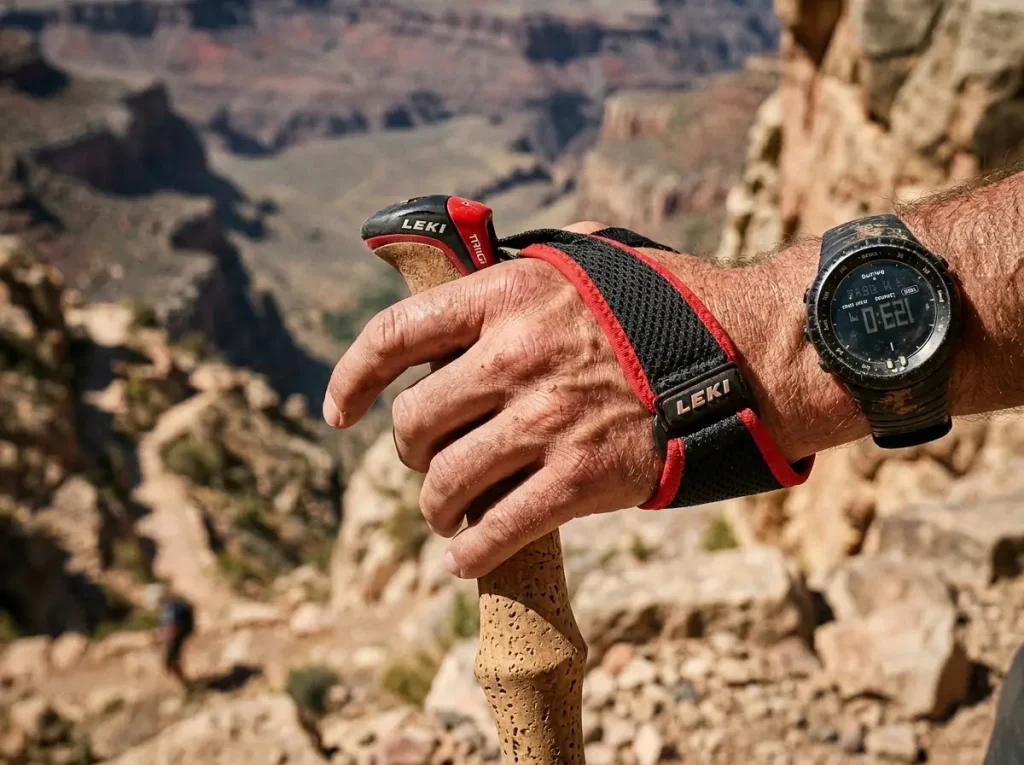
Beyond the slow loss of your balance, there is a specific, physical injury that sneaks up on heavy pole users. It isn’t caused by a catastrophic fall. It comes from thousands of repetitive downward strikes, generating focused pressure straight into your palm. That pressure can definitively cause serious localized injury over time.
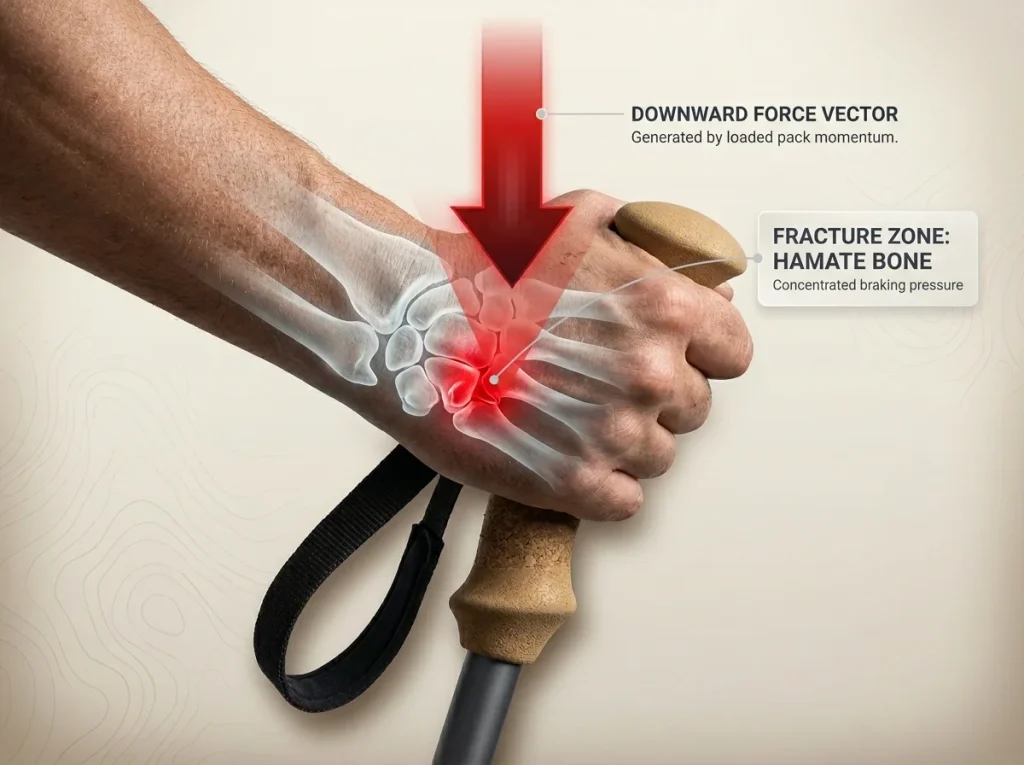
The hamate bone sits tucked away on the pinky side of your wrist. It features a prominent little hook that serves as an attachment point for ligaments and several flexor tendons. Medical journals typically associate hamate fractures with golfers slamming clubs into the dirt or baseball players taking awkward swings. But a hiker bombing down a 4,000-foot descent with a forty-pound pack experiences the exact same compressive force vector.
Anatomy of the Hypothenar Eminence
The fleshy pad at the base of your pinky finger is called the hypothenar eminence. It directly shields the hook of the hamate. When you grip a rigid handle and push down hard to brake your momentum, you drive an incredible amount of stress straight through that protective tissue and into the bone.
Older L-shaped grips or T-shaped grips typically lack the refined ergonomics to disperse this weight, concentrating this force specifically on the ulnar side. The constant vibration transmitted up the aluminum shafts amplifies the microscopic bone trauma with every single step. Orthopedic data confirms that the hook of the hamate serves as an attachment point for flexor tendons, making it a terrible place to focus repetitive shockwaves.
The Physics of Downward Braking Force
How much force hits your hand depends entirely on the size and shape of your grip. When you engage in heavy downhill braking under a loaded pack, you shift an excessive percentage of your own mass forward right into the stick axis.
If you hit a rigid section of rock, an aluminum pole instantly sends shockwaves backward into your palm. To protect yourself, you must utilize ergonomic, rounded grip tops for palm-pushing down steep drops, rather than wrapping your fingers tightly around the shaft like a baseball bat. Getting your hand placement right and employing proper trekking pole exercises to support joint health teaches you how to engage your triceps rather than burying your skeleton into the handles.
Misdiagnosis Strategies: Recognizing the Stealth Fracture
These hamate fractures are notorious for masquerading as a general, minor wrist sprain or a harmless muscle cramp. The localized pain frequently fools both the hiker and the initial physician screening. You might finish your trip thinking you just held the grips too tight, only to find you can’t turn a doorknob the next morning.
You’ll notice localized point tenderness directly on the fleshy pad of your palm, often accompanied by tingling weakness radiating down your pinky finger. Standard X-rays frequently fail to detect the hairline fracture because of the complex overlapping bones in the wrist. Final confirmation almost always requires a CT scan or an MRI. Ignoring the pain is a gamble you will lose. The jagged edges of the broken hook can permanently scrape and rupture the flexor tendons of your fingers, resulting in a mandatory surgical procedure and a miserable forty-five-day recovery timeline before you see dirt again.
Pro-Tip: Never employ a tight grip on your pole handles during descents. Let the straps do the heavy lifting, or use mesh glove attachments to actively distribute the load across the structural meat of your hand rather than your carpal bones.
The Fall Leverage Problem: Why Wrist Straps Exacerbate Backcountry Injuries
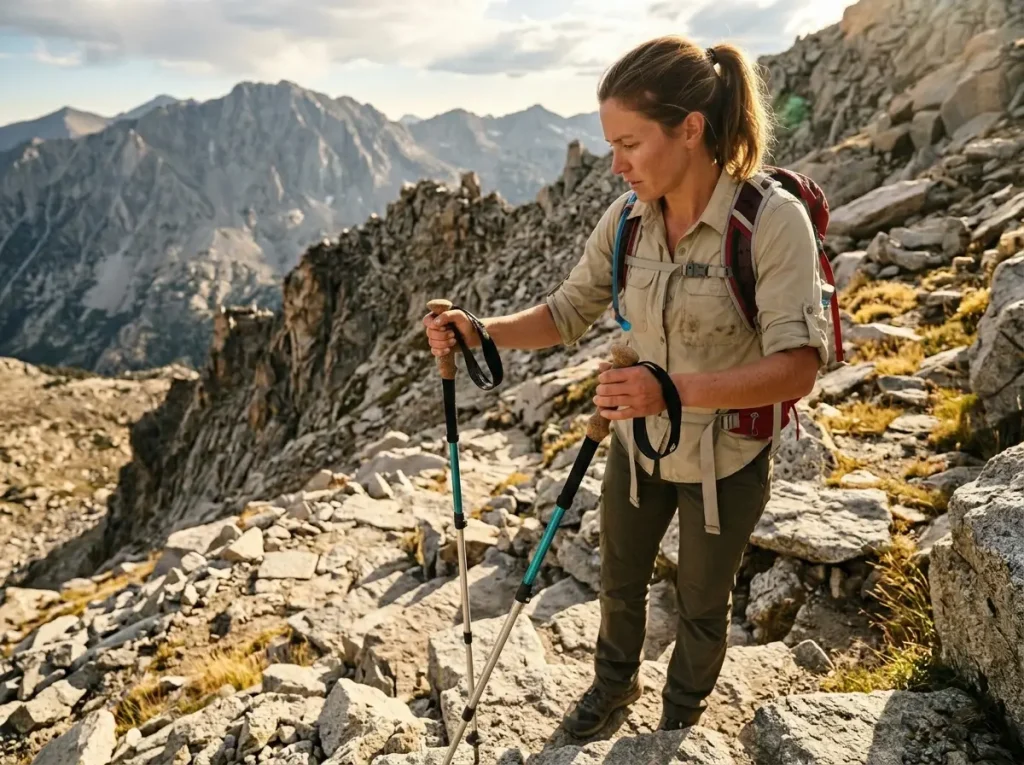
Wrist strap safety is widely misunderstood in the outdoor community. Straps are brilliant for uphill efficiency. Inserting your hands upward through the loops allows you to push down on the strap itself, transferring load without exhausting your forearm muscles. But leaving your hands securely bound in those straps during a steep descent turns a simple slip into a medical evacuation.
The Mechanics of a Leveraged Fall
If you leave your hands locked in and take a dive, that 130cm rigid shaft instantly becomes a fixed crowbar against you as you fall. If the pole tip catches on a root, sinks into mud, or gets wedged in rock cracks, it cannot release.
Your forward momentum, combined with gravity, generates a massive force multiplier. This upward rotational force is transmitted continuously through the pole, right past your trapped hand, and straight into your wrist and shoulder socket. Clinical studies detailing posttraumatic wrist injuries from leveraged impacts show that strap binding forces the fragile forearm bones to incorrectly absorb the entire shock of the event. Because you cannot throw the tool away, your system’s natural defensive reflexes are paralyzed. You cannot splay your palms for a sliding catch, and you cannot tuck and roll. You just take the impact straight into the joint.
Shoulder Dislocation Pathways
The physics here are brutal. That intense upward force drives the head of the upper arm bone right out of the shoulder joint. As you fall forward and the snagged tip refuses to move, your trailing arm gets yanked violently backward at an entirely unnatural angle.
The lever arm of the pole effectively multiplies the sheer trauma of your own weight. Instead of a scraped knee and a torn pant leg, you end up with a fully dislocated shoulder miles from the nearest trailhead. Mountain rescue teams consistently report debilitating upper-limb trauma resulting precisely from this mechanical disadvantage. The hiker was strapped in, slipped on wet scree, and the pole broke them before it broke itself.
Safety Protocols for Strategic Release
The solution is non-negotiable. You must actively withdraw your hands from all straps the moment you step onto a steep, loose descent or any Yosemite Decimal System Class 2 talus scramble. Keeping your straps downhill is a recipe for disaster.
Learning proper trekking pole wrist strap technique means knowing exactly when to use that tension efficiently on flat ground, and knowing when to ditch it completely. Accepting that you might accidentally drop and scratch a $150 carbon pole on the rocks is vastly preferable to accepting a permanent rotator cuff tear.
Manufacturers have tried to engineer around this. The breakaway myth suggests that you can just pull hard and snap the strap under sudden load. Quick-release bindings do lower the risk by popping out under extreme pressure, but they cannot completely bypass the sudden angular force events that happen in a fraction of a second. Simply palming the grips with your hands totally free of the loops is the only guaranteed way to ditch the gear safely when gravity takes over.
Structural Material Limits: The Physics of Hardware Failure
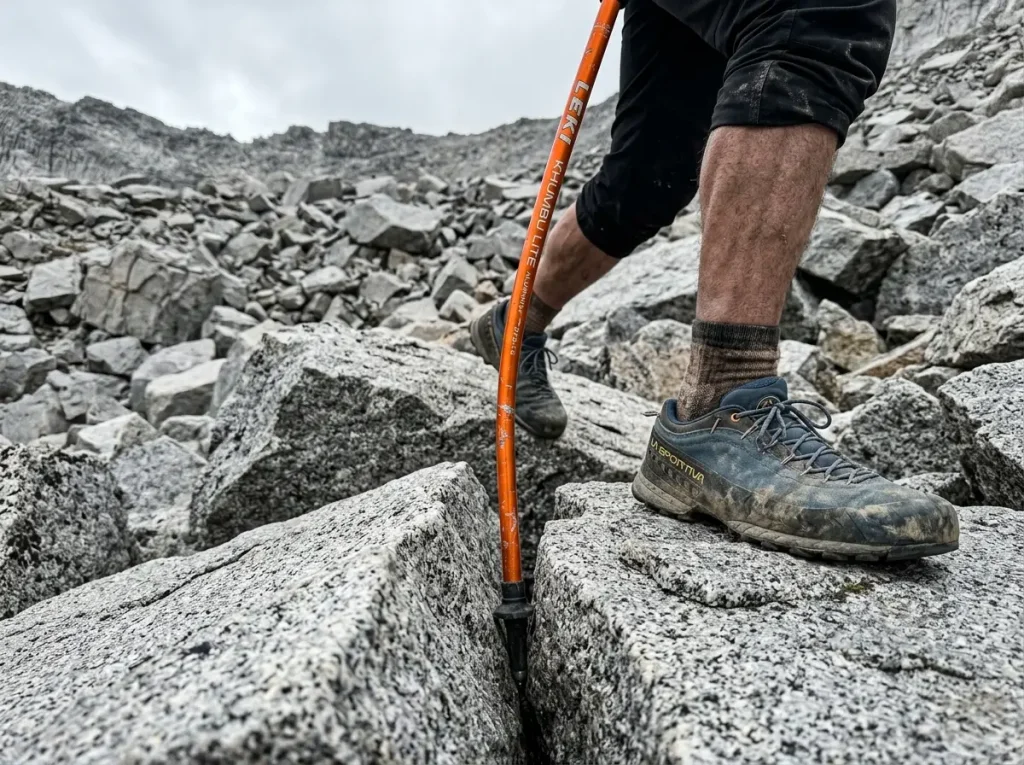
When evaluating the endless debate between carbon fiber and 7075 aluminum, you have to look past the scale to answer if they are really worth the weight. Yes, carbon saves ounces. But the choice is not just about carrying less; it is a choice between two completely different physical mechanical failure points when things go wrong in the backcountry.
Carbon Fiber and Brittle Fracture Realities
Carbon fiber boasts an insanely high stiffness. It manages loads pushing straight down flawlessly with minimal weight. You can lean your entire weight straight down onto a carbon shaft and it will feel like a solid steel pillar.
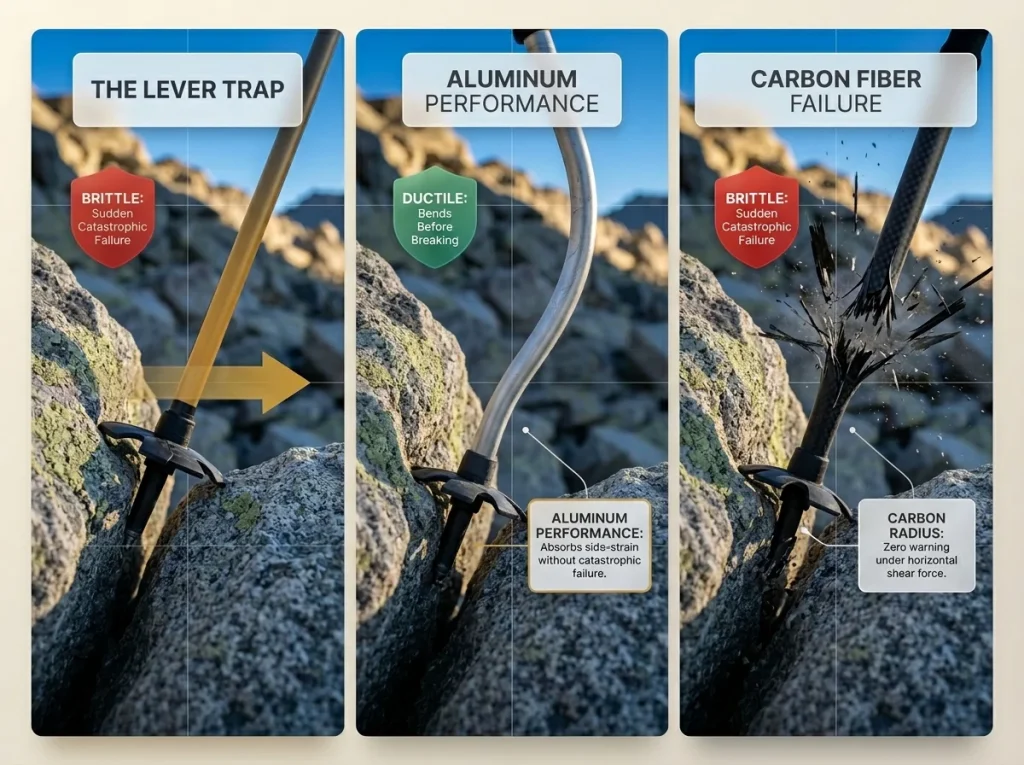
But side-bending or lateral shear force is carbon’s greatest structural weakness. Carbon is incredibly stiff, but it is brittle. When you inevitably get your tip wedged deeply between two boulders while hiking at a fast clip, the forward momentum of your walking bends the shaft sideways. A carbon pole will reach its breaking limit and shatter catastrophically without a single warning creak. It breaks exactly like a dry pane of glass. That abrupt, violent failure offers you zero milliseconds to correct your posture, practically guaranteeing a face-plant. It is ideal for groomed trails, but deeply risky off-trail.
Aluminum and Ductile Forgiveness
Aircraft-grade 7075 aluminum operates on a different physical principle altogether. Aluminum is ductile. It absorbs sideways strain by bowing and stretching rather than snapping into fragments.
This stretching provides a gradual, forgiving failure state. If you wedge an aluminum pole and keep walking, you’ll physically feel the shaft yield and bend. This tactile feedback warns you to stop immediately. Even better, a heavily curved aluminum shaft can often be carefully bent back over your knee just enough to limp back to the car or pitch your tarp for the night, aiding in essential gear preservation. Understanding how folding and telescoping poles fail is critical for selecting the right tool for deep wilderness expeditions. Aluminum requires thicker sidewalls and weighs more, but it bends before it breaks. Carbon has no such grace period.
The Talus Field Lever Arm Effect
The moment your tip drops into a crack in a scree or talus field, you have initiated a severe mechanical hazard. The wedged tip acts as the pivot point. Your forward momentum converts your weight into massive sideways force against the shaft, easily exceeding its shear strength.
The mechanical friction of that lever arm multiplies destruction, resulting in complete lever arm breakage. This is exactly why you must practice diligent basket removal in rocky environments. Those wide snow or mud baskets act exactly like concrete anchors when they get trapped beneath heavy, shifting stones. The resulting leverage will cleanly snap any carbon pole like a twig and severely taco any aluminum one, whether it’s a Black Diamond or a budget brand. Take the baskets off the moment you hit the rocky alpine zone.
The Stowage Matrix: Technical Terrain Management and Scrambling
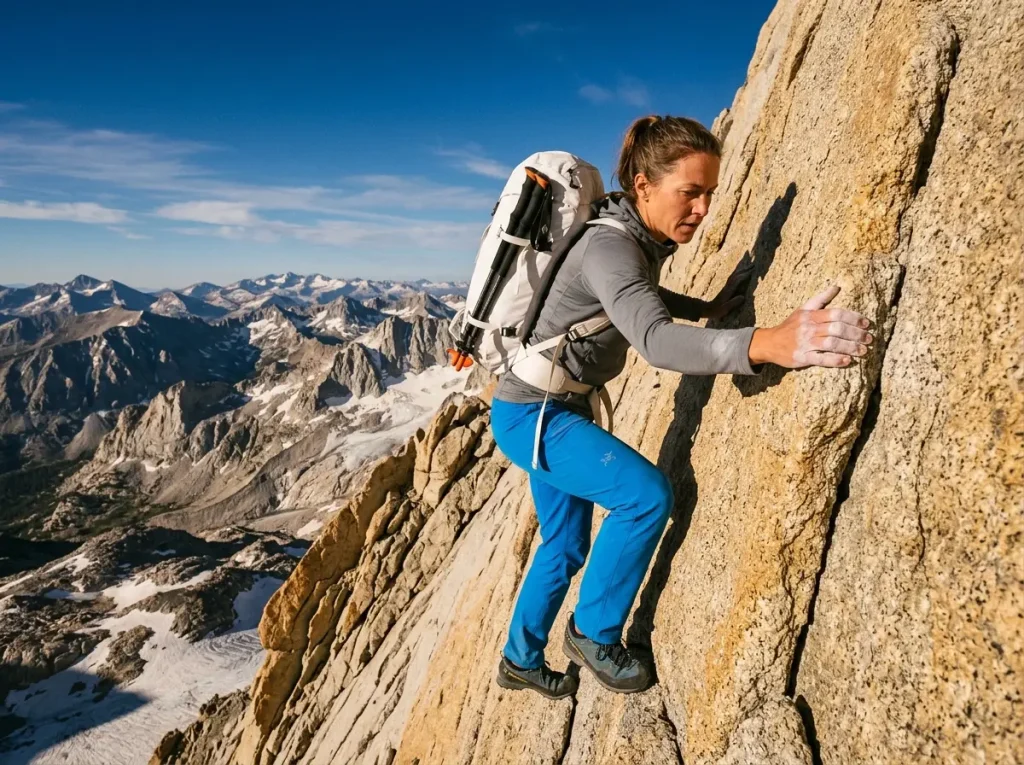
There is a distinct line where holding anything in your hands evolves from a hiking aid into an active threat to your safety. The defining characteristic of a true mountain expert is consulting their internal stowage matrix: knowing the precise moment to stop relying on accessories and start relying on their fingers and toes.
YDS Class 3 and the Three-Points-of-Contact Rule
Navigating anything graded as scrambling class 2-4 requires strict adherence to the 3-point scrambling rule. At any given moment, either two hands and one foot, or two feet and one hand must be completely secure on the rock face before you initiate your next move.
Carrying poles obviously occupies your hands, denying you the functional use of palm friction on the granite. Hikers who stubbornly refuse to put their poles away end up trying to climb while holding the shafts horizontally in their fists. This invites catastrophic snags. Trying to rely on a pole tip on a near-vertical surface forces you into an unstable upright posture, heavily shifting your center of gravity outward away from the rock. When learning about transitioning from baseline hiking to peak bagging safely, respecting this vertical boundary for technical optimization is the very first lesson taught.
Near-Vertical Terrain and Safe Stowage Options
Some folks attempt a lazy compromise by just dangling the poles loosely from their wrists via the straps while they scramble. Never do this. Dangling shafts create lethal trip hazards that catch on roots, lock behind boulders, and violently tangle in your own knees during dynamic step-ups. It completely compromises your safety when a hand-line necessity arises.
Entering Class 3 territory demands that your gear be physically collapsed and safely strapped to your back. The exterior geometry of your backpack must remain fully streamlined. Loose, protruding handles act like meat hooks when you squeeze through tight rock chimneys or push through dense alpine scrub.
Pro-Tip: Always orient your stowed telescoping pole tips facing straight down in your pack pouches, and cap them with rubber heads. Stowing them tips-up creates a serious puncture hazard that can easily impale your own arm if you slip backward, or gouge the face of a climber following closely beneath you on a steep pitch.
The Steep Snow and Ice Axe Conflict
High-angle snow completely nullifies the utility of a trekking pole. In these high-alpine environments, you require the immediate capability to execute a self-arrest sequence if you lose your footing.
Mountaineering organizations explicitly list trekking poles as ineffective tools for self-belay and self-arrest on steep slopes. A common, dangerous mistake is trying to hold an ice axe in the uphill hand and a single pole in the downhill hand. A proper self-arrest requires gripping the adze and the lower shaft of an axe with two rapid, dedicated hands driving your weight directly into the snow. Trying to hold or ditch a pole delays this critical reaction timing. If your wrist is stuck in a strap, that pole will twist violently and tangle your arms during an uncontrollable icy slide, guaranteeing you won’t get your pick buried in time to stop.
Ethical Failures: Surface Degradation and the LNT Perspective
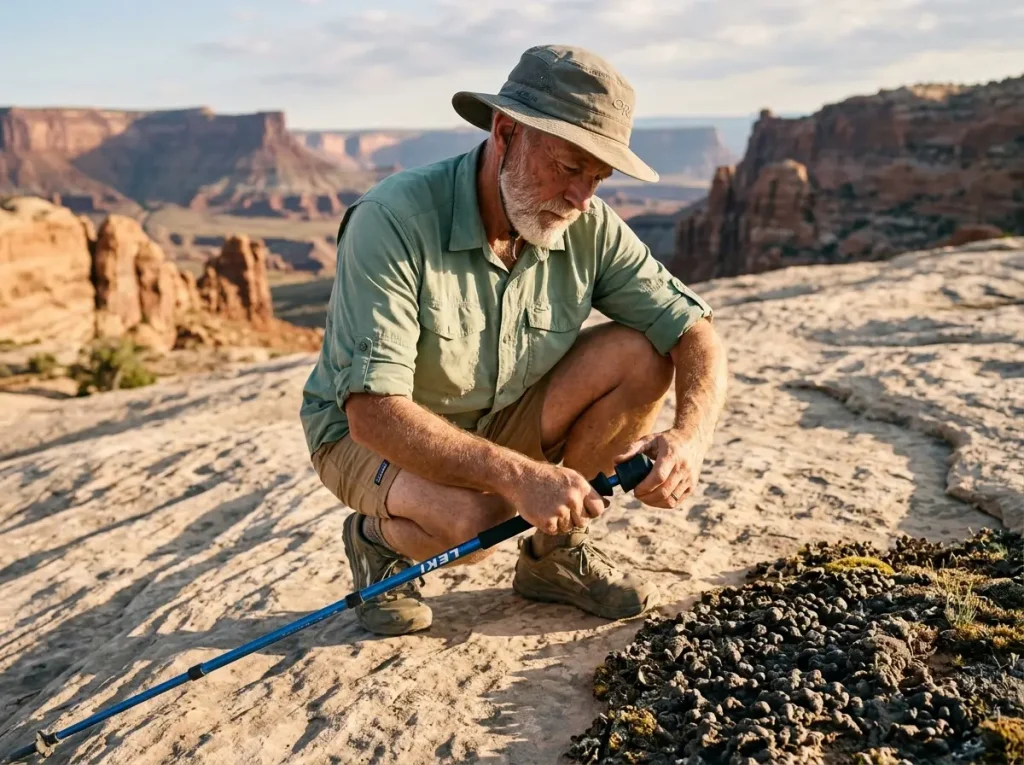
We usually care about gear breaking because it ruins our trip. But the real problem is what that metal tip does to the trail. True wilderness stewardship demands that we evaluate how our gear impacts the environment. Taking sharp metal into fragile ecosystems comes with a very high cost of entry and a massive environmental impact.
Permanent Scarring on Alpine Rock
Most modern poles use bare carbide tips. Carbide metal is much harder than natural rock, so it grinds away softer sandstones and granites. You are essentially hiking with two micro-pickaxes.
On heavily trafficked alpine routes, the repeated strikes leave the trail permanently marked with thousands of white, chipped rock scars. This concentrated tip scarring strips away the aesthetic value of pristine alpine rock slabs and actively damages historical and cultural geological sites. Visual scarring directly degrades the wilderness experience for every single person who follows your route and actively serves to damage trails.
The Devastation of Biological Soil Crusts
The ethical stakes rise dramatically in arid environments. In deserts like the Colorado Plateau, the loose sand is knit together by vital, living cryptobiotic soil crusts. These dark, knobby communities of cyanobacteria, lichens, and moss act as the living glue that prevents massive wind dispersal and severe terrain erosion.
These crusts are astonishingly fragile. They take fifty years to develop any meaningful structure, but a single blunt strike from a metal tip shatters their nitrogen-fixing network instantly. Off-trail hiking with deployed poles creates an invisible pathway of ecological damage. Smashing these soil biomes radically accelerates severe water erosion, destroying the trail’s foundation. The National Park Service explicitly identifies the maintenance of biological soil crusts and erosion control as a critical priority.
Mitigating Impact With Rubber Tips
You must read the terrain and adapt your equipment. Snapping on rubber tips provides significantly better grip friction on smooth slickrock slabs where bare carbide would otherwise skate out dangerously.
Rubber caps completely nullify the impact of the metal on sensitive archaeological zones and fragile rock structures. Transitioning completely off-trail in the desert mandates that you stow your gear entirely, or religiously utilize rubber dampeners. For high-alpine explorers, reviewing our guide on identifying and avoiding cryptobiotic soil will keep you from blindly shredding ancient ecosystems while staring down at your GPS.
Conclusion
Relying on any tool makes your natural balance lazy over time. While an external crutch saves your knees on the flats, it requires deliberate, pole-free mileage to keep your proprioception sharp for the technical cruxes ahead. Wrist straps and rigid carbon shafts become extreme liabilities the moment you step onto steep, rocky descents, converting falls into broken shafts and dislocated shoulders.
Finally, anytime you find yourself scrambling Class 3 rock or crossing fragile high-desert soil crusts, the situation demands that your tools be securely collapsed and stowed away in your pack. Evaluate your upcoming weekend route honestly. Treat your poles as a situational, tactical tool to be deployed when gravity is working against your knees, rather than a permanent four-legged foundation. Learn the freedom and the essential safety of trusting your own two feet on the rock.
FAQ
Are trekking poles worth the extra weight?
For groomed trails and Class 1 to 2 terrain, they are incredibly efficient at preserving knee cartilage and setting a fast walking cadence. However, their physical weight and clumsiness become an active safety liability when transitioning into Class 3 scrambling or dense alpine bushwhacking where your hands are required for climbing.
Can trekking poles cause wrist injuries?
Yes. Repetitive downwards braking pressure on rigid grips can cause occult, hairline fractures of the hamate bone over long mileage. A leveraged fall while locked securely into a wrist strap can also easily result in severe shoulder dislocations and trapped-wrist trauma.
Should you use the wrist straps on steep or downhill terrain?
You should completely pull your hands out of the straps during steep, technical, or high-consequence descents. In the event of a slip, you must be able to jettison the shafts instantly to effectively catch yourself, slide on your palms, or safely roll out of the impact zone.
Do trekking poles cause damage to the environment?
Raw metal carbide tips cause permanent visual scarring on alpine rock slabs and can completely devastate fragile, living cryptobiotic soils in arid deserts. Always install rubber friction tips on smooth rock and securely stow your poles when moving off-trail in sensitive, high-risk ecosystems.
Risk Disclaimer: Hiking, trekking, backpacking, and all related outdoor activities involve inherent
risks which may result in serious injury, illness, or death. The information provided on The Hiking Tribe is for
educational and informational purposes only. While we strive for accuracy, information on trails, gear, techniques,
and safety is not a substitute for your own best judgment and thorough preparation. Trail conditions, weather, and
other environmental factors change rapidly and may differ from what is described on this site. Always check with
official sources like park services for the most current alerts and conditions. Never undertake a hike beyond your
abilities and always be prepared for the unexpected. By using this website, you agree that you are solely
responsible for your own safety. Any reliance you place on our content is strictly at your own risk, and you assume
all liability for your actions and decisions in the outdoors. The Hiking Tribe and its authors will not be held
liable for any injury, damage, or loss sustained in connection with the use of the information herein.
Affiliate Disclosure: We are a participant in the Amazon Services LLC Associates Program, an
affiliate advertising program designed to provide a means for us to earn advertising fees by advertising and linking
to Amazon.com. As an Amazon Associate, we earn from qualifying purchases. We are also an official affiliate partner
of Black Diamond Equipment via the AvantLink network. If you click on a Black Diamond affiliate link and make a
purchase, we may earn a commission at no additional cost to you. We also participate in other affiliate programs and
may receive a commission on products purchased through our links. Additional terms are found in the terms of
service.