In this article
The puddle was deeper than it looked, and the icy water immediately shot over the laces of my left boot. Six miles from the trailhead with the temperature dropping, my “$250 waterproof” footwear was now a heavy, soggy anchor dragging on my foot. After testing gear across thousands of trail miles, I can tell you this is when most hikers realize a painful truth: a waterproof membrane means nothing if the outer material soaks through. Protecting your boots is about manipulating physics to keep your foot from freezing.
Here is exactly how to stop your boots from failing, when to use heavy wax, and why modern sprays are mandatory for technical gear.
⚡ Quick Answer: You should only use heavy wax on traditional full-grain leather boots to build a rigid, impenetrable barrier. For modern boots made with suede, nubuck, or synthetic mesh over a breathable membrane, always use water-based spray-on treatments. Wax destroys the breathability of technical boots and weakens the glue holding the soles together. Always scrub your boots clean before applying any waterproofing.
The Physics of Porosity and Wetting Out
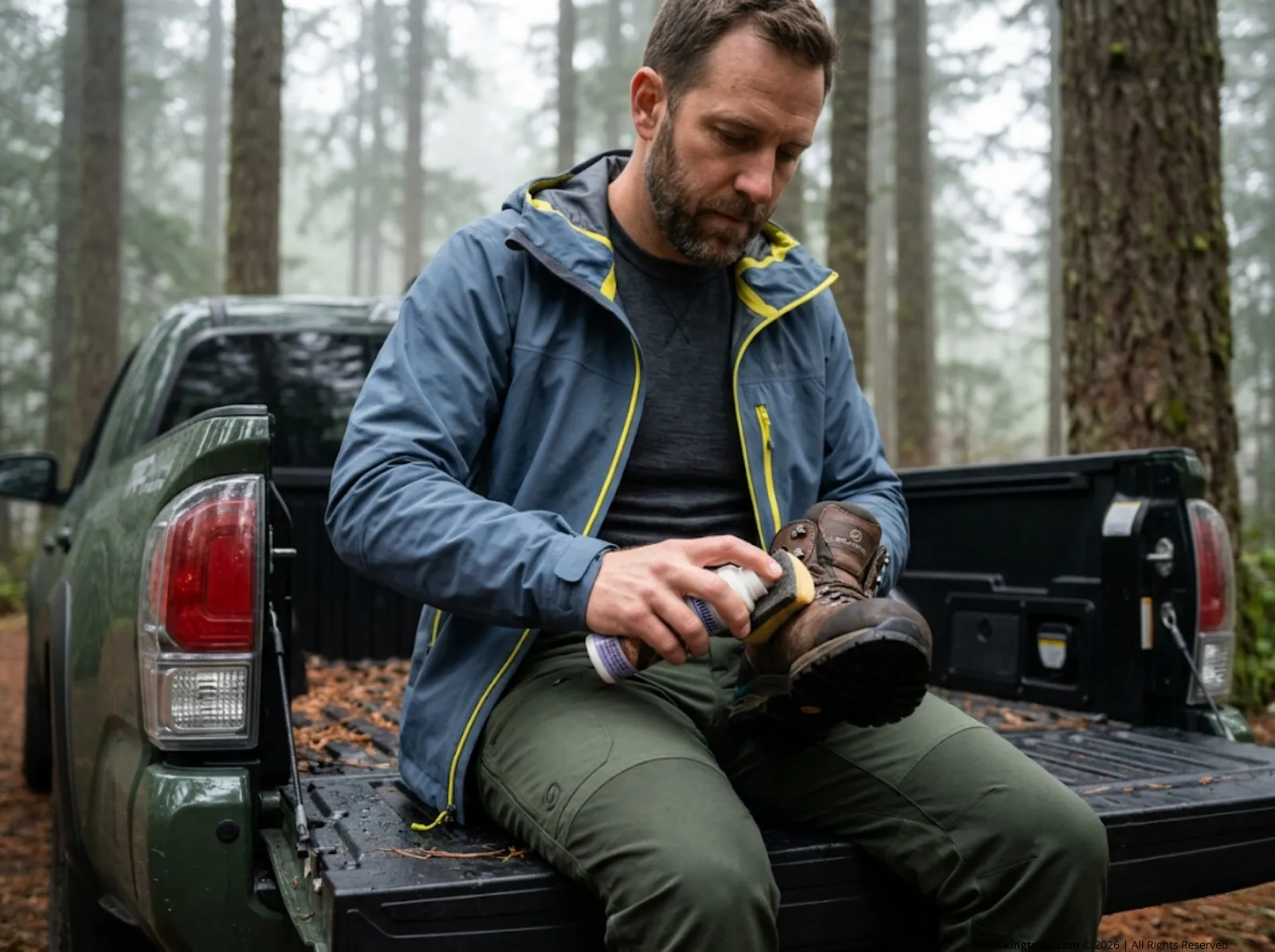
The main reason you waterproof a boot is to alter the surface energy of the outer material so it stops sucking in moisture. Leather and nylon naturally pull liquid inside through capillary action. You want to increase surface tension so water beads up and rolls off instead of penetrating.
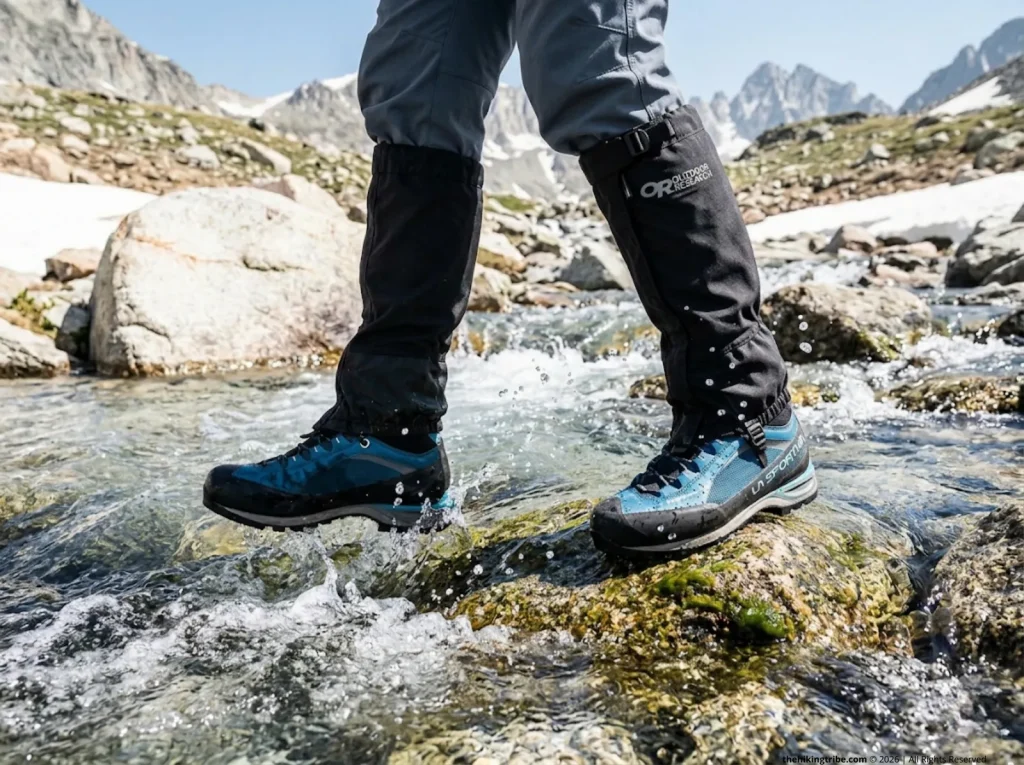
Many hikers mistakenly believe that if a boot has a Gore-Tex or eVent tag, it doesn’t need treatment. This is the Gore-Tex Paradox. Even if the internal membrane stops water from touching your socks, a soaked outer fabric creates a wet wall that traps your sweat inside. A water droplet is massive compared to a membrane pore, but water vapor is tiny. Once the outer layer suffers from wetting out, your sweat condenses back into liquid because the vapor can no longer push through the waterlogged shell.
If you want a closer look at how fabrics handle external moisture pressure, understanding hydrostatic head ratings is a good place to start. A damp foot loses heat about 38 times faster than a dry one, which is why actual military evaluations on cold and wet scenarios treat wet boots as acute hypothermia hazards.
New footwear rarely requires treatment straight out of the box because the factory Durable Water Repellent (DWR) provides excellent water repellency. But visual inspection isn’t enough to know when it dies. You have to use the Drop Test. Drip clean water onto the toe box. If you see a water beading effect, you are good. If the water instantly flattens, absorbs, and forms a dark patch, the factory coating has failed and you need to intervene.
Pro tip: Perform the Drop Test on the flex points of your boots—specifically where the toes bend. This area experiences the most friction and abrasion, and it is always the first spot where waterproofing completely strips away.
Decoding the Boot Material Matrix
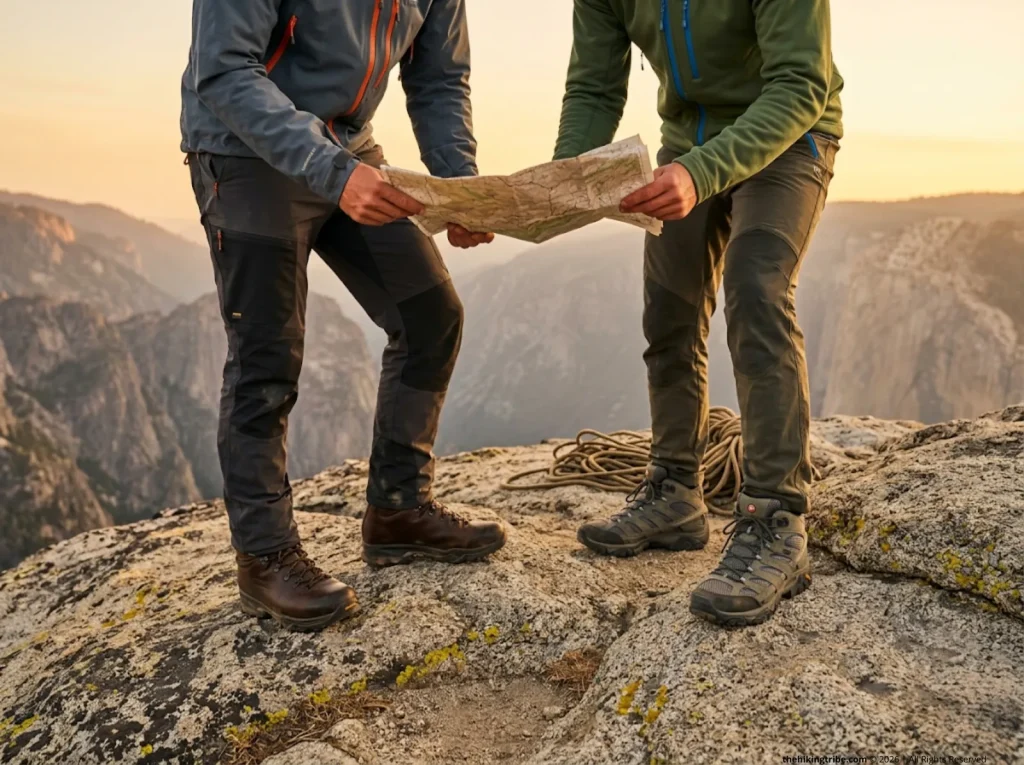
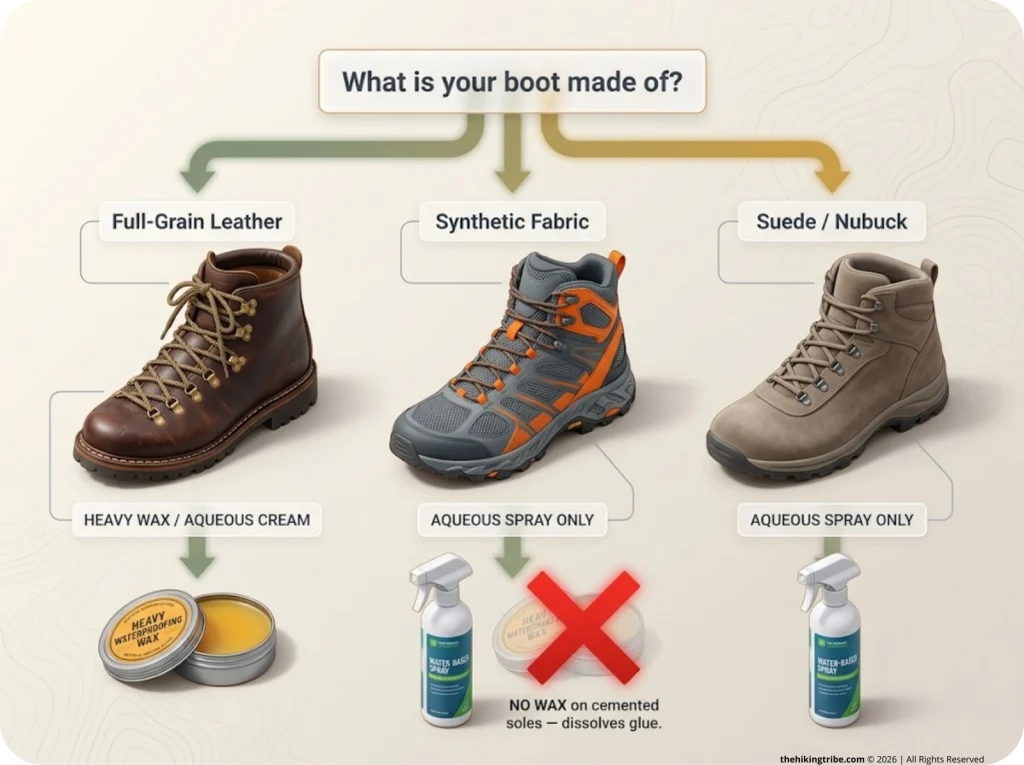
Applying the wrong chemical treatment permanently ruins expensive footwear and makes proper fabric care impossible. Modern mountain boots are highly specialized, and you must match the waterproofing chemistry to your specific material type.
For decades, full-grain leather was the gold standard for durability. It handles deep conditioning waxes incredibly well, making it the right choice when absolute water blocking matters more than sweat ventilation. But modern hikers increasingly rely on lighter, mixed-material designs. If you need help identifying your exact footwear build, check our leather vs synthetic hiking boots comparison to see what you actually own.
Suede and nubuck feature a delicate, sanded surface that breathes extremely well. Applying an occlusive wax to these leathers crushes the nap permanently. It turns a highly breathable boot into a smooth, dark, non-porous shell with zero possibility of recovery. To maintain proper foot climate, these materials demand specialized spray or sponge-on treatments. Independent research on footwear upper breathability consistently proves that blocking airflow through suede drastically increases the core temperature of your foot.
Synthetic fabric uppers rely entirely on their internal membrane and surface coatings. They save weight and dry fast. Trying to rub heavy wax into a synthetic mesh boot is a disaster. It traps dirt, blocks the ventilation panels, and creates a sticky mess that actually holds moisture against the shoe.
Wax-Based Waterproofing: Occlusive Protection
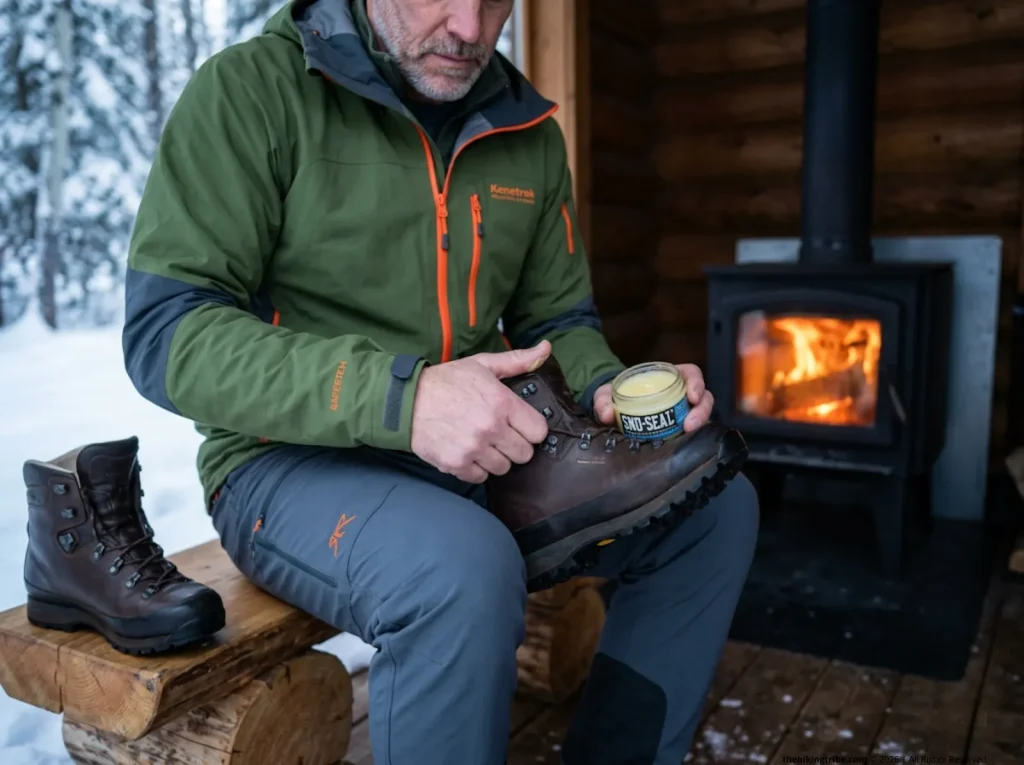
Traditional treatments like Sno-Seal, G-Wax, and Obenauf’s LP work by physically stuffing the pores between collagen fibers with sticky, heavy compounds. They create a near-impenetrable barrier. Think of it as armor plating for your boots.
These products offer deep leather nourishment, preventing the hide from drying out, shrinking, and cracking after dozens of wet-to-dry cycles. Because they require a manual application method and heat activation to liquify and penetrate the grain, the application creates an absolute seal. But this extreme protection comes at a severe cost: it completely destroys the Moisture Vapor Transmission Rate (MVTR). The pore-filling mechanism of heavy wax eliminates the breathability gradient required for internal membranes to function, creating a swampy internal condition.
If breathability tradeoffs don’t scare you, the threat of sole failure should. I regularly see hikers destroy their modern cemented mountain boots with heavy wax. Modern boots glue the rubber Vibram sole directly to the upper material using polyurethane adhesives. Wax acts as a slow-release solvent. As it migrates downward toward the midsole, it chemically attacks the glue. This soling interference causes catastrophic delamination on the trail.
Worse, you ruin the long-term impact of wax on re-soling. Cobblers will often reject heavily waxed boots because new glue simply cannot stick to leather that is saturated with bearing grease and dubbin wax. If you want a deeper look at long-term leather performance, review the durability of nubuck and leather under aggressive use. Stick to wax only if you own traditional, heavy stitch-down boots.
Pro tip: If you must use a heavy beeswax on your stitch-down boots, apply it with your bare fingers. The natural heat from your skin melts the wax just enough to push it deeply into the leather grain without risking damage from an external heat source.
Spray-On and Aqueous Treatments
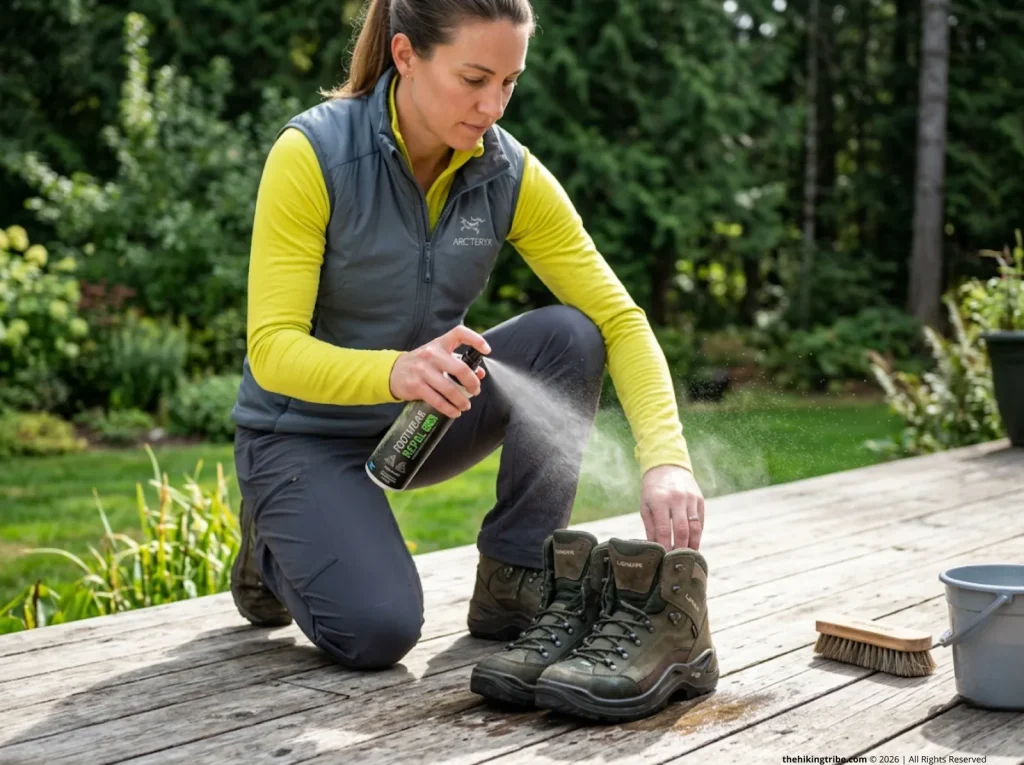
For modern technical boots with vegan membranes or synthetic membranes, water-based polymer treatments are mandatory. Brands like Nikwax and Grangers manufacture these aqueous treatments to use water as a carrier. They pull microscopic waterproofing polymers deep into the boot material without clogging the microscopic gaps that let sweat escape.
Instead of filling the pores like a wax, these treatments coat the individual fibers. This provides total breathability preservation while delivering excellent water column protection. They are actively designed to work with—not against—porous fabrics. Comparing Gore-Tex vs eVent membranes shows nuanced differences in how they vent heat, but both systems collapse completely if you choke their outer shell with a solvent-based paste.
Another massive shift is pfc-free sustainability. The outdoor industry is aggressively transitioning away from toxic fluorocarbons toward Bluesign-approved water-based formulas to reduce their environmental impact. The USDA Forest Service protocols and modern land management guidelines strongly recommend abandoning legacy chemical sprays that bioaccumulate in watersheds.
The trade-off for protecting your breathability and factory glue is physical durability. An aqueous spray or cream lacks the heavy bunker-like armor of beeswax. Grinding your boots against abrasive scree and acidic mud violently rips the polymer coating off the fibers. In my experience, aggressive off-trail routes require you to reapply a water-based dwr every 100 miles to keep the water from breaking through. You don’t need a complex usage frequency calculator—the superior application ease makes this frequent maintenance completely manageable.
The Step-by-Step Maintenance Cycle
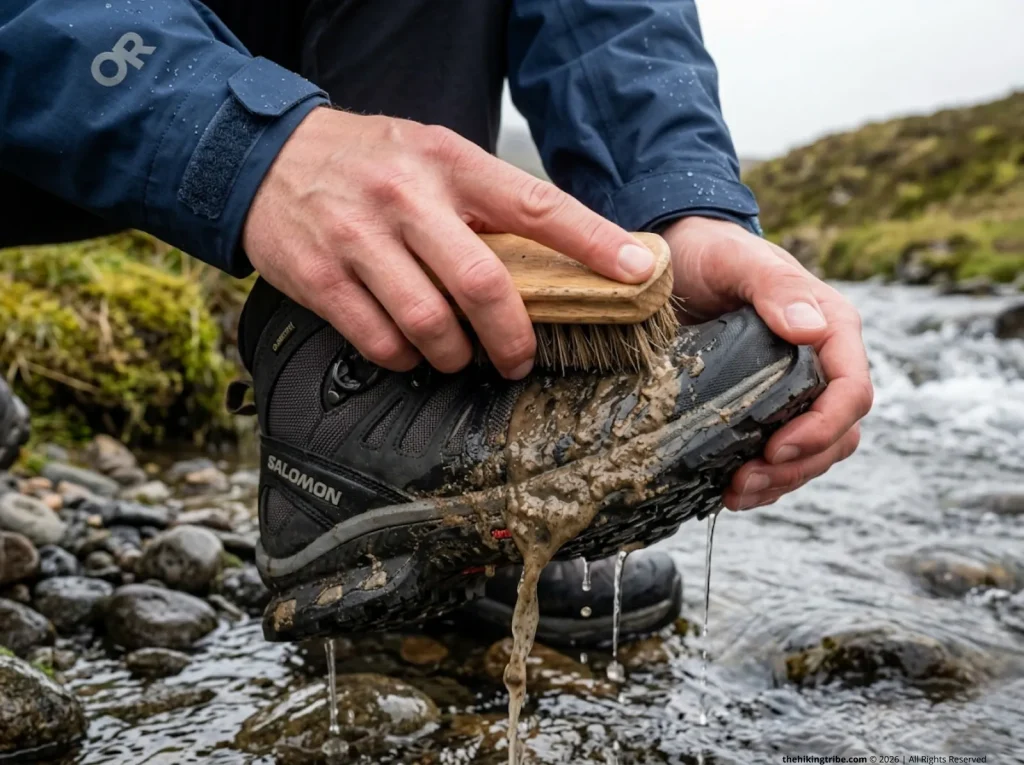
Applying any chemical to a dirty boot is a waste of money. Mud acts like abrasive sandpaper on your DWR coating, and it is inherently acidic. If you spray waterproofing directly over grit, you simply glue the dirt to the fabric and block the polymers from bonding.
First, use a soft nylon brush and a dedicated technical boot cleaner to strip the mud away. Never use standard household laundry detergents, as they strip the essential structural oils out of the hide and leave hydrophilic residues that attract water.
If you are using a water-based treatment like TX.Direct or a specialized sponge-on applicator, you actually want to apply it while the boot is still damp. The water inside the leather acts as a conductive track, pulling the waterproofing deep into the fibers via capillary action.
Never try to aggressively bake your boots dry to speed up the curing process. High heat strips essential oils, cracks the leather, and melts the sole glue. If you need to rapidly prep your gear for the next day, learn the proper methods for drying wet footwear safely overnight without using campfires or direct radiators.
For extreme late-season conditions, some experienced hikers use a strategic multi-layering approach for leather nourishment. They clean the boot, apply an aqueous conditioning cream to feed the leather, and then lightly hit the flex points with a synthetic spray to maximize the immediate water-shedding surface tension.
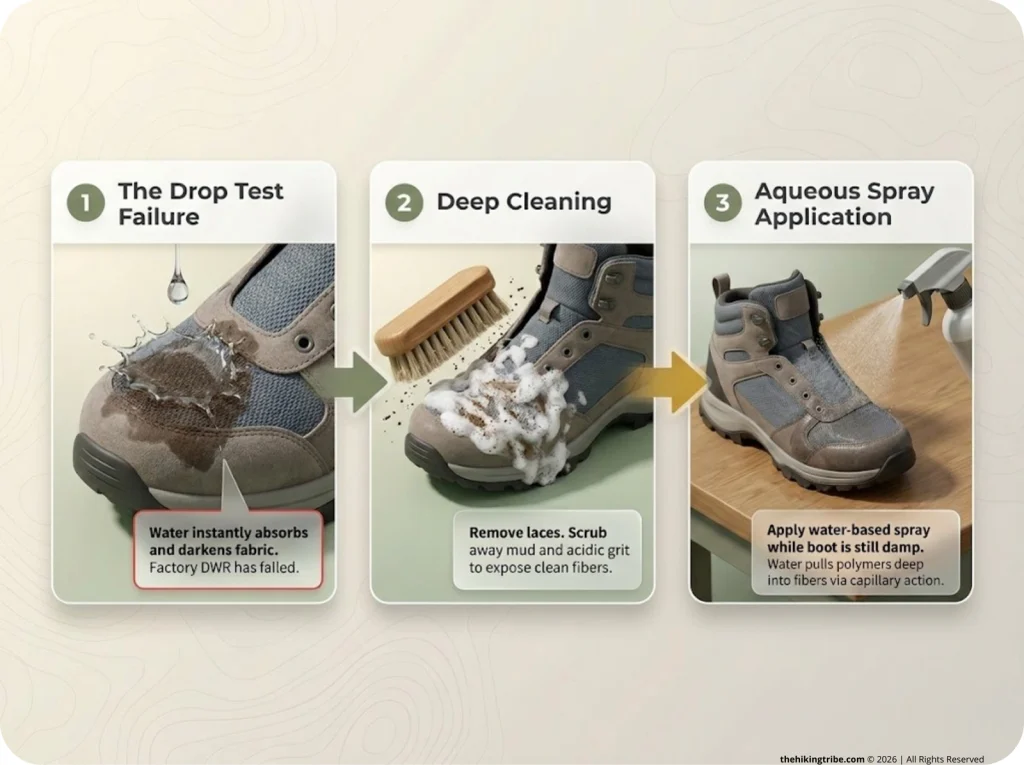
Pro tip: Remove your laces completely before cleaning or waterproofing. Dirt hides under the lacing hardware, and waterproofing chemicals will often degrade nylon laces or make them incredibly stiff and prone to untying on the trail.
Conclusion
- Wax treatments provide absolute moisture blocking and extreme durability, but they run a high risk of destroying your membrane breathability and melting the glue on modern soles.
- Aqueous and spray-on treatments preserve your boot’s ventilation and ensure excellent material compatibility with long-term resoling, though they require a more frequent application schedule.
- You must match your waterproofing chemical to your specific boot material—putting wax on a synthetic mesh shoe guarantees a miserable, swampy hike.
- Stop trusting the Gore-Tex tag to save you. Make a habit of performing the Drop Test on your toe box to catch moisture failures before they turn into cold-weather emergencies.
Taking care of your boots guarantees they take care of you. When you are six miles deep in freezing mud, you want physics on your side.
FAQ
Does spraying waterproofing ruin Gore-Tex boots?
No, water-based sprays actually protect Gore-Tex boots. By restoring the outer fabric’s DWR, they prevent the boot from wetting out, which is required for the internal membrane to successfully vent sweat vapor. Keep solvent-based heavy waxes away from them.
Can I use Sno-Seal or wax on modern hiking boots?
You should only use heavy wax on full-grain leather boots with traditional stitch-down construction. On modern, cemented mountain boots, wax migrates downward into the sole interface, acting as a chemical solvent that weakens the adhesives and causes catastrophic sole delamination.
How do I know when my hiking boots need waterproofing?
Rely on the Drop Test instead of guessing or using a calendar. Drip clean water directly onto the high-flex areas of the toe box; if it instantly absorbs and forms a dark wet patch, the DWR has failed. If the water forms a tight spherical bead and rolls off, your treatment is still active.
Why do my feet still get wet in waterproof boots?
This is usually caused by the Gore-Tex Paradox. When your boot’s outer fabric becomes completely saturated with water, the breathable membrane is choked by a liquid wall. Your feet are getting wet from your own trapped perspiration condensing back into a liquid inside the shoe.
Risk Disclaimer: Hiking, trekking, backpacking, and all related outdoor activities involve inherent
risks which may result in serious injury, illness, or death. The information provided on The Hiking Tribe is for
educational and informational purposes only. While we strive for accuracy, information on trails, gear, techniques,
and safety is not a substitute for your own best judgment and thorough preparation. Trail conditions, weather, and
other environmental factors change rapidly and may differ from what is described on this site. Always check with
official sources like park services for the most current alerts and conditions. Never undertake a hike beyond your
abilities and always be prepared for the unexpected. By using this website, you agree that you are solely
responsible for your own safety. Any reliance you place on our content is strictly at your own risk, and you assume
all liability for your actions and decisions in the outdoors. The Hiking Tribe and its authors will not be held
liable for any injury, damage, or loss sustained in connection with the use of the information herein.
Affiliate Disclosure: We are a participant in the Amazon Services LLC Associates Program, an
affiliate advertising program designed to provide a means for us to earn advertising fees by advertising and linking
to Amazon.com. As an Amazon Associate, we earn from qualifying purchases. We are also an official affiliate partner
of Black Diamond Equipment via the AvantLink network. If you click on a Black Diamond affiliate link and make a
purchase, we may earn a commission at no additional cost to you. We also participate in other affiliate programs and
may receive a commission on products purchased through our links. Additional terms are found in the terms of
service.