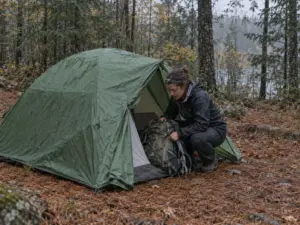

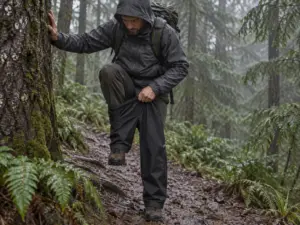



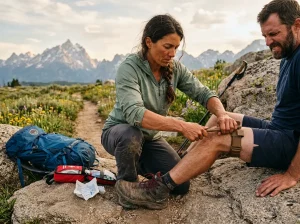

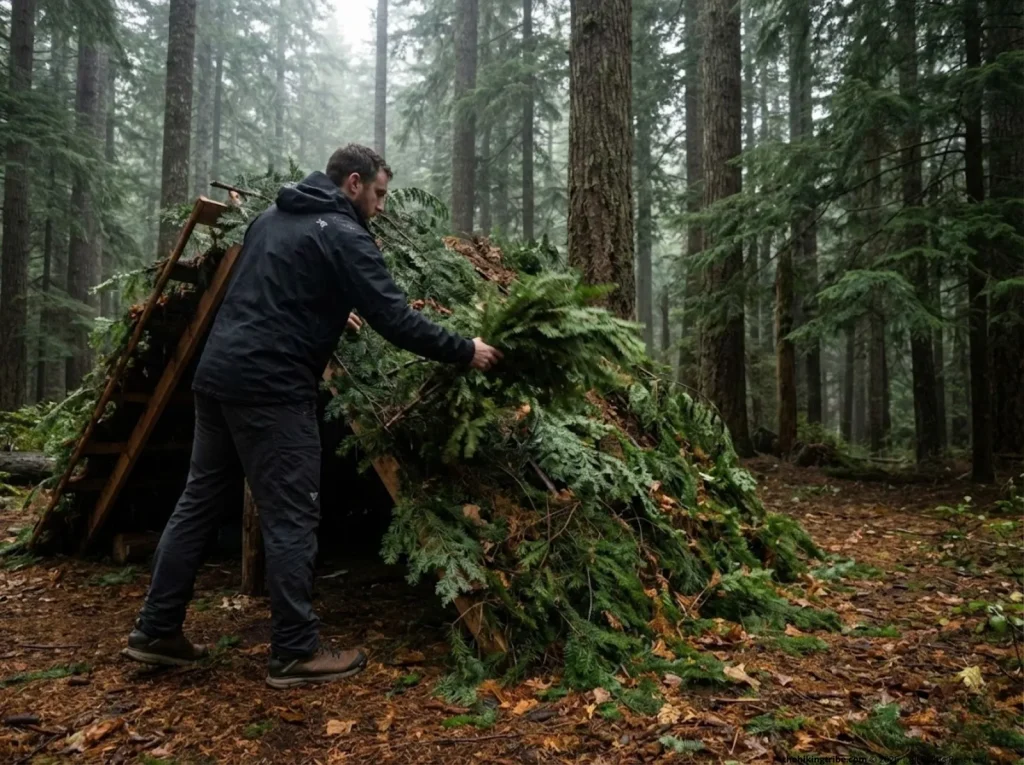
The front blew in two hours earlier than the forecast said it would. One second I was crossing a ridge in the Rockies with a clear sky. Twenty minutes later I couldn’t see the treeline twenty feet below me. No tent. No bivy. Temps dropping hard. What I built in the next hour and a half from deadfall and pine boughs is the reason I walked out the next morning.
I’ve spent years guiding backpackers through high-consequence terrain, and the skill I’ve seen people skip the most is also the one that matters most when things go sideways: knowing how to make the wilderness survival decision before dark, and following through with your hands.
This guide covers everything — site selection, building the ridgepole frame, packing on enough leaf insulation to actually stay warm, and how to restore the site afterward like you were never there.
⚡ Quick Answer: Build a debris hut by propping a ridgepole on a Y-branch support about 2 feet off the ground, leaning rib sticks against both sides at 45°, weaving cross branches through them, then piling at least 3 feet of dry leaves, pine boughs, or grass on every surface. Pack 1-2 feet of debris on the ground inside as your bed. Build tight — shoulder-width clearance only — and your body heat does the rest. Expect 90 minutes with two people; 2-3 hours solo.
Why Most Trail Shelter Advice Gets You Colder
Most online guides about building natural shelters are written for preppers and bushcraft enthusiasts who show up with a fixed-blade knife, a month of supplies, and time on their hands. That’s not you.
You’re a hiker who already practices emergency preparedness, follows Leave No Trace, and carries the Ten Essentials. What you need is a guide built around a specific scenario: an unplanned night out on a real trail, with only what’s on your back.
The gap is bigger than you think. Out of the top five articles ranking for this topic, zero mention deadfall-only materials, zero include a site restoration protocol, and none are written for hikers who already care about backcountry ethics. They treat shelter building as a recreational activity, not an actual trail emergency.
Before you even think about touching a stick, you need to know when the decision applies. If you have a tarp shelter or emergency blanket and temperatures are mild, that’s usually enough. But if you’re below 45°F with wet clothing, injury is involved, or darkness is coming, a debris hut is what you want. The rule is simple: start building at least two-and-a-half hours before dark. A rushed build with thin insulation is worse than no build at all.
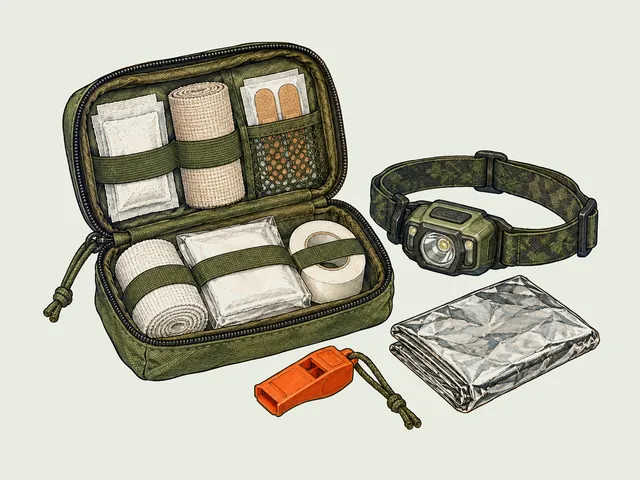
Make sure you’re carrying a properly stocked emergency kit before your next overnight — it’s the difference between a debris hut being a backup plan and a last resort.
Site Selection: The 5-Minute Decision That Determines Everything
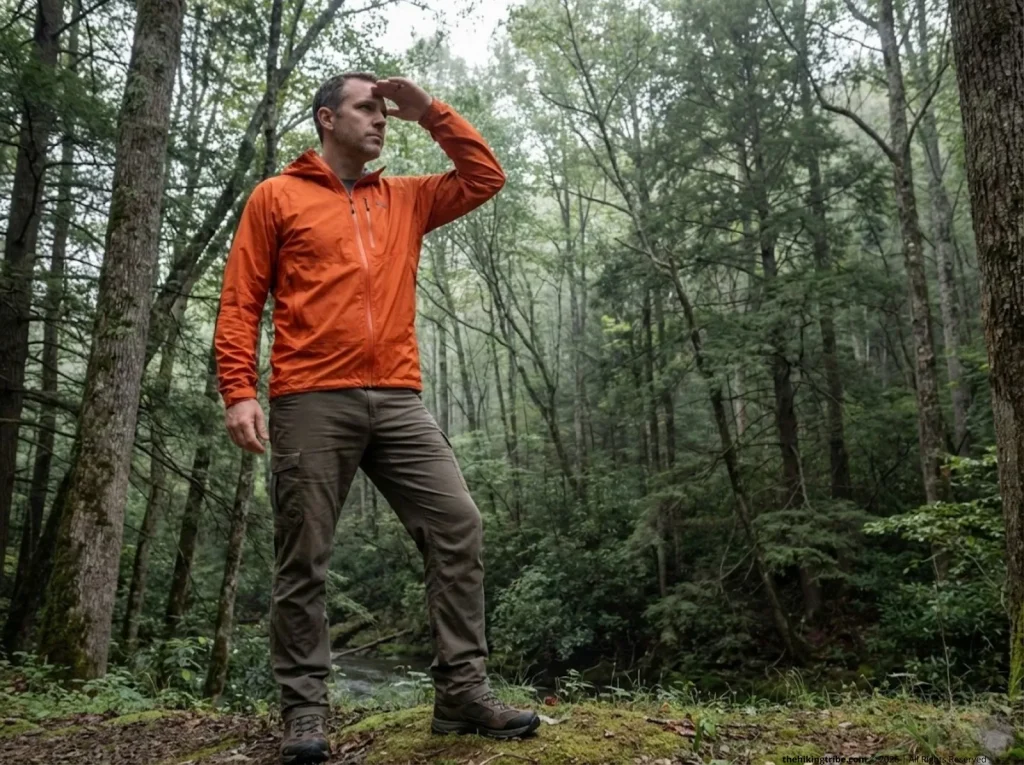
You could build the best debris hut of your life in the wrong location and still freeze. Site selection is not optional, and it’s not a five-second look around.
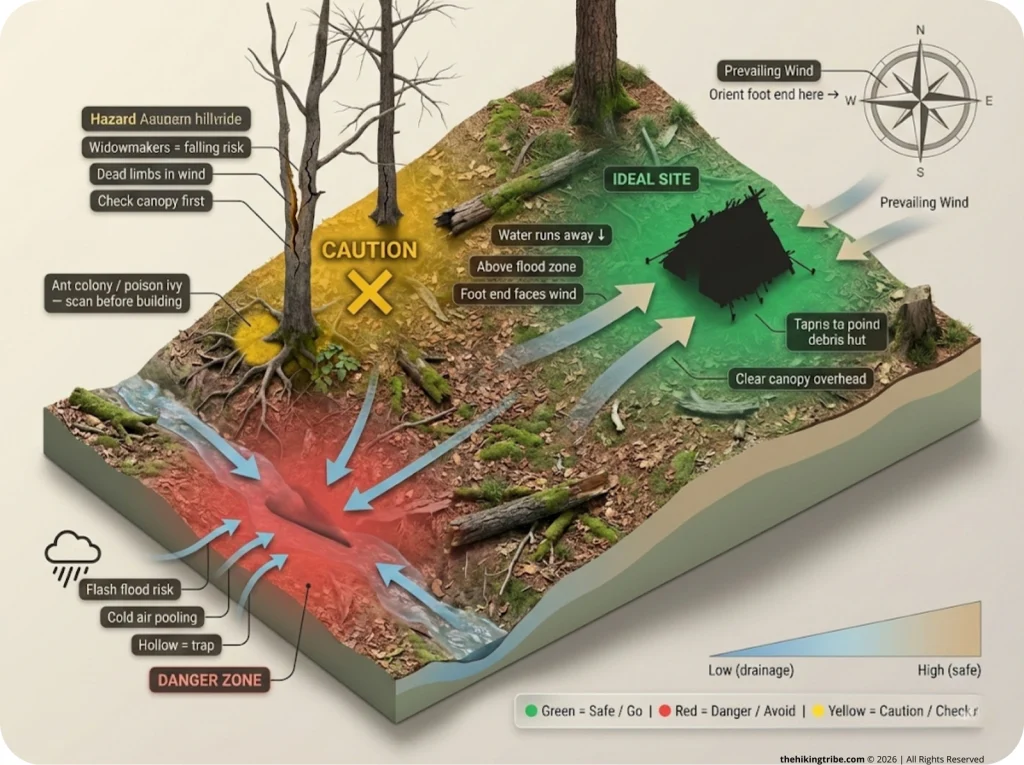
Safe high ground is your first filter. Get above any drainage, creek bed, or hollow. Flash flooding kills more hikers than cold does. Pick a slight rise or a hillside shelf — somewhere water runs away from you, not toward you.
Then scan the canopy above your build zone. Dead standing trees (you’ll hear backcountry guides call them widowmakers) can drop branches or fall entirely in a storm. Stay well clear. Also look for poison ivy, ant colonies, and anything that looks like a good home for something else.
Once you have elevation and safety locked in, orient the shelter. The foot end — the closed, tapered end — should face into the prevailing wind. Your body crawls in from the open end, which faces away from the wind so you’re not sleeping in a draft.
Terrain matters regionally. If you’re on the Appalachian Trail, you’re surrounded by hardwood leaf litter all autumn — abundant, dry, and perfect for thermal insulation. Out in the Rocky Mountains or Utah high desert, lean on pine boughs, cattail thatch, and dry grass stems. In the Pacific Northwest, those same materials are often wet, so your waterproofing layer — bark slabs or fir boughs shingled like a roof — needs to go on thick and overlapping, not just piled.
As described in the NJ State Park Naturalist’s guide on debris hut construction, choose a site where the forest floor offers abundant fallen materials without needing to touch a single living plant. That’s the standard — match it.
Pro-tip: Kick the ground before you commit to a site. If it’s soggy underfoot, you’ll be soggy all night. Move ten feet uphill and test again.
The same principles that govern wind and rain campsite optimization apply here — middle-third slope position, natural windproofing, ground that sheds water. Read that terrain before you build.
Building the Frame: Ridgepole, Ribs, and Lattice
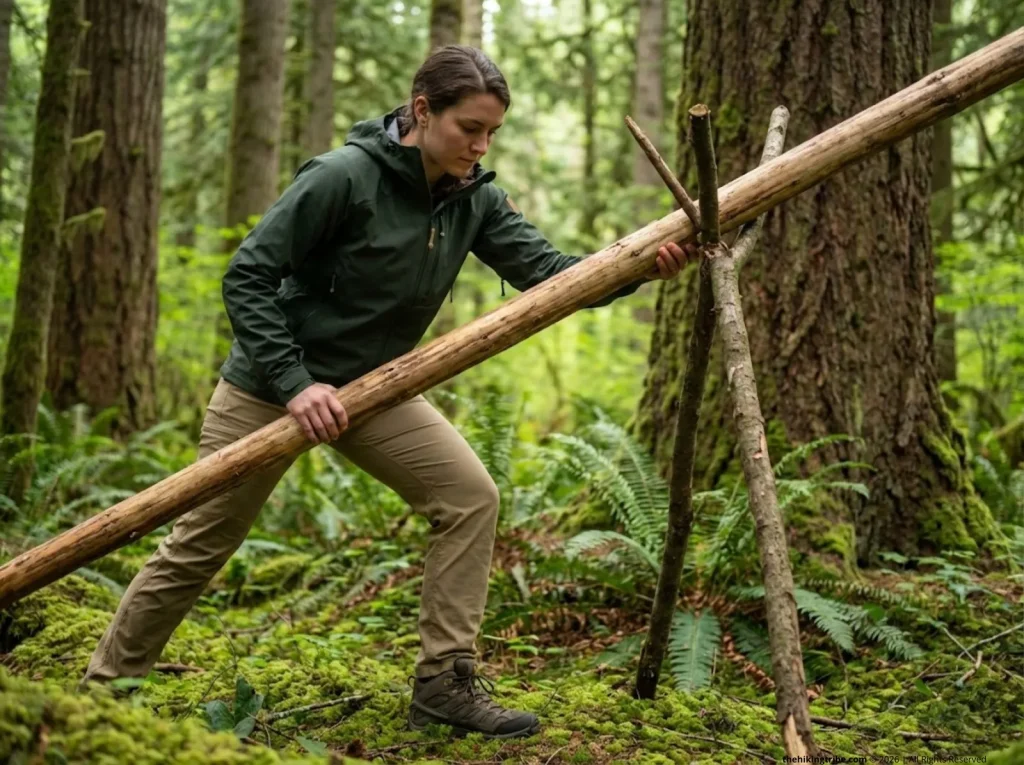
The structure of a debris hut is simple, but the details matter.
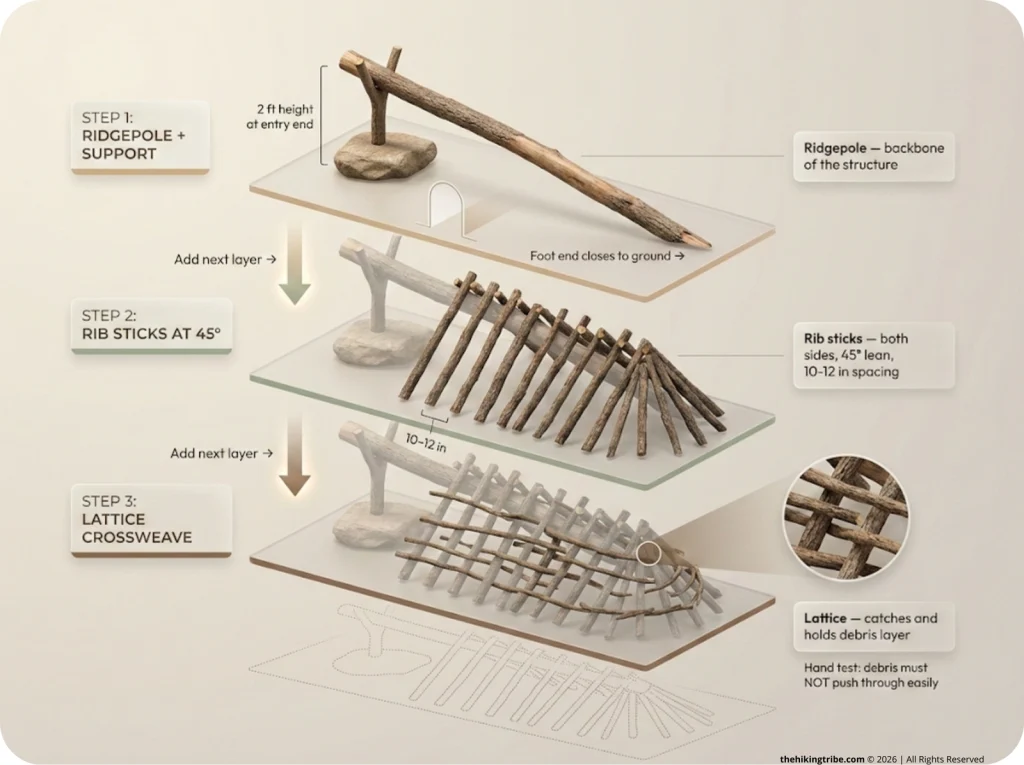
Start with the ridgepole — the backbone. Find a straight, sturdy stick a little longer than your body, typically 7-9 feet. It needs to hold up under pressure, so test it: push down hard with both hands. If it flexes dramatically or splinters, find a thicker one. Prop one end in a natural Y-branch, tree fork, or flat-topped boulder roughly 2 feet off the ground. The open entrance goes at the high end. The foot end tapers down and closes against the earth.
Build small. This is what most people get wrong. Shane Hobel, founder of Mountain Scout Survival School, is direct about it: “Build low to lock in body heat.” If you can sit up inside, you’ve built a cold room, not a natural sleeping bag. Shoulder-width clearance, and only 6-8 inches of headroom above the ridgepole — no more.
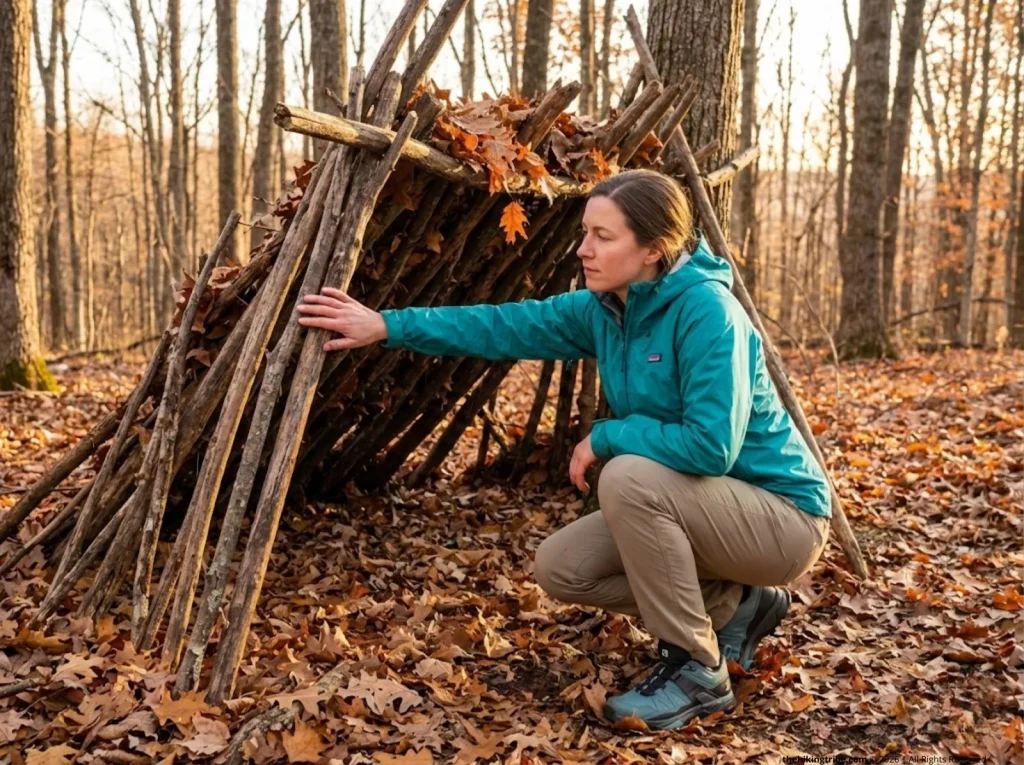
Next come the rib sticks. These are tent-pole-sized branches leaned against both sides of the ridgepole at roughly 45°, spaced about 10-12 inches apart. They don’t need to be perfect. Branched sticks that interlock with each other are fine. What matters is coverage — ribs on both sides from ridgepole to ground, with the entrance left open and the foot end fully closed.
Over the ribs goes the latticework. Smaller, bendier branches laid horizontally across the ribs, perpendicular to the ridgepole. Weave them through each other where you can. The job of the lattice is to catch and hold the debris you pile on next. Hold your hand flat against the inside of the frame — if you can push debris through easily, add more lattice.
If you have a knife, a trail multi-tool for splitting or trimming branches cuts frame construction time by a third. But the entire structure is buildable with nothing but your hands.
Insulation Science: Why 3 Feet of Debris Is Not Negotiable
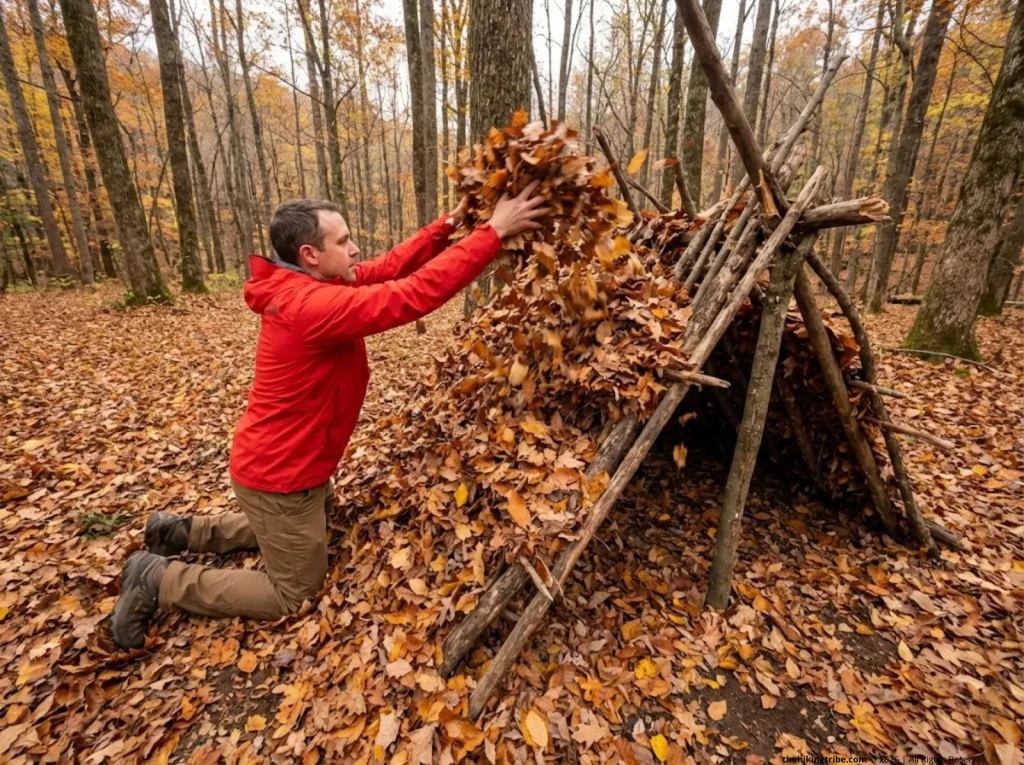
Here’s where most people under-build — and why they pay for it around 3 AM.
Your body runs at 98.6°F. A debris hut turns that heat into your only heating system. The principle is the same as a sleeping bag: dead air trapped inside loose material slows heat from leaving. Dry leaves, pine needles, cattail leaves, and dry grass stems all have tiny hollow structures that trap air. Packed-down or wet debris loses most of its thermal insulation value.
The minimum is 3 feet of loosely piled debris on every surface — top, both sides, and the foot end. Four feet is better in cold or wet conditions. Survival instructor Yost documented surviving –19°F in Wisconsin with no fire — just debris thick enough to do its job.
The test is simple: crawl inside and look for daylight. Pile on the debris until no daylight shows. Not a pinhole. Not a soft glow. Nothing. Then pin the whole thing with a final cap layer of thick sticks or branches across the top to keep insulation layering locked against overnight wind.
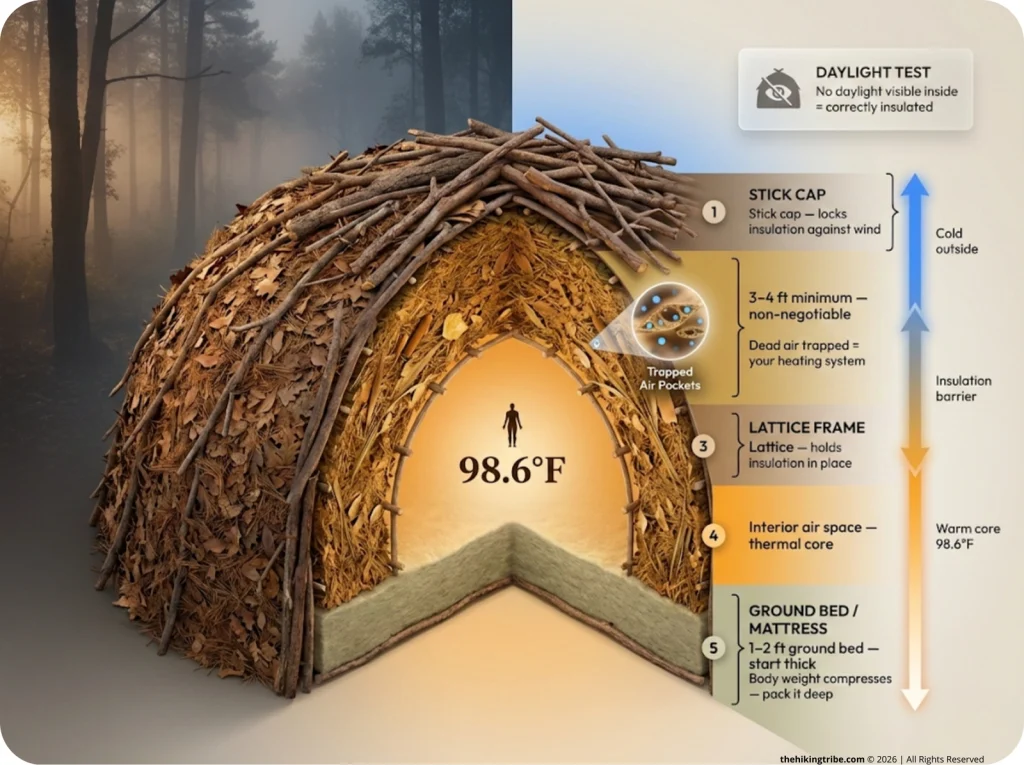
Off-ground bedding is the other half of the equation. Conduction block — getting your body off the cold earth — is the single biggest heat drain in any ground shelter. Pack 1-2 feet of the softest, driest debris you can find inside the shelter as your mattress before you crawl in. Body weight compresses it by about half, so start thick. Prioritize the driest material closest to your skin — dry leaves beat damp pine needles every time.
As explained in how fast wet materials steal your heat, cotton and wet organic material draw heat away from your body nearly as fast as bare ground. Your insulation layer — inside and out — needs to be dry to work.
Pro-tip: The last armload of debris you don’t feel like hauling is the one that keeps you warm. Every time you think you’re done, add one more.
The Hybrid Edge: One Item From Your Pack Changes Everything
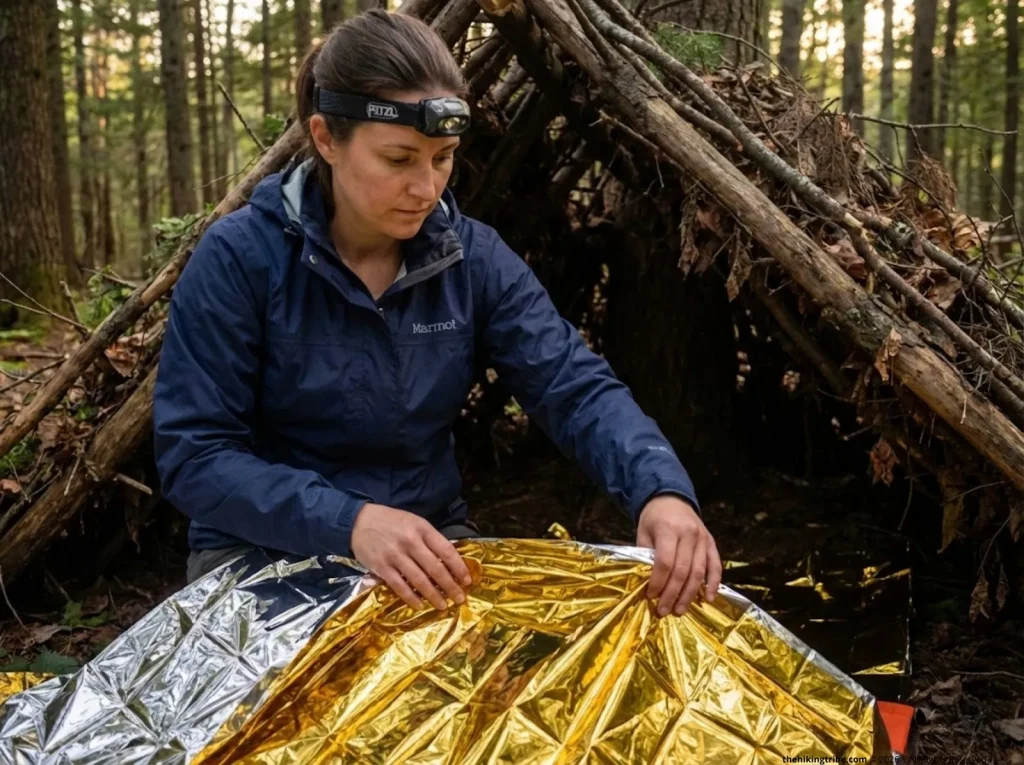
Most survival guides treat this as all-or-nothing. Pure natural shelter, or nothing. But you’re a hiker — you already carry things.
A Mylar emergency blanket weighs 2-3 ounces and costs around three dollars. Drape it inside the frame before you pile on the outer debris, shiny side facing inward toward where your body will be. It reflects your radiated heat back instead of letting it escape. In practical terms, this one addition can cut how cold you feel in half — not because it generates heat, but because it slows the heat you’re already generating from leaving the shelter.
Tape or pin the corners to the ribs if you can. If you can’t, fold it loosely so it stays in position. Leave No Trace Center for Outdoor Ethics principles still apply: the blanket comes out with you in the morning — no exceptions.
A fixed-blade knife changes what you can build and how fast. Batoning deadfall to size — splitting thicker logs into usable rib sticks — means you spend less time searching for perfectly-sized branches and more time building. A 3-5 inch fixed-blade adds maybe 20-30 minutes back to your window before dark. Never baton with a folding knife; the pivot joint isn’t built for lateral stress.
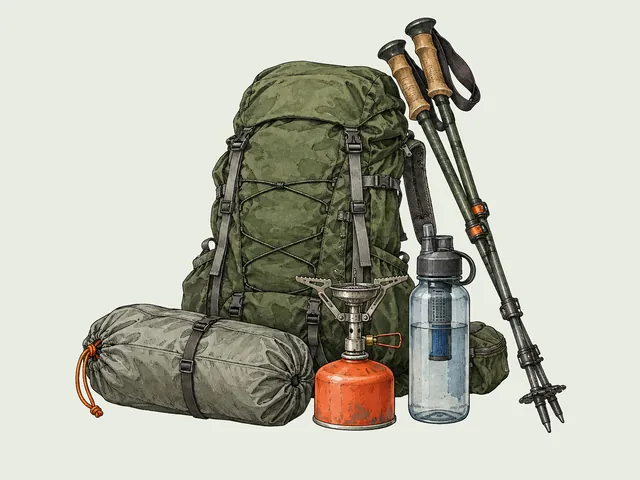
These two items — emergency blanket, fixed blade — represent what a committed hiker carries anyway as part of bushcraft preparedness. Their value in a shelter build is a reason to never leave them behind. For broader context on what to carry and why, wilderness first aid and emergency preparedness is worth reviewing before your next multi-day trip.
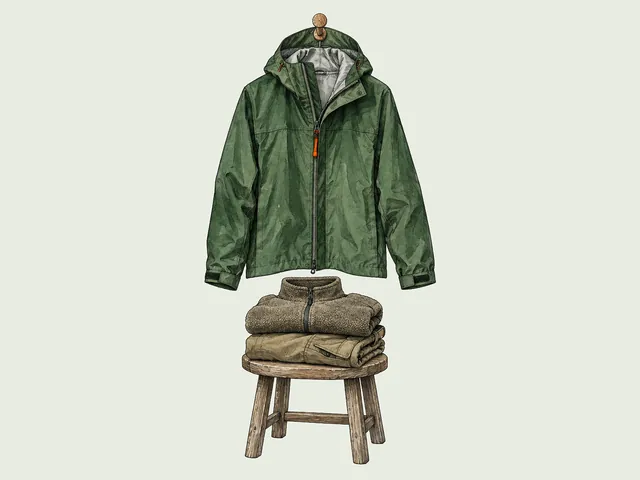
Pro-tip: Before you crawl in for the night, stuff whatever clothing you’re not wearing into the entrance behind you. That makeshift door plug seals the last major draft pathway. A stuffed rain jacket works perfectly.
After the Night: LNT Restoration and Lessons Learned
You made it through the night. That’s the primary mission. But your job isn’t done when the sun comes up.
A debris hut built right uses only fallen materials — no living plants cut, no roots disturbed, no soil compacted beyond what the forest receives naturally. Park naturalist Wayne Henderek of Washington Crossing State Park put it plainly in the NJ DEP’s field guide: the shelter is constructed “completely out of fallen materials and it is not necessary to destroy living plants to build this structure.” That’s the ethic — hold it.
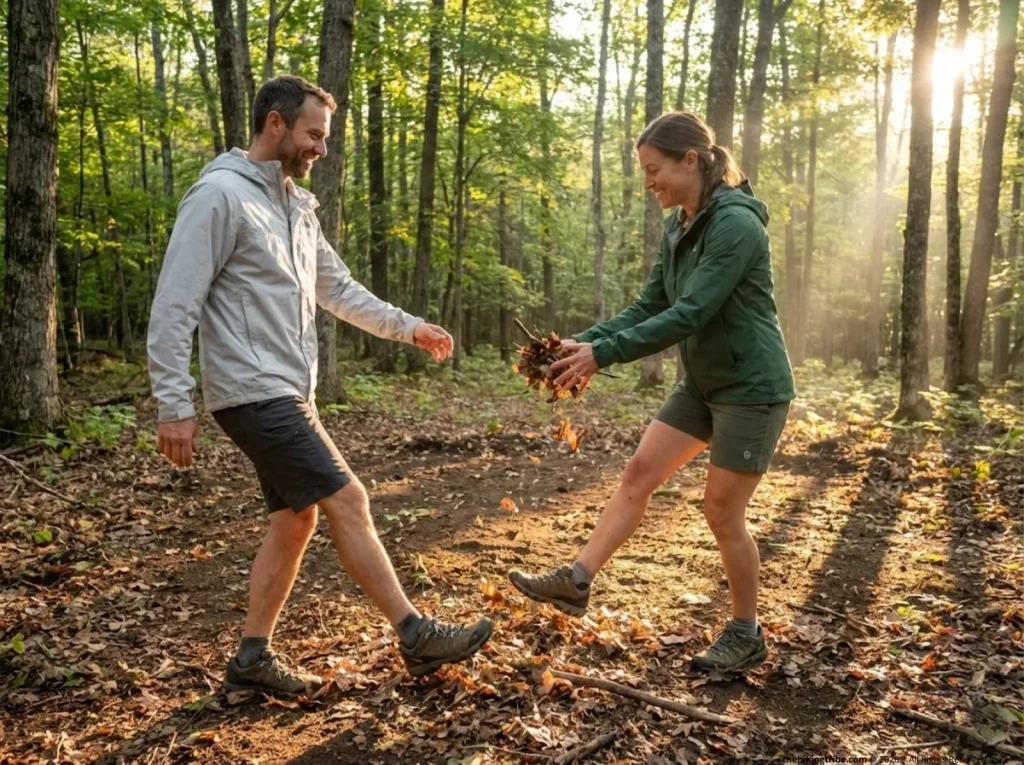
Pull the rib sticks off the ridgepole. Lay the ridgepole flat. Scatter the debris pile widely across the surrounding area — not left in a mound, but spread thinly the way the forest floor looks naturally. Kick apart the compressed ground bed inside and spread that material too. The goal is that a hiker passing by 24 hours later sees nothing unusual. That’s site restoration done right.
Check yourself for ticks after extended contact with leaf litter — from the ankles up, systematically. Lyme disease exposure doesn’t wait for a convenient moment.
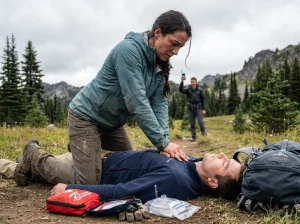
If you’re showing signs of hypothermia or a significant injury, the shelter has done its job. But once conditions allow, prioritize signaling for rescue with a mirror and whistle over making the site perfect. And review treating hypothermia on the trail so you recognize the warning signs before they turn critical.
The best thing you can do with this skill after you’re home is practice it. Not on a pristine trail — on a spot in your backyard or a designated skills area. A 90-minute timed build at home is the closest thing you get to muscle memory before you need it for real.
Conclusion
Three things. First, your site determines everything — five minutes choosing safe high ground, wind-blocked terrain is never wasted time. Second, insulation thickness is not negotiable: three feet minimum, pile on the debris until no daylight shows, and your body heat handles the rest. Third, build it from deadfall-only materials, sleep through the night, scatter every stick in the morning. The shelter disappears — and so should every trace of it.
Next time you’re heading out on an overnight, give yourself 90 minutes during camp setup and build one just to practice. Not because you expect to need it — but because the night you do, your hands will already know what to do.
FAQ
What is the easiest survival shelter to build in the woods?
A debris hut — an A-frame skeleton of leaned sticks covered in 3-4 feet of piled leaves, grass, or pine boughs — is the easiest and most effective wilderness survival shelter you can build with zero tools. It requires nothing but fallen materials and time, and it traps your own body heat like a natural sleeping bag. Most hikers can complete a functional build in 90 minutes to 3 hours depending on how much debris is available nearby.
Can you build an emergency shelter without any tools?
Yes, completely. A no-tool build needs only a ridgepole, leaning rib sticks, cross-branch latticework, and armloads of forest debris — no cutting, cordage, or specialized gear required. A fixed-blade knife speeds up the process significantly by letting you split branches to size, but it is optional. The structure is fully buildable with hands alone.
How thick should insulation be on a debris hut?
A minimum of 3 feet of loosely piled debris on all sides and the roof — 4 feet or more in below-freezing or wet conditions. Test from inside: if any daylight shows through the walls or ceiling, pile more on. Also nail the off-ground bedding layer: pack 1-2 feet of dry debris inside as a mattress to block conductive heat loss through the earth.
How do you stay warm in a debris shelter without a fire?
Build the interior body-sized — shoulder-width clearance, just 6-8 inches of headroom above the ridgepole — insulate to 3-4 feet on all surfaces, and seal the entrance with a debris plug or stuffed jacket. Your body generates constant heat; a small, well-insulated shelter traps it. Body-heat retention in a tight debris hut matches a mid-weight sleeping bag when built correctly. A Mylar emergency blanket liner amplifies this significantly.
Is building a debris shelter Leave No Trace compliant?
It can be, if you follow the deadfall-only rule and fully complete site restoration afterward. Use only fallen branches and loose debris — never cut living plants or strip bark from standing trees. After use, disassemble the frame, scatter all materials, and restore the ground so no trace remains. This is an emergency technique — not a recreational activity to build and leave standing.

I've spent more than a decade researching hiking gear and trail technique. I read the specs, the forum threads and the long-term reviews, and every pick here comes with what it gets wrong.
End of the trail
You read every mile of this one. Here's where the trail goes next.